WHAT IS LITERARY THEORY?
Literary criticism is the practice of interpreting and writing about literature as the latter,
in turn, strives to make sense of the world. Literary theory is the study of the principles
which inform how critics make sense of literary works.
Purpose Of Studying Literary theory:
• One of the views is likely to affirm your perspective and speak to what you see in the
literature you are studying.
• Studying a view different from yours not to disagree with it, but to understand it , it
helps you understand those who hold that view.
• Studying a work from more than one view gives you a deeper understanding of the
author’s work and a better appreciation for the richness of it.


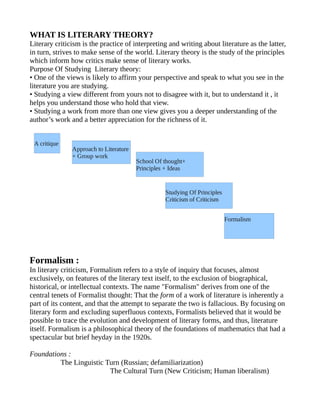
 A critique
               Approach to Literature
               + Group work
                                        School Of thought+
                                        Principles + Ideas


                                                  Studying Of Principles
                                                  Criticism of Criticism


                                                                           Formalism


Formalism :
In literary criticism, Formalism refers to a style of inquiry that focuses, almost
exclusively, on features of the literary text itself, to the exclusion of biographical,
historical, or intellectual contexts. The name "Formalism" derives from one of the
central tenets of Formalist thought: That the form of a work of literature is inherently a
part of its content, and that the attempt to separate the two is fallacious. By focusing on
literary form and excluding superfluous contexts, Formalists believed that it would be
possible to trace the evolution and development of literary forms, and thus, literature
itself. Formalism is a philosophical theory of the foundations of mathematics that had a
spectacular but brief heyday in the 1920s.

Foundations :
         The Linguistic Turn (Russian; defamiliarization)
                         The Cultural Turn (New Criticism; Human liberalism)
Formalism has advantage of forcing writers to evaluate a work on its own terms rather
to relay on “accepted” notions of writer work.
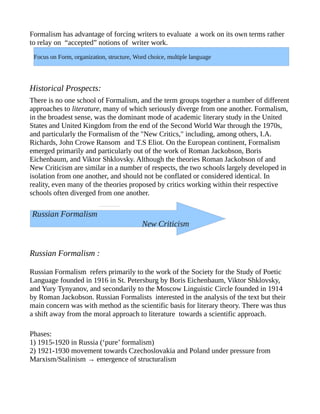
 Focus on Form, organization, structure, Word choice, multiple language


Historical Prospects:
There is no one school of Formalism, and the term groups together a number of different
approaches to literature, many of which seriously diverge from one another. Formalism,
in the broadest sense, was the dominant mode of academic literary study in the United
States and United Kingdom from the end of the Second World War through the 1970s,
and particularly the Formalism of the "New Critics," including, among others, I.A.
Richards, John Crowe Ransom and T.S Eliot. On the European continent, Formalism
emerged primarily and particularly out of the work of Roman Jackobson, Boris
Eichenbaum, and Viktor Shklovsky. Although the theories Roman Jackobson of and
New Criticism are similar in a number of respects, the two schools largely developed in
isolation from one another, and should not be conflated or considered identical. In
reality, even many of the theories proposed by critics working within their respective
schools often diverged from one another.

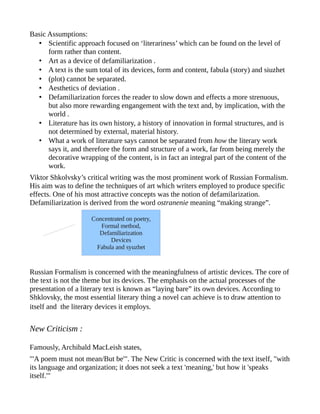
Russian Formalism
                                           New Criticism


Russian Formalism :

Russian Formalism refers primarily to the work of the Society for the Study of Poetic
Language founded in 1916 in St. Petersburg by Boris Eichenbaum, Viktor Shklovsky,
and Yury Tynyanov, and secondarily to the Moscow Linguistic Circle founded in 1914
by Roman Jackobson. Russian Formalists interested in the analysis of the text but their
main concern was with method as the scientific basis for literary theory. There was thus
a shift away from the moral approach to literature towards a scientific approach.

Phases:
1) 1915-1920 in Russia (‘pure’ formalism)
2) 1921-1930 movement towards Czechoslovakia and Poland under pressure from
Marxism/Stalinism → emergence of structuralism
Basic Assumptions:
  • Scientific approach focused on ‘literariness’ which can be found on the level of
      form rather than content.
  • Art as a device of defamiliarization .
  • A text is the sum total of its devices, form and content, fabula (story) and siuzhet
  • (plot) cannot be separated.
  • Aesthetics of deviation .
  • Defamiliarization forces the reader to slow down and effects a more strenuous,
      but also more rewarding engangement with the text and, by implication, with the
      world .
  • Literature has its own history, a history of innovation in formal structures, and is
      not determined by external, material history.
  • What a work of literature says cannot be separated from how the literary work
      says it, and therefore the form and structure of a work, far from being merely the
      decorative wrapping of the content, is in fact an integral part of the content of the
      work.
Viktor Shkolvsky’s critical writing was the most prominent work of Russian Formalism.
His aim was to define the techniques of art which writers employed to produce specific
effects. One of his most attractive concepts was the notion of defamilarization.
Defamiliarization is derived from the word ostranenie meaning “making strange”.

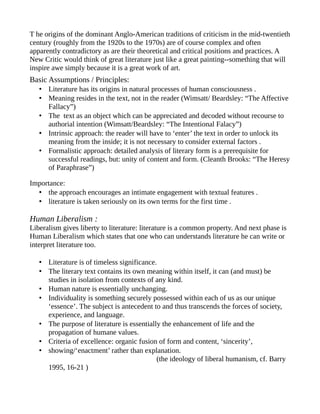
                     Concentrated on poetry,
                        Formal method,
                       Defamiliarization
                           Devices
                      Fabula and syuzhet


Russian Formalism is concerned with the meaningfulness of artistic devices. The core of
the text is not the theme but its devices. The emphasis on the actual processes of the
presentation of a literary text is known as “laying bare” its own devices. According to
Shklovsky, the most essential literary thing a novel can achieve is to draw attention to
itself and the literary devices it employs.


New Criticism :

Famously, Archibald MacLeish states,
"'A poem must not mean/But be'". The New Critic is concerned with the text itself, "with
its language and organization; it does not seek a text 'meaning,' but how it 'speaks
itself.'"
T he origins of the dominant Anglo-American traditions of criticism in the mid-twentieth
century (roughly from the 1920s to the 1970s) are of course complex and often
apparently contradictory as are their theoretical and critical positions and practices. A
New Critic would think of great literature just like a great painting--something that will
inspire awe simply because it is a great work of art.
Basic Assumptions / Principles:
   • Literature has its origins in natural processes of human consciousness .
   • Meaning resides in the text, not in the reader (Wimsatt/ Beardsley: “The Affective
     Fallacy”)
   • The text as an object which can be appreciated and decoded without recourse to
     authorial intention (Wimsatt/Beardsley: “The Intentional Falacy”)
   • Intrinsic approach: the reader will have to ‘enter’ the text in order to unlock its
     meaning from the inside; it is not necessary to consider external factors .
   • Formalistic approach: detailed analysis of literary form is a prerequisite for
     successful readings, but: unity of content and form. (Cleanth Brooks: “The Heresy
     of Paraphrase”)

Importance:
  • the approach encourages an intimate engagement with textual features .
  • literature is taken seriously on its own terms for the first time .

Human Liberalism :
Liberalism gives liberty to literature: literature is a common property. And next phase is
Human Liberalism which states that one who can understands literature he can write or
interpret literature too.

   • Literature is of timeless significance.
   • The literary text contains its own meaning within itself, it can (and must) be
     studies in isolation from contexts of any kind.
   • Human nature is essentially unchanging.
   • Individuality is something securely possessed within each of us as our unique
     ‘essence’. The subject is antecedent to and thus transcends the forces of society,
     experience, and language.
   • The purpose of literature is essentially the enhancement of life and the
     propagation of humane values.
   • Criteria of excellence: organic fusion of form and content, ‘sincerity’,
   • showing/‘enactment’ rather than explanation.
                                            (the ideology of liberal humanism, cf. Barry
     1995, 16-21 )
Summary:
Formalist theory has dominated the American literary scene for most of the twentieth
century, and it has retained its great influence in many academic quarters. Its
practitioners advocate methodical and systematic readings of texts. The major premises
of New Criticism include: "art for art's sake," "content form," and "texts exist in and for
themselves." These premises lead to the development of reading strategies that isolate
and objectify the overt structures of texts as well as authorial techniques and language
usage. With these isolated and objective readings, New Criticism aims to classify,
categorize, and catalog works according to their formal attributes. Along the way, New
Criticism wants to pull out and discuss any universal truths that literary works might
hold concerning the human condition. These truths are considered by New Critics to be
static, enduring, and applicable to all humanity. Formalists value poetry rich in
ambiguity, irony, and intention, and want to make literary criticism a science. Current
theorists tend to criticize Formalism for this and other symptoms of narrow-mindedness;
still, they cannot deny that New Criticism has left a lasting impression on American
literary scholarship. Its terminology continues as the basis for most literary education in
the United States, and other critical approaches to reading and critiquing literature
depend upon readers’ familiarity with these terms to articulate their findings.
            ________________________________________________

Formalism (Literary Theory)

  • 1.
    WHAT IS LITERARYTHEORY? Literary criticism is the practice of interpreting and writing about literature as the latter, in turn, strives to make sense of the world. Literary theory is the study of the principles which inform how critics make sense of literary works. Purpose Of Studying Literary theory: • One of the views is likely to affirm your perspective and speak to what you see in the literature you are studying. • Studying a view different from yours not to disagree with it, but to understand it , it helps you understand those who hold that view. • Studying a work from more than one view gives you a deeper understanding of the author’s work and a better appreciation for the richness of it. A critique Approach to Literature + Group work School Of thought+ Principles + Ideas Studying Of Principles Criticism of Criticism Formalism Formalism : In literary criticism, Formalism refers to a style of inquiry that focuses, almost exclusively, on features of the literary text itself, to the exclusion of biographical, historical, or intellectual contexts. The name "Formalism" derives from one of the central tenets of Formalist thought: That the form of a work of literature is inherently a part of its content, and that the attempt to separate the two is fallacious. By focusing on literary form and excluding superfluous contexts, Formalists believed that it would be possible to trace the evolution and development of literary forms, and thus, literature itself. Formalism is a philosophical theory of the foundations of mathematics that had a spectacular but brief heyday in the 1920s. Foundations : The Linguistic Turn (Russian; defamiliarization) The Cultural Turn (New Criticism; Human liberalism)
  • 2.
    Formalism has advantageof forcing writers to evaluate a work on its own terms rather to relay on “accepted” notions of writer work. Focus on Form, organization, structure, Word choice, multiple language Historical Prospects: There is no one school of Formalism, and the term groups together a number of different approaches to literature, many of which seriously diverge from one another. Formalism, in the broadest sense, was the dominant mode of academic literary study in the United States and United Kingdom from the end of the Second World War through the 1970s, and particularly the Formalism of the "New Critics," including, among others, I.A. Richards, John Crowe Ransom and T.S Eliot. On the European continent, Formalism emerged primarily and particularly out of the work of Roman Jackobson, Boris Eichenbaum, and Viktor Shklovsky. Although the theories Roman Jackobson of and New Criticism are similar in a number of respects, the two schools largely developed in isolation from one another, and should not be conflated or considered identical. In reality, even many of the theories proposed by critics working within their respective schools often diverged from one another. Russian Formalism New Criticism Russian Formalism : Russian Formalism refers primarily to the work of the Society for the Study of Poetic Language founded in 1916 in St. Petersburg by Boris Eichenbaum, Viktor Shklovsky, and Yury Tynyanov, and secondarily to the Moscow Linguistic Circle founded in 1914 by Roman Jackobson. Russian Formalists interested in the analysis of the text but their main concern was with method as the scientific basis for literary theory. There was thus a shift away from the moral approach to literature towards a scientific approach. Phases: 1) 1915-1920 in Russia (‘pure’ formalism) 2) 1921-1930 movement towards Czechoslovakia and Poland under pressure from Marxism/Stalinism → emergence of structuralism
  • 3.
    Basic Assumptions: • Scientific approach focused on ‘literariness’ which can be found on the level of form rather than content. • Art as a device of defamiliarization . • A text is the sum total of its devices, form and content, fabula (story) and siuzhet • (plot) cannot be separated. • Aesthetics of deviation . • Defamiliarization forces the reader to slow down and effects a more strenuous, but also more rewarding engangement with the text and, by implication, with the world . • Literature has its own history, a history of innovation in formal structures, and is not determined by external, material history. • What a work of literature says cannot be separated from how the literary work says it, and therefore the form and structure of a work, far from being merely the decorative wrapping of the content, is in fact an integral part of the content of the work. Viktor Shkolvsky’s critical writing was the most prominent work of Russian Formalism. His aim was to define the techniques of art which writers employed to produce specific effects. One of his most attractive concepts was the notion of defamilarization. Defamiliarization is derived from the word ostranenie meaning “making strange”. Concentrated on poetry, Formal method, Defamiliarization Devices Fabula and syuzhet Russian Formalism is concerned with the meaningfulness of artistic devices. The core of the text is not the theme but its devices. The emphasis on the actual processes of the presentation of a literary text is known as “laying bare” its own devices. According to Shklovsky, the most essential literary thing a novel can achieve is to draw attention to itself and the literary devices it employs. New Criticism : Famously, Archibald MacLeish states, "'A poem must not mean/But be'". The New Critic is concerned with the text itself, "with its language and organization; it does not seek a text 'meaning,' but how it 'speaks itself.'"
  • 4.
    T he originsof the dominant Anglo-American traditions of criticism in the mid-twentieth century (roughly from the 1920s to the 1970s) are of course complex and often apparently contradictory as are their theoretical and critical positions and practices. A New Critic would think of great literature just like a great painting--something that will inspire awe simply because it is a great work of art. Basic Assumptions / Principles: • Literature has its origins in natural processes of human consciousness . • Meaning resides in the text, not in the reader (Wimsatt/ Beardsley: “The Affective Fallacy”) • The text as an object which can be appreciated and decoded without recourse to authorial intention (Wimsatt/Beardsley: “The Intentional Falacy”) • Intrinsic approach: the reader will have to ‘enter’ the text in order to unlock its meaning from the inside; it is not necessary to consider external factors . • Formalistic approach: detailed analysis of literary form is a prerequisite for successful readings, but: unity of content and form. (Cleanth Brooks: “The Heresy of Paraphrase”) Importance: • the approach encourages an intimate engagement with textual features . • literature is taken seriously on its own terms for the first time . Human Liberalism : Liberalism gives liberty to literature: literature is a common property. And next phase is Human Liberalism which states that one who can understands literature he can write or interpret literature too. • Literature is of timeless significance. • The literary text contains its own meaning within itself, it can (and must) be studies in isolation from contexts of any kind. • Human nature is essentially unchanging. • Individuality is something securely possessed within each of us as our unique ‘essence’. The subject is antecedent to and thus transcends the forces of society, experience, and language. • The purpose of literature is essentially the enhancement of life and the propagation of humane values. • Criteria of excellence: organic fusion of form and content, ‘sincerity’, • showing/‘enactment’ rather than explanation. (the ideology of liberal humanism, cf. Barry 1995, 16-21 )
  • 5.
    Summary: Formalist theory hasdominated the American literary scene for most of the twentieth century, and it has retained its great influence in many academic quarters. Its practitioners advocate methodical and systematic readings of texts. The major premises of New Criticism include: "art for art's sake," "content form," and "texts exist in and for themselves." These premises lead to the development of reading strategies that isolate and objectify the overt structures of texts as well as authorial techniques and language usage. With these isolated and objective readings, New Criticism aims to classify, categorize, and catalog works according to their formal attributes. Along the way, New Criticism wants to pull out and discuss any universal truths that literary works might hold concerning the human condition. These truths are considered by New Critics to be static, enduring, and applicable to all humanity. Formalists value poetry rich in ambiguity, irony, and intention, and want to make literary criticism a science. Current theorists tend to criticize Formalism for this and other symptoms of narrow-mindedness; still, they cannot deny that New Criticism has left a lasting impression on American literary scholarship. Its terminology continues as the basis for most literary education in the United States, and other critical approaches to reading and critiquing literature depend upon readers’ familiarity with these terms to articulate their findings. ________________________________________________