INTRODUCTION(Historical Context)
Late19th century: No dominant school of literary criticism
Literary criticism was not widely recognized as academic discipline
Research was often based on psychological or sociohistorical
principles
Some scholars focused on the author’s personal vision and creativity
Others used biographical approach: Interpreting literature through the
author's life.
Early 20th century: Emergence of Russian Formalism, shifting away
from traditional interpretations
3.
RUSSIAN FORMALISM
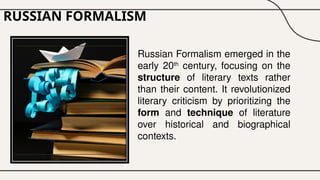
Russian Formalismemerged in the
early 20th
century, focusing on the
structure of literary texts rather
than their content. It revolutionized
literary criticism by prioritizing the
form and technique of literature
over historical and biographical
contexts.
4.
RUSSIAN FORMALISM (Proponents)
•In the mid-1910s, two distinct Russian scholarly groups
emerged: the Moscow Linguistic Circle (1915) and OPOYAZ
(1916) in Petrograd.
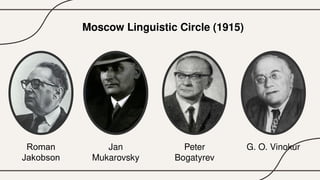
• Key figures in the Moscow Linguistic Circle: Roman
Jakobson, Jan Mukarovsky, Peter Bogatyrev, and G. O.
Vinokur.
• Key members of OPOYAZ: Victor Shklovsky, Boris
Eichenbaum, and Victor Vinogradov.
He wasa Russian and Soviet literary
theorist, critic, writer, and pamphleteer.
He is best known for developing the
concept of defamiliarization in literature
where he explained it in the important
essay "Arts as Technique".
Victor Shklovsky
8.
RUSSIAN FORMALISM
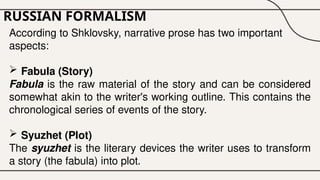
According toShklovsky, narrative prose has two important
aspects:
Fabula (Story)
Fabula is the raw material of the story and can be considered
somewhat akin to the writer's working outline. This contains the
chronological series of events of the story.
Syuzhet (Plot)
The syuzhet is the literary devices the writer uses to transform
a story (the fabula) into plot.
9.
RUSSIAN FORMALISM
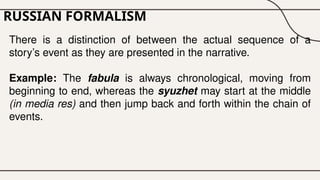
There isa distinction of between the actual sequence of a
story’s event as they are presented in the narrative.
Example: The fabula is always chronological, moving from
beginning to end, whereas the syuzhet may start at the middle
(in media res) and then jump back and forth within the chain of
events.
10.
RUSSIAN FORMALISM
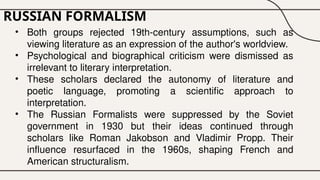
• Bothgroups rejected 19th-century assumptions, such as
viewing literature as an expression of the author's worldview.
• Psychological and biographical criticism were dismissed as
irrelevant to literary interpretation.
• These scholars declared the autonomy of literature and
poetic language, promoting a scientific approach to
interpretation.
• The Russian Formalists were suppressed by the Soviet
government in 1930 but their ideas continued through
scholars like Roman Jakobson and Vladimir Propp. Their
influence resurfaced in the 1960s, shaping French and
American structuralism.
11.
Russian formalists attempteda
scientific description of
literature as a special use of
language
0
1
0
2
0
3
0
4
BASIC ASSUMPTIONS
They focused more on the
form of literature, rather than
its content.
Biographical, social, political or
cultural context are not
important in the critical
process.
They also emphasized the
difference between literary
language and non-literary
practical language that aims at
communicating information
12.
0
5
0
6
0
7
0
8
BASIC ASSUMPTIONS
It isimportant for them to show
the way something is said
rather that what is said.
The text is the sum total of its
devices, form and content. The
plot cannot be separated.
13.
IMPORTANT CONCEPTS
LITERARINESS
Literarinessis a feature that distinguishes literature from other
human creations
Russian formalists thought of literature as the sum of technical
devices that made the text different from others.
14.
IMPORTANT CONCEPTS
FOREGROUNDING
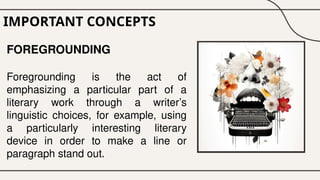
Foregrounding isthe act of
emphasizing a particular part of a
literary work through a writer’s
linguistic choices, for example, using
a particularly interesting literary
device in order to make a line or
paragraph stand out.
15.
IMPORTANT CONCEPTS
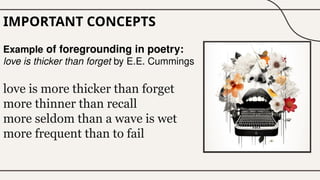
Example offoregrounding in poetry:
love is thicker than forget by E.E. Cummings
love is more thicker than forget
more thinner than recall
more seldom than a wave is wet
more frequent than to fail
16.
IMPORTANT CONCEPTS
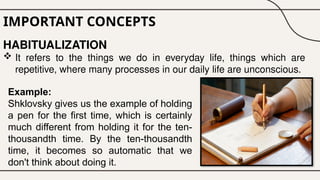
HABITUALIZATION
Itrefers to the things we do in everyday life, things which are
repetitive, where many processes in our daily life are unconscious.
Example:
Shklovsky gives us the example of holding
a pen for the first time, which is certainly
much different from holding it for the ten-
thousandth time. By the ten-thousandth
time, it becomes so automatic that we
don't think about doing it.
17.
IMPORTANT CONCEPTS
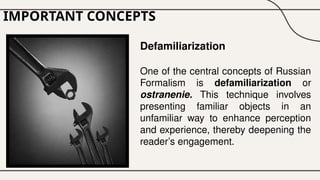
Defamiliarization
One ofthe central concepts of Russian
Formalism is defamiliarization or
ostranenie. This technique involves
presenting familiar objects in an
unfamiliar way to enhance perception
and experience, thereby deepening the
reader’s engagement.
18.
BRIDGING THE GAPBETWEEN RUSSIAN
FORMALISM AND NEW CRITICISM
• Russian Formalism is sometimes paired with New Criticism, which
dominated Anglo-American criticism from the 1930s to the 1950s.
• Both are identified as types of Formalism but have distinct histories
and developments.
• New Criticism developed separately in the U.S. and Britain, with no
direct relation to Russian Formalism.
• In the 1940s, Russian Formalists Roman Jakobson and René
Wellek engaged with New Critics in the U.S., influencing each
other's ideas.
• Some New Critical principles reflect concepts from Russian
Formalism.
20.
APPLYING RUSSIAN FORMALISMTO A TEXT
Instructions: Read the poem “Instructions for Not
Giving Up” and answer the following questions:
21.
APPLYING RUSSIAN FORMALISMTO A TEXT
1. What literary devices (like metaphor, simile, or
imagery) are used in the poem?
o Focus on the specific techniques the poet uses and how
these techniques affect the meaning.
2. In what ways do the poem make ordinary ideas or
objects feel strange or new? (defamiliarization)
o Look at how the poem presents familiar things in unexpected
ways to make the reader see them differently.
22.
APPLYING RUSSIAN FORMALISMTO A TEXT
3. How does the poem’s use of sound (like rhyme,
alliteration, or repetition) enhance its meaning or
emotional impact?
o Analyze how the sounds of the poem affect its rhythm, tone,
or mood.
Editor's Notes
#2 By the late 19th century, no single school of literary criticism dominated.
Literary criticism was not widely considered an academic activity.
Academic research often focused on psychological or sociohistorical approaches, viewing literature as a product of its social or political context.
Some scholars argued that literary works reflected the personal visions and impressions of the author, encouraging creative interaction between author and reader.
Others adopted a biographical approach, interpreting texts through the author's life experiences.
In the early 20th century, Russian Formalism emerged, marking a radical shift away from these traditional methods of interpretation.
#3 In other words, it is the study of a text without taking into account any outside influences such as cultural, societal, biographical, and political contexts.
#4 They are considered founders of modern literary criticism, known as Russian Formalism, radically shifting the direction of literary theory.
#7 Later on, we are going to discuss the concept of defamiliarization.
#10 Although the members of both groups often disagreed concerning the principles of literary interpretation, they were united in their rejection of 19th century…..
#13
The proper study of literature, they declared, is literature itself. To study literature is to study poetics, which is an analysis of a work's constituent parts-its linguistic and structural features-or its form. Form, they asserted, included the internal mechanics of the work itself, especially its poetic language. It is these internal mechanics or what the Formalists called devices that compose the artfulness and literariness of any given text, not a work's subject matter or content.
#17 To make it simple, It is the idea of looking at an object in a different way.
“A cold glass of water” can be described as “crystal-clear liquid that glistens like diamonds, refreshing the parched throat with its cool embrace.”
Or Instead of saying, "The sun set in the evening," you might say, "The fiery orange ball dipped below the horizon, casting long shadows as it bid farewell to the day."