
Modern Literary
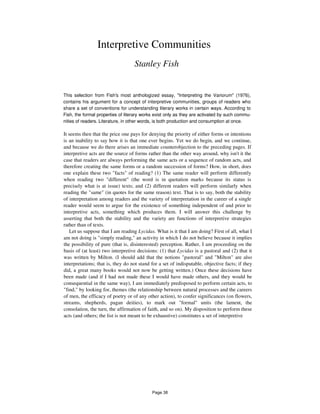
Studies
University of Bisha
College of Arts
Department of English
‫الدارسا‬
‫ت‬
‫احلديثة‬ ‫األدبية‬
‫عادل‬ ‫عبدالفتاح‬ .‫د‬ ‫المقرر‬ ‫أستاذ‬
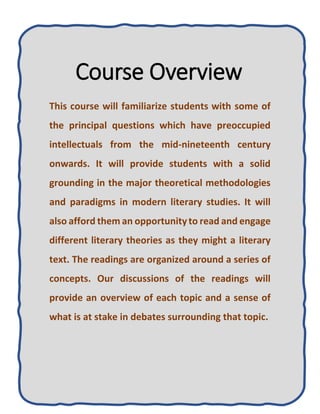
Course Overview
This course will familiarize students with some of
the principal questions which have preoccupied
intellectuals from the mid-nineteenth century
onwards. It will provide students with a solid
grounding in the major theoretical methodologies
and paradigms in modern literary studies. It will
also afford them an opportunityto read and engage
different literary theories as they might a literary
text. The readings are organized around a series of
concepts. Our discussions of the readings will
provide an overview of each topic and a sense of
what is at stake in debates surrounding that topic.
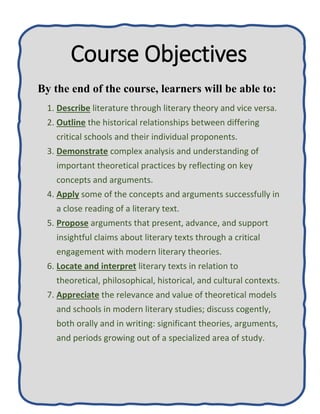
Course Objectives
By the end of the course, learners will be able to:
1. Describe literature through literary theory and vice versa.
2. Outline the historical relationships between differing
critical schools and their individual proponents.
3. Demonstrate complex analysis and understanding of
important theoretical practices by reflecting on key
concepts and arguments.
4. Apply some of the concepts and arguments successfully in
a close reading of a literary text.
5. Propose arguments that present, advance, and support
insightful claims about literary texts through a critical
engagement with modern literary theories.
6. Locate and interpret literary texts in relation to
theoretical, philosophical, historical, and cultural contexts.
7. Appreciate the relevance and value of theoretical models
and schools in modern literary studies; discuss cogently,
both orally and in writing: significant theories, arguments,
and periods growing out of a specialized area of study.
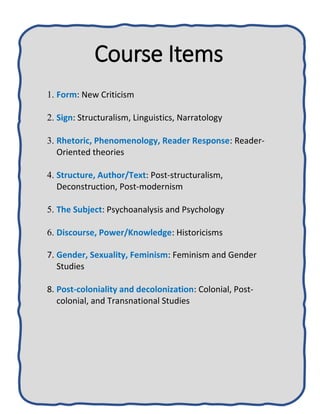
Course Items
1. Form: New Criticism
2. Sign: Structuralism, Linguistics, Narratology
3. Rhetoric, Phenomenology, Reader Response: Reader-
Oriented theories
4. Structure, Author/Text: Post-structuralism,
Deconstruction, Post-modernism
5. The Subject: Psychoanalysis and Psychology
6. Discourse, Power/Knowledge: Historicisms
7. Gender, Sexuality, Feminism: Feminism and Gender
Studies
8. Post-coloniality and decolonization: Colonial, Post-
colonial, and Transnational Studies
Formalisms: Russian Formalism
and New Criticism
Page 5
1
Introduction: Formalisms
Julie Rivkin and Michael Ryan
It has become a commonplace of literary study that to study literature is to study
language, yet prior to the formalist movements of the early twentieth century -Russian
Formalism and American New Criticism - the study of literature was concerned with
everything about literature except language, from the historical context of a literary work
to the biography of its author. How literary language worked was of less importance than
what a literary work was about. Two movements in early twentieth-century thought
helped move literary study away from this orientation. The first movement was the
attempt on the part of philosophers of science like Edmund Husserl to isolate objects of
knowledge in their unmixed purity. The Russian Formalists, a group of young scholars
(Viktor Shklovsky, Roman Jakobson, Boris Tomashevsky, Boris Eichenbaum) who
wrote in the teens and twenties, were influenced by this approach. For them, literature
would be considered not as a window on the world but as something with specifically
literary characteristics that make it literature as opposed to philosophy or sociology or
biography. Literature is not a window for looking at sociological themes or philosophic
ideas or biographical information; rather, it is a mural or wall painting, something with a
palpability of its own which arrests the eye and merits study. The manipulation of
representational devices may create a semblance of reality and allow one to have the
impression of gazing through glass, but it is the devices alone that produce that
impression, and they alone are what makes literature literary.
The second movement was the attempt on the part of idealist philosophers like
Benedetto Croce to develop a new aesthetics, or philosophy of art, which would rebut the
claim of science that all truth is grounded in empirical facts knowable through scientific
methods. Art provides access to a different kind of truth than is available to science, a
truth that is immune to scientific investigation because it is accessible only through
connotative language (allusion, metaphor, symbolism, etc.) and cannot be rendered in the
direct, denotative, fact-naming language of the sciences. The American New Critics
(Cleanth Brooks, William K. Wimsett, John Crowe Ransom, Allen Tate) were influenced
by the new aesthetic philosophies. For them, literature should be studied for the way
literary language differs from ordinary practical language and for the unique truths
conveyed only through such literary language.
The Russian Formalists were interested both in describing the general characteristics
of literary language and in analyzing the specific devices or modes of operation of such
language. Perhaps their most famous general claim is that literary language consists of an
act of defamiharization, by which they mean that such literature
Page 6
4 Formalisms
presents objects or experiences from such an unusual perspective or in such uncon-
ventional and self-conscious language that our habitual, ordinary, rote perceptions of
those things are disturbed. We are forced to see things that had become automatic and
overly familiar in new ways. Shklovsky cites the example of Tolstoy, who presents a
meditation on property from the point of view of a horse, or who recounts the story of a
flogging in such a blank manner that the then accepted practice seems strange and novel
to the otherwise inured reader.
More specifically, the Formalists were interested in analyzing literature into its
component parts and in describing its principal devices and modes of operation. This
analysis took two main forms in the two major genres of prose narrative and poetry,
concentrating in the first on the operations of narrative and in the second on sound in
verse. The Formalists noticed that narrative literature consisted of two major
components: the plot, by which they meant the story as narrated within the pages of the
book (with all the attendant arrangements of chronological sequence, point of view, etc.),
and the story, by which they meant the sequence of events in the order and the actual
duration in which they ostensibly occurred. Once this simple distinction is made, one can
begin to analyze all of the features of story-telling, the many devices such as point of
view, delayed disclosure, narrative voice, and the like that go into the creation of the
imaginary story through the manipulation of plot or story-telling devices. One can, for
example, begin to study a. novel like The Scarlet Letter for its narrative strategies instead
of for the ways in which it depicts Puritanism.
In the analysis of poetry, the Formalist focus was on the qualities of poetic language
that distinguish it from ordinary practical language, the distinction between the literary
and the non-literary being more pronounced in this genre. Whereas ordinary language
must subordinate its rules of operation (grammar) to the practical goal of communicating
information, poetic language is distinguished by the foregrounding of such devices or
motifs as euphony, rhythm, alliteration, consonance, repetition, and rhyme which obey a
very different logic from that required to communicate information. A meteorologist
might say that "precipitation in the Iberian peninsula is concentrated in the central
plateau," and in light of that practical use of language, the internal rhyming of "the rain in
Spain falls mainly on the plain" will seem impractical and unnecessary, but it is such
devices that make poetry a distinct linguistic undertaking, a mode of language use with
autonomous rules of operation which, unlike grammar, are not subordinated to a practical
function. While practical speech facilitates access to information by making language as
transparent as possible, poetic speech contorts and roughens up ordinary language and
submits it to what Roman Jakobson called "organized violence," and it is this roughening
up of ordinary language into tortuous "formed speech" that makes poetry poetry rather
than a weather report.
While literature for the Formalists is characterized by invariant patterns, recurring
devices, and law-like relations, it also changes over time and varies from one historical
epoch to another. The Formalists account for such change in two ways. They claim that
literary evolution is the result of the constant attempt to disrupt existing literary
conventions and to generate new ones. And they argue that literary change is the result of
the autonomous evolution of literary devices.
A more traditional concept of the content/form distinction might lead one to conclude
that literature changes when the world changes because literature merely
Page 7
Formalisms 5
gives form to ideas and realities that lie outside the literary realm and constitute its cause
or motivation. But for the Formalists, literary devices owe no debt to such motivations;
they evolve autonomously of them and are motivated entirely by literary origins. For
literature to be literature, it must constantly defamiliarize the familiar, constantly evolve
new procedures for story-telling or poetry-making. And such change is entirely
autonomous of the social and historical world from which the materials of literature are
taken. Cervantes' satiric novel Don Quixote, for example, makes fun of the popular
romantic novels about knights and quests which constituted the dominant form of story-
telling in his day. It emerged not because of changes in the world or in Cervantes' life but
rather as a result of a specifically literary evolution. The new device of the problematic
hero was made possible and necessary by the development of the novel form itself.
You will find a major Russian Formalist, Roman Jakobson, placed under Structuralism
in this anthology because there is a strong historical as well as methodological link
between the two intellectual movements. Many of the original Formalists were linguists,
with Jakobson being the most influential. He left Russia in 1920 and traveled to
Czechoslovakia, where he was part of the linguistic circles that inspired French
Structuralism in the 1940s and 1950s. The Structuralists, whose work was particularly
influential in France through the 1960s, share a methodological interest with Formalist
linguistics in that they saw culture in general as constituted by the same rules of
operation that one finds in language. Although the Russian Formalists were suppressed
by the Stalinist government in Russia in the 1920s, news of their work was borne West
by East European emigres such as Rene Wellek, Julia Kristeva, and Tzvetan Todorov,
where it helped shape French Structuralism as well as such literary critical schools as
poetics, stylistics, and narratology.
The impulse toward formal analysis was not limited in Russia to the group of thinkers
usually clustered under the rubric Russian Formalists. Vladimir Propp was a scholar of
folktales who wrote at the same time as the Formalists and who analyzed the component
features of folktale narratives. A wide range of tales could be shown to share the same
sequence of narrative motifs, from "the hero leaves home" to "the hero receives a magic
token" to "the hero is tested in battle." The work of Mikhail Bakhtin, while it is
historically at odds with the Formalists in its emphasis on the social and ideological
features of literature, shares their concern with describing those formal elements that
make a literary genre such as the novel distinct from other literary forms. His work also
represents an expansion of the original Formalist undertaking to include not only genres
but also extra-literary uses of language such as that of the carnival, which Bakhtin saw
influencing the work of certain writers such as Francois Rabelais.
While the Russian Formalist movement was scientific and rational, the other major
formalist school - American New Criticism - was anti-scientific and interested in the
nonrational dimension of art. Both critical movements nevertheless shared an interest in
what it is about literary language that makes it different from the ordinary use of
language, and both considered the proper object of literary study to be literary texts and
how they worked rather than authors' lives or the social and historical worlds to which
literature refers. Two well-known terms that are part of a New Critical legacy - the
intentional fallacy and the affective fallacy - name this act of delimiting the object of
literary study and separating it from biography or sociology. According to the intentional
fallacy, meaning resides in the verbal design of a literary work, not in
Page 8
6 Formalisms
statements regarding his or her intention that the author might make. According to the
affective fallacy, the subjective effects or emotional reactions a work provokes in readers
are irrelevant to the study of the verbal object itself, since its objective structure alone
contains the meaning of the work.
While the Russian Formalists were concerned with elucidating the modes of operation
of entire genres such as the novel, the New Critics concentrated their energies on
individual literary works, especially poems. "Close reading" is the term most often used
to describe their method. The purpose of such close reading was not, however, the
analysis of literary devices or motifs considered as an end in itself. It was instead the
elucidation of the way literature embodies or concretely enacts universal truth, what the
New Critics called "concrete universals."
Poetry, they argued, differs from ordinary practical speech, which uses language
denotatively (one word for one thing), in that poetry uses language connotatively or in a
way that evokes secondary meanings. Such language use allows poetry to be both
concrete and specific as well as universal and general. An urn can be both an ordinary
object and a metaphor for the eternal durability of art. Poetic language thus reconciles the
ordinarily opposed elements of the concrete and the universal, the specific word and
general meaning, body and spirit. Such reconciliation is possible in connotative poetic
tropes such as paradox, irony, and metaphor, tropes which either join ordinary objects to
universal meanings (metaphor, symbol) or reconcile seemingly opposed elements (irony,
paradox). Cleanth Brooks, for example, notices in a famous close reading that Keats'
poem "Ode on a Grecian Urn" is full of paradoxes such as "Cold pastoral" and "unheard
melodies" which imply both life and death at once, the paradoxical cohabitation of what
is vivid and moving with what is frozen and still. This is so, Brooks argues, because the
poem is about how art, figured in the urn, is more vivid than life itself, even though it
seems lifeless. Although dead, it possesses eternal life.
The practical denotative language of science cannot name such truth because such
language is limited to the naming of positive empirical facts that can be grasped by the
senses. The realm of universal meaning, however, is beyond sensory experience and
cannot be analyzed using scientific methods. It can only be alluded to indirectly in poetic
language and cannot be paraphrased in literal, denotative speech. For the American New
Critics, therefore, the description of literary devices such as metaphor, irony, and paradox
was inseparable from a theory of universal meaning that was a polemical response to
modern positivist science. While the Russian Formalists sought a value-free mode of
critical description, one that would scientifically specify what it is about literature that is
literary, the New Critics informed the study of literature with a concern for traditional
religious and aesthetic values of a kind being displaced by science, in this case, the values
of Christian theology and idealist aesthetics (that is, an aesthetics rooted in the idea that
universal truth is available through art of a kind that is not determined by material social
and historical circumstances). Those values have receded in importance with time, and
the legacy of the New Criticism that has remained most abiding is the concern with the
close reading of texts and with the analysis of the operation of literary language in all its
complexity.
Page 9
Art as Technique
Viktor Shklovsky
One of the founders of the Formalist study group in Petrograd in the early twentieth century,
Shklovsky was also one of its most innovative thinkers. In seeking to move literary study out of
the realm of religion and into that of science, Shklovsky and his colleagues argued against the
Symbolists who conceived of poetry in spiritualist terms. In continuing the effort to exactly
delineate the "literary" quality of those devices and techniques that separates them from
ordinary prose, Shklovsky argues in this essay (1916) that such devices impede normal percep-
tions. This essay demonstrates the similarity between the formal scholarly undertaking and the
innovations in poetry that were occurring at the same time in Europe, such as Dada. Con-
cerned with writing that would be brutally honest and shockingly new, these writers rejected
traditional culture and traditional artistic forms that had for them become both boring and
overly conventional. Shklovsky, thinking along similar lines, saw all poetry as producing a
shock effect that disrupted habitual ways of seeing and thinking.
If we start to examine the general laws of perception, we see that as perception becomes
habitual, it becomes automatic. Thus, for example, all of our habits retreat into the area of
the unconsciously automatic; if one remembers the sensations of holding a pen or of
speaking in a foreign language for the first time and compares that with his feeling at
performing the action for the ten thousandth time, he will agree with us. Such habituation
explains the principles by which, in ordinary speech, we leave phrases unfinished and
words half expressed. In this process, ideally realized in algebra, things are replaced by
symbols. Complete words are not expressed in rapid speech; their initial sounds are
barely perceived. Alexander Pogodin offers the example of a boy considering the
sentence "The Swiss mountains are beautiful" in the form of a series of letters: T, S, m, a,
b.
This characteristic of thought not only suggests the method of algebra, but even
prompts the choice of symbols (letters, especially initial letters). By this "algebraic"
method of thought we apprehend objects only as shapes with imprecise extensions; we do
not see them in their entirety but rather recognize them by their main characteristics. We
see the object as though it were enveloped in a sack. We know what it is by its
configuration, but we see only its silhouette. The object, perceived thus in the manner of
prose perception, fades and does not leave even a first impression; ultimately even the
essence of what it was is forgotten. Such perception explains why we fail to hear the
prose word in its entirety (see Leo Jakubinsky's article ) and, hence, why (along with
other slips of the tongue) we fail to pronounce it. The process of "algebrization," the
over-automatization of an object, permits the greatest economy of perceptive effort.
Either objects are assigned only one proper feature - a number,
Page 10
16 Formalisms
for example — or else they function as though by formula and do not even appear in
cognition:
I was cleaning and, meandering about, approached the divan and couldn't remember
whether or not I had dusted it. Since these movements are habitual and unconscious I
could not remember and felt that it was impossible to remember - so that if I had dusted
it and forgot — that is, had acted unconsciously, then it was the same as if I had not.
If some conscious person had been watching, then the fact could be established. If,
however, no one was looking, or looking on unconsciously, if the whole complex lives
of many people go on unconsciously, then such lives are as if they had never been.3
And so life is reckoned as nothing. Habitualization devours work, clothes, furniture,
one's wife, and the fear of war. "If the whole complex lives of many people go on
unconsciously, then such lives are as if they had never been." And art exists that one may
recover the sensation of life; it exists to make one feel things, to make the stone stony.
The purpose of art is to impart the sensation of things as they are perceived and not as
they are known. The technique of art is to make objects "unfamiliar," to make forms
difficult, to increase the difficulty and length of perception because the process of
perception is an aesthetic end in itself and must be prolonged. Art is a way of
experiencing the artfulness of an object: the object is not important...
After we see an object several times, we begin to recognize it. The object is in front of
us and we know about it, but we do not see it - hence we cannot say anything significant
about it. Art removes objects from the automatism of perception in several ways. Here I
want to illustrate a way used repeatedly by Leo Tolstoy, that writer who, for
Merezhkovsky at least, seems to present things as if he himself saw them, saw them in
their entirety, and did not alter them.
Tolstoy makes the familiar seem strange by not naming the familiar object. He
describes an object as if he were seeing it for the first time, an event as if it were
happening for the first time. In describing something he avoids the accepted names of its
parts and instead names corresponding parts of other objects. For example, in "Shame"
Tolstoy "defamiliarizes" the idea of flogging in this way: "to strip people who have
broken the law, to hurl them to the floor, and to rap on their bottoms with switches," and,
after a few lines, "to lash about on the naked buttocks." Then he remarks:
Just why precisely this stupid, savage means of causing pain and not any other - why
not prick the shoulders or any part of the body with needles, squeeze the hands or the
feet in a vise, or anything like that?
I apologize for this harsh example, but it is typical of Tolstoy's way of pricking the
conscience. The familiar act of flogging is made unfamiliar both by the description and
by the proposal to change its form without changing its nature. Tolstoy uses this
technique of "defamiliarization" constantly. The narrator of "Kholstomer," for example,
is a horse, and it is the horse's point of view (rather than a person's) that makes the
content of the story seem unfamiliar. Here is how the horse regards the institution of
private property:
I understood well what they said about whipping and Christianity. But then I was
absolutely in the dark. What's the meaning of "his own," "his colt"? From these
Page 11
The Formalist Critics
Cleanth Brooks
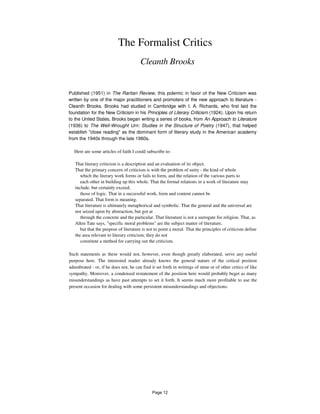
Published (1951) in The Raritan Review, this polemic in favor of the New Criticism was
written by one of the major practitioners and promoters of the new approach to literature -
Cleanth Brooks. Brooks had studied in Cambridge with I. A. Richards, who first laid the
foundation for the New Criticism in his Principles of Literary Criticism (1924). Upon his return
to the United States, Brooks began writing a series of books, from An Approach to Literature
(1936) to The Well-Wrought Urn: Studies in the Structure of Poetry (1947), that helped
establish "close reading" as the dominant form of literary study in the American academy
from the 1940s through the late 1960s.
Here are some articles of faith I could subscribe to:
That literary criticism is a description and an evaluation of its object.
That the primary concern of criticism is with the problem of unity - the kind of whole
which the literary work forms or fails to form, and the relation of the various parts to
each other in building up this whole. That the formal relations in a work of literature may
include, but certainly exceed,
those of logic. That in a successful work, form and content cannot be
separated. That form is meaning.
That literature is ultimately metaphorical and symbolic. That the general and the universal are
not seized upon by abstraction, but got at
through the concrete and the particular. That literature is not a surrogate for religion. That, as
Allen Tate says, "specific moral problems" are the subject matter of literature,
but that the purpose of literature is not to point a moral. That the principles of criticism define
the area relevant to literary criticism; they do not
constitute a method for carrying out the criticism.
Such statements as these would not, however, even though greatly elaborated, serve any useful
purpose here. The interested reader already knows the general nature of the critical position
adumbrated - or, if he does not, he can find it set forth in writings of mine or of other critics of like
sympathy. Moreover, a condensed restatement of the position here would probably beget as many
misunderstandings as have past attempts to set it forth. It seems much more profitable to use the
present occasion for dealing with some persistent misunderstandings and objections.
Page 12
The Formalist Critics 23
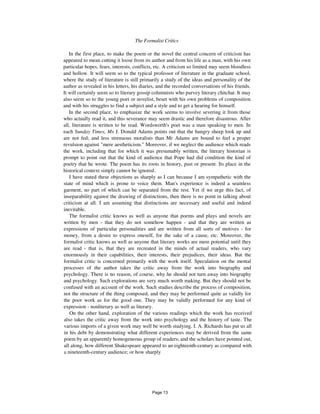
In the first place, to make the poem or the novel the central concern of criticism has
appeared to mean cutting it loose from its author and from his life as a man, with his own
particular hopes, fears, interests, conflicts, etc. A criticism so limited may seem bloodless
and hollow. It will seem so to the typical professor of literature in the graduate school,
where the study of literature is still primarily a study of the ideas and personality of the
author as revealed in his letters, his diaries, and the recorded conversations of his friends.
It will certainly seem so to literary gossip columnists who purvey literary chitchat. It may
also seem so to the young poet or novelist, beset with his own problems of composition
and with his struggles to find a subject and a style and to get a hearing for himself.
In the second place, to emphasize the work seems to involve severing it from those
who actually read it, and this severance may seem drastic and therefore disastrous. After
all, literature is written to be read. Wordsworth's poet was a man speaking to men. In
each Sunday Times, Mx J. Donald Adams points out that the hungry sheep look up and
are not fed; and less strenuous moralists than Mr Adams are bound to feel a proper
revulsion against "mere aestheticism." Moreover, if we neglect the audience which reads
the work, including that for which it was presumably written, the literary historian is
prompt to point out that the kind of audience that Pope had did condition the kind of
poetry that he wrote. The poem has its roots in history, past or present. Its place in the
historical context simply cannot be ignored.
I have stated these objections as sharply as I can because I am sympathetic with the
state of mind which is prone to voice them. Man's experience is indeed a seamless
garment, no part of which can be separated from the rest. Yet if we urge this fact, of
inseparability against the drawing of distinctions, then there is no point in talking about
criticism at all. I am assuming that distinctions are necessary and useful and indeed
inevitable.
The formalist critic knows as well as anyone that poems and plays and novels are
written by men - that they do not somehow happen - and that they are written as
expressions of particular personalities and are written from all sorts of motives - for
money, from a desire to express oneself, for the sake of a cause, etc. Moreover, the
formalist critic knows as well as anyone that literary works are mere potential until they
are read - that is, that they are recreated in the minds of actual readers, who vary
enormously in their capabilities, their interests, their prejudices, their ideas. But the
formalist critic is concerned primarily with the work itself. Speculation on the mental
processes of the author takes the critic away from the work into biography and
psychology. There is no reason, of course, why he should not turn away into biography
and psychology. Such explorations are very much worth making. But they should not be
confused with an account of the work. Such studies describe the process of composition,
not the structure of the thing composed, and they may be performed quite as validly for
the poor work as for the good one. They may be validly performed for any kind of
expression - nonliterary as well as literary.
On the other hand, exploration of the various readings which the work has received
also takes the critic away from the work into psychology and the history of taste. The
various imports of a given work may well be worth studying. I. A. Richards has put us all
in his debt by demonstrating what different experiences may be derived from the same
poem by an apparently homogeneous group of readers; and the scholars have pointed out,
all along, how different Shakespeare appeared to an eighteenth-century as compared with
a nineteenth-century audience; or how sharply
Page 13
The Language of Paradox
Cleanth Brooks
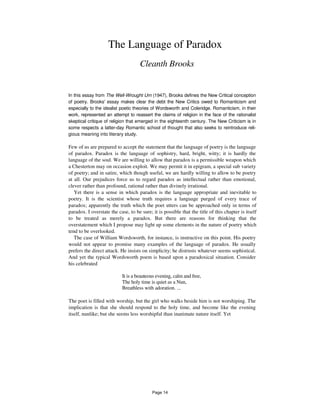
In this essay from The Well-Wrought Urn (1947), Brooks defines the New Critical conception
of poetry. Brooks' essay makes clear the debt the New Critics owed to Romanticism and
especially to the idealist poetic theories of Wordsworth and Coleridge. Romanticism, in their
work, represented an attempt to reassert the claims of religion in the face of the rationalist
skeptical critique of religion that emerged in the eighteenth century. The New Criticism is in
some respects a latter-day Romantic school of thought that also seeks to reintroduce reli-
gious meaning into literary study.
Few of us are prepared to accept the statement that the language of poetry is the language
of paradox. Paradox is the language of sophistry, hard, bright, witty; it is hardly the
language of the soul. We are willing to allow that paradox is a permissible weapon which
a Chesterton may on occasion exploit. We may permit it in epigram, a special sub variety
of poetry; and in satire, which though useful, we are hardly willing to allow to be poetry
at all. Our prejudices force us to regard paradox as intellectual rather than emotional,
clever rather than profound, rational rather than divinely irrational.
Yet there is a sense in which paradox is the language appropriate and inevitable to
poetry. It is the scientist whose truth requires a language purged of every trace of
paradox; apparently the truth which the poet utters can be approached only in terms of
paradox. I overstate the case, to be sure; it is possible that the title of this chapter is itself
to be treated as merely a paradox. But there are reasons for thinking that the
overstatement which I propose may light up some elements in the nature of poetry which
tend to be overlooked.
The case of William Wordsworth, for instance, is instructive on this point. His poetry
would not appear to promise many examples of the language of paradox. He usually
prefers the direct attack. He insists on simplicity; he distrusts whatever seems sophistical.
And yet the typical Wordsworth poem is based upon a paradoxical situation. Consider
his celebrated
It is a beauteous evening, calm and free,
The holy time is quiet as a Nun,
Breathless with adoration. ...
The poet is filled with worship, but the girl who walks beside him is not worshiping. The
implication is that she should respond to the holy time, and become like the evening
itself, nunlike; but she seems less worshipful than inanimate nature itself. Yet
Page 14
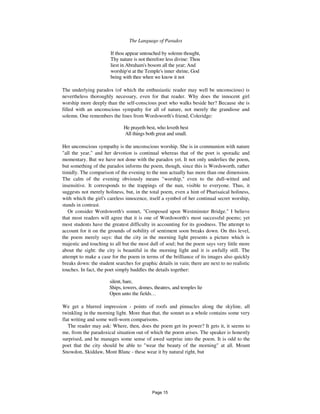
The Language of Paradox 29
If thou appear untouched by solemn thought,
Thy nature is not therefore less divine: Thou
liest in Abraham's bosom all the year; And
worship'st at the Temple's inner shrine, God
being with thee when we know it not
The underlying paradox (of which the enthusiastic reader may well be unconscious) is
nevertheless thoroughly necessary, even for that reader. Why does the innocent girl
worship more deeply than the self-conscious poet who walks beside her? Because she is
filled with an unconscious sympathy for all of nature, not merely the grandiose and
solemn. One remembers the lines from Wordsworth's friend, Coleridge:
He prayeth best, who loveth best
All things both great and small.
Her unconscious sympathy is the unconscious worship. She is in communion with nature
"all the year," and her devotion is continual whereas that of the poet is sporadic and
momentary. But we have not done with the paradox yet. It not only underlies the poem,
but something of the paradox informs the poem, though, since this is Wordsworth, rather
timidly. The comparison of the evening to the nun actually has more than one dimension.
The calm of the evening obviously means "worship," even to the dull-witted and
insensitive. It corresponds to the trappings of the nun, visible to everyone. Thus, it
suggests not merely holiness, but, in the total poem, even a hint of Pharisaical holiness,
with which the girl's careless innocence, itself a symbol of her continual secret worship,
stands in contrast.
Or consider Wordsworth's sonnet, "Composed upon Westminster Bridge." I believe
that most readers will agree that it is one of Wordsworth's most successful poems; yet
most students have the greatest difficulty in accounting for its goodness. The attempt to
account for it on the grounds of nobility of sentiment soon breaks down. On this level,
the poem merely says: that the city in the morning light presents a picture which is
majestic and touching to all but the most dull of soul; but the poem says very little more
about the sight: the city is beautiful in the morning light and it is awfully still. The
attempt to make a case for the poem in terms of the brilliance of its images also quickly
breaks down: the student searches for graphic details in vain; there are next to no realistic
touches. In fact, the poet simply huddles the details together:
silent, bare,
Ships, towers, domes, theatres, and temples lie
Open unto the fields...
We get a blurred impression - points of roofs and pinnacles along the skyline, all
twinkling in the morning light. More than that, the sonnet as a whole contains some very
flat writing and some well-worn comparisons.
The reader may ask: Where, then, does the poem get its power? It gets it, it seems to
me, from the paradoxical situation out of which the poem arises. The speaker is honestly
surprised, and he manages some sense of awed surprise into the poem. It is odd to the
poet that the city should be able to "wear the beauty of the morning" at all. Mount
Snowdon, Skiddaw, Mont Blanc - these wear it by natural right, but
Page 15
Structuralism, Linguistics,
Narratology
Page 16
2
Introduction: The Implied Order:
Structuralism
Julie Rivkin and Michael Ryan
Structuralism begins with the work of Ferdinand de Saussure, an early twentieth-century
Swiss linguist who argued that language should be studied as if it were frozen in time
and cut transversely like a leaf. What results is a vision of the entire language system as
it exists in implied or unconscious fashion in any spoken utterance. Utterances are
merely the manifestation of the rules of the system that lend order to the heterogeneity of
language. This notion of an implied order is central to the Structuralist undertaking, as it
spreads out from linguistics to anthropology and philosophy and to literary criticism
through the course of the twentieth century.
Structuralism derives both historically and logically from Formalism. Roman
Jakobson, one of the original Formalists, was also, by virtue of emigration, one of the
first major influences on French Structuralism, which flourished from the 1950s through
the 1960s. The scientific impulse evident in Formalism also finds its fulfillment in the
Structuralist emphasis on the task of adducing the internal system or order of linguistic,
cultural, and literary phenomena.
From Jakobson, early Structuralists such as anthropologist Claude Levi-Strauss learned
of Saussure's ideas about language. Levi-Strauss began to see that culture, like language,
is a system characterized by an internal order of interconnected parts that obey certain
rules of operation. A structure is both like a skeleton and like a genetic code in that it is
the principle of stability and coherence in any cultural system, while also being the
principle of action that allows the culture to exist in time as a living thing. After meeting
Jakobson in New York during their mutual exile during World War II, Levi-Strauss began
to think about culture as a form of communication like language. What was
communicated between cultural participants were tokens, like words, that enacted and
reproduced the basic assumptions and rules of the culture. In his analysis of kinship
systems, Elementary Structures of Kinship (1949), Levi-Strauss argued that primitive
cultures maintain peace between social groups by using women as tokens in marriage.
Such inter-familial and intertribal marriages function as a form of communication and
create personal or family relations that work to diminish the possibility of conflict. Levi-
Strauss went on to conduct famous studies of myths that noticed, in the same manner as
Russian critic Vladimir Propp's path-breaking work on folk tales, that such myths, despite
their heterogeneity and multiplicity, told the same kernel narratives. Those narratives
tended to work to resolve contradictions in the culture, such as that between a conception
of humans as plant-growing and peaceful and humans as hunters and
Page 17
54 Structuralism, Linguistics, Neonatology
warriors. The many versions of the Oedipus myth, for example, all tell a story about the
conflict between the idea that humans emerge from the earth ("Oedipus" means lame in
the foot) and the idea that they are born from other humans (hence the sanctity of the
incest taboo). The tale's function is to provide a mediation to the contradiction between
nature (sexuality) and culture (rule against incest) by forbidding natural sex between
family members.
The second major contribution that Saussure made to Structuralism was his conception
of the linguistic sign. Words, he noted, are signs, and linguistics rightly belongs to
another discipline called semiology, which would study the way signs, including words,
operate. Words are signs in that they consist of two faces or sides -the signifier, which is
the phonic component, and the signified, which is the ideational component. A word is
both a sound and an idea or image of its referent. Alongside and often in conjunction
with the Structural anthropology of Levi-Strauss, there developed in France in the 1950s,
especially in the work of Roland Barthes, a concern with the study of the semiological
dimension of literature and culture. A work of literature, Barthes noted, is, after all,
nothing but an assemblage of signs that function in certain ways to create meaning. In
studying culture, Barthes noticed that films, commodities, events, and images are lent
meaning by their association with certain signs. Barthes went on in the 1960s to become
one of the major practitioners of semiological analysis in literature. His most important
books are Writing Degree Zero (1953), Mythologies (1957), On Racine (1963), Critical
Essays (1964), Elements of Semiology (1965), and S/Z (1970).
A direct link between French Structuralism and Russian Formalism was established in
1965 with the publication of Tzvetan Todorov's collected translations of the Formalists'
Theory of Literature. Todorov's work is associated most often with the study of narrative,
and he helped formulate the Structuralist conception of narrative as the common element
of organization among diverse examples. In his study of Henry James's tales, for example
("The Structural Analysis of Narrative" in Poetics of Prose [1971]), he contends that they
all revolve around a missing center, a point of desire that is sought but that never appears.
The study of narrative (or narratology, as it is also called) is one of the most abiding
strands of Structuralist thinking.
By the mid-1960s, Structuralism was the dominant school of thought in French
intellectual life, and its influence is evident in the work of historian Michel Foucault,
psychoanalyst Jacques Lacan, literary critic Julia Kristeva, and philosopher Louis
Althusser. Foucault's work at that time included The Order of Things: An Archeology of
the Human Sciences (Les Mots et les choses, 1966), The Archeology of Knowledge (1969),
and The Order of Discourse (1970). Foucault is important for drawing attention to the
role of language in the conceptual frameworks or "epistemes" that are used in different
epochs for understanding the world. Words provide us with maps for assigning order to
nature and to society. Foucault notices that what counts as knowledge changes with time,
and with each change, the place of language in knowledge is also modified. In one era,
the world is considered to be a site of analogies between levels, but in a later epoch, the
world is broken down into discrete parts that are then organized into taxonomies.
Foucault is important as well for developing the idea of discourse and of discourse
formation. A discursive formation is a coherent group of assumptions and language
practices that applies to one region of knowledge, or expresses the beliefs of a social
group, or articulates rules and ideals regarding kinds of behavior. Modern science is
Page 18
The Implied Order: Structuralism 55
a discursive formation in that it is characterized both by a list of discoveries and a body
of knowledge, but also by recognized and widely accepted linguistic forms for describing
the methods and findings of science. When we get to feminism, you will encounter
feminists who speak of the "discourse of patriarchy," the set of ways of thinking and of
practicing language that lend coherence to male rule in society. They also describe the
discourse of advice books that educated women prior to the modern era in how to behave
"properly" as women, that is, in how to be "chaste, silent, and obedient."
Foucault's work draws attention to the fact that many assumptions in a culture are
maintained by language practices that comprise a common tool both for knowing the
world and for constructing it. By construction here, we mean the translation of physical
realities into discursive realities. The "dominant discourse" of the US, for example, is one
that lends great privilege to the "freedom" of the individual. The physical reality of
modern life is hemmed in and constrained in many complex ways, from laws that allow
police to search automobiles without cause to an economic system that requires
enormous amounts of time spent at the workplace under someone else's control.
Nevertheless, this physical and institutional reality is rendered discursively in the
American lexicon as "freedom." Just as all women were far from being chaste, silent, and
obedient, despite what the dominant discourse of the advice or courtesy books mandated,
so also most Americans have limited access to the kind of pure freedom the dominant
term seems to imply. What Foucault noted was that the world we live in is shaped as
much by language as by knowledge or perception. Indeed, according to him, knowledge
and perception always occur through the mediation of language. We would not be able to
know anything if we were not able to order the world linguistically in certain ways.
In his later work, Foucault explores the way sexuality is characterized over history in
different discourses of the body {History of Sexuality [1976]). And he examines the
change in regimes of social discipline from medieval times to modern times {Discipline
and Punish [1975]).
Page 19
j f) 1 il / . hi ■-] - ! ; | 3 U
[}" ll u i' M.:
U (.:. The
Linguistic Foundation
Jonathan Culler
Jonathan Culler's Structuralist Poetics (1975) was one of the first complete introductions in
English to the French structuralist movement in literary criticism. In this selection, he pro-
poses an analogy between the structuralist description of how language operates and the
rules and conventions that make up human culture.
The notion that linguistics might be useful in studying other cultural phenomena is based
on two fundamental insights: first, that social and cultural phenomena are not simply
material objects or events but objects or events with meaning, and hence signs; and
second, that they do not have essences but are defined by a network of relations, both
internal and external. Stress may fall on one or the other of these propositions - it would
be in these terms, for example, that one might try to distinguish semiology and
structuralism - but in fact the two are inseparable, for in studying signs one must
investigate the system of relations that enables meaning to be produced and, reciprocally,
one can only determine what are the pertinent relations among items by considering them
as signs.
Structuralism is thus based, in the first instance, on the realization that if human
actions or productions have a meaning there must be an underlying system of dis
tinctions and conventions which makes this meaning possible. Confronted with a
marriage ceremony or a game of football, for example, an observer from a culture
where these did not exist could present an objective description of the actions which
took place, but he would be unable to grasp their meaning and so would not be
treating them as social or cultural phenomena. The actions are meaningful only with
respect to a set of institutional conventions. Wherever there are two posts one can
kick a ball between them but one can score a goal only within a certain institutional
ized framework. As Levi-Strauss says in his "Introduction a l'ceuvre de Marcel
Mauss," "particular actions of individuals are never symbolic in themselves; they are
the elements out of which is constructed a symbolic system, which must be collect
ive" (p. xvi). The cultural meaning of any particular act or object is determined by a
whole system of constitutive rules: rules which do not regulate behavior so much as
create the possibility of particular forms of behavior. The rules of English enable
sequences of sound to have meaning; they make it possible to utter grammatical or
ungrammatical sentences. And analogously, various social rules make it possible to
marry, to score a goal, to write a poem, to be impolite. It is in this sense that a
culture is composed of a set of symbolic systems ___
To claim that cultural systems may with profit be treated as "languages" is to suggest
that one will understand them better if one discusses them in terms provided
Page 20
The Linguistic Foundation 57
by linguistics and analyzes them according to procedures used by linguists. In fact, the
range of concepts and methods which structuralists have found useful is fairly restricted
and only some half-dozen linguists could qualify as seminal influences. The first, of
course, is Ferdinand de Saussure, who waded into the heterogeneous mass of linguistic
phenomena and, recognizing that progress would be possible only if one isolated a
suitable object for study, distinguished between speech acts (la parole) and the system of
a language (la langue). The latter is the proper object of linguistics. Following Saussure's
example and concentrating on the system which underlies speech sounds, members of the
Prague linguistic circle - particularly Jakobson and Trubetz-koy - effected what Levi-
Strauss called the "phonological revolution" and provided what was to later structuralists
the clearest model of linguistic method. Distinguishing between the study of actual
speech sounds (phonetics) and the investigation of those aspects of sound that are
functional in a particular language (phonology), Trubetzkoy argued that "phonology
should investigate which phonic differences are linked, in the language under
consideration, with differences of meaning, how these differentiating elements or marks
are related to one another, and according to what rules they combine to form words and
phrases" (Principes de phonologie, pp. 11-12). Phonology was important for
structuralists because it showed the systematic nature of the most familiar phenomena,
distinguished between the system and its realization and concentrated not on the
substantive characteristics of individual phenomena but on abstract differential features
which could be defined in relational terms....
The basic distinction on which modern linguistics rests, and which is equally crucial
to the structuralist enterprise in other fields, is Saussure's isolation of langue from parole.
The former is a system, an institution, a set of interpersonal rules and norms, while the
latter comprises the actual manifestations of the system in speech and writing. It is, of
course, easy to confuse the system with its manifestations, to think of English as the set
of English utterances. But to learn English is not to memorize a set of utterances; it is to
master a system of rules and norms which make it possible to produce and understand
utterances. To know English is to have assimilated the system of the language. And the
linguist's task is not to study utterances for their own sake; they are of interest to him
only in so far as they provide evidence about the nature of the underlying system, the
English language.
Within linguistics itself there are disagreements about what precisely belongs to
langue and what to parole: whether, for example, an account of the linguistic system
should specify the acoustic and articulatory features that distinguish one phoneme from
another (/p/ is "voiceless" and /b/ "voiced"), or whether such features as "voiced" and
"voiceless" should be thought of as the manifestations in parole of what, in la langue
itself, is a purely formal and abstract distinction. Such debates need not concern the
structuralist, except in so far as they indicate that structure can be defined at various
levels of abstraction. What does concern him is a pair of distinctions which the
differentiation of langue from parole is designed to cover between rule and behavior and
between the functional and the nonfunctional.
The distinction between rule and behavior is crucial to any study concerned with the
production or communication of meaning. In investigating physical events one may
formulate laws which are nothing other than direct summaries of behavior, but in the case
of social and cultural phenomena the rule is always at some distance from actual behavior
and that gap is a space of potential meaning. The instituting of the simplest rule, such as
"members of this club will not step on cracks in the
Page 21
Course in General Linguistics
Ferdinand de Saussure
Assembled by students from class notes and published in 1916, Ferdinand de Saussure's
Course in General Linguistics quickly became one of the most influential books of the
twentieth century. It inspired a wide range of work in anthropology, sociology, philosophy,
and literary criticism that is usually referred to as Structuralism.
In separating language from speaking we are at the same time separating: (1) what is
social from what is individual; and (2) what is essential from what is accessory and more
or less accidental.
Language is not a function of the speaker; it is a product that is passively assimilated
by the individual. It never requires premeditation, and reflection enters in only for the
purpose of classification, which we shall take up later.
Speaking, on the contrary, is an individual act. It is willful and intellectual. Within the
act, we should distinguish between: (1) the combinations by which the speaker uses the
language code for expressing his own thought; and (2) the psychophysical mechanism
that allows him to exeriorize those combinations.
To summarize, these are the characteristics of language:
(1) Language is a well-defined object in the heterogeneous mass of speech facts. It can
be localized in the limited segment of the speaking-circuit where an auditory image
becomes associated with a concept. It is the social side of speech, outside the individual
who can never create nor modify it by himself; it exists only by virtue of a sort of
contract signed by the members of a community. Moreover, the individual must always
serve an apprenticeship in order to learn the functioning of language; a child assimilates
it only gradually. It is such a distinct thing that a man deprived of the use of speaking
retains it provided that he understands the vocal signs that he hears.
(2) Language, unlike speaking, is something that we can study separately. Although
dead languages are no longer spoken, we can easily assimilate their linguistic organisms.
We can dispense with the other elements of speech; indeed, the science of language is
possible only if the other elements are excluded.
(3) Whereas speech is heterogeneous, language, as defined, is homogeneous. It is a
system of signs in which the only essential thing is the union of meanings and sound-
images, and in which both parts of the sign are psychological.
Page 22
60 Structuralism, Linguistics, Narratology
(4) Language is concrete, no less so than speaking; and this is a help in our study of it.
Linguistic signs, though basically psychological, are not abstractions; associations which
bear the stamp of collective approval - and which added together constitute language - are
realities that have their seat in the brain.
We have just seen that language is a social institution; but several features set it apart
from other political, legal, etc. institutions.
We must call in a new type of facts in order to illuminate the special nature of
language.
Language is a system of signs that express ideas, and is therefore comparable to a
system of writing, the alphabet of deaf-mutes, symbolic rites, polite formulas, military
signals, etc. But it is the most important of all these systems.
A science that studies the life of signs within society is conceivable; it would be a part
of social psychology and consequently of general psychology; I shall call it semiology
(from Greek semeion, "sign"). Semiology would show what constitutes signs, what laws
govern them. Since the science does not yet exist, no one can say what it would be; but it
has a right to existence, a place started out in advance. Linguistics is only a part of the
general science of semiology; the laws discovered by semiology will be applicable to
linguistics, and the latter will circumscribe a well-defined area within the mass of
anthropological facts...
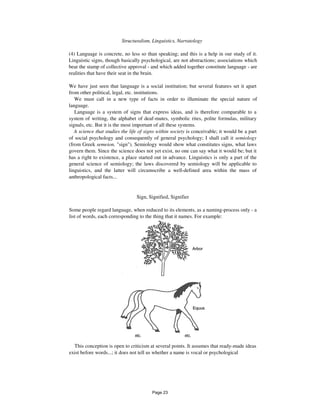
Sign, Signified, Signifier
Some people regard language, when reduced to its elements, as a naming-process only - a
list of words, each corresponding to the thing that it names. For example:
etc. etc.
This conception is open to criticism at several points. It assumes that ready-made ideas
exist before words...; it does not tell us whether a name is vocal or psychological
Page 23
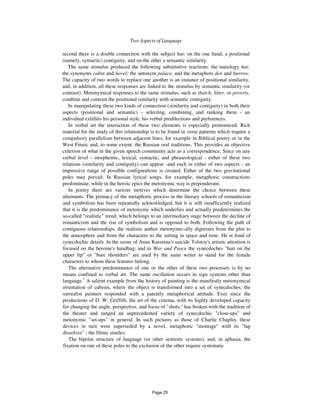
Two Aspects of Language
Roman Jakobson
Roman Jakobson helped found the Moscow Linguistic Circle, and he worked with Viktor
Shklovsky at the Society for the Study of Poetic Language. After emigrating from Russia in
1920, he worked in Prague with the Prague Linguistic Circle. Eventually, he made his way to
the US, where he helped inspire Claude Levi-Strauss, another European exile driven from
home by the Nazis, to invent Structuralist Anthropology, an attempt to merge linguistic
theory and anthropological analysis. Jakobson, along with N. S. Troubetzkoy, contributed to
the "phonological revolution," the insight that words are generated from differences be-
tween distinctive features such as voiced and unvoiced or aspirated and non-aspirated
sounds. This selection was first published in 1956.
The varieties of aphasia are numerous and diverse, but all of them oscillate between the
two polar types just described. Every form of aphasic disturbance consists in some
impairment, more or less severe, either of the faculty for selection and substitution or for
combination and contexture. The former affliction involves a deterioration of
metalinguistic operations, while the latter damages the capacity for maintaining the
hierarchy of linguistic units. The relation of similarity is suppressed in the former, the
relation of contiguity in the latter type of aphasia. Metaphor is alien to the similarity
disorder, and metonymy to the contiguity disorder.
The development of a discourse may take place along two different semantic lines: one
topic may lead to another either through their similarity or through their contiguity. The
metaphoric way would be the most appropriate term for the first case and the metonymic
way for the second, since they find their most condensed expression in metaphor and
metonymy respectively. In aphasia one or the other of these two processes is restricted or
totally blocked - an effect which makes the study of aphasia particularly illuminating for
the linguist. In normal verbal behavior both processes are continually operative, but
careful observation will reveal that under the influence of a cultural pattern, personality,
and verbal style, preference is given to one of the two processes over the other.
In a well-known psychological test, children are confronted with some noun and told
to utter the first verbal response that comes into their heads. In this experiment two
opposite linguistic predilections are invariably exhibited: the response is intended either
as a substitute for, or as a complement to the stimulus. In the latter case the stimulus and
the response together form a proper syntactic construction, most usually a sentence.
These two types of reaction have been labeled substitutive and predicative.
To the stimulus hut one response was burnt out; another is a poor little house. Both
reactions are predicative; but the first creates a purely narrative context, while in the
Page 24
Two Aspects of Language 11
second there is a double connection with the subject hut; on the one hand, a positional
(namely, syntactic) contiguity, and on the other a semantic similarity.
The same stimulus produced the following substitutive reactions: the tautology hut;
the synonyms cabin and hovel; the antonym palace, and the metaphors den and burrow.
The capacity of two words to replace one another is an instance of positional similarity,
and, in addition, all these responses are linked to the stimulus by semantic similarity (or
contrast). Metonymical responses to the same stimulus, such as thatch, litter, or poverty,
combine and contrast the positional similarity with semantic contiguity.
In manipulating these two kinds of connection (similarity and contiguity) in both their
aspects (positional and semantic) - selecting, combining, and ranking them - an
individual exhibits his personal style, his verbal predilections and preferences.
In verbal art the interaction of these two elements is especially pronounced. Rich
material for the study of this relationship is to be found in verse patterns which require a
compulsory parallelism between adjacent lines, for example in Biblical poetry or in the
West Finnic and, to some extent, the Russian oral traditions. This provides an objective
criterion of what in the given speech community acts as a correspondence. Since on any
verbal level - morphemic, lexical, syntactic, and phraseological - either of these two
relations (similarity and contiguity) can appear -and each in either of two aspects - an
impressive range of possible configurations is created. Either of the two gravitational
poles may prevail. In Russian lyrical songs, for example, metaphoric constructions
predominate, while in the heroic epics the metonymic way is preponderant.
In poetry there are various motives which determine the choice between these
alternants. The primacy of the metaphoric process in the literary schools of romanticism
and symbolism has been repeatedly acknowledged, but it is still insufficiently realized
that it is the predominance of metonymy which underlies and actually predetermines the
so-called "realistic" trend, which belongs to an intermediary stage between the decline of
romanticism and the rise of symbolism and is opposed to both. Following the path of
contiguous relationships, the realistic author metonymic-ally digresses from the plot to
the atmosphere and from the characters to the setting in space and time. He is fond of
synecdochic details. In the scene of Anna Karenina's suicide Tolstoy's artistic attention is
focused on the heroine's handbag; and in War and Peace the synecdoches "hair on the
upper lip" or "bare shoulders" are used by the same writer to stand for the female
characters to whom these features belong.
The alternative predominance of one or the other of these two processes is by no
means confined to verbal art. The same oscillation occurs in sign systems other than
language.1
A salient example from the history of painting is the manifestly metonymical
orientation of cubism, where the object is transformed into a set of synecdoches; the
surrealist painters responded with a patently metaphorical attitude. Ever since the
productions of D. W. Griffith, the art of the cinema, with its highly developed capacity
for changing the angle, perspective, and focus of "shots," has broken with the tradition of
the theater and ranged an unprecedented variety of synecdochic "close-ups" and
metonymic "set-ups" in general. In such pictures as those of Charlie Chaplin, these
devices in turn were superseded by a novel, metaphoric "montage" with its "lap
dissolves" - the filmic similes.
The bipolar structure of language (or other semiotic systems), and, in aphasia, the
fixation on one of these poles to the exclusion of the other require systematic
Page 25
Mythologies
Roland Barthes
Roland Barthes played a major role in the development of Structuralist and Post-Structuralist
literary criticism in France from the 1950s to the 1970s. In his early work, Elements of
Semiology (1965), he introduced the ideas of Saussure to the French intellectual community,
and he offered a wide range of exemplary applications of "semiology," or the science of
signs, to everything from literature to fashion and cuisine. He went on to write numerous
works of Structuralist literary criticism. After 1968, influenced by the work of Jacques
Derrida, Barthes turned away from classic Structuralism's concern with the orders of signs
and worked instead on the disordering potential of literary semiosis, its tendency,to trans-
gress the identities and boundaries (such as the idea of the "author") that define traditional
literary study. His essay "Death of the Author" (1968) is something of a Post-Structuralist
manifesto, and this stage of Barthes's work achieves its most mature manifestation in his
famous S/Z (1970), a lengthy reading of a short story by Balzac. These selections from
Mythologies date from 1957.
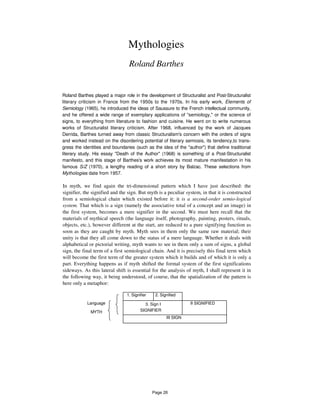
In myth, we find again the tri-dimensional pattern which I have just described: the
signifier, the signified and the sign. But myth is a peculiar system, in that it is constructed
from a semiological chain which existed before it: it is a second-order semio-logical
system. That which is a sign (namely the associative total of a concept and an image) in
the first system, becomes a mere signifier in the second. We must here recall that the
materials of mythical speech (the language itself, photography, painting, posters, rituals,
objects, etc.), however different at the start, are reduced to a pure signifying function as
soon as they are caught by myth. Myth sees in them only the same raw material; their
unity is that they all come down to the status of a mere language. Whether it deals with
alphabetical or pictorial writing, myth wants to see in them only a sum of signs, a global
sign, the final term of a first semiological chain. And it is precisely this final term which
will become the first term of the greater system which it builds and of which it is only a
part. Everything happens as if myth shifted the formal system of the first significations
sideways. As this lateral shift is essential for the analysis of myth, I shall represent it in
the following way, it being understood, of course, that the spatialization of the pattern is
here only a metaphor:
Language
MYTH
1. Signifier 2. Signified
3. Sign I
SIGNIFIER
II SIGNIFIED
III SIGN
Page 26
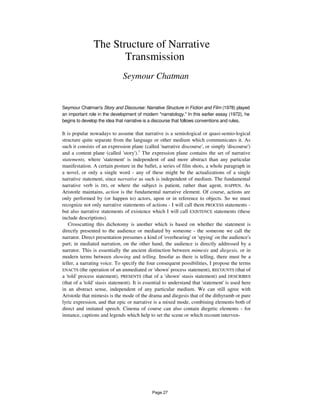
The Structure of Narrative
Transmission
Seymour Chatman
Seymour Chatman's Story and Discourse: Narrative Structure in Fiction and Film (1978) played
an important role in the development of modern "narratology." In this earlier essay (1972), he
begins to develop the idea that narrative is a discourse that follows conventions and rules,
It is popular nowadays to assume that narrative is a semiological or quasi-semio-logical
structure quite separate from the language or other medium which communicates it. As
such it consists of an expression plane (called 'narrative discourse', or simply 'discourse')
and a content plane (called 'story').1
The expression plane contains the set of narrative
statements, where 'statement' is independent of and more abstract than any particular
manifestation. A certain posture in the ballet, a series of film shots, a whole paragraph in
a novel, or only a single word - any of these might be the actualizations of a single
narrative statement, since narrative as such is independent of medium. The fundamental
narrative verb is DO, or where the subject is patient, rather than agent, HAPPEN. As
Aristotle maintains, action is the fundamental narrative element. Of course, actions are
only performed by (or happen to) actors, upon or in reference to objects. So we must
recognize not only narrative statements of actions - I will call them PROCESS statements -
but also narrative statements of existence which I will call EXISTENCE statements (these
include descriptions).
Crosscutting this dichotomy is another which is based on whether the statement is
directly presented to the audience or mediated by someone - the someone we call the
narrator. Direct presentation presumes a kind of 'overhearing' or 'spying' on the audience's
part; in mediated narration, on the other hand, the audience is directly addressed by a
narrator. This is essentially the ancient distinction between mimesis and diegesis, or in
modern terms between showing and telling. Insofar as there is telling, there must be a
teller, a narrating voice. To specify the four consequent possibilities, I propose the terms
ENACTS (the operation of an unmediated or 'shown' process statement), RECOUNTS (that of
a 'told' process statement), PRESENTS (that of a 'shown' stasis statement) and DESCRIBES
(that of a 'told' stasis statement). It is essential to understand that 'statement' is used here
in an abstract sense, independent of any particular medium. We can still agree with
Aristotle that mimesis is the mode of the drama and diegesis that of the dithyramb or pure
lyric expression, and that epic or narrative is a mixed mode, combining elements both of
direct and imitated speech. Cinema of course can also contain diegetic elements - for
instance, captions and legends which help to set the scene or which recount interven-
Page 27
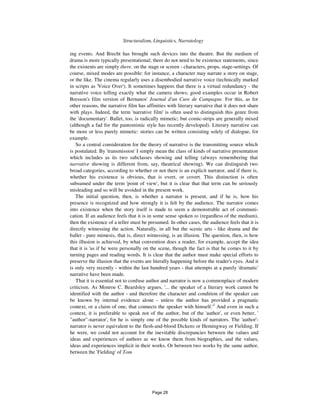
98 Structuralism, Linguistics, Narratology
ing events. And Brecht has brought such devices into the theatre. But the medium of
drama is more typically presentational; there do not need to be existence statements, since
the existents are simply there, on the stage or screen - characters, props, stage-settings. Of
course, mixed modes are possible: for instance, a character may narrate a story on stage,
or the like. The cinema regularly uses a disembodied narrative voice (technically marked
in scripts as 'Voice Over'). It sometimes happens that there is a virtual redundancy - the
narrative voice telling exactly what the camera shows; good examples occur in Robert
Bresson's film version of Bernanos' Journal d'un Cure de Campagne. For this, as for
other reasons, the narrative film has affinities with literary narrative that it does not share
with plays. Indeed, the term 'narrative film' is often used to distinguish this genre from
the 'documentary'. Ballet, too, is radically mimetic; but comic-strips are generally mixed
(although a fad for the pantomimic style has recently developed). Literary narrative can
be more or less purely mimetic: stories can be written consisting solely of dialogue, for
example.
So a central consideration for the theory of narrative is the transmitting source which
is postulated. By 'transmission' I simply mean the class of kinds of narrative presentation
which includes as its two subclasses showing and telling (always remembering that
narrative showing is different from, say, theatrical showing). We can distinguish two
broad categories, according to whether or not there is an explicit narrator, and if there is,
whether his existence is obvious, that is overt, or covert. This distinction is often
subsumed under the term 'point of view', but it is clear that that term can be seriously
misleading and so will be avoided in the present work.
The initial question, then, is whether a narrator is present, and if he is, how his
presence is recognized and how strongly it is felt by the audience. The narrator comes
into existence when the story itself is made to seem a demonstrable act of communi-
cation. If an audience feels that it is in some sense spoken to (regardless of the medium),
then the existence of a teller must be presumed. In other cases, the audience feels that it is
directly witnessing the action. Naturally, in all but the scenic arts - like drama and the
ballet - pure mimesis, that is, direct witnessing, is an illusion. The question, then, is how
this illusion is achieved, by what convention does a reader, for example, accept the idea
that it is 'as if he were personally on the scene, though the fact is that he comes to it by
turning pages and reading words. It is clear that the author must make special efforts to
preserve the illusion that the events are literally happening before the reader's eyes. And it
is only very recently - within the last hundred years - that attempts at a purely 'dramatic'
narrative have been made.
That it is essential not to confuse author and narrator is now a commonplace of modern
criticism. As Monroe C. Beardsley argues, '... the speaker of a literary work cannot be
identified with the author - and therefore the character and condition of the speaker can
be known by internal evidence alone - unless the author has provided a pragmatic
context, or a claim of one, that connects the speaker with himself.'3
And even in such a
context, it is preferable to speak not of the author, but of the 'author', or even better, '
"author"-narrator', for he is simply one of the possible kinds of narrators. The 'author'-
narrator is never equivalent to the flesh-and-blood Dickens or Hemingway or Fielding. If
he were, we could not account for the inevitable discrepancies between the values and
ideas and experiences of authors as we know them from biographies, and the values,
ideas and experiences implicit in their works. Or between two works by the same author,
between the 'Fielding' of Tom
Page 28
Rhetoric, Phenomenology,
Reader Response
Page 29
3
Introduction: Language and Action
Julie Rivkin and Michael Ryan
In this section, we bring together two sides of the equation of reading - the production of
language acts known as rhetoric and the reception of such acts in reading and
interpretation. The dialogic structure of the literary text requires that both sides be taken
into account. Rhetoric, the formulation of language for readers, invites and solicits a
response from readers.
In ancient Greece and Rome, language was recognized as an important feature of
social and political life. Training in how to think properly took the form of training in
how to use language effectively. Logic, the right use of such mental processes as
induction and deduction, was studied in conjunction with rhetoric, the use of forms to
give shape to language and the use of language to make argumentative points and attain
emotional effects. In the modern period, the rise of a positivist model of science and the
development of more refined forms of abstract mathematical logic eroded the link
between philosophy and rhetoric. A study of the forms, tropes, topics, and genres of
discourse was no longer considered sufficient for gaining an understanding of how
thinking worked or of how far logic could be extended and elaborated. Rhetoric receded
in importance in the humanities. Some literary scholars, like Kenneth Burke in the 1930s,
still spoke of the importance of rhetoric for an understanding of social action and literary
form, but they were few in number. The intellectual movement called Positivism, which
favored scientific method and the study of positive facts, displaced rhetoric from its
central place in the humanities in education.
One of the major intellectual revolutions of the twentieth century consisted of restoring
importance to the study of language. It began in linguistics and carried over into
anthropology, philosophy, and the literary criticism of the Russian Formalists and the
French Structuralists. Continental philosophers, such as Ernst Cassirer and Martin
Heidegger, were among the first to argue for the centrality of language to human
experience and to social institutions. Language philosophers in England, such as Ludwig
Wittgenstein and J. L. Austin, noted that human knowledge takes place in language and
that language is central to human social activity. In conjunction with these intellectual
movements there arose a new interest in rhetoric on the part of literary scholars in the mid
to late twentieth century.
The work of J. L. Austin, especially his seminal How To Do Things With Words
(1962), provoked an interest in the way language acts to create institutions, social bonds,
emotional effects, and modified realities. He described a class of what he called
"performative utterances," statements such as "I pronounce you man and wife" or "I
sentence you to death" that make things happen in the world. The
Page 30
128 Rhetoric, Phenomenology, Reader Response
American philosopher John Searle, in his books Speech Acts (1970) and The Social
Construction of Language (1995), played an especially important role in furthering
Austin's "speech act" theory. Literary critics have used the theory to study how literary
language takes the form of lies, promises, excuses, etc.
Austin's work and speech-act theory in general more rightly belong to the field of
pragmatics, the study of the active work of language to achieve certain effects in
particular situations. Language is both a means of representing things and thoughts and a
means of acting in the world. In the contemporary era, the study of the language of
literature, which is usually called "stylistics," blends with the study of language in many
other arenas of use. Modern rhetoricians examine, for example, the use of language in the
discourse of medicine or of economics. They are concerned particularly with the way
language contains embedded within it schemas for understanding the world in a particular
way. An important assumption of such discourse analysis is that language shapes people's
perceptions of the world. Further developments in speech-act theory contend that
language also actively constructs social reality. Institutions such as money depend on
language acts that create them and guarantee their credibility.
Like such social institutions, literature depends on being read in a certain way in order
to be effective and successful. It is written for an audience, and that audience is implied
in the text. Reception, response, and interpretation are in a sense preordained by the
rhetoric of the literary work, but the audience also plays a role in shaping how the work
will be understood and what meanings it will have. Each new generation and each new
group of readers in a new setting brings to a work different codes for understanding it.
One of the first literary critics, the Greek philosopher Aristotle, noticed that a work of
literature is as remarkable for its effects as for its causes. Tragedy, he famously remarked,
succeeds not so much for reasons of formal perfection as for reasons of the emotional
transformation that it works on audiences. The turn in the tragic plot is also a turn of
emotion in the audience as, with the tragic hero, the audience moves from blindness to
recognition. Such recognition is both a moment of cognitive turning or revelation and a
moment of affective response and fellow-feeling. Identified with the hero, we also
identify with his feelings of horror or pain or despair. His sense of revolt at the mockery
Fate works on human delusions is our own.
A sense of the importance of the contact between literary work and its audiences was
shunted aside by later aesthetic theories, especially those developed under the auspices of
Romanticism. They emphasized the genius of the writer or creator in bringing the ideal
and the real, the universal and the concrete, together in a work of art. Attention shifted
from the psychological and emotional link between work and audience to the inner
harmony or organic unity of the work itself. These aesthetic theories were Platonic rather
than Aristotelian, more indebted to the idealism of Plato than to the realism of Aristotle.
If a work of literature had an effect on its audience worth noting, it was to inspire awe at
the way it provided a sublime glimpse into Eternity.
Two schools of thought worked to resuscitate interest in the role of the audience in
literature. One was the historical school that in the eighteenth century argued that to
know the meaning of older texts, one had to reconstruct the context in which they were
originally written. Who a work was addressed to in part determined how it
Page 31
Language and Action 129
should retroactively be interpreted. The other school was the philosophy of Imman-uel
Kant, who argued that knowledge is shaped by inner mental categories that operate prior
to any sense experience. They determine how we know the world. Knowledge that was
made up of sensory experience alone would have no unity or coherence. Such ideational
unity could be provided only by logical operations that the mind could produce. One
implication of this argument was to shift attention toward the work of the observer in
constructing knowledge both of the world and of art.
The important point for literary criticism is that the mind comes to literature or to
reading already prepared to follow the logic of the narrative or the verse form, to
formulate judgments, and to ascribe or deduce meaning. While there may be an object
called King Lear that exists independently in the world, its very construction as an
orderly narrative assumes certain capacities on the part of its audience. They must be
capable of recognizing the temporal structure of the play as a unity. As a play in which
certain kinds of speech are practiced, certain conclusions are reached, and certain kinds
of character delineated, it presupposes that the audience is capable of perceiving this
display of literary signs as a coherent order. Each person's reading will be shaped by
mental operations that are idiosyncratic and determined by that person's life history and
sociocultural context, but some are universal in character (and thus pretty much the same
for everyone). The universal mental operations have to do with the ability to follow the
logic of temporal narrative and to recognize the different placements of characters in
space from scene to scene. The more socially and historically specific (and therefore
variable) a priori judgments vary according to gender (some women might read the play
differently from some men and find Goneril more attractive, for example, than Cordelia)
or geography (someone in a country suffering from tyrannical rulers might find the
demise of Lear a pleasing, rather than a tragic, resolution).
The Kantian investigation of the role of the mind in shaping knowledge of the world
and, by implication, shaping the perception of the work of art was continued by Edmund
Husserl at the beginning of the twentieth century. His work on the phenomenology of
knowledge deepened an understanding of the operations of consciousness in bringing to
sensory experience an ideational and presensory component that was a feature of the
mind itself. Husserl was interested in delimiting the pure ideas that were possible only in
consciousness. Other philosophers in the same tradition, especially Martin Heidegger and
Hans-Georg Gadamer, worked out a compromise between the historicist position and the
Kantian one. Knowledge, they argued, occurs in time and history; it cannot achieve the
kind of transcendence Husserl especially desired for it. Instead, all knowledge is
interpretation, a transfer of meaning from one moment of history into another that always
inflects what is known with the categories and assumptions of the later moment.
Gadamer, in Truth and Method (1972), went so far as to argue that as a result all
knowledge will be tinged with error.
The leap from these conclusions to an understanding of the role of the reader's
cognition in the work of art was executed by Georges Poulet and Roman Ingarden. The
phenomenological literary criticism of Poulet, especially his book Metamorphoses of the
Circle (1961), transferred to American criticism a sense of the importance of the reader's
experience of a literary work. Ingarden's Cognition of the Work of Art (1968) argued for
an essential link between the work of the audience and the work itself.
Page 32
130 Rhetoric, Phenomenology, Reader Response
The US critic most responsible for disseminating the idea that the reader's experience
is as important as those qualities inherent to the work itself was Stanley Fish. Fish argued,
famously, that "there is no text in this class," by which he meant that the reader's
experience takes precedence over a description of the formal features of the work and, in
fact, constitutes those formal features. (See Is there a Text in this Class? [1980].) Those
features cannot be described except insofar as the mind grasps them. Hence, they have no
independent existence apart from the reader's response to them.
More recent thinkers along these lines have explored such things as the psychological
workings of reader response to a work of literature. Such work takes two forms. One is
an analysis of the way a work manipulates such feeling states as desire, anxiety, and fear.
A work of art evokes and directs libidinal urges in its audience. Another strand of work
studies actual audiences and asks how they respond to a particular writer. Finally,
researchers have also taken to noticing how a single work can be remade by different
moments of history or interpreted differently by differently located social agents. King
Lear, for example, was produced for many years with a happy ending that the culture of
the nineteenth century found more appealing than its original tragic conclusion. John
Frow has noted that Homer's Iliad changes remarkably from one epoch to another, as
translators give shape to the original that is usually inflected with their own culture's
concerns and preoccupations. French sociologist Pierre Bourdieu argues in his book,
Distinction (1979), that audiences have different tastes that are largely determined by
class location and educational level. We classify literary works according to schemes that
we have inherited from our culture and from our social class situation.
Page 33
How To Do Things With Words
J. L. Austin
J. L Austin's How To Do Things With Words (1962) is one of those books that at first seem
unremarkable but become increasingly more remarkable with time. Austin describes a class
of utterances, which he calls "performatives," that effect actions in the world. John Searle
popularized and deepened Austin's work in his book Speech Acts (1969). Austin's work has
been important for Post-Structuralists and for gender theorists.
Lecture I
Preliminary isolation of the performative1
The type of utterance we are to consider here is not, of course, in general a type of
nonsense; though misuse of it can, as we shall see, engender rather special varieties of
'nonsense'. Rather, it is one of our second class - the masqueraders. But it does not by any
means necessarily masquerade as a statement of fact, descriptive or constative. Yet it
does quite commonly do so, and that, oddly enough, when it assumes its most explicit
form. Grammarians have not, I believe, seen through this 'disguise', and philosophers
only at best incidentally. It will be convenient, therefore, to study it first in this
misleading form, in order to bring out its characteristics by contrasting them with those of
the statement of fact which it apes.
We shall take, then, for our first examples some utterances which can fall into no
hitherto recognized grammatical category save that of 'statement', which are not non-
sense, and which contain none of those verbal danger-signals which philosophers have
by now detected or think they have detected (curious words like 'good' or 'all', suspect
auxiliaries like 'ought' or 'can', and dubious constructions like the hypothetical): all will
have, as it happens, humdrum verbs in the first person singular present indicative active.
Utterances can be found, satisfying these conditions, yet such that
A they do not 'describe' or 'report' or constate anything at all, are not 'true or false';
and B the uttering of the sentence is, or is a part of, the doing of an action, which
again
would not normally be described as saying something.
This is far from being as paradoxical as it may sound or as I have meanly been trying
to make it sound: indeed, the examples now to be given will be disappointing.
Page 34
Horn To Do Things With Words 163
Examples:
(E. a) 'I do (sc. take this woman to be my lawful wedded wife)' - as uttered in the
course of the marriage ceremony. (E. b) 'I name this ship the Queen Elizabeth' -
as uttered when smashing the bottle
against the stem. (E. c) 'I give and bequeath my watch to my brother'
- as occurring in a will. (E. d) 'I bet you sixpence it will rain tomorrow.'
In these examples it seems clear that to utter the sentence (in, of course, the appro-
priate circumstances) is not to describe my doing of what I should be said in so uttering
to be doing or to state that I am doing it: it is to do it. None of the utterances cited is
either true or false: I assert this as obvious and do not argue it. It needs argument no more
than that 'damn' is not true or false: it may be that the utterance 'serves to inform you' -
but that is quite different. To name the ship is to say (in the appropriate circumstances)
the words 'I name, &c.'. When I say, before the registrar or altar, &c, 'I do', I am not
reporting on a marriage: I am indulging in it.
What are we to call a sentence or an utterance of this type? I propose to call it a
performative sentence or a performative utterance, or, for short, 'a performative'. The
term 'performative' will be used in a variety of cognate ways and constructions, much as
the term 'imperative' is.7
The name is derived, of course, from 'perform', the usual verb
with the noun 'action': it indicates that the issuing of the utterance is the performing of an
action - it is not normally thought of as just saying something.
A number of other terms may suggest themselves, each of which would suitably cover
this or that wider or narrower class of performatives: for example, many performatives
are contractual ('I bet') or declaratory ('I declare war') utterances. But no term in current
use that I know of is nearly wide enough to cover them all. One technical term that
comes nearest to what we need is perhaps 'operative', as it is used strictly by lawyers in
referring to that part, i.e. those clauses, of an instrument which serves to effect the
transaction (conveyance or what not) which is its main object, whereas the rest of the
document merely 'recites' the circumstances in which the transaction is to be effected.
But 'operative' has other meanings, and indeed is often used nowadays to mean little
more than 'important'. I have preferred a new word, to which, though its etymology is not
irrelevant, we shall perhaps not be so ready to attach some preconceived meaning.
Can saying make it so? Are
we then to say things like this:
'To marry is to say a few words', or
'Betting is simply saying something'?
Such a doctrine sounds odd or even flippant at first, but with sufficient safeguards it may
become not odd at all.
A sound initial objection to them may be this; and it is not without some importance.
In very many cases it is possible to perform an act of exactly the same kind not by
uttering words, whether written or spoken, but in some other way. For example, I may
Page 35
Not so much a Teaching as an
Intangling
Stanley Fish
With the publication of Surprised by Sin in 1967, Stanley Fish launched a long, successful
career as the most passionate defender of reader response criticism in the United States,
a career that culminated with the publication of his humorously entitled Is there a Text in
this Class? in 1980. In this selection from Surprised by Sin, Fish notices how John Milton
manipulates his readers in order to advance his moral argument.
The right thing in speaking really is that we should be satisfied not to annoy our
hearers, without trying to delight them: we ought in fairness to fight our case with no
help beyond the bare facts: nothing, therefore, should matter except the proof of those
facts. Still, as has been said, other things affect the result considerably, owing to the
defects of our hearers.
ARISTOTLE, Rhetoric
(i) The Defects of our Hearers
I would like to suggest something about Paradise Lost that is not new except for the
literalness with which the point will be made: (1) the poem's centre of reference is its
reader who is also its subject; (2) Milton's purpose is to educate the reader to an
awareness of his position and responsibilities as a fallen man, and to a sense of the
distance which separates him from the innocence once his; (3) Milton's method is to re-
create in the mind of the reader (which is, finally, the poem's scene) the drama of the Fall,
to make him fall again exactly as Adam did and with Adam's troubled clarity, that is to
say, 'not deceived'. In a limited sense few would deny the truth of my first two
statements; Milton's concern with the ethical imperatives of political and social behaviour
would hardly allow him to write an epic which did not attempt to give his audience a
basis for moral action; but I do not think the third has been accepted in the way that I
intend it.
A. J. A. Waldock, one of many sensitive readers who have confronted the poem since
1940, writes: 'Paradise Lost is an epic poem of singularly hard and definite outline,
expressing itself (or so at least would be our first impressions) with unmistakable clarity
and point.' In the course of his book Waldock expands the reservation indicated by his
parenthesis into a reading which predicates a disparity between Milton's intention and his
performance:
Page 36
196 Rhetoric, Phenomenology, Reader Response
In a sense Milton's central theme denied him the full expression of his deepest inter-
ests. It was likely, then, that as his really deep interests could not find outlet in his
poem in the right way they might find outlet in the wrong way. And to a certain extent
they do; they find vents and safety-valves often in inopportune places. Adam cannot
give Milton much scope to express what he really feels about life; but Satan is there,
Satan gives him scope. And the result is that the balance is somewhat disturbed;
pressures are set up that are at times disquieting, that seem to threaten more than once,
indeed, the equilibrium of the poem.
The 'unconscious meaning' portion of Waldock's thesis is, I think, as wrong as his
description of the reading experience as 'disquieting' is right. If we transfer the emphasis
from Milton's interests and intentions which are available to us only from a distance, to
our responses which are available directly, the disparity between intention and execution
becomes a disparity between reader expectation and reading experience; and the resulting
'pressures' can be seen as part of an intelligible pattern. In this way we are led to consider
our own experience as a part of the poem's subject.
By 'hard and definite outline' I take Waldock to mean the sense of continuity and
direction evoked by the simultaneous introduction of the epic tradition and Christian
myth. The 'definiteness' of a genre classification leads the reader to expect a series of
formal stimuli - martial encounters, complex similes, an epic voice - to which his
response is more or less automatic; the hardness of the Christian myth predetermines his
sympathies; the union of the two allows the assumption of a comfortable reading
experience in which conveniently labelled protagonists act out rather simple roles in a
succession of familiar situations. The reader is prepared to hiss the devil off the stage and
applaud the pronouncements of a partisan and somewhat human deity who is not unlike
Tasso's 'il Padre eterno'. But of course this is not the case; no sensitive reading of
Paradise Lost tallies with these expectations, and it is my contention that Milton
ostentatiously calls them up in order to provide his reader with the shock of their
disappointment. This is not to say merely that Milton communicates a part of his
meaning by a calculated departure from convention; every poet does that; but that Milton
consciously wants to worry his reader, to force him to doubt the correctness of his
responses, and to bring him to the realization that his inability to read the poem with any
confidence in his own perception is its focus.
Milton's programme of reader harassment begins in the opening lines; the reader,
however, may not be aware of it until line 84 when Satan speaks for the first time. The
speech is a powerful one, moving smoothly from the exdamatio of 'But O how fall'n' (84)
to the regret and apparent logic of 'till then who knew / The force of those dire Arms' (93-
4), the determination of 'courage never to submit or yield' (108) and the grand defiance of
'Irreconcilable to our grand Foe, / Who now triumphs, and in th' excess of joy / Sole
reigning holds the Tyranny of Heav'n' (122-4). This is our first view of Satan and the
impression given, reinforced by a succession of speeches in Book I, is described by
Waldock: 'fortitude in adversity, enormous endurance, a certain splendid recklessness,
remarkable powers of rising to an occasion, extraordinary qualities of leadership (shown
not least in his salutary taunts)'. But in each case Milton follows the voice of Satan with a
comment which complicates, and according to some, falsifies, our reaction to it:
Page 37
Interpretive Communities
Stanley Fish
This selection from Fish's most anthologized essay, "Interpreting the Variorum" (1976),
contains his argument for a concept of interpretive communities, groups of readers who
share a set of conventions for understanding literary works in certain ways. According to
Fish, the formal properties of literary works exist only as they are activated by such commu-
nities of readers. Literature, in other words, is both production and consumption at once.
It seems then that the price one pays for denying the priority of either forms or intentions
is an inability to say how it is that one ever begins. Yet we do begin, and we continue,
and because we do there arises an immediate counterobjection to the preceding pages. If
interpretive acts are the source of forms rather than the other way around, why isn't it the
case that readers are always performing the same acts or a sequence of random acts, and
therefore creating the same forms or a random succession of forms? How, in short, does
one explain these two "facts" of reading? (1) The same reader will perform differently
when reading two "different" (the word is in quotation marks because its status is
precisely what is at issue) texts; and (2) different readers will perform similarly when
reading the "same" (in quotes for the same reason) text. That is to say, both the stability
of interpretation among readers and the variety of interpretation in the career of a single
reader would seem to argue for the existence of something independent of and prior to
interpretive acts, something which produces them. I will answer this challenge by
asserting that both the stability and the variety are functions of interpretive strategies
rather than of texts.
Let us suppose that I am reading Lycidas. What is it that I am doing? First of all, what I
am not doing is "simply reading," an activity in which I do not believe because it implies
the possibility of pure (that is, disinterested) perception. Rather, I am proceeding on the
basis of (at least) two interpretive decisions: (1) that Lycidas is a pastoral and (2) that it
was written by Milton. (I should add that the notions "pastoral" and "Milton" are also
interpretations; that is, they do not stand for a set of indisputable, objective facts; if they
did, a great many books would not now be getting written.) Once these decisions have
been made (and if I had not made these I would have made others, and they would be
consequential in the same way), I am immediately predisposed to perform certain acts, to
"find," by looking for, themes (the relationship between natural processes and the careers
of men, the efficacy of poetry or of any other action), to confer significances (on flowers,
streams, shepherds, pagan deities), to mark out "formal" units (the lament, the
consolation, the turn, the affirmation of faith, and so on). My disposition to perform these
acts (and others; the list is not meant to be exhaustive) constitutes a set of interpretive
Page 38
218 Rhetoric, Phenomenology, Reader Response
strategies, which, when they are put into execution, become the large act of reading. That
is to say, interpretive strategies are not put into execution after reading (the pure act of
perception in which I do not believe); they are the shape of reading, and because they are
the shape of reading, they give texts their shape, making them rather than, as it is usually
assumed, arising from them. Several important things follow from this account:
(1) I did not have to execute this particular set of interpretive strategies because I did
not have to make those particular interpretive (pre-reading) decisions. I could have
decided, for example, that Lycidas was a text in which a set of fantasies and defenses find
expression. These decisions would have entailed the assumption of another set of
interpretive strategies (perhaps like that put forward by Norman Holland in The
Dynamics of Literary Response) and the execution of that set would have made another
text.
(2) I could execute this same set of strategies when presented with texts that did not
bear the title (again a notion which is itself an interpretation) Lycidas, a Pastoral
Monody. I could decide (it is a decision some have made) that Adam Bede2
is a pastoral
written by an author who consciously modeled herself on Milton (still remembering that
"pastoral" and "Milton" are interpretations, not facts in the public domain); or I could
decide, as Empson did, that a great many things not usually considered pastoral were in
fact to be so read; and either decision would give rise to a set of interpretive strategies,
which, when put into action, would write the text I write when reading Lycidas. (Are you
with me?)
(3) A reader other than myself who, when presented with Lycidas, proceeds to put
into execution a set of interpretive strategies similar to mine (how he could do so is a
question I will take up later), will perform the same (or at least a similar) succession of
interpretive acts. He and I then might be tempted to say that we agree about the poem
(thereby assuming that the poem exists independently of the acts either of us performs);
but what we really would agree about is the way to write it.
(4) A reader other than myself who, when presented with Lycidas (please keep in
mind that the status of Lycidas is what is at issue), puts into execution a different set of
interpretive strategies will perform a different succession of interpretive acts. (I am
assuming, it is the article of my faith, that a reader will always execute some set of
interpretive strategies and therefore perform some succession of interpretive acts.) One of
us might then be tempted to complain to the other that we could not possibly be reading
the same poem (literary criticism is full of such complaints) and he would be right; for
each of us would be reading the poem he had made.
The large conclusion that follows from these four smaller ones is that the notions of
the "same" or "different" texts are fictions. If I read Lycidas and The Waste Land
differently (in fact I do not), it will not be because the formal structures of the two poems
(to term them such is also an interpretive decision) call forth different interpretive
strategies but because my predisposition to execute different interpretive strategies will
produce different formal structures. That is, the two poems are different because I have
decided that they will be. The proof of this is the possibility of doing the reverse (that is
why point 2 is so important). That is to say, the answer to the question "why do different
texts give rise to different sequences of interpretive acts?" is that they don't have to, an
answer which implies strongly that "they" don't exist. Indeed, it has always been possible
to put into action interpretive strategies designed to make all texts one, or to put it more
accurately, to be forever making the
Page 39
Post-structuralism,
Deconstruction, Post-modernism
Page 40
4
Introduction: Introductory
Deconstruction
Julie Rivkin and Michael Ryan
Around 1967 in Paris, Structuralism, which had dominated French intellectual life for
much of the 1960s, was displaced by a new intellectual movement. The new thinking in
philosophy, sociology, and literature that began to emerge around 1967 in the work of
such French thinkers as Jacques Derrida, Julia Kristeva, Gilles Deleuze, Luce Irigaray,
Helene Cixous, Jean-Francois Lyotard, and Jean Baudrillard is usually referred to as
Post-structuralism because it departed so radically from the core assumptions of
Structuralism. In 1979, Lyotard wrote a book called The Post-Modern Condition that
described the contemporary era as one in which the old "grand narratives" of the world,
from Humanism to Marxism, had lost their validity and been replaced by a proliferation
of "micro" stories. Lyotard borrowed the term "Post-Modernism" from US culture, where
it had been used to describe a self-reflexive style of writing that broke with standard
literary conventions. Almost immediately, "Post-modernism" began to be applied to both
the contemporary era and to Post-structuralism.
Another term widely associated with Post-structuralism is "deconstruction." De-
construction is the name of a method of critique developed by Jacques Derrida, a
philosopher whose writing is central to the emergence of Post-structuralism. In 1967, he
published three books that effectively put an end to Structuralism and launched a new era
in French intellectual life. The books were Writing and Difference, OfGram-matology,
and Speech and Phenomenon. The first was a collection of essays on philosophy and
literature; the second a long critical reading of Levi-Strauss, Saussure, and Rousseau; the
third a "deconstruction" of the Logical Investigations of Edmund Husserl.
What did Derrida do that was so revolutionary? He began with the concept of
difference that he found in the work of Friedrich Nietzsche, Martin Heidegger, and
Ferdinand de Saussure. It recalled for him the work of Greek philosophers who stood
outside the dominant Greek tradition of Aristotle and Plato. For Aristotle, knowledge
consists of the analysis of objects in terms of their essences; Plato invented the
"metaphysical" notion of an ideal realm of ideas that transcended or existed outside and
apart from physical reality. The so-called "pre-Socratic" philosophers, on the other hand,
were interested in the process of space and time that wove together all material objects in
a "sumploke," or confluence, of being. They emphasized change over stasis and the
blending together of things over their discreteness or separable identities.
Page 41
258 Post-structuralism, Deconstruction, Post-modernism
Derrida brought these related strains of thought together. He began by focusing on
Saussure's concept of the diacritical nature of the linguistic sign, according to which the
identity of a sign is constituted by its differences from other signs. For this to be the case,
according to Derrida, there had to be a more primordial process of differentiation at work
that affected everything having to do with language, thought, and reality. His name for
this more primordial process was "differance" by which he meant a simultaneous process
of deferment in time and difference in space. One present moment assumes past present
moments as well as future present moments; to be "present," a present moment
presupposes its difference from other presents. Similarly, the presence of an object of
conscious perception or of a thought in the mind is shaped by its difference from other
objects or thoughts. This simultaneous movement of temporal deferment and spatial
difference, both ongoing processes that constitute being, are what Derrida means by "
differance P Ideas and things are like signs in language; there are no identities, only
differences.
This idea challenged the central assumptions of metaphysics. According to that
tradition, the most fundamental or foundational components of knowledge and the criteria
of truth were presence, substance, essence, and identity - not difference. True ideas were
present to consciousness, and the essence of a thing consisted of its being fully present to
itself. But such presence, according to Derrida, is produced by spatial differences and
temporal delays, in short, by differance. When you point to a presence (of a thing or of an
idea), you are referred to some other from which it differs. Each presence bears the
"trace" of its others. When you see the world, what you see is not identities but a network
of relations between things whose difference from one another allows them to appear to
be separate and identifiable. What is present to the mind in conscious experience is a kind
of ghost effect, a flickering of passing moments that are differentially constituted by their
relations and their inter-connectedness. They have no full, substantial presence (much as
a flicking of cards of slightly different pictures of the same thing creates the effect of
seeing the actual thing in motion).
The same is true of ideas in the mind. When philosophers think of a concept like
"nature" that is distinct from "culture," they are in fact using concepts that could not exist
as identities apart from their difference from one another. The difference between the two
concepts must preexist the concepts. The concept of nature is simply the concept of
culture differed and deferred. It is the differance of culture. One important implication of
this insight is that if all things (all objects, ideas, and words) are produced as identities by
their differences from other things, then a complete determination of identity (a statement
of what something "is" fully and completely "in itself) would require an endless
inventory of relations to other terms in a potentially infinite network of differences.
Truth, as a result, will always be incomplete.
To say that reality and thought are differential is to say that they are like signs. Derrida
noted that the structure of signification is a structure of difference. Signs refer to
something else - an idea or an object - from which they differ. Either they represent an
idea which they signify in order to mean something, or, they must substitute for the
presence of an object in the world that they designate. In either case, the ideas and the
objects are of a different order of being from signs. The identity, presence, and substance
of the sign are constituted by or as difference. Moreover, all signifiers relate to an other -
the signified - that makes their identity
Page 42
Introductory Deconstruction 259
relational and differential. And all signifieds are in turn themselves differential; they too
are signifiers. They consist of the reference from one thing to another. Reference inhabits
reality and makes it possible.
If every object derives its identity from its difference from other objects, then every
thing or object and every idea or concept refers to something else to be what it "is." Like
signifiers, all things bear the "trace" of something to which they refer in an ongoing
network of relays and references. The structure of signification is internal to reality and
to thought. Yet signification is normally thought of as something added on to reality that
stands outside its substantive presence. Reality is matter, and signification is a network
of differences.
Yet, if all things are produced by difference, then the very criterion that separates
signification in language from thought and reality - that it operates through the
substitution of one thing for another and that the sign refers to something other in order
to be what it "is" - no longer holds. Because the presence of a thing or of an idea depends
on something other than itself, it too is a sign. To determine what an idea in the mind
"is," one must shuttle from it to the others whose difference shapes it. Each one
substitutes or stands in for the first, much as a sign stands in for the thing it designates.
What this suggests is that no presence or substance of an object or of an idea is
complete in itself. Each presence requires supplementation by something else to which it
refers or relates and from which it differs. This accounts for one of Derrida's more
controversial ideas - that of the "supplement at the origin." By this, he meant that if one
tries to grasp the presence of something, one encounters a difference, not something
substantial. One term, an other, slips in through a differential relation and takes the place
of the first. As a result, one must say that there is no "first." The second term takes its
place immediately because the "first" depends on its difference from the second to "be"
anything. Instead of an original presence, what one encounters is a supplementary
relationship between terms.
Another way of putting this is to say that the movement of signification, whereby one
thing refers to another in a relationship of difference, allows the presence of ideas and
objects to come into being in the first place. Signification is therefore not something
standing outside presence (the presence of ideas or of objects) that is added on later to an
already intact and constituted presence. Presence cannot exist without being from the
very outset caught up in the movement of difference and signification. In his early work,
Derrida used the word "text" to refer to the way the structure of difference in reality
resembles signification, and this accounts for his conclusion that all reality is "textual."
That is, it is made possible by difference, the inter-supplementation of terms, the trace
structure whereby one thing depends on others to be what it "is," and the referential
character of identity.
That insight poses a threat to the metaphysical tradition in philosophy that Plato
initiated. Metaphysical philosophy founded itself on the assumption that signification was
an external contrivance added on to the substance of reality and to the ideality of thought.
Metaphysics assumed especially that ideas exist apart from signs and that the presence
that guarantees truth in the mind exists prior to all signification. It is this kind of belief
that allowed, for example, the New Critics to claim that poetry embodies ideas that are
universal. The New Criticism assumes that ideas are of a different ideal order than the
physical and technical mechanisms of signification.
Page 43
260 Post-structuralism, Deconstruction, Post-modernism
This kind of assumption, according to Derrida, is an inflection of the metaphysical
tradition of philosophy that posited the possibility of a "transcendental signified," the
possibility that ideas somehow exist apart from signification. Such ideas are not
themselves signifiers; they exist outside the differential network that makes signification
possible. Once this standard of transcendent truth is established, it becomes normative, a
measure of value. In relation to its supposed truthfulness, a host of other terms associated
with signification and connoting difference could be declared to be secondary and
derivative, a falling away from the standard and a depletion of substance. They are often
associated with immorality in the metaphysical tradition as well as with writing, that
purely external, empty technique that bears no immediate relationship to the living voice
of consciousness, that other criterion of truthfulness in the metaphysical tradition.
In criticizing this tradition, Derrida noticed that metaphysical philosophy's metaphors,
the way it described its fundamental values, were supposed to be added on to that
philosophy's truth, yet truth was created by using metaphors that were never accounted
for. The most powerful of these metaphors was the spatial distinction between an inside
and an outside. Derrida noted that the metaphysical system of thought simply took for
granted that one could differentiate between an inside and an outside without recourse to
a technique such as differentiation that had not been accounted for. The inside of thought
and of reality was described as being present to itself, full, immediate, natural, true,
substantive, and prior to all signifying substitution. The outside was described as the
realm of signification that was added on to thought and to reality. The living voice of
consciousness for this reason was declared superior to mere writing, an external artificial
contrivance that was a dead letter, not a living, breathing presence. The substance of
objects was conceived as an internal essence that owed nothing to external relations. But,
Derrida noted, it is the act of spatial differentiation that allows one to think of inside and
outside, truth and falsity, substance and representation, etc. in the first place. This act of
spatial differentiation precedes and makes possible the foundations of metaphysics, its
most basic values and ideals, ideals that supposedly sanctified the superiority and priority
of identity to difference and of the interiority of mental ideas to the spatialization
associated with external writing. It is not so much that the outside is declared to be inside
in a simple inversion of premises; rather, a more primordial process of differentiation is
shown to encompass both inside and outside so that the distinction between the two
becomes untenable.
As a result of this argument, all the values of the metaphysical tradition had to be put
in question because they all assumed the primacy and the priority of presence, substance,
and identity as foundations while nonetheless describing the fact that difference,
something insubstantial and nonpresent, made them possible. All of the categories and
hierarchies that placed presence over difference, immediacy over mediation, identity over
substitution, nature over culture, speech in the mind over external writing, essence over
accident, substance over technology, etc., have to be rethought. It is no longer possible to
characterize difference, substitution, repetition, and the like as nontruth if the truthfulness
of true ideas, their presence in the mind as something palpable, present, and immediate,
itself depends on difference and is produced by differance.
If one could not rigorously distinguish between the realm of signification and the
realms of thought and reality because thought and reality are also differential, then
Page 44
Introductory Deconstruction 261
the criterion for distinguishing signification from reality no longer holds, and the
metaphysical value system collapses. The basis for a number of metaphysical prejudices
was thereby discredited. The authentic, the original, the natural, the living, the
immediate, and the present could no longer be declared normal, standard, and more true
than terms connoting artifice, derivation, substitution, difference, and representational
repetition. All of our notions of authenticity, originality, and the like that were sustained
by the fiction of a truth completely separate from the structure of signification have to be
rethought. In literature especially, it becomes important to reexamine all of those
moments where virtue is described as what is authentic, present to itself, self-identical,
aloof from signs, true, and real, while vice is described as what is artificial, changeable,
infected by the ruses of signification, false, and unreal. According to Derrida, what one
will find is that the authentic will itself prove to be an artifact, the original derivative, the
self-identical a double, the natural itself contrived and conventional, substance itself
form, etc.
Moreover, one can no longer assume, as New Critics did, for example, that signs are
physical, while thought is spiritual or ideal, that one is a realm of artifice and represen-
tation, the other of universal truth. Literary texts do not harbor "transcendental
signifieds," points where truth appears in a realm separated entirely from signifiers. Such
apparent moments of meaning or truth also pertain to the order of signification and
difference. They too are signifiers. To point to the presence of an idea, a truth, or a
meaning in a work of literature is to point to something whose identity depends on its
difference from other terms in an endless chain of supplements.
If the old metaphysical ideas regarding a transcendental signified that stands outside
signifying substitution are disabled in this way, what results is a world in which the
grounding of truth in some authority becomes much more difficult. If behind or within
the old model of truth as a ground outside signification is merely more signification, then
in essence, we have arrived at a conventionalist theory of truth. The notion that truth is a
presence or essence in consciousness that is a ground of authority is no longer feasible. If
such presence is inseparable from representation, then like representation, it is shaped by
conventions regarding how those acts of representation work. It must be haggled over and
settled on through agreements. It is not a natural substance that is self-identical and aloof
from differences that shape it; rather it is a formal arrangement that is contingent on other
things than "itself." What it is "in itself" is a performance or rehearsal of those
conventions, codes, and agreements, which means, of course, that it is not really
something "in itself."
We have spent so much time on Derrida's ideas because those ideas are central to what
happened afterwards in the work of such thinkers as Irigaray, Cixous, Deleuze, and
Lyotard. Their work reflects the shift Derrida engineered away from the central-ity of
consciousness in philosophical discussion and toward a sense that the world is a field of
contingency, not natural order, that the identities of truth that philosophy takes for
granted are unstable, that the truthful orders of value we live by may be rhetorical acts of
linguistic meaning-making, rather than representations of preexisting truth, that the
substance of thought and of reality conceals insubstantial processes that constitute them,
etc. Deleuze's move from the arboresque to the rhizomatic, Kristeva's move from the
symbolic to the semiotic, Lyotard's move from grand narratives to micro-narratives,
Cixous and Irigaray's move from the phallocentric to the feminine - all bear the imprint
of Derrida's move from substance, presence, and identity to differance.
Page 45
On Truth and Lying in an
Extra-moral Sense
Friedrich Nietzsche
Doubts regarding the ability of the human mind to attain certain knowledge of the kind
Positivism promised began to arise in the late nineteenth century. Positivism had so domin-
ated the early nineteenth century that few questioned the ability of the mind to achieve a
purely factual, scientific knowledge of the world. Using the very observations regarding
perception that science itself produced, Friedrich Nietzsche (1844-1900), a German philoso-
pher best known for his writings about early Greek philosophy, began to question in this
early essay (1873) the assumptions regarding the certainty of knowledge that dominated his
culture.
The intellect, as a means for the preservation of the individual, develops its chief
power in dissimulation___ What indeed does man know about himself? Oh! that he
could but once see himself complete, placed as it were in an illuminated glass-case! Does
not nature keep secret from him most things, even about his body, e.g., the convolutions
of the intestines, the quick flow of the blood-currents, the intricate vibrations of the
fibers, so as to banish and lock him up in proud, delusive knowledge? Nature threw away
the key; and woe to the fateful curiosity which might be able for a moment to look out
and down through a crevice in the chamber of consciousness, and discover that man,
indifferent to his own ignorance, is resting on the pitiless, the greedy, the insatiable, the
murderous and, as it were, hanging in dreams on the back of a tiger?...
[W]hat after all are those conventions of language? Are they possibly products of
knowledge, of the love of truth; do the designations and the things coincide? Is language
the adequate expression of all realities?
Only by means of forgetfulness can man ever arrive at imagining that he possesses
"truth" in that degree just indicated. If he does not mean to content himself with truth in
the shape of tautology, that is, with empty husks, he will always obtain illusions instead
of truth. What is a word? The expression of a nerve-stimulus in sounds. But to infer a
cause outside us from the nerve-stimulus is already the result of a wrong and
unjustifiable application of the proposition of causality. How should we dare, if truth
with the genesis of language, if the point of view of certainty with the designations had
alone been decisive; how indeed should we dare to say: the stone is hard; as if "hard" was
known to us otherwise; and not merely as an entirely subjective stimulus. We divide
things according to genders; we designate the tree as masculine [der Baum in German],
the plant as feminine [die Pflanze in German]:
Page 46
On Truth and Lying 263
what arbitrary metaphors! How far flown beyond the canon of certainty! We speak of
a "serpent"; the designation fits nothing but the sinuosity, and could therefore also
appertain to the worm. What arbitrary demarcations! what one-sided preferences
given sometimes to this, sometimes to that quality of a thing! The different languages
placed side by side show that with words truth or adequate expression matters little:
for otherwise there would not be so many languages____ A nerve-stimulus, first trans
formed into a percept! First metaphor! The percept again copied into a sound!
Second metaphor! And each time he leaps completely out of one sphere right into
the midst of an entirely different one....
Let us especially think about the formation of ideas. Every word becomes at once
an idea not by having, as one might presume, to serve as a reminder for the original
experience happening but once and absolutely individualized, to which experience
such word owes its origin, no, but by having simultaneously to fit innumerable, more
or less similar (which really means never equal, therefore altogether unequal) cases.
Every idea originates through equating the unequal. As certainly as no one leaf is
exactly similar to any other, so certain is it that the idea "leaf" has been formed
through an arbitrary omission of these individual differences, through a forgetting of
the differentiating qualities, and this idea now awakens the notion that in nature
there is, besides the leaves, a something called "the leaf," perhaps a primal form
according to which all leaves were woven, drawn, accurately measured, colored,
crinkled, painted, but by unskilled hands, so that no copy had turned out correct and
trustworthy as a true copy of the primal form ____
What therefore is truth? A mobile army of metaphors, metonymies, anthropo-
morphisms: in short a sum of human relations which became poetically and rhetorically
intensified, metamorphosed, adorned, and after long usage seem to a notion fixed,
canonic, and binding; truths are illusions of which one has forgotten that they are
illusions; worn-out metaphors which have become powerless to affect the senses; coins
which have their obverse effaced and now are no longer of account as coins but merely
as metal.
Still we do not yet know whence the impulse to truth comes, for up to now we have
heard only about the obligation which society imposes in order to exist: to be truthful,
that is, to use the usual metaphors, therefore expressed morally: we have heard only about
the obligation to lie according to a fixed convention, to lie gregariously in a style binding
for all. Now man of course forgets that matters are going thus with him; he therefore lies
in that fashion pointed out unconsciously and according to habits of centuries' standing -
and by this very unconsciousness, by this very forgetting, he arrives at a sense for truth.
Through this feeling of being obliged to designate one thing as "red," another as "cold," a
third one as "dumb," awakes a moral emotion relating to truth. Out of the antithesis "liar"
whom nobody trusts, whom all exclude, man demonstrates to himself the venerableness,
reliability, usefulness of truth. Now as a "rational" being he submits his actions to the
sway of abstractions; he no longer suffers himself to be carried away by sudden
impressions, by sensations, he first generalizes all these impressions into paler, cooler
ideas, in order to attach to them the ship of his life and actions. Everything which makes
man stand out in bold relief against the animal depends on this faculty of volatilizing the
concrete metaphors into a schema, and therefore resolving a perception into an idea. For
within the range of those schemata a something becomes possible that never could
succeed under the first perceptual impressions: to build up a pyramidal order
Page 47
The Will to Power
Friedrich Nietzsche
Nietzsche died before being able to complete what was to be his major work, The Will to
Power (1885-6). In it, he argues that the essential drive in all life is a yearning for mastery.
Nietzsche links this yearning to knowledge. When we know the world, we master its
temporally fluid and spatially diverse reality by fixing identities with words. For Nietzsche,
philosophical courage consists of being able to tolerate the nonidentical and meaningless
character of existence without having to resort to words that posit identities or meanings in
things. The world merely exists (what he calls the "eternal return" of the same), and there is
no theological origin or conclusion to history. This skepticism regarding the likelihood of a
separate spiritual realm in existence carries over into Post-Structuralism, which also questions
the more secular versions of this ideal of transcendence, especially the notion that the realm
of meaning is essentially distinct from the realm of signification. When the Post-Structuralists
declare that there is no "transcendental signified," they are echoing Nietzsche's claim that
there is teleology, no theological origin or goal to the world.
499
"Thinking" in primitive conditions (pre-organic) is the crystallization of forms, as in the
case of crystal. - In our thought, the essential feature is fitting new material into old
schemas ("Procrustes" = bed), making equal what is new.
500
... The same equalizing and ordering force that rules in the idioplasm, rules also in the
incorporation of the outer world: our sense perceptions are already the result of this
assimilation and equalization in regard to all the past in us; they do not follow directly
upon the "impression" -
501
All thought, judgment, perception, considered as comparison, has as its precondition a
"positing of equality," and earlier still a "making equal." The process of making equal is
the same as the process of incorporation of appropriated material in the amoeba.
Page 48
The Will to Power 267
511
Equality and similarity.
1 The coarser organ sees much apparent equality;
2 the mind wants equality, i.e., to subsume a sense impression into an existing series: in the
same way as the body assimilates inorganic matter.
Toward an understanding of logic: the will to equality is the will to power - the belief that
something is thus and thus (the essence of judgment) is the consequence of a will that
things as much as possible shall be equal.
512
Logic is bound to the condition: assume there are identical cases. In fact, to make
possible logical thinking and inferences, this condition must first be treated fictitiously as
fulfilled. That is: the will to logical truth can be carried through only after a fundamental
falsification of all events is assumed. From which it follows that a drive rules here that is
capable of employing both means, firstly falsification, then the implementation of its
own point of view: logic does not spring from the will to truth.
513
The inventive force that invented categories labored in the service of our needs, namely
of our need for security, for quick understanding on the basis of signs and sounds, for
means of abbreviation: "substance," "subject," "object," "being," "becoming" have
nothing to do with metaphysical truths. -
It is the powerful who made the names of things into law, and among the powerful it is the
greatest artists in abstraction who created the categories.
514
A morality, a mode of living tried and proved by long experience and testing, at length
enters consciousness as a law, as dominating - And therewith the entire group of related
values and states enters into it: it becomes venerable, unassailable, holy, true; it is part of
its development that its origin should be forgotten - That is a sign it has become master -
Exactly the same thing could have happened with the categories of reason: they could
have prevailed, after much groping and fumbling, through their relative utility - There
came a point when one collected them together, raised them to consciousness as a whole
- and when one commanded them, i.e., when they had the effect of a command - From
then on, they counted as a priori, as beyond experience, as irrefutable. And yet perhaps
they represent nothing more than the expediency of a certain race and species - their
utility alone is their "truth" -
Page 49
Identity and Difference
Martin Heidegger
With Friedrich Nietzsche, Martin Heidegger (1889-1976) played a crucial role in the develop-
ment of Derrida's deconstructive philosophy. Heidegger in Being and Time (1937) situated
philosophy in the world of existence and displaced the purely rationalist focus that had
preoccupied philosophy for several centuries. In this selection from his essay "Identity and
Difference" (1957), he elaborates on the necessity of difference to any determination of
identity.
Metaphysics thinks Existence as such, in general. Metaphysics thinks Existence as
such, that is, in the Whole. Metaphysics thinks the Being of Existence in the
fathoming unity of the greatest generality, that is, the universal equi-valence, as well
as in the understanding unity of totality, which is highest above all else. Thus, we
presuppose the Being of Existence as authenticating reason. Hence, all metaphysics
is, basically, the fathoming from the very bottom, reasoning which renders account of
the ground, replies, and finally calls it to account ____
[A]lways and everywhere Being means the Being of Existence ...
[I]n the case of the Being of Existence and the Existence of Being we are concerned
every time with a difference.
We think of Being, therefore, as object only when we think it as different from
Existence and think Existence as different from Being. Thus difference proper emerges.
If we attempt to form an image of it, we shall discover that we are immediately tempted
to comprehend difference as a relation which our thinking has added to Being and to
Existence. As a result, difference is reduced to a distinction, to a product of human
intelligence.
However, let us assume for once that difference is an addition resulting from our
forming of a mental image, then the problem arises: An addition to what? And the
answer we get is: to Existence. Well and good. But what do we mean by this
"Existence"? What else do we mean by it than such as it is? Thus we accommodate
the alleged addition, the idea of a difference, under Being. Yet, "Being" itself pro
claims: Being which is Existence. Wherever we would introduce difference as an
alleged addition, we always meet Existence and Being in their difference ------------Exis
tence and Being, each in its own way, are to be discovered through and in differ
ence ... What we call difference we find everywhere and at all times in the object of
thought, in Existence as such, and we come up against it in a manner so free of
doubt that we do not pay any particular attention to it---------------What is the meaning
of this oft-mentioned Being? If under these conditions Being exhibits itself as a being
Page 50
Differance
Jacques Derrida
In his 1968 essay, "Differance," Derrida describes the process of spatial and temporal
movement that he claims makes all thought and all reality possible. To justify it, he draws
on the work of Saussure, Heidegger, and Nietzsche. He also alludes to the work of the pre-
Socratic philosophers such as Anaximander.
Saussure argued that there is no substance in language. All language consists of differ-
ences. In language there are only forms, not substances, and by that he meant that all
apparently substantive units of language are generated by other things that lie outside them,
but these external characteristics are actually internal to their make-up. A "form" is some-
thing external that shapes material into a particular identity or substance. All elements of
language have identity only in so much as they are produced by a network of differences,
and each element will itself consist of further differentiations, endlessly.
Derrida contends that thought and our perception of reality are governed by similar
processes. Traditional philosophy held that we see actual presences and substances in the
world and that our ideas have presence and substance that guarantees their truthfulness.
Derrida set about demonstrating that ideas especially are like units of language; they are
generated by difference; they have no substance apart from the networks of differences
(each bearing the traces of other elements and other differences) that generate them as
effects. But of course, as in language, those processes that generate them do not have a
palpable or graspable presence of their own. Like forms, they are empty, nonpresent, and
nonsubstantive.
In this essay, he uses two axes to talk about the work of difference that produces
presence as an effect that the mind then mistakenly assumes is a substance that guarantees
truthfulness. The first is time. When we think of anything, we cannot grasp it in the "present
moment," because that present moment is always passing away. Presence is shadowed by
the death of presence, its shuttling past the mind into the oblivion of the past. Similarly, any
current present moment bears in it the future present moments toward which it is moving.
The differences between these "presents" constitute the "present" we attempt to grasp as
something substantive before our minds. The second axis is space, and the same process of
difference haunts the idea of a spatially determinate identity of presence. Any spatially
locatable object of thought or idea has an identity or presence of its own only by differing
from other things.
Another term for this operation of difference that shadows presence is "trace." All ideas
and all objects of thought and perception bear the trace of other things, other moments,
other "presences." To bear the trace of other things is to be shadowed by "alterity," which
literally means "otherness."
Page 51
Differance 279
Derrida concludes this essay by evoking the pre-Socratic notion of the "sumploke" or
"confluence of being." What the concept of differance leads to is a sense that everything in
existence is relationally connected. We can sort it out into parts, but we should not assume
those parts are pure and original or that they are pure identities. They are the effects of
other processes of relation and differentiation. Derrida will elsewhere argue that what this
means is that all things are signs and that all reality is "textual," in that all parts refer to or
signify other parts, which are themselves signifiers of other parts. If we bear in mind the
traditional definition of writing as the sign of a sign (the written sign of mental speech), then
all reality is in a sense graphic, a form of writing. At the origin of thought is not a purely
present idea but rather what Derrida calls "archi-writing," and by that he means the process
he here describes as the spatio-temporal movement of "differance."
Derrida brings Saussure's notion of difference to bear on philosophical concepts. Like signs
in language, he argues, they too are given identity by their differences from one another. He
famously notes that philosophical oppositions such as the intelligible and the sensible, nature
and culture, the ideal and physical, etc. can be shown to be produced by differance. Many
literary critics have mistakenly limited deconstruction to this "undoing of binary opposition,"
but the questioning of oppositions is only one part of Derrida's undertaking, which aims to
put in question the values and assumptions of the metaphysical philosophical tradition.
The verb "to differ" [differer] seems to differ from itself. On the one hand, it indicates
difference as distinction, inequality, or discernibility; on the other, it expresses the
interposition of delay, the interval of a spacing and temporalizing that puts off until
"later" what is presently denied, the possible that is presently impossible. Sometimes the
different and sometimes the deferred correspond [in French] to the verb "to differ." This
correlation, however, is not simply one between act and object, cause and effect, or
primordial and derived.
In the one case "to differ" signifies nonidentity; in the other case it signifies the order
of the same. Yet there must be a common, although entirely differant [differ-ante root
within the sphere that relates the two movements of differing to one another. We
provisionally give the name differance to this sameness which is not identical: by the
silent writing of its a, it has the desired advantage of referring to differing, both as
spacing/temporalizing and as the movement that structures every dissociation.
As distinct from difference, differance thus points out the irreducibility of tempor-
alizing (which is also temporalization - in transcendental language which is no longer
adequate here, this would be called the constitution of primordial temporality — just as
the term "spacing" also includes the constitution of primordial spatiality). Differance is
not simply active (any more than it is a subjective accomplishment); it rather indicates
the middle voice, it precedes and sets up the opposition between passivity and activity.
With its a, differance more properly refers to what in classical language would be called
the origin or production of differences and the differences between differences, the play
jeu] of differences. Its locus and operation will therefore be seen wherever speech
appeals to difference.
Differance is neither a word nor a concept. In it, however, we shall see the juncture
rather than the summation - of what has been most decisively inscribed in the thought of
what is conveniently called our "epoch": the difference of forces in Nietzsche, Saussure's
principle of semiological difference, differing as the possibility of [neurone] facilitation,
impression and delayed effect in Freud, difference as the irreducibility of the trace of the
other in Levinas, and the ontic-entological difference
Page 52
Of Grammatology
Jacques Derrida
Of Grammatology (1967) is a polemic against the metaphysical tradition in philosophy from
Plato to Husserl. That tradition sought a basis for determining truth in the operations of the
mind or logos. The mind's ability to grasp the presence of an object or of an idea was the
gold standard of truthfulness. In this "logocentric" conception of truth, objects and ideas
were conceived as being substances and presences that could exist apart from differance and
supplementarity. The techniques of signification especially were considered alien to the
presence of ideas. Mere "re-presentation" in language was an artificial supplement to and a
substitute for ideas but was not itself a bearer of authentic presence or ideational substance.
Derrida notices that this assumption is necessarily phonological and phonocentric. It associ-
ates the ability of the mind to grasp pure ideas with mental speech and the voice of
consciousness. The mind's ability to hear itself speak and think is closely associated with the
metaphysical notion that ideas transcend the ordinary empirical world of language and
signification. In this tradition, the external contrivances and techniques of signification in
language, writing especially, have to be added onto mental speech and to ideal meaning if it
is to be communicated. But according to metaphysics such supplementary addition is alien to
the purely ideal quality of thought and of mental speech, which is purely expressive of the
living immediacy of presence.
Derrida's critique of this tradition notices that writing in the metaphysical tradition is a
recurring delinquent. It more than any other form of signification is associated with the loss
of presence and with untruth. Writing is a signifier of a signifier, the graphic sign of mental
speech, itself a sign of ideas. As such, it is doubly removed from true ideas in consciousness.
It represents the twin dangers of difference and alterity (or otherness) because it depends on
something else or "other" to be "itself." As such, it is the perfect embodiment of the
concept of the differential constitution of identity. Derrida examines those texts in the
metaphysical tradition that discuss the origin of language and noti ces that the origin of
language is described as a moment of presence that is prior to all signification. Writing,
especially, is characterized as alien to presence because it is merely "supplementary," an
addition to presence in the mind as rendered in mental speech. Derrida finds that when
writers like Rousseau describe an origin of language that is supposedly a pure natural
presence prior to signification and to writing, what they describe instead is differance.
Derrida calls this version of differance "proto-" or "archi-writing" because differance and
writing are two names for the same structure of supplementation whereby the identity of
one term requires reference to and supplementation by an-other to be itself. One cannot
isolate presence from difference or the identity of presence from differential relations that
necessarily and in an essential way contaminate it with the characteristics of writing. If
everything is differential, then everything is, like writing, a signifier
Page 53
Of Grammatology 301
of a signifies To be "itself," it must refer to "others" which are themselves referential or
differential.
Logocentric metaphysics consistently banishes writing as a defective addition to presence,
but when one reads metaphysical texts in a deconstructive manner, what one finds is that
writing (as a metaphor for differance) is the precondition of presence. Presence cannot exist
outside of a structure of supplementary and signification, a network of differential relations
between terms that permit identities to form. Yet, as Derrida notes, ideas cannot elude
spatialization. If they are to be expressed in language, they must contain the potential to be
re-presented within them. They must be capable of differing from themselves and assuming
another form that doubles them and re-presents their presence. Derrida contends this is the
case because they are already doubled within themselves. The process of differance, the
network of signification which makes meaning possible by differentially linking signifying
elements, allows ideas to come into being in the first place, but what this means is that
each single element is in its very constitution doubled. It is both "itself" and its "others," a
double rather than a singular thing. Rather than be an external feature added on to the
identity of individual ideas, the doubling of difference produces and makes possible ideation
in the first place. Ideas could not assume the form of external representation if the doubling
that re-presentation represents did not inhabit ideas from the get go. And what this means is
that a certain spatial relation - between a thing and its other(s) - inhabits all presence. Each
presence is re-presented (by its others) in its essence, in its origin, and in "itself."
In this book, Derrida's method is most explicitly deconstructive in that he seems to use
writers' texts against themselves. Whenever one examines how writers in the metaphysical
tradition designate a moment of pure presence, he finds, they invariably have recourse to
differentiations that situate presence within a network of relations between terms. They
declare the priority of presence but describe the priority of differance. Saussure, for example,
is loyal to the metaphysical tradition when he makes speech prior to and more central than
writing. Yet his argument works in a way that undermines his own premises. He declares
writing secondary, but in order to do so, he must begin by differentiating an inside from an
outside, an inside of language that is speech from an outside that is the realm of writing and
graphic notation. Yet this initial act of differentiation is never accounted for by Saussure. It
begins his argument, but, like writing, it remains outside his thinking, like an empty supple-
ment, both a danger to his thought and the remedy that makes his thought possible. In later
works, Derrida will draw attention to the problematic nature of this "his" in "his thought."
He will note that our thinking is made possible by processes of signification and by move-
ments of differance that lie outside our subjective control. In so doing, he will shift focus
away from the "logos" and from the idea that consciousness is central in the determination
of truth. "To deconstruct" in some sense means to notice the a-logical, a-human processes
that make our thinking possible while also making it other than what we think.
Some vocabulary:
"Phenomenon, phenomenology." The philosopy of Edmund Husserl was called phenomen-
ology. A phenomenon is the idea of an object, its mental representation. Husserl was
concerned with describing the operations of consciousness that would allow true ideas to be
grasped by the mind.
"Epoch, epoche, epochal." Epoch (from the Greek word epoche) refers to Husserl's phe-
nomenological reduction, whereby all contingent, worldly, empirical features of an object are
separated out from the idea of that object so that the mind can grasp it as a pure idea.
Another term for this operation is "bracketing" or putting out of play.
Page 54
Writing
Barbara Johnson
An American school of deconstructive criticism developed out of Jacques Derrida's work. Its
leading proponents were Paul de Man and J. Hillis Miller. While Derrida sought to dislocate
the assumptions of metaphysics in philosophy, these critics were concerned with the disloca-
tion of naive assumptions about meaning in literary texts. Texts are figural or rhetorical, and
they refer endlessly to other texts, not to a knowable presence of truth or to determinable
meanings that might, as the New Critics assumed, be said to constitute "universals." In this
selection, Barbara Johnson, a student of de Man and herself a leading practitioner of
American deconstruction, explains how the French concern with "writing" is linked to the
deconstructive project.
How is it that the word "writing" has come to be considered a critical term? Isn't
"writing" simply one of those aspects of literature that can be taken for granted? Isn't it
merely the medium through which a reader encounters words on a page - for example,
these?
Every essay in this volume communicates to some extent by means of the very thing it
is talking about. Nowhere is this more obvious than in the case of writing. An essay
about writing, therefore, is an unclosable loop: it is an attempt to comprehend that which
it is comprehended by. The non-Euclidean logic of such reciprocal inclusion has often
itself been an object of attention in recent theoretical discussions of writing. That is only
one of the consequences that the study of writing has entailed.
Writing about writing is hardly a new phenomenon, however. From Omar Khayyam's
moving finger to Rousseau's trembling hand, from the broken tables of Moses to the
purloined letters of Poe and Alice Walker, from Borges's encyclopedia to Wordsworth's
lines left upon a seat in a yew tree, images of writing in writing testify to an enduring
fascination with the mechanics and materiality of the written word. A comprehensive
treatment of the question of writing is obviously beyond the scope of the present essay. I
will therefore concentrate on a particular recent moment of reflection about writing - the
theoretical "revolution" in France in 1967 - which has had a decisive impact upon the
shape of literary studies today.
Writing (I'ecriture) came to philosophical, psychoanalytic, and literary prominence in
France in the 1960s, primarily through the work of Jacques Derrida, Roland Barthes, and
other writers who were at that time associated with the journal Tel Quel. Philippe Sollers,
in a "Program" that heads the group's collective theoretical volume, proclaimed in 1967:
"A comprehensive theory arising out of a thought about the
Page 55
Writing 341
practice of writing cries out for elaboration." Writing, it seemed, was to become the key
to all mythologies. The sudden spectacular interest in writing sprang from many different
sources, some of which I will outline quickly here.
As early as 1953, in Writing Degree Zero, Roland Barthes had investigated the
paradoxical relationship that existed in the nineteenth century in France between the
development of a concept of Literature (with a capital L) and the growing sense of a
breakdown in the representational capacities of language. Literature was in some ways
being exalted as a substitute religion, but it was a religion whose high priests seemed only
to proclaim the obscurity, imperfection, or unreliability of their own medium. The proper
names associated with the elaboration of both sides of this phenomenon are Flaubert and
Mallarme. These writers, says Barthes, constructed the object Literature in the very act of
announcing its death. In later essays, Barthes lays out a theory of literature based on a
split between the classic notion of a work (oeuvre) - considered as a closed, finished,
reliable representational object - and the modern notion of a text - considered as an open,
infinite process that is both meaning-generating and meaning-subverting. "Work" and
"text" are thus not two different kinds of object but two different ways of viewing the
written word. What interests Barthes is the tension between the concept of Literature and
the concept of textuality. While Literature is seen as a series of discrete and highly
meaningful Great Works, textuality is the manifestation of an open-ended,
heterogeneous, disruptive force of signification and erasure that transgresses all closure -
a force that is operative even within the Great Works themselves.
Closure versus subversion, product versus practice, meaning-containing object versus
significance-scattering process: Barthes' theory of writing owes a great deal, as we shall
see, both to Marxism and to psychoanalysis. But the Tel Quel writers' involvement with
Marxism and psychoanalysis takes on its particular coloring, strangely enough, through
the mediation of Saussurian linguistics. How does this happen?
In his Course in General Linguistics (first published by his students in 1916, with new
editions in 1948 and 1966), Ferdinand de Saussure mapped out a science of linguistics
based not on the historical ("diachronic") development of families of languages but on
the structural ("synchronic") properties of language "as such," frozen in time as a system.
This "structuralist" perspective, also developed in the 1950s in anthropology by Claude
Levi-Strauss, involves viewing the system as a set of relations among elements governed
by rules. The favorite analogy for such systems is chess: whatever the particular
properties of an individual "man" (ivory, wood, plastic), the "man" is involved in a
system of moves and relations that can be known and manipulated in themselves. From
the structural point of view, there is no difference between ivory and plastic. There is
difference between king, queen, and knight, or between white and black.
Saussure's most enduring contribution has been his description of the sign as the unit
of the language system. The sign is composed of two parts: a mental image or concept
(the "signified"), and a phonic or graphic vehicle (the "signifier"). The sign is thus both
conceptual and material, sense and sound, spirit and letter at once. The existence of
numerous languages indicates that the relation between the signifier and the signified in
any given sign is arbitrary (there is no natural resemblance between sound and idea), but
once fixed, that relation becomes a convention that cannot be modified at will by any
individual speaker. By thus deciding that what is relevant to
Page 56
The Newly Born Woman
Helene Cixous
Helene Cixous in The Newly Born Woman (1975), from which this selection is taken, helped
to define "French feminism" for a generation of anglophone feminists. She is famous for
advocating "feminine writing," a new paratactic style of expression that would give voice to
all that Western rationalism has repressed. Drawing on Derrida's critique of metaphysics,
Cixous describes the tradition of gender representation as an oppositional one in which all
that connotes women is portrayed as being secondary to male rationalist principles. Interest-
ingly, she argues that feminine writing is a practice that both men and women can engage
in, and one of her most famous analyses is of Joyce's Ulysses.
Sorties: Out and Out: Attacks/Ways Out/Forays
Where is she?
Activity/passivity
Sun/Moon
Culture/Nature
Day/Night
Father/Mother
Head/Heart
Intelligible/Palpable
Logos/Pathos
Form, convex, step, advance, semen, progress
Matter, concave, ground - where steps are taken, holding- and dumping-ground
Man
Woman
Always the same metaphor: we follow it, it carries us, beneath all its figures, wherever
discourse is organized. If we read or speak, the same thread or double braid is leading us
throughout literature, philosophy, criticism, centuries of representation and reflection.
Thought has always worked through opposition, Speaking/Writing, Parole/Ecriture,
High/Low.
Through dual, hierarchical oppositions. Superior/Inferior. Myths, legends, books.
Philosophical systems. Everywhere (where) ordering intervenes, where a law organizes
what is thinkable by oppositions (dual, irreconcilable; or sublatable, dialectical). And all
these pairs of oppositions are couples. Does that mean something? Is the fact
Page 57
The Newly Born Woman 349
that Logocentrism subjects thought - all concepts, codes and values - to a binary system,
related to "the" couple, man/woman?
Nature/History
Nature/Art
Nature/Mind
Passion/Action
Theory of culture, theory of society, symbolic systems in general - art, religion, family,
language - it is all developed while bringing the same schemes to light. And the
movement whereby each opposition is set up to make sense is the movement through
which the couple is destroyed. A universal battlefield. Each time, a war is let loose.
Death is always at work.
Father/son
Relations of authority, privilege, force.
The Word/Writing Relations: opposition, conflict, sublation, return.
Master/slave
Violence
Repression.
We see that "victory" always comes down to the same thing: things get hierarchical.
Organization by hierarchy makes all conceptual organization subject to man. Male
privilege, shown in the opposition between activity and passivity, which he uses to
sustain himself. Traditionally, the question of sexual difference is treated by coupling it
with the opposition: activity/passivity.
There are repercussions. Consulting the history of philosophy - since philosophical
discourse both orders and reproduces all thought - one notices that it is marked by an
absolute constant which orders values and which is precisely this opposition,
activity/passivity.
Moreover, woman is always associated with passivity in philosophy. Whenever it is a
question of woman, when one examines kinship structures, when a family model is
brought into play. In fact, as soon as the question of ontology raises its head, as soon as
one asks oneself "what is it?", as soon as there is intended meaning. Intention: desire,
authority - examine them and you are led right back... to the father. It is even possible not
to notice that there is no place whatsoever for woman in the calculations. Ultimately the
world of being can function while precluding the mother. No need for a mother, as long
as there is some motherliness: and it is the father, then, who acts the part, who is the
mother. Either woman is passive or she does not exist. What is left of her is unthinkable,
unthought. Which certainly means that she is not thought, that she does not enter into the
oppositions, that she does not make a couple with the father (who makes a couple with
the son).
There is Mallarme's tragic dream, that father's lamentation on the mystery of paternity,
that wrenches from the poet the mourning, the mourning of mournings, the death of the
cherished son: this dream of marriage between father and son. -And there's no mother
then. A man's dream when faced with death. Which always threatens him differently than
it threatens a woman.
Page 58
Psychoanalysis and Psychology
Page 59
5
Introduction: Strangers to Ourselves:
Psychoanalysis
Julie Rivkin and Michael Ryan
A picture of the human mind as a unified whole that can achieve full awareness of itself
has been central to western thought since the seventeenth century. The "cogito" or
thinking self defines our humanity and our civility, our difference from animals chained
to blind nature and uncontrollable instincts. In the early part of the twentieth century, the
assurance of that self-description was disturbed by Sigmund Freud's book, The
Interpretation of Dreams (1900), which described a discovery that would become the
centerpiece of a new discipline called psychoanalysis. His discovery was that the human
mind contains a dimension that is only partially accessible to consciousness and then only
through indirect means such as dreams or neurotic symptoms. The "unconscious," as he
called it, is a repository of repressed desires, feelings, memories, and instinctual drives,
many of which, according to Freud, have to do with sexuality and violence. In subsequent
books and studies such as Beyond the Pleasure Principle, "A Case of Infantile Neurosis,"
Three Essays on Sexuality, The Ego and the Id, and The Psychopathology of Everyday Life,
Freud argued that our mental lives derive largely from biological drives, that the highest
achievements and ideals of civilization are inseparable from instinctual urges toward
pleasure, constancy, and the release of excitation and energy. As each child grows and
enters first the family then society, he or she learns to repress those instinctual drives and
the conscious desires they instigate and to mold aggressive and sexual impulses as well as
an initially grandiose sense of self to the demands of life with others. Repression is
essential to civilization, the conversion of animal instinct into civil behavior, but such
repression creates what might be called a second self, a stranger within, a place where all
that cannot for one reason or another be expressed or realized in civil life takes up
residence. This, for Freud, explains why people experience what he calls "uncanny"
feelings of doubleness that consist of a sense that something strange coexists with what is
most familiar inside ourselves. It also explains why we compulsively repeat certain
gestures, desires, experiences, and self-induced situations that might be quite distressing
but also compellingly unavoidable. We cannot help but do so because they are brought
about by forces and drives within ourselves over which we exercise very little conscious
control because they arise from something or somewhere that is beyond our control - the
unconscious.
Freud discovered the unconscious by studying patients with neurotic symptoms which
pointed towards unresolved conflicts between unconscious inclinations or
Page 60
390 Psychoanalysis and Psychology
feelings and the repressive demands of the ego or conscious self. He noticed that such
patients engaged in behavior that frequently embodied desires or fears (persistent phobic
anxiety about animals, for example) whose repetitiveness suggested that the patient was
in the grip of something outside his awareness or her control. Freud borrowed from his
teacher Josef Breuer a method of analysis whereby patients would say whatever came to
their minds regardless of how seemingly meaningless or unper-tinent. In this way, he
found that patients divulged thoughts and feelings that had been kept repressed in the
unconscious and hidden from the patient's own conscious view. One patient, for example,
experienced a recurring fear of animals that turned out, through his free associations or
thoughts, to refer to his childhood fear of his father, something he had repressed and
forgotten.
In studying his patients, Freud realized that the unconscious often expresses itself in
the form of dreams, since at night during sleep, the vigilance of the repressive ego in
regard to unconscious desire is stilled. Dreams, Freud found, express wishes or desires
that cannot find expression in waking life precisely because they are at odds with the
requirements of the ego, which itself merely registers the requirements of the larger
society. Unconscious wishes can find expression in dreams because dreams distort the
unconscious material and make it appear different from itself and more acceptable to
consciousness. The "dream work" displaces unacceptable material onto acceptable
images, condenses several different though related unconscious elements into a single
image, and turns drives into their opposites, so that they can elude censorship. A dream
about not being able to serve a smoked salmon dinner to a friend might turn out to have
nothing to do with dining but instead might refer to a wish not to help the friend gain
weight and become more attractive to one's husband, who that very day, before the
dream, mentioned how attractive he found the friend to be precisely because of her
plumpness.
A similar process is at work, Freud discovered, in neurotic symptoms. They frequently
displace desires, or anxieties, or drive energies that are unconscious onto expressive
activities or compulsive thoughts. Such symptoms perform a variety of translative
procedures on unconscious material, from compromise formation (the construction of an
indirect expression that allows release of unacceptable drive energy while nonetheless
honoring the imperatives of repression) to inversion (the conversion into its opposite of a
desire or impulse). For example, someone raised in a strongly religious way that
proscribes sexual activity may perform forbidden sexual acts ritualistically so as to seem
to be respecting the norm while nonetheless attaining satisfaction. Or someone who feels
great animosity toward a cold and distant mother may convert that feeling into its
opposite, a fantasy that all women are themselves hostile and therefore unworthy of his
love.
Other important terms in the study of symptom formation are fixation, splitting,
introjection, and projection. Anxiety about entry into an adult world perceived as
threatening of a too fragile sense of self or anxiety that awakens either troubling
memories or drive energies will propel some people to fixate at an early state of
development. They will remain attached to early forms of emotional life and sexual
activity that are usually surpassed in the transition to adulthood. In some instances, for
example, people who fear the passage to genital sexuality will continue to find
gratification from other parts of their bodies or other activities than genital sex. Splitting
is a way of dealing with anxiety by dividing the object of anxiety in two, one bearing all
the negative feeling while the other embodies all the positive feelings
Page 61
Strangers to Ourselves 391
one wishes to substitute for the anxieties the object or situation provokes. Children may,
for example, direct all of their aggression or hostility toward one parent while idealizing
the other, and such splitting may be as much a response to the trajectory of their own
drive energies as to external parental behavior. Finally, introjection and projection are
terms used to describe how the self shapes itself by adapting models from outside itself
and externalizes its own feelings by assigning them to others. If introjection brings in
something from someone else, creating an ideal of that person within oneself, projection
throws out something from within oneself and makes it seem as if it is a trait of someone
else.
Freud spent most of his life studying the boundary and the dynamic movements
between the conscious self or ego and the unconscious, which he later came to call the id.
The id is the site of the energy of the mind, energy that Freud characterized as a
combination of sexual libido and other instincts, such as aggression, that propel the
human organism through life, moving it to grow, develop, and eventually to die. That
primary process of life is entirely irrational, and it cannot distinguish images and things,
reasonable objects and unreasonable or socially unacceptable ones. It is the secondary
processes of the mind, lodged in the ego and superego or conscience, that bring reason,
order, logic, and social acceptability to the otherwise uncontrolled and potentially
harmful realm of the biological drives. But, according to Freud, the drives of the
unconscious, though repressed, can never be quelled entirely. They emerge in dreams,
and, when the rational part of the mind fails to handle them successfully, in the
seemingly irrational behavior that is neurotic symptomatology (the fears, unjustified
anxieties, and compulsive behaviors that indicate something out of joint in a personality).
When conscious control breaks down altogether and drives and unconscious content are
expressed directly, without any mediation by consciousness, one is in the realm of
psychosis or schizophrenia, which Freud distinguished from neurosis by saying that
neurosis maintains the relationship to an external reality while in psychosis that
relationship breaks down altogether.
Freud insisted that sexuality was evident throughout life, from childhood on. The
energy of sexuality is far from exclusively genital; it can also be anal or oral, Freud
noted, and it can also be displaced onto fetish objects or substitutes that replace early
desired objects with ones that avoid anxiety or are responses to trauma. In one famous
case study, Freud analyzed an obsessional neurotic (known as the "Wolf Man" because of
a dream he had about wolves in a tree staring at him) who developed a sexually invested
fondness for military dress and regimen in response to early traumatic experiences
regarding his sexual identity. His anxiety provoked him to displace his sexual drive away
from human objects and onto fetish substitutes.
At the core of Freud's sexual theory is the so-called "Oedipus Complex," something
Freud believed all children experience as a rite of passage to adult gender identity. As
befitted his time, Freud was primarily concerned with the Oedipal trajectory of the male
child (hence Oedipus rather than, say, Clytemnestra or Medea). All male children, Freud
argued, experience an early attachment to the mother that is sexual in nature. Only the
father's intervention, separating mother from child, prevents incest. All civilization is
founded on the prohibition expressed in the father's intervention. The male child learns to
give up his initial "pre-Oedipal" desire for and attachment to the mother; instead, he
identifies with the father (instead of longing to be the father with his mother) and learns
to desire other women than the mother. He becomes an adult male heterosexual (Freud's
implicit norm).
Page 62
392 Psychoanalysis and Psychology
Similarly, the female child experiences an early desire for the father which takes the form
of a simultaneous desire to be her mother, to take her place as the father's sexual object,
but she too learns to relinquish that desire and to identify with her mother and to seek
other objects outside the family. The crucial process in gender formation is identification,
the molding of a self from equations made between oneself and external objects through
the internalization of images or models of those objects.
Psychoanalytic theory after Freud divides into two strands, one called object relations,
the other neo-Freudianism. While object relations theory favors a model that does without
instincts almost altogether and concentrates instead on the way the self interacts with its
social world, especially the initial world of primary caretakers such as the mother, neo-
Freudian theory in the work of Jacques Lacan especially argues that the instinctual drives
and the unconscious are more essential to psychoanalytic work than the ego, which Lacan
sees as a mirage that can never fully know and master the unconscious.
The theory of identification, which places greater emphasis on social relations at the
expense of the instinctual drives, was especially appealing to the object relations school
of psychoanalysis that came into being after World War II in Britain and America and is
associated with such names as Melanie Klein, D. W. Winnicott, and Margaret Mahler. It
is concerned less with the battle between the ego and the instinctual drives, a notion that
some of the theorists reject outright, than it is with the way the relations between the
child and its objects, especially the mother, during the pre-Oedipal period, shape its
personality. The contours of self-identity are given or shaped by that primary
relationship, by whether or not it is distant, cold, and frustrating, for example, or
overwhelming and engulfing. The child's ability to separate successfully from its primary
unity with the mother by building self-boundaries and appropriate mental representations
of an external object world will determine what kind of personality he or she will possess
- be it one yearning for fusion with objects that never fully satisfy its yearning or one
dominated by a feeling of being compelled to flee from relationships that threaten to
overwhelm its fragile self-boundaries.
Unlike Freud, object relations theorists consider the ego to be a major part of (if not the
entire) personality. How it manages to construct an internal world for itself made up of
introjected fantasy objects or projections of destructive feelings onto the world during the
"pre-Oedipal" stage of development is more important for such theorists than the later
Oedipal stage of passage into adult gender identity. Some consider the original separation
from the mother to be a primary frustration that can never be assuaged; life's longings are
defined by its schema. Others like Margaret Mahler see the relation to the mother more
positively as providing a "beacon" that allows the child to emerge into the world from a
primary symbiotic state. And others like Melanie Klein see the child constructing a world
for itself through fantasies that allow it to distinguish its destructive from its affectionate
feelings through introjec-tion/projection and the splitting between good and bad internal
objects. For a child, the mother consists of "part objects" like the breast or the face.
Ultimately, the child learns to engage in "reparation," the restoration of whole objects and
good relations that its own destructive impulses sundered during the process of
separation, individuation, and growth. While object relations theory has been criticized
for at times advancing an overly optimistic picture of "adaptation" of a debatably
coherent "self"
Page 63
Strangers to Ourselves 393
to an unproblematic "environment," it has also inspired such pathbreaking work as Klaus
Theweleit's Male Fantasies, a study of pre-Nazi literature that locates the origins of
Nazism in a particular psychological formation that perceived women, communists, and
Jews as external equivalents of internal boundary-threatening urges that had to be either
violently expelled or regimented.
Neo-Freudianism enjoyed great popularity in France in the 1960s and 1970s and
continues to be a viable school of literary criticism. In the 1950s and 1960s, Lacan
developed a structuralist theory of psychoanalysis based on the linguistic theory of
Saussure. Against object relations theory, Lacan argues that the ego is constructed
through imaginary percepts and narcissistic fantasies, and it remains blind to its
determination by the drives, the unconscious, and its placement and construction in/ by
language. Before language assigns us an "I," we possess no sense of self. It is language
that gives us identity (while simultaneously taking it away in the sense of something pre-
given or internal). The unified self posited by object relations theory is an illusion. The
child begins as fragmented drives, percepts, and attachments that eventually congeal into
an imaginary identity at the "mirror stage" of development. It is through the child's
original symbiotic relationship with the mother that he/she develops a false narcissistic
sense of unity. The child assumes the mother is himself, and his primary desire is for her
desire (of him). Desire and its realization only appear immediate, however, and what
Lacan calls the Real, an impossible wholeness of self, plenitude of desire satisfaction
(jouissance), and continuity of signifier and signified or word and object, is never
possible. The mother is a congeries of part objects (I'objet petit a) and partial fulfillments
like the breast, and the whole we imaginarily seek and imagine we have when we
construct egos for ourselves is merely a way of concealing from ourselves the initial
fissure or beance that separation from her installs permanently within our being. Indeed,
our being is not founded on the mythic identity of the ego; rather it is founded on what
Lacan calls our initial lack-of-being (manque-d-etre), the initial experience of being
ripped out of an original imaginary fullness of being and separated from the object - the
mother - that provided us with it. More real is our overdetermination by the drives, the
unconscious, and the Symbolic Order of our culture, the social languages that identify us
and lend us identities, all of which exceed consciousness and never assume the form of
knowable or conscious identity (which, for Lacan, is always fantasmatic). Our identity is
given to us from outside, and we are constitutively alienated. The imaginary or
narcissistic character of all desire merely conceals this basic fault, this radical alterity or
otherness, in human existence.
The mirror stage of dyadic symbiosis with the mother must be left behind as the child
develops and enters that social world. The shattering of it occurs when the child is
confronted with the father's "no," which is to say, with the incest taboo that declares the
mother an inappropriate object. The child then learns to accept his/her place in the
Symbolic Order, that symbolic language which assigns social roles and dictates proper
behavior in society. That order is like a language, since it is defined as relations between
terms (mother/father, mother/son, etc.) and by a lexicon that assigns meaning or identity
according to the binary opposition of presence or absence (of terms). With the initiation
of the Symbolic, the original desire for the mother is repressed, and Lacan compares this
to the way the signified is made absent by the signifier, and is always beneath the bar in
Saussure's algorithm: S/s. The acceptance of repression and the entry into the Symbolic is
itself comparable to language in that
Page 64
394 Psychoanalysis and Psychology
once one learns to name something, one accepts separation from it; by naming, one
sacrifices the object, since the presence of the sign/word is the absence of the signified
thing. The naming of objects separates one from them. The arrival of the Symbolic and
the shattering of the Imaginary thus consists of the installation of a combined
linguistic/psychological separation of the child both from its initial object, the mother,
and from the undifferentiated matter of natural existence. We learn to be social, to have
social identities, by learning to say no, to sacrifice or give up both the initial contact one
has with the natural world and with one's first human objects. The mother's body is
barred, and the desire for it is placed under the bar of the signifier and enters the
unconscious. The small "o" other or initial object becomes the large "O" Other of the
symbolic unconscious; it acquires meaning as what one cannot have and as that whose
absence dictates the form of all subsequent desires, all the signifiers we pursue as hoped-
for fillers for an initial unfillable absence. That bar can never be crossed, and all our
desires throughout life will consist of attempts to come to terms with this separation, our
"lack-of-being." The other side of the bar can enter our consciousness only in the form of
substitutes, as metaphors that can indicate it only as/in its absence because the
unconscious can never be present to the mind (except through substitute signifiers).
Similarly, all desire is inherently meta-phoric, inherently a matter of a substitute object
that stands in for the initially absent mother object, and because no metaphor can embody
what we ultimately desire when we desire anything, we are condemned to slide along a
chain of signifiers each of which is a metonymy, a part standing in for the whole we
(always) miss. Thus, unlike object relations theory, which assumes a whole self is
possible that would be transparent to itself and would be defined by a healthy ego, Lacan
thinks that we are constitutively split from ourselves and that we can never possibly attain
wholeness in the world of objects. That is a delusion of the ego (and of ego psychology,
he would add, somewhat polemically). What we can learn is to accept frustration and to
come to acknowledge the lack that defines our being. We exist in a chain of signifiers of
desires that never arrive at the Real, the ever absent cause of desire which is the
undifferentiatedness of nature, something we can never have access to from within
society except through signifiers that distance it (substitute for it) as they name it.
Psychoanalytic literary criticism begins with Freud himself, whose "The Uncanny," in
part a reading of Hoffman's horror story "The Sandman," can be said to inaugurate the
critical genre. Freud notices that literary texts are like dreams; they embody or express
unconscious material in the form of complex displacements and condensations. The same
rule that he prescribes for dream interpretation, however, also applies to literature: it is
not a direct translation of the unconscious into symbols that "stand for" unconscious
meanings. Rather, literature displaces unconscious desires, drives, and motives into
imagery that might bear no resemblance to its origin but that nonetheless permits it to
achieve release or expression. Literature, as fiction, might even be said to demonstrate
these very processes of representation-through-indirection at work. For Freud in "The
Uncanny," fear of castration takes the form not of a literal image, but of a metaphoric
substitute that displaces the protagonist's anxiety onto a fear of losing his eyes, a fear that
is available for interpretation only because language displays the latent connection.
Freud and many later psychoanalytic critics were concerned with what they thought
was the primary anxiety of patriarchal culture, the male child's fears as he moves from
presexual childhood to sexual adulthood, a trajectory that necessarily
Page 65
Strangers to Ourselves 395
crosses the sexual relationship between his mother and his father. All of Nathaniel
Hawthorne's fiction, for example, might be read in this light as embodying the Oedipal
conflict between a son and a threatening father (as between Reverend Dim-mesdale and
Chillingsworth in The Scarlet Letter). As object relations theory shifts attention toward
the pre-Oedipal realm, however, so also does later psychoanalytic criticism focus more
on the relational dynamics of psychosexual development and on children's relations to
their mothers in patrocentric cultures that assign child-rearing work to women. Klaus
Theweleit in Male Fantasies, for example, studies the representations of violence against
women in literature by German ex-soldiers from World War I who would eventually
become major supporters of Nazism and interprets them as expressions of hostility
against mothers. The literary works are characterized by images of fear in regard to
women perceived as being too powerful, fear that is displaced onto anxieties about
having one's self-boundaries overwhelmed by a "red flood" of Bolshevism. Nazism
would be the German response to that political threat of communist revolution, an
erection of a rigid social order that was the equivalent of the psychological defense these
males constructed to guard themselves against personal dissolution, what Theweleit calls
"body armor." Theweleit sees the relation to the mother as more determining of these
men's psychological identities than that to the father, who tends to be a peripheral figure
in the literature. At stake in the literature is not an ego that does battle with a paternal
superego or with unconscious urges for pleasure that meet repression; rather the literature
depicts a self that never fully formed, never acquired a healthy relation to the world,
because of abusive child-rearing practices in German society at the time. It is this that
accounts for the enormous representational violence against women who might be
construed as similarly maternal and similarly abusive of self-identity.
Lacanian criticism shifts attention to language and sees it and the unconscious as
almost identical. Human desire is carried by signifiers which stand in for a lack that can
never be filled in. It is in the signifiers then, in language itself, that the unconscious, what
of the unconscious one can know, resides. Processes of signification of the kind that are
frozen temporarily in works of literature constitute the human subject and determine the
shape of its life - whether one neurotically and repetitively pursues the same signifier of a
possibly completely fulfilled desire (a particular kind of sexual partner) or whether one
renounces such pursuits and accommodates oneself to a more mundane destiny, for
example. Such fulfillment is, of course, for Lacan, an impossibility; so literature always
enacts the way the chain of signifiers simply eternally displaces an end to signification,
the arrival of a real referent that would be the fulfillment of desire and the end of its
displacement along a chain.
For example, Hemingway's novel A Farewell to Arms hinges on a play on words in the
title. About a wounded soldier who has an affair with a nurse who dies in the end while
giving birth to their child (itself stillborn), Arms is about both bodily "arms" (as in the
sexual embrace) and military "arms" (as in the guns that wound Jake, the hero). He
wishes to escape from the military into the arms of the maternal Catherine, but he is
obliged to say farewell to her arms in the end. The novel maps out the trajectory of
development as Lacan describes it: the male child must learn to renounce the imaginary
moment of fulfilled desire with the mother in order to accept separation and to enter the
Symbolic Order. The bifurcating meanings of "arms" indicate a split in the narrative
subject (the narrator shifts from "we" to "I" throughout) that testifies to the split within
all human subjectivity between the
Page 66
396 Psychoanalysis and Psychology
conscious self and the unconscious that determines that self and between the desiring self
and the ultimately impossible fulfillment of that desire (in a return to the mother's arms).
The imaginary identity (of self/(m)other) must be given up, and separation (the duality of
meaning implied by the fact that one can only have metaphors and not real things or
complete fulfillment) accepted.1
Note
1 See Ben Stoltzfus, Lacan and Literature: Purloined Pretexts (Albany: SUNY Press, 1996), from
whom we purloined this reading of the novel.
Page 67
The Interpretation of Dreams
Sigmund Freud
When it was published in 1900, Freud's Interpretation of Dreams launched an entirely new
idea and a new discipline of human knowledge. The idea was that the mind harbors wishes
or desires that lie outside awareness but that nevertheless manifest themselves at night in
dreams. Dreams, when read or interpreted as a rebus or puzzle, instead of being taken
literally, turn out to be translations into semi-conscious form of unconscious material. Such
material is generally in the unconscious because it has been repressed, or driven from
consciousness by a mental censor that judges what is fit for expression. Things unfit for
expression (at the time of Freud's work) were ideas or desires having to do, for example,
with sexuality. But not all dreams were of a sexual character. In the central dream analyzed
in this selection, Freud, for example, has a dream that expresses an egotistical wish that his
work be properly recognized.
The Dream of the Botanical Monograph
/ had written a monograph on a certain plant. The book lay before me and I was at the
moment turning over a folded colored plate. Bound up in each copy there was a dried
specimen of the plant, as though it had been taken from a herbarium.
Analysis
That morning I had seen a new book in the window of a book-shop, bearing the title The
Genus Cyclamen - evidently a monograph on that plant.
Cyclamens, I reflected, were my wife's favorite flowers and I reproached myself for so
rarely remembering to bring her flowers, which was what she liked. - The subject of
u
bringing flowers'''' recalled an anecdote which I had recently repeated to a circle of
friends and which I had used as evidence in favor of my theory that forgetting is very
often determined by an unconscious purpose and that it always enables one to deduce the
secret intentions of the person who forgets. A young woman was accustomed to receiving
a bouquet of flowers from her husband on her birthday. One year this token of his
affection failed to appear, and she burst into tears. Her husband came in and had no idea
why she was crying till she told him that to-day was her birthday. He clasped his hand to
his head and exclaimed: "I'm so sorry, but I'd quite forgotten. I'll go out at once and fetch
your flowers.'''' But she was not to be consoled; for she recognized that her husband's
forgetfulness was a proof that she no longer had the same place in his thoughts as she had
formerly. - This lady, Frau L., had met
Page 68
398 Psychoanalysis and Psychology
my wife two days before I had the dream, had told her that she was feeling quite well and
enquired after me. Some years ago she had come to me for treatment.
I now made a fresh start. Once, I recalled, I really had written something in the nature
of a monograph on a plant, namely a dissertation on the coca-plant, which had drawn
Karl Koller's attention to the anaesthetic properties of cocaine. I had myself indicated this
application of the alkaloid in my published paper, but I had not been thorough enough to
pursue the matter further. This reminded me that on the morning of the day after the
dream - I had not found time to interpret it till the evening -I had thought about cocaine in
a kind of daydream. If ever I got glaucoma, I had thought, I should travel to Berlin and
get myself operated on, incognito, in my friend's [Fliess's] house, by a surgeon
recommended by him. The operating surgeon, who would have no idea of my identity,
would boast once again of how easily such operations could be performed since the
introduction of cocaine; and I should not give the slightest hint that I myself had had a
share in the discovery. This phantasy had led on to reflections of how awkward it is,
when all is said and done, for a physician to ask for medical treatment for himself from
his professional colleagues. The Berlin eye-surgeon would not know me, and I should be
able to pay his fees like anyone else. It was not until I had recalled this daydream that I
realized that the recollection of a specific event lay behind it. Shortly after Koller's
discovery, my father had in fact been attacked by glaucoma; my friend Dr Konigstein, the
ophthalmic surgeon, had operated on him; while Dr Koller had been in charge of the
cocaine anaesthesia and had commented on the fact that this case had brought together all
of the three men who had had a share in the introduction of cocaine.
My thoughts then went on to the occasion when I had last been reminded of this
business of the cocaine. It had been a few days earlier, when I had been looking at a copy
of a Festschrift in which grateful pupils had celebrated the jubilee of their teacher and
laboratory director. Among the laboratory's claims to distinction which were enumerated
in this book I had seen a mention of the fact that Koller had made his discovery there of
the anaesthetic properties of cocaine. I then suddenly perceived that my dream was
connected with an event of the previous evening. I had walked home precisely with Dr
Konigstein and had got into conversation with him about a matter which never fails to
excite my feelings whenever it is raised. While I was talking to him in the entrance-hall,
Professor Gartner [Gardener] and his wife had joined us; and I could not help
congratulating them both on their blooming looks. But Professor Gartner was one of the
authors of the Festschrift I have just mentioned, and may well have reminded me of it.
Moreover, the Frau L., whose disappointment on her birthday I described earlier, was
mentioned - though only, it is true, in another connection - in my conversation with Dr
Konigstein.
I will make an attempt at interpreting the other determinants of the content of the
dream as well. There was a dried specimen of the plant included in the monograph, as
though it had been a herbarium. This led me to a memory from my secondary school.
Our headmaster once called together the boys from the higher forms and handed over the
school's herbarium to them to be looked through and cleaned. Some small worms - book-
worms - had found their way into it. He does not seem to have had much confidence in
my helpfulness, for he handed me only a few sheets. These, as I could still recall,
included some Crucifers. I never had a specially intimate contact with botany. In my
preliminary examination in botany I was also given a Crucifer to identify - and failed to
do so. My prospects would not have been too bright, if I had
Page 69
The Instance of the Letter In the
Unconscious or Reason since Freud
Jacques Lacan
In this 1957 essay, Lacan incorporates Saussure's structural linguistics into his account of how
desire works in humans. He notes that, for Saussure, signifiers move along a chain and never
reach a signified. Signifiers are determined by their relations of difference to other signifiers,
and their relationship to real referents is arbitrary. The move away from any signifier toward a
signified merely takes one to other signifiers. The road to the signified is blocked by the
essential difference between the realm of interconnected signifiers and the realm of meanings
or referents that are of a completely different order and that can be signified in their absence
from language only through conventional agreements. Lacan describes this difference of
realms as a bar separating the signifier from the signified, and he compares it to the bar
separating consciousness from the unconscious. Like the signified or referent, the content of
the unconscious can be signified obliquely but never revealed as such.
Desire operates in a similar way. First, what we desire is always a signifier of something
else. What we desire is desirable because it satisfies urges that hark back to our primordial
experience of unity with our mother's body. All desire is shaped by that first experience, and
all desired objects signify it. But that lost unity is unattainable; it is the condition of our being
to be in a state of lack in relation to it. Something like a bar, then, separates our conscious
yearnings from the unconscious. Our desire is motivated by the unconscious and by uncon-
scious residues, but desire must remain in the realm of consciousness. It latches on to objects
that can signify the unconscious but only as something inaccessible.
Lacan also uses rhetorical terms to account for the structure of desire. Metaphor, whereby
one term substitutes for another, is his name for the relation between desire and its uncon-
scious source. The desired object is a substitute for the real unattainable object (the mother's
body; the original lost unity) whose residue in the unconscious provokes desire. Such desire
can only move from one desired object to another; it can never attain its goal of restoring that
lost unity of the self. It therefore resembles metonymy, which consists of reference from part
to whole or between one adjacent object to another. Desire is thus a movement along a chain
of desired objects, all contiguously connected, that can never convert themselves into the
object of desire.
As my title suggests, beyond this "speech," what the psychoanalytic experience discovers
in the unconscious is the whole structure of language. Thus from the outset I have alerted
informed minds to the extent to which the notion that the unconscious is merely the seat
of the instincts will have to be rethought. But how are we to take this "letter" here? Quite
simply, literally.
Page 70
448 Psychoanalysis and Psychology
By "letter" I designate that material support that concrete discourse borrows from
language.
This simple definition assumes that language is not to be confused with the various
psychical and somatic functions that serve it in the speaking subject - primarily because
language and its structure exist prior to the moment at which each subject at a certain
point in his mental development makes his entry into it.
Let us note then that aphasias, although caused by purely anatomical lesions in the
cerebral apparatus that supplies the mental center for these functions, prove, on the
whole, to distribute their deficits between the two sides of the signifying effect of what
we call here "the letter" in the creation of signification. A point that will be clarified later.
Thus the subject, too, if he can appear to be the slave of language, is all the more so of
a discourse in the universal movement in which his place is already inscribed at birth, if
only by virtue of his proper name.
Reference to the experience of the community, or to the substance of this discourse,
settles nothing. For this experience assumes its essential dimension in the tradition that
this discourse itself establishes. This tradition, long before the drama of history is
inscribed in it, lays down the elementary structures of culture. And these very structures
reveal an ordering of possible exchanges which, even if unconscious, is inconceivable
outside the permutations authorized by language^
With the result that the ethnographic duality of nature and culture is giving way
to a ternary conception of the human condition - nature, society, and culture - the
last term of which could well be reduced to language, or that which essentially
distinguishes human society from natural societies ____
To pinpoint the emergence of linguistic science we may say that, as in the case of all
sciences in the modern sense, it is contained in the constitutive moment of an algorithm
that is its foundation. This algorithm is the following:
S
s
which is read as: the signifier over the signified, "over" corresponding to the bar
separating the two stages ___
The thematics of this science is henceforth suspended, in effect, at the primordial
position of the signifier and the signified as being distinct orders separated initially by a
barrier resisting signification. And that is what was to make possible an exact study of
the connections proper to the signifier, and of the extent of their function in the genesis of
the signified.
For this primordial distinction goes well beyond the discussion concerning the arbi-
trariness of the sign, as it has been elaborated since the earliest reflections of the ancients,
and even beyond the impasse which, through the same period, has been encountered in
every discussion of the bi-univocal correspondence between the word and the thing, if
only in the mere act of naming. All this, of course, is quite contrary to the appearances
suggested by the importance often imputed to the role of the index finger pointing to an
object in the learning process of the infans subject learning his mother tongue, of the use
in foreign language teaching of so-called "concrete" methods.
One cannot go further along this line of thought than to demonstrate that no
signification can be sustained other than by reference to another signification: in its
Page 71
The Instance of the Letter 449
extreme form this amounts to the proposition that there is no language (langue) in
existence for which there is any question of its inability to cover the whole field of the
signified, it being an effect of its existence as a language (langue) that it necessarily
answers all needs. If we try to grasp in language the constitution of the object, we cannot
fail to notice that this constitution is to be found only at the level of concept, a very
different thing from a simple nominative, and that the thing, when reduced to the noun,
breaks up into the double, divergent beam of the "cause" (causa) in which it has taken
shelter in the French word chose, and the nothing (rien) to which it has abandoned its
Latin dress (rem).
These considerations, important as their existence is for the philosopher, turn us away
from the locus in which language questions us as to its very nature. And we will fail to
pursue the question further as long as we cling to the illusion that the signifier answers to
the function of representing the signified, or better, that the signifier has to answer for its
existence in the name of any signification whatever.
For even reduced to this latter formulation, the heresy is the same - the heresy that
leads logical positivism in search of the "meaning of meaning," as its objective is called
in the language of the devotees. As a result, we can observe that even a text highly
charged with meaning can be reduced, through this sort of analysis, to insignificant
bagatelles, all that survives being mathematical algorithms that are, of course, without
any meaning.
To return to our formula S/s: if we could infer nothing from it but the notion of the
parallelism of its upper and lower terms, each one taken in its globality, it would remain
the enigmatic sign of a total mystery. Which of course is not the case.
In order to grasp its function I shall begin by reproducing the classic yet faulty
illustration... by which its usage is normally introduced, and one can see how it opens the
way to the kind of error referred to above.
Tree
In my lecture, I replaced this illustration with another, which has no greater claim to
correctness than that it has been transplanted into that incongruous dimension that the
psychoanalyst has not yet altogether renounced because of his quite justified feeling that
his conformism takes its value entirely from it. Here is the other diagram:
jgfina gggyniafifriaial
Page 72
Historicisms
Page 73
6
Introduction: Writing the Past
Julie Rivkin and Michael Ryan
In the early 1980s a critic named Stephen Greenblatt coined a term for the kind of
criticism he was doing - he called it New Historicism - and the name stuck. Greenblatt
himself went on to question the term, and to rename his own practice Cultural Poetics,
but New Historicism was launched. The name is useful, however much questioned by its
founder, as much because it acknowledges an older form of historicism as for its
enunciation of something new. We use the term Historicisms here to indicate the range of
theoretical practices that are historical, and we might well begin with a more traditional
kind of historicism.
Back when New Criticism was getting itself named new, one kind of traditional
criticism that it was replacing was historical. This historical work might or might not be
governed by a specific theory of history - such as, for example, Marxism - but it would
invariably see the historical as a context for the study of the literary work. Historical
background, historical context: the language of a traditional historicism saw the literary
work in the foreground and history in the background, with the task of the critic being to
connect the two. The literary work might represent or refer to the historical context; the
critic would make sense of the literary work by researching the history to which it
referred. Without such background information, how could the reader understand
anything from the wars fought in a Shakespeare play to the property laws that governed
the plot of an Austen novel? One notable consequence was that a literary critic needed to
read a good deal of nonliterary work, and the critic's enterprise led to the historical
archive. Biographical, social, cultural, political - there were as many possibilities as there
were schools of historical study, and the literary critic might share with his colleague in
history a knowledge of certain eras or institutions that could make him look like an early
advocate of interdisciplinarity. Indeed, such was the accusation of the New Critics, who
were interested in distinguishing and clarifying the uniquely literary nature of their
enterprise, and in sending the historians, sociologists, and biographers of literary study
off to their separate fields of study. But history has returned to literary study, and like any
repressed entity, it has done so with a vengeance. Literary study today is pervasively
historical.
The first return of history falls under the denomination of New Historicism. New
Historicism distinguished itself from its antecedents largely because of the way in which
the concept of history it assumed had passed through a Post-Structuralist critique. What
such a critique makes explicit is the textuality of history, the way in which history is only
available as a collection of discourses. Foucault is the Post-Structuralist historian who
most influenced this critical approach, and his histories of everything from madness to
sexuality are histories of the discourses that have
Page 74
506 Historicisms
constructed the past. New Historians, in the wake of Foucualt, see the historical as
textual, and one effect is to create a new relationship between the historical and the
literary text. Because both are representations, a term very important to the New
Historians (so much so that it is the title of a New Historical journal), neither one is closer
to the "truth" of history. History is not some unmediated reality out there, some stable
background that the literary text reflects or refers to; it is not a context. Rather, it is like
the literary text itself - of a different genre, granted, but no less a discourse. Such a view
might seem to undo the privilege of the literary text or of "history" - depending on
whether someone valorizes an aesthetic distinction or an ontological one - but it does
make it possible to study relations between texts both literary and historical and discover
how they trace certain patterns and negotiate various kinds of cultural meaning.
What kinds of patterns interest the New Historian? Influenced at once by Fou-cauldian
and Marxist theories of history, the New Historian focuses on issues of power - with a
particular interest in the ways in which power is maintained by unofficial means such as
the theatricality of royal display in the Court. This New Historicist view was most clearly
articulated in response to a critique from a more Marxist school of historiography called
cultural materialism. The cultural materialists argued that all power is fragile, subject to
undermining by dissident elements within a society, and they believed that literature
inadvertently displays the fissures in power, the moments of subversion where the
precariousness of power is most palpable. Responding to their critique, Greenblatt argued
that subversion itself was a ruse of power. His essay, entitled "Invisible Bullets," referred
to a ploy of English colonists, who characterized the diseases ravaging Native
populations as God-sent punishment for disobedience to their colonial masters; in
Greenblatt's argument, the containment of subversion was like the "invisible bullets" of
germ warfare used to contain native resistance. A playwright like Shakespeare might
evoke the undermining of royal power in his Henry plays, but in the end, such
undermining merely serves the ends of reinforcing that power all the more forcefully. At
a certain point, subversion and containment were almost the catch phrases of New
Historicism.
Another preoccupation of New Historicism is with the circulation of discourses both
within and through various texts. Any text itself will have a mode of circulation — it will
have a place within an economic system - but it will also serve to circulate certain
discourses. To see the discourses circulating in a particular era, one needs to see not only
their literary manifestation but also their presence in other kinds of cultural
representations. The New Historian is selective in an approach to the archive; the
historical text that illuminates a pattern might be a single manifesto or conduct book, a
broadside or a periodical. All texts might be called interventions in such patterns, in that
they do not merely reflect but have effects on the cultural situation they represent. A New
Historicist essay will often put the same reading practices into play for all the texts it
studies, with the nonliterary subject to the same close reading as the literary.
At present, the exemplary New Historicist practice typified by the Greenblatt essay
included here has given way to more wide-ranging kinds of historicist work. The turn to
history is a crucial part of the current scene in literary study and is one conducted under
the aegis of many critical approaches. Feminism and gender studies, post-colonialism
and ethnic studies: the categories of analysis are themselves historical, and in the anti-
essentialism of the moment few would be willing to adopt
Page 75
Writing the Past 507
a vocabulary without historicizing it. Who, for example, can speak the terms of gender or
race without recognizing that they are historically constituted? Historicism in literary
study received a highly visible revival with the creation of New Historicism, but in some
sense the wider success of historicism is evidenced in the ways historicism has entered
almost every other critical approach. Thus, the explicitly historicist selections we have
included here might be extended to include everything from C. L. R. James's study of the
revolution in Haiti, The Black Jacobins, to Gerald Vizenor's work on nostalgic imagery
of the "vanishing" Native Americans, Native Poses to Paul Gilroy's account of a circum-
Atlantic African cultural diaspora in "Black Atlantic."
A historian recently characterized his discipline as one in which knowledge is
presumed to be diachronic, across time, to use the vocabulary introduced by Saus-sure.
Saussure himself focused on a synchronic mode of analysis, we might note. Historicism
today is, in fact, both diachronic and synchronic. That is, many contemporary historicist
critics draw on the synchronic analysis of Saussure and his structuralist heirs, who show
"reality" to be constituted of systems of signs, realms of discourse that work to construct
a version of the real. Understanding "history" as discursively produced allows one to
consider the source of a given discourse, its genealogy, to use a term important to
Foucault, and along with its source the perspective it might serve. In a recent film entitled
The Official Story, an Argentinian woman who teaches history in a high school is brought
face to face with the discrepancy between history as she is teaching it, as her government
wants her to teach it, with all of its occlusions, and history as she is living it. Reading
between the lines of "the official story," she discovers an alternative discourse being
produced by the mothers of the disappeared (victims of Argentina's right-wing military
dictatorship), a discourse that inhabits her own family, however much the official story
denies its existence. Or to cite a different example, in a preface to Frederick Douglass's
Narrative, Wendell Phillips recounts the fable of "The Man and the Lion" in which the
Lion complains that he would not be so misrepresented "when the lions write history."
Frederick Douglass, a fugitive slave for whom literacy itself was against the law, was
Wendell Phillips's lion, and he was writing history. Presumably the disappeared can tell
no stories. No more can lions. But the metaphor of their missing stories is another way to
mark the place of alternative discourses, alternative histories, of all the historical work
yet to be done in the ever-expanding processes of writing the past.
Page 76
The Country and the City
Raymond Williams
Raymond Williams was the leading cultural historian in England from the 1950s to the
1980s. His work is the basis for the contemporary school of criticism known as Cultural
Materialism. In his 1973 book, The Country and the City, he examined the changing signifi-
cance of the two sites in English literature from the Renaissance down to the twentieth
century.
The Morality of Improvement
(i)
The true history of the English countryside has been centred throughout in the problems
of property in land, and in the consequent social and working relationships. By the
eighteenth century, nearly half of the cultivated land was owned by some five thousand
families. As a central form of this predominance, four hundred families, in a population
of some seven or eight million people, owned nearly a quarter of the cultivated land.
Beneath this domination, there was no longer, in any classical sense, a peasantry, but an
increasingly regular structure of tenant farmers and wage-labourers: the social
relationships that we can properly call those of agrarian capitalism. The regulation of
production was increasingly in terms of an organised market.
The transition from feudal and immediately post-feudal arrangements to this de-
veloping agrarian capitalism is of course immensely complicated. But its social impli-
cations are clear enough. It is true that the predominant landowning class was also, in
political terms, an aristocracy, whose ancient or ancient-seeming titles and houses
offered the illusion of a society determined by obligations and traditional relations
between social orders. But the main activity of this class was of a radically different kind.
They lived by a calculation of rents and returns on investments of capital, and it was the
process of rack-renting, engrossing and enclosure which increased their hold on the land.
Yet there was never any simple confrontation between the four hundred families and a
rural proletariat. On the contrary, between these poles of the economic process there was
an increasingly stratified hierarchy of smaller landowners, large tenants, surviving small
freeholders and copyholders, middle and small tenants, and cottagers and craftsmen with
residual common rights. A process begun in the sixteenth century was still powerfully
under way, with many of the smaller farms being suppressed, especially on improved
arable land, while at the same time the area of cultivated land was itself steadily and at
times dramatically increased. Even within
Page 77
The Country and the City 509
the social relations of landowner, tenant, and labourer, there was a continual evolution of
new attitudes. An estate passed from being regarded as an inheritance, carrying such and
such income, to being calculated as an opportunity for investment, carrying greatly
increased returns. In this development, an ideology of improvement - of a transformed
and regulated land - became significant and directive. Social relations which stood in the
way of this kind of modernisation were then steadily and at times ruthlessly broken
down.
The crisis of values which resulted from these changes is enacted in varying ways in
eighteenth-century literature. In poetry, as we shall see, the idealisation of the happy
tenant, and of the rural retreat, gave way to a deep and melancholy consciousness of
change and loss, which eventually established, in a new way, a conventional structure of
retrospect.
But before this development, there was a lively engagement with the human
consequences of the new institutions and emphases. Indeed it was in just this interest that
the novel emerged as the most creative form of the time. The problems of love and
marriage, in a society dominated by issues of property in land, were extended from the
later Jacobean comedy and the Restoration comedy of manners, and from the moral
epistles of Pope, to the novels of Richardson and Fielding, and in the mode of their
extension were transformed. Airworthy and Squire Western, the neighbouring
landowners in Fielding's Tom Jones, or Lovelace in Richardson's Clarissa, are in some
ways lineal descendants of the world of Wellborn and Overreach, and then of Tunbelly
Clumsey and Young Fashion. The plot of Tom Jones is based on the desire to link by
marriage the two largest estates in Somersetshire: the proposed marriage of Sophia
Western to Blifil is conceived for this end; her marriage to Tom Jones, when he is
eventually revealed as Allworthy's true heir, achieves what had formerly, for personal
reasons, been rejected. Similarly, Clarissa Harlowe's proposed marriage to Solmes is part
of her family's calculation in concentrating their estates and increasing their rank; it is
from this that she recoils to the destructive and cynical world of the established
landowning aristocrat, Lovelace.
What is dramatised, under increasing pressure, in the actions of these novels, is the
long process of choice between economic advantage and other ideas of value. Yet
whereas, in the plays, we saw this from one particular standpoint - the social world of
London in which the contracts were made and in which, by isolation and concentration,
the tone of the protesting and then the cynical observer could be established and
maintained - in the novels we move out to the families themselves, and see the action in
its homes and in its private character. For all the differences between Richardson and
Fielding, this change is something they have in common. Instead of the formal
confrontation between representatives of different groups - the wellborn and the
overreachers - and the amused observation of a distanced way of the world, the action
becomes internal, and is experienced and dramatised as a problem of character.
The open ideology of improvement is in fact most apparent in Defoe, but in an
abstraction which marks an essential difference from Richardson and Fielding. There is
some irony in this fact, in that in his Tour of England and Wales, in the 1720s, Defoe was
an incomparable observer of the detailed realities of country life, with his notes on
methods of production, marketing and rents. It is from him that we learn the degree of
specialisation and market-production in early eighteenth-century agriculture, and its
intricate involvement with the cities, the ports, and the early coal,
Page 78
Discipline and Punish
Michel Foucault
Michel Foucault's major work on the history of power, published in 1975, portrays power as
something dispersed throughout society. In his famous example of the Panopticon, a circular
prison that allows for permanent surveillance of prisoners, Foucault suggests that the citizens
of Western democracies act as their own jail-keepers. They internalize the social control that
monitors society and maintains the disciplined efficiency of the social system. In this work as
well, Foucault began to draw attention to the role of the body in social discipline.
Historians long ago began to write the history of the body. They have studied the body in
the field of historical demography or pathology; they have considered it as the seat of
needs and appetites, as the locus of physiological processes and metabolisms, as a target
for the attacks of germs or viruses; they have shown to what extent historical processes
were involved in what might seem to be the purely biological base of existence; and what
place should be given in the history of society to biological "events" such as the
circulation of bacilli, or the extension of the lifespan. But the body is also directly
involved in a political field; power relations have an immediate hold upon it; they invest
it, mark it, train it, torture it, force it to carry out tasks, to perform ceremonies, to emit
signs. This political investment of the body is bound up, in accordance with complex
reciprocal relations, with its economic use: it is largely as a force of production that the
body is invested with relations of power and domination; but, on the other hand, its
constitution as labor power is possible only if it is caught up in a system of subjection (in
which need is also a political instrument meticulously prepared, calculated, and used); the
body becomes a useful force only if it is both a productive body and a subjected body.
This subjection is not only obtained by the instruments of violence or ideology; it can
also be direct, physical, pitting force against force, bearing on material elements, and yet
without involving violence; it may be calculated, organized, technically thought out; it
may be subtle, make use neither of weapons nor of terror and yet remain of a physical
order. That is to say, there may be a "knowledge" of the body that is not exactly the
science of its functioning, and a mastery of its forces that is more than the ability to
conquer them: this knowledge and this mastery constitute what might be called the
political technology of the body. Of course, this technology is diffuse, rarely formulated
in continuous, systematic discourse; it is often made up of bits and pieces; it implements
a disparate set of tools or methods. In spite of the coherence of its results, it is generally
no more than a multiform instrumentation. Moreover, it cannot be localized in a
particular type of institution or state apparatus.
Page 79
550 Historicisms
For they have recourse to it; they use, select, or impose certain of its methods. But, in its
mechanisms and its effects, it is situated at a quite different level. What the apparatuses
and institutions operate is, in a sense, a micro-physics of power, whose field of validity is
situated in a sense between these great functionings and the bodies themselves with their
materiality and their forces.
Now, the study of this micro-physics presupposes that the power exercised on the
body is conceived not as a property, but as a strategy, that its effects of domination are
attributed not to "appropriation," but to dispositions, maneuvers, tactics, techniques,
functionings; that one should decipher in it a network of relations, constantly in tension,
in activity, rather than a privilege that one might possess; that one should take as its
model a perpetual battle rather than a contract regulating a transaction or the conquest of
a territory. In short this power is exercised rather than possessed; it is not the "privilege,"
acquired or preserved, of the dominant class, but the overall effect of its strategic
positions - an effect that is manifested and sometimes extended by the position of those
who are dominated. Furthermore, this power is not exercised simply as an obligation or a
prohibition on those who "do not have it"; it invests them, is transmitted by them and
through them; it exerts pressure upon them, just as they themselves, in their struggle
against it, resist the grip it has on them. This means that these relations go right down
into the depths of society, that they are not localized in the relations between the state and
its citizens or on the frontier between classes and that they do not merely reproduce, at
the level of individuals, bodies, gestures, and behavior, the general form of the law or
government; that, although there is continuity (they are indeed articulated on this form
through a whole series of complex mechanisms), there is neither analogy nor homology,
but a specificity of mechanism and modality. Lastly, they are not univocal; they define
innumerable points of confrontation, focuses of instability, each of which has its own
risks of conflict, of struggles, and of an at least temporary inversion of the power
relations. The overthrow of these "micro-powers" does not, then, obey the law of all or
nothing; it is not acquired once and for all by a new control of the apparatuses nor by a
new functioning or a destruction of the institutions; on the other hand, none of its
localized episodes may be inscribed in history except by the effects that it induces on the
entire network in which it is caught up.
Perhaps, too, we should abandon a whole tradition that allows us to imagine that
knowledge can exist only where the power relations are suspended and that knowledge
can develop only outside its injunctions, its demands, and its interests. Perhaps we should
abandon the belief that power makes mad and that, by the same token, the renunciation of
power is one of the conditions of knowledge. We should admit rather that power
produces knowledge (and not simply by encouraging it because it serves power or by
applying it because it is useful); that power and knowledge directly imply one another;
that there is no power relation without the correlative constitution of a field of
knowledge, nor any knowledge that does not presuppose and constitute at the same time
power relations. These "power-knowledge relations" are to be analyzed, therefore, not on
the basis of a subject of knowledge who is or is not free in relation to the power system,
but, on the contrary, the subject who knows, the objects to be known and the modalities
of knowledge must be regarded as so many effects of these fundamental implications of
power-knowledge and their historical transformations. In short, it is not the activity of the
subject of knowledge that
Page 80
Shakespeare and the Exorcists
Stephen Greenblatt
Stephen Greenblatt's Shakespearean Negotiations (1988) is rightly considered a central text
of the New Historicism. In this selection on King Lear, Greenblatt connects the play to one of
its sources, Samuel Harsnett's A Declaration of Egregious Popish Impostures. He notes that
Shakespeare not only borrowed a vocabulary of demonic possession from the text. He also
reiterated Harsnett's concern with the sacred and the question of Christian redemption.
Between the spring of 1585 and the summer of 1586, a group of English Catholic priests
led by the Jesuit William Weston, alias Father Edmunds, conducted a series of
spectacular exorcisms, principally in the house of a recusant gentleman, Sir George
Peckham of Denham, Buckinghamshire. The priests were outlaws - by an act of 1585 the
mere presence in England of a Jesuit or seminary priest constituted high treason - and
those who sheltered them were guilty of a felony, punishable by death. Yet the
exorcisms, though clandestine, drew large crowds, almost certainly in the hundreds, and
must have been common knowledge to hundreds more. In 1603, long after the arrest and
punishment of those involved, Samuel Harsnett, then chaplain to the bishop of London,
wrote a detailed account of the cases, based on sworn statements taken from four of the
demoniacs and one of the priests. It has been recognized since the eighteenth century that
Shakespeare was reading Harsnett's book, A Declaration of Egregious Popish
Impostures, as he was writing King Lear.
The relation between these two texts enables us to glimpse with unusual clarity and
precision the institutional negotiation and exchange of social energy. The link between
King Lear and A Declaration of Egregious Popish Impostures has been known for centuries,
but the knowledge has remained almost entirely inert, locked in the conventional pieties
of source study. From Harsnett, we are told, Shakespeare borrowed the names of the foul
fiends by whom Edgar, in his disguise as the bedlam beggar Poor Tom, claims to be
possessed. From Harsnett too the playwright derived some of the language of madness,
several of the attributes of hell, and a number of colorful adjectives. These and other
possible borrowings have been carefully cataloged, but the question of their significance
has been not only unanswered but, until recently, unasked. For a long time the prevailing
model for the study of literary sources, a model in effect parceled out between the old
historicism and the new criticism, blocked such a question. As a freestanding, self-
sufficient, disinterested art work produced by a solitary genius, King Lear has only an
accidental relation to its sources: they provide a glimpse of the "raw material" that the
artist fashioned. Insofar as this "material" is taken seriously at all, it is as part of the
work's "historical background," a phrase that reduces history to a decorative setting or a
conveni-
Page 81
Shakespeare and the Exorcists 593
ent, well-lighted pigeonhole. But once the differentiations on which this model is based
begin to crumble, then source study is compelled to change its character: history cannot
simply be set against literary texts as either stable antithesis or stable background, and
the protective isolation of those texts gives way to a sense of their interaction with other
texts and hence of the permeability of their boundaries. "When I play with my cat,"
writes Montaigne, "who knows if I am not a pastime to her more than she is to me?"
When Shakespeare borrows from Harsnett, who knows if Harsnett has not already, in a
deep sense, borrowed from Shakespeare's theater what Shakespeare borrows back?
Whose interests are served by the borrowing? And is there a larger cultural text produced
by the exchange?
Such questions do not lead, for me at least, to the 0 altitudo! of radical indeterminacy.
They lead rather to an exploration of the institutional strategies in which both King Lear
and Harsnett's Declaration are embedded. These strategies, I suggest, are part of an
intense and sustained struggle in late sixteenth- and early seventeenth-century England to
redefine the central values of society. Such a redefinition entailed transforming the
prevailing standards of judgment and action, rethinking the conceptual categories by
which the ruling elites constructed their world and which they attempted to impose on
the majority of the population. At the heart of this struggle, which eventuated in a
murderous civil war, was the definition of the sacred, a definition that directly involved
secular as well as religious institutions, since the legitimacy of the state rested explicitly
on its claim to a measure of sacredness. What is the sacred? Who defines and polices its
boundaries? How can society distinguish between legitimate and illegitimate claims to
sacred authority? In early modern England rivalry among elites competing for the major
share of authority was characteristically expressed not only in parliamentary factions but
also in bitter struggles over religious doctrine and practice.
Harsnett's Declaration is a weapon in one such struggle, the attempt by the established
and state-supported Church of England to eliminate competing religious authorities by
wiping out pockets of rivalrous charisma. Charisma, in Edward Shils's phrase, is "awe-
arousing centrality," the sense of breaking through the routine into the realm of the
"extraordinary" to make direct contact with the ultimate, vital sources of legitimacy,
authority, and sacredness. Exorcism was for centuries one of the supreme manifestations
in Latin Christianity of this charisma: "In the healing of the possessed," Peter Brown
writes, "the praesentia of the saints was held to be registered with unfailing accuracy, and
their ideal power, their potentia, shown most fully and in the most reassuring manner."5
Reassuring, that is, not only or even primarily to the demoniac but to the community of
believers who bore witness to the ritual and, indeed, through their tears and prayers and
thanksgiving, participated in it. For unlike the sorcerer who practiced his art most
frequently in the dark corners of the land, in remote rural hamlets and isolated cottages,
the charismatic healer depended upon an audience: the great exorcisms of the late Middle
Ages and early Renaissance took place at the heart of cities, in churches packed with
spectators.
"Great troupes did daily flock thither," writes the Dominican exorcist Sebastian
Michaelis about a series of exorcisms he conducted in Aix-en-Provence in the early
seventeenth century, and they were, he argues, deeply moved by what they witnessed.
Thus, for example, from the body of the young nun Louise, the demon Verrine cried out
"with great and ghastly exclamations" that heretics and sinners would be deprived of the
vision of God "for ever, for ever, for ever, for ever, for
Page 82
Feminism
Page 83
7 A
Introduction: Feminist Paradigms
Julie Rivkin and Michael Ryan
Contemporary feminist literary criticism begins as much in the women's movement of the
late 1960s and early 1970s as it does in the academy. Its antecedents go back much
further, of course, whether one takes Virginia Woolf's A Room of One's Own or an even
earlier text as a point of departure (Maggie Humm cites Inanna, a text written 2,000 years
before the Bible, which presents the fate of a goddess who questions sexual discourse).
Feminist criticism's self-transformations over the past several decades as it engages with
both critiques from within and encounters from without - encounters with psychoanalysis,
Marxism, Post-Structuralisms, ethnic studies, post-colonial theory, and lesbian and gay
studies - have produced a complex proliferation of work not easily subsumed to a single
description. The title of a recent collection of essays - Conflicts in Feminism - speaks to
the situation of feminist criticism at the present: equality versus difference, cultural
feminism versus Post-Structuralist feminism, essentialism versus social constructionism.
Feminism and gender theory? Feminism or gender theory? Feminism with ethnic
specificity or with other crossings? Feminism national or feminism international? If the
student of literature in the early 1970s was moved to ask why is there not a feminist
criticism, the student of literary theory in the late 1990s might well be moved to shift the
emphasis and ask but why is there not a feminist criticism? The frustrations of
proliferation can also be construed as the pains of progress, and if the tone of feminist
criticism has lost the celebratory solidarity of its early days, it has gained a much needed
complexity of analysis. An analysis of gender that "ignores" race, class, nationality, and
sexuality is one that assumes a white, middle-class, heterosexual woman inclined toward
motherhood as the subject of feminism; only by questioning the status of the subject of
feminism - "woman" - does a feminist criticism avoid replicating the masculinist cultural
error of taking the dominant for the universal.
For the women's movement of the 1960s and early 1970s the subject of feminism was
women's experience under patriarchy, the long tradition of male rule in society which
silenced women's voices, distorted their lives, and treated their concerns as peripheral. To
be a woman under such conditions was in some respects not to exist at all. "When We
Dead Awaken" seemed to Adrienne Rich a justified title for an address regarding women
at the Modern Language Association in 1970. With other noteworthy feminists of the
1960s and 1970s like Germaine Greer {The Female Eunuch) and Kate Millett {Sexual
Politics), Rich inspired into life a school of feminist literary criticism that took the history
of women's oppression and the silencing of their voices as twin beacons to guide its work.
But how was that history to be interpreted, those voices to be read? Were they the voices
of fellow beings who
Page 84
766 Feminism
shared a common biology or ontology? Or were history and social context so constitutive
of all being that no thing called "woman" could be said to exist outside them? Was
"woman" something to be escaped from or into?
Early on, feminist scholars realized that the "canon" taught in schools was over-
whelmingly male. To be a woman graduate student in the 1960s was to hear recognizably
male points of view, some of which were noticeably misogynist, declared to be
"universal." Were there no women writers, then, aside from George Eliot and Jane
Austen, Willa Gather or Emily Dickinson? And how were feminist scholars to deal with
the canon? Elaine Showalter set about reconstructing a history of women writers {A
Literature of Their Own). Judith Fetter ley took up the question of how women are
represented in "great" American literature {The Resisting Reader). And Sandra Gilbert
and Susan Gubar examined the issue of what it meant for women writers to seek entry to
a tradition dominated by images that did such violence to women {The Madwoman in the
Attic).
The movement very quickly leapt across ethnic and gender boundaries (if indeed,
given Rich's work both on her own ethnicity and her own gender difference, it might not
be said to always have been across such boundaries). African American feminist scholars
like Mary Helen Washington, Barbara Smith, and bell hooks depicted a history of
African American women's experience along the twin axes of race and gender that had a
unique specificity. Lesbian feminist critics like Bonnie Zimmerman and Susan Griffin
reconstructed a hidden tradition of lesbian writing and explored the experience of radical
alterity within a heterosexist world. Feminist literary scholarship in the 1970s and early
1980s was a rich, sometimes vexed, sometimes convivial, world in which words like
"sisterhood" had a certain currency.
This early period is sometimes described as having two stages, one concerned with the
critique of misogynist stereotypes in male literature, the other devoted to the recovery of
a lost tradition and to the long labor of historical reconstruction. Banished from education
and from public life, women writers had found refuge in literary forms despised by men,
in diaries and letters and in sentimental fiction. Feminist scholars began to notice how the
seemingly disinterested aesthetic categories that imbued literary scholarship in the
academy automatically disqualified such writing from consideration for inclusion in the
canon.
The mid-1980s are in retrospect a moment of great change in feminist criticism. What
is called "French feminism" - essentially the work of Julia Kristeva, Luce Irigaray, and
Helene Cixous - began to have an impact on how feminist scholars thought about their
work and about the assumptions that inspired it. "Woman," that unproblematic
"character" of feminist stories about the world, suddenly became a matter of
interpretation. Gender, rather than be the sight line that allowed one to trace woman's
banishment from an androcentric culture, might instead be a construct of culture,
something written into the psyche by language. Liberal and radical feminists had been in
disagreement since the 1970s regarding the direction the women's movement should take
- toward a deeper identification with a female "essence" or toward a departure from the
way women had been made to be by patriarchy, the very thing radical feminists construed
as essentially female. That difference now gained volatility within feminist literary
critical discussions, and two perspectives began to form, one "constructionist" or
accepting of the idea that gender is made by culture in history, the other "essentialist,"
more inclined to the idea that gender reflects a natural difference between men and
women that is as much psychological, even linguistic, as it is
Page 85
Feminist Paradigms 161
biological. And there was no possible meeting of minds between the two, for each
necessarily denied the other. Feminism was suddenly feminisms.
Each perspective derived support from different theoretical sources, and both, curiously
enough, found support in French Post-Structuralism. The essentialists looked to the work
of feminist psychoanalyst Nancy Chodorow (The Reproduction of Mothering), ethical
philosopher Carol Gilligan {In a Different Voice), and French feminist philosopher Luce
Irigaray {Speculum of the Other Woman and This Sex Which Is Not One) and argued that
women's physical differences alone (birthing, lactation, menstruation, etc.) make them
more connected with matter or with the physical world than men. Luce Irigaray
distinguishes between blood and sham, between the direct link to material nature in
women's bodies and the flight from such contact that is the driving force of male
abstraction, its pretense to be above matter and outside of nature (in civilization). She
notes how matter (which she links etymologically to maternity and to the matrix, the
space that is the prop for male philosophical speculation or abstract thinking) is
irreducible to male Western concep-tuality; outside and making possible, yet impossible
to assimilate to male reason, matter is what makes women women, an identity and an
experience of their own, forever apart from male power and male concepts.
Women, essentialists argued, are innately capable of offering a different ethics from
men, one more attuned to preserving the earth from destruction by weapons devised by
men. Men must abstract themselves from the material world as they separate from mothers
in order to acquire a license to enter the patriarchate, and they consequently adopt a violent
and aggressive posture toward the world left behind, which is now construed as an "object."
The primary matter they must separate from is the mother, who for them represents the tie
to nature that must be overcome by the cut into abstraction that inaugurates civilization as
men understand it (a set of abstract rules for assigning identities, appropriate social roles
and the like that favor male power over women). Women, on the other hand, are not
requirecrto separate from the mother as they acquire a gender identity; they simply identify
with v the closest person to them as they grow up, their own mother. No cut is required, no
separation that launches a precarious journey toward a fragile "identity" predicated on
separation that simply denies its links to the physical world. Essentialist feminists argued
that men think in terms of rights when confronted with ethical issues, while women think in
terms of responsibilities to others. Women are more caring because their psychological and
physical ties to physical being remain unbroken.
While one strand of essentialist theory finds common ground with Post-Structuralism
around the body (that which male-defined reason must transcend but which includes and
exceeds it always), another finds in Post-Structuralism an argument against all identity.
What lies outside male reason is precisely everything such reason abhors - contradiction,
nonidentity, fluidity, nonrationality, illogicality, mixing of genres, etc. Domination
through categorical analysis (the violent cut of distinction) is impossible in the realm of
matter where things flow into one another and are unamenable to philosophical
opposition. Woman names this nonidentity, and her language, what the French feminists
call ecriture feminine or feminine writing, is exercised in a heterogeneous style that
deliberately undermines all the hierarchical orders of male rationalist philosophy by
breaking from the ideal of coherent meaning and good rational style. (It should be noted
that for writers like Cixous, feminine writing also characterizes the work of male writers
like Joyce.)
Page 86
768 Feminism
The constructivist position took inspiration from the Marxist theory of the social
construction of individual subjectivity (Althusser) and from the Post-Structuralist idea
that language writes rather than reflects identities. Gender identity is no less a
construction of patriarchal culture than the idea that men are somehow superior to
women; both are born at the same time and with the same stroke of the pen. The
psychology or identity that feminist essentialists think is different from men's is merely
the product of conditioning under patriarchy, a conditioning to be caring, relational, and
maternal that may make women seem more ethical than men, but a conditioning
nonetheless. The constructionists worried that the essentialists were taking an effect to be
a cause, interpreting the subordination of women as women's nature. What must change,
they contended, is not the way androcentric culture traps and stifles a woman's identity
that should be liberated into separation, but rather the way all gender, both male and
female, is fabricated. Marxist feminists especially noted that much of what the
essentialists took to be signs of a good female nature were in fact attributes assigned
women in capitalist culture to make them better domestic laborers, better angels in the
house.
At its most radical, the constructivist counter-paradigm embraces such categories as
performativity, masquerade, and imitation, which are seen as cultural processes that
generate gender identities that only appear to possess a pre-existing natural or material
substance. Of more importance than physical or biological difference might be
psychological identity (across a range from "masculine" to "feminine," from aggressivity
and self-assertiveness to emotional flexibility and psychological relation-alky). Women
can be just as much "masculine" as men, and biological men might simply be
"masculine" (or pretend to be such) only out of obedience to cultural codes. Feminist
critics like Judith Butler began to argue in the mid-1980s that all gender is
"performative," an imitation of a code that refers to no natural substance. Masculine
means not feminine as much as it means anything natural. Susan Jeffords in The
Remasculinization of American Culture notices, for example, that male masculinity in US
culture after the Vietnam War is constructed through an expulsion of emotional traits
associated with femininity.
The encounter with psychoanalysis has been crucial to the development of con-
temporary feminist thinking about literature and culture. Millett attacked Freud's most
noteworthy mistakes regarding women, but later feminists have argued that the
engagement with psychoanalysis should not be one entirely of rejection. Juliet Mitchell
has argued that what is important about Freud is the theory of engendering. Gender is
socially constructed, and although Freud's own account is patriarchal, other accounts are
possible, as are other ways of constructing human subjectivity. While Freud favored the
Oedipal drama of gender inscription, whereby the father's intervention between mother
and son initiates the separation that preserves civilization, feminists have urged that
greater attention be given the pre-Oedipal period, one shaped by the child's relationship
with its mother (at least in traditional households in which men work and women do
domestic labor). In the mother-child relationship might be found more of the constituents
of identity (as object relations psychoanalytic theory claims) than are given during the
later Oedipal stage. This shift in attention has the virtue of displacing a central theoretical
premise of patriarchal culture - that fathers determine sexual identity - but it broaches the
dangerous possibility of reducing a sociological postulate - mothering - to a biological
destiny. Is "mothering" constructed within patriarchy as the other of "fathering"
(understood
Page 87
Feminist Paradigms 769
as nondomestic labor), or is it a value, an ideal, and a human relationship that offers a
way out of patriarchy, a different voice and perhaps even a different language?
Feminist literary criticism moves with time from the criticism of writing by men and
the exploration of writing by women to a questioning of what it means at all to engage
with or in language. If all language carries worlds within it, assumptions and values that
lie embedded in the simplest of utterances, then how can women take up such language,
the language of patriarchy, and hope to use it to forge a better world for women? Or is
language neutral, an indifferent instrument that can be wielded in any number of socially
constructive ways? And what does it mean here to speak of "a better world for women"?
Is that not to nominate into an indifferent identity a splintered multiplicity of women's
lives around the world and around any one community or society? And if feminism, in its
inspiration, is about the painful particularities of any one person's experience, their right
to be heard despite centuries of deafness and deliberate, systematic muting, then how can
it especially name into silence voices that know no language with which to speak?
Shouldn't women especially know what it means to need to speak and be denied a
language with which to speak? Yet isn't to speak for "other" women, women outside the
glow of the tent lights of highly literate literary culture, even if it is to take up their cause
and stand in for them at the podium of history, to do what men have always done for
women? How can language be given when it takes so much away? Yet a woman was
stoned to death on March 30, 1997, for being in the company of someone not of her
"kin." If silence is complicity, what form should speech take in such a situation? Should
it adopt the language of rights, the one created by men? Or is there a different con-
struction of the problem, one less abstract, made more angry by painful experience, that
is more appropriately "feminist"?
At its outer boundary, the feminist literary criticism that arose in the 1960s and 1970s
in the US and the Commonwealth countries discovers the conditions as well as the limits
of its own possibility in language and in literacy. And by looking beyond the boundary it
encounters its own origin in the pain of denied speech and the presumption of assigned
speech. There as well, perhaps, from the achieved vantage of an international,
transethnic, parasexual perspective, it discovers a field of work that takes it back beyond
its own beginning in the emergence from silence into language - to undo the silence of
those who still do not speak.
Notes
1 Marianne Hirsch and Evelyn Fox Keller, eds., Conflicts in Feminism (New York and London:
Routledge, 1990).
2 Adrienne Rich, "When We Dead Awaken: Writing as Re-Vision," in On Lies, Secrets Silence:
Selected Prose 1966-1978 (New York: Norton, 1979).
Page 88
The Traffic In Women
Gayle Rubin
This 1975 essay by feminist anthropologist Gayle Rubin quickly became a key text of feminist
argument in the 1970s. At that time, feminists were trying to find their place in relation to
three of the dominant schools of thought on the academic Left - Freudian psychoanalysis,
Structural anthropology, and Marxism. Rubin's essay notes the points of helpful contact for
feminists with these schools as well as the moments of dissonance.
The literature on women - both feminist and anti-feminist - is a long rumination on the
question of the nature and genesis of women's oppression and social subordination. The
question is not a trivial one, since the answers given it determine our visions of the future,
and our evaluation of whether or not it is realistic to hope for a sexually egalitarian
society. More importantly, the analysis of the causes of women's oppression forms the
basis for any assessment of just what would have to be changed in order to achieve a
society without gender hierarchy. Thus, if innate male aggression and dominance are at
the root of female oppression, then the feminist program would logically require either
the extermination of the offending sex, or else a eugenics project to modify its character.
If sexism is a by-product of capitalism's relentless appetite for profit, then sexism would
wither away in the advent of a successful socialist revolution. If the world historical
defeat of women occurred at the hands of an armed patriarchal revolt, then it is time for
Amazon guerrillas to start training in the Adirondacks.
It lies outside the scope of this paper to conduct a sustained critique of some of the
currently popular explanations of the genesis of sexual inequality - theories such as the
popular evolution exemplified by The Imperial Animal, the alleged overthrow of
prehistoric matriarchies, or the attempt to extract all of the phenomena of social
subordination from the first volume of Capital. Instead, I want to sketch some elements
of an alternate explanation of the problem.
Marx once asked: "What is a Negro slave? A man of the black race. The one
explanation is as good as the other. A Negro is a Negro. He only becomes a slave in
certain relations. A cotton spinning jenny is a machine for spinning cotton. It becomes
capital only in certain relations. Torn from these relationships it is no more capital than
gold in itself is money or sugar is the price of sugar."1
One might paraphrase: What is a
domesticated woman? A female of the species. The one explanation is as good as the
other. A woman is a woman. She only becomes a domestic, a wife, a chattel, a playboy
bunny, a prostitute, or a human dictaphone in certain relations. Torn from these
relationships, she is no more the helpmate of man than gold in itself is money... etc. What
then are these relationships by which a female
Page 89
The Traffic in Women 111
becomes an oppressed woman? The place to begin to unravel the system of relationships
by which women become the prey of men is in the overlapping works of Claude Levi-
Strauss and Sigmund Freud. The domestication of women, under other names, is
discussed at length in both of their ceuvre. In reading through these works, one begins to
have a sense of a systematic social apparatus which takes up females as raw materials and
fashions domesticated women as products. Neither Freud nor Levi-Strauss sees his work
in this light, and certainly neither turns a critical glance upon the processes he describes.
Their analyses and descriptions must be read, therefore, in something like the way in
which Marx read the classical political economists who preceded him.2
Freud and Levi-
Strauss are in some sense analogous to Ricardo and Smith: They see neither the
implications of what they are saying, nor the implicit critique which their work can
generate when subjected to a feminist eye. Nevertheless, they provide conceptual tools
with which one can build descriptions of the part of social life which is the locus of the
oppression of women, of sexual minorities, and of certain aspects of human personality
within individuals. I call that part of social life the "sex/gender system," for lack of a
more elegant term. As a preliminary definition, a "sex/gender system" is the set of
arrangements by which a society transforms biological sexuality into products of human
activity, and in which these transformed sexual needs are satisfied.
The purpose of this essay is to arrive at a more fully developed definition of the
sex/gender system, by way of a somewhat idiosyncratic and exegetical reading of Levi-
Strauss and Freud. I use the word "exegetical" deliberately. The dictionary defines
"exegesis" as a "critical explanation or analysis; especially, interpretation of the
Scriptures." At times, my reading of Levi-Strauss and Freud is freely interpretive,
moving from the explicit content of a text to its presuppositions and implications. My
reading of certain psychoanalytic texts is filtered through a lens provided by Jacques
Lacan, whose own interpretation of the Freudian scripture has been heavily influenced by
Levi-Strauss.
I will return later to a refinement of the definition of a sex/gender system. First,
however, I will try to demonstrate the need for such a concept by discussing the failure of
classical Marxism to fully express or conceptualize sex oppression. This failure results
from the fact that Marxism, as a theory of social life, is relatively unconcerned with sex.
In Marx's map of the social world, human beings are workers, peasants, or capitalists;
that they are also men and women is not seen as very significant. By contrast, in the
maps of social reality drawn by Freud and Levi-Strauss, there is a deep recognition of the
place of sexuality in society, and of the profound differences between the social
experience of men and women.
Marx
There is no theory which accounts for the oppression of women - in its endless variety
and monotonous similarity, cross-culturally and throughout history - with anything like
the explanatory power of the Marxist theory of class oppression. Therefore, it is not
surprising that there have been numerous attempts to apply Marxist analysis to the
question of women. There are many ways of doing this. It has been argued that women
are a reserve labor force for capitalism, that women's generally lower wages provide
extra surplus to a capitalist employer, that women serve the
Page 90
The Power of Discourse and the
Subordination of the Feminine
Luce Irigaray
French philosopher Luce Irigaray published two highly influential books in the 1970s - Specu-
lum of the Other Woman (1975) and This Sex Which Is Not One (1977). The first was a
meditation on the history of Western philosophy from the perspective of women. The second
was a more polemical feminist text that advanced the ideas of separatism, the idea that
women should withdraw from patriarchy entirely and constitute an alternative arena of their
own. In this selection, Irigaray discusses the male philosophic tradition as one founded on a
speculative separation from matter. What she calls "the feminine" - everything having to do
with matter and the contact between material planes - has to be subordinated to a masculine
idealizing tendency that uses the feminine as a mirror for its own narcissistic speculations.
Unless we limit ourselves naively - or perhaps strategically - to some kind of limited or
marginal issue, it is indeed precisely philosophical discourse that we have to challenge,
and disrupt, inasmuch as this discourse sets forth the law for all others, inasmuch as it
constitutes the discourse on discourse.
Thus we have had to go back to it in order to try to find out what accounts for the
power of its systematicity, the force of its cohesion, the resourcefulness of its strat
egies, the general applicability of its law and its value. That is, its position of mastery,
and of potential reappropriation of the various productions of history --------
How can we introduce ourselves into such a tightly woven systematicity?
There is, in an initial phase, perhaps only one "path," the one historically assigned to
the feminine: that of mimicry. One must assume the feminine role deliberately. Which
means already to convert a form of subordination into an affirmation, and thus to begin to
thwart it. Whereas a direct feminine challenge to this condition means demanding to
speak as a (masculine) "subject," that is, it means to postulate a relation to the intelligible
that would maintain sexual difference.
To play with mimesis is thus, for a woman, to try to recover the place of her
exploitation by discourse, without allowing herself to be simply reduced to it. It means to
resubmit herself - inasmuch as she is on the side of the "perceptible," of "matter" - to
"ideas," in particular to ideas about herself, that are elaborated in/by a masculine logic,
but so as to make "visible," by an effect of playful repetition, what was supposed to
remain invisible - the cover-up of a possible operation of the feminine in language. It also
means "to unveil" the fact that, if women are such good mimics, it is because they are not
simply absorbed in this function. They also remain elsewhere: another case of the
persistence of "matter," but also of "sexual pleasure."
Page 91
796 Feminism
Elsewhere of "matter": if women can play with mimesis, it is because they are capable
of bringing new nourishment to its operation. Because they have always nourished this
operation?
Is not the "first" stake in mimesis that of re-producing (from) nature? Of giving it form
in order to appropriate it for oneself. As guardians of "nature," are not women the ones
who maintain, thus who make possible, the resource of mimesis for men? For the logos?
It is here, of course, that the hypothesis of a reversal - within the phallic order - is
always possible. Re-semblance cannot do without red blood. Mother-matter-nature must
go on forever nourishing speculation. But this re-source is also rejected as the waste
product of reflection, cast outside as what resists it: as madness. Besides the ambivalence
that the nourishing phallic mother attracts to herself, this function leaves woman's sexual
pleasure aside.
That "elsewhere" of female pleasure might rather be sought first in the place where it
sustains ek-stasy in the transcendental. The place where it serves as security for a
narcissism extrapolated into the "God" of men. It can play this role only at the price of its
ultimate withdrawal from prospection, of its "virginity" unsuited for the representation of
self. Feminine pleasure has to remain inarticulate in language, in its own language, if it is
not to threaten the underpinnings of logical operations. And so what is most strictly
forbidden to women today is that they should attempt to express their own pleasure.
That "elsewhere" of feminine pleasure can be found only at the price of crossing back
through the mirror that subtends all [philosophical] speculation. For this pleasure is not
simply situated in a process of reflection or mimesis, nor on one side of this process or
the other: neither on the near side, the empirical realm that is opaque to all language, nor
on the far side, the self-sufficient infinite of the God of men. Instead, it refers all these
categories and ruptures back to the necessities of the self-representation of phallic desire
in discourse. A playful crossing, and an unsettling one, which would allow woman to
rediscover the place of her "self-affection." Of her "god," we might say. A god to which
one can obviously not have recourse - unless its duality is granted - without leading the
feminine right back into the phallocratic economy...
For to speak ofov about woman may always boil down to, or be understood as, a
recuperation of the feminine within a logic that maintains it in repression, censorship,
nonrecognition.
In other words, the issue is not one of elaborating a new theory of which woman would
be the subject or the object, but of jamming the theoretical machinery itself, of
suspending its pretension to the production of a truth and of a meaning that are
excessively univocal. Which presupposes that women do not aspire simply to be men's
equals in knowledge. That they do not claim to be rivaling men in constructing a logic of
the feminine that would still take onto-theo-logic as its model, but that they are rather
attempting to wrest this question away from the economy of the logos. They should not
put it, then, in the form "What is woman?" but rather, repeating/interpreting the way in
which, within discourse, the feminine finds itself defined as lack, deficiency, or as
imitation and negative image of the subject, they should signify that with respect to this
logic a disruptive excess is possible on the feminine side.
An excess that exceeds common sense only on condition that the feminine not
renounce its "style." Which, of course, is not a style at all, according to the traditional
way of looking at things.
Page 92
The Madwoman in the Attic
Sandra Gilbert and Susan Gubar
Gilbert and Gubar's multi-volume history of women in literature began in 1980 with the
publication of The Madwoman in the Attic. It was followed by No Man's Land: The Place of
Women Writers in the 20th Century (1988). Gilbert and Gubar's books were the first to
review in a complete way the place of women both as literary figures and as writers.
Drawing on the work of Harold Bloom regarding poetic identity, they argued that women
could not become writers and assume a writer's identity until they found appropriate models
for themselves in the tradition. Given the way women were represented, that was a difficult
task at best. Their argument in this selection is that even the positive images of wpmen in
literature express negative energies and desires on the part of male writers.
Before the woman writer can journey through the looking glass toward literary
autonomy... she must come to terms with the images on the surface of the glass, with,
that is, those mythic masks male artists have fastened over her human face both to lessen
their dread of her "inconstancy" and by identifying her with the "eternal types" they have
themselves invented to possess her more thoroughly. Specifically, as we will try to show
here, a woman writer must examine, assimilate, and transcend the extreme images of
"angel" and "monster" which male authors have generated for her. Before we women can
write, declared Virginia Woolf, we must "kill" the "angel in the house." In other words,
women must kill the aesthetic ideal through which they themselves have been "killed"
into art. And similarly, all women writers must kill the angel's necessary opposite and
double, the "monster" in the house, whose Medusa-face also kills female creativity. For
us as feminist critics, however, the Woolflan act of "killing" both angels and monsters
must here begin with an understanding of the nature and origin of these images. At this
point in our construction of a feminist poetics, then, we really must dissect in order to
murder. And we must particularly do this in order to understand literature by women
because, as we shall show, the images of "angel" and "monster" have been so ubiquitous
throughout literature by men that they have also pervaded women's writing to such an
extent that few women have definitively "killed" either figure. Rather, the female
imagination has perceived itself, as it were, through a glass darkly: until quite recently
the woman writer has had (if only unconsciously) to define herself as a mysterious
creature who resides behind the angel or monster or angel/ monster image that lives on
what Mary Elizabeth Coleridge called "the crystal surface."...
For all literary artists, of course, self-definition necessarily precedes self-assertion: the
creative "I AM" cannot be uttered if the "I" knows not what it is. But for the
Page 93
The Madwoman in the Attic 813
female artist the essential process of self-definition is complicated by all those patriarchal
definitions that intervene between herself and herself. From Anne Finch's Ardelia, who
struggles to escape the male designs in which she feels herself enmeshed, to Sylvia
Plath's "Lady Lazarus," who tells "Herr Doktor... Herr Enemy" that "I am your opus,"/"I
am your valuable," the woman writer acknowledges with pain, confusion, and anger that
what she sees in the mirror is usually a male construct, the "pure gold baby" of male
brains, a glittering and wholly artificial child. With Christina Rossetti, moreover, she
realizes that the male artist often "feeds" upon his female subject's face "not as she is but
as she fills his dreams." Finally, as "A Woman's Poem" of 1859 simply puts it, the
woman writer insists that "You [men] make the worlds wherein you move.... Our world
(alas you make that too!)" - and in its narrow confines, "shut in four blank walls .. .we act
our parts."
Though the highly stylized women's roles to which this last poem alludes are all
ultimately variations upon the roles of angel and monster, they seem on the surface quite
varied, because so many masks, reflecting such an elaborate typology, have been
invented for women. A crucial passage from Elizabeth Barrett Browning's Aurora Leigh
suggests both the mystifying deathliness and the mysterious variety female artists
perceive in male imagery of women. Contemplating a portrait of her mother which,
significantly, was made after its subject was dead (so that it is a kind of death mask, an
image of a woman metaphorically killed into art) the young Aurora broods on the work's
iconography. Noting that her mother's chambermaid had insisted upon having her dead
mistress painted in "the red stiff silk" of her court dress rather than in an "English-
fashioned shroud," she remarks that the effect of this unlikely costume was "very
strange." As the child stared at the painting, her mother's "swan-like supernatural white
life" seemed to mingle with "whatever I last read, or heard, or dreamed," and thus in its
charismatic beauty, her mother's image became
by turns Ghost,
fiend, and angel, fairy, witch, and sprite; A
dauntless Muse who eyes a dreadful Fate; A
loving Psyche who loses sight of Love; A still
Medusa with mild milky brows. All curdled and
all clothed upon with snakes Whose slime falls
fast as sweat will; or anon Our Lady of the
Passion, stabbed with swords Where the Babe
sucked; or Lamia in her first Moonlighted pallor,
ere she shrunk and blinked, And shuddering
wriggled down to the unclean; Or my own
mother, leaving her last smile In her last kiss
upon the baby-mouth My father pushed down
on the bed for that; Or my dead mother, without
smile or kiss, Buried at Florence.
The female forms Aurora sees in her dead mother's picture are extreme, melodramatic,
gothic - "Ghost, fiend, and angel, fairy, witch, and sprite" - specifically, as she tells us,
because her reading merges with her seeing. What this implies, however,
Page 94
Three Women's Texts and a Critique of
Imperialism
Gayatri Chakravorty Spivak
Gayatri Chakravorty Spivak has written widely on post-colonialism, feminism, and Post-
Structuralist literary theory. In this 1986 essay, she criticizes American feminists for ignoring
the figure of Bertha Mason in Charlotte Bronte's Jane Eyre, and she offers an alternative to
the dominant liberal individualism of US feminism that takes the historical reality of imperial-
ism and colonialism into account.
It should not be possible to read nineteenth-century British literature without re-
membering that imperialism, understood as England's social mission, was a crucial part
of the cultural representation of England to the English. The role of literature in the
production of cultural representation should not be ignored. These two obvious "facts"
continue to be disregarded in the reading of nineteenth-century British literature. This
itself attests to the continuing success of the imperialist project, displaced and dispersed
into more modern forms.
If these "facts" were remembered, not only in the study of British literature but in the
study of the literatures of the European colonizing cultures of the great age of
imperialism, we would produce a narrative, in literary history, of the "worlding" of what
is now called "the Third World." To consider the Third World as distant cultures,
exploited but with rich intact literary heritages waiting to be recovered, interpreted, and
curricularized in English translation fosters the emergence of "the Third World" as a
signifier that allows us to forget that "worlding," even as it expands the empire of the
literary discipline.l
It seems particularly unfortunate when the emergent perspective of feminist criticism
reproduces the axioms of imperialism. A basically isolationist admiration for the
literature of the female subject in Europe and Anglo-America establishes the high
feminist norm. It is supported and operated by an information-retrieval approach to
"Third World" literature which often employs a deliberately "nontheoretical" meth-
odology with self-conscious rectitude.
In this essay, I will attempt to examine the operation of the "worlding" of what is
today "the Third World" by what has become a cult text of feminism: Jane Eyre? I plot
the novel's reach and grasp, and locate its structural motors. I read Wide Sargasso Sea as
Jane Eyre's reinscription and Frankenstein as an analysis - even a deconstruction — of a
"worlding" such as Jane Eyre's.
I need hardly mention that the object of my investigation is the printed book, not its
"author." To make such a distinction is, of course, to ignore the lessons of decon-
Page 95
Three Women's Texts 839
struction. A deconstructive critical approach would loosen the binding of the book, undo
the opposition between verbal text and the bio-graphy of the named subject "Charlotte
Bronte," and see the two as each other's "scene of writing." In such a reading, the life that
writes itself as "my life" is as much a production in psychosocial space (other names can
be found) as the book that is written by the holder of that named life - a book that is then
consigned to what is most often recognized as genuinely "social": the world of
publication and distribution. To touch Bronte's "life" in such a way, however, would be
too risky here. We must rather strategically take shelter in an essentialism which, not
wishing to lose the important advantages won by US mainstream feminism, will continue
to honor the suspect binary oppositions - book and author, individual and history - and
start with an assurance of the following sort: my readings here do not seek to undermine
the excellence of the individual artist. If even minimally successful, the readings will
incite a degree of rage against the imperialist narrativization of history, that it should
produce so abject a script for her. I provide these assurances to allow myself some room
to situate feminist individualism in its historical determination rather than simply to
canonize it as feminism as such.
Sympathetic US feminists have remarked that I do not do justice to Jane Eyre's
subjectivity. A word of explanation is perhaps in order. The broad strokes of my
presuppositions are that what is at stake, for feminist individualism in the age of
imperialism, is precisely the making of human beings, the constitution and "interpel-
lation" of the subject not only as individual but as "individualist." This stake is
represented on two registers: childbearing and soul making. The first is domestic-society-
through-sexual-reproduction cathected as "companionate love"; the second is the
imperialist project cathected as civil-society-through-social-mission. As the female
individualist, not-quite/not-male, articulates herself in shifting relationship to what is at
stake, the "native female" as such {within discourse, as a signifier) is excluded from any
share in this emerging norm.6
If we read this account from an isolationist perspective in a
"metropolitan" context, we see nothing there but the psychobiography of the militant
female subject. In a reading such as mine, in contrast, the effort is to wrench oneself
away from the mesmerizing focus of the "subject-constitution" of the female
individualist.
To develop further the notion that my stance need not be an accusing one, I will refer
to a passage from Roberto Fernandez Retamar's "Caliban."7
Jose Enrique Rodo had
argued in 1900 that the model for the Latin American intellectual in relationship to
Europe could be Shakespeare's Ariel. In 1971 Retamar, denying the possibility of an
identifiable "Latin American Culture," recast the model as Caliban. Not surprisingly, this
powerful exchange still excludes any specific consideration of the civilizations of the
Maya, the Aztecs, the Incas, or the smaller nations of what is now called Latin America.
Let us note carefully that, at this stage of my argument, this "conversation" between
Europe and Latin America (without a specific consideration of the political economy of
the "worlding" of the "native") provides a sufficient thematic description of our attempt
to confront the ethnocentric and reverse-ethnocentric benevolent double bind (that is,
considering the "native" as object for enthusiastic information-retrieval and thus denying
its own "worlding") that I sketched in my opening paragraphs.
In a moving passage in "Caliban," Retamar locates both Caliban and Ariel in the
postcolonial intellectual:
Page 96
Gender Studies
Page 97
7 B
Introduction: Contingencies of Gender
Julie Rivkin and Michael Ryan
In 1968 a revolution occurred. It seemed small at first, but like many other small gestures
of rebellion, it represented the first significant fissure in the crystalline edifice of a certain
social order. Ultimately that fissure widened, and in spreading broke the system that
defined what otherwise might have been a night's fun as a gesture of rebellion in the first
place. In retrospect, the fact that a group of gays, lesbians, and transvestites should resist
undergoing the by then routine procedure of being harassed and arrested by the New
York police seems fairly happenstance. But something much bigger was at stake in the
riot that occurred that night. That something was the regime of what Adrienne Rich calls
"compulsory heterosexuality." That regime had as a major correlate (if not
presupposition) the banishment of alternative sexual practices and the violation of bearers
of non-heterosexual gender identities. If women were to be compelled to be child-
productive wives by the dominant social group of heterosexual men, then women's
friendships would be deemed suspicious, and lesbianism would be enjoined. If men were
to behave in accordance with the dictates of compulsory heterosexuality and not engage
in sexual practices that placed the reigning code of heterosexual masculinity in question,
then their friendships too would be suspect, and male homosexuality would also be
forbidden. Those guilty of daring to challenge this social and cultural regime - Oscar
Wilde comes to mind - would be the objects of calumny, if not of overt violence. And all
of this would be called "normality" while all of "that" would be stigmatized as
"perversion." That science and medicine were complicit in this regime only says once
again, in case it needs repeating, that science and medicine could do to rethink their
founding rationalist criteria and their principles of social constitution, two things that
always coexist but whose coexistence science always has trouble recognizing.
The emergence of a Gay and Lesbian Liberation Movement in the late 1960s and early
1970s intersected necessarily with the work of feminists who were concerned with issues
of sexuality and of gender identity. For a time, the two movements seemed to share a
common ground; women and gays were objects of oppression by a dominant male
heterosexual group. But in other respects (and in hindsight), there were grounds for
difference.
In the 1980s, feminism began to change direction. For some time, feminist theorists
had been discussing the idea that there might be a difference within feminism proper
between biological sexual identity (the physical difference that makes women women
and men men) and gender identity. If biological sexual identity belonged to nature and
could allow a general class of "women" to be identified as "not male," gender identity
seemed more subject to the contingencies of culture and history,
Page 98
886 Gender Studies
more something constructed in and variable across society and through history. It might
not lend itself to an opposition such as that between "man" and "woman." The generality
of the category "women" might in fact conceal and suppress differentiations between
women in regard to choice of sexual object, sexual practices, and psychological identities,
some of which might be "masculine." While a masculine woman would for Feminists of
the 1970s be "male-identified," for the emerging Gender Studies and Gay/Lesbian
Theories of the 1980s, such a person might simply be one of a variety of possible gender
and sexual locations, an intersection of biology and culture, or physicality and
psychology that is not easily identified (and certainly not easily vilified). The path-
breaking work of anthropologists like Gayle Rubin and historians like Alan Bray and
Michel Foucault bore out the point that gender is variable: in history and between
societies, there is variation between different ways of practicing sex and being one gender
or another. Sexual practices like anal intercourse, intercourse between women, fellatio,
and cunnilingus are coded differently across different societies and throughout history.
Anal intercourse and fellatio between men were common in fifth-century Greek society,
and only later (in the late nineteenth century, according to Foucault) would they be
"discovered" to be signs of an identifiable "perversion." Christianity stands between the
two dates or sites and probably has a great deal to do with how non-reproductive sexual
practices became stigmatized over time.
Gay and lesbian scholars during the 1970s and 1980s began to peel away the layers of
prejudice that had made it almost impossible, before the Stonewall riot, to study the
history of gay and lesbian writing or to analyze how gays and lesbian life and experience
were distorted in cultural history. Some of this early work included Guy Hocquengham's
examination of the psychology of homophobia, Jeffrey Weeks's history of "coming out,"
Richard Dyer's exploration of representations of gays and lesbians in film, Terry Castle's
study of "things not fit to be mentioned" in eighteenth-century literature, Lillian
Faderman's work on love between women in the Renaissance, the Combahee River
Collective's manifesto for African American lesbians, Andrew Britton's rebuttal of
normative homophobia on the intellectual Left, Adrienne Rich's celebrated statement
against "compulsory heterosexuality," Sharon O'Brien's exploration of Willa Gather's
problematic attitude toward her own lesbianism, John D'Emilio's history of how
homosexuals were minoritized in US culture, and Jeffrey Escoffier's analysis of the need
for a gay revolution equivalent to the socialist one against capitalism. One of the more
attention-getting publications during this period was the translation of the first volume of
Foucault's History of Sexuality (1978). Foucault's argument that "homosexuality" is a
social, medical, and ontological category invented in the late nineteenth century and
imposed on sexual practices that prior to that point had enjoyed an absence of such
"scientific" scrutiny provided impetus to the idea that modern heterocentric gender culture
founds itself on the anathemizing of non-reproductive sexual alternatives that are in fact
everywhere present in human society.
In the mid to late 1970s and into the early 1980s, a new field of Gender Studies
constituted itself in conjunction with Gay and Lesbian Studies. It turned its attention on
all gender formations, both heterosexual and homosexual. Gender scholars found that
heterosexuality can be understood as forming a continuum with homosexuality in that
such ideals as heterosexual masculinity seem inseparable from a "panic" component, an
apotropaic move or turn away from a certain homosexuality
Page 99
Contingencies of Gender 887
that helps construct heterosexuality. In Between Men (1985), Eve Sedgwick notices that
male heterosexual desire is always modeled on another male's desire and always has a
"homosocial" cast. The male bonding that sutures patriarchy is necessarily homophilic
and forms a continuum with homosexuality.
More so than Gay Studies, Lesbian Studies has demonstrated a tendency towards
separatism, perhaps because as women, lesbians suffer a double oppression. (If one
factors in ethnic prejudice, as in the case of Gloria Anzaldua (Borderlands/La Fron-tera),
the sense of pain grows exponentially.) A separatist strand of Lesbian Studies was
theorized by Monique Wittig ("The Straight Mind," 1980) and Luce Irigaray (in her This
Sex Which Is Not One (1977; English translation, 1985)). Lesbian women, Irigaray
argues, can only exist as such in a world of their own apart from patrocentric culture. The
difference of Lesbian Studies from Feminism also began to be marked at this time. Judith
Butler's Gender Trouble (1990) made the argument against enclosing Lesbian Studies
within Feminism emphatic by deconstructing the very notion of an identity of "woman"
and demonstrating that all gender identity is a performance, an apparent substance that is
an effect of a prior act of imitation. That same year Eve Kosofsky Sedgwick published
her celebrated theoretical analysis of "closeting" (Epistemology of the Closet). Building
on her earlier work, Sedgwick contends that one cannot logically separate men-loving-
men within patriarchy from homosexuality. Sedgwick's work demonstrates the
significance of Post-Structuralist thinking for Gender Theory, since it underscores the
contingency of all supposedly axiomatic oppositions as that between homosexuality and
heterosexuality. Sexuality and gender are variable and indeterminate; they do not align
with simple polarities and can take multiple, highly differentiated forms. In 1994, Lee
Edelman's Homo-graphesis brought deconstructive theory to bear on the question of gay
identity and the issue of recognizability. The gay is a "homograph," someone who
simulates the "normality" of masculinity or heterosexuality only to displace them as
grounding ontological categories.
In the mid to late 1980s, Acquired Immune Deficiency Syndrome killed many people
in the gay community. Queer Theory, which emerged around this time, is in some
respects a response to the epidemic, both a way of providing gays and lesbians with a
common term around which to unite and a more radical way of calling attention to the
issues raised by them. Queer Theory adopted a term of stigmatiza-tion ("queer" being a
derogatory name for a gay or lesbian person) and turned it against the perpetrator by
transforming it into a token of pride. The shift in name also indicates a shift in analytic
strategy, for now gay and lesbian theorists began to explore the "queerness" of
supposedly "normal" sexual culture. The controversy over the photographs of Robert
Mapplethorpe, some of which depict aspects of the gay sadomasochistic subculture,
helped focus attention on the mendacity of a heterosexual sex gender system that
condemned as "perversion" in others what it practiced on a routine basis in its own
homes. The work of Michael Moon and Paul Morrison is especially compelling in this
regard. Morrison suggests that one reason Mapplethorpe's pictures of men in leather
bound with chains sitting in living rooms and looking very normal, almost like dinner
guests awaiting their cue to head for the table, were so disturbing to the dominant
heterosexual community is that they draw attention to the discipline and coercion
operative in those living rooms. That discipline is normal, whereas the gay mimesis or
enactment of such violence in the routines of sadism or masochism is stigmatized. In a
similar fashion, Moon uses Freud's
Page 100
888 Gender Studies
notion of the "uncanny," the disturbing other within, to intimate that routine male
heterosexual identity is premised on violent competition between men that has a sadistic
component. Where we draw the lines between normal and nonnormal is, Moon suggests,
entirely contingent.
Gender Studies, Gay/Lesbian Studies, and Queer Theory have delineated three broad
areas of work in literary and cultural theory. First, the examination of the history of the
oppression of gays, lesbians, and practitioners of sexualities other than those deemed
normal by the dominant heterosexual group. Second, the exploration of the
countercultures of gay and lesbian writing that existed in parallel fashion with the
dominant heterosexual culture. And third, the analysis of the instability and
indeterminacy of all gender identity, such that even "normal" heterosexuality itself might
be seen as a kind of panicked closure imposed on a variable, contingent, and multiple
sexuality whose mobility and potentiality is signaled by the worlds of possibility opened
up by gays and lesbians.
Notes
1 Paul Morrison, "Coffee Table Sex," Genders, no. 11 (Fall 1991), pp. 17-34.
2 Moon's essay is included in this anthology (see pp. 922-34).
Page 101
Sexual Transformations
Gayle Rubin
Published in 1984, this essay by Gayle Rubin combines history with anthropology. It provides
an account of how the lives of gays and lesbians have changed over the past several
centuries, as Western culture moved from intolerance to tolerance regarding homosexuality.
Rubin notes that the rise of urban subcultures was crucial in the development of
homosexuality.
Sexual Transformation
As defined by the ancient civil or canonical codes, sodomy was a category of forbidden
acts; their perpetrator was nothing more than the juridical subject of them. The
nineteenth-century homosexual became a personage, a past, a case history, and a
childhood, in addition to being a type of life, a life form, and a morphology, with an
indiscreet anatomy and possibly a mysterious physiology___ The sodomite had been a
temporary aberration; the homosexual was now a species.
In spite of many continuities with ancestral forms, modern sexual arrangements have a
distinctive character which sets them apart from preexisting systems. In Western Europe
and the United States, industrialization and urbanization reshaped the traditional rural
and peasant populations into a new urban industrial and service workforce. It generated
new forms of state apparatus, reorganized family relations, altered gender roles, made
possible new forms of identity, produced new varieties of social inequality, and created
new formats for political and ideological conflict. It also gave rise to a new sexual
system characterized by distinct types of sexual persons, populations, stratification, and
political conflict.
The writings of nineteenth-century sexology suggest the appearance of a kind of erotic
speciation. However outlandish their explanations, the early sexologists were witnessing
the emergence of new kinds of erotic individuals and their aggregation into rudimentary
communities. The modern sexual system contains sets of these sexual populations,
stratified by the operation of an ideological and social hierarchy. Differences in social
value create friction among these groups, who engage in political contests to alter or
maintain their place in the ranking. Contemporary sexual politics should be
reconceptualized in terms of the emergence and on-going development of this system, its
social relations, the ideologies which interpret it, and its characteristic modes of conflict.
Homosexuality is the best example of this process of erotic speciation. Homosexual
behavior is always present among humans. But in different societies and epochs it
Page 102
890 Gender Studies
may be rewarded or punished, required or forbidden, a temporary experience or a life-
long vocation. In some New Guinea societies, for example, homosexual activities are
obligatory for all males. Homosexual acts are considered utterly masculine, roles are
based on age, and partners are determined by kinship status. Although these men engage
in extensive homosexual and pedophile behavior, they are neither homosexuals nor
pederasts.
Nor was the sixteenth-century sodomite a homosexual. In 1631, Mervyn Touchet, Earl
of Castlehaven, was tried and executed for sodomy. It is clear from the proceedings that
the earl was not understood by himself or anyone else to be a particular kind of sexual
individual. "While from the twentieth-century viewpoint Lord Castlehaven obviously
suffered from psychosexual problems requiring the services of an analyst, from the
seventeenth-century viewpoint he had deliberately broken the Law of God and the Laws
of England, and required the simpler services of an executioner." The earl did not slip
into his tightest doublet and waltz down to the nearest gay tavern to mingle with his
fellow sodomists. He stayed in his manor house and buggered his servants. Gay self-
awareness, gay pubs, the sense of group commonality, and even the term homosexual
were not part of the earl's universe.
The New Guinea bachelor and the sodomite nobleman are only tangentially related to
a modern gay man, who may migrate from rural Colorado to San Francisco in order to
live in a gay neighborhood, work in a gay business, and participate in an elaborate
experience that includes a self-conscious identity, group solidarity, a literature, a press,
and a high level of political activity. In modern, Western, industrial societies,
homosexuality has acquired much of the institutional structure of an ethnic group.
The relocation of homoeroticism into these quasi-ethnic, nucleated, sexually con-
stituted communities is to some extent a consequence of the transfers of population
brought about by industrialization. As laborers migrated to work in cities, there were
increased opportunities for voluntary communities to form. Homosexually inclined
women and men, who would have been vulnerable and isolated in most pre-industrial
villages, began to congregate in small corners of the big cities. Most large nineteenth-
century cities in Western Europe and North America had areas where men could cruise
for other men. Lesbian communities seem to have coalesced more slowly and on a
smaller scale. Nevertheless, by the 1890s, there were several cafes in Paris near the Place
Pigalle which catered to a lesbian clientele, and it is likely that there were similar places
in the other major capitals of Western Europe.
Areas like these acquired bad reputations, which alerted other interested individuals of
their existence and location. In the United States, lesbian and gay male territories were
well established in New York, Chicago, San Francisco, and Los Angeles in the 1950s.
Sexually motivated migration to places such as Greenwich Village had become a sizable
sociological phenomenon. By the late 1970s, sexual migration was occurring on a scale
so significant that it began to have a recognizable impact on urban politics in the United
States, with San Francisco being the most notable and notorious example.
Prostitution has undergone a similar metamorphosis. Prostitution began to change
from a temporary job to a more permanent occupation as a result of nineteenth-century
agitation, legal reform, and police persecution. Prostitutes, who had been part of the
general working-class population, became increasingly isolated as members of an outcast
group. Prostitutes and other sex workers differ from homosexuals and other sexual
minorities. Sex work is an occupation, while sexual deviation
Page 103
The History of Sexuality
Michel Foucault
The post-1969 emergence of a movement promoting equal rights for gays, lesbians, and
transsexuals gained assistance from the French intellectual community in 1976 with the
publication of the first volume of Michel Foucault's three-volume History of Sexuality.
Foucault converted the sexological discourse that had made homosexuals into a prejudicial
object of study into an object of study in its own right. He thereby reframed the debate over
homosexuality in a new and quite liberatory way.
The Perverse Implantation
A possible objection: it would be a mistake to see in this proliferation of discourses
[regarding sexuality in the eighteenth and nineteenth centuries] merely a quantitative
phenomenon, something like a pure increase, as if what was said in them were imma-
terial, as if the fact of speaking about sex were of itself more important than the forms of
imperatives that were imposed on it by speaking about it. For was this transformation of
sex into discourse not governed by the endeavor to expel from reality the forms of
sexuality that were not amenable to the strict economy of reproduction: to say no to
unproductive activities, to banish casual pleasures, to reduce or exclude practices whose
object was not procreation? Through the various discourses, legal sanctions against
minor perversions were multiplied; sexual irregularity was annexed to mental illness;
from childhood to old age, a norm of sexual development was defined and all the
possible deviations were carefully described; pedagogical controls and medical
treatments were organized; around the least fantasies, moralists, but especially doctors,
brandished the whole emphatic vocabulary of abomination. Were these anything more
than means employed to absorb, for the benefit of a genitally centered sexuality, all the
fruitless pleasures? All this garrulous attention which has us in a stew over sexuality, is it
not motivated by one basic concern: to ensure population, to reproduce labor capacity, to
perpetuate the form of social relations: in short, to constitute a sexuality that is
economically useful and politically conservative?
I still do not know whether this is the ultimate objective. But this much is certain:
reduction has not been the means employed for trying to achieve it. The nineteenth
century and our own have been rather the age of multiplication: a dispersion of
sexualities, a strengthening of their disparate forms, a multiple implantation of "per-
versions." Our epoch has initiated sexual heterogeneities.
Up to the end of the eighteenth century, three major explicit codes - apart from the
customary regularities and constraints of opinion - governed sexual practices:
Page 104
The History of Sexuality 893
canonical law, the Christian pastoral, and civil law. They determined, each in its own
way, the division between licit and illicit. They were all centered on matrimonial
relations: the marital obligation, the ability to fulfill it, the manner in which one complied
with it, the requirements and violences that accompanied it, the useless or unwarranted
caresses for which it was a pretext, its fecundity or the way one went about making it
sterile, the moments when one demanded it (dangerous periods of pregnancy or breast-
feeding, forbidden times of Lent or abstinence), its frequency or infrequency, and so on.
It was this domain that was especially saturated with prescriptions. The sex of husband
and wife was beset by rules and recommendations. The marriage relation was the most
intense focus of constraints; it was spoken of more than anything else; more than any
other relation, it was required to give a detailed accounting of itself. It was under constant
surveillance: if it was found to be lacking, it had to come forward and plead its case
before a witness. The "rest" remained a good deal more confused: one only has to think
of the uncertain status of "sodomy," or the indifference regarding the sexuality of
children.
Moreover, these different codes did not make a clear distinction between violations of
the rules of marriage and deviations with respect to genitality. Breaking the rules of
marriage or seeking strange pleasures brought an equal measure of condemnation. On the
list of grave sins, and separated only by their relative importance, there appeared
debauchery (extramarital relations), adultery, rape, spiritual or carnal incest, but also
sodomy, or the mutual "caress." As to the courts, they could condemn homosexuality as
well as infidelity, marriage without parental consent, or bestiality. What was taken into
account in the civil and religious jurisdictions alike was a general unlawfulness.
Doubtless acts "contrary to nature" were stamped as especially abominable, but they were
perceived simply as an extreme form of acts "against the law"; they were infringements
of decrees which were just as sacred as those of marriage, and which had been
established for governing the order of things and the plan of beings. Prohibitions bearing
on sex were essentially of a juridical nature. The "nature" on which they were based was
still a kind of law. For a long time hermaphrodites were criminals, or crime's offspring,
since their anatomical disposition, their very being, confounded the law that distinguished
the sexes and prescribed their union.
The discursive explosion of the eighteenth and nineteenth centuries caused this system
centered on legitimate alliance to undergo two modifications. First, a centrifugal
movement with respect to heterosexual monogamy. Of course, the array of practices and
pleasures continued to be referred to it as their internal standard; but it was spoken of less
and less, or in any case with a growing moderation. Efforts to find out its secrets were
abandoned; nothing further was demanded of it than to define itself from day to day. The
legitimate couple, with its regular sexuality, had a right to more discretion. It tended to
function as a norm, one that was stricter, perhaps, but quieter. On the other hand, what
came under scrutiny was the sexuality of children, mad men and women, and criminals;
the sensuality of those who did not like the opposite sex; reveries, obsessions, petty
manias, or great transports of rage. It was time for all these figures, scarcely noticed in
the past, to step forward and speak, to make the difficult confession of what they were.
No doubt they were condemned all the same; but they were listened to; and if regular
sexuality happened to be questioned once again, it was through a reflux movement,
originating in these peripheral sexualities.
Page 105
Performative Acts and Gender
Constitution
Judith Butler
Judith Butler's book Gender Trouble: Feminism and the Subversion of Identity (1990) helped
to found contemporary Queer Theory. In this 1988 essay, she begins to develop her ideas
regarding the relationship between performance and gender identity. For Butler, gender is
entirely imitative. She quarrels with Freud, who contended that lesbians strive to imitate a
masculine ideal. Lesbianism, in Freudian theory, has no secure ontological status as a
gender; rather, it is a neurotic imitation, a desire on the part of women to be men. Butler
argues that all gender can be understood, using Freud's own account of how identity is
formed, as an imitation of an ideal or norm. One cannot therefore distinguish between the
original and the imitation. All gender identity is performed or enacted.
Philosophers rarely think about acting in the theatrical sense, but they do have a discourse
of "acts" that maintains associative semantic meanings with theories of performance and
acting. For example, John Searle's "speech acts," those verbal assurance and promises
which seem not only to refer to a speaking relationship, but to constitute a moral bond
between speakers, illustrate one of the illocutionary gestures that constitutes the stage of
the analytic philosophy of language. Further, "action theory," a domain of moral
philosophy, seeks to understand what it is "to do" prior to any claim of what one ought to
do. Finally, the phenomenological theory of "acts," espoused by Edmund Husserl,
Maurice Merleau-Ponty, and George Herbert Mead, among others, seeks to explain the
mundane way in which social agents constitute social reality through language, gesture,
and all manner of symbolic social sign. Though phenomenology sometimes appears to
assume the existence of a choosing and constituting agent prior to language (who poses
as the sole source of its constituting acts), there is also a more radical use of the doctrine
of constitution that takes the social agent as an object rather than the subject of
constitutive acts.
When Simone de Beauvoir claims, "one is not born, but, rather, becomes a woman,"
she is appropriating and reinterpreting this doctrine of constituting acts from the
phenomenological tradition.1
In this sense, gender is in no way a stable identity or locus
of agency from which various acts proceed; rather, it is an identity tenuously constituted
in time - an identity instituted through a stylized repetition of acts. Further, gender is
instituted through the stylization of the body and, hence, must be understood as the
mundane way in which bodily gestures, movements, and enactments of various kinds
constitute the illusion of an abiding gendered self. This formulation moves the conception
of gender off the ground of a substantial model of
Page 106
Performative Acts and Gender Constitution 901
identity to one that requires a conception of a constituted social temporality. Signifi-
cantly, if gender is instituted through acts which are internally discontinuous, then the
appearance of substance is precisely that, a constructed identity, a performative
accomplishment which the mundane social audience, including the actors themselves,
come to believe and to perform in the mode of belief. If the ground of gender identity is
the stylized repetition of acts through time, and not a seemingly seamless identity, then
the possibilities of gender transformation are to be found in the arbitrary relation between
such acts, in the possibility of a different sort of repeating, in the breaking or subversive
repetition of that style.
Through the conception of gender acts sketched above, I will try to show some ways
in which reified and naturalized conceptions of gender might be understood as
constituted and, hence, capable of being constituted differently. In opposition to
theatrical or phenomenological models which take the gendered self to be prior to its
acts, I will understand constituting acts not only as constituting the identity of the actor,
but as constituting that identity as a compelling illusion, an object of belief In the course
of making my argument, I will draw from theatrical, anthropological, and philosophical
discourses, but mainly phenomenology, to show that what is called gender identity is a
performative accomplishment compelled by social sanction and taboo. In its very
character as performative resides the possibility of contesting its reified status.
I Sex/gender: Feminist and Phenomenological Views
Feminist theory has often been critical of naturalistic explanations of sex and sexuality
that assume that the meaning of women's social existence can be derived from some fact
of their physiology. In distinguishing sex from gender, feminist theorists have disputed
causal explanations that assume that sex dictates or necessitates certain social meanings
for women's experience. Phenomenological theories of human embodiment have also
been concerned to distinguish between the various physiological and biological
causalities that structure bodily existence and the meanings that embodied existence
assumes in the context of lived experience. In Merleau-Ponty's reflections in The
Phenomenology of Perception on "the body in its sexual being," he takes issue with such
accounts of bodily experience and claims that the body is "an historical idea" rather than
"a natural species."2
Significantly, it is this claim that Simone de Beauvoir cites in The
Second Sex when she sets the stage for her claim that "woman," and by extension, any
gender, is an historical situation rather than a natural fact.
In both contexts, the existence and facticity of the material or natural dimensions of
the body are not denied, but reconceived as distinct from the process by which the body
comes to bear cultural meanings. For both Beauvoir and Merleau-Ponty, the body is
understood to be an active process of embodying certain cultural and historical
possibilities, a complicated process of appropriation which any phenomenological theory
of embodiment needs to describe. In order to describe the gendered body, a
phenomenological theory of constitution requires an expansion of the conventional view
of acts to mean both that which constitutes meaning and that through which meaning is
performed or enacted. In other words, the acts by which gender is constituted bear
similarities to performative acts within theatrical contexts. My task,
Page 107
Colonial, Post-Colonial, and
Transnational Studies
Page 108
8
Introduction: English Without Shadows:
Literature on a World Scale
Julie Rivkin and Michael Ryan
"English," the name given the literary tradition of a body of work produced in the dialect
of the southeastern region of an island off the west coast of Europe, supplanted the
"Classics," the literature of two Mediterranean peninsulas dating back to over two
thousand years ago, as the body of texts used in the cultural training of young
professional men in Great Britain in the late nineteenth century. Instead of Homer,
Aeschylus, Pindar, Seneca, and Cicero, men in training now read Shakespeare, Milton,
Pope, Wordsworth, and Eliot. This change might have been inconsequential enough had
Great Britain not been the center of a global empire. But because of that imperial status,
"English" soon became a very powerful global cultural institution. Most of you reading
this book will be doing so in the context of an "English Department" at an institution of
higher learning. Those of you not doing so in such a context will probably be doing so for
related reasons: either because you are in a literature department where the language in
use is English even if the literature in question is not (is Australian or Canadian, say) or
because the largest publishing market for literary discussions of any kind is in English
even though your native language is something else.
While during the age of empire English the language was providing large parts of the
world with a cultural, political, and economic lingua franca (as also French and Spanish)
and English the cultural institution providing a supposedly universal set of ideals for
proper living, people's lives were being changed and people's bodies moved in ways that
made for painful and brutal contrasts to the benign values the English literary tradition
supposedly fostered. The enslavement and displacement of large numbers of Africans to
the Caribbean and North America is only the most powerful and violent example of such
a counter-reality. The violence done by empire (with the US slave system being
considered here a kind of internal imperialism) generated the negative energies that
would eventually end empire and which have been the seeds out of which alternatives to
"English" have grown.
That English the language and English the cultural institution are inseparable from the
experience of empire does not mean that English is or was in itself an imperial
undertaking. It was indeed used to help create a more "literate" and, one might argue,
docile class of colonized subjects capable of co-administering empire, and English (the
literary tradition and the conjoined academic institution) has for a long time and for
reasons of empire occupied a central place in literature departments in many parts of the
world. The cultural misconstrual of the local for the
Page 109
1072 Colonial, Post-Colonial, and Transnational Studies
universal could only endure for so long, however, and English's status for some time has
also been changing, as indigenous literatures, from Australia to Africa to North America,
have emerged to assume equal standing with or to displace entirely the English tradition.
Those changes are bound up with the end of official empire and the transfer of political,
if not always economic power, to formerly colonialized peoples in the latter half of the
twentieth century.
These historical developments wrought great changes in literature and in the discussion
and teaching of literature. Entire bodies of writing emerged out of the imperial front, that
line of contact between colonizer and colonized which is characterized as much by
reciprocal envy and adulation as by reciprocal fear and resentment. On the one side of
that front stand works like Forster's Passage to India or Kipling's Kim, while on the other
stand such works as Rhys's Wide Sargasso Sea or Kincaid's A Small Place. Each
colonized nation also produced its own body of literature that dealt with the imperial
experience or attempted to define a post-imperial sense of national and cultural identity,
with the works of African writers such as Wole Soyinka and Ngugi wa Thiong'o being
exemplary in this regard. In places like the United States, the former slave population of
displaced Africans has given rise to a literary tradition of its own, many works of which,
from the poetry of Langston Hughes to the novels of Toni Morrison, seek to make sense
of their history and their continuing experience of racism. And throughout the world,
peoples in diasporic situations of dispersal sought to establish a sense of cultural and
ethnic identity within locales like England itself, where the majority ethnic group tended
to control the production of mainstream culture.
The 1960s are once again a time of enormous transformation. English in England
expanded to include the literature of the Commonwealth, while in the former colonies
like the Caribbean it began to be displaced by indigenous traditions. In the US, it came to
embrace the long ignored tradition of African-American writing in the form of Afro-
American Programs. Such changes in institutional shape and disciplinary self-definition
both fostered and were brought about by new developments in literary criticism. Scholars
emerged who were less interested in the European tradition and more interested in post-
colonial writers like V. S. Naipaul or Nadine Gordimer.
If English was losing some of its institutional power, it was also being cast in a new
light as a result of these developments. No longer could it present itself as a repository of
good values or of appropriate style if those values were connected, albeit metonymically
rather than metaphorically, to imperial violence or if that style could be shown to be the
result of a history of the forced displacement of other linguistic forms which had the
misfortune alone of being practiced by people with smaller or no guns. Scholars began to
take note of the fact that many great works of English literature promoted beliefs and
assumptions regarding other geographic regions and other ethnic groups - from
Shakespeare's Caliban to Bronte's Mrs Rochester — that created the cultural
preconditions for and no doubt enabled the work of empire. The promotion of such
beliefs and assumptions in literature, Edward Said noted in his pathbreaking Orientalism
(1978), was just one part of larger processes of discursive construction in a variety of
forms of writing, from novels to scholarly treatises on geography and philology, that
represented other peoples (in Said's example, the people of "the Orient") as less civilized
or less capable and as needing western paternalist assistance. Any attention to processes
of domination
Page 110
English Without Shadows 1073
usually spurs an interest in counter-processes of resistance, and as interest in colonial and
post-colonial literature increased in the 1980s, attention turned, especially in the work of
Homi Bhabha and in the collective volume The Empire Writes Back (1989), to the
complex interface between colonizer and colonized, an interface that Bhabha found
characterized as much by a subversive work of parody and mimicry as by straightforward
domination. Later work along these lines, especially Paul Gilroy's The Black Atlantic
(1993), has moved away from inter-national or inter-ethnic demarcations and toward an
understanding of the para-national and trans-regional flows of culture. From the
Caribbean to New York to London, black cultural influences and migrations tend not to
heed traditional literary boundary lines, and these new realities demand new modes of
non-national critical thinking.
Much of the early work in this rather large and diverse area of ethnic, post-colonial,
and international studies was shaped by categories that have since been rethought by
scholars in the field whose critical perspective is shaped by Structuralism, Feminism, and
Post-Structuralism. While early anti-imperialist thinkers like DuBois and Fanon resorted
to unproblematic notions of ethnic identity or to ideals of a traditional "people's culture,"
later thinkers have pointed out the isomorphism of racist and racialist ideologies as well
as the mistake of assuming the unproblematic existence of such things as ethnic identities
where fluctuation, change, and temporary blood-line settlements are more likely to be the
case. Others have contended that recourse to a supposedly more authentic traditional
culture as a counterpoint to imperial or neocolonial domination merely reduces the
complex history of cultural change to an inaccurate folkloric myth and selectively
privileges quaint "tribal" practices which are misconstrued as original and without
history. Feminists have noted that there would be no ethnic identity without the forced
containment and channeling of women's reproductive capacities along consanguine
family and clan lines and that the privileging of ideals of ethnic or national cultural
identity conceals internal fissures of gender and sexual domination. And Post-
Structuralists in the field suggest that other concepts of identity, from the nation or the
ethnic group to the national culture, are no longer relevant to a transnational, migratory,
and diaspo-ric world culture. What the experience of geographic displacement teaches is
that all the supposedly stable equations of place, ethnos, and national political institution
are imaginary constructs which displace displacement by substituting for the history of
permanent migratory dislocation an ontologizing image of home or of a homeland, a
proper place where a spuriously pure ethnos can authenticate itself.
The recent critical attention to such concepts as exile, home, and diaspora as much
reflects the influence of Post-Structuralism's re-examination of taken-for-granted notions
of identity as it does the experience of writers and theorists of African, Asian, or
Caribbean descent who live in former imperial centers like Britain. DuBois first
formulated the problematic nature of such experience when he spoke of "two-ness," the
twin experience of being both American and black, loyal to a nation while yet a victim of
its prejudice against the minority ethnic group. For Fanon, the problem of twoness
reappeared in a different guise, that of travelers to the imperial center from the colonized
periphery who adopted the imperial culture as their own out of a sense of the inferiority
of their own native culture. Since they wrote and since the emergence of new generations
of people whose immigrant ethnic roots do not conflict with a sense of at-homeness in an
imperial center like England, twoness gives way to a bilateral sense of parallel cultures
and to a sense of multiple
Page 111
1074 Colonial, Post-Colonial, and Transnational Studies
belongings, plural identities with no one more standard or normal or appropriate than
another. And with that change of experience comes, of course, the possibility of multiple
languages - not Creole or English, as Fanon noticed, but Creole and English.
What does all of this mean for English, for English as an academic institution that still
in many places consists of the teaching of THE national tradition century by century? It
has meant the creation of new slots for an African-American specialist or a Post-Colonial
specialist. And it has meant the reconceptualization of at least twentieth-century English
literature to include Commonwealth literature and the emergence of new ways of
organizing the American literary canon so that it includes more African and other voices
(the much praised Heath Anthology). But if one source of empire was the national
parochialism embodied in the ideal of the teaching of one's national literature alone and
one result of the new ethnic, post-colonial, and international criticism is a sense of how
all national literatures, especially those with global connections or with apparently
singular ethnic roots, always cast shadows and are therefore always shadowed by their
others, from Caliban to Mrs Rochester to Beloved, then perhaps English itself should be
reconsidered as a project of knowledge limited by national and linguistic boundaries. The
national parochialism of empire continues as the national parochialism of "international
competition," with each nation or ethnic group's imaginary sanctity and identity upheld
by just the kind of national literary traditions and academic literary institutions that made
English English. But by piercing its others and walking with its shadows, English also
generated a migratory and cultural reciprocity that means that the future of English in
England at least is necessarily multicultural and multiethnic (if not polylingual). It is also,
Paul Gilroy would argue, transgeographical, a culture without national boundaries that
thrives on lateral connections and syncretisms, a culture where in-betweenness replaces
identity as the defining trope of cultural production. And such a new English is in some
respects a model (shades of empire) for a new kind of Literature Department, one that
would be at once national, international, and non-national or non-ethnic, one in which
students might become as familiar with African as with English literature and learn
thereby, not falsely universal values or accurately parochial national traditions, but the
complex reality of difference.
Page 112
History
Dennis Walder
In this selection from his 1998 book, Post-colonial Literatures in English: History, Language,
Theory, Dennis Walder provides an informative synopsis of some of the crucial issues raised
by the colonial experience - violence, expropriation, conquest, slavery - and the way the
colonizers tried to find ways to justify their activities.
The settler makes history; his life is an epoch, an Odyssey
Frantz Fanon, The Wretched of the Earth (1961), 1967
/ met History once, but he ain 't recognize me, A
parchment Creole
Derek Walcott, 'The Schooner Flight', 1979
But he shall also have
cycles of history
outnumbering the guns of supremacy
Arthur Nortje, 'Native's Letter', 1973
This part is about the basic issues involved in studying post-colonial literatures. Getting
to grips with these literatures involves getting to grips with three basic issues: history,
language and theory. History has to do with context; language with medium; and theory,
with approach. I will devote a chapter to each.
Making History Let's start with
history. There is a well-known rhyme which begins:
In fourteen-hundred and ninety-two
Columbus sailed the ocean blue
It was written by the American poetess, Winifred Sackville Stonier Jr, whose name has
not survived as well as her little ditty. Generations of schoolchildren have learnt it to help
them remember the date. And in 1992, publishers and the media worldwide set
themselves up for what was meant to be the largest anniversary splash ever: the 500th
anniversary of the arrival of Columbus in the New World. At least ten
Page 113
1076 Colonial, Post-Colonial, and Transnational Studies
books came out in the UK alone, and a veritable flood of articles, television series, films,
festivals and other celebrations emerged around the globe - including a World Expo
event in Spain, whose monarchy funded the Genoese explorer, and a $40 million monu-
ment in the Dominican Republic, formerly part of Hispaniola, one of the first places he
'discovered'.
We all know Columbus arrived in the Americas when he did. But he wasn't the first
European to arrive in the Americas - the Vikings got there before him; and some
historians believe others preceded them. Furthermore, the indigenous peoples already
knew about Turtle Island - they'd been there since 30,000 years BC, if not earlier. Nor had
Columbus found what he was sent to find - a new route to Asia, displacing the
Portuguese, whose recent voyages round the southern tip of Africa and across the Indian
Ocean had already shown the way to get silks and spices and all the other things badly
wanted in Europe. To his dying day Columbus insisted that the 'new' continent was India,
a belief still commemorated in the name of the West Indies - original home of the Caribs
and Arawaks, whose own place names he took to be mispronunciations of place names in
the East. When Columbus landed in Guanahani in the Bahamas he thought he had arrived
in India, and so, as the novelist V. S. Naipaul has put it, he called the people 'Indians, and
Indians they remained, walking Indian file through the Indian corn'.
For someone like Naipaul - the grandson of indentured labourers brought from India to
replace freed African slaves on the sugar plantations in Trinidad -Columbus seems at
least partially responsible for what he calls his 'improbable', his 'colonial' identity: an
'East Indian' from the West Indies. It is an identity created by others, by Europeans like
Columbus. Like those who succeeded him, Columbus was following a European dream, a
Christian vision of being the first man, Adam naming the world. On his third voyage,
dedicated to the Holy Trinity, he imagined he saw three hills on a new island: he
promptly named it Trinidad. As Naipaul reminded readers of The Loss of El Dorado
(1969) Columbus dreamt also of gold. He believed he had found the mines of Solomon,
the source of all the gold in the world. An indigenous Indian memory or legend added to
the temptations for the Spaniards: of a chief who once a year was rolled in turpentine,
covered in gold dust and who then dived into a lake - becoming el dorado, the gilded one.
The dream of El Dorado, of a people and a place wealthy beyond anything previously
experienced, always a step further on into the unknown, continues to grip the Western
imagination, not least through its embodiment in Hollywood adventure films. What was
being celebrated in 1992 was this complex mixture of imaginings, centred on the opening
up of the world to European enterprise. And yet the impact of these imaginings upon
those involved was far from imaginary.
Columbus's landfall at Guanahani and his further discoveries before returning
triumphantly in 1493 to accept the prize for being first to see land (actually a member of
his crew was first) led to a claim upon the peoples and territories of the New World by
Europeans which was to end up with the death or enslavement of most of the original
inhabitants, and the headlong exploitation of their resources. One in three of the
indigenous population of Hispaniola were dead within two years of Columbus's arrival;
in thirty years they had all been wiped out. What torture, disease and imprisonment did
not achieve, mass suicide completed. Gaps in the local labour force were soon filled by
slave labour from Africa; thereby initiating one of the worst aspects of European
domination - the Atlantic slave trade.
Page 114
The Revival of the Imperial Spirit
C. C. Eldridge
C C. Eldrige's brief work of history, The Imperial Experience (1996), is crammed with
important quotations from British commentators on the subject of imperialism from Lord
Curzon to Kipling. Eldridge traces the history of the "imperial idea" from its beginnings
down to its decline in the middle of the twentieth century.
England cannot afford to be little. She must be what she is, or nothing [ ______ ]
Sir, England is the parent of many flourishing colonies - one of them is become an empire
among the most powerful in the world. In every quarter of the globe we have planted the
seeds of freedom, civilization and Christianity. To every quarter of the globe we have carried
the language, the free institutions, the system of laws, which prevail in this country; - in
every quarter they are fructifying and making progress; and if it be said by some selfish
calculator, that we have done all this at the expense of sacrifices which we ought not to have
made, my answer is, - in spite of these sacrifices, we are still the first and happiest people in
the old world; and, whilst this is our lot, let us rejoice rather in that rich harvest of glory,
which must belong to a nation that has laid the foundation of similar happiness and
prosperity to other nations, kindred in blood, in habits, and in feelings to ourselves.
William Huskisson, House of Commons, 2
May 1828, Speeches (1831), vol. 3, pp. 286-7
Such expressions of a sense of mission, of obligations incurred and responsibilities to be
shouldered, as well as outright pride in British achievements overseas, were constantly made
throughout the nineteenth century. In 1839, Thomas Carlyle asserted:
To the English people in World History, there have been, shall I prophesy, two grand tasks
assigned? Huge-looming through the dim tumult of the always incommensurable Present
Time, outlines of two tasks disclose themselves: the grand industrial task of conquering
some half or more of this Terraqueous Planet for the use of man; then secondly, the grand
Constitutional task of sharing, in some pacific endurable manner, the fruit of said conquest,
and showing how it might be done.
T. Carlyle, Chartism (1839), chapter VIII, p. 214
The Edinburgh Review explained:
It is a noble work to plant the foot of England and extend her sceptre by the banks of streams
unnamed, and over regions yet unknown - and to conquer, not by the tyran-
Page 115
The Revival of the Imperial Spirit 1091
nous subjugation of inferior races, but by the victories of mind over brute matter and blind
mechanical obstacles. A yet nobler work it is to diffuse over a new created world the laws of
Alfred, the language of Shakespeare, and the Christian religion, the last great heritage of
man.
Edinburgh Review (1850), vol. 41, p. 61
The custodians of empire in the early Victorian age emphasised the sense of duty, responsibility
and self-sacrifice. Earl Grey, when defending his record as Colonial Secretary during the years
1846-52, stated:
I conceive that, by the acquisition of its Colonial dominions, the Nation has incurred a
responsibility of the highest kind, which it is not at liberty to throw off. The authority of the
British Crown is at this moment the most powerful instrument, under Providence, of
maintaining peace and order in many extensive regions of the earth, and thereby assists in
diffusing amongst millions of the human race, the blessings of Christianity and civilization.
Earl Grey, The Colonial Policy of Lord John Russell's
Administration (1853), vol. 1, p. 14
Similar sentiments were repeated and emphasised by a later Colonial Secretary, the Earl of
Carnarvon, when addressing the Philosophical Institution in Edinburgh in
1878:
If we turn to that far larger empire over our native fellow-subjects of which I have spoken,
the limits expand and the proportions rise till there forms itself a picture so vast and noble
that the mind loses itself in the contemplation of what might be under
the beneficent rule of Great Britain [ _____ ] There we have races struggling to emerge
into civilization, to whom emancipation from servitude is but the foretaste of the far higher
law of liberty and progress to which they may yet attain; and vast populations like those of
India sitting like children in the shadow of doubt and poverty and sorrow, yet looking up to
us for guidance and for help. To them it is our part to give wise laws, good government, and
a well ordered finance, which is the foundation of good things in human communities; it is
ours to supply them with a system where the humblest may enjoy freedom from oppression
and wrong equally with the greatest; where the light of religion and morality can penetrate
into the darkest dwelling places. This is the real fulfilment of our duties; this, again, I say, is
the true strength and meaning of imperialism.
Earl of Carnarvon, 'Imperial Administration',
Fortnightly Review (December, 1878), vol. 24, pp. 763-4
The imperial idea was clearly present throughout the whole of the nineteenth century.
However, the atmosphere of the early and mid-Victorian years, before the full panoply of
imperial ideology came into existence, was very different from that of the age of the New
Imperialism. International economic and political conditions were entirely different and British
attention focused on evangelical and humanitarian issues, the consolidation (rather than the
extension) of the empire, on the colonies of British settlement rather than the tropics, and on the
restructuring of the imperial relationship. Imperial ideology had yet to become embedded in British
patriotism.
Page 116
Situating Colonial and Postcolonlal
Studies
Ania Loomba
Ania Loomba, in this selection from her 1998 book, Colonialism-Postcolonialism points out
some problems with the terminology of colonialism and post-colonialism. Not all countries
that are technically in "post-colonial" situations have the same experience of or relationship
to the formerly colonizing countries. The meanings of the terms have to be seen as fluctuat-
ing according to context and situation.
Defining the Terms: Colonialism, Imperialism, Neo-
colonialism, Postcolonialism
Colonialism and imperialism are often used interchangeably. The word colonialism,
according to the Oxford English Dictionary (OED), comes from the Roman 'colonia'
which meant 'farm' or 'settlement', and referred to Romans who settled in other lands but
still retained their citizenship. Accordingly, the OED describes it as,
a settlement in a new country... a body of people who settle in a new locality, forming
a community subject to or connected with their parent state; the community so formed,
consisting of the original settlers and their descendants and successors, as long as the
connection with the parent state is kept up.
This definition, quite remarkably, avoids any reference to people other than the
colonisers, people who might already have been living in those places where colonies
were established. Hence it evacuates the word 'colonialism' of any implication of an
encounter between peoples, or of conquest and domination. There is no hint that the 'new
locality' may not be so 'new' and that the process of 'forming a community' might be
somewhat unfair. Colonialism was not an identical process in different parts of the world
but everywhere it locked the original inhabitants and the newcomers into the most
complex and traumatic relationships in human history. In The Tempest, for example,
Shakespeare's single major addition to the story he found in certain pamphlets about a
shipwreck in the Bermudas was to make the island inhabited before Prospero's arrival
(Hulme 1986b: 69). That single addition turned the adventure story into an allegory of
the colonial encounter. The process of 'forming a community' in the new land necessarily
meant unforming or re-forming the commu-
Page 117
Jane Austen and Empire
Edward Said
Edward Said's Orientalism (1977) helped to create the new field of Colonial and Post-
Colonial Studies. Said drew on the work of Structuralist historian Michel Foucault in his
examination of how Western academic discourses described non-Western countries that
were in the process of being colonized by Western Europe. The "Orient," as the East was
called, was depicted in necessarily stereotypical ways in Western academic discourse, and
that discourse often underwrote colonial policy and licensed further imperial undertakings. In
his next major work, Culture and Imperialism (1993), from which this selection is taken, he
examines the intertwining of literature with its imperial context.
We are on solid ground with V. G. Kiernan when he says that "empires must have a
mould of ideas or conditioned reflexes to flow into, and youthful nations dream of a great
place in the world as young men dream of fame and fortunes." It is, as I have been saying
throughout, too simple and reductive to argue that everything in European or American
culture therefore prepares for or consolidates the grand idea of empire. It is also,
however, historically inaccurate to ignore those tendencies -whether in narrative, political
theory, or pictorial technique - that enabled, encouraged, and otherwise assured the
West's readiness to assume and enjoy the experience of empire. If there was cultural
resistance to the notion of an imperial mission, there was not much support for that
resistance in the main departments of cultural thought. Liberal though he was, John Stuart
Mill - as a telling case in point - could still say, "The sacred duties which civilized
nations owe to the independence and nationality of each other, are not binding towards
those to whom nationality and independence are certain evil, or at best a questionable
good." Ideas like this were not original with Mill; they were already current in the
English subjugation of Ireland during the sixteenth century and, as Nicholas Canny has
persuasively demonstrated, were equally useful in the ideology of English colonization in
the Americas. Almost all colonial schemes begin with an assumption of native
backwardness and general inadequacy to be independent, "equal," and fit.
Why that should be so, why sacred obligation on one front should not be binding on
another, why rights accepted in one may be denied in another, are questions best
understood in the terms of a culture well-grounded in moral, economic, and even
metaphysical norms designed to approve a satisfying local, that is European, order and to
permit the abrogation of the right to a similar order abroad. Such a statement may appear
preposterous or extreme. In fact, it formulates the connection between Europe's
wellbeing and cultural identity on the one hand and, on the other, the subjugation of
imperial realms overseas rather too fastidiously and circumspectly.
Page 118
Jane Austen and Empire 1113
Part of our difficulty today in accepting any connection at all is that we tend to reduce
this complicated matter to an apparently simple causal one, which in turn produces a
rhetoric of blame and defensiveness. I am not saying that the major factor in early
European culture was that it caused late-nineteenth-century imperialism, and I am not
implying that all the problems of the formerly colonial world should be blamed on
Europe. I am saying, however, that European culture often, if not always, characterized
itself in such a way as simultaneously to validate its own preferences while also
advocating those preferences in conjunction with distant imperial rule. Mill certainly did:
he always recommended that India not be given independence. When for various reasons
imperial rule concerned Europe more intensely after 1880, this schizophrenic habit
became useful.
The first thing to be done now is more or less to jettison simple causality in thinking
through the relationship between Europe and the non-European world, and lessening the
hold on our thought of the equally simple temporal sequence. We must not admit any
notion, for instance, that proposes to show that Wordsworth, Austen, or Coleridge,
because they wrote before 1857, actually caused the establishment of formal British
governmental rule over India after 1857. We should try to discern instead a counterpoint
between overt patterns in British writing about Britain and representations of the world
beyond the British Isles. The inherent mode for this counterpoint is not temporal but
spatial. How do writers in the period before the great age of explicit, programmatic
colonial expansion - the "scramble for Africa," say - situate and see themselves and their
work in the larger world? We shall find them using striking but careful strategies, many
of them derived from expected sources - positive ideas of home, of a nation and its
language, of proper order, good behavior, moral values.
But positive ideas of this sort do more than validate "our" world. They also tend to
devalue other worlds and, perhaps more significantly from a retrospective point of view,
they do not prevent or inhibit or give resistance to horrendously unattractive imperialist
practices. No, cultural forms like the novel or the opera do not cause people to go out and
imperialize - Carlyle did not drive Rhodes directly, and he certainly cannot be "blamed"
for the problems in today's southern Africa - but it is genuinely troubling to see how little
Britain's great humanistic ideas, institutions, and monuments, which we still celebrate as
having the power ahistorically to command our approval, how little they stand in the way
of the accelerating imperial process. We are entitled to ask how this body of humanistic
ideas coexisted so comfortably with imperialism, and why - until the resistance to
imperialism in the imperial domain, among Africans, Asians, Latin Americans,
developed - there was little significant opposition or deterrence to empire at home.
Perhaps the custom of distinguishing "our" home and order from "theirs" grew into a
harsh political rule for accumulating more of "them" to rule, study, and subordinate. In
the great, humane ideas and values promulgated by mainstream European culture, we
have precisely that "mould of ideas or conditioned reflexes" of which Kiernan speaks,
into which the whole business of empire later flowed.
The extent to which these ideas are actually invested in geographical distinctions
between real places is the subject of Raymond Williams's richest book, The Country and
the City. His argument concerning the interplay between rural and urban places in
England admits of the most extraordinary transformations - from the pastoral populism
of Langland, through Ben Jonson's country-house poems and the novels of Dickens's
London, right up to visions of the metropolis in twentieth-century
Page 119
Decolonislng the Mind
Ngugi wa Thiong'o
Frantz Fanon distinguished in The Wretched of the Earth between writers who seek models for
literature in the metropolitan countries and writers who seek models in the indigenous cultures
of their own nations. While he warned of the danger of over-valuing native cultural forms, he
also recognized their importance as means of resistance to colonial cultural domination. One
such form of domination is language, and in Black Skin, White Masks Fanon also examines the
pitfalls of allowing the colonial language to shape the identity of colonial subjects.
Kenyan writer Ngugi wa Thiong'o begins his book Decolorising the Mind: The Politics of
Language in African Literature (1986) with the words: "This book...is my farewell to
English as a vehicle for any of my writings. From now on it is Gikuyu and Kiswahili all the
way." In the selections that follow from that book, he explains the reasoning behind that
choice.
The Language of African Literature
I
The language of African literature cannot be discussed meaningfully outside the context
of those social forces which have made it both an issue demanding our attention and a
problem calling for a resolution.
On the one hand is imperialism in its colonial and neo-colonial phases continuously
press-ganging the African hand to the plough to turn the soil over, and putting blinkers
on him to make him view the path ahead only as determined for him by the master armed
with the bible and the sword. In other words, imperialism continues to control the
economy, politics, and cultures of Africa. But on the other, and pitted against it, are the
ceaseless struggles of African people to liberate their economy, politics and culture from
that Euro-American-based stranglehold to usher a new era of true communal self-
regulation and self-determination. It is an ever-continuing struggle to seize back their
creative initiative in history through a real control of all the means of communal self-
definition in time and space. The choice of language and the use to which language is put
is central to a people's definition of themselves in relation to their natural and social
environment, indeed in relation to the entire universe. Hence language has always been at
the heart of the two contending social forces in the Africa of the twentieth century.
The contention started a hundred years ago when in 1884 the capitalist powers of
Europe sat in Berlin and carved an entire continent with a multiplicity of peoples,
Page 120
Decolonising the Mind 1127
cultures, and languages into different colonies. It seems it is the fate of Africa to have her
destiny always decided around conference tables in the metropolises of the western
world: her submergence from self-governing communities into colonies was decided in
Berlin; her more recent transition into neo-colonies along the same boundaries was
negotiated around the same tables in London, Paris, Brussels and Lisbon. The Berlin-
drawn division under which Africa is still living was obviously economic and political,
despite the claims of bible-wielding diplomats, but it was also cultural. Berlin in 1884
saw the division of Africa into the different languages of the European powers. African
countries, as colonies and even today as neo-colonies, came to be defined and to define
themselves in terms of the languages of Europe: English-speaking, French-speaking or
Portuguese-speaking African countries.1
Unfortunately writers who should have been mapping paths out of that linguistic
encirclement of their continent also came to be defined and to define themselves in terms
of the languages of imperialist imposition. Even at their most radical and pro-African
position in their sentiments and articulation of problems they still took it as axiomatic
that the renaissance of African cultures lay in the languages of Europe.
I should know!
II
In 1962 I was invited to that historic meeting of African writers at Makerere University
College, Kampala, Uganda. The list of participants contained most of the names which
have now become the subject of scholarly dissertations in universities all over the world.
The title? 'A Conference of African Writers of English Expression''.2
I was then a student of English at Makerere, an overseas college of the University of
London. The main attraction for me was the certain possibility of meeting Chinua
Achebe. I had with me a rough typescript of a novel in progress, Weep Not, Child, and I
wanted him to read it. In the previous year, 1961, I had completed The River Between, my
first-ever attempt at a novel, and entered it for a writing competition organised by the
East African Literature Bureau. I was keeping in step with the tradition of Peter
Abrahams with his output of novels and autobiographies from Path of Thunder to Tell
Freedom and followed by Chinua Achebe with his publication of Things Fall Apart in
1959. Or there were their counterparts in French colonies, the generation of Sedar
Senghor and David Diop included in the 1947/48 Paris edition of Anthologie de la nouvelle
poisie negre et malgache de langue frangaise. They all wrote in European languages as was
the case with all the participants in that momentous encounter on Makerere hill in
Kampala in 1962.
The title, 'A Conference of African Writers of English Expression', automatically
excluded those who wrote in African languages. Now on looking back from the self-
questioning heights of 1986, I can see this contained absurd anomalies. I, a student, could
qualify for the meeting on the basis of only two published short stories, 'The Fig Tree
(Mugumo)' in a student journal, Penpoint, and 'The Return' in a new journal, Transition.
But neither Shabaan Robert, then the greatest living East African poet with several works
of poetry and prose to his credit in Kiswahili, nor Chief Fagunwa, the great Nigerian
writer with several published titles in Yoruba, could possibly qualify.
The discussions on the novel, the short story, poetry, and drama were based on extracts
from works in English and hence they excluded the main body of work in
Page 121

MLS

  • 1.
    Modern Literary Studies University ofBisha College of Arts Department of English ‫الدارسا‬ ‫ت‬ ‫احلديثة‬ ‫األدبية‬ ‫عادل‬ ‫عبدالفتاح‬ .‫د‬ ‫المقرر‬ ‫أستاذ‬
  • 2.
    Course Overview This coursewill familiarize students with some of the principal questions which have preoccupied intellectuals from the mid-nineteenth century onwards. It will provide students with a solid grounding in the major theoretical methodologies and paradigms in modern literary studies. It will also afford them an opportunityto read and engage different literary theories as they might a literary text. The readings are organized around a series of concepts. Our discussions of the readings will provide an overview of each topic and a sense of what is at stake in debates surrounding that topic.
  • 3.
    Course Objectives By theend of the course, learners will be able to: 1. Describe literature through literary theory and vice versa. 2. Outline the historical relationships between differing critical schools and their individual proponents. 3. Demonstrate complex analysis and understanding of important theoretical practices by reflecting on key concepts and arguments. 4. Apply some of the concepts and arguments successfully in a close reading of a literary text. 5. Propose arguments that present, advance, and support insightful claims about literary texts through a critical engagement with modern literary theories. 6. Locate and interpret literary texts in relation to theoretical, philosophical, historical, and cultural contexts. 7. Appreciate the relevance and value of theoretical models and schools in modern literary studies; discuss cogently, both orally and in writing: significant theories, arguments, and periods growing out of a specialized area of study.
  • 4.
    Course Items 1. Form:New Criticism 2. Sign: Structuralism, Linguistics, Narratology 3. Rhetoric, Phenomenology, Reader Response: Reader- Oriented theories 4. Structure, Author/Text: Post-structuralism, Deconstruction, Post-modernism 5. The Subject: Psychoanalysis and Psychology 6. Discourse, Power/Knowledge: Historicisms 7. Gender, Sexuality, Feminism: Feminism and Gender Studies 8. Post-coloniality and decolonization: Colonial, Post- colonial, and Transnational Studies
  • 5.
    Formalisms: Russian Formalism andNew Criticism Page 5 1
  • 6.
    Introduction: Formalisms Julie Rivkinand Michael Ryan It has become a commonplace of literary study that to study literature is to study language, yet prior to the formalist movements of the early twentieth century -Russian Formalism and American New Criticism - the study of literature was concerned with everything about literature except language, from the historical context of a literary work to the biography of its author. How literary language worked was of less importance than what a literary work was about. Two movements in early twentieth-century thought helped move literary study away from this orientation. The first movement was the attempt on the part of philosophers of science like Edmund Husserl to isolate objects of knowledge in their unmixed purity. The Russian Formalists, a group of young scholars (Viktor Shklovsky, Roman Jakobson, Boris Tomashevsky, Boris Eichenbaum) who wrote in the teens and twenties, were influenced by this approach. For them, literature would be considered not as a window on the world but as something with specifically literary characteristics that make it literature as opposed to philosophy or sociology or biography. Literature is not a window for looking at sociological themes or philosophic ideas or biographical information; rather, it is a mural or wall painting, something with a palpability of its own which arrests the eye and merits study. The manipulation of representational devices may create a semblance of reality and allow one to have the impression of gazing through glass, but it is the devices alone that produce that impression, and they alone are what makes literature literary. The second movement was the attempt on the part of idealist philosophers like Benedetto Croce to develop a new aesthetics, or philosophy of art, which would rebut the claim of science that all truth is grounded in empirical facts knowable through scientific methods. Art provides access to a different kind of truth than is available to science, a truth that is immune to scientific investigation because it is accessible only through connotative language (allusion, metaphor, symbolism, etc.) and cannot be rendered in the direct, denotative, fact-naming language of the sciences. The American New Critics (Cleanth Brooks, William K. Wimsett, John Crowe Ransom, Allen Tate) were influenced by the new aesthetic philosophies. For them, literature should be studied for the way literary language differs from ordinary practical language and for the unique truths conveyed only through such literary language. The Russian Formalists were interested both in describing the general characteristics of literary language and in analyzing the specific devices or modes of operation of such language. Perhaps their most famous general claim is that literary language consists of an act of defamiharization, by which they mean that such literature Page 6
  • 7.
    4 Formalisms presents objectsor experiences from such an unusual perspective or in such uncon- ventional and self-conscious language that our habitual, ordinary, rote perceptions of those things are disturbed. We are forced to see things that had become automatic and overly familiar in new ways. Shklovsky cites the example of Tolstoy, who presents a meditation on property from the point of view of a horse, or who recounts the story of a flogging in such a blank manner that the then accepted practice seems strange and novel to the otherwise inured reader. More specifically, the Formalists were interested in analyzing literature into its component parts and in describing its principal devices and modes of operation. This analysis took two main forms in the two major genres of prose narrative and poetry, concentrating in the first on the operations of narrative and in the second on sound in verse. The Formalists noticed that narrative literature consisted of two major components: the plot, by which they meant the story as narrated within the pages of the book (with all the attendant arrangements of chronological sequence, point of view, etc.), and the story, by which they meant the sequence of events in the order and the actual duration in which they ostensibly occurred. Once this simple distinction is made, one can begin to analyze all of the features of story-telling, the many devices such as point of view, delayed disclosure, narrative voice, and the like that go into the creation of the imaginary story through the manipulation of plot or story-telling devices. One can, for example, begin to study a. novel like The Scarlet Letter for its narrative strategies instead of for the ways in which it depicts Puritanism. In the analysis of poetry, the Formalist focus was on the qualities of poetic language that distinguish it from ordinary practical language, the distinction between the literary and the non-literary being more pronounced in this genre. Whereas ordinary language must subordinate its rules of operation (grammar) to the practical goal of communicating information, poetic language is distinguished by the foregrounding of such devices or motifs as euphony, rhythm, alliteration, consonance, repetition, and rhyme which obey a very different logic from that required to communicate information. A meteorologist might say that "precipitation in the Iberian peninsula is concentrated in the central plateau," and in light of that practical use of language, the internal rhyming of "the rain in Spain falls mainly on the plain" will seem impractical and unnecessary, but it is such devices that make poetry a distinct linguistic undertaking, a mode of language use with autonomous rules of operation which, unlike grammar, are not subordinated to a practical function. While practical speech facilitates access to information by making language as transparent as possible, poetic speech contorts and roughens up ordinary language and submits it to what Roman Jakobson called "organized violence," and it is this roughening up of ordinary language into tortuous "formed speech" that makes poetry poetry rather than a weather report. While literature for the Formalists is characterized by invariant patterns, recurring devices, and law-like relations, it also changes over time and varies from one historical epoch to another. The Formalists account for such change in two ways. They claim that literary evolution is the result of the constant attempt to disrupt existing literary conventions and to generate new ones. And they argue that literary change is the result of the autonomous evolution of literary devices. A more traditional concept of the content/form distinction might lead one to conclude that literature changes when the world changes because literature merely Page 7
  • 8.
    Formalisms 5 gives formto ideas and realities that lie outside the literary realm and constitute its cause or motivation. But for the Formalists, literary devices owe no debt to such motivations; they evolve autonomously of them and are motivated entirely by literary origins. For literature to be literature, it must constantly defamiliarize the familiar, constantly evolve new procedures for story-telling or poetry-making. And such change is entirely autonomous of the social and historical world from which the materials of literature are taken. Cervantes' satiric novel Don Quixote, for example, makes fun of the popular romantic novels about knights and quests which constituted the dominant form of story- telling in his day. It emerged not because of changes in the world or in Cervantes' life but rather as a result of a specifically literary evolution. The new device of the problematic hero was made possible and necessary by the development of the novel form itself. You will find a major Russian Formalist, Roman Jakobson, placed under Structuralism in this anthology because there is a strong historical as well as methodological link between the two intellectual movements. Many of the original Formalists were linguists, with Jakobson being the most influential. He left Russia in 1920 and traveled to Czechoslovakia, where he was part of the linguistic circles that inspired French Structuralism in the 1940s and 1950s. The Structuralists, whose work was particularly influential in France through the 1960s, share a methodological interest with Formalist linguistics in that they saw culture in general as constituted by the same rules of operation that one finds in language. Although the Russian Formalists were suppressed by the Stalinist government in Russia in the 1920s, news of their work was borne West by East European emigres such as Rene Wellek, Julia Kristeva, and Tzvetan Todorov, where it helped shape French Structuralism as well as such literary critical schools as poetics, stylistics, and narratology. The impulse toward formal analysis was not limited in Russia to the group of thinkers usually clustered under the rubric Russian Formalists. Vladimir Propp was a scholar of folktales who wrote at the same time as the Formalists and who analyzed the component features of folktale narratives. A wide range of tales could be shown to share the same sequence of narrative motifs, from "the hero leaves home" to "the hero receives a magic token" to "the hero is tested in battle." The work of Mikhail Bakhtin, while it is historically at odds with the Formalists in its emphasis on the social and ideological features of literature, shares their concern with describing those formal elements that make a literary genre such as the novel distinct from other literary forms. His work also represents an expansion of the original Formalist undertaking to include not only genres but also extra-literary uses of language such as that of the carnival, which Bakhtin saw influencing the work of certain writers such as Francois Rabelais. While the Russian Formalist movement was scientific and rational, the other major formalist school - American New Criticism - was anti-scientific and interested in the nonrational dimension of art. Both critical movements nevertheless shared an interest in what it is about literary language that makes it different from the ordinary use of language, and both considered the proper object of literary study to be literary texts and how they worked rather than authors' lives or the social and historical worlds to which literature refers. Two well-known terms that are part of a New Critical legacy - the intentional fallacy and the affective fallacy - name this act of delimiting the object of literary study and separating it from biography or sociology. According to the intentional fallacy, meaning resides in the verbal design of a literary work, not in Page 8
  • 9.
    6 Formalisms statements regardinghis or her intention that the author might make. According to the affective fallacy, the subjective effects or emotional reactions a work provokes in readers are irrelevant to the study of the verbal object itself, since its objective structure alone contains the meaning of the work. While the Russian Formalists were concerned with elucidating the modes of operation of entire genres such as the novel, the New Critics concentrated their energies on individual literary works, especially poems. "Close reading" is the term most often used to describe their method. The purpose of such close reading was not, however, the analysis of literary devices or motifs considered as an end in itself. It was instead the elucidation of the way literature embodies or concretely enacts universal truth, what the New Critics called "concrete universals." Poetry, they argued, differs from ordinary practical speech, which uses language denotatively (one word for one thing), in that poetry uses language connotatively or in a way that evokes secondary meanings. Such language use allows poetry to be both concrete and specific as well as universal and general. An urn can be both an ordinary object and a metaphor for the eternal durability of art. Poetic language thus reconciles the ordinarily opposed elements of the concrete and the universal, the specific word and general meaning, body and spirit. Such reconciliation is possible in connotative poetic tropes such as paradox, irony, and metaphor, tropes which either join ordinary objects to universal meanings (metaphor, symbol) or reconcile seemingly opposed elements (irony, paradox). Cleanth Brooks, for example, notices in a famous close reading that Keats' poem "Ode on a Grecian Urn" is full of paradoxes such as "Cold pastoral" and "unheard melodies" which imply both life and death at once, the paradoxical cohabitation of what is vivid and moving with what is frozen and still. This is so, Brooks argues, because the poem is about how art, figured in the urn, is more vivid than life itself, even though it seems lifeless. Although dead, it possesses eternal life. The practical denotative language of science cannot name such truth because such language is limited to the naming of positive empirical facts that can be grasped by the senses. The realm of universal meaning, however, is beyond sensory experience and cannot be analyzed using scientific methods. It can only be alluded to indirectly in poetic language and cannot be paraphrased in literal, denotative speech. For the American New Critics, therefore, the description of literary devices such as metaphor, irony, and paradox was inseparable from a theory of universal meaning that was a polemical response to modern positivist science. While the Russian Formalists sought a value-free mode of critical description, one that would scientifically specify what it is about literature that is literary, the New Critics informed the study of literature with a concern for traditional religious and aesthetic values of a kind being displaced by science, in this case, the values of Christian theology and idealist aesthetics (that is, an aesthetics rooted in the idea that universal truth is available through art of a kind that is not determined by material social and historical circumstances). Those values have receded in importance with time, and the legacy of the New Criticism that has remained most abiding is the concern with the close reading of texts and with the analysis of the operation of literary language in all its complexity. Page 9
  • 10.
    Art as Technique ViktorShklovsky One of the founders of the Formalist study group in Petrograd in the early twentieth century, Shklovsky was also one of its most innovative thinkers. In seeking to move literary study out of the realm of religion and into that of science, Shklovsky and his colleagues argued against the Symbolists who conceived of poetry in spiritualist terms. In continuing the effort to exactly delineate the "literary" quality of those devices and techniques that separates them from ordinary prose, Shklovsky argues in this essay (1916) that such devices impede normal percep- tions. This essay demonstrates the similarity between the formal scholarly undertaking and the innovations in poetry that were occurring at the same time in Europe, such as Dada. Con- cerned with writing that would be brutally honest and shockingly new, these writers rejected traditional culture and traditional artistic forms that had for them become both boring and overly conventional. Shklovsky, thinking along similar lines, saw all poetry as producing a shock effect that disrupted habitual ways of seeing and thinking. If we start to examine the general laws of perception, we see that as perception becomes habitual, it becomes automatic. Thus, for example, all of our habits retreat into the area of the unconsciously automatic; if one remembers the sensations of holding a pen or of speaking in a foreign language for the first time and compares that with his feeling at performing the action for the ten thousandth time, he will agree with us. Such habituation explains the principles by which, in ordinary speech, we leave phrases unfinished and words half expressed. In this process, ideally realized in algebra, things are replaced by symbols. Complete words are not expressed in rapid speech; their initial sounds are barely perceived. Alexander Pogodin offers the example of a boy considering the sentence "The Swiss mountains are beautiful" in the form of a series of letters: T, S, m, a, b. This characteristic of thought not only suggests the method of algebra, but even prompts the choice of symbols (letters, especially initial letters). By this "algebraic" method of thought we apprehend objects only as shapes with imprecise extensions; we do not see them in their entirety but rather recognize them by their main characteristics. We see the object as though it were enveloped in a sack. We know what it is by its configuration, but we see only its silhouette. The object, perceived thus in the manner of prose perception, fades and does not leave even a first impression; ultimately even the essence of what it was is forgotten. Such perception explains why we fail to hear the prose word in its entirety (see Leo Jakubinsky's article ) and, hence, why (along with other slips of the tongue) we fail to pronounce it. The process of "algebrization," the over-automatization of an object, permits the greatest economy of perceptive effort. Either objects are assigned only one proper feature - a number, Page 10
  • 11.
    16 Formalisms for example— or else they function as though by formula and do not even appear in cognition: I was cleaning and, meandering about, approached the divan and couldn't remember whether or not I had dusted it. Since these movements are habitual and unconscious I could not remember and felt that it was impossible to remember - so that if I had dusted it and forgot — that is, had acted unconsciously, then it was the same as if I had not. If some conscious person had been watching, then the fact could be established. If, however, no one was looking, or looking on unconsciously, if the whole complex lives of many people go on unconsciously, then such lives are as if they had never been.3 And so life is reckoned as nothing. Habitualization devours work, clothes, furniture, one's wife, and the fear of war. "If the whole complex lives of many people go on unconsciously, then such lives are as if they had never been." And art exists that one may recover the sensation of life; it exists to make one feel things, to make the stone stony. The purpose of art is to impart the sensation of things as they are perceived and not as they are known. The technique of art is to make objects "unfamiliar," to make forms difficult, to increase the difficulty and length of perception because the process of perception is an aesthetic end in itself and must be prolonged. Art is a way of experiencing the artfulness of an object: the object is not important... After we see an object several times, we begin to recognize it. The object is in front of us and we know about it, but we do not see it - hence we cannot say anything significant about it. Art removes objects from the automatism of perception in several ways. Here I want to illustrate a way used repeatedly by Leo Tolstoy, that writer who, for Merezhkovsky at least, seems to present things as if he himself saw them, saw them in their entirety, and did not alter them. Tolstoy makes the familiar seem strange by not naming the familiar object. He describes an object as if he were seeing it for the first time, an event as if it were happening for the first time. In describing something he avoids the accepted names of its parts and instead names corresponding parts of other objects. For example, in "Shame" Tolstoy "defamiliarizes" the idea of flogging in this way: "to strip people who have broken the law, to hurl them to the floor, and to rap on their bottoms with switches," and, after a few lines, "to lash about on the naked buttocks." Then he remarks: Just why precisely this stupid, savage means of causing pain and not any other - why not prick the shoulders or any part of the body with needles, squeeze the hands or the feet in a vise, or anything like that? I apologize for this harsh example, but it is typical of Tolstoy's way of pricking the conscience. The familiar act of flogging is made unfamiliar both by the description and by the proposal to change its form without changing its nature. Tolstoy uses this technique of "defamiliarization" constantly. The narrator of "Kholstomer," for example, is a horse, and it is the horse's point of view (rather than a person's) that makes the content of the story seem unfamiliar. Here is how the horse regards the institution of private property: I understood well what they said about whipping and Christianity. But then I was absolutely in the dark. What's the meaning of "his own," "his colt"? From these Page 11
  • 12.
    The Formalist Critics CleanthBrooks Published (1951) in The Raritan Review, this polemic in favor of the New Criticism was written by one of the major practitioners and promoters of the new approach to literature - Cleanth Brooks. Brooks had studied in Cambridge with I. A. Richards, who first laid the foundation for the New Criticism in his Principles of Literary Criticism (1924). Upon his return to the United States, Brooks began writing a series of books, from An Approach to Literature (1936) to The Well-Wrought Urn: Studies in the Structure of Poetry (1947), that helped establish "close reading" as the dominant form of literary study in the American academy from the 1940s through the late 1960s. Here are some articles of faith I could subscribe to: That literary criticism is a description and an evaluation of its object. That the primary concern of criticism is with the problem of unity - the kind of whole which the literary work forms or fails to form, and the relation of the various parts to each other in building up this whole. That the formal relations in a work of literature may include, but certainly exceed, those of logic. That in a successful work, form and content cannot be separated. That form is meaning. That literature is ultimately metaphorical and symbolic. That the general and the universal are not seized upon by abstraction, but got at through the concrete and the particular. That literature is not a surrogate for religion. That, as Allen Tate says, "specific moral problems" are the subject matter of literature, but that the purpose of literature is not to point a moral. That the principles of criticism define the area relevant to literary criticism; they do not constitute a method for carrying out the criticism. Such statements as these would not, however, even though greatly elaborated, serve any useful purpose here. The interested reader already knows the general nature of the critical position adumbrated - or, if he does not, he can find it set forth in writings of mine or of other critics of like sympathy. Moreover, a condensed restatement of the position here would probably beget as many misunderstandings as have past attempts to set it forth. It seems much more profitable to use the present occasion for dealing with some persistent misunderstandings and objections. Page 12
  • 13.
    The Formalist Critics23 In the first place, to make the poem or the novel the central concern of criticism has appeared to mean cutting it loose from its author and from his life as a man, with his own particular hopes, fears, interests, conflicts, etc. A criticism so limited may seem bloodless and hollow. It will seem so to the typical professor of literature in the graduate school, where the study of literature is still primarily a study of the ideas and personality of the author as revealed in his letters, his diaries, and the recorded conversations of his friends. It will certainly seem so to literary gossip columnists who purvey literary chitchat. It may also seem so to the young poet or novelist, beset with his own problems of composition and with his struggles to find a subject and a style and to get a hearing for himself. In the second place, to emphasize the work seems to involve severing it from those who actually read it, and this severance may seem drastic and therefore disastrous. After all, literature is written to be read. Wordsworth's poet was a man speaking to men. In each Sunday Times, Mx J. Donald Adams points out that the hungry sheep look up and are not fed; and less strenuous moralists than Mr Adams are bound to feel a proper revulsion against "mere aestheticism." Moreover, if we neglect the audience which reads the work, including that for which it was presumably written, the literary historian is prompt to point out that the kind of audience that Pope had did condition the kind of poetry that he wrote. The poem has its roots in history, past or present. Its place in the historical context simply cannot be ignored. I have stated these objections as sharply as I can because I am sympathetic with the state of mind which is prone to voice them. Man's experience is indeed a seamless garment, no part of which can be separated from the rest. Yet if we urge this fact, of inseparability against the drawing of distinctions, then there is no point in talking about criticism at all. I am assuming that distinctions are necessary and useful and indeed inevitable. The formalist critic knows as well as anyone that poems and plays and novels are written by men - that they do not somehow happen - and that they are written as expressions of particular personalities and are written from all sorts of motives - for money, from a desire to express oneself, for the sake of a cause, etc. Moreover, the formalist critic knows as well as anyone that literary works are mere potential until they are read - that is, that they are recreated in the minds of actual readers, who vary enormously in their capabilities, their interests, their prejudices, their ideas. But the formalist critic is concerned primarily with the work itself. Speculation on the mental processes of the author takes the critic away from the work into biography and psychology. There is no reason, of course, why he should not turn away into biography and psychology. Such explorations are very much worth making. But they should not be confused with an account of the work. Such studies describe the process of composition, not the structure of the thing composed, and they may be performed quite as validly for the poor work as for the good one. They may be validly performed for any kind of expression - nonliterary as well as literary. On the other hand, exploration of the various readings which the work has received also takes the critic away from the work into psychology and the history of taste. The various imports of a given work may well be worth studying. I. A. Richards has put us all in his debt by demonstrating what different experiences may be derived from the same poem by an apparently homogeneous group of readers; and the scholars have pointed out, all along, how different Shakespeare appeared to an eighteenth-century as compared with a nineteenth-century audience; or how sharply Page 13
  • 14.
    The Language ofParadox Cleanth Brooks In this essay from The Well-Wrought Urn (1947), Brooks defines the New Critical conception of poetry. Brooks' essay makes clear the debt the New Critics owed to Romanticism and especially to the idealist poetic theories of Wordsworth and Coleridge. Romanticism, in their work, represented an attempt to reassert the claims of religion in the face of the rationalist skeptical critique of religion that emerged in the eighteenth century. The New Criticism is in some respects a latter-day Romantic school of thought that also seeks to reintroduce reli- gious meaning into literary study. Few of us are prepared to accept the statement that the language of poetry is the language of paradox. Paradox is the language of sophistry, hard, bright, witty; it is hardly the language of the soul. We are willing to allow that paradox is a permissible weapon which a Chesterton may on occasion exploit. We may permit it in epigram, a special sub variety of poetry; and in satire, which though useful, we are hardly willing to allow to be poetry at all. Our prejudices force us to regard paradox as intellectual rather than emotional, clever rather than profound, rational rather than divinely irrational. Yet there is a sense in which paradox is the language appropriate and inevitable to poetry. It is the scientist whose truth requires a language purged of every trace of paradox; apparently the truth which the poet utters can be approached only in terms of paradox. I overstate the case, to be sure; it is possible that the title of this chapter is itself to be treated as merely a paradox. But there are reasons for thinking that the overstatement which I propose may light up some elements in the nature of poetry which tend to be overlooked. The case of William Wordsworth, for instance, is instructive on this point. His poetry would not appear to promise many examples of the language of paradox. He usually prefers the direct attack. He insists on simplicity; he distrusts whatever seems sophistical. And yet the typical Wordsworth poem is based upon a paradoxical situation. Consider his celebrated It is a beauteous evening, calm and free, The holy time is quiet as a Nun, Breathless with adoration. ... The poet is filled with worship, but the girl who walks beside him is not worshiping. The implication is that she should respond to the holy time, and become like the evening itself, nunlike; but she seems less worshipful than inanimate nature itself. Yet Page 14
  • 15.
    The Language ofParadox 29 If thou appear untouched by solemn thought, Thy nature is not therefore less divine: Thou liest in Abraham's bosom all the year; And worship'st at the Temple's inner shrine, God being with thee when we know it not The underlying paradox (of which the enthusiastic reader may well be unconscious) is nevertheless thoroughly necessary, even for that reader. Why does the innocent girl worship more deeply than the self-conscious poet who walks beside her? Because she is filled with an unconscious sympathy for all of nature, not merely the grandiose and solemn. One remembers the lines from Wordsworth's friend, Coleridge: He prayeth best, who loveth best All things both great and small. Her unconscious sympathy is the unconscious worship. She is in communion with nature "all the year," and her devotion is continual whereas that of the poet is sporadic and momentary. But we have not done with the paradox yet. It not only underlies the poem, but something of the paradox informs the poem, though, since this is Wordsworth, rather timidly. The comparison of the evening to the nun actually has more than one dimension. The calm of the evening obviously means "worship," even to the dull-witted and insensitive. It corresponds to the trappings of the nun, visible to everyone. Thus, it suggests not merely holiness, but, in the total poem, even a hint of Pharisaical holiness, with which the girl's careless innocence, itself a symbol of her continual secret worship, stands in contrast. Or consider Wordsworth's sonnet, "Composed upon Westminster Bridge." I believe that most readers will agree that it is one of Wordsworth's most successful poems; yet most students have the greatest difficulty in accounting for its goodness. The attempt to account for it on the grounds of nobility of sentiment soon breaks down. On this level, the poem merely says: that the city in the morning light presents a picture which is majestic and touching to all but the most dull of soul; but the poem says very little more about the sight: the city is beautiful in the morning light and it is awfully still. The attempt to make a case for the poem in terms of the brilliance of its images also quickly breaks down: the student searches for graphic details in vain; there are next to no realistic touches. In fact, the poet simply huddles the details together: silent, bare, Ships, towers, domes, theatres, and temples lie Open unto the fields... We get a blurred impression - points of roofs and pinnacles along the skyline, all twinkling in the morning light. More than that, the sonnet as a whole contains some very flat writing and some well-worn comparisons. The reader may ask: Where, then, does the poem get its power? It gets it, it seems to me, from the paradoxical situation out of which the poem arises. The speaker is honestly surprised, and he manages some sense of awed surprise into the poem. It is odd to the poet that the city should be able to "wear the beauty of the morning" at all. Mount Snowdon, Skiddaw, Mont Blanc - these wear it by natural right, but Page 15
  • 16.
  • 17.
    Introduction: The ImpliedOrder: Structuralism Julie Rivkin and Michael Ryan Structuralism begins with the work of Ferdinand de Saussure, an early twentieth-century Swiss linguist who argued that language should be studied as if it were frozen in time and cut transversely like a leaf. What results is a vision of the entire language system as it exists in implied or unconscious fashion in any spoken utterance. Utterances are merely the manifestation of the rules of the system that lend order to the heterogeneity of language. This notion of an implied order is central to the Structuralist undertaking, as it spreads out from linguistics to anthropology and philosophy and to literary criticism through the course of the twentieth century. Structuralism derives both historically and logically from Formalism. Roman Jakobson, one of the original Formalists, was also, by virtue of emigration, one of the first major influences on French Structuralism, which flourished from the 1950s through the 1960s. The scientific impulse evident in Formalism also finds its fulfillment in the Structuralist emphasis on the task of adducing the internal system or order of linguistic, cultural, and literary phenomena. From Jakobson, early Structuralists such as anthropologist Claude Levi-Strauss learned of Saussure's ideas about language. Levi-Strauss began to see that culture, like language, is a system characterized by an internal order of interconnected parts that obey certain rules of operation. A structure is both like a skeleton and like a genetic code in that it is the principle of stability and coherence in any cultural system, while also being the principle of action that allows the culture to exist in time as a living thing. After meeting Jakobson in New York during their mutual exile during World War II, Levi-Strauss began to think about culture as a form of communication like language. What was communicated between cultural participants were tokens, like words, that enacted and reproduced the basic assumptions and rules of the culture. In his analysis of kinship systems, Elementary Structures of Kinship (1949), Levi-Strauss argued that primitive cultures maintain peace between social groups by using women as tokens in marriage. Such inter-familial and intertribal marriages function as a form of communication and create personal or family relations that work to diminish the possibility of conflict. Levi- Strauss went on to conduct famous studies of myths that noticed, in the same manner as Russian critic Vladimir Propp's path-breaking work on folk tales, that such myths, despite their heterogeneity and multiplicity, told the same kernel narratives. Those narratives tended to work to resolve contradictions in the culture, such as that between a conception of humans as plant-growing and peaceful and humans as hunters and Page 17
  • 18.
    54 Structuralism, Linguistics,Neonatology warriors. The many versions of the Oedipus myth, for example, all tell a story about the conflict between the idea that humans emerge from the earth ("Oedipus" means lame in the foot) and the idea that they are born from other humans (hence the sanctity of the incest taboo). The tale's function is to provide a mediation to the contradiction between nature (sexuality) and culture (rule against incest) by forbidding natural sex between family members. The second major contribution that Saussure made to Structuralism was his conception of the linguistic sign. Words, he noted, are signs, and linguistics rightly belongs to another discipline called semiology, which would study the way signs, including words, operate. Words are signs in that they consist of two faces or sides -the signifier, which is the phonic component, and the signified, which is the ideational component. A word is both a sound and an idea or image of its referent. Alongside and often in conjunction with the Structural anthropology of Levi-Strauss, there developed in France in the 1950s, especially in the work of Roland Barthes, a concern with the study of the semiological dimension of literature and culture. A work of literature, Barthes noted, is, after all, nothing but an assemblage of signs that function in certain ways to create meaning. In studying culture, Barthes noticed that films, commodities, events, and images are lent meaning by their association with certain signs. Barthes went on in the 1960s to become one of the major practitioners of semiological analysis in literature. His most important books are Writing Degree Zero (1953), Mythologies (1957), On Racine (1963), Critical Essays (1964), Elements of Semiology (1965), and S/Z (1970). A direct link between French Structuralism and Russian Formalism was established in 1965 with the publication of Tzvetan Todorov's collected translations of the Formalists' Theory of Literature. Todorov's work is associated most often with the study of narrative, and he helped formulate the Structuralist conception of narrative as the common element of organization among diverse examples. In his study of Henry James's tales, for example ("The Structural Analysis of Narrative" in Poetics of Prose [1971]), he contends that they all revolve around a missing center, a point of desire that is sought but that never appears. The study of narrative (or narratology, as it is also called) is one of the most abiding strands of Structuralist thinking. By the mid-1960s, Structuralism was the dominant school of thought in French intellectual life, and its influence is evident in the work of historian Michel Foucault, psychoanalyst Jacques Lacan, literary critic Julia Kristeva, and philosopher Louis Althusser. Foucault's work at that time included The Order of Things: An Archeology of the Human Sciences (Les Mots et les choses, 1966), The Archeology of Knowledge (1969), and The Order of Discourse (1970). Foucault is important for drawing attention to the role of language in the conceptual frameworks or "epistemes" that are used in different epochs for understanding the world. Words provide us with maps for assigning order to nature and to society. Foucault notices that what counts as knowledge changes with time, and with each change, the place of language in knowledge is also modified. In one era, the world is considered to be a site of analogies between levels, but in a later epoch, the world is broken down into discrete parts that are then organized into taxonomies. Foucault is important as well for developing the idea of discourse and of discourse formation. A discursive formation is a coherent group of assumptions and language practices that applies to one region of knowledge, or expresses the beliefs of a social group, or articulates rules and ideals regarding kinds of behavior. Modern science is Page 18
  • 19.
    The Implied Order:Structuralism 55 a discursive formation in that it is characterized both by a list of discoveries and a body of knowledge, but also by recognized and widely accepted linguistic forms for describing the methods and findings of science. When we get to feminism, you will encounter feminists who speak of the "discourse of patriarchy," the set of ways of thinking and of practicing language that lend coherence to male rule in society. They also describe the discourse of advice books that educated women prior to the modern era in how to behave "properly" as women, that is, in how to be "chaste, silent, and obedient." Foucault's work draws attention to the fact that many assumptions in a culture are maintained by language practices that comprise a common tool both for knowing the world and for constructing it. By construction here, we mean the translation of physical realities into discursive realities. The "dominant discourse" of the US, for example, is one that lends great privilege to the "freedom" of the individual. The physical reality of modern life is hemmed in and constrained in many complex ways, from laws that allow police to search automobiles without cause to an economic system that requires enormous amounts of time spent at the workplace under someone else's control. Nevertheless, this physical and institutional reality is rendered discursively in the American lexicon as "freedom." Just as all women were far from being chaste, silent, and obedient, despite what the dominant discourse of the advice or courtesy books mandated, so also most Americans have limited access to the kind of pure freedom the dominant term seems to imply. What Foucault noted was that the world we live in is shaped as much by language as by knowledge or perception. Indeed, according to him, knowledge and perception always occur through the mediation of language. We would not be able to know anything if we were not able to order the world linguistically in certain ways. In his later work, Foucault explores the way sexuality is characterized over history in different discourses of the body {History of Sexuality [1976]). And he examines the change in regimes of social discipline from medieval times to modern times {Discipline and Punish [1975]). Page 19
  • 20.
    j f) 1il / . hi ■-] - ! ; | 3 U [}" ll u i' M.: U (.:. The Linguistic Foundation Jonathan Culler Jonathan Culler's Structuralist Poetics (1975) was one of the first complete introductions in English to the French structuralist movement in literary criticism. In this selection, he pro- poses an analogy between the structuralist description of how language operates and the rules and conventions that make up human culture. The notion that linguistics might be useful in studying other cultural phenomena is based on two fundamental insights: first, that social and cultural phenomena are not simply material objects or events but objects or events with meaning, and hence signs; and second, that they do not have essences but are defined by a network of relations, both internal and external. Stress may fall on one or the other of these propositions - it would be in these terms, for example, that one might try to distinguish semiology and structuralism - but in fact the two are inseparable, for in studying signs one must investigate the system of relations that enables meaning to be produced and, reciprocally, one can only determine what are the pertinent relations among items by considering them as signs. Structuralism is thus based, in the first instance, on the realization that if human actions or productions have a meaning there must be an underlying system of dis tinctions and conventions which makes this meaning possible. Confronted with a marriage ceremony or a game of football, for example, an observer from a culture where these did not exist could present an objective description of the actions which took place, but he would be unable to grasp their meaning and so would not be treating them as social or cultural phenomena. The actions are meaningful only with respect to a set of institutional conventions. Wherever there are two posts one can kick a ball between them but one can score a goal only within a certain institutional ized framework. As Levi-Strauss says in his "Introduction a l'ceuvre de Marcel Mauss," "particular actions of individuals are never symbolic in themselves; they are the elements out of which is constructed a symbolic system, which must be collect ive" (p. xvi). The cultural meaning of any particular act or object is determined by a whole system of constitutive rules: rules which do not regulate behavior so much as create the possibility of particular forms of behavior. The rules of English enable sequences of sound to have meaning; they make it possible to utter grammatical or ungrammatical sentences. And analogously, various social rules make it possible to marry, to score a goal, to write a poem, to be impolite. It is in this sense that a culture is composed of a set of symbolic systems ___ To claim that cultural systems may with profit be treated as "languages" is to suggest that one will understand them better if one discusses them in terms provided Page 20
  • 21.
    The Linguistic Foundation57 by linguistics and analyzes them according to procedures used by linguists. In fact, the range of concepts and methods which structuralists have found useful is fairly restricted and only some half-dozen linguists could qualify as seminal influences. The first, of course, is Ferdinand de Saussure, who waded into the heterogeneous mass of linguistic phenomena and, recognizing that progress would be possible only if one isolated a suitable object for study, distinguished between speech acts (la parole) and the system of a language (la langue). The latter is the proper object of linguistics. Following Saussure's example and concentrating on the system which underlies speech sounds, members of the Prague linguistic circle - particularly Jakobson and Trubetz-koy - effected what Levi- Strauss called the "phonological revolution" and provided what was to later structuralists the clearest model of linguistic method. Distinguishing between the study of actual speech sounds (phonetics) and the investigation of those aspects of sound that are functional in a particular language (phonology), Trubetzkoy argued that "phonology should investigate which phonic differences are linked, in the language under consideration, with differences of meaning, how these differentiating elements or marks are related to one another, and according to what rules they combine to form words and phrases" (Principes de phonologie, pp. 11-12). Phonology was important for structuralists because it showed the systematic nature of the most familiar phenomena, distinguished between the system and its realization and concentrated not on the substantive characteristics of individual phenomena but on abstract differential features which could be defined in relational terms.... The basic distinction on which modern linguistics rests, and which is equally crucial to the structuralist enterprise in other fields, is Saussure's isolation of langue from parole. The former is a system, an institution, a set of interpersonal rules and norms, while the latter comprises the actual manifestations of the system in speech and writing. It is, of course, easy to confuse the system with its manifestations, to think of English as the set of English utterances. But to learn English is not to memorize a set of utterances; it is to master a system of rules and norms which make it possible to produce and understand utterances. To know English is to have assimilated the system of the language. And the linguist's task is not to study utterances for their own sake; they are of interest to him only in so far as they provide evidence about the nature of the underlying system, the English language. Within linguistics itself there are disagreements about what precisely belongs to langue and what to parole: whether, for example, an account of the linguistic system should specify the acoustic and articulatory features that distinguish one phoneme from another (/p/ is "voiceless" and /b/ "voiced"), or whether such features as "voiced" and "voiceless" should be thought of as the manifestations in parole of what, in la langue itself, is a purely formal and abstract distinction. Such debates need not concern the structuralist, except in so far as they indicate that structure can be defined at various levels of abstraction. What does concern him is a pair of distinctions which the differentiation of langue from parole is designed to cover between rule and behavior and between the functional and the nonfunctional. The distinction between rule and behavior is crucial to any study concerned with the production or communication of meaning. In investigating physical events one may formulate laws which are nothing other than direct summaries of behavior, but in the case of social and cultural phenomena the rule is always at some distance from actual behavior and that gap is a space of potential meaning. The instituting of the simplest rule, such as "members of this club will not step on cracks in the Page 21
  • 22.
    Course in GeneralLinguistics Ferdinand de Saussure Assembled by students from class notes and published in 1916, Ferdinand de Saussure's Course in General Linguistics quickly became one of the most influential books of the twentieth century. It inspired a wide range of work in anthropology, sociology, philosophy, and literary criticism that is usually referred to as Structuralism. In separating language from speaking we are at the same time separating: (1) what is social from what is individual; and (2) what is essential from what is accessory and more or less accidental. Language is not a function of the speaker; it is a product that is passively assimilated by the individual. It never requires premeditation, and reflection enters in only for the purpose of classification, which we shall take up later. Speaking, on the contrary, is an individual act. It is willful and intellectual. Within the act, we should distinguish between: (1) the combinations by which the speaker uses the language code for expressing his own thought; and (2) the psychophysical mechanism that allows him to exeriorize those combinations. To summarize, these are the characteristics of language: (1) Language is a well-defined object in the heterogeneous mass of speech facts. It can be localized in the limited segment of the speaking-circuit where an auditory image becomes associated with a concept. It is the social side of speech, outside the individual who can never create nor modify it by himself; it exists only by virtue of a sort of contract signed by the members of a community. Moreover, the individual must always serve an apprenticeship in order to learn the functioning of language; a child assimilates it only gradually. It is such a distinct thing that a man deprived of the use of speaking retains it provided that he understands the vocal signs that he hears. (2) Language, unlike speaking, is something that we can study separately. Although dead languages are no longer spoken, we can easily assimilate their linguistic organisms. We can dispense with the other elements of speech; indeed, the science of language is possible only if the other elements are excluded. (3) Whereas speech is heterogeneous, language, as defined, is homogeneous. It is a system of signs in which the only essential thing is the union of meanings and sound- images, and in which both parts of the sign are psychological. Page 22
  • 23.
    60 Structuralism, Linguistics,Narratology (4) Language is concrete, no less so than speaking; and this is a help in our study of it. Linguistic signs, though basically psychological, are not abstractions; associations which bear the stamp of collective approval - and which added together constitute language - are realities that have their seat in the brain. We have just seen that language is a social institution; but several features set it apart from other political, legal, etc. institutions. We must call in a new type of facts in order to illuminate the special nature of language. Language is a system of signs that express ideas, and is therefore comparable to a system of writing, the alphabet of deaf-mutes, symbolic rites, polite formulas, military signals, etc. But it is the most important of all these systems. A science that studies the life of signs within society is conceivable; it would be a part of social psychology and consequently of general psychology; I shall call it semiology (from Greek semeion, "sign"). Semiology would show what constitutes signs, what laws govern them. Since the science does not yet exist, no one can say what it would be; but it has a right to existence, a place started out in advance. Linguistics is only a part of the general science of semiology; the laws discovered by semiology will be applicable to linguistics, and the latter will circumscribe a well-defined area within the mass of anthropological facts... Sign, Signified, Signifier Some people regard language, when reduced to its elements, as a naming-process only - a list of words, each corresponding to the thing that it names. For example: etc. etc. This conception is open to criticism at several points. It assumes that ready-made ideas exist before words...; it does not tell us whether a name is vocal or psychological Page 23
  • 24.
    Two Aspects ofLanguage Roman Jakobson Roman Jakobson helped found the Moscow Linguistic Circle, and he worked with Viktor Shklovsky at the Society for the Study of Poetic Language. After emigrating from Russia in 1920, he worked in Prague with the Prague Linguistic Circle. Eventually, he made his way to the US, where he helped inspire Claude Levi-Strauss, another European exile driven from home by the Nazis, to invent Structuralist Anthropology, an attempt to merge linguistic theory and anthropological analysis. Jakobson, along with N. S. Troubetzkoy, contributed to the "phonological revolution," the insight that words are generated from differences be- tween distinctive features such as voiced and unvoiced or aspirated and non-aspirated sounds. This selection was first published in 1956. The varieties of aphasia are numerous and diverse, but all of them oscillate between the two polar types just described. Every form of aphasic disturbance consists in some impairment, more or less severe, either of the faculty for selection and substitution or for combination and contexture. The former affliction involves a deterioration of metalinguistic operations, while the latter damages the capacity for maintaining the hierarchy of linguistic units. The relation of similarity is suppressed in the former, the relation of contiguity in the latter type of aphasia. Metaphor is alien to the similarity disorder, and metonymy to the contiguity disorder. The development of a discourse may take place along two different semantic lines: one topic may lead to another either through their similarity or through their contiguity. The metaphoric way would be the most appropriate term for the first case and the metonymic way for the second, since they find their most condensed expression in metaphor and metonymy respectively. In aphasia one or the other of these two processes is restricted or totally blocked - an effect which makes the study of aphasia particularly illuminating for the linguist. In normal verbal behavior both processes are continually operative, but careful observation will reveal that under the influence of a cultural pattern, personality, and verbal style, preference is given to one of the two processes over the other. In a well-known psychological test, children are confronted with some noun and told to utter the first verbal response that comes into their heads. In this experiment two opposite linguistic predilections are invariably exhibited: the response is intended either as a substitute for, or as a complement to the stimulus. In the latter case the stimulus and the response together form a proper syntactic construction, most usually a sentence. These two types of reaction have been labeled substitutive and predicative. To the stimulus hut one response was burnt out; another is a poor little house. Both reactions are predicative; but the first creates a purely narrative context, while in the Page 24
  • 25.
    Two Aspects ofLanguage 11 second there is a double connection with the subject hut; on the one hand, a positional (namely, syntactic) contiguity, and on the other a semantic similarity. The same stimulus produced the following substitutive reactions: the tautology hut; the synonyms cabin and hovel; the antonym palace, and the metaphors den and burrow. The capacity of two words to replace one another is an instance of positional similarity, and, in addition, all these responses are linked to the stimulus by semantic similarity (or contrast). Metonymical responses to the same stimulus, such as thatch, litter, or poverty, combine and contrast the positional similarity with semantic contiguity. In manipulating these two kinds of connection (similarity and contiguity) in both their aspects (positional and semantic) - selecting, combining, and ranking them - an individual exhibits his personal style, his verbal predilections and preferences. In verbal art the interaction of these two elements is especially pronounced. Rich material for the study of this relationship is to be found in verse patterns which require a compulsory parallelism between adjacent lines, for example in Biblical poetry or in the West Finnic and, to some extent, the Russian oral traditions. This provides an objective criterion of what in the given speech community acts as a correspondence. Since on any verbal level - morphemic, lexical, syntactic, and phraseological - either of these two relations (similarity and contiguity) can appear -and each in either of two aspects - an impressive range of possible configurations is created. Either of the two gravitational poles may prevail. In Russian lyrical songs, for example, metaphoric constructions predominate, while in the heroic epics the metonymic way is preponderant. In poetry there are various motives which determine the choice between these alternants. The primacy of the metaphoric process in the literary schools of romanticism and symbolism has been repeatedly acknowledged, but it is still insufficiently realized that it is the predominance of metonymy which underlies and actually predetermines the so-called "realistic" trend, which belongs to an intermediary stage between the decline of romanticism and the rise of symbolism and is opposed to both. Following the path of contiguous relationships, the realistic author metonymic-ally digresses from the plot to the atmosphere and from the characters to the setting in space and time. He is fond of synecdochic details. In the scene of Anna Karenina's suicide Tolstoy's artistic attention is focused on the heroine's handbag; and in War and Peace the synecdoches "hair on the upper lip" or "bare shoulders" are used by the same writer to stand for the female characters to whom these features belong. The alternative predominance of one or the other of these two processes is by no means confined to verbal art. The same oscillation occurs in sign systems other than language.1 A salient example from the history of painting is the manifestly metonymical orientation of cubism, where the object is transformed into a set of synecdoches; the surrealist painters responded with a patently metaphorical attitude. Ever since the productions of D. W. Griffith, the art of the cinema, with its highly developed capacity for changing the angle, perspective, and focus of "shots," has broken with the tradition of the theater and ranged an unprecedented variety of synecdochic "close-ups" and metonymic "set-ups" in general. In such pictures as those of Charlie Chaplin, these devices in turn were superseded by a novel, metaphoric "montage" with its "lap dissolves" - the filmic similes. The bipolar structure of language (or other semiotic systems), and, in aphasia, the fixation on one of these poles to the exclusion of the other require systematic Page 25
  • 26.
    Mythologies Roland Barthes Roland Barthesplayed a major role in the development of Structuralist and Post-Structuralist literary criticism in France from the 1950s to the 1970s. In his early work, Elements of Semiology (1965), he introduced the ideas of Saussure to the French intellectual community, and he offered a wide range of exemplary applications of "semiology," or the science of signs, to everything from literature to fashion and cuisine. He went on to write numerous works of Structuralist literary criticism. After 1968, influenced by the work of Jacques Derrida, Barthes turned away from classic Structuralism's concern with the orders of signs and worked instead on the disordering potential of literary semiosis, its tendency,to trans- gress the identities and boundaries (such as the idea of the "author") that define traditional literary study. His essay "Death of the Author" (1968) is something of a Post-Structuralist manifesto, and this stage of Barthes's work achieves its most mature manifestation in his famous S/Z (1970), a lengthy reading of a short story by Balzac. These selections from Mythologies date from 1957. In myth, we find again the tri-dimensional pattern which I have just described: the signifier, the signified and the sign. But myth is a peculiar system, in that it is constructed from a semiological chain which existed before it: it is a second-order semio-logical system. That which is a sign (namely the associative total of a concept and an image) in the first system, becomes a mere signifier in the second. We must here recall that the materials of mythical speech (the language itself, photography, painting, posters, rituals, objects, etc.), however different at the start, are reduced to a pure signifying function as soon as they are caught by myth. Myth sees in them only the same raw material; their unity is that they all come down to the status of a mere language. Whether it deals with alphabetical or pictorial writing, myth wants to see in them only a sum of signs, a global sign, the final term of a first semiological chain. And it is precisely this final term which will become the first term of the greater system which it builds and of which it is only a part. Everything happens as if myth shifted the formal system of the first significations sideways. As this lateral shift is essential for the analysis of myth, I shall represent it in the following way, it being understood, of course, that the spatialization of the pattern is here only a metaphor: Language MYTH 1. Signifier 2. Signified 3. Sign I SIGNIFIER II SIGNIFIED III SIGN Page 26
  • 27.
    The Structure ofNarrative Transmission Seymour Chatman Seymour Chatman's Story and Discourse: Narrative Structure in Fiction and Film (1978) played an important role in the development of modern "narratology." In this earlier essay (1972), he begins to develop the idea that narrative is a discourse that follows conventions and rules, It is popular nowadays to assume that narrative is a semiological or quasi-semio-logical structure quite separate from the language or other medium which communicates it. As such it consists of an expression plane (called 'narrative discourse', or simply 'discourse') and a content plane (called 'story').1 The expression plane contains the set of narrative statements, where 'statement' is independent of and more abstract than any particular manifestation. A certain posture in the ballet, a series of film shots, a whole paragraph in a novel, or only a single word - any of these might be the actualizations of a single narrative statement, since narrative as such is independent of medium. The fundamental narrative verb is DO, or where the subject is patient, rather than agent, HAPPEN. As Aristotle maintains, action is the fundamental narrative element. Of course, actions are only performed by (or happen to) actors, upon or in reference to objects. So we must recognize not only narrative statements of actions - I will call them PROCESS statements - but also narrative statements of existence which I will call EXISTENCE statements (these include descriptions). Crosscutting this dichotomy is another which is based on whether the statement is directly presented to the audience or mediated by someone - the someone we call the narrator. Direct presentation presumes a kind of 'overhearing' or 'spying' on the audience's part; in mediated narration, on the other hand, the audience is directly addressed by a narrator. This is essentially the ancient distinction between mimesis and diegesis, or in modern terms between showing and telling. Insofar as there is telling, there must be a teller, a narrating voice. To specify the four consequent possibilities, I propose the terms ENACTS (the operation of an unmediated or 'shown' process statement), RECOUNTS (that of a 'told' process statement), PRESENTS (that of a 'shown' stasis statement) and DESCRIBES (that of a 'told' stasis statement). It is essential to understand that 'statement' is used here in an abstract sense, independent of any particular medium. We can still agree with Aristotle that mimesis is the mode of the drama and diegesis that of the dithyramb or pure lyric expression, and that epic or narrative is a mixed mode, combining elements both of direct and imitated speech. Cinema of course can also contain diegetic elements - for instance, captions and legends which help to set the scene or which recount interven- Page 27
  • 28.
    98 Structuralism, Linguistics,Narratology ing events. And Brecht has brought such devices into the theatre. But the medium of drama is more typically presentational; there do not need to be existence statements, since the existents are simply there, on the stage or screen - characters, props, stage-settings. Of course, mixed modes are possible: for instance, a character may narrate a story on stage, or the like. The cinema regularly uses a disembodied narrative voice (technically marked in scripts as 'Voice Over'). It sometimes happens that there is a virtual redundancy - the narrative voice telling exactly what the camera shows; good examples occur in Robert Bresson's film version of Bernanos' Journal d'un Cure de Campagne. For this, as for other reasons, the narrative film has affinities with literary narrative that it does not share with plays. Indeed, the term 'narrative film' is often used to distinguish this genre from the 'documentary'. Ballet, too, is radically mimetic; but comic-strips are generally mixed (although a fad for the pantomimic style has recently developed). Literary narrative can be more or less purely mimetic: stories can be written consisting solely of dialogue, for example. So a central consideration for the theory of narrative is the transmitting source which is postulated. By 'transmission' I simply mean the class of kinds of narrative presentation which includes as its two subclasses showing and telling (always remembering that narrative showing is different from, say, theatrical showing). We can distinguish two broad categories, according to whether or not there is an explicit narrator, and if there is, whether his existence is obvious, that is overt, or covert. This distinction is often subsumed under the term 'point of view', but it is clear that that term can be seriously misleading and so will be avoided in the present work. The initial question, then, is whether a narrator is present, and if he is, how his presence is recognized and how strongly it is felt by the audience. The narrator comes into existence when the story itself is made to seem a demonstrable act of communi- cation. If an audience feels that it is in some sense spoken to (regardless of the medium), then the existence of a teller must be presumed. In other cases, the audience feels that it is directly witnessing the action. Naturally, in all but the scenic arts - like drama and the ballet - pure mimesis, that is, direct witnessing, is an illusion. The question, then, is how this illusion is achieved, by what convention does a reader, for example, accept the idea that it is 'as if he were personally on the scene, though the fact is that he comes to it by turning pages and reading words. It is clear that the author must make special efforts to preserve the illusion that the events are literally happening before the reader's eyes. And it is only very recently - within the last hundred years - that attempts at a purely 'dramatic' narrative have been made. That it is essential not to confuse author and narrator is now a commonplace of modern criticism. As Monroe C. Beardsley argues, '... the speaker of a literary work cannot be identified with the author - and therefore the character and condition of the speaker can be known by internal evidence alone - unless the author has provided a pragmatic context, or a claim of one, that connects the speaker with himself.'3 And even in such a context, it is preferable to speak not of the author, but of the 'author', or even better, ' "author"-narrator', for he is simply one of the possible kinds of narrators. The 'author'- narrator is never equivalent to the flesh-and-blood Dickens or Hemingway or Fielding. If he were, we could not account for the inevitable discrepancies between the values and ideas and experiences of authors as we know them from biographies, and the values, ideas and experiences implicit in their works. Or between two works by the same author, between the 'Fielding' of Tom Page 28
  • 29.
  • 30.
    Introduction: Language andAction Julie Rivkin and Michael Ryan In this section, we bring together two sides of the equation of reading - the production of language acts known as rhetoric and the reception of such acts in reading and interpretation. The dialogic structure of the literary text requires that both sides be taken into account. Rhetoric, the formulation of language for readers, invites and solicits a response from readers. In ancient Greece and Rome, language was recognized as an important feature of social and political life. Training in how to think properly took the form of training in how to use language effectively. Logic, the right use of such mental processes as induction and deduction, was studied in conjunction with rhetoric, the use of forms to give shape to language and the use of language to make argumentative points and attain emotional effects. In the modern period, the rise of a positivist model of science and the development of more refined forms of abstract mathematical logic eroded the link between philosophy and rhetoric. A study of the forms, tropes, topics, and genres of discourse was no longer considered sufficient for gaining an understanding of how thinking worked or of how far logic could be extended and elaborated. Rhetoric receded in importance in the humanities. Some literary scholars, like Kenneth Burke in the 1930s, still spoke of the importance of rhetoric for an understanding of social action and literary form, but they were few in number. The intellectual movement called Positivism, which favored scientific method and the study of positive facts, displaced rhetoric from its central place in the humanities in education. One of the major intellectual revolutions of the twentieth century consisted of restoring importance to the study of language. It began in linguistics and carried over into anthropology, philosophy, and the literary criticism of the Russian Formalists and the French Structuralists. Continental philosophers, such as Ernst Cassirer and Martin Heidegger, were among the first to argue for the centrality of language to human experience and to social institutions. Language philosophers in England, such as Ludwig Wittgenstein and J. L. Austin, noted that human knowledge takes place in language and that language is central to human social activity. In conjunction with these intellectual movements there arose a new interest in rhetoric on the part of literary scholars in the mid to late twentieth century. The work of J. L. Austin, especially his seminal How To Do Things With Words (1962), provoked an interest in the way language acts to create institutions, social bonds, emotional effects, and modified realities. He described a class of what he called "performative utterances," statements such as "I pronounce you man and wife" or "I sentence you to death" that make things happen in the world. The Page 30
  • 31.
    128 Rhetoric, Phenomenology,Reader Response American philosopher John Searle, in his books Speech Acts (1970) and The Social Construction of Language (1995), played an especially important role in furthering Austin's "speech act" theory. Literary critics have used the theory to study how literary language takes the form of lies, promises, excuses, etc. Austin's work and speech-act theory in general more rightly belong to the field of pragmatics, the study of the active work of language to achieve certain effects in particular situations. Language is both a means of representing things and thoughts and a means of acting in the world. In the contemporary era, the study of the language of literature, which is usually called "stylistics," blends with the study of language in many other arenas of use. Modern rhetoricians examine, for example, the use of language in the discourse of medicine or of economics. They are concerned particularly with the way language contains embedded within it schemas for understanding the world in a particular way. An important assumption of such discourse analysis is that language shapes people's perceptions of the world. Further developments in speech-act theory contend that language also actively constructs social reality. Institutions such as money depend on language acts that create them and guarantee their credibility. Like such social institutions, literature depends on being read in a certain way in order to be effective and successful. It is written for an audience, and that audience is implied in the text. Reception, response, and interpretation are in a sense preordained by the rhetoric of the literary work, but the audience also plays a role in shaping how the work will be understood and what meanings it will have. Each new generation and each new group of readers in a new setting brings to a work different codes for understanding it. One of the first literary critics, the Greek philosopher Aristotle, noticed that a work of literature is as remarkable for its effects as for its causes. Tragedy, he famously remarked, succeeds not so much for reasons of formal perfection as for reasons of the emotional transformation that it works on audiences. The turn in the tragic plot is also a turn of emotion in the audience as, with the tragic hero, the audience moves from blindness to recognition. Such recognition is both a moment of cognitive turning or revelation and a moment of affective response and fellow-feeling. Identified with the hero, we also identify with his feelings of horror or pain or despair. His sense of revolt at the mockery Fate works on human delusions is our own. A sense of the importance of the contact between literary work and its audiences was shunted aside by later aesthetic theories, especially those developed under the auspices of Romanticism. They emphasized the genius of the writer or creator in bringing the ideal and the real, the universal and the concrete, together in a work of art. Attention shifted from the psychological and emotional link between work and audience to the inner harmony or organic unity of the work itself. These aesthetic theories were Platonic rather than Aristotelian, more indebted to the idealism of Plato than to the realism of Aristotle. If a work of literature had an effect on its audience worth noting, it was to inspire awe at the way it provided a sublime glimpse into Eternity. Two schools of thought worked to resuscitate interest in the role of the audience in literature. One was the historical school that in the eighteenth century argued that to know the meaning of older texts, one had to reconstruct the context in which they were originally written. Who a work was addressed to in part determined how it Page 31
  • 32.
    Language and Action129 should retroactively be interpreted. The other school was the philosophy of Imman-uel Kant, who argued that knowledge is shaped by inner mental categories that operate prior to any sense experience. They determine how we know the world. Knowledge that was made up of sensory experience alone would have no unity or coherence. Such ideational unity could be provided only by logical operations that the mind could produce. One implication of this argument was to shift attention toward the work of the observer in constructing knowledge both of the world and of art. The important point for literary criticism is that the mind comes to literature or to reading already prepared to follow the logic of the narrative or the verse form, to formulate judgments, and to ascribe or deduce meaning. While there may be an object called King Lear that exists independently in the world, its very construction as an orderly narrative assumes certain capacities on the part of its audience. They must be capable of recognizing the temporal structure of the play as a unity. As a play in which certain kinds of speech are practiced, certain conclusions are reached, and certain kinds of character delineated, it presupposes that the audience is capable of perceiving this display of literary signs as a coherent order. Each person's reading will be shaped by mental operations that are idiosyncratic and determined by that person's life history and sociocultural context, but some are universal in character (and thus pretty much the same for everyone). The universal mental operations have to do with the ability to follow the logic of temporal narrative and to recognize the different placements of characters in space from scene to scene. The more socially and historically specific (and therefore variable) a priori judgments vary according to gender (some women might read the play differently from some men and find Goneril more attractive, for example, than Cordelia) or geography (someone in a country suffering from tyrannical rulers might find the demise of Lear a pleasing, rather than a tragic, resolution). The Kantian investigation of the role of the mind in shaping knowledge of the world and, by implication, shaping the perception of the work of art was continued by Edmund Husserl at the beginning of the twentieth century. His work on the phenomenology of knowledge deepened an understanding of the operations of consciousness in bringing to sensory experience an ideational and presensory component that was a feature of the mind itself. Husserl was interested in delimiting the pure ideas that were possible only in consciousness. Other philosophers in the same tradition, especially Martin Heidegger and Hans-Georg Gadamer, worked out a compromise between the historicist position and the Kantian one. Knowledge, they argued, occurs in time and history; it cannot achieve the kind of transcendence Husserl especially desired for it. Instead, all knowledge is interpretation, a transfer of meaning from one moment of history into another that always inflects what is known with the categories and assumptions of the later moment. Gadamer, in Truth and Method (1972), went so far as to argue that as a result all knowledge will be tinged with error. The leap from these conclusions to an understanding of the role of the reader's cognition in the work of art was executed by Georges Poulet and Roman Ingarden. The phenomenological literary criticism of Poulet, especially his book Metamorphoses of the Circle (1961), transferred to American criticism a sense of the importance of the reader's experience of a literary work. Ingarden's Cognition of the Work of Art (1968) argued for an essential link between the work of the audience and the work itself. Page 32
  • 33.
    130 Rhetoric, Phenomenology,Reader Response The US critic most responsible for disseminating the idea that the reader's experience is as important as those qualities inherent to the work itself was Stanley Fish. Fish argued, famously, that "there is no text in this class," by which he meant that the reader's experience takes precedence over a description of the formal features of the work and, in fact, constitutes those formal features. (See Is there a Text in this Class? [1980].) Those features cannot be described except insofar as the mind grasps them. Hence, they have no independent existence apart from the reader's response to them. More recent thinkers along these lines have explored such things as the psychological workings of reader response to a work of literature. Such work takes two forms. One is an analysis of the way a work manipulates such feeling states as desire, anxiety, and fear. A work of art evokes and directs libidinal urges in its audience. Another strand of work studies actual audiences and asks how they respond to a particular writer. Finally, researchers have also taken to noticing how a single work can be remade by different moments of history or interpreted differently by differently located social agents. King Lear, for example, was produced for many years with a happy ending that the culture of the nineteenth century found more appealing than its original tragic conclusion. John Frow has noted that Homer's Iliad changes remarkably from one epoch to another, as translators give shape to the original that is usually inflected with their own culture's concerns and preoccupations. French sociologist Pierre Bourdieu argues in his book, Distinction (1979), that audiences have different tastes that are largely determined by class location and educational level. We classify literary works according to schemes that we have inherited from our culture and from our social class situation. Page 33
  • 34.
    How To DoThings With Words J. L. Austin J. L Austin's How To Do Things With Words (1962) is one of those books that at first seem unremarkable but become increasingly more remarkable with time. Austin describes a class of utterances, which he calls "performatives," that effect actions in the world. John Searle popularized and deepened Austin's work in his book Speech Acts (1969). Austin's work has been important for Post-Structuralists and for gender theorists. Lecture I Preliminary isolation of the performative1 The type of utterance we are to consider here is not, of course, in general a type of nonsense; though misuse of it can, as we shall see, engender rather special varieties of 'nonsense'. Rather, it is one of our second class - the masqueraders. But it does not by any means necessarily masquerade as a statement of fact, descriptive or constative. Yet it does quite commonly do so, and that, oddly enough, when it assumes its most explicit form. Grammarians have not, I believe, seen through this 'disguise', and philosophers only at best incidentally. It will be convenient, therefore, to study it first in this misleading form, in order to bring out its characteristics by contrasting them with those of the statement of fact which it apes. We shall take, then, for our first examples some utterances which can fall into no hitherto recognized grammatical category save that of 'statement', which are not non- sense, and which contain none of those verbal danger-signals which philosophers have by now detected or think they have detected (curious words like 'good' or 'all', suspect auxiliaries like 'ought' or 'can', and dubious constructions like the hypothetical): all will have, as it happens, humdrum verbs in the first person singular present indicative active. Utterances can be found, satisfying these conditions, yet such that A they do not 'describe' or 'report' or constate anything at all, are not 'true or false'; and B the uttering of the sentence is, or is a part of, the doing of an action, which again would not normally be described as saying something. This is far from being as paradoxical as it may sound or as I have meanly been trying to make it sound: indeed, the examples now to be given will be disappointing. Page 34
  • 35.
    Horn To DoThings With Words 163 Examples: (E. a) 'I do (sc. take this woman to be my lawful wedded wife)' - as uttered in the course of the marriage ceremony. (E. b) 'I name this ship the Queen Elizabeth' - as uttered when smashing the bottle against the stem. (E. c) 'I give and bequeath my watch to my brother' - as occurring in a will. (E. d) 'I bet you sixpence it will rain tomorrow.' In these examples it seems clear that to utter the sentence (in, of course, the appro- priate circumstances) is not to describe my doing of what I should be said in so uttering to be doing or to state that I am doing it: it is to do it. None of the utterances cited is either true or false: I assert this as obvious and do not argue it. It needs argument no more than that 'damn' is not true or false: it may be that the utterance 'serves to inform you' - but that is quite different. To name the ship is to say (in the appropriate circumstances) the words 'I name, &c.'. When I say, before the registrar or altar, &c, 'I do', I am not reporting on a marriage: I am indulging in it. What are we to call a sentence or an utterance of this type? I propose to call it a performative sentence or a performative utterance, or, for short, 'a performative'. The term 'performative' will be used in a variety of cognate ways and constructions, much as the term 'imperative' is.7 The name is derived, of course, from 'perform', the usual verb with the noun 'action': it indicates that the issuing of the utterance is the performing of an action - it is not normally thought of as just saying something. A number of other terms may suggest themselves, each of which would suitably cover this or that wider or narrower class of performatives: for example, many performatives are contractual ('I bet') or declaratory ('I declare war') utterances. But no term in current use that I know of is nearly wide enough to cover them all. One technical term that comes nearest to what we need is perhaps 'operative', as it is used strictly by lawyers in referring to that part, i.e. those clauses, of an instrument which serves to effect the transaction (conveyance or what not) which is its main object, whereas the rest of the document merely 'recites' the circumstances in which the transaction is to be effected. But 'operative' has other meanings, and indeed is often used nowadays to mean little more than 'important'. I have preferred a new word, to which, though its etymology is not irrelevant, we shall perhaps not be so ready to attach some preconceived meaning. Can saying make it so? Are we then to say things like this: 'To marry is to say a few words', or 'Betting is simply saying something'? Such a doctrine sounds odd or even flippant at first, but with sufficient safeguards it may become not odd at all. A sound initial objection to them may be this; and it is not without some importance. In very many cases it is possible to perform an act of exactly the same kind not by uttering words, whether written or spoken, but in some other way. For example, I may Page 35
  • 36.
    Not so mucha Teaching as an Intangling Stanley Fish With the publication of Surprised by Sin in 1967, Stanley Fish launched a long, successful career as the most passionate defender of reader response criticism in the United States, a career that culminated with the publication of his humorously entitled Is there a Text in this Class? in 1980. In this selection from Surprised by Sin, Fish notices how John Milton manipulates his readers in order to advance his moral argument. The right thing in speaking really is that we should be satisfied not to annoy our hearers, without trying to delight them: we ought in fairness to fight our case with no help beyond the bare facts: nothing, therefore, should matter except the proof of those facts. Still, as has been said, other things affect the result considerably, owing to the defects of our hearers. ARISTOTLE, Rhetoric (i) The Defects of our Hearers I would like to suggest something about Paradise Lost that is not new except for the literalness with which the point will be made: (1) the poem's centre of reference is its reader who is also its subject; (2) Milton's purpose is to educate the reader to an awareness of his position and responsibilities as a fallen man, and to a sense of the distance which separates him from the innocence once his; (3) Milton's method is to re- create in the mind of the reader (which is, finally, the poem's scene) the drama of the Fall, to make him fall again exactly as Adam did and with Adam's troubled clarity, that is to say, 'not deceived'. In a limited sense few would deny the truth of my first two statements; Milton's concern with the ethical imperatives of political and social behaviour would hardly allow him to write an epic which did not attempt to give his audience a basis for moral action; but I do not think the third has been accepted in the way that I intend it. A. J. A. Waldock, one of many sensitive readers who have confronted the poem since 1940, writes: 'Paradise Lost is an epic poem of singularly hard and definite outline, expressing itself (or so at least would be our first impressions) with unmistakable clarity and point.' In the course of his book Waldock expands the reservation indicated by his parenthesis into a reading which predicates a disparity between Milton's intention and his performance: Page 36
  • 37.
    196 Rhetoric, Phenomenology,Reader Response In a sense Milton's central theme denied him the full expression of his deepest inter- ests. It was likely, then, that as his really deep interests could not find outlet in his poem in the right way they might find outlet in the wrong way. And to a certain extent they do; they find vents and safety-valves often in inopportune places. Adam cannot give Milton much scope to express what he really feels about life; but Satan is there, Satan gives him scope. And the result is that the balance is somewhat disturbed; pressures are set up that are at times disquieting, that seem to threaten more than once, indeed, the equilibrium of the poem. The 'unconscious meaning' portion of Waldock's thesis is, I think, as wrong as his description of the reading experience as 'disquieting' is right. If we transfer the emphasis from Milton's interests and intentions which are available to us only from a distance, to our responses which are available directly, the disparity between intention and execution becomes a disparity between reader expectation and reading experience; and the resulting 'pressures' can be seen as part of an intelligible pattern. In this way we are led to consider our own experience as a part of the poem's subject. By 'hard and definite outline' I take Waldock to mean the sense of continuity and direction evoked by the simultaneous introduction of the epic tradition and Christian myth. The 'definiteness' of a genre classification leads the reader to expect a series of formal stimuli - martial encounters, complex similes, an epic voice - to which his response is more or less automatic; the hardness of the Christian myth predetermines his sympathies; the union of the two allows the assumption of a comfortable reading experience in which conveniently labelled protagonists act out rather simple roles in a succession of familiar situations. The reader is prepared to hiss the devil off the stage and applaud the pronouncements of a partisan and somewhat human deity who is not unlike Tasso's 'il Padre eterno'. But of course this is not the case; no sensitive reading of Paradise Lost tallies with these expectations, and it is my contention that Milton ostentatiously calls them up in order to provide his reader with the shock of their disappointment. This is not to say merely that Milton communicates a part of his meaning by a calculated departure from convention; every poet does that; but that Milton consciously wants to worry his reader, to force him to doubt the correctness of his responses, and to bring him to the realization that his inability to read the poem with any confidence in his own perception is its focus. Milton's programme of reader harassment begins in the opening lines; the reader, however, may not be aware of it until line 84 when Satan speaks for the first time. The speech is a powerful one, moving smoothly from the exdamatio of 'But O how fall'n' (84) to the regret and apparent logic of 'till then who knew / The force of those dire Arms' (93- 4), the determination of 'courage never to submit or yield' (108) and the grand defiance of 'Irreconcilable to our grand Foe, / Who now triumphs, and in th' excess of joy / Sole reigning holds the Tyranny of Heav'n' (122-4). This is our first view of Satan and the impression given, reinforced by a succession of speeches in Book I, is described by Waldock: 'fortitude in adversity, enormous endurance, a certain splendid recklessness, remarkable powers of rising to an occasion, extraordinary qualities of leadership (shown not least in his salutary taunts)'. But in each case Milton follows the voice of Satan with a comment which complicates, and according to some, falsifies, our reaction to it: Page 37
  • 38.
    Interpretive Communities Stanley Fish Thisselection from Fish's most anthologized essay, "Interpreting the Variorum" (1976), contains his argument for a concept of interpretive communities, groups of readers who share a set of conventions for understanding literary works in certain ways. According to Fish, the formal properties of literary works exist only as they are activated by such commu- nities of readers. Literature, in other words, is both production and consumption at once. It seems then that the price one pays for denying the priority of either forms or intentions is an inability to say how it is that one ever begins. Yet we do begin, and we continue, and because we do there arises an immediate counterobjection to the preceding pages. If interpretive acts are the source of forms rather than the other way around, why isn't it the case that readers are always performing the same acts or a sequence of random acts, and therefore creating the same forms or a random succession of forms? How, in short, does one explain these two "facts" of reading? (1) The same reader will perform differently when reading two "different" (the word is in quotation marks because its status is precisely what is at issue) texts; and (2) different readers will perform similarly when reading the "same" (in quotes for the same reason) text. That is to say, both the stability of interpretation among readers and the variety of interpretation in the career of a single reader would seem to argue for the existence of something independent of and prior to interpretive acts, something which produces them. I will answer this challenge by asserting that both the stability and the variety are functions of interpretive strategies rather than of texts. Let us suppose that I am reading Lycidas. What is it that I am doing? First of all, what I am not doing is "simply reading," an activity in which I do not believe because it implies the possibility of pure (that is, disinterested) perception. Rather, I am proceeding on the basis of (at least) two interpretive decisions: (1) that Lycidas is a pastoral and (2) that it was written by Milton. (I should add that the notions "pastoral" and "Milton" are also interpretations; that is, they do not stand for a set of indisputable, objective facts; if they did, a great many books would not now be getting written.) Once these decisions have been made (and if I had not made these I would have made others, and they would be consequential in the same way), I am immediately predisposed to perform certain acts, to "find," by looking for, themes (the relationship between natural processes and the careers of men, the efficacy of poetry or of any other action), to confer significances (on flowers, streams, shepherds, pagan deities), to mark out "formal" units (the lament, the consolation, the turn, the affirmation of faith, and so on). My disposition to perform these acts (and others; the list is not meant to be exhaustive) constitutes a set of interpretive Page 38
  • 39.
    218 Rhetoric, Phenomenology,Reader Response strategies, which, when they are put into execution, become the large act of reading. That is to say, interpretive strategies are not put into execution after reading (the pure act of perception in which I do not believe); they are the shape of reading, and because they are the shape of reading, they give texts their shape, making them rather than, as it is usually assumed, arising from them. Several important things follow from this account: (1) I did not have to execute this particular set of interpretive strategies because I did not have to make those particular interpretive (pre-reading) decisions. I could have decided, for example, that Lycidas was a text in which a set of fantasies and defenses find expression. These decisions would have entailed the assumption of another set of interpretive strategies (perhaps like that put forward by Norman Holland in The Dynamics of Literary Response) and the execution of that set would have made another text. (2) I could execute this same set of strategies when presented with texts that did not bear the title (again a notion which is itself an interpretation) Lycidas, a Pastoral Monody. I could decide (it is a decision some have made) that Adam Bede2 is a pastoral written by an author who consciously modeled herself on Milton (still remembering that "pastoral" and "Milton" are interpretations, not facts in the public domain); or I could decide, as Empson did, that a great many things not usually considered pastoral were in fact to be so read; and either decision would give rise to a set of interpretive strategies, which, when put into action, would write the text I write when reading Lycidas. (Are you with me?) (3) A reader other than myself who, when presented with Lycidas, proceeds to put into execution a set of interpretive strategies similar to mine (how he could do so is a question I will take up later), will perform the same (or at least a similar) succession of interpretive acts. He and I then might be tempted to say that we agree about the poem (thereby assuming that the poem exists independently of the acts either of us performs); but what we really would agree about is the way to write it. (4) A reader other than myself who, when presented with Lycidas (please keep in mind that the status of Lycidas is what is at issue), puts into execution a different set of interpretive strategies will perform a different succession of interpretive acts. (I am assuming, it is the article of my faith, that a reader will always execute some set of interpretive strategies and therefore perform some succession of interpretive acts.) One of us might then be tempted to complain to the other that we could not possibly be reading the same poem (literary criticism is full of such complaints) and he would be right; for each of us would be reading the poem he had made. The large conclusion that follows from these four smaller ones is that the notions of the "same" or "different" texts are fictions. If I read Lycidas and The Waste Land differently (in fact I do not), it will not be because the formal structures of the two poems (to term them such is also an interpretive decision) call forth different interpretive strategies but because my predisposition to execute different interpretive strategies will produce different formal structures. That is, the two poems are different because I have decided that they will be. The proof of this is the possibility of doing the reverse (that is why point 2 is so important). That is to say, the answer to the question "why do different texts give rise to different sequences of interpretive acts?" is that they don't have to, an answer which implies strongly that "they" don't exist. Indeed, it has always been possible to put into action interpretive strategies designed to make all texts one, or to put it more accurately, to be forever making the Page 39
  • 40.
  • 41.
    Introduction: Introductory Deconstruction Julie Rivkinand Michael Ryan Around 1967 in Paris, Structuralism, which had dominated French intellectual life for much of the 1960s, was displaced by a new intellectual movement. The new thinking in philosophy, sociology, and literature that began to emerge around 1967 in the work of such French thinkers as Jacques Derrida, Julia Kristeva, Gilles Deleuze, Luce Irigaray, Helene Cixous, Jean-Francois Lyotard, and Jean Baudrillard is usually referred to as Post-structuralism because it departed so radically from the core assumptions of Structuralism. In 1979, Lyotard wrote a book called The Post-Modern Condition that described the contemporary era as one in which the old "grand narratives" of the world, from Humanism to Marxism, had lost their validity and been replaced by a proliferation of "micro" stories. Lyotard borrowed the term "Post-Modernism" from US culture, where it had been used to describe a self-reflexive style of writing that broke with standard literary conventions. Almost immediately, "Post-modernism" began to be applied to both the contemporary era and to Post-structuralism. Another term widely associated with Post-structuralism is "deconstruction." De- construction is the name of a method of critique developed by Jacques Derrida, a philosopher whose writing is central to the emergence of Post-structuralism. In 1967, he published three books that effectively put an end to Structuralism and launched a new era in French intellectual life. The books were Writing and Difference, OfGram-matology, and Speech and Phenomenon. The first was a collection of essays on philosophy and literature; the second a long critical reading of Levi-Strauss, Saussure, and Rousseau; the third a "deconstruction" of the Logical Investigations of Edmund Husserl. What did Derrida do that was so revolutionary? He began with the concept of difference that he found in the work of Friedrich Nietzsche, Martin Heidegger, and Ferdinand de Saussure. It recalled for him the work of Greek philosophers who stood outside the dominant Greek tradition of Aristotle and Plato. For Aristotle, knowledge consists of the analysis of objects in terms of their essences; Plato invented the "metaphysical" notion of an ideal realm of ideas that transcended or existed outside and apart from physical reality. The so-called "pre-Socratic" philosophers, on the other hand, were interested in the process of space and time that wove together all material objects in a "sumploke," or confluence, of being. They emphasized change over stasis and the blending together of things over their discreteness or separable identities. Page 41
  • 42.
    258 Post-structuralism, Deconstruction,Post-modernism Derrida brought these related strains of thought together. He began by focusing on Saussure's concept of the diacritical nature of the linguistic sign, according to which the identity of a sign is constituted by its differences from other signs. For this to be the case, according to Derrida, there had to be a more primordial process of differentiation at work that affected everything having to do with language, thought, and reality. His name for this more primordial process was "differance" by which he meant a simultaneous process of deferment in time and difference in space. One present moment assumes past present moments as well as future present moments; to be "present," a present moment presupposes its difference from other presents. Similarly, the presence of an object of conscious perception or of a thought in the mind is shaped by its difference from other objects or thoughts. This simultaneous movement of temporal deferment and spatial difference, both ongoing processes that constitute being, are what Derrida means by " differance P Ideas and things are like signs in language; there are no identities, only differences. This idea challenged the central assumptions of metaphysics. According to that tradition, the most fundamental or foundational components of knowledge and the criteria of truth were presence, substance, essence, and identity - not difference. True ideas were present to consciousness, and the essence of a thing consisted of its being fully present to itself. But such presence, according to Derrida, is produced by spatial differences and temporal delays, in short, by differance. When you point to a presence (of a thing or of an idea), you are referred to some other from which it differs. Each presence bears the "trace" of its others. When you see the world, what you see is not identities but a network of relations between things whose difference from one another allows them to appear to be separate and identifiable. What is present to the mind in conscious experience is a kind of ghost effect, a flickering of passing moments that are differentially constituted by their relations and their inter-connectedness. They have no full, substantial presence (much as a flicking of cards of slightly different pictures of the same thing creates the effect of seeing the actual thing in motion). The same is true of ideas in the mind. When philosophers think of a concept like "nature" that is distinct from "culture," they are in fact using concepts that could not exist as identities apart from their difference from one another. The difference between the two concepts must preexist the concepts. The concept of nature is simply the concept of culture differed and deferred. It is the differance of culture. One important implication of this insight is that if all things (all objects, ideas, and words) are produced as identities by their differences from other things, then a complete determination of identity (a statement of what something "is" fully and completely "in itself) would require an endless inventory of relations to other terms in a potentially infinite network of differences. Truth, as a result, will always be incomplete. To say that reality and thought are differential is to say that they are like signs. Derrida noted that the structure of signification is a structure of difference. Signs refer to something else - an idea or an object - from which they differ. Either they represent an idea which they signify in order to mean something, or, they must substitute for the presence of an object in the world that they designate. In either case, the ideas and the objects are of a different order of being from signs. The identity, presence, and substance of the sign are constituted by or as difference. Moreover, all signifiers relate to an other - the signified - that makes their identity Page 42
  • 43.
    Introductory Deconstruction 259 relationaland differential. And all signifieds are in turn themselves differential; they too are signifiers. They consist of the reference from one thing to another. Reference inhabits reality and makes it possible. If every object derives its identity from its difference from other objects, then every thing or object and every idea or concept refers to something else to be what it "is." Like signifiers, all things bear the "trace" of something to which they refer in an ongoing network of relays and references. The structure of signification is internal to reality and to thought. Yet signification is normally thought of as something added on to reality that stands outside its substantive presence. Reality is matter, and signification is a network of differences. Yet, if all things are produced by difference, then the very criterion that separates signification in language from thought and reality - that it operates through the substitution of one thing for another and that the sign refers to something other in order to be what it "is" - no longer holds. Because the presence of a thing or of an idea depends on something other than itself, it too is a sign. To determine what an idea in the mind "is," one must shuttle from it to the others whose difference shapes it. Each one substitutes or stands in for the first, much as a sign stands in for the thing it designates. What this suggests is that no presence or substance of an object or of an idea is complete in itself. Each presence requires supplementation by something else to which it refers or relates and from which it differs. This accounts for one of Derrida's more controversial ideas - that of the "supplement at the origin." By this, he meant that if one tries to grasp the presence of something, one encounters a difference, not something substantial. One term, an other, slips in through a differential relation and takes the place of the first. As a result, one must say that there is no "first." The second term takes its place immediately because the "first" depends on its difference from the second to "be" anything. Instead of an original presence, what one encounters is a supplementary relationship between terms. Another way of putting this is to say that the movement of signification, whereby one thing refers to another in a relationship of difference, allows the presence of ideas and objects to come into being in the first place. Signification is therefore not something standing outside presence (the presence of ideas or of objects) that is added on later to an already intact and constituted presence. Presence cannot exist without being from the very outset caught up in the movement of difference and signification. In his early work, Derrida used the word "text" to refer to the way the structure of difference in reality resembles signification, and this accounts for his conclusion that all reality is "textual." That is, it is made possible by difference, the inter-supplementation of terms, the trace structure whereby one thing depends on others to be what it "is," and the referential character of identity. That insight poses a threat to the metaphysical tradition in philosophy that Plato initiated. Metaphysical philosophy founded itself on the assumption that signification was an external contrivance added on to the substance of reality and to the ideality of thought. Metaphysics assumed especially that ideas exist apart from signs and that the presence that guarantees truth in the mind exists prior to all signification. It is this kind of belief that allowed, for example, the New Critics to claim that poetry embodies ideas that are universal. The New Criticism assumes that ideas are of a different ideal order than the physical and technical mechanisms of signification. Page 43
  • 44.
    260 Post-structuralism, Deconstruction,Post-modernism This kind of assumption, according to Derrida, is an inflection of the metaphysical tradition of philosophy that posited the possibility of a "transcendental signified," the possibility that ideas somehow exist apart from signification. Such ideas are not themselves signifiers; they exist outside the differential network that makes signification possible. Once this standard of transcendent truth is established, it becomes normative, a measure of value. In relation to its supposed truthfulness, a host of other terms associated with signification and connoting difference could be declared to be secondary and derivative, a falling away from the standard and a depletion of substance. They are often associated with immorality in the metaphysical tradition as well as with writing, that purely external, empty technique that bears no immediate relationship to the living voice of consciousness, that other criterion of truthfulness in the metaphysical tradition. In criticizing this tradition, Derrida noticed that metaphysical philosophy's metaphors, the way it described its fundamental values, were supposed to be added on to that philosophy's truth, yet truth was created by using metaphors that were never accounted for. The most powerful of these metaphors was the spatial distinction between an inside and an outside. Derrida noted that the metaphysical system of thought simply took for granted that one could differentiate between an inside and an outside without recourse to a technique such as differentiation that had not been accounted for. The inside of thought and of reality was described as being present to itself, full, immediate, natural, true, substantive, and prior to all signifying substitution. The outside was described as the realm of signification that was added on to thought and to reality. The living voice of consciousness for this reason was declared superior to mere writing, an external artificial contrivance that was a dead letter, not a living, breathing presence. The substance of objects was conceived as an internal essence that owed nothing to external relations. But, Derrida noted, it is the act of spatial differentiation that allows one to think of inside and outside, truth and falsity, substance and representation, etc. in the first place. This act of spatial differentiation precedes and makes possible the foundations of metaphysics, its most basic values and ideals, ideals that supposedly sanctified the superiority and priority of identity to difference and of the interiority of mental ideas to the spatialization associated with external writing. It is not so much that the outside is declared to be inside in a simple inversion of premises; rather, a more primordial process of differentiation is shown to encompass both inside and outside so that the distinction between the two becomes untenable. As a result of this argument, all the values of the metaphysical tradition had to be put in question because they all assumed the primacy and the priority of presence, substance, and identity as foundations while nonetheless describing the fact that difference, something insubstantial and nonpresent, made them possible. All of the categories and hierarchies that placed presence over difference, immediacy over mediation, identity over substitution, nature over culture, speech in the mind over external writing, essence over accident, substance over technology, etc., have to be rethought. It is no longer possible to characterize difference, substitution, repetition, and the like as nontruth if the truthfulness of true ideas, their presence in the mind as something palpable, present, and immediate, itself depends on difference and is produced by differance. If one could not rigorously distinguish between the realm of signification and the realms of thought and reality because thought and reality are also differential, then Page 44
  • 45.
    Introductory Deconstruction 261 thecriterion for distinguishing signification from reality no longer holds, and the metaphysical value system collapses. The basis for a number of metaphysical prejudices was thereby discredited. The authentic, the original, the natural, the living, the immediate, and the present could no longer be declared normal, standard, and more true than terms connoting artifice, derivation, substitution, difference, and representational repetition. All of our notions of authenticity, originality, and the like that were sustained by the fiction of a truth completely separate from the structure of signification have to be rethought. In literature especially, it becomes important to reexamine all of those moments where virtue is described as what is authentic, present to itself, self-identical, aloof from signs, true, and real, while vice is described as what is artificial, changeable, infected by the ruses of signification, false, and unreal. According to Derrida, what one will find is that the authentic will itself prove to be an artifact, the original derivative, the self-identical a double, the natural itself contrived and conventional, substance itself form, etc. Moreover, one can no longer assume, as New Critics did, for example, that signs are physical, while thought is spiritual or ideal, that one is a realm of artifice and represen- tation, the other of universal truth. Literary texts do not harbor "transcendental signifieds," points where truth appears in a realm separated entirely from signifiers. Such apparent moments of meaning or truth also pertain to the order of signification and difference. They too are signifiers. To point to the presence of an idea, a truth, or a meaning in a work of literature is to point to something whose identity depends on its difference from other terms in an endless chain of supplements. If the old metaphysical ideas regarding a transcendental signified that stands outside signifying substitution are disabled in this way, what results is a world in which the grounding of truth in some authority becomes much more difficult. If behind or within the old model of truth as a ground outside signification is merely more signification, then in essence, we have arrived at a conventionalist theory of truth. The notion that truth is a presence or essence in consciousness that is a ground of authority is no longer feasible. If such presence is inseparable from representation, then like representation, it is shaped by conventions regarding how those acts of representation work. It must be haggled over and settled on through agreements. It is not a natural substance that is self-identical and aloof from differences that shape it; rather it is a formal arrangement that is contingent on other things than "itself." What it is "in itself" is a performance or rehearsal of those conventions, codes, and agreements, which means, of course, that it is not really something "in itself." We have spent so much time on Derrida's ideas because those ideas are central to what happened afterwards in the work of such thinkers as Irigaray, Cixous, Deleuze, and Lyotard. Their work reflects the shift Derrida engineered away from the central-ity of consciousness in philosophical discussion and toward a sense that the world is a field of contingency, not natural order, that the identities of truth that philosophy takes for granted are unstable, that the truthful orders of value we live by may be rhetorical acts of linguistic meaning-making, rather than representations of preexisting truth, that the substance of thought and of reality conceals insubstantial processes that constitute them, etc. Deleuze's move from the arboresque to the rhizomatic, Kristeva's move from the symbolic to the semiotic, Lyotard's move from grand narratives to micro-narratives, Cixous and Irigaray's move from the phallocentric to the feminine - all bear the imprint of Derrida's move from substance, presence, and identity to differance. Page 45
  • 46.
    On Truth andLying in an Extra-moral Sense Friedrich Nietzsche Doubts regarding the ability of the human mind to attain certain knowledge of the kind Positivism promised began to arise in the late nineteenth century. Positivism had so domin- ated the early nineteenth century that few questioned the ability of the mind to achieve a purely factual, scientific knowledge of the world. Using the very observations regarding perception that science itself produced, Friedrich Nietzsche (1844-1900), a German philoso- pher best known for his writings about early Greek philosophy, began to question in this early essay (1873) the assumptions regarding the certainty of knowledge that dominated his culture. The intellect, as a means for the preservation of the individual, develops its chief power in dissimulation___ What indeed does man know about himself? Oh! that he could but once see himself complete, placed as it were in an illuminated glass-case! Does not nature keep secret from him most things, even about his body, e.g., the convolutions of the intestines, the quick flow of the blood-currents, the intricate vibrations of the fibers, so as to banish and lock him up in proud, delusive knowledge? Nature threw away the key; and woe to the fateful curiosity which might be able for a moment to look out and down through a crevice in the chamber of consciousness, and discover that man, indifferent to his own ignorance, is resting on the pitiless, the greedy, the insatiable, the murderous and, as it were, hanging in dreams on the back of a tiger?... [W]hat after all are those conventions of language? Are they possibly products of knowledge, of the love of truth; do the designations and the things coincide? Is language the adequate expression of all realities? Only by means of forgetfulness can man ever arrive at imagining that he possesses "truth" in that degree just indicated. If he does not mean to content himself with truth in the shape of tautology, that is, with empty husks, he will always obtain illusions instead of truth. What is a word? The expression of a nerve-stimulus in sounds. But to infer a cause outside us from the nerve-stimulus is already the result of a wrong and unjustifiable application of the proposition of causality. How should we dare, if truth with the genesis of language, if the point of view of certainty with the designations had alone been decisive; how indeed should we dare to say: the stone is hard; as if "hard" was known to us otherwise; and not merely as an entirely subjective stimulus. We divide things according to genders; we designate the tree as masculine [der Baum in German], the plant as feminine [die Pflanze in German]: Page 46
  • 47.
    On Truth andLying 263 what arbitrary metaphors! How far flown beyond the canon of certainty! We speak of a "serpent"; the designation fits nothing but the sinuosity, and could therefore also appertain to the worm. What arbitrary demarcations! what one-sided preferences given sometimes to this, sometimes to that quality of a thing! The different languages placed side by side show that with words truth or adequate expression matters little: for otherwise there would not be so many languages____ A nerve-stimulus, first trans formed into a percept! First metaphor! The percept again copied into a sound! Second metaphor! And each time he leaps completely out of one sphere right into the midst of an entirely different one.... Let us especially think about the formation of ideas. Every word becomes at once an idea not by having, as one might presume, to serve as a reminder for the original experience happening but once and absolutely individualized, to which experience such word owes its origin, no, but by having simultaneously to fit innumerable, more or less similar (which really means never equal, therefore altogether unequal) cases. Every idea originates through equating the unequal. As certainly as no one leaf is exactly similar to any other, so certain is it that the idea "leaf" has been formed through an arbitrary omission of these individual differences, through a forgetting of the differentiating qualities, and this idea now awakens the notion that in nature there is, besides the leaves, a something called "the leaf," perhaps a primal form according to which all leaves were woven, drawn, accurately measured, colored, crinkled, painted, but by unskilled hands, so that no copy had turned out correct and trustworthy as a true copy of the primal form ____ What therefore is truth? A mobile army of metaphors, metonymies, anthropo- morphisms: in short a sum of human relations which became poetically and rhetorically intensified, metamorphosed, adorned, and after long usage seem to a notion fixed, canonic, and binding; truths are illusions of which one has forgotten that they are illusions; worn-out metaphors which have become powerless to affect the senses; coins which have their obverse effaced and now are no longer of account as coins but merely as metal. Still we do not yet know whence the impulse to truth comes, for up to now we have heard only about the obligation which society imposes in order to exist: to be truthful, that is, to use the usual metaphors, therefore expressed morally: we have heard only about the obligation to lie according to a fixed convention, to lie gregariously in a style binding for all. Now man of course forgets that matters are going thus with him; he therefore lies in that fashion pointed out unconsciously and according to habits of centuries' standing - and by this very unconsciousness, by this very forgetting, he arrives at a sense for truth. Through this feeling of being obliged to designate one thing as "red," another as "cold," a third one as "dumb," awakes a moral emotion relating to truth. Out of the antithesis "liar" whom nobody trusts, whom all exclude, man demonstrates to himself the venerableness, reliability, usefulness of truth. Now as a "rational" being he submits his actions to the sway of abstractions; he no longer suffers himself to be carried away by sudden impressions, by sensations, he first generalizes all these impressions into paler, cooler ideas, in order to attach to them the ship of his life and actions. Everything which makes man stand out in bold relief against the animal depends on this faculty of volatilizing the concrete metaphors into a schema, and therefore resolving a perception into an idea. For within the range of those schemata a something becomes possible that never could succeed under the first perceptual impressions: to build up a pyramidal order Page 47
  • 48.
    The Will toPower Friedrich Nietzsche Nietzsche died before being able to complete what was to be his major work, The Will to Power (1885-6). In it, he argues that the essential drive in all life is a yearning for mastery. Nietzsche links this yearning to knowledge. When we know the world, we master its temporally fluid and spatially diverse reality by fixing identities with words. For Nietzsche, philosophical courage consists of being able to tolerate the nonidentical and meaningless character of existence without having to resort to words that posit identities or meanings in things. The world merely exists (what he calls the "eternal return" of the same), and there is no theological origin or conclusion to history. This skepticism regarding the likelihood of a separate spiritual realm in existence carries over into Post-Structuralism, which also questions the more secular versions of this ideal of transcendence, especially the notion that the realm of meaning is essentially distinct from the realm of signification. When the Post-Structuralists declare that there is no "transcendental signified," they are echoing Nietzsche's claim that there is teleology, no theological origin or goal to the world. 499 "Thinking" in primitive conditions (pre-organic) is the crystallization of forms, as in the case of crystal. - In our thought, the essential feature is fitting new material into old schemas ("Procrustes" = bed), making equal what is new. 500 ... The same equalizing and ordering force that rules in the idioplasm, rules also in the incorporation of the outer world: our sense perceptions are already the result of this assimilation and equalization in regard to all the past in us; they do not follow directly upon the "impression" - 501 All thought, judgment, perception, considered as comparison, has as its precondition a "positing of equality," and earlier still a "making equal." The process of making equal is the same as the process of incorporation of appropriated material in the amoeba. Page 48
  • 49.
    The Will toPower 267 511 Equality and similarity. 1 The coarser organ sees much apparent equality; 2 the mind wants equality, i.e., to subsume a sense impression into an existing series: in the same way as the body assimilates inorganic matter. Toward an understanding of logic: the will to equality is the will to power - the belief that something is thus and thus (the essence of judgment) is the consequence of a will that things as much as possible shall be equal. 512 Logic is bound to the condition: assume there are identical cases. In fact, to make possible logical thinking and inferences, this condition must first be treated fictitiously as fulfilled. That is: the will to logical truth can be carried through only after a fundamental falsification of all events is assumed. From which it follows that a drive rules here that is capable of employing both means, firstly falsification, then the implementation of its own point of view: logic does not spring from the will to truth. 513 The inventive force that invented categories labored in the service of our needs, namely of our need for security, for quick understanding on the basis of signs and sounds, for means of abbreviation: "substance," "subject," "object," "being," "becoming" have nothing to do with metaphysical truths. - It is the powerful who made the names of things into law, and among the powerful it is the greatest artists in abstraction who created the categories. 514 A morality, a mode of living tried and proved by long experience and testing, at length enters consciousness as a law, as dominating - And therewith the entire group of related values and states enters into it: it becomes venerable, unassailable, holy, true; it is part of its development that its origin should be forgotten - That is a sign it has become master - Exactly the same thing could have happened with the categories of reason: they could have prevailed, after much groping and fumbling, through their relative utility - There came a point when one collected them together, raised them to consciousness as a whole - and when one commanded them, i.e., when they had the effect of a command - From then on, they counted as a priori, as beyond experience, as irrefutable. And yet perhaps they represent nothing more than the expediency of a certain race and species - their utility alone is their "truth" - Page 49
  • 50.
    Identity and Difference MartinHeidegger With Friedrich Nietzsche, Martin Heidegger (1889-1976) played a crucial role in the develop- ment of Derrida's deconstructive philosophy. Heidegger in Being and Time (1937) situated philosophy in the world of existence and displaced the purely rationalist focus that had preoccupied philosophy for several centuries. In this selection from his essay "Identity and Difference" (1957), he elaborates on the necessity of difference to any determination of identity. Metaphysics thinks Existence as such, in general. Metaphysics thinks Existence as such, that is, in the Whole. Metaphysics thinks the Being of Existence in the fathoming unity of the greatest generality, that is, the universal equi-valence, as well as in the understanding unity of totality, which is highest above all else. Thus, we presuppose the Being of Existence as authenticating reason. Hence, all metaphysics is, basically, the fathoming from the very bottom, reasoning which renders account of the ground, replies, and finally calls it to account ____ [A]lways and everywhere Being means the Being of Existence ... [I]n the case of the Being of Existence and the Existence of Being we are concerned every time with a difference. We think of Being, therefore, as object only when we think it as different from Existence and think Existence as different from Being. Thus difference proper emerges. If we attempt to form an image of it, we shall discover that we are immediately tempted to comprehend difference as a relation which our thinking has added to Being and to Existence. As a result, difference is reduced to a distinction, to a product of human intelligence. However, let us assume for once that difference is an addition resulting from our forming of a mental image, then the problem arises: An addition to what? And the answer we get is: to Existence. Well and good. But what do we mean by this "Existence"? What else do we mean by it than such as it is? Thus we accommodate the alleged addition, the idea of a difference, under Being. Yet, "Being" itself pro claims: Being which is Existence. Wherever we would introduce difference as an alleged addition, we always meet Existence and Being in their difference ------------Exis tence and Being, each in its own way, are to be discovered through and in differ ence ... What we call difference we find everywhere and at all times in the object of thought, in Existence as such, and we come up against it in a manner so free of doubt that we do not pay any particular attention to it---------------What is the meaning of this oft-mentioned Being? If under these conditions Being exhibits itself as a being Page 50
  • 51.
    Differance Jacques Derrida In his1968 essay, "Differance," Derrida describes the process of spatial and temporal movement that he claims makes all thought and all reality possible. To justify it, he draws on the work of Saussure, Heidegger, and Nietzsche. He also alludes to the work of the pre- Socratic philosophers such as Anaximander. Saussure argued that there is no substance in language. All language consists of differ- ences. In language there are only forms, not substances, and by that he meant that all apparently substantive units of language are generated by other things that lie outside them, but these external characteristics are actually internal to their make-up. A "form" is some- thing external that shapes material into a particular identity or substance. All elements of language have identity only in so much as they are produced by a network of differences, and each element will itself consist of further differentiations, endlessly. Derrida contends that thought and our perception of reality are governed by similar processes. Traditional philosophy held that we see actual presences and substances in the world and that our ideas have presence and substance that guarantees their truthfulness. Derrida set about demonstrating that ideas especially are like units of language; they are generated by difference; they have no substance apart from the networks of differences (each bearing the traces of other elements and other differences) that generate them as effects. But of course, as in language, those processes that generate them do not have a palpable or graspable presence of their own. Like forms, they are empty, nonpresent, and nonsubstantive. In this essay, he uses two axes to talk about the work of difference that produces presence as an effect that the mind then mistakenly assumes is a substance that guarantees truthfulness. The first is time. When we think of anything, we cannot grasp it in the "present moment," because that present moment is always passing away. Presence is shadowed by the death of presence, its shuttling past the mind into the oblivion of the past. Similarly, any current present moment bears in it the future present moments toward which it is moving. The differences between these "presents" constitute the "present" we attempt to grasp as something substantive before our minds. The second axis is space, and the same process of difference haunts the idea of a spatially determinate identity of presence. Any spatially locatable object of thought or idea has an identity or presence of its own only by differing from other things. Another term for this operation of difference that shadows presence is "trace." All ideas and all objects of thought and perception bear the trace of other things, other moments, other "presences." To bear the trace of other things is to be shadowed by "alterity," which literally means "otherness." Page 51
  • 52.
    Differance 279 Derrida concludesthis essay by evoking the pre-Socratic notion of the "sumploke" or "confluence of being." What the concept of differance leads to is a sense that everything in existence is relationally connected. We can sort it out into parts, but we should not assume those parts are pure and original or that they are pure identities. They are the effects of other processes of relation and differentiation. Derrida will elsewhere argue that what this means is that all things are signs and that all reality is "textual," in that all parts refer to or signify other parts, which are themselves signifiers of other parts. If we bear in mind the traditional definition of writing as the sign of a sign (the written sign of mental speech), then all reality is in a sense graphic, a form of writing. At the origin of thought is not a purely present idea but rather what Derrida calls "archi-writing," and by that he means the process he here describes as the spatio-temporal movement of "differance." Derrida brings Saussure's notion of difference to bear on philosophical concepts. Like signs in language, he argues, they too are given identity by their differences from one another. He famously notes that philosophical oppositions such as the intelligible and the sensible, nature and culture, the ideal and physical, etc. can be shown to be produced by differance. Many literary critics have mistakenly limited deconstruction to this "undoing of binary opposition," but the questioning of oppositions is only one part of Derrida's undertaking, which aims to put in question the values and assumptions of the metaphysical philosophical tradition. The verb "to differ" [differer] seems to differ from itself. On the one hand, it indicates difference as distinction, inequality, or discernibility; on the other, it expresses the interposition of delay, the interval of a spacing and temporalizing that puts off until "later" what is presently denied, the possible that is presently impossible. Sometimes the different and sometimes the deferred correspond [in French] to the verb "to differ." This correlation, however, is not simply one between act and object, cause and effect, or primordial and derived. In the one case "to differ" signifies nonidentity; in the other case it signifies the order of the same. Yet there must be a common, although entirely differant [differ-ante root within the sphere that relates the two movements of differing to one another. We provisionally give the name differance to this sameness which is not identical: by the silent writing of its a, it has the desired advantage of referring to differing, both as spacing/temporalizing and as the movement that structures every dissociation. As distinct from difference, differance thus points out the irreducibility of tempor- alizing (which is also temporalization - in transcendental language which is no longer adequate here, this would be called the constitution of primordial temporality — just as the term "spacing" also includes the constitution of primordial spatiality). Differance is not simply active (any more than it is a subjective accomplishment); it rather indicates the middle voice, it precedes and sets up the opposition between passivity and activity. With its a, differance more properly refers to what in classical language would be called the origin or production of differences and the differences between differences, the play jeu] of differences. Its locus and operation will therefore be seen wherever speech appeals to difference. Differance is neither a word nor a concept. In it, however, we shall see the juncture rather than the summation - of what has been most decisively inscribed in the thought of what is conveniently called our "epoch": the difference of forces in Nietzsche, Saussure's principle of semiological difference, differing as the possibility of [neurone] facilitation, impression and delayed effect in Freud, difference as the irreducibility of the trace of the other in Levinas, and the ontic-entological difference Page 52
  • 53.
    Of Grammatology Jacques Derrida OfGrammatology (1967) is a polemic against the metaphysical tradition in philosophy from Plato to Husserl. That tradition sought a basis for determining truth in the operations of the mind or logos. The mind's ability to grasp the presence of an object or of an idea was the gold standard of truthfulness. In this "logocentric" conception of truth, objects and ideas were conceived as being substances and presences that could exist apart from differance and supplementarity. The techniques of signification especially were considered alien to the presence of ideas. Mere "re-presentation" in language was an artificial supplement to and a substitute for ideas but was not itself a bearer of authentic presence or ideational substance. Derrida notices that this assumption is necessarily phonological and phonocentric. It associ- ates the ability of the mind to grasp pure ideas with mental speech and the voice of consciousness. The mind's ability to hear itself speak and think is closely associated with the metaphysical notion that ideas transcend the ordinary empirical world of language and signification. In this tradition, the external contrivances and techniques of signification in language, writing especially, have to be added onto mental speech and to ideal meaning if it is to be communicated. But according to metaphysics such supplementary addition is alien to the purely ideal quality of thought and of mental speech, which is purely expressive of the living immediacy of presence. Derrida's critique of this tradition notices that writing in the metaphysical tradition is a recurring delinquent. It more than any other form of signification is associated with the loss of presence and with untruth. Writing is a signifier of a signifier, the graphic sign of mental speech, itself a sign of ideas. As such, it is doubly removed from true ideas in consciousness. It represents the twin dangers of difference and alterity (or otherness) because it depends on something else or "other" to be "itself." As such, it is the perfect embodiment of the concept of the differential constitution of identity. Derrida examines those texts in the metaphysical tradition that discuss the origin of language and noti ces that the origin of language is described as a moment of presence that is prior to all signification. Writing, especially, is characterized as alien to presence because it is merely "supplementary," an addition to presence in the mind as rendered in mental speech. Derrida finds that when writers like Rousseau describe an origin of language that is supposedly a pure natural presence prior to signification and to writing, what they describe instead is differance. Derrida calls this version of differance "proto-" or "archi-writing" because differance and writing are two names for the same structure of supplementation whereby the identity of one term requires reference to and supplementation by an-other to be itself. One cannot isolate presence from difference or the identity of presence from differential relations that necessarily and in an essential way contaminate it with the characteristics of writing. If everything is differential, then everything is, like writing, a signifier Page 53
  • 54.
    Of Grammatology 301 ofa signifies To be "itself," it must refer to "others" which are themselves referential or differential. Logocentric metaphysics consistently banishes writing as a defective addition to presence, but when one reads metaphysical texts in a deconstructive manner, what one finds is that writing (as a metaphor for differance) is the precondition of presence. Presence cannot exist outside of a structure of supplementary and signification, a network of differential relations between terms that permit identities to form. Yet, as Derrida notes, ideas cannot elude spatialization. If they are to be expressed in language, they must contain the potential to be re-presented within them. They must be capable of differing from themselves and assuming another form that doubles them and re-presents their presence. Derrida contends this is the case because they are already doubled within themselves. The process of differance, the network of signification which makes meaning possible by differentially linking signifying elements, allows ideas to come into being in the first place, but what this means is that each single element is in its very constitution doubled. It is both "itself" and its "others," a double rather than a singular thing. Rather than be an external feature added on to the identity of individual ideas, the doubling of difference produces and makes possible ideation in the first place. Ideas could not assume the form of external representation if the doubling that re-presentation represents did not inhabit ideas from the get go. And what this means is that a certain spatial relation - between a thing and its other(s) - inhabits all presence. Each presence is re-presented (by its others) in its essence, in its origin, and in "itself." In this book, Derrida's method is most explicitly deconstructive in that he seems to use writers' texts against themselves. Whenever one examines how writers in the metaphysical tradition designate a moment of pure presence, he finds, they invariably have recourse to differentiations that situate presence within a network of relations between terms. They declare the priority of presence but describe the priority of differance. Saussure, for example, is loyal to the metaphysical tradition when he makes speech prior to and more central than writing. Yet his argument works in a way that undermines his own premises. He declares writing secondary, but in order to do so, he must begin by differentiating an inside from an outside, an inside of language that is speech from an outside that is the realm of writing and graphic notation. Yet this initial act of differentiation is never accounted for by Saussure. It begins his argument, but, like writing, it remains outside his thinking, like an empty supple- ment, both a danger to his thought and the remedy that makes his thought possible. In later works, Derrida will draw attention to the problematic nature of this "his" in "his thought." He will note that our thinking is made possible by processes of signification and by move- ments of differance that lie outside our subjective control. In so doing, he will shift focus away from the "logos" and from the idea that consciousness is central in the determination of truth. "To deconstruct" in some sense means to notice the a-logical, a-human processes that make our thinking possible while also making it other than what we think. Some vocabulary: "Phenomenon, phenomenology." The philosopy of Edmund Husserl was called phenomen- ology. A phenomenon is the idea of an object, its mental representation. Husserl was concerned with describing the operations of consciousness that would allow true ideas to be grasped by the mind. "Epoch, epoche, epochal." Epoch (from the Greek word epoche) refers to Husserl's phe- nomenological reduction, whereby all contingent, worldly, empirical features of an object are separated out from the idea of that object so that the mind can grasp it as a pure idea. Another term for this operation is "bracketing" or putting out of play. Page 54
  • 55.
    Writing Barbara Johnson An Americanschool of deconstructive criticism developed out of Jacques Derrida's work. Its leading proponents were Paul de Man and J. Hillis Miller. While Derrida sought to dislocate the assumptions of metaphysics in philosophy, these critics were concerned with the disloca- tion of naive assumptions about meaning in literary texts. Texts are figural or rhetorical, and they refer endlessly to other texts, not to a knowable presence of truth or to determinable meanings that might, as the New Critics assumed, be said to constitute "universals." In this selection, Barbara Johnson, a student of de Man and herself a leading practitioner of American deconstruction, explains how the French concern with "writing" is linked to the deconstructive project. How is it that the word "writing" has come to be considered a critical term? Isn't "writing" simply one of those aspects of literature that can be taken for granted? Isn't it merely the medium through which a reader encounters words on a page - for example, these? Every essay in this volume communicates to some extent by means of the very thing it is talking about. Nowhere is this more obvious than in the case of writing. An essay about writing, therefore, is an unclosable loop: it is an attempt to comprehend that which it is comprehended by. The non-Euclidean logic of such reciprocal inclusion has often itself been an object of attention in recent theoretical discussions of writing. That is only one of the consequences that the study of writing has entailed. Writing about writing is hardly a new phenomenon, however. From Omar Khayyam's moving finger to Rousseau's trembling hand, from the broken tables of Moses to the purloined letters of Poe and Alice Walker, from Borges's encyclopedia to Wordsworth's lines left upon a seat in a yew tree, images of writing in writing testify to an enduring fascination with the mechanics and materiality of the written word. A comprehensive treatment of the question of writing is obviously beyond the scope of the present essay. I will therefore concentrate on a particular recent moment of reflection about writing - the theoretical "revolution" in France in 1967 - which has had a decisive impact upon the shape of literary studies today. Writing (I'ecriture) came to philosophical, psychoanalytic, and literary prominence in France in the 1960s, primarily through the work of Jacques Derrida, Roland Barthes, and other writers who were at that time associated with the journal Tel Quel. Philippe Sollers, in a "Program" that heads the group's collective theoretical volume, proclaimed in 1967: "A comprehensive theory arising out of a thought about the Page 55
  • 56.
    Writing 341 practice ofwriting cries out for elaboration." Writing, it seemed, was to become the key to all mythologies. The sudden spectacular interest in writing sprang from many different sources, some of which I will outline quickly here. As early as 1953, in Writing Degree Zero, Roland Barthes had investigated the paradoxical relationship that existed in the nineteenth century in France between the development of a concept of Literature (with a capital L) and the growing sense of a breakdown in the representational capacities of language. Literature was in some ways being exalted as a substitute religion, but it was a religion whose high priests seemed only to proclaim the obscurity, imperfection, or unreliability of their own medium. The proper names associated with the elaboration of both sides of this phenomenon are Flaubert and Mallarme. These writers, says Barthes, constructed the object Literature in the very act of announcing its death. In later essays, Barthes lays out a theory of literature based on a split between the classic notion of a work (oeuvre) - considered as a closed, finished, reliable representational object - and the modern notion of a text - considered as an open, infinite process that is both meaning-generating and meaning-subverting. "Work" and "text" are thus not two different kinds of object but two different ways of viewing the written word. What interests Barthes is the tension between the concept of Literature and the concept of textuality. While Literature is seen as a series of discrete and highly meaningful Great Works, textuality is the manifestation of an open-ended, heterogeneous, disruptive force of signification and erasure that transgresses all closure - a force that is operative even within the Great Works themselves. Closure versus subversion, product versus practice, meaning-containing object versus significance-scattering process: Barthes' theory of writing owes a great deal, as we shall see, both to Marxism and to psychoanalysis. But the Tel Quel writers' involvement with Marxism and psychoanalysis takes on its particular coloring, strangely enough, through the mediation of Saussurian linguistics. How does this happen? In his Course in General Linguistics (first published by his students in 1916, with new editions in 1948 and 1966), Ferdinand de Saussure mapped out a science of linguistics based not on the historical ("diachronic") development of families of languages but on the structural ("synchronic") properties of language "as such," frozen in time as a system. This "structuralist" perspective, also developed in the 1950s in anthropology by Claude Levi-Strauss, involves viewing the system as a set of relations among elements governed by rules. The favorite analogy for such systems is chess: whatever the particular properties of an individual "man" (ivory, wood, plastic), the "man" is involved in a system of moves and relations that can be known and manipulated in themselves. From the structural point of view, there is no difference between ivory and plastic. There is difference between king, queen, and knight, or between white and black. Saussure's most enduring contribution has been his description of the sign as the unit of the language system. The sign is composed of two parts: a mental image or concept (the "signified"), and a phonic or graphic vehicle (the "signifier"). The sign is thus both conceptual and material, sense and sound, spirit and letter at once. The existence of numerous languages indicates that the relation between the signifier and the signified in any given sign is arbitrary (there is no natural resemblance between sound and idea), but once fixed, that relation becomes a convention that cannot be modified at will by any individual speaker. By thus deciding that what is relevant to Page 56
  • 57.
    The Newly BornWoman Helene Cixous Helene Cixous in The Newly Born Woman (1975), from which this selection is taken, helped to define "French feminism" for a generation of anglophone feminists. She is famous for advocating "feminine writing," a new paratactic style of expression that would give voice to all that Western rationalism has repressed. Drawing on Derrida's critique of metaphysics, Cixous describes the tradition of gender representation as an oppositional one in which all that connotes women is portrayed as being secondary to male rationalist principles. Interest- ingly, she argues that feminine writing is a practice that both men and women can engage in, and one of her most famous analyses is of Joyce's Ulysses. Sorties: Out and Out: Attacks/Ways Out/Forays Where is she? Activity/passivity Sun/Moon Culture/Nature Day/Night Father/Mother Head/Heart Intelligible/Palpable Logos/Pathos Form, convex, step, advance, semen, progress Matter, concave, ground - where steps are taken, holding- and dumping-ground Man Woman Always the same metaphor: we follow it, it carries us, beneath all its figures, wherever discourse is organized. If we read or speak, the same thread or double braid is leading us throughout literature, philosophy, criticism, centuries of representation and reflection. Thought has always worked through opposition, Speaking/Writing, Parole/Ecriture, High/Low. Through dual, hierarchical oppositions. Superior/Inferior. Myths, legends, books. Philosophical systems. Everywhere (where) ordering intervenes, where a law organizes what is thinkable by oppositions (dual, irreconcilable; or sublatable, dialectical). And all these pairs of oppositions are couples. Does that mean something? Is the fact Page 57
  • 58.
    The Newly BornWoman 349 that Logocentrism subjects thought - all concepts, codes and values - to a binary system, related to "the" couple, man/woman? Nature/History Nature/Art Nature/Mind Passion/Action Theory of culture, theory of society, symbolic systems in general - art, religion, family, language - it is all developed while bringing the same schemes to light. And the movement whereby each opposition is set up to make sense is the movement through which the couple is destroyed. A universal battlefield. Each time, a war is let loose. Death is always at work. Father/son Relations of authority, privilege, force. The Word/Writing Relations: opposition, conflict, sublation, return. Master/slave Violence Repression. We see that "victory" always comes down to the same thing: things get hierarchical. Organization by hierarchy makes all conceptual organization subject to man. Male privilege, shown in the opposition between activity and passivity, which he uses to sustain himself. Traditionally, the question of sexual difference is treated by coupling it with the opposition: activity/passivity. There are repercussions. Consulting the history of philosophy - since philosophical discourse both orders and reproduces all thought - one notices that it is marked by an absolute constant which orders values and which is precisely this opposition, activity/passivity. Moreover, woman is always associated with passivity in philosophy. Whenever it is a question of woman, when one examines kinship structures, when a family model is brought into play. In fact, as soon as the question of ontology raises its head, as soon as one asks oneself "what is it?", as soon as there is intended meaning. Intention: desire, authority - examine them and you are led right back... to the father. It is even possible not to notice that there is no place whatsoever for woman in the calculations. Ultimately the world of being can function while precluding the mother. No need for a mother, as long as there is some motherliness: and it is the father, then, who acts the part, who is the mother. Either woman is passive or she does not exist. What is left of her is unthinkable, unthought. Which certainly means that she is not thought, that she does not enter into the oppositions, that she does not make a couple with the father (who makes a couple with the son). There is Mallarme's tragic dream, that father's lamentation on the mystery of paternity, that wrenches from the poet the mourning, the mourning of mournings, the death of the cherished son: this dream of marriage between father and son. -And there's no mother then. A man's dream when faced with death. Which always threatens him differently than it threatens a woman. Page 58
  • 59.
  • 60.
    Introduction: Strangers toOurselves: Psychoanalysis Julie Rivkin and Michael Ryan A picture of the human mind as a unified whole that can achieve full awareness of itself has been central to western thought since the seventeenth century. The "cogito" or thinking self defines our humanity and our civility, our difference from animals chained to blind nature and uncontrollable instincts. In the early part of the twentieth century, the assurance of that self-description was disturbed by Sigmund Freud's book, The Interpretation of Dreams (1900), which described a discovery that would become the centerpiece of a new discipline called psychoanalysis. His discovery was that the human mind contains a dimension that is only partially accessible to consciousness and then only through indirect means such as dreams or neurotic symptoms. The "unconscious," as he called it, is a repository of repressed desires, feelings, memories, and instinctual drives, many of which, according to Freud, have to do with sexuality and violence. In subsequent books and studies such as Beyond the Pleasure Principle, "A Case of Infantile Neurosis," Three Essays on Sexuality, The Ego and the Id, and The Psychopathology of Everyday Life, Freud argued that our mental lives derive largely from biological drives, that the highest achievements and ideals of civilization are inseparable from instinctual urges toward pleasure, constancy, and the release of excitation and energy. As each child grows and enters first the family then society, he or she learns to repress those instinctual drives and the conscious desires they instigate and to mold aggressive and sexual impulses as well as an initially grandiose sense of self to the demands of life with others. Repression is essential to civilization, the conversion of animal instinct into civil behavior, but such repression creates what might be called a second self, a stranger within, a place where all that cannot for one reason or another be expressed or realized in civil life takes up residence. This, for Freud, explains why people experience what he calls "uncanny" feelings of doubleness that consist of a sense that something strange coexists with what is most familiar inside ourselves. It also explains why we compulsively repeat certain gestures, desires, experiences, and self-induced situations that might be quite distressing but also compellingly unavoidable. We cannot help but do so because they are brought about by forces and drives within ourselves over which we exercise very little conscious control because they arise from something or somewhere that is beyond our control - the unconscious. Freud discovered the unconscious by studying patients with neurotic symptoms which pointed towards unresolved conflicts between unconscious inclinations or Page 60
  • 61.
    390 Psychoanalysis andPsychology feelings and the repressive demands of the ego or conscious self. He noticed that such patients engaged in behavior that frequently embodied desires or fears (persistent phobic anxiety about animals, for example) whose repetitiveness suggested that the patient was in the grip of something outside his awareness or her control. Freud borrowed from his teacher Josef Breuer a method of analysis whereby patients would say whatever came to their minds regardless of how seemingly meaningless or unper-tinent. In this way, he found that patients divulged thoughts and feelings that had been kept repressed in the unconscious and hidden from the patient's own conscious view. One patient, for example, experienced a recurring fear of animals that turned out, through his free associations or thoughts, to refer to his childhood fear of his father, something he had repressed and forgotten. In studying his patients, Freud realized that the unconscious often expresses itself in the form of dreams, since at night during sleep, the vigilance of the repressive ego in regard to unconscious desire is stilled. Dreams, Freud found, express wishes or desires that cannot find expression in waking life precisely because they are at odds with the requirements of the ego, which itself merely registers the requirements of the larger society. Unconscious wishes can find expression in dreams because dreams distort the unconscious material and make it appear different from itself and more acceptable to consciousness. The "dream work" displaces unacceptable material onto acceptable images, condenses several different though related unconscious elements into a single image, and turns drives into their opposites, so that they can elude censorship. A dream about not being able to serve a smoked salmon dinner to a friend might turn out to have nothing to do with dining but instead might refer to a wish not to help the friend gain weight and become more attractive to one's husband, who that very day, before the dream, mentioned how attractive he found the friend to be precisely because of her plumpness. A similar process is at work, Freud discovered, in neurotic symptoms. They frequently displace desires, or anxieties, or drive energies that are unconscious onto expressive activities or compulsive thoughts. Such symptoms perform a variety of translative procedures on unconscious material, from compromise formation (the construction of an indirect expression that allows release of unacceptable drive energy while nonetheless honoring the imperatives of repression) to inversion (the conversion into its opposite of a desire or impulse). For example, someone raised in a strongly religious way that proscribes sexual activity may perform forbidden sexual acts ritualistically so as to seem to be respecting the norm while nonetheless attaining satisfaction. Or someone who feels great animosity toward a cold and distant mother may convert that feeling into its opposite, a fantasy that all women are themselves hostile and therefore unworthy of his love. Other important terms in the study of symptom formation are fixation, splitting, introjection, and projection. Anxiety about entry into an adult world perceived as threatening of a too fragile sense of self or anxiety that awakens either troubling memories or drive energies will propel some people to fixate at an early state of development. They will remain attached to early forms of emotional life and sexual activity that are usually surpassed in the transition to adulthood. In some instances, for example, people who fear the passage to genital sexuality will continue to find gratification from other parts of their bodies or other activities than genital sex. Splitting is a way of dealing with anxiety by dividing the object of anxiety in two, one bearing all the negative feeling while the other embodies all the positive feelings Page 61
  • 62.
    Strangers to Ourselves391 one wishes to substitute for the anxieties the object or situation provokes. Children may, for example, direct all of their aggression or hostility toward one parent while idealizing the other, and such splitting may be as much a response to the trajectory of their own drive energies as to external parental behavior. Finally, introjection and projection are terms used to describe how the self shapes itself by adapting models from outside itself and externalizes its own feelings by assigning them to others. If introjection brings in something from someone else, creating an ideal of that person within oneself, projection throws out something from within oneself and makes it seem as if it is a trait of someone else. Freud spent most of his life studying the boundary and the dynamic movements between the conscious self or ego and the unconscious, which he later came to call the id. The id is the site of the energy of the mind, energy that Freud characterized as a combination of sexual libido and other instincts, such as aggression, that propel the human organism through life, moving it to grow, develop, and eventually to die. That primary process of life is entirely irrational, and it cannot distinguish images and things, reasonable objects and unreasonable or socially unacceptable ones. It is the secondary processes of the mind, lodged in the ego and superego or conscience, that bring reason, order, logic, and social acceptability to the otherwise uncontrolled and potentially harmful realm of the biological drives. But, according to Freud, the drives of the unconscious, though repressed, can never be quelled entirely. They emerge in dreams, and, when the rational part of the mind fails to handle them successfully, in the seemingly irrational behavior that is neurotic symptomatology (the fears, unjustified anxieties, and compulsive behaviors that indicate something out of joint in a personality). When conscious control breaks down altogether and drives and unconscious content are expressed directly, without any mediation by consciousness, one is in the realm of psychosis or schizophrenia, which Freud distinguished from neurosis by saying that neurosis maintains the relationship to an external reality while in psychosis that relationship breaks down altogether. Freud insisted that sexuality was evident throughout life, from childhood on. The energy of sexuality is far from exclusively genital; it can also be anal or oral, Freud noted, and it can also be displaced onto fetish objects or substitutes that replace early desired objects with ones that avoid anxiety or are responses to trauma. In one famous case study, Freud analyzed an obsessional neurotic (known as the "Wolf Man" because of a dream he had about wolves in a tree staring at him) who developed a sexually invested fondness for military dress and regimen in response to early traumatic experiences regarding his sexual identity. His anxiety provoked him to displace his sexual drive away from human objects and onto fetish substitutes. At the core of Freud's sexual theory is the so-called "Oedipus Complex," something Freud believed all children experience as a rite of passage to adult gender identity. As befitted his time, Freud was primarily concerned with the Oedipal trajectory of the male child (hence Oedipus rather than, say, Clytemnestra or Medea). All male children, Freud argued, experience an early attachment to the mother that is sexual in nature. Only the father's intervention, separating mother from child, prevents incest. All civilization is founded on the prohibition expressed in the father's intervention. The male child learns to give up his initial "pre-Oedipal" desire for and attachment to the mother; instead, he identifies with the father (instead of longing to be the father with his mother) and learns to desire other women than the mother. He becomes an adult male heterosexual (Freud's implicit norm). Page 62
  • 63.
    392 Psychoanalysis andPsychology Similarly, the female child experiences an early desire for the father which takes the form of a simultaneous desire to be her mother, to take her place as the father's sexual object, but she too learns to relinquish that desire and to identify with her mother and to seek other objects outside the family. The crucial process in gender formation is identification, the molding of a self from equations made between oneself and external objects through the internalization of images or models of those objects. Psychoanalytic theory after Freud divides into two strands, one called object relations, the other neo-Freudianism. While object relations theory favors a model that does without instincts almost altogether and concentrates instead on the way the self interacts with its social world, especially the initial world of primary caretakers such as the mother, neo- Freudian theory in the work of Jacques Lacan especially argues that the instinctual drives and the unconscious are more essential to psychoanalytic work than the ego, which Lacan sees as a mirage that can never fully know and master the unconscious. The theory of identification, which places greater emphasis on social relations at the expense of the instinctual drives, was especially appealing to the object relations school of psychoanalysis that came into being after World War II in Britain and America and is associated with such names as Melanie Klein, D. W. Winnicott, and Margaret Mahler. It is concerned less with the battle between the ego and the instinctual drives, a notion that some of the theorists reject outright, than it is with the way the relations between the child and its objects, especially the mother, during the pre-Oedipal period, shape its personality. The contours of self-identity are given or shaped by that primary relationship, by whether or not it is distant, cold, and frustrating, for example, or overwhelming and engulfing. The child's ability to separate successfully from its primary unity with the mother by building self-boundaries and appropriate mental representations of an external object world will determine what kind of personality he or she will possess - be it one yearning for fusion with objects that never fully satisfy its yearning or one dominated by a feeling of being compelled to flee from relationships that threaten to overwhelm its fragile self-boundaries. Unlike Freud, object relations theorists consider the ego to be a major part of (if not the entire) personality. How it manages to construct an internal world for itself made up of introjected fantasy objects or projections of destructive feelings onto the world during the "pre-Oedipal" stage of development is more important for such theorists than the later Oedipal stage of passage into adult gender identity. Some consider the original separation from the mother to be a primary frustration that can never be assuaged; life's longings are defined by its schema. Others like Margaret Mahler see the relation to the mother more positively as providing a "beacon" that allows the child to emerge into the world from a primary symbiotic state. And others like Melanie Klein see the child constructing a world for itself through fantasies that allow it to distinguish its destructive from its affectionate feelings through introjec-tion/projection and the splitting between good and bad internal objects. For a child, the mother consists of "part objects" like the breast or the face. Ultimately, the child learns to engage in "reparation," the restoration of whole objects and good relations that its own destructive impulses sundered during the process of separation, individuation, and growth. While object relations theory has been criticized for at times advancing an overly optimistic picture of "adaptation" of a debatably coherent "self" Page 63
  • 64.
    Strangers to Ourselves393 to an unproblematic "environment," it has also inspired such pathbreaking work as Klaus Theweleit's Male Fantasies, a study of pre-Nazi literature that locates the origins of Nazism in a particular psychological formation that perceived women, communists, and Jews as external equivalents of internal boundary-threatening urges that had to be either violently expelled or regimented. Neo-Freudianism enjoyed great popularity in France in the 1960s and 1970s and continues to be a viable school of literary criticism. In the 1950s and 1960s, Lacan developed a structuralist theory of psychoanalysis based on the linguistic theory of Saussure. Against object relations theory, Lacan argues that the ego is constructed through imaginary percepts and narcissistic fantasies, and it remains blind to its determination by the drives, the unconscious, and its placement and construction in/ by language. Before language assigns us an "I," we possess no sense of self. It is language that gives us identity (while simultaneously taking it away in the sense of something pre- given or internal). The unified self posited by object relations theory is an illusion. The child begins as fragmented drives, percepts, and attachments that eventually congeal into an imaginary identity at the "mirror stage" of development. It is through the child's original symbiotic relationship with the mother that he/she develops a false narcissistic sense of unity. The child assumes the mother is himself, and his primary desire is for her desire (of him). Desire and its realization only appear immediate, however, and what Lacan calls the Real, an impossible wholeness of self, plenitude of desire satisfaction (jouissance), and continuity of signifier and signified or word and object, is never possible. The mother is a congeries of part objects (I'objet petit a) and partial fulfillments like the breast, and the whole we imaginarily seek and imagine we have when we construct egos for ourselves is merely a way of concealing from ourselves the initial fissure or beance that separation from her installs permanently within our being. Indeed, our being is not founded on the mythic identity of the ego; rather it is founded on what Lacan calls our initial lack-of-being (manque-d-etre), the initial experience of being ripped out of an original imaginary fullness of being and separated from the object - the mother - that provided us with it. More real is our overdetermination by the drives, the unconscious, and the Symbolic Order of our culture, the social languages that identify us and lend us identities, all of which exceed consciousness and never assume the form of knowable or conscious identity (which, for Lacan, is always fantasmatic). Our identity is given to us from outside, and we are constitutively alienated. The imaginary or narcissistic character of all desire merely conceals this basic fault, this radical alterity or otherness, in human existence. The mirror stage of dyadic symbiosis with the mother must be left behind as the child develops and enters that social world. The shattering of it occurs when the child is confronted with the father's "no," which is to say, with the incest taboo that declares the mother an inappropriate object. The child then learns to accept his/her place in the Symbolic Order, that symbolic language which assigns social roles and dictates proper behavior in society. That order is like a language, since it is defined as relations between terms (mother/father, mother/son, etc.) and by a lexicon that assigns meaning or identity according to the binary opposition of presence or absence (of terms). With the initiation of the Symbolic, the original desire for the mother is repressed, and Lacan compares this to the way the signified is made absent by the signifier, and is always beneath the bar in Saussure's algorithm: S/s. The acceptance of repression and the entry into the Symbolic is itself comparable to language in that Page 64
  • 65.
    394 Psychoanalysis andPsychology once one learns to name something, one accepts separation from it; by naming, one sacrifices the object, since the presence of the sign/word is the absence of the signified thing. The naming of objects separates one from them. The arrival of the Symbolic and the shattering of the Imaginary thus consists of the installation of a combined linguistic/psychological separation of the child both from its initial object, the mother, and from the undifferentiated matter of natural existence. We learn to be social, to have social identities, by learning to say no, to sacrifice or give up both the initial contact one has with the natural world and with one's first human objects. The mother's body is barred, and the desire for it is placed under the bar of the signifier and enters the unconscious. The small "o" other or initial object becomes the large "O" Other of the symbolic unconscious; it acquires meaning as what one cannot have and as that whose absence dictates the form of all subsequent desires, all the signifiers we pursue as hoped- for fillers for an initial unfillable absence. That bar can never be crossed, and all our desires throughout life will consist of attempts to come to terms with this separation, our "lack-of-being." The other side of the bar can enter our consciousness only in the form of substitutes, as metaphors that can indicate it only as/in its absence because the unconscious can never be present to the mind (except through substitute signifiers). Similarly, all desire is inherently meta-phoric, inherently a matter of a substitute object that stands in for the initially absent mother object, and because no metaphor can embody what we ultimately desire when we desire anything, we are condemned to slide along a chain of signifiers each of which is a metonymy, a part standing in for the whole we (always) miss. Thus, unlike object relations theory, which assumes a whole self is possible that would be transparent to itself and would be defined by a healthy ego, Lacan thinks that we are constitutively split from ourselves and that we can never possibly attain wholeness in the world of objects. That is a delusion of the ego (and of ego psychology, he would add, somewhat polemically). What we can learn is to accept frustration and to come to acknowledge the lack that defines our being. We exist in a chain of signifiers of desires that never arrive at the Real, the ever absent cause of desire which is the undifferentiatedness of nature, something we can never have access to from within society except through signifiers that distance it (substitute for it) as they name it. Psychoanalytic literary criticism begins with Freud himself, whose "The Uncanny," in part a reading of Hoffman's horror story "The Sandman," can be said to inaugurate the critical genre. Freud notices that literary texts are like dreams; they embody or express unconscious material in the form of complex displacements and condensations. The same rule that he prescribes for dream interpretation, however, also applies to literature: it is not a direct translation of the unconscious into symbols that "stand for" unconscious meanings. Rather, literature displaces unconscious desires, drives, and motives into imagery that might bear no resemblance to its origin but that nonetheless permits it to achieve release or expression. Literature, as fiction, might even be said to demonstrate these very processes of representation-through-indirection at work. For Freud in "The Uncanny," fear of castration takes the form not of a literal image, but of a metaphoric substitute that displaces the protagonist's anxiety onto a fear of losing his eyes, a fear that is available for interpretation only because language displays the latent connection. Freud and many later psychoanalytic critics were concerned with what they thought was the primary anxiety of patriarchal culture, the male child's fears as he moves from presexual childhood to sexual adulthood, a trajectory that necessarily Page 65
  • 66.
    Strangers to Ourselves395 crosses the sexual relationship between his mother and his father. All of Nathaniel Hawthorne's fiction, for example, might be read in this light as embodying the Oedipal conflict between a son and a threatening father (as between Reverend Dim-mesdale and Chillingsworth in The Scarlet Letter). As object relations theory shifts attention toward the pre-Oedipal realm, however, so also does later psychoanalytic criticism focus more on the relational dynamics of psychosexual development and on children's relations to their mothers in patrocentric cultures that assign child-rearing work to women. Klaus Theweleit in Male Fantasies, for example, studies the representations of violence against women in literature by German ex-soldiers from World War I who would eventually become major supporters of Nazism and interprets them as expressions of hostility against mothers. The literary works are characterized by images of fear in regard to women perceived as being too powerful, fear that is displaced onto anxieties about having one's self-boundaries overwhelmed by a "red flood" of Bolshevism. Nazism would be the German response to that political threat of communist revolution, an erection of a rigid social order that was the equivalent of the psychological defense these males constructed to guard themselves against personal dissolution, what Theweleit calls "body armor." Theweleit sees the relation to the mother as more determining of these men's psychological identities than that to the father, who tends to be a peripheral figure in the literature. At stake in the literature is not an ego that does battle with a paternal superego or with unconscious urges for pleasure that meet repression; rather the literature depicts a self that never fully formed, never acquired a healthy relation to the world, because of abusive child-rearing practices in German society at the time. It is this that accounts for the enormous representational violence against women who might be construed as similarly maternal and similarly abusive of self-identity. Lacanian criticism shifts attention to language and sees it and the unconscious as almost identical. Human desire is carried by signifiers which stand in for a lack that can never be filled in. It is in the signifiers then, in language itself, that the unconscious, what of the unconscious one can know, resides. Processes of signification of the kind that are frozen temporarily in works of literature constitute the human subject and determine the shape of its life - whether one neurotically and repetitively pursues the same signifier of a possibly completely fulfilled desire (a particular kind of sexual partner) or whether one renounces such pursuits and accommodates oneself to a more mundane destiny, for example. Such fulfillment is, of course, for Lacan, an impossibility; so literature always enacts the way the chain of signifiers simply eternally displaces an end to signification, the arrival of a real referent that would be the fulfillment of desire and the end of its displacement along a chain. For example, Hemingway's novel A Farewell to Arms hinges on a play on words in the title. About a wounded soldier who has an affair with a nurse who dies in the end while giving birth to their child (itself stillborn), Arms is about both bodily "arms" (as in the sexual embrace) and military "arms" (as in the guns that wound Jake, the hero). He wishes to escape from the military into the arms of the maternal Catherine, but he is obliged to say farewell to her arms in the end. The novel maps out the trajectory of development as Lacan describes it: the male child must learn to renounce the imaginary moment of fulfilled desire with the mother in order to accept separation and to enter the Symbolic Order. The bifurcating meanings of "arms" indicate a split in the narrative subject (the narrator shifts from "we" to "I" throughout) that testifies to the split within all human subjectivity between the Page 66
  • 67.
    396 Psychoanalysis andPsychology conscious self and the unconscious that determines that self and between the desiring self and the ultimately impossible fulfillment of that desire (in a return to the mother's arms). The imaginary identity (of self/(m)other) must be given up, and separation (the duality of meaning implied by the fact that one can only have metaphors and not real things or complete fulfillment) accepted.1 Note 1 See Ben Stoltzfus, Lacan and Literature: Purloined Pretexts (Albany: SUNY Press, 1996), from whom we purloined this reading of the novel. Page 67
  • 68.
    The Interpretation ofDreams Sigmund Freud When it was published in 1900, Freud's Interpretation of Dreams launched an entirely new idea and a new discipline of human knowledge. The idea was that the mind harbors wishes or desires that lie outside awareness but that nevertheless manifest themselves at night in dreams. Dreams, when read or interpreted as a rebus or puzzle, instead of being taken literally, turn out to be translations into semi-conscious form of unconscious material. Such material is generally in the unconscious because it has been repressed, or driven from consciousness by a mental censor that judges what is fit for expression. Things unfit for expression (at the time of Freud's work) were ideas or desires having to do, for example, with sexuality. But not all dreams were of a sexual character. In the central dream analyzed in this selection, Freud, for example, has a dream that expresses an egotistical wish that his work be properly recognized. The Dream of the Botanical Monograph / had written a monograph on a certain plant. The book lay before me and I was at the moment turning over a folded colored plate. Bound up in each copy there was a dried specimen of the plant, as though it had been taken from a herbarium. Analysis That morning I had seen a new book in the window of a book-shop, bearing the title The Genus Cyclamen - evidently a monograph on that plant. Cyclamens, I reflected, were my wife's favorite flowers and I reproached myself for so rarely remembering to bring her flowers, which was what she liked. - The subject of u bringing flowers'''' recalled an anecdote which I had recently repeated to a circle of friends and which I had used as evidence in favor of my theory that forgetting is very often determined by an unconscious purpose and that it always enables one to deduce the secret intentions of the person who forgets. A young woman was accustomed to receiving a bouquet of flowers from her husband on her birthday. One year this token of his affection failed to appear, and she burst into tears. Her husband came in and had no idea why she was crying till she told him that to-day was her birthday. He clasped his hand to his head and exclaimed: "I'm so sorry, but I'd quite forgotten. I'll go out at once and fetch your flowers.'''' But she was not to be consoled; for she recognized that her husband's forgetfulness was a proof that she no longer had the same place in his thoughts as she had formerly. - This lady, Frau L., had met Page 68
  • 69.
    398 Psychoanalysis andPsychology my wife two days before I had the dream, had told her that she was feeling quite well and enquired after me. Some years ago she had come to me for treatment. I now made a fresh start. Once, I recalled, I really had written something in the nature of a monograph on a plant, namely a dissertation on the coca-plant, which had drawn Karl Koller's attention to the anaesthetic properties of cocaine. I had myself indicated this application of the alkaloid in my published paper, but I had not been thorough enough to pursue the matter further. This reminded me that on the morning of the day after the dream - I had not found time to interpret it till the evening -I had thought about cocaine in a kind of daydream. If ever I got glaucoma, I had thought, I should travel to Berlin and get myself operated on, incognito, in my friend's [Fliess's] house, by a surgeon recommended by him. The operating surgeon, who would have no idea of my identity, would boast once again of how easily such operations could be performed since the introduction of cocaine; and I should not give the slightest hint that I myself had had a share in the discovery. This phantasy had led on to reflections of how awkward it is, when all is said and done, for a physician to ask for medical treatment for himself from his professional colleagues. The Berlin eye-surgeon would not know me, and I should be able to pay his fees like anyone else. It was not until I had recalled this daydream that I realized that the recollection of a specific event lay behind it. Shortly after Koller's discovery, my father had in fact been attacked by glaucoma; my friend Dr Konigstein, the ophthalmic surgeon, had operated on him; while Dr Koller had been in charge of the cocaine anaesthesia and had commented on the fact that this case had brought together all of the three men who had had a share in the introduction of cocaine. My thoughts then went on to the occasion when I had last been reminded of this business of the cocaine. It had been a few days earlier, when I had been looking at a copy of a Festschrift in which grateful pupils had celebrated the jubilee of their teacher and laboratory director. Among the laboratory's claims to distinction which were enumerated in this book I had seen a mention of the fact that Koller had made his discovery there of the anaesthetic properties of cocaine. I then suddenly perceived that my dream was connected with an event of the previous evening. I had walked home precisely with Dr Konigstein and had got into conversation with him about a matter which never fails to excite my feelings whenever it is raised. While I was talking to him in the entrance-hall, Professor Gartner [Gardener] and his wife had joined us; and I could not help congratulating them both on their blooming looks. But Professor Gartner was one of the authors of the Festschrift I have just mentioned, and may well have reminded me of it. Moreover, the Frau L., whose disappointment on her birthday I described earlier, was mentioned - though only, it is true, in another connection - in my conversation with Dr Konigstein. I will make an attempt at interpreting the other determinants of the content of the dream as well. There was a dried specimen of the plant included in the monograph, as though it had been a herbarium. This led me to a memory from my secondary school. Our headmaster once called together the boys from the higher forms and handed over the school's herbarium to them to be looked through and cleaned. Some small worms - book- worms - had found their way into it. He does not seem to have had much confidence in my helpfulness, for he handed me only a few sheets. These, as I could still recall, included some Crucifers. I never had a specially intimate contact with botany. In my preliminary examination in botany I was also given a Crucifer to identify - and failed to do so. My prospects would not have been too bright, if I had Page 69
  • 70.
    The Instance ofthe Letter In the Unconscious or Reason since Freud Jacques Lacan In this 1957 essay, Lacan incorporates Saussure's structural linguistics into his account of how desire works in humans. He notes that, for Saussure, signifiers move along a chain and never reach a signified. Signifiers are determined by their relations of difference to other signifiers, and their relationship to real referents is arbitrary. The move away from any signifier toward a signified merely takes one to other signifiers. The road to the signified is blocked by the essential difference between the realm of interconnected signifiers and the realm of meanings or referents that are of a completely different order and that can be signified in their absence from language only through conventional agreements. Lacan describes this difference of realms as a bar separating the signifier from the signified, and he compares it to the bar separating consciousness from the unconscious. Like the signified or referent, the content of the unconscious can be signified obliquely but never revealed as such. Desire operates in a similar way. First, what we desire is always a signifier of something else. What we desire is desirable because it satisfies urges that hark back to our primordial experience of unity with our mother's body. All desire is shaped by that first experience, and all desired objects signify it. But that lost unity is unattainable; it is the condition of our being to be in a state of lack in relation to it. Something like a bar, then, separates our conscious yearnings from the unconscious. Our desire is motivated by the unconscious and by uncon- scious residues, but desire must remain in the realm of consciousness. It latches on to objects that can signify the unconscious but only as something inaccessible. Lacan also uses rhetorical terms to account for the structure of desire. Metaphor, whereby one term substitutes for another, is his name for the relation between desire and its uncon- scious source. The desired object is a substitute for the real unattainable object (the mother's body; the original lost unity) whose residue in the unconscious provokes desire. Such desire can only move from one desired object to another; it can never attain its goal of restoring that lost unity of the self. It therefore resembles metonymy, which consists of reference from part to whole or between one adjacent object to another. Desire is thus a movement along a chain of desired objects, all contiguously connected, that can never convert themselves into the object of desire. As my title suggests, beyond this "speech," what the psychoanalytic experience discovers in the unconscious is the whole structure of language. Thus from the outset I have alerted informed minds to the extent to which the notion that the unconscious is merely the seat of the instincts will have to be rethought. But how are we to take this "letter" here? Quite simply, literally. Page 70
  • 71.
    448 Psychoanalysis andPsychology By "letter" I designate that material support that concrete discourse borrows from language. This simple definition assumes that language is not to be confused with the various psychical and somatic functions that serve it in the speaking subject - primarily because language and its structure exist prior to the moment at which each subject at a certain point in his mental development makes his entry into it. Let us note then that aphasias, although caused by purely anatomical lesions in the cerebral apparatus that supplies the mental center for these functions, prove, on the whole, to distribute their deficits between the two sides of the signifying effect of what we call here "the letter" in the creation of signification. A point that will be clarified later. Thus the subject, too, if he can appear to be the slave of language, is all the more so of a discourse in the universal movement in which his place is already inscribed at birth, if only by virtue of his proper name. Reference to the experience of the community, or to the substance of this discourse, settles nothing. For this experience assumes its essential dimension in the tradition that this discourse itself establishes. This tradition, long before the drama of history is inscribed in it, lays down the elementary structures of culture. And these very structures reveal an ordering of possible exchanges which, even if unconscious, is inconceivable outside the permutations authorized by language^ With the result that the ethnographic duality of nature and culture is giving way to a ternary conception of the human condition - nature, society, and culture - the last term of which could well be reduced to language, or that which essentially distinguishes human society from natural societies ____ To pinpoint the emergence of linguistic science we may say that, as in the case of all sciences in the modern sense, it is contained in the constitutive moment of an algorithm that is its foundation. This algorithm is the following: S s which is read as: the signifier over the signified, "over" corresponding to the bar separating the two stages ___ The thematics of this science is henceforth suspended, in effect, at the primordial position of the signifier and the signified as being distinct orders separated initially by a barrier resisting signification. And that is what was to make possible an exact study of the connections proper to the signifier, and of the extent of their function in the genesis of the signified. For this primordial distinction goes well beyond the discussion concerning the arbi- trariness of the sign, as it has been elaborated since the earliest reflections of the ancients, and even beyond the impasse which, through the same period, has been encountered in every discussion of the bi-univocal correspondence between the word and the thing, if only in the mere act of naming. All this, of course, is quite contrary to the appearances suggested by the importance often imputed to the role of the index finger pointing to an object in the learning process of the infans subject learning his mother tongue, of the use in foreign language teaching of so-called "concrete" methods. One cannot go further along this line of thought than to demonstrate that no signification can be sustained other than by reference to another signification: in its Page 71
  • 72.
    The Instance ofthe Letter 449 extreme form this amounts to the proposition that there is no language (langue) in existence for which there is any question of its inability to cover the whole field of the signified, it being an effect of its existence as a language (langue) that it necessarily answers all needs. If we try to grasp in language the constitution of the object, we cannot fail to notice that this constitution is to be found only at the level of concept, a very different thing from a simple nominative, and that the thing, when reduced to the noun, breaks up into the double, divergent beam of the "cause" (causa) in which it has taken shelter in the French word chose, and the nothing (rien) to which it has abandoned its Latin dress (rem). These considerations, important as their existence is for the philosopher, turn us away from the locus in which language questions us as to its very nature. And we will fail to pursue the question further as long as we cling to the illusion that the signifier answers to the function of representing the signified, or better, that the signifier has to answer for its existence in the name of any signification whatever. For even reduced to this latter formulation, the heresy is the same - the heresy that leads logical positivism in search of the "meaning of meaning," as its objective is called in the language of the devotees. As a result, we can observe that even a text highly charged with meaning can be reduced, through this sort of analysis, to insignificant bagatelles, all that survives being mathematical algorithms that are, of course, without any meaning. To return to our formula S/s: if we could infer nothing from it but the notion of the parallelism of its upper and lower terms, each one taken in its globality, it would remain the enigmatic sign of a total mystery. Which of course is not the case. In order to grasp its function I shall begin by reproducing the classic yet faulty illustration... by which its usage is normally introduced, and one can see how it opens the way to the kind of error referred to above. Tree In my lecture, I replaced this illustration with another, which has no greater claim to correctness than that it has been transplanted into that incongruous dimension that the psychoanalyst has not yet altogether renounced because of his quite justified feeling that his conformism takes its value entirely from it. Here is the other diagram: jgfina gggyniafifriaial Page 72
  • 73.
  • 74.
    Introduction: Writing thePast Julie Rivkin and Michael Ryan In the early 1980s a critic named Stephen Greenblatt coined a term for the kind of criticism he was doing - he called it New Historicism - and the name stuck. Greenblatt himself went on to question the term, and to rename his own practice Cultural Poetics, but New Historicism was launched. The name is useful, however much questioned by its founder, as much because it acknowledges an older form of historicism as for its enunciation of something new. We use the term Historicisms here to indicate the range of theoretical practices that are historical, and we might well begin with a more traditional kind of historicism. Back when New Criticism was getting itself named new, one kind of traditional criticism that it was replacing was historical. This historical work might or might not be governed by a specific theory of history - such as, for example, Marxism - but it would invariably see the historical as a context for the study of the literary work. Historical background, historical context: the language of a traditional historicism saw the literary work in the foreground and history in the background, with the task of the critic being to connect the two. The literary work might represent or refer to the historical context; the critic would make sense of the literary work by researching the history to which it referred. Without such background information, how could the reader understand anything from the wars fought in a Shakespeare play to the property laws that governed the plot of an Austen novel? One notable consequence was that a literary critic needed to read a good deal of nonliterary work, and the critic's enterprise led to the historical archive. Biographical, social, cultural, political - there were as many possibilities as there were schools of historical study, and the literary critic might share with his colleague in history a knowledge of certain eras or institutions that could make him look like an early advocate of interdisciplinarity. Indeed, such was the accusation of the New Critics, who were interested in distinguishing and clarifying the uniquely literary nature of their enterprise, and in sending the historians, sociologists, and biographers of literary study off to their separate fields of study. But history has returned to literary study, and like any repressed entity, it has done so with a vengeance. Literary study today is pervasively historical. The first return of history falls under the denomination of New Historicism. New Historicism distinguished itself from its antecedents largely because of the way in which the concept of history it assumed had passed through a Post-Structuralist critique. What such a critique makes explicit is the textuality of history, the way in which history is only available as a collection of discourses. Foucault is the Post-Structuralist historian who most influenced this critical approach, and his histories of everything from madness to sexuality are histories of the discourses that have Page 74
  • 75.
    506 Historicisms constructed thepast. New Historians, in the wake of Foucualt, see the historical as textual, and one effect is to create a new relationship between the historical and the literary text. Because both are representations, a term very important to the New Historians (so much so that it is the title of a New Historical journal), neither one is closer to the "truth" of history. History is not some unmediated reality out there, some stable background that the literary text reflects or refers to; it is not a context. Rather, it is like the literary text itself - of a different genre, granted, but no less a discourse. Such a view might seem to undo the privilege of the literary text or of "history" - depending on whether someone valorizes an aesthetic distinction or an ontological one - but it does make it possible to study relations between texts both literary and historical and discover how they trace certain patterns and negotiate various kinds of cultural meaning. What kinds of patterns interest the New Historian? Influenced at once by Fou-cauldian and Marxist theories of history, the New Historian focuses on issues of power - with a particular interest in the ways in which power is maintained by unofficial means such as the theatricality of royal display in the Court. This New Historicist view was most clearly articulated in response to a critique from a more Marxist school of historiography called cultural materialism. The cultural materialists argued that all power is fragile, subject to undermining by dissident elements within a society, and they believed that literature inadvertently displays the fissures in power, the moments of subversion where the precariousness of power is most palpable. Responding to their critique, Greenblatt argued that subversion itself was a ruse of power. His essay, entitled "Invisible Bullets," referred to a ploy of English colonists, who characterized the diseases ravaging Native populations as God-sent punishment for disobedience to their colonial masters; in Greenblatt's argument, the containment of subversion was like the "invisible bullets" of germ warfare used to contain native resistance. A playwright like Shakespeare might evoke the undermining of royal power in his Henry plays, but in the end, such undermining merely serves the ends of reinforcing that power all the more forcefully. At a certain point, subversion and containment were almost the catch phrases of New Historicism. Another preoccupation of New Historicism is with the circulation of discourses both within and through various texts. Any text itself will have a mode of circulation — it will have a place within an economic system - but it will also serve to circulate certain discourses. To see the discourses circulating in a particular era, one needs to see not only their literary manifestation but also their presence in other kinds of cultural representations. The New Historian is selective in an approach to the archive; the historical text that illuminates a pattern might be a single manifesto or conduct book, a broadside or a periodical. All texts might be called interventions in such patterns, in that they do not merely reflect but have effects on the cultural situation they represent. A New Historicist essay will often put the same reading practices into play for all the texts it studies, with the nonliterary subject to the same close reading as the literary. At present, the exemplary New Historicist practice typified by the Greenblatt essay included here has given way to more wide-ranging kinds of historicist work. The turn to history is a crucial part of the current scene in literary study and is one conducted under the aegis of many critical approaches. Feminism and gender studies, post-colonialism and ethnic studies: the categories of analysis are themselves historical, and in the anti- essentialism of the moment few would be willing to adopt Page 75
  • 76.
    Writing the Past507 a vocabulary without historicizing it. Who, for example, can speak the terms of gender or race without recognizing that they are historically constituted? Historicism in literary study received a highly visible revival with the creation of New Historicism, but in some sense the wider success of historicism is evidenced in the ways historicism has entered almost every other critical approach. Thus, the explicitly historicist selections we have included here might be extended to include everything from C. L. R. James's study of the revolution in Haiti, The Black Jacobins, to Gerald Vizenor's work on nostalgic imagery of the "vanishing" Native Americans, Native Poses to Paul Gilroy's account of a circum- Atlantic African cultural diaspora in "Black Atlantic." A historian recently characterized his discipline as one in which knowledge is presumed to be diachronic, across time, to use the vocabulary introduced by Saus-sure. Saussure himself focused on a synchronic mode of analysis, we might note. Historicism today is, in fact, both diachronic and synchronic. That is, many contemporary historicist critics draw on the synchronic analysis of Saussure and his structuralist heirs, who show "reality" to be constituted of systems of signs, realms of discourse that work to construct a version of the real. Understanding "history" as discursively produced allows one to consider the source of a given discourse, its genealogy, to use a term important to Foucault, and along with its source the perspective it might serve. In a recent film entitled The Official Story, an Argentinian woman who teaches history in a high school is brought face to face with the discrepancy between history as she is teaching it, as her government wants her to teach it, with all of its occlusions, and history as she is living it. Reading between the lines of "the official story," she discovers an alternative discourse being produced by the mothers of the disappeared (victims of Argentina's right-wing military dictatorship), a discourse that inhabits her own family, however much the official story denies its existence. Or to cite a different example, in a preface to Frederick Douglass's Narrative, Wendell Phillips recounts the fable of "The Man and the Lion" in which the Lion complains that he would not be so misrepresented "when the lions write history." Frederick Douglass, a fugitive slave for whom literacy itself was against the law, was Wendell Phillips's lion, and he was writing history. Presumably the disappeared can tell no stories. No more can lions. But the metaphor of their missing stories is another way to mark the place of alternative discourses, alternative histories, of all the historical work yet to be done in the ever-expanding processes of writing the past. Page 76
  • 77.
    The Country andthe City Raymond Williams Raymond Williams was the leading cultural historian in England from the 1950s to the 1980s. His work is the basis for the contemporary school of criticism known as Cultural Materialism. In his 1973 book, The Country and the City, he examined the changing signifi- cance of the two sites in English literature from the Renaissance down to the twentieth century. The Morality of Improvement (i) The true history of the English countryside has been centred throughout in the problems of property in land, and in the consequent social and working relationships. By the eighteenth century, nearly half of the cultivated land was owned by some five thousand families. As a central form of this predominance, four hundred families, in a population of some seven or eight million people, owned nearly a quarter of the cultivated land. Beneath this domination, there was no longer, in any classical sense, a peasantry, but an increasingly regular structure of tenant farmers and wage-labourers: the social relationships that we can properly call those of agrarian capitalism. The regulation of production was increasingly in terms of an organised market. The transition from feudal and immediately post-feudal arrangements to this de- veloping agrarian capitalism is of course immensely complicated. But its social impli- cations are clear enough. It is true that the predominant landowning class was also, in political terms, an aristocracy, whose ancient or ancient-seeming titles and houses offered the illusion of a society determined by obligations and traditional relations between social orders. But the main activity of this class was of a radically different kind. They lived by a calculation of rents and returns on investments of capital, and it was the process of rack-renting, engrossing and enclosure which increased their hold on the land. Yet there was never any simple confrontation between the four hundred families and a rural proletariat. On the contrary, between these poles of the economic process there was an increasingly stratified hierarchy of smaller landowners, large tenants, surviving small freeholders and copyholders, middle and small tenants, and cottagers and craftsmen with residual common rights. A process begun in the sixteenth century was still powerfully under way, with many of the smaller farms being suppressed, especially on improved arable land, while at the same time the area of cultivated land was itself steadily and at times dramatically increased. Even within Page 77
  • 78.
    The Country andthe City 509 the social relations of landowner, tenant, and labourer, there was a continual evolution of new attitudes. An estate passed from being regarded as an inheritance, carrying such and such income, to being calculated as an opportunity for investment, carrying greatly increased returns. In this development, an ideology of improvement - of a transformed and regulated land - became significant and directive. Social relations which stood in the way of this kind of modernisation were then steadily and at times ruthlessly broken down. The crisis of values which resulted from these changes is enacted in varying ways in eighteenth-century literature. In poetry, as we shall see, the idealisation of the happy tenant, and of the rural retreat, gave way to a deep and melancholy consciousness of change and loss, which eventually established, in a new way, a conventional structure of retrospect. But before this development, there was a lively engagement with the human consequences of the new institutions and emphases. Indeed it was in just this interest that the novel emerged as the most creative form of the time. The problems of love and marriage, in a society dominated by issues of property in land, were extended from the later Jacobean comedy and the Restoration comedy of manners, and from the moral epistles of Pope, to the novels of Richardson and Fielding, and in the mode of their extension were transformed. Airworthy and Squire Western, the neighbouring landowners in Fielding's Tom Jones, or Lovelace in Richardson's Clarissa, are in some ways lineal descendants of the world of Wellborn and Overreach, and then of Tunbelly Clumsey and Young Fashion. The plot of Tom Jones is based on the desire to link by marriage the two largest estates in Somersetshire: the proposed marriage of Sophia Western to Blifil is conceived for this end; her marriage to Tom Jones, when he is eventually revealed as Allworthy's true heir, achieves what had formerly, for personal reasons, been rejected. Similarly, Clarissa Harlowe's proposed marriage to Solmes is part of her family's calculation in concentrating their estates and increasing their rank; it is from this that she recoils to the destructive and cynical world of the established landowning aristocrat, Lovelace. What is dramatised, under increasing pressure, in the actions of these novels, is the long process of choice between economic advantage and other ideas of value. Yet whereas, in the plays, we saw this from one particular standpoint - the social world of London in which the contracts were made and in which, by isolation and concentration, the tone of the protesting and then the cynical observer could be established and maintained - in the novels we move out to the families themselves, and see the action in its homes and in its private character. For all the differences between Richardson and Fielding, this change is something they have in common. Instead of the formal confrontation between representatives of different groups - the wellborn and the overreachers - and the amused observation of a distanced way of the world, the action becomes internal, and is experienced and dramatised as a problem of character. The open ideology of improvement is in fact most apparent in Defoe, but in an abstraction which marks an essential difference from Richardson and Fielding. There is some irony in this fact, in that in his Tour of England and Wales, in the 1720s, Defoe was an incomparable observer of the detailed realities of country life, with his notes on methods of production, marketing and rents. It is from him that we learn the degree of specialisation and market-production in early eighteenth-century agriculture, and its intricate involvement with the cities, the ports, and the early coal, Page 78
  • 79.
    Discipline and Punish MichelFoucault Michel Foucault's major work on the history of power, published in 1975, portrays power as something dispersed throughout society. In his famous example of the Panopticon, a circular prison that allows for permanent surveillance of prisoners, Foucault suggests that the citizens of Western democracies act as their own jail-keepers. They internalize the social control that monitors society and maintains the disciplined efficiency of the social system. In this work as well, Foucault began to draw attention to the role of the body in social discipline. Historians long ago began to write the history of the body. They have studied the body in the field of historical demography or pathology; they have considered it as the seat of needs and appetites, as the locus of physiological processes and metabolisms, as a target for the attacks of germs or viruses; they have shown to what extent historical processes were involved in what might seem to be the purely biological base of existence; and what place should be given in the history of society to biological "events" such as the circulation of bacilli, or the extension of the lifespan. But the body is also directly involved in a political field; power relations have an immediate hold upon it; they invest it, mark it, train it, torture it, force it to carry out tasks, to perform ceremonies, to emit signs. This political investment of the body is bound up, in accordance with complex reciprocal relations, with its economic use: it is largely as a force of production that the body is invested with relations of power and domination; but, on the other hand, its constitution as labor power is possible only if it is caught up in a system of subjection (in which need is also a political instrument meticulously prepared, calculated, and used); the body becomes a useful force only if it is both a productive body and a subjected body. This subjection is not only obtained by the instruments of violence or ideology; it can also be direct, physical, pitting force against force, bearing on material elements, and yet without involving violence; it may be calculated, organized, technically thought out; it may be subtle, make use neither of weapons nor of terror and yet remain of a physical order. That is to say, there may be a "knowledge" of the body that is not exactly the science of its functioning, and a mastery of its forces that is more than the ability to conquer them: this knowledge and this mastery constitute what might be called the political technology of the body. Of course, this technology is diffuse, rarely formulated in continuous, systematic discourse; it is often made up of bits and pieces; it implements a disparate set of tools or methods. In spite of the coherence of its results, it is generally no more than a multiform instrumentation. Moreover, it cannot be localized in a particular type of institution or state apparatus. Page 79
  • 80.
    550 Historicisms For theyhave recourse to it; they use, select, or impose certain of its methods. But, in its mechanisms and its effects, it is situated at a quite different level. What the apparatuses and institutions operate is, in a sense, a micro-physics of power, whose field of validity is situated in a sense between these great functionings and the bodies themselves with their materiality and their forces. Now, the study of this micro-physics presupposes that the power exercised on the body is conceived not as a property, but as a strategy, that its effects of domination are attributed not to "appropriation," but to dispositions, maneuvers, tactics, techniques, functionings; that one should decipher in it a network of relations, constantly in tension, in activity, rather than a privilege that one might possess; that one should take as its model a perpetual battle rather than a contract regulating a transaction or the conquest of a territory. In short this power is exercised rather than possessed; it is not the "privilege," acquired or preserved, of the dominant class, but the overall effect of its strategic positions - an effect that is manifested and sometimes extended by the position of those who are dominated. Furthermore, this power is not exercised simply as an obligation or a prohibition on those who "do not have it"; it invests them, is transmitted by them and through them; it exerts pressure upon them, just as they themselves, in their struggle against it, resist the grip it has on them. This means that these relations go right down into the depths of society, that they are not localized in the relations between the state and its citizens or on the frontier between classes and that they do not merely reproduce, at the level of individuals, bodies, gestures, and behavior, the general form of the law or government; that, although there is continuity (they are indeed articulated on this form through a whole series of complex mechanisms), there is neither analogy nor homology, but a specificity of mechanism and modality. Lastly, they are not univocal; they define innumerable points of confrontation, focuses of instability, each of which has its own risks of conflict, of struggles, and of an at least temporary inversion of the power relations. The overthrow of these "micro-powers" does not, then, obey the law of all or nothing; it is not acquired once and for all by a new control of the apparatuses nor by a new functioning or a destruction of the institutions; on the other hand, none of its localized episodes may be inscribed in history except by the effects that it induces on the entire network in which it is caught up. Perhaps, too, we should abandon a whole tradition that allows us to imagine that knowledge can exist only where the power relations are suspended and that knowledge can develop only outside its injunctions, its demands, and its interests. Perhaps we should abandon the belief that power makes mad and that, by the same token, the renunciation of power is one of the conditions of knowledge. We should admit rather that power produces knowledge (and not simply by encouraging it because it serves power or by applying it because it is useful); that power and knowledge directly imply one another; that there is no power relation without the correlative constitution of a field of knowledge, nor any knowledge that does not presuppose and constitute at the same time power relations. These "power-knowledge relations" are to be analyzed, therefore, not on the basis of a subject of knowledge who is or is not free in relation to the power system, but, on the contrary, the subject who knows, the objects to be known and the modalities of knowledge must be regarded as so many effects of these fundamental implications of power-knowledge and their historical transformations. In short, it is not the activity of the subject of knowledge that Page 80
  • 81.
    Shakespeare and theExorcists Stephen Greenblatt Stephen Greenblatt's Shakespearean Negotiations (1988) is rightly considered a central text of the New Historicism. In this selection on King Lear, Greenblatt connects the play to one of its sources, Samuel Harsnett's A Declaration of Egregious Popish Impostures. He notes that Shakespeare not only borrowed a vocabulary of demonic possession from the text. He also reiterated Harsnett's concern with the sacred and the question of Christian redemption. Between the spring of 1585 and the summer of 1586, a group of English Catholic priests led by the Jesuit William Weston, alias Father Edmunds, conducted a series of spectacular exorcisms, principally in the house of a recusant gentleman, Sir George Peckham of Denham, Buckinghamshire. The priests were outlaws - by an act of 1585 the mere presence in England of a Jesuit or seminary priest constituted high treason - and those who sheltered them were guilty of a felony, punishable by death. Yet the exorcisms, though clandestine, drew large crowds, almost certainly in the hundreds, and must have been common knowledge to hundreds more. In 1603, long after the arrest and punishment of those involved, Samuel Harsnett, then chaplain to the bishop of London, wrote a detailed account of the cases, based on sworn statements taken from four of the demoniacs and one of the priests. It has been recognized since the eighteenth century that Shakespeare was reading Harsnett's book, A Declaration of Egregious Popish Impostures, as he was writing King Lear. The relation between these two texts enables us to glimpse with unusual clarity and precision the institutional negotiation and exchange of social energy. The link between King Lear and A Declaration of Egregious Popish Impostures has been known for centuries, but the knowledge has remained almost entirely inert, locked in the conventional pieties of source study. From Harsnett, we are told, Shakespeare borrowed the names of the foul fiends by whom Edgar, in his disguise as the bedlam beggar Poor Tom, claims to be possessed. From Harsnett too the playwright derived some of the language of madness, several of the attributes of hell, and a number of colorful adjectives. These and other possible borrowings have been carefully cataloged, but the question of their significance has been not only unanswered but, until recently, unasked. For a long time the prevailing model for the study of literary sources, a model in effect parceled out between the old historicism and the new criticism, blocked such a question. As a freestanding, self- sufficient, disinterested art work produced by a solitary genius, King Lear has only an accidental relation to its sources: they provide a glimpse of the "raw material" that the artist fashioned. Insofar as this "material" is taken seriously at all, it is as part of the work's "historical background," a phrase that reduces history to a decorative setting or a conveni- Page 81
  • 82.
    Shakespeare and theExorcists 593 ent, well-lighted pigeonhole. But once the differentiations on which this model is based begin to crumble, then source study is compelled to change its character: history cannot simply be set against literary texts as either stable antithesis or stable background, and the protective isolation of those texts gives way to a sense of their interaction with other texts and hence of the permeability of their boundaries. "When I play with my cat," writes Montaigne, "who knows if I am not a pastime to her more than she is to me?" When Shakespeare borrows from Harsnett, who knows if Harsnett has not already, in a deep sense, borrowed from Shakespeare's theater what Shakespeare borrows back? Whose interests are served by the borrowing? And is there a larger cultural text produced by the exchange? Such questions do not lead, for me at least, to the 0 altitudo! of radical indeterminacy. They lead rather to an exploration of the institutional strategies in which both King Lear and Harsnett's Declaration are embedded. These strategies, I suggest, are part of an intense and sustained struggle in late sixteenth- and early seventeenth-century England to redefine the central values of society. Such a redefinition entailed transforming the prevailing standards of judgment and action, rethinking the conceptual categories by which the ruling elites constructed their world and which they attempted to impose on the majority of the population. At the heart of this struggle, which eventuated in a murderous civil war, was the definition of the sacred, a definition that directly involved secular as well as religious institutions, since the legitimacy of the state rested explicitly on its claim to a measure of sacredness. What is the sacred? Who defines and polices its boundaries? How can society distinguish between legitimate and illegitimate claims to sacred authority? In early modern England rivalry among elites competing for the major share of authority was characteristically expressed not only in parliamentary factions but also in bitter struggles over religious doctrine and practice. Harsnett's Declaration is a weapon in one such struggle, the attempt by the established and state-supported Church of England to eliminate competing religious authorities by wiping out pockets of rivalrous charisma. Charisma, in Edward Shils's phrase, is "awe- arousing centrality," the sense of breaking through the routine into the realm of the "extraordinary" to make direct contact with the ultimate, vital sources of legitimacy, authority, and sacredness. Exorcism was for centuries one of the supreme manifestations in Latin Christianity of this charisma: "In the healing of the possessed," Peter Brown writes, "the praesentia of the saints was held to be registered with unfailing accuracy, and their ideal power, their potentia, shown most fully and in the most reassuring manner."5 Reassuring, that is, not only or even primarily to the demoniac but to the community of believers who bore witness to the ritual and, indeed, through their tears and prayers and thanksgiving, participated in it. For unlike the sorcerer who practiced his art most frequently in the dark corners of the land, in remote rural hamlets and isolated cottages, the charismatic healer depended upon an audience: the great exorcisms of the late Middle Ages and early Renaissance took place at the heart of cities, in churches packed with spectators. "Great troupes did daily flock thither," writes the Dominican exorcist Sebastian Michaelis about a series of exorcisms he conducted in Aix-en-Provence in the early seventeenth century, and they were, he argues, deeply moved by what they witnessed. Thus, for example, from the body of the young nun Louise, the demon Verrine cried out "with great and ghastly exclamations" that heretics and sinners would be deprived of the vision of God "for ever, for ever, for ever, for ever, for Page 82
  • 83.
  • 84.
    Introduction: Feminist Paradigms JulieRivkin and Michael Ryan Contemporary feminist literary criticism begins as much in the women's movement of the late 1960s and early 1970s as it does in the academy. Its antecedents go back much further, of course, whether one takes Virginia Woolf's A Room of One's Own or an even earlier text as a point of departure (Maggie Humm cites Inanna, a text written 2,000 years before the Bible, which presents the fate of a goddess who questions sexual discourse). Feminist criticism's self-transformations over the past several decades as it engages with both critiques from within and encounters from without - encounters with psychoanalysis, Marxism, Post-Structuralisms, ethnic studies, post-colonial theory, and lesbian and gay studies - have produced a complex proliferation of work not easily subsumed to a single description. The title of a recent collection of essays - Conflicts in Feminism - speaks to the situation of feminist criticism at the present: equality versus difference, cultural feminism versus Post-Structuralist feminism, essentialism versus social constructionism. Feminism and gender theory? Feminism or gender theory? Feminism with ethnic specificity or with other crossings? Feminism national or feminism international? If the student of literature in the early 1970s was moved to ask why is there not a feminist criticism, the student of literary theory in the late 1990s might well be moved to shift the emphasis and ask but why is there not a feminist criticism? The frustrations of proliferation can also be construed as the pains of progress, and if the tone of feminist criticism has lost the celebratory solidarity of its early days, it has gained a much needed complexity of analysis. An analysis of gender that "ignores" race, class, nationality, and sexuality is one that assumes a white, middle-class, heterosexual woman inclined toward motherhood as the subject of feminism; only by questioning the status of the subject of feminism - "woman" - does a feminist criticism avoid replicating the masculinist cultural error of taking the dominant for the universal. For the women's movement of the 1960s and early 1970s the subject of feminism was women's experience under patriarchy, the long tradition of male rule in society which silenced women's voices, distorted their lives, and treated their concerns as peripheral. To be a woman under such conditions was in some respects not to exist at all. "When We Dead Awaken" seemed to Adrienne Rich a justified title for an address regarding women at the Modern Language Association in 1970. With other noteworthy feminists of the 1960s and 1970s like Germaine Greer {The Female Eunuch) and Kate Millett {Sexual Politics), Rich inspired into life a school of feminist literary criticism that took the history of women's oppression and the silencing of their voices as twin beacons to guide its work. But how was that history to be interpreted, those voices to be read? Were they the voices of fellow beings who Page 84
  • 85.
    766 Feminism shared acommon biology or ontology? Or were history and social context so constitutive of all being that no thing called "woman" could be said to exist outside them? Was "woman" something to be escaped from or into? Early on, feminist scholars realized that the "canon" taught in schools was over- whelmingly male. To be a woman graduate student in the 1960s was to hear recognizably male points of view, some of which were noticeably misogynist, declared to be "universal." Were there no women writers, then, aside from George Eliot and Jane Austen, Willa Gather or Emily Dickinson? And how were feminist scholars to deal with the canon? Elaine Showalter set about reconstructing a history of women writers {A Literature of Their Own). Judith Fetter ley took up the question of how women are represented in "great" American literature {The Resisting Reader). And Sandra Gilbert and Susan Gubar examined the issue of what it meant for women writers to seek entry to a tradition dominated by images that did such violence to women {The Madwoman in the Attic). The movement very quickly leapt across ethnic and gender boundaries (if indeed, given Rich's work both on her own ethnicity and her own gender difference, it might not be said to always have been across such boundaries). African American feminist scholars like Mary Helen Washington, Barbara Smith, and bell hooks depicted a history of African American women's experience along the twin axes of race and gender that had a unique specificity. Lesbian feminist critics like Bonnie Zimmerman and Susan Griffin reconstructed a hidden tradition of lesbian writing and explored the experience of radical alterity within a heterosexist world. Feminist literary scholarship in the 1970s and early 1980s was a rich, sometimes vexed, sometimes convivial, world in which words like "sisterhood" had a certain currency. This early period is sometimes described as having two stages, one concerned with the critique of misogynist stereotypes in male literature, the other devoted to the recovery of a lost tradition and to the long labor of historical reconstruction. Banished from education and from public life, women writers had found refuge in literary forms despised by men, in diaries and letters and in sentimental fiction. Feminist scholars began to notice how the seemingly disinterested aesthetic categories that imbued literary scholarship in the academy automatically disqualified such writing from consideration for inclusion in the canon. The mid-1980s are in retrospect a moment of great change in feminist criticism. What is called "French feminism" - essentially the work of Julia Kristeva, Luce Irigaray, and Helene Cixous - began to have an impact on how feminist scholars thought about their work and about the assumptions that inspired it. "Woman," that unproblematic "character" of feminist stories about the world, suddenly became a matter of interpretation. Gender, rather than be the sight line that allowed one to trace woman's banishment from an androcentric culture, might instead be a construct of culture, something written into the psyche by language. Liberal and radical feminists had been in disagreement since the 1970s regarding the direction the women's movement should take - toward a deeper identification with a female "essence" or toward a departure from the way women had been made to be by patriarchy, the very thing radical feminists construed as essentially female. That difference now gained volatility within feminist literary critical discussions, and two perspectives began to form, one "constructionist" or accepting of the idea that gender is made by culture in history, the other "essentialist," more inclined to the idea that gender reflects a natural difference between men and women that is as much psychological, even linguistic, as it is Page 85
  • 86.
    Feminist Paradigms 161 biological.And there was no possible meeting of minds between the two, for each necessarily denied the other. Feminism was suddenly feminisms. Each perspective derived support from different theoretical sources, and both, curiously enough, found support in French Post-Structuralism. The essentialists looked to the work of feminist psychoanalyst Nancy Chodorow (The Reproduction of Mothering), ethical philosopher Carol Gilligan {In a Different Voice), and French feminist philosopher Luce Irigaray {Speculum of the Other Woman and This Sex Which Is Not One) and argued that women's physical differences alone (birthing, lactation, menstruation, etc.) make them more connected with matter or with the physical world than men. Luce Irigaray distinguishes between blood and sham, between the direct link to material nature in women's bodies and the flight from such contact that is the driving force of male abstraction, its pretense to be above matter and outside of nature (in civilization). She notes how matter (which she links etymologically to maternity and to the matrix, the space that is the prop for male philosophical speculation or abstract thinking) is irreducible to male Western concep-tuality; outside and making possible, yet impossible to assimilate to male reason, matter is what makes women women, an identity and an experience of their own, forever apart from male power and male concepts. Women, essentialists argued, are innately capable of offering a different ethics from men, one more attuned to preserving the earth from destruction by weapons devised by men. Men must abstract themselves from the material world as they separate from mothers in order to acquire a license to enter the patriarchate, and they consequently adopt a violent and aggressive posture toward the world left behind, which is now construed as an "object." The primary matter they must separate from is the mother, who for them represents the tie to nature that must be overcome by the cut into abstraction that inaugurates civilization as men understand it (a set of abstract rules for assigning identities, appropriate social roles and the like that favor male power over women). Women, on the other hand, are not requirecrto separate from the mother as they acquire a gender identity; they simply identify with v the closest person to them as they grow up, their own mother. No cut is required, no separation that launches a precarious journey toward a fragile "identity" predicated on separation that simply denies its links to the physical world. Essentialist feminists argued that men think in terms of rights when confronted with ethical issues, while women think in terms of responsibilities to others. Women are more caring because their psychological and physical ties to physical being remain unbroken. While one strand of essentialist theory finds common ground with Post-Structuralism around the body (that which male-defined reason must transcend but which includes and exceeds it always), another finds in Post-Structuralism an argument against all identity. What lies outside male reason is precisely everything such reason abhors - contradiction, nonidentity, fluidity, nonrationality, illogicality, mixing of genres, etc. Domination through categorical analysis (the violent cut of distinction) is impossible in the realm of matter where things flow into one another and are unamenable to philosophical opposition. Woman names this nonidentity, and her language, what the French feminists call ecriture feminine or feminine writing, is exercised in a heterogeneous style that deliberately undermines all the hierarchical orders of male rationalist philosophy by breaking from the ideal of coherent meaning and good rational style. (It should be noted that for writers like Cixous, feminine writing also characterizes the work of male writers like Joyce.) Page 86
  • 87.
    768 Feminism The constructivistposition took inspiration from the Marxist theory of the social construction of individual subjectivity (Althusser) and from the Post-Structuralist idea that language writes rather than reflects identities. Gender identity is no less a construction of patriarchal culture than the idea that men are somehow superior to women; both are born at the same time and with the same stroke of the pen. The psychology or identity that feminist essentialists think is different from men's is merely the product of conditioning under patriarchy, a conditioning to be caring, relational, and maternal that may make women seem more ethical than men, but a conditioning nonetheless. The constructionists worried that the essentialists were taking an effect to be a cause, interpreting the subordination of women as women's nature. What must change, they contended, is not the way androcentric culture traps and stifles a woman's identity that should be liberated into separation, but rather the way all gender, both male and female, is fabricated. Marxist feminists especially noted that much of what the essentialists took to be signs of a good female nature were in fact attributes assigned women in capitalist culture to make them better domestic laborers, better angels in the house. At its most radical, the constructivist counter-paradigm embraces such categories as performativity, masquerade, and imitation, which are seen as cultural processes that generate gender identities that only appear to possess a pre-existing natural or material substance. Of more importance than physical or biological difference might be psychological identity (across a range from "masculine" to "feminine," from aggressivity and self-assertiveness to emotional flexibility and psychological relation-alky). Women can be just as much "masculine" as men, and biological men might simply be "masculine" (or pretend to be such) only out of obedience to cultural codes. Feminist critics like Judith Butler began to argue in the mid-1980s that all gender is "performative," an imitation of a code that refers to no natural substance. Masculine means not feminine as much as it means anything natural. Susan Jeffords in The Remasculinization of American Culture notices, for example, that male masculinity in US culture after the Vietnam War is constructed through an expulsion of emotional traits associated with femininity. The encounter with psychoanalysis has been crucial to the development of con- temporary feminist thinking about literature and culture. Millett attacked Freud's most noteworthy mistakes regarding women, but later feminists have argued that the engagement with psychoanalysis should not be one entirely of rejection. Juliet Mitchell has argued that what is important about Freud is the theory of engendering. Gender is socially constructed, and although Freud's own account is patriarchal, other accounts are possible, as are other ways of constructing human subjectivity. While Freud favored the Oedipal drama of gender inscription, whereby the father's intervention between mother and son initiates the separation that preserves civilization, feminists have urged that greater attention be given the pre-Oedipal period, one shaped by the child's relationship with its mother (at least in traditional households in which men work and women do domestic labor). In the mother-child relationship might be found more of the constituents of identity (as object relations psychoanalytic theory claims) than are given during the later Oedipal stage. This shift in attention has the virtue of displacing a central theoretical premise of patriarchal culture - that fathers determine sexual identity - but it broaches the dangerous possibility of reducing a sociological postulate - mothering - to a biological destiny. Is "mothering" constructed within patriarchy as the other of "fathering" (understood Page 87
  • 88.
    Feminist Paradigms 769 asnondomestic labor), or is it a value, an ideal, and a human relationship that offers a way out of patriarchy, a different voice and perhaps even a different language? Feminist literary criticism moves with time from the criticism of writing by men and the exploration of writing by women to a questioning of what it means at all to engage with or in language. If all language carries worlds within it, assumptions and values that lie embedded in the simplest of utterances, then how can women take up such language, the language of patriarchy, and hope to use it to forge a better world for women? Or is language neutral, an indifferent instrument that can be wielded in any number of socially constructive ways? And what does it mean here to speak of "a better world for women"? Is that not to nominate into an indifferent identity a splintered multiplicity of women's lives around the world and around any one community or society? And if feminism, in its inspiration, is about the painful particularities of any one person's experience, their right to be heard despite centuries of deafness and deliberate, systematic muting, then how can it especially name into silence voices that know no language with which to speak? Shouldn't women especially know what it means to need to speak and be denied a language with which to speak? Yet isn't to speak for "other" women, women outside the glow of the tent lights of highly literate literary culture, even if it is to take up their cause and stand in for them at the podium of history, to do what men have always done for women? How can language be given when it takes so much away? Yet a woman was stoned to death on March 30, 1997, for being in the company of someone not of her "kin." If silence is complicity, what form should speech take in such a situation? Should it adopt the language of rights, the one created by men? Or is there a different con- struction of the problem, one less abstract, made more angry by painful experience, that is more appropriately "feminist"? At its outer boundary, the feminist literary criticism that arose in the 1960s and 1970s in the US and the Commonwealth countries discovers the conditions as well as the limits of its own possibility in language and in literacy. And by looking beyond the boundary it encounters its own origin in the pain of denied speech and the presumption of assigned speech. There as well, perhaps, from the achieved vantage of an international, transethnic, parasexual perspective, it discovers a field of work that takes it back beyond its own beginning in the emergence from silence into language - to undo the silence of those who still do not speak. Notes 1 Marianne Hirsch and Evelyn Fox Keller, eds., Conflicts in Feminism (New York and London: Routledge, 1990). 2 Adrienne Rich, "When We Dead Awaken: Writing as Re-Vision," in On Lies, Secrets Silence: Selected Prose 1966-1978 (New York: Norton, 1979). Page 88
  • 89.
    The Traffic InWomen Gayle Rubin This 1975 essay by feminist anthropologist Gayle Rubin quickly became a key text of feminist argument in the 1970s. At that time, feminists were trying to find their place in relation to three of the dominant schools of thought on the academic Left - Freudian psychoanalysis, Structural anthropology, and Marxism. Rubin's essay notes the points of helpful contact for feminists with these schools as well as the moments of dissonance. The literature on women - both feminist and anti-feminist - is a long rumination on the question of the nature and genesis of women's oppression and social subordination. The question is not a trivial one, since the answers given it determine our visions of the future, and our evaluation of whether or not it is realistic to hope for a sexually egalitarian society. More importantly, the analysis of the causes of women's oppression forms the basis for any assessment of just what would have to be changed in order to achieve a society without gender hierarchy. Thus, if innate male aggression and dominance are at the root of female oppression, then the feminist program would logically require either the extermination of the offending sex, or else a eugenics project to modify its character. If sexism is a by-product of capitalism's relentless appetite for profit, then sexism would wither away in the advent of a successful socialist revolution. If the world historical defeat of women occurred at the hands of an armed patriarchal revolt, then it is time for Amazon guerrillas to start training in the Adirondacks. It lies outside the scope of this paper to conduct a sustained critique of some of the currently popular explanations of the genesis of sexual inequality - theories such as the popular evolution exemplified by The Imperial Animal, the alleged overthrow of prehistoric matriarchies, or the attempt to extract all of the phenomena of social subordination from the first volume of Capital. Instead, I want to sketch some elements of an alternate explanation of the problem. Marx once asked: "What is a Negro slave? A man of the black race. The one explanation is as good as the other. A Negro is a Negro. He only becomes a slave in certain relations. A cotton spinning jenny is a machine for spinning cotton. It becomes capital only in certain relations. Torn from these relationships it is no more capital than gold in itself is money or sugar is the price of sugar."1 One might paraphrase: What is a domesticated woman? A female of the species. The one explanation is as good as the other. A woman is a woman. She only becomes a domestic, a wife, a chattel, a playboy bunny, a prostitute, or a human dictaphone in certain relations. Torn from these relationships, she is no more the helpmate of man than gold in itself is money... etc. What then are these relationships by which a female Page 89
  • 90.
    The Traffic inWomen 111 becomes an oppressed woman? The place to begin to unravel the system of relationships by which women become the prey of men is in the overlapping works of Claude Levi- Strauss and Sigmund Freud. The domestication of women, under other names, is discussed at length in both of their ceuvre. In reading through these works, one begins to have a sense of a systematic social apparatus which takes up females as raw materials and fashions domesticated women as products. Neither Freud nor Levi-Strauss sees his work in this light, and certainly neither turns a critical glance upon the processes he describes. Their analyses and descriptions must be read, therefore, in something like the way in which Marx read the classical political economists who preceded him.2 Freud and Levi- Strauss are in some sense analogous to Ricardo and Smith: They see neither the implications of what they are saying, nor the implicit critique which their work can generate when subjected to a feminist eye. Nevertheless, they provide conceptual tools with which one can build descriptions of the part of social life which is the locus of the oppression of women, of sexual minorities, and of certain aspects of human personality within individuals. I call that part of social life the "sex/gender system," for lack of a more elegant term. As a preliminary definition, a "sex/gender system" is the set of arrangements by which a society transforms biological sexuality into products of human activity, and in which these transformed sexual needs are satisfied. The purpose of this essay is to arrive at a more fully developed definition of the sex/gender system, by way of a somewhat idiosyncratic and exegetical reading of Levi- Strauss and Freud. I use the word "exegetical" deliberately. The dictionary defines "exegesis" as a "critical explanation or analysis; especially, interpretation of the Scriptures." At times, my reading of Levi-Strauss and Freud is freely interpretive, moving from the explicit content of a text to its presuppositions and implications. My reading of certain psychoanalytic texts is filtered through a lens provided by Jacques Lacan, whose own interpretation of the Freudian scripture has been heavily influenced by Levi-Strauss. I will return later to a refinement of the definition of a sex/gender system. First, however, I will try to demonstrate the need for such a concept by discussing the failure of classical Marxism to fully express or conceptualize sex oppression. This failure results from the fact that Marxism, as a theory of social life, is relatively unconcerned with sex. In Marx's map of the social world, human beings are workers, peasants, or capitalists; that they are also men and women is not seen as very significant. By contrast, in the maps of social reality drawn by Freud and Levi-Strauss, there is a deep recognition of the place of sexuality in society, and of the profound differences between the social experience of men and women. Marx There is no theory which accounts for the oppression of women - in its endless variety and monotonous similarity, cross-culturally and throughout history - with anything like the explanatory power of the Marxist theory of class oppression. Therefore, it is not surprising that there have been numerous attempts to apply Marxist analysis to the question of women. There are many ways of doing this. It has been argued that women are a reserve labor force for capitalism, that women's generally lower wages provide extra surplus to a capitalist employer, that women serve the Page 90
  • 91.
    The Power ofDiscourse and the Subordination of the Feminine Luce Irigaray French philosopher Luce Irigaray published two highly influential books in the 1970s - Specu- lum of the Other Woman (1975) and This Sex Which Is Not One (1977). The first was a meditation on the history of Western philosophy from the perspective of women. The second was a more polemical feminist text that advanced the ideas of separatism, the idea that women should withdraw from patriarchy entirely and constitute an alternative arena of their own. In this selection, Irigaray discusses the male philosophic tradition as one founded on a speculative separation from matter. What she calls "the feminine" - everything having to do with matter and the contact between material planes - has to be subordinated to a masculine idealizing tendency that uses the feminine as a mirror for its own narcissistic speculations. Unless we limit ourselves naively - or perhaps strategically - to some kind of limited or marginal issue, it is indeed precisely philosophical discourse that we have to challenge, and disrupt, inasmuch as this discourse sets forth the law for all others, inasmuch as it constitutes the discourse on discourse. Thus we have had to go back to it in order to try to find out what accounts for the power of its systematicity, the force of its cohesion, the resourcefulness of its strat egies, the general applicability of its law and its value. That is, its position of mastery, and of potential reappropriation of the various productions of history -------- How can we introduce ourselves into such a tightly woven systematicity? There is, in an initial phase, perhaps only one "path," the one historically assigned to the feminine: that of mimicry. One must assume the feminine role deliberately. Which means already to convert a form of subordination into an affirmation, and thus to begin to thwart it. Whereas a direct feminine challenge to this condition means demanding to speak as a (masculine) "subject," that is, it means to postulate a relation to the intelligible that would maintain sexual difference. To play with mimesis is thus, for a woman, to try to recover the place of her exploitation by discourse, without allowing herself to be simply reduced to it. It means to resubmit herself - inasmuch as she is on the side of the "perceptible," of "matter" - to "ideas," in particular to ideas about herself, that are elaborated in/by a masculine logic, but so as to make "visible," by an effect of playful repetition, what was supposed to remain invisible - the cover-up of a possible operation of the feminine in language. It also means "to unveil" the fact that, if women are such good mimics, it is because they are not simply absorbed in this function. They also remain elsewhere: another case of the persistence of "matter," but also of "sexual pleasure." Page 91
  • 92.
    796 Feminism Elsewhere of"matter": if women can play with mimesis, it is because they are capable of bringing new nourishment to its operation. Because they have always nourished this operation? Is not the "first" stake in mimesis that of re-producing (from) nature? Of giving it form in order to appropriate it for oneself. As guardians of "nature," are not women the ones who maintain, thus who make possible, the resource of mimesis for men? For the logos? It is here, of course, that the hypothesis of a reversal - within the phallic order - is always possible. Re-semblance cannot do without red blood. Mother-matter-nature must go on forever nourishing speculation. But this re-source is also rejected as the waste product of reflection, cast outside as what resists it: as madness. Besides the ambivalence that the nourishing phallic mother attracts to herself, this function leaves woman's sexual pleasure aside. That "elsewhere" of female pleasure might rather be sought first in the place where it sustains ek-stasy in the transcendental. The place where it serves as security for a narcissism extrapolated into the "God" of men. It can play this role only at the price of its ultimate withdrawal from prospection, of its "virginity" unsuited for the representation of self. Feminine pleasure has to remain inarticulate in language, in its own language, if it is not to threaten the underpinnings of logical operations. And so what is most strictly forbidden to women today is that they should attempt to express their own pleasure. That "elsewhere" of feminine pleasure can be found only at the price of crossing back through the mirror that subtends all [philosophical] speculation. For this pleasure is not simply situated in a process of reflection or mimesis, nor on one side of this process or the other: neither on the near side, the empirical realm that is opaque to all language, nor on the far side, the self-sufficient infinite of the God of men. Instead, it refers all these categories and ruptures back to the necessities of the self-representation of phallic desire in discourse. A playful crossing, and an unsettling one, which would allow woman to rediscover the place of her "self-affection." Of her "god," we might say. A god to which one can obviously not have recourse - unless its duality is granted - without leading the feminine right back into the phallocratic economy... For to speak ofov about woman may always boil down to, or be understood as, a recuperation of the feminine within a logic that maintains it in repression, censorship, nonrecognition. In other words, the issue is not one of elaborating a new theory of which woman would be the subject or the object, but of jamming the theoretical machinery itself, of suspending its pretension to the production of a truth and of a meaning that are excessively univocal. Which presupposes that women do not aspire simply to be men's equals in knowledge. That they do not claim to be rivaling men in constructing a logic of the feminine that would still take onto-theo-logic as its model, but that they are rather attempting to wrest this question away from the economy of the logos. They should not put it, then, in the form "What is woman?" but rather, repeating/interpreting the way in which, within discourse, the feminine finds itself defined as lack, deficiency, or as imitation and negative image of the subject, they should signify that with respect to this logic a disruptive excess is possible on the feminine side. An excess that exceeds common sense only on condition that the feminine not renounce its "style." Which, of course, is not a style at all, according to the traditional way of looking at things. Page 92
  • 93.
    The Madwoman inthe Attic Sandra Gilbert and Susan Gubar Gilbert and Gubar's multi-volume history of women in literature began in 1980 with the publication of The Madwoman in the Attic. It was followed by No Man's Land: The Place of Women Writers in the 20th Century (1988). Gilbert and Gubar's books were the first to review in a complete way the place of women both as literary figures and as writers. Drawing on the work of Harold Bloom regarding poetic identity, they argued that women could not become writers and assume a writer's identity until they found appropriate models for themselves in the tradition. Given the way women were represented, that was a difficult task at best. Their argument in this selection is that even the positive images of wpmen in literature express negative energies and desires on the part of male writers. Before the woman writer can journey through the looking glass toward literary autonomy... she must come to terms with the images on the surface of the glass, with, that is, those mythic masks male artists have fastened over her human face both to lessen their dread of her "inconstancy" and by identifying her with the "eternal types" they have themselves invented to possess her more thoroughly. Specifically, as we will try to show here, a woman writer must examine, assimilate, and transcend the extreme images of "angel" and "monster" which male authors have generated for her. Before we women can write, declared Virginia Woolf, we must "kill" the "angel in the house." In other words, women must kill the aesthetic ideal through which they themselves have been "killed" into art. And similarly, all women writers must kill the angel's necessary opposite and double, the "monster" in the house, whose Medusa-face also kills female creativity. For us as feminist critics, however, the Woolflan act of "killing" both angels and monsters must here begin with an understanding of the nature and origin of these images. At this point in our construction of a feminist poetics, then, we really must dissect in order to murder. And we must particularly do this in order to understand literature by women because, as we shall show, the images of "angel" and "monster" have been so ubiquitous throughout literature by men that they have also pervaded women's writing to such an extent that few women have definitively "killed" either figure. Rather, the female imagination has perceived itself, as it were, through a glass darkly: until quite recently the woman writer has had (if only unconsciously) to define herself as a mysterious creature who resides behind the angel or monster or angel/ monster image that lives on what Mary Elizabeth Coleridge called "the crystal surface."... For all literary artists, of course, self-definition necessarily precedes self-assertion: the creative "I AM" cannot be uttered if the "I" knows not what it is. But for the Page 93
  • 94.
    The Madwoman inthe Attic 813 female artist the essential process of self-definition is complicated by all those patriarchal definitions that intervene between herself and herself. From Anne Finch's Ardelia, who struggles to escape the male designs in which she feels herself enmeshed, to Sylvia Plath's "Lady Lazarus," who tells "Herr Doktor... Herr Enemy" that "I am your opus,"/"I am your valuable," the woman writer acknowledges with pain, confusion, and anger that what she sees in the mirror is usually a male construct, the "pure gold baby" of male brains, a glittering and wholly artificial child. With Christina Rossetti, moreover, she realizes that the male artist often "feeds" upon his female subject's face "not as she is but as she fills his dreams." Finally, as "A Woman's Poem" of 1859 simply puts it, the woman writer insists that "You [men] make the worlds wherein you move.... Our world (alas you make that too!)" - and in its narrow confines, "shut in four blank walls .. .we act our parts." Though the highly stylized women's roles to which this last poem alludes are all ultimately variations upon the roles of angel and monster, they seem on the surface quite varied, because so many masks, reflecting such an elaborate typology, have been invented for women. A crucial passage from Elizabeth Barrett Browning's Aurora Leigh suggests both the mystifying deathliness and the mysterious variety female artists perceive in male imagery of women. Contemplating a portrait of her mother which, significantly, was made after its subject was dead (so that it is a kind of death mask, an image of a woman metaphorically killed into art) the young Aurora broods on the work's iconography. Noting that her mother's chambermaid had insisted upon having her dead mistress painted in "the red stiff silk" of her court dress rather than in an "English- fashioned shroud," she remarks that the effect of this unlikely costume was "very strange." As the child stared at the painting, her mother's "swan-like supernatural white life" seemed to mingle with "whatever I last read, or heard, or dreamed," and thus in its charismatic beauty, her mother's image became by turns Ghost, fiend, and angel, fairy, witch, and sprite; A dauntless Muse who eyes a dreadful Fate; A loving Psyche who loses sight of Love; A still Medusa with mild milky brows. All curdled and all clothed upon with snakes Whose slime falls fast as sweat will; or anon Our Lady of the Passion, stabbed with swords Where the Babe sucked; or Lamia in her first Moonlighted pallor, ere she shrunk and blinked, And shuddering wriggled down to the unclean; Or my own mother, leaving her last smile In her last kiss upon the baby-mouth My father pushed down on the bed for that; Or my dead mother, without smile or kiss, Buried at Florence. The female forms Aurora sees in her dead mother's picture are extreme, melodramatic, gothic - "Ghost, fiend, and angel, fairy, witch, and sprite" - specifically, as she tells us, because her reading merges with her seeing. What this implies, however, Page 94
  • 95.
    Three Women's Textsand a Critique of Imperialism Gayatri Chakravorty Spivak Gayatri Chakravorty Spivak has written widely on post-colonialism, feminism, and Post- Structuralist literary theory. In this 1986 essay, she criticizes American feminists for ignoring the figure of Bertha Mason in Charlotte Bronte's Jane Eyre, and she offers an alternative to the dominant liberal individualism of US feminism that takes the historical reality of imperial- ism and colonialism into account. It should not be possible to read nineteenth-century British literature without re- membering that imperialism, understood as England's social mission, was a crucial part of the cultural representation of England to the English. The role of literature in the production of cultural representation should not be ignored. These two obvious "facts" continue to be disregarded in the reading of nineteenth-century British literature. This itself attests to the continuing success of the imperialist project, displaced and dispersed into more modern forms. If these "facts" were remembered, not only in the study of British literature but in the study of the literatures of the European colonizing cultures of the great age of imperialism, we would produce a narrative, in literary history, of the "worlding" of what is now called "the Third World." To consider the Third World as distant cultures, exploited but with rich intact literary heritages waiting to be recovered, interpreted, and curricularized in English translation fosters the emergence of "the Third World" as a signifier that allows us to forget that "worlding," even as it expands the empire of the literary discipline.l It seems particularly unfortunate when the emergent perspective of feminist criticism reproduces the axioms of imperialism. A basically isolationist admiration for the literature of the female subject in Europe and Anglo-America establishes the high feminist norm. It is supported and operated by an information-retrieval approach to "Third World" literature which often employs a deliberately "nontheoretical" meth- odology with self-conscious rectitude. In this essay, I will attempt to examine the operation of the "worlding" of what is today "the Third World" by what has become a cult text of feminism: Jane Eyre? I plot the novel's reach and grasp, and locate its structural motors. I read Wide Sargasso Sea as Jane Eyre's reinscription and Frankenstein as an analysis - even a deconstruction — of a "worlding" such as Jane Eyre's. I need hardly mention that the object of my investigation is the printed book, not its "author." To make such a distinction is, of course, to ignore the lessons of decon- Page 95
  • 96.
    Three Women's Texts839 struction. A deconstructive critical approach would loosen the binding of the book, undo the opposition between verbal text and the bio-graphy of the named subject "Charlotte Bronte," and see the two as each other's "scene of writing." In such a reading, the life that writes itself as "my life" is as much a production in psychosocial space (other names can be found) as the book that is written by the holder of that named life - a book that is then consigned to what is most often recognized as genuinely "social": the world of publication and distribution. To touch Bronte's "life" in such a way, however, would be too risky here. We must rather strategically take shelter in an essentialism which, not wishing to lose the important advantages won by US mainstream feminism, will continue to honor the suspect binary oppositions - book and author, individual and history - and start with an assurance of the following sort: my readings here do not seek to undermine the excellence of the individual artist. If even minimally successful, the readings will incite a degree of rage against the imperialist narrativization of history, that it should produce so abject a script for her. I provide these assurances to allow myself some room to situate feminist individualism in its historical determination rather than simply to canonize it as feminism as such. Sympathetic US feminists have remarked that I do not do justice to Jane Eyre's subjectivity. A word of explanation is perhaps in order. The broad strokes of my presuppositions are that what is at stake, for feminist individualism in the age of imperialism, is precisely the making of human beings, the constitution and "interpel- lation" of the subject not only as individual but as "individualist." This stake is represented on two registers: childbearing and soul making. The first is domestic-society- through-sexual-reproduction cathected as "companionate love"; the second is the imperialist project cathected as civil-society-through-social-mission. As the female individualist, not-quite/not-male, articulates herself in shifting relationship to what is at stake, the "native female" as such {within discourse, as a signifier) is excluded from any share in this emerging norm.6 If we read this account from an isolationist perspective in a "metropolitan" context, we see nothing there but the psychobiography of the militant female subject. In a reading such as mine, in contrast, the effort is to wrench oneself away from the mesmerizing focus of the "subject-constitution" of the female individualist. To develop further the notion that my stance need not be an accusing one, I will refer to a passage from Roberto Fernandez Retamar's "Caliban."7 Jose Enrique Rodo had argued in 1900 that the model for the Latin American intellectual in relationship to Europe could be Shakespeare's Ariel. In 1971 Retamar, denying the possibility of an identifiable "Latin American Culture," recast the model as Caliban. Not surprisingly, this powerful exchange still excludes any specific consideration of the civilizations of the Maya, the Aztecs, the Incas, or the smaller nations of what is now called Latin America. Let us note carefully that, at this stage of my argument, this "conversation" between Europe and Latin America (without a specific consideration of the political economy of the "worlding" of the "native") provides a sufficient thematic description of our attempt to confront the ethnocentric and reverse-ethnocentric benevolent double bind (that is, considering the "native" as object for enthusiastic information-retrieval and thus denying its own "worlding") that I sketched in my opening paragraphs. In a moving passage in "Caliban," Retamar locates both Caliban and Ariel in the postcolonial intellectual: Page 96
  • 97.
  • 98.
    Introduction: Contingencies ofGender Julie Rivkin and Michael Ryan In 1968 a revolution occurred. It seemed small at first, but like many other small gestures of rebellion, it represented the first significant fissure in the crystalline edifice of a certain social order. Ultimately that fissure widened, and in spreading broke the system that defined what otherwise might have been a night's fun as a gesture of rebellion in the first place. In retrospect, the fact that a group of gays, lesbians, and transvestites should resist undergoing the by then routine procedure of being harassed and arrested by the New York police seems fairly happenstance. But something much bigger was at stake in the riot that occurred that night. That something was the regime of what Adrienne Rich calls "compulsory heterosexuality." That regime had as a major correlate (if not presupposition) the banishment of alternative sexual practices and the violation of bearers of non-heterosexual gender identities. If women were to be compelled to be child- productive wives by the dominant social group of heterosexual men, then women's friendships would be deemed suspicious, and lesbianism would be enjoined. If men were to behave in accordance with the dictates of compulsory heterosexuality and not engage in sexual practices that placed the reigning code of heterosexual masculinity in question, then their friendships too would be suspect, and male homosexuality would also be forbidden. Those guilty of daring to challenge this social and cultural regime - Oscar Wilde comes to mind - would be the objects of calumny, if not of overt violence. And all of this would be called "normality" while all of "that" would be stigmatized as "perversion." That science and medicine were complicit in this regime only says once again, in case it needs repeating, that science and medicine could do to rethink their founding rationalist criteria and their principles of social constitution, two things that always coexist but whose coexistence science always has trouble recognizing. The emergence of a Gay and Lesbian Liberation Movement in the late 1960s and early 1970s intersected necessarily with the work of feminists who were concerned with issues of sexuality and of gender identity. For a time, the two movements seemed to share a common ground; women and gays were objects of oppression by a dominant male heterosexual group. But in other respects (and in hindsight), there were grounds for difference. In the 1980s, feminism began to change direction. For some time, feminist theorists had been discussing the idea that there might be a difference within feminism proper between biological sexual identity (the physical difference that makes women women and men men) and gender identity. If biological sexual identity belonged to nature and could allow a general class of "women" to be identified as "not male," gender identity seemed more subject to the contingencies of culture and history, Page 98
  • 99.
    886 Gender Studies moresomething constructed in and variable across society and through history. It might not lend itself to an opposition such as that between "man" and "woman." The generality of the category "women" might in fact conceal and suppress differentiations between women in regard to choice of sexual object, sexual practices, and psychological identities, some of which might be "masculine." While a masculine woman would for Feminists of the 1970s be "male-identified," for the emerging Gender Studies and Gay/Lesbian Theories of the 1980s, such a person might simply be one of a variety of possible gender and sexual locations, an intersection of biology and culture, or physicality and psychology that is not easily identified (and certainly not easily vilified). The path- breaking work of anthropologists like Gayle Rubin and historians like Alan Bray and Michel Foucault bore out the point that gender is variable: in history and between societies, there is variation between different ways of practicing sex and being one gender or another. Sexual practices like anal intercourse, intercourse between women, fellatio, and cunnilingus are coded differently across different societies and throughout history. Anal intercourse and fellatio between men were common in fifth-century Greek society, and only later (in the late nineteenth century, according to Foucault) would they be "discovered" to be signs of an identifiable "perversion." Christianity stands between the two dates or sites and probably has a great deal to do with how non-reproductive sexual practices became stigmatized over time. Gay and lesbian scholars during the 1970s and 1980s began to peel away the layers of prejudice that had made it almost impossible, before the Stonewall riot, to study the history of gay and lesbian writing or to analyze how gays and lesbian life and experience were distorted in cultural history. Some of this early work included Guy Hocquengham's examination of the psychology of homophobia, Jeffrey Weeks's history of "coming out," Richard Dyer's exploration of representations of gays and lesbians in film, Terry Castle's study of "things not fit to be mentioned" in eighteenth-century literature, Lillian Faderman's work on love between women in the Renaissance, the Combahee River Collective's manifesto for African American lesbians, Andrew Britton's rebuttal of normative homophobia on the intellectual Left, Adrienne Rich's celebrated statement against "compulsory heterosexuality," Sharon O'Brien's exploration of Willa Gather's problematic attitude toward her own lesbianism, John D'Emilio's history of how homosexuals were minoritized in US culture, and Jeffrey Escoffier's analysis of the need for a gay revolution equivalent to the socialist one against capitalism. One of the more attention-getting publications during this period was the translation of the first volume of Foucault's History of Sexuality (1978). Foucault's argument that "homosexuality" is a social, medical, and ontological category invented in the late nineteenth century and imposed on sexual practices that prior to that point had enjoyed an absence of such "scientific" scrutiny provided impetus to the idea that modern heterocentric gender culture founds itself on the anathemizing of non-reproductive sexual alternatives that are in fact everywhere present in human society. In the mid to late 1970s and into the early 1980s, a new field of Gender Studies constituted itself in conjunction with Gay and Lesbian Studies. It turned its attention on all gender formations, both heterosexual and homosexual. Gender scholars found that heterosexuality can be understood as forming a continuum with homosexuality in that such ideals as heterosexual masculinity seem inseparable from a "panic" component, an apotropaic move or turn away from a certain homosexuality Page 99
  • 100.
    Contingencies of Gender887 that helps construct heterosexuality. In Between Men (1985), Eve Sedgwick notices that male heterosexual desire is always modeled on another male's desire and always has a "homosocial" cast. The male bonding that sutures patriarchy is necessarily homophilic and forms a continuum with homosexuality. More so than Gay Studies, Lesbian Studies has demonstrated a tendency towards separatism, perhaps because as women, lesbians suffer a double oppression. (If one factors in ethnic prejudice, as in the case of Gloria Anzaldua (Borderlands/La Fron-tera), the sense of pain grows exponentially.) A separatist strand of Lesbian Studies was theorized by Monique Wittig ("The Straight Mind," 1980) and Luce Irigaray (in her This Sex Which Is Not One (1977; English translation, 1985)). Lesbian women, Irigaray argues, can only exist as such in a world of their own apart from patrocentric culture. The difference of Lesbian Studies from Feminism also began to be marked at this time. Judith Butler's Gender Trouble (1990) made the argument against enclosing Lesbian Studies within Feminism emphatic by deconstructing the very notion of an identity of "woman" and demonstrating that all gender identity is a performance, an apparent substance that is an effect of a prior act of imitation. That same year Eve Kosofsky Sedgwick published her celebrated theoretical analysis of "closeting" (Epistemology of the Closet). Building on her earlier work, Sedgwick contends that one cannot logically separate men-loving- men within patriarchy from homosexuality. Sedgwick's work demonstrates the significance of Post-Structuralist thinking for Gender Theory, since it underscores the contingency of all supposedly axiomatic oppositions as that between homosexuality and heterosexuality. Sexuality and gender are variable and indeterminate; they do not align with simple polarities and can take multiple, highly differentiated forms. In 1994, Lee Edelman's Homo-graphesis brought deconstructive theory to bear on the question of gay identity and the issue of recognizability. The gay is a "homograph," someone who simulates the "normality" of masculinity or heterosexuality only to displace them as grounding ontological categories. In the mid to late 1980s, Acquired Immune Deficiency Syndrome killed many people in the gay community. Queer Theory, which emerged around this time, is in some respects a response to the epidemic, both a way of providing gays and lesbians with a common term around which to unite and a more radical way of calling attention to the issues raised by them. Queer Theory adopted a term of stigmatiza-tion ("queer" being a derogatory name for a gay or lesbian person) and turned it against the perpetrator by transforming it into a token of pride. The shift in name also indicates a shift in analytic strategy, for now gay and lesbian theorists began to explore the "queerness" of supposedly "normal" sexual culture. The controversy over the photographs of Robert Mapplethorpe, some of which depict aspects of the gay sadomasochistic subculture, helped focus attention on the mendacity of a heterosexual sex gender system that condemned as "perversion" in others what it practiced on a routine basis in its own homes. The work of Michael Moon and Paul Morrison is especially compelling in this regard. Morrison suggests that one reason Mapplethorpe's pictures of men in leather bound with chains sitting in living rooms and looking very normal, almost like dinner guests awaiting their cue to head for the table, were so disturbing to the dominant heterosexual community is that they draw attention to the discipline and coercion operative in those living rooms. That discipline is normal, whereas the gay mimesis or enactment of such violence in the routines of sadism or masochism is stigmatized. In a similar fashion, Moon uses Freud's Page 100
  • 101.
    888 Gender Studies notionof the "uncanny," the disturbing other within, to intimate that routine male heterosexual identity is premised on violent competition between men that has a sadistic component. Where we draw the lines between normal and nonnormal is, Moon suggests, entirely contingent. Gender Studies, Gay/Lesbian Studies, and Queer Theory have delineated three broad areas of work in literary and cultural theory. First, the examination of the history of the oppression of gays, lesbians, and practitioners of sexualities other than those deemed normal by the dominant heterosexual group. Second, the exploration of the countercultures of gay and lesbian writing that existed in parallel fashion with the dominant heterosexual culture. And third, the analysis of the instability and indeterminacy of all gender identity, such that even "normal" heterosexuality itself might be seen as a kind of panicked closure imposed on a variable, contingent, and multiple sexuality whose mobility and potentiality is signaled by the worlds of possibility opened up by gays and lesbians. Notes 1 Paul Morrison, "Coffee Table Sex," Genders, no. 11 (Fall 1991), pp. 17-34. 2 Moon's essay is included in this anthology (see pp. 922-34). Page 101
  • 102.
    Sexual Transformations Gayle Rubin Publishedin 1984, this essay by Gayle Rubin combines history with anthropology. It provides an account of how the lives of gays and lesbians have changed over the past several centuries, as Western culture moved from intolerance to tolerance regarding homosexuality. Rubin notes that the rise of urban subcultures was crucial in the development of homosexuality. Sexual Transformation As defined by the ancient civil or canonical codes, sodomy was a category of forbidden acts; their perpetrator was nothing more than the juridical subject of them. The nineteenth-century homosexual became a personage, a past, a case history, and a childhood, in addition to being a type of life, a life form, and a morphology, with an indiscreet anatomy and possibly a mysterious physiology___ The sodomite had been a temporary aberration; the homosexual was now a species. In spite of many continuities with ancestral forms, modern sexual arrangements have a distinctive character which sets them apart from preexisting systems. In Western Europe and the United States, industrialization and urbanization reshaped the traditional rural and peasant populations into a new urban industrial and service workforce. It generated new forms of state apparatus, reorganized family relations, altered gender roles, made possible new forms of identity, produced new varieties of social inequality, and created new formats for political and ideological conflict. It also gave rise to a new sexual system characterized by distinct types of sexual persons, populations, stratification, and political conflict. The writings of nineteenth-century sexology suggest the appearance of a kind of erotic speciation. However outlandish their explanations, the early sexologists were witnessing the emergence of new kinds of erotic individuals and their aggregation into rudimentary communities. The modern sexual system contains sets of these sexual populations, stratified by the operation of an ideological and social hierarchy. Differences in social value create friction among these groups, who engage in political contests to alter or maintain their place in the ranking. Contemporary sexual politics should be reconceptualized in terms of the emergence and on-going development of this system, its social relations, the ideologies which interpret it, and its characteristic modes of conflict. Homosexuality is the best example of this process of erotic speciation. Homosexual behavior is always present among humans. But in different societies and epochs it Page 102
  • 103.
    890 Gender Studies maybe rewarded or punished, required or forbidden, a temporary experience or a life- long vocation. In some New Guinea societies, for example, homosexual activities are obligatory for all males. Homosexual acts are considered utterly masculine, roles are based on age, and partners are determined by kinship status. Although these men engage in extensive homosexual and pedophile behavior, they are neither homosexuals nor pederasts. Nor was the sixteenth-century sodomite a homosexual. In 1631, Mervyn Touchet, Earl of Castlehaven, was tried and executed for sodomy. It is clear from the proceedings that the earl was not understood by himself or anyone else to be a particular kind of sexual individual. "While from the twentieth-century viewpoint Lord Castlehaven obviously suffered from psychosexual problems requiring the services of an analyst, from the seventeenth-century viewpoint he had deliberately broken the Law of God and the Laws of England, and required the simpler services of an executioner." The earl did not slip into his tightest doublet and waltz down to the nearest gay tavern to mingle with his fellow sodomists. He stayed in his manor house and buggered his servants. Gay self- awareness, gay pubs, the sense of group commonality, and even the term homosexual were not part of the earl's universe. The New Guinea bachelor and the sodomite nobleman are only tangentially related to a modern gay man, who may migrate from rural Colorado to San Francisco in order to live in a gay neighborhood, work in a gay business, and participate in an elaborate experience that includes a self-conscious identity, group solidarity, a literature, a press, and a high level of political activity. In modern, Western, industrial societies, homosexuality has acquired much of the institutional structure of an ethnic group. The relocation of homoeroticism into these quasi-ethnic, nucleated, sexually con- stituted communities is to some extent a consequence of the transfers of population brought about by industrialization. As laborers migrated to work in cities, there were increased opportunities for voluntary communities to form. Homosexually inclined women and men, who would have been vulnerable and isolated in most pre-industrial villages, began to congregate in small corners of the big cities. Most large nineteenth- century cities in Western Europe and North America had areas where men could cruise for other men. Lesbian communities seem to have coalesced more slowly and on a smaller scale. Nevertheless, by the 1890s, there were several cafes in Paris near the Place Pigalle which catered to a lesbian clientele, and it is likely that there were similar places in the other major capitals of Western Europe. Areas like these acquired bad reputations, which alerted other interested individuals of their existence and location. In the United States, lesbian and gay male territories were well established in New York, Chicago, San Francisco, and Los Angeles in the 1950s. Sexually motivated migration to places such as Greenwich Village had become a sizable sociological phenomenon. By the late 1970s, sexual migration was occurring on a scale so significant that it began to have a recognizable impact on urban politics in the United States, with San Francisco being the most notable and notorious example. Prostitution has undergone a similar metamorphosis. Prostitution began to change from a temporary job to a more permanent occupation as a result of nineteenth-century agitation, legal reform, and police persecution. Prostitutes, who had been part of the general working-class population, became increasingly isolated as members of an outcast group. Prostitutes and other sex workers differ from homosexuals and other sexual minorities. Sex work is an occupation, while sexual deviation Page 103
  • 104.
    The History ofSexuality Michel Foucault The post-1969 emergence of a movement promoting equal rights for gays, lesbians, and transsexuals gained assistance from the French intellectual community in 1976 with the publication of the first volume of Michel Foucault's three-volume History of Sexuality. Foucault converted the sexological discourse that had made homosexuals into a prejudicial object of study into an object of study in its own right. He thereby reframed the debate over homosexuality in a new and quite liberatory way. The Perverse Implantation A possible objection: it would be a mistake to see in this proliferation of discourses [regarding sexuality in the eighteenth and nineteenth centuries] merely a quantitative phenomenon, something like a pure increase, as if what was said in them were imma- terial, as if the fact of speaking about sex were of itself more important than the forms of imperatives that were imposed on it by speaking about it. For was this transformation of sex into discourse not governed by the endeavor to expel from reality the forms of sexuality that were not amenable to the strict economy of reproduction: to say no to unproductive activities, to banish casual pleasures, to reduce or exclude practices whose object was not procreation? Through the various discourses, legal sanctions against minor perversions were multiplied; sexual irregularity was annexed to mental illness; from childhood to old age, a norm of sexual development was defined and all the possible deviations were carefully described; pedagogical controls and medical treatments were organized; around the least fantasies, moralists, but especially doctors, brandished the whole emphatic vocabulary of abomination. Were these anything more than means employed to absorb, for the benefit of a genitally centered sexuality, all the fruitless pleasures? All this garrulous attention which has us in a stew over sexuality, is it not motivated by one basic concern: to ensure population, to reproduce labor capacity, to perpetuate the form of social relations: in short, to constitute a sexuality that is economically useful and politically conservative? I still do not know whether this is the ultimate objective. But this much is certain: reduction has not been the means employed for trying to achieve it. The nineteenth century and our own have been rather the age of multiplication: a dispersion of sexualities, a strengthening of their disparate forms, a multiple implantation of "per- versions." Our epoch has initiated sexual heterogeneities. Up to the end of the eighteenth century, three major explicit codes - apart from the customary regularities and constraints of opinion - governed sexual practices: Page 104
  • 105.
    The History ofSexuality 893 canonical law, the Christian pastoral, and civil law. They determined, each in its own way, the division between licit and illicit. They were all centered on matrimonial relations: the marital obligation, the ability to fulfill it, the manner in which one complied with it, the requirements and violences that accompanied it, the useless or unwarranted caresses for which it was a pretext, its fecundity or the way one went about making it sterile, the moments when one demanded it (dangerous periods of pregnancy or breast- feeding, forbidden times of Lent or abstinence), its frequency or infrequency, and so on. It was this domain that was especially saturated with prescriptions. The sex of husband and wife was beset by rules and recommendations. The marriage relation was the most intense focus of constraints; it was spoken of more than anything else; more than any other relation, it was required to give a detailed accounting of itself. It was under constant surveillance: if it was found to be lacking, it had to come forward and plead its case before a witness. The "rest" remained a good deal more confused: one only has to think of the uncertain status of "sodomy," or the indifference regarding the sexuality of children. Moreover, these different codes did not make a clear distinction between violations of the rules of marriage and deviations with respect to genitality. Breaking the rules of marriage or seeking strange pleasures brought an equal measure of condemnation. On the list of grave sins, and separated only by their relative importance, there appeared debauchery (extramarital relations), adultery, rape, spiritual or carnal incest, but also sodomy, or the mutual "caress." As to the courts, they could condemn homosexuality as well as infidelity, marriage without parental consent, or bestiality. What was taken into account in the civil and religious jurisdictions alike was a general unlawfulness. Doubtless acts "contrary to nature" were stamped as especially abominable, but they were perceived simply as an extreme form of acts "against the law"; they were infringements of decrees which were just as sacred as those of marriage, and which had been established for governing the order of things and the plan of beings. Prohibitions bearing on sex were essentially of a juridical nature. The "nature" on which they were based was still a kind of law. For a long time hermaphrodites were criminals, or crime's offspring, since their anatomical disposition, their very being, confounded the law that distinguished the sexes and prescribed their union. The discursive explosion of the eighteenth and nineteenth centuries caused this system centered on legitimate alliance to undergo two modifications. First, a centrifugal movement with respect to heterosexual monogamy. Of course, the array of practices and pleasures continued to be referred to it as their internal standard; but it was spoken of less and less, or in any case with a growing moderation. Efforts to find out its secrets were abandoned; nothing further was demanded of it than to define itself from day to day. The legitimate couple, with its regular sexuality, had a right to more discretion. It tended to function as a norm, one that was stricter, perhaps, but quieter. On the other hand, what came under scrutiny was the sexuality of children, mad men and women, and criminals; the sensuality of those who did not like the opposite sex; reveries, obsessions, petty manias, or great transports of rage. It was time for all these figures, scarcely noticed in the past, to step forward and speak, to make the difficult confession of what they were. No doubt they were condemned all the same; but they were listened to; and if regular sexuality happened to be questioned once again, it was through a reflux movement, originating in these peripheral sexualities. Page 105
  • 106.
    Performative Acts andGender Constitution Judith Butler Judith Butler's book Gender Trouble: Feminism and the Subversion of Identity (1990) helped to found contemporary Queer Theory. In this 1988 essay, she begins to develop her ideas regarding the relationship between performance and gender identity. For Butler, gender is entirely imitative. She quarrels with Freud, who contended that lesbians strive to imitate a masculine ideal. Lesbianism, in Freudian theory, has no secure ontological status as a gender; rather, it is a neurotic imitation, a desire on the part of women to be men. Butler argues that all gender can be understood, using Freud's own account of how identity is formed, as an imitation of an ideal or norm. One cannot therefore distinguish between the original and the imitation. All gender identity is performed or enacted. Philosophers rarely think about acting in the theatrical sense, but they do have a discourse of "acts" that maintains associative semantic meanings with theories of performance and acting. For example, John Searle's "speech acts," those verbal assurance and promises which seem not only to refer to a speaking relationship, but to constitute a moral bond between speakers, illustrate one of the illocutionary gestures that constitutes the stage of the analytic philosophy of language. Further, "action theory," a domain of moral philosophy, seeks to understand what it is "to do" prior to any claim of what one ought to do. Finally, the phenomenological theory of "acts," espoused by Edmund Husserl, Maurice Merleau-Ponty, and George Herbert Mead, among others, seeks to explain the mundane way in which social agents constitute social reality through language, gesture, and all manner of symbolic social sign. Though phenomenology sometimes appears to assume the existence of a choosing and constituting agent prior to language (who poses as the sole source of its constituting acts), there is also a more radical use of the doctrine of constitution that takes the social agent as an object rather than the subject of constitutive acts. When Simone de Beauvoir claims, "one is not born, but, rather, becomes a woman," she is appropriating and reinterpreting this doctrine of constituting acts from the phenomenological tradition.1 In this sense, gender is in no way a stable identity or locus of agency from which various acts proceed; rather, it is an identity tenuously constituted in time - an identity instituted through a stylized repetition of acts. Further, gender is instituted through the stylization of the body and, hence, must be understood as the mundane way in which bodily gestures, movements, and enactments of various kinds constitute the illusion of an abiding gendered self. This formulation moves the conception of gender off the ground of a substantial model of Page 106
  • 107.
    Performative Acts andGender Constitution 901 identity to one that requires a conception of a constituted social temporality. Signifi- cantly, if gender is instituted through acts which are internally discontinuous, then the appearance of substance is precisely that, a constructed identity, a performative accomplishment which the mundane social audience, including the actors themselves, come to believe and to perform in the mode of belief. If the ground of gender identity is the stylized repetition of acts through time, and not a seemingly seamless identity, then the possibilities of gender transformation are to be found in the arbitrary relation between such acts, in the possibility of a different sort of repeating, in the breaking or subversive repetition of that style. Through the conception of gender acts sketched above, I will try to show some ways in which reified and naturalized conceptions of gender might be understood as constituted and, hence, capable of being constituted differently. In opposition to theatrical or phenomenological models which take the gendered self to be prior to its acts, I will understand constituting acts not only as constituting the identity of the actor, but as constituting that identity as a compelling illusion, an object of belief In the course of making my argument, I will draw from theatrical, anthropological, and philosophical discourses, but mainly phenomenology, to show that what is called gender identity is a performative accomplishment compelled by social sanction and taboo. In its very character as performative resides the possibility of contesting its reified status. I Sex/gender: Feminist and Phenomenological Views Feminist theory has often been critical of naturalistic explanations of sex and sexuality that assume that the meaning of women's social existence can be derived from some fact of their physiology. In distinguishing sex from gender, feminist theorists have disputed causal explanations that assume that sex dictates or necessitates certain social meanings for women's experience. Phenomenological theories of human embodiment have also been concerned to distinguish between the various physiological and biological causalities that structure bodily existence and the meanings that embodied existence assumes in the context of lived experience. In Merleau-Ponty's reflections in The Phenomenology of Perception on "the body in its sexual being," he takes issue with such accounts of bodily experience and claims that the body is "an historical idea" rather than "a natural species."2 Significantly, it is this claim that Simone de Beauvoir cites in The Second Sex when she sets the stage for her claim that "woman," and by extension, any gender, is an historical situation rather than a natural fact. In both contexts, the existence and facticity of the material or natural dimensions of the body are not denied, but reconceived as distinct from the process by which the body comes to bear cultural meanings. For both Beauvoir and Merleau-Ponty, the body is understood to be an active process of embodying certain cultural and historical possibilities, a complicated process of appropriation which any phenomenological theory of embodiment needs to describe. In order to describe the gendered body, a phenomenological theory of constitution requires an expansion of the conventional view of acts to mean both that which constitutes meaning and that through which meaning is performed or enacted. In other words, the acts by which gender is constituted bear similarities to performative acts within theatrical contexts. My task, Page 107
  • 108.
  • 109.
    Introduction: English WithoutShadows: Literature on a World Scale Julie Rivkin and Michael Ryan "English," the name given the literary tradition of a body of work produced in the dialect of the southeastern region of an island off the west coast of Europe, supplanted the "Classics," the literature of two Mediterranean peninsulas dating back to over two thousand years ago, as the body of texts used in the cultural training of young professional men in Great Britain in the late nineteenth century. Instead of Homer, Aeschylus, Pindar, Seneca, and Cicero, men in training now read Shakespeare, Milton, Pope, Wordsworth, and Eliot. This change might have been inconsequential enough had Great Britain not been the center of a global empire. But because of that imperial status, "English" soon became a very powerful global cultural institution. Most of you reading this book will be doing so in the context of an "English Department" at an institution of higher learning. Those of you not doing so in such a context will probably be doing so for related reasons: either because you are in a literature department where the language in use is English even if the literature in question is not (is Australian or Canadian, say) or because the largest publishing market for literary discussions of any kind is in English even though your native language is something else. While during the age of empire English the language was providing large parts of the world with a cultural, political, and economic lingua franca (as also French and Spanish) and English the cultural institution providing a supposedly universal set of ideals for proper living, people's lives were being changed and people's bodies moved in ways that made for painful and brutal contrasts to the benign values the English literary tradition supposedly fostered. The enslavement and displacement of large numbers of Africans to the Caribbean and North America is only the most powerful and violent example of such a counter-reality. The violence done by empire (with the US slave system being considered here a kind of internal imperialism) generated the negative energies that would eventually end empire and which have been the seeds out of which alternatives to "English" have grown. That English the language and English the cultural institution are inseparable from the experience of empire does not mean that English is or was in itself an imperial undertaking. It was indeed used to help create a more "literate" and, one might argue, docile class of colonized subjects capable of co-administering empire, and English (the literary tradition and the conjoined academic institution) has for a long time and for reasons of empire occupied a central place in literature departments in many parts of the world. The cultural misconstrual of the local for the Page 109
  • 110.
    1072 Colonial, Post-Colonial,and Transnational Studies universal could only endure for so long, however, and English's status for some time has also been changing, as indigenous literatures, from Australia to Africa to North America, have emerged to assume equal standing with or to displace entirely the English tradition. Those changes are bound up with the end of official empire and the transfer of political, if not always economic power, to formerly colonialized peoples in the latter half of the twentieth century. These historical developments wrought great changes in literature and in the discussion and teaching of literature. Entire bodies of writing emerged out of the imperial front, that line of contact between colonizer and colonized which is characterized as much by reciprocal envy and adulation as by reciprocal fear and resentment. On the one side of that front stand works like Forster's Passage to India or Kipling's Kim, while on the other stand such works as Rhys's Wide Sargasso Sea or Kincaid's A Small Place. Each colonized nation also produced its own body of literature that dealt with the imperial experience or attempted to define a post-imperial sense of national and cultural identity, with the works of African writers such as Wole Soyinka and Ngugi wa Thiong'o being exemplary in this regard. In places like the United States, the former slave population of displaced Africans has given rise to a literary tradition of its own, many works of which, from the poetry of Langston Hughes to the novels of Toni Morrison, seek to make sense of their history and their continuing experience of racism. And throughout the world, peoples in diasporic situations of dispersal sought to establish a sense of cultural and ethnic identity within locales like England itself, where the majority ethnic group tended to control the production of mainstream culture. The 1960s are once again a time of enormous transformation. English in England expanded to include the literature of the Commonwealth, while in the former colonies like the Caribbean it began to be displaced by indigenous traditions. In the US, it came to embrace the long ignored tradition of African-American writing in the form of Afro- American Programs. Such changes in institutional shape and disciplinary self-definition both fostered and were brought about by new developments in literary criticism. Scholars emerged who were less interested in the European tradition and more interested in post- colonial writers like V. S. Naipaul or Nadine Gordimer. If English was losing some of its institutional power, it was also being cast in a new light as a result of these developments. No longer could it present itself as a repository of good values or of appropriate style if those values were connected, albeit metonymically rather than metaphorically, to imperial violence or if that style could be shown to be the result of a history of the forced displacement of other linguistic forms which had the misfortune alone of being practiced by people with smaller or no guns. Scholars began to take note of the fact that many great works of English literature promoted beliefs and assumptions regarding other geographic regions and other ethnic groups - from Shakespeare's Caliban to Bronte's Mrs Rochester — that created the cultural preconditions for and no doubt enabled the work of empire. The promotion of such beliefs and assumptions in literature, Edward Said noted in his pathbreaking Orientalism (1978), was just one part of larger processes of discursive construction in a variety of forms of writing, from novels to scholarly treatises on geography and philology, that represented other peoples (in Said's example, the people of "the Orient") as less civilized or less capable and as needing western paternalist assistance. Any attention to processes of domination Page 110
  • 111.
    English Without Shadows1073 usually spurs an interest in counter-processes of resistance, and as interest in colonial and post-colonial literature increased in the 1980s, attention turned, especially in the work of Homi Bhabha and in the collective volume The Empire Writes Back (1989), to the complex interface between colonizer and colonized, an interface that Bhabha found characterized as much by a subversive work of parody and mimicry as by straightforward domination. Later work along these lines, especially Paul Gilroy's The Black Atlantic (1993), has moved away from inter-national or inter-ethnic demarcations and toward an understanding of the para-national and trans-regional flows of culture. From the Caribbean to New York to London, black cultural influences and migrations tend not to heed traditional literary boundary lines, and these new realities demand new modes of non-national critical thinking. Much of the early work in this rather large and diverse area of ethnic, post-colonial, and international studies was shaped by categories that have since been rethought by scholars in the field whose critical perspective is shaped by Structuralism, Feminism, and Post-Structuralism. While early anti-imperialist thinkers like DuBois and Fanon resorted to unproblematic notions of ethnic identity or to ideals of a traditional "people's culture," later thinkers have pointed out the isomorphism of racist and racialist ideologies as well as the mistake of assuming the unproblematic existence of such things as ethnic identities where fluctuation, change, and temporary blood-line settlements are more likely to be the case. Others have contended that recourse to a supposedly more authentic traditional culture as a counterpoint to imperial or neocolonial domination merely reduces the complex history of cultural change to an inaccurate folkloric myth and selectively privileges quaint "tribal" practices which are misconstrued as original and without history. Feminists have noted that there would be no ethnic identity without the forced containment and channeling of women's reproductive capacities along consanguine family and clan lines and that the privileging of ideals of ethnic or national cultural identity conceals internal fissures of gender and sexual domination. And Post- Structuralists in the field suggest that other concepts of identity, from the nation or the ethnic group to the national culture, are no longer relevant to a transnational, migratory, and diaspo-ric world culture. What the experience of geographic displacement teaches is that all the supposedly stable equations of place, ethnos, and national political institution are imaginary constructs which displace displacement by substituting for the history of permanent migratory dislocation an ontologizing image of home or of a homeland, a proper place where a spuriously pure ethnos can authenticate itself. The recent critical attention to such concepts as exile, home, and diaspora as much reflects the influence of Post-Structuralism's re-examination of taken-for-granted notions of identity as it does the experience of writers and theorists of African, Asian, or Caribbean descent who live in former imperial centers like Britain. DuBois first formulated the problematic nature of such experience when he spoke of "two-ness," the twin experience of being both American and black, loyal to a nation while yet a victim of its prejudice against the minority ethnic group. For Fanon, the problem of twoness reappeared in a different guise, that of travelers to the imperial center from the colonized periphery who adopted the imperial culture as their own out of a sense of the inferiority of their own native culture. Since they wrote and since the emergence of new generations of people whose immigrant ethnic roots do not conflict with a sense of at-homeness in an imperial center like England, twoness gives way to a bilateral sense of parallel cultures and to a sense of multiple Page 111
  • 112.
    1074 Colonial, Post-Colonial,and Transnational Studies belongings, plural identities with no one more standard or normal or appropriate than another. And with that change of experience comes, of course, the possibility of multiple languages - not Creole or English, as Fanon noticed, but Creole and English. What does all of this mean for English, for English as an academic institution that still in many places consists of the teaching of THE national tradition century by century? It has meant the creation of new slots for an African-American specialist or a Post-Colonial specialist. And it has meant the reconceptualization of at least twentieth-century English literature to include Commonwealth literature and the emergence of new ways of organizing the American literary canon so that it includes more African and other voices (the much praised Heath Anthology). But if one source of empire was the national parochialism embodied in the ideal of the teaching of one's national literature alone and one result of the new ethnic, post-colonial, and international criticism is a sense of how all national literatures, especially those with global connections or with apparently singular ethnic roots, always cast shadows and are therefore always shadowed by their others, from Caliban to Mrs Rochester to Beloved, then perhaps English itself should be reconsidered as a project of knowledge limited by national and linguistic boundaries. The national parochialism of empire continues as the national parochialism of "international competition," with each nation or ethnic group's imaginary sanctity and identity upheld by just the kind of national literary traditions and academic literary institutions that made English English. But by piercing its others and walking with its shadows, English also generated a migratory and cultural reciprocity that means that the future of English in England at least is necessarily multicultural and multiethnic (if not polylingual). It is also, Paul Gilroy would argue, transgeographical, a culture without national boundaries that thrives on lateral connections and syncretisms, a culture where in-betweenness replaces identity as the defining trope of cultural production. And such a new English is in some respects a model (shades of empire) for a new kind of Literature Department, one that would be at once national, international, and non-national or non-ethnic, one in which students might become as familiar with African as with English literature and learn thereby, not falsely universal values or accurately parochial national traditions, but the complex reality of difference. Page 112
  • 113.
    History Dennis Walder In thisselection from his 1998 book, Post-colonial Literatures in English: History, Language, Theory, Dennis Walder provides an informative synopsis of some of the crucial issues raised by the colonial experience - violence, expropriation, conquest, slavery - and the way the colonizers tried to find ways to justify their activities. The settler makes history; his life is an epoch, an Odyssey Frantz Fanon, The Wretched of the Earth (1961), 1967 / met History once, but he ain 't recognize me, A parchment Creole Derek Walcott, 'The Schooner Flight', 1979 But he shall also have cycles of history outnumbering the guns of supremacy Arthur Nortje, 'Native's Letter', 1973 This part is about the basic issues involved in studying post-colonial literatures. Getting to grips with these literatures involves getting to grips with three basic issues: history, language and theory. History has to do with context; language with medium; and theory, with approach. I will devote a chapter to each. Making History Let's start with history. There is a well-known rhyme which begins: In fourteen-hundred and ninety-two Columbus sailed the ocean blue It was written by the American poetess, Winifred Sackville Stonier Jr, whose name has not survived as well as her little ditty. Generations of schoolchildren have learnt it to help them remember the date. And in 1992, publishers and the media worldwide set themselves up for what was meant to be the largest anniversary splash ever: the 500th anniversary of the arrival of Columbus in the New World. At least ten Page 113
  • 114.
    1076 Colonial, Post-Colonial,and Transnational Studies books came out in the UK alone, and a veritable flood of articles, television series, films, festivals and other celebrations emerged around the globe - including a World Expo event in Spain, whose monarchy funded the Genoese explorer, and a $40 million monu- ment in the Dominican Republic, formerly part of Hispaniola, one of the first places he 'discovered'. We all know Columbus arrived in the Americas when he did. But he wasn't the first European to arrive in the Americas - the Vikings got there before him; and some historians believe others preceded them. Furthermore, the indigenous peoples already knew about Turtle Island - they'd been there since 30,000 years BC, if not earlier. Nor had Columbus found what he was sent to find - a new route to Asia, displacing the Portuguese, whose recent voyages round the southern tip of Africa and across the Indian Ocean had already shown the way to get silks and spices and all the other things badly wanted in Europe. To his dying day Columbus insisted that the 'new' continent was India, a belief still commemorated in the name of the West Indies - original home of the Caribs and Arawaks, whose own place names he took to be mispronunciations of place names in the East. When Columbus landed in Guanahani in the Bahamas he thought he had arrived in India, and so, as the novelist V. S. Naipaul has put it, he called the people 'Indians, and Indians they remained, walking Indian file through the Indian corn'. For someone like Naipaul - the grandson of indentured labourers brought from India to replace freed African slaves on the sugar plantations in Trinidad -Columbus seems at least partially responsible for what he calls his 'improbable', his 'colonial' identity: an 'East Indian' from the West Indies. It is an identity created by others, by Europeans like Columbus. Like those who succeeded him, Columbus was following a European dream, a Christian vision of being the first man, Adam naming the world. On his third voyage, dedicated to the Holy Trinity, he imagined he saw three hills on a new island: he promptly named it Trinidad. As Naipaul reminded readers of The Loss of El Dorado (1969) Columbus dreamt also of gold. He believed he had found the mines of Solomon, the source of all the gold in the world. An indigenous Indian memory or legend added to the temptations for the Spaniards: of a chief who once a year was rolled in turpentine, covered in gold dust and who then dived into a lake - becoming el dorado, the gilded one. The dream of El Dorado, of a people and a place wealthy beyond anything previously experienced, always a step further on into the unknown, continues to grip the Western imagination, not least through its embodiment in Hollywood adventure films. What was being celebrated in 1992 was this complex mixture of imaginings, centred on the opening up of the world to European enterprise. And yet the impact of these imaginings upon those involved was far from imaginary. Columbus's landfall at Guanahani and his further discoveries before returning triumphantly in 1493 to accept the prize for being first to see land (actually a member of his crew was first) led to a claim upon the peoples and territories of the New World by Europeans which was to end up with the death or enslavement of most of the original inhabitants, and the headlong exploitation of their resources. One in three of the indigenous population of Hispaniola were dead within two years of Columbus's arrival; in thirty years they had all been wiped out. What torture, disease and imprisonment did not achieve, mass suicide completed. Gaps in the local labour force were soon filled by slave labour from Africa; thereby initiating one of the worst aspects of European domination - the Atlantic slave trade. Page 114
  • 115.
    The Revival ofthe Imperial Spirit C. C. Eldridge C C. Eldrige's brief work of history, The Imperial Experience (1996), is crammed with important quotations from British commentators on the subject of imperialism from Lord Curzon to Kipling. Eldridge traces the history of the "imperial idea" from its beginnings down to its decline in the middle of the twentieth century. England cannot afford to be little. She must be what she is, or nothing [ ______ ] Sir, England is the parent of many flourishing colonies - one of them is become an empire among the most powerful in the world. In every quarter of the globe we have planted the seeds of freedom, civilization and Christianity. To every quarter of the globe we have carried the language, the free institutions, the system of laws, which prevail in this country; - in every quarter they are fructifying and making progress; and if it be said by some selfish calculator, that we have done all this at the expense of sacrifices which we ought not to have made, my answer is, - in spite of these sacrifices, we are still the first and happiest people in the old world; and, whilst this is our lot, let us rejoice rather in that rich harvest of glory, which must belong to a nation that has laid the foundation of similar happiness and prosperity to other nations, kindred in blood, in habits, and in feelings to ourselves. William Huskisson, House of Commons, 2 May 1828, Speeches (1831), vol. 3, pp. 286-7 Such expressions of a sense of mission, of obligations incurred and responsibilities to be shouldered, as well as outright pride in British achievements overseas, were constantly made throughout the nineteenth century. In 1839, Thomas Carlyle asserted: To the English people in World History, there have been, shall I prophesy, two grand tasks assigned? Huge-looming through the dim tumult of the always incommensurable Present Time, outlines of two tasks disclose themselves: the grand industrial task of conquering some half or more of this Terraqueous Planet for the use of man; then secondly, the grand Constitutional task of sharing, in some pacific endurable manner, the fruit of said conquest, and showing how it might be done. T. Carlyle, Chartism (1839), chapter VIII, p. 214 The Edinburgh Review explained: It is a noble work to plant the foot of England and extend her sceptre by the banks of streams unnamed, and over regions yet unknown - and to conquer, not by the tyran- Page 115
  • 116.
    The Revival ofthe Imperial Spirit 1091 nous subjugation of inferior races, but by the victories of mind over brute matter and blind mechanical obstacles. A yet nobler work it is to diffuse over a new created world the laws of Alfred, the language of Shakespeare, and the Christian religion, the last great heritage of man. Edinburgh Review (1850), vol. 41, p. 61 The custodians of empire in the early Victorian age emphasised the sense of duty, responsibility and self-sacrifice. Earl Grey, when defending his record as Colonial Secretary during the years 1846-52, stated: I conceive that, by the acquisition of its Colonial dominions, the Nation has incurred a responsibility of the highest kind, which it is not at liberty to throw off. The authority of the British Crown is at this moment the most powerful instrument, under Providence, of maintaining peace and order in many extensive regions of the earth, and thereby assists in diffusing amongst millions of the human race, the blessings of Christianity and civilization. Earl Grey, The Colonial Policy of Lord John Russell's Administration (1853), vol. 1, p. 14 Similar sentiments were repeated and emphasised by a later Colonial Secretary, the Earl of Carnarvon, when addressing the Philosophical Institution in Edinburgh in 1878: If we turn to that far larger empire over our native fellow-subjects of which I have spoken, the limits expand and the proportions rise till there forms itself a picture so vast and noble that the mind loses itself in the contemplation of what might be under the beneficent rule of Great Britain [ _____ ] There we have races struggling to emerge into civilization, to whom emancipation from servitude is but the foretaste of the far higher law of liberty and progress to which they may yet attain; and vast populations like those of India sitting like children in the shadow of doubt and poverty and sorrow, yet looking up to us for guidance and for help. To them it is our part to give wise laws, good government, and a well ordered finance, which is the foundation of good things in human communities; it is ours to supply them with a system where the humblest may enjoy freedom from oppression and wrong equally with the greatest; where the light of religion and morality can penetrate into the darkest dwelling places. This is the real fulfilment of our duties; this, again, I say, is the true strength and meaning of imperialism. Earl of Carnarvon, 'Imperial Administration', Fortnightly Review (December, 1878), vol. 24, pp. 763-4 The imperial idea was clearly present throughout the whole of the nineteenth century. However, the atmosphere of the early and mid-Victorian years, before the full panoply of imperial ideology came into existence, was very different from that of the age of the New Imperialism. International economic and political conditions were entirely different and British attention focused on evangelical and humanitarian issues, the consolidation (rather than the extension) of the empire, on the colonies of British settlement rather than the tropics, and on the restructuring of the imperial relationship. Imperial ideology had yet to become embedded in British patriotism. Page 116
  • 117.
    Situating Colonial andPostcolonlal Studies Ania Loomba Ania Loomba, in this selection from her 1998 book, Colonialism-Postcolonialism points out some problems with the terminology of colonialism and post-colonialism. Not all countries that are technically in "post-colonial" situations have the same experience of or relationship to the formerly colonizing countries. The meanings of the terms have to be seen as fluctuat- ing according to context and situation. Defining the Terms: Colonialism, Imperialism, Neo- colonialism, Postcolonialism Colonialism and imperialism are often used interchangeably. The word colonialism, according to the Oxford English Dictionary (OED), comes from the Roman 'colonia' which meant 'farm' or 'settlement', and referred to Romans who settled in other lands but still retained their citizenship. Accordingly, the OED describes it as, a settlement in a new country... a body of people who settle in a new locality, forming a community subject to or connected with their parent state; the community so formed, consisting of the original settlers and their descendants and successors, as long as the connection with the parent state is kept up. This definition, quite remarkably, avoids any reference to people other than the colonisers, people who might already have been living in those places where colonies were established. Hence it evacuates the word 'colonialism' of any implication of an encounter between peoples, or of conquest and domination. There is no hint that the 'new locality' may not be so 'new' and that the process of 'forming a community' might be somewhat unfair. Colonialism was not an identical process in different parts of the world but everywhere it locked the original inhabitants and the newcomers into the most complex and traumatic relationships in human history. In The Tempest, for example, Shakespeare's single major addition to the story he found in certain pamphlets about a shipwreck in the Bermudas was to make the island inhabited before Prospero's arrival (Hulme 1986b: 69). That single addition turned the adventure story into an allegory of the colonial encounter. The process of 'forming a community' in the new land necessarily meant unforming or re-forming the commu- Page 117
  • 118.
    Jane Austen andEmpire Edward Said Edward Said's Orientalism (1977) helped to create the new field of Colonial and Post- Colonial Studies. Said drew on the work of Structuralist historian Michel Foucault in his examination of how Western academic discourses described non-Western countries that were in the process of being colonized by Western Europe. The "Orient," as the East was called, was depicted in necessarily stereotypical ways in Western academic discourse, and that discourse often underwrote colonial policy and licensed further imperial undertakings. In his next major work, Culture and Imperialism (1993), from which this selection is taken, he examines the intertwining of literature with its imperial context. We are on solid ground with V. G. Kiernan when he says that "empires must have a mould of ideas or conditioned reflexes to flow into, and youthful nations dream of a great place in the world as young men dream of fame and fortunes." It is, as I have been saying throughout, too simple and reductive to argue that everything in European or American culture therefore prepares for or consolidates the grand idea of empire. It is also, however, historically inaccurate to ignore those tendencies -whether in narrative, political theory, or pictorial technique - that enabled, encouraged, and otherwise assured the West's readiness to assume and enjoy the experience of empire. If there was cultural resistance to the notion of an imperial mission, there was not much support for that resistance in the main departments of cultural thought. Liberal though he was, John Stuart Mill - as a telling case in point - could still say, "The sacred duties which civilized nations owe to the independence and nationality of each other, are not binding towards those to whom nationality and independence are certain evil, or at best a questionable good." Ideas like this were not original with Mill; they were already current in the English subjugation of Ireland during the sixteenth century and, as Nicholas Canny has persuasively demonstrated, were equally useful in the ideology of English colonization in the Americas. Almost all colonial schemes begin with an assumption of native backwardness and general inadequacy to be independent, "equal," and fit. Why that should be so, why sacred obligation on one front should not be binding on another, why rights accepted in one may be denied in another, are questions best understood in the terms of a culture well-grounded in moral, economic, and even metaphysical norms designed to approve a satisfying local, that is European, order and to permit the abrogation of the right to a similar order abroad. Such a statement may appear preposterous or extreme. In fact, it formulates the connection between Europe's wellbeing and cultural identity on the one hand and, on the other, the subjugation of imperial realms overseas rather too fastidiously and circumspectly. Page 118
  • 119.
    Jane Austen andEmpire 1113 Part of our difficulty today in accepting any connection at all is that we tend to reduce this complicated matter to an apparently simple causal one, which in turn produces a rhetoric of blame and defensiveness. I am not saying that the major factor in early European culture was that it caused late-nineteenth-century imperialism, and I am not implying that all the problems of the formerly colonial world should be blamed on Europe. I am saying, however, that European culture often, if not always, characterized itself in such a way as simultaneously to validate its own preferences while also advocating those preferences in conjunction with distant imperial rule. Mill certainly did: he always recommended that India not be given independence. When for various reasons imperial rule concerned Europe more intensely after 1880, this schizophrenic habit became useful. The first thing to be done now is more or less to jettison simple causality in thinking through the relationship between Europe and the non-European world, and lessening the hold on our thought of the equally simple temporal sequence. We must not admit any notion, for instance, that proposes to show that Wordsworth, Austen, or Coleridge, because they wrote before 1857, actually caused the establishment of formal British governmental rule over India after 1857. We should try to discern instead a counterpoint between overt patterns in British writing about Britain and representations of the world beyond the British Isles. The inherent mode for this counterpoint is not temporal but spatial. How do writers in the period before the great age of explicit, programmatic colonial expansion - the "scramble for Africa," say - situate and see themselves and their work in the larger world? We shall find them using striking but careful strategies, many of them derived from expected sources - positive ideas of home, of a nation and its language, of proper order, good behavior, moral values. But positive ideas of this sort do more than validate "our" world. They also tend to devalue other worlds and, perhaps more significantly from a retrospective point of view, they do not prevent or inhibit or give resistance to horrendously unattractive imperialist practices. No, cultural forms like the novel or the opera do not cause people to go out and imperialize - Carlyle did not drive Rhodes directly, and he certainly cannot be "blamed" for the problems in today's southern Africa - but it is genuinely troubling to see how little Britain's great humanistic ideas, institutions, and monuments, which we still celebrate as having the power ahistorically to command our approval, how little they stand in the way of the accelerating imperial process. We are entitled to ask how this body of humanistic ideas coexisted so comfortably with imperialism, and why - until the resistance to imperialism in the imperial domain, among Africans, Asians, Latin Americans, developed - there was little significant opposition or deterrence to empire at home. Perhaps the custom of distinguishing "our" home and order from "theirs" grew into a harsh political rule for accumulating more of "them" to rule, study, and subordinate. In the great, humane ideas and values promulgated by mainstream European culture, we have precisely that "mould of ideas or conditioned reflexes" of which Kiernan speaks, into which the whole business of empire later flowed. The extent to which these ideas are actually invested in geographical distinctions between real places is the subject of Raymond Williams's richest book, The Country and the City. His argument concerning the interplay between rural and urban places in England admits of the most extraordinary transformations - from the pastoral populism of Langland, through Ben Jonson's country-house poems and the novels of Dickens's London, right up to visions of the metropolis in twentieth-century Page 119
  • 120.
    Decolonislng the Mind Ngugiwa Thiong'o Frantz Fanon distinguished in The Wretched of the Earth between writers who seek models for literature in the metropolitan countries and writers who seek models in the indigenous cultures of their own nations. While he warned of the danger of over-valuing native cultural forms, he also recognized their importance as means of resistance to colonial cultural domination. One such form of domination is language, and in Black Skin, White Masks Fanon also examines the pitfalls of allowing the colonial language to shape the identity of colonial subjects. Kenyan writer Ngugi wa Thiong'o begins his book Decolorising the Mind: The Politics of Language in African Literature (1986) with the words: "This book...is my farewell to English as a vehicle for any of my writings. From now on it is Gikuyu and Kiswahili all the way." In the selections that follow from that book, he explains the reasoning behind that choice. The Language of African Literature I The language of African literature cannot be discussed meaningfully outside the context of those social forces which have made it both an issue demanding our attention and a problem calling for a resolution. On the one hand is imperialism in its colonial and neo-colonial phases continuously press-ganging the African hand to the plough to turn the soil over, and putting blinkers on him to make him view the path ahead only as determined for him by the master armed with the bible and the sword. In other words, imperialism continues to control the economy, politics, and cultures of Africa. But on the other, and pitted against it, are the ceaseless struggles of African people to liberate their economy, politics and culture from that Euro-American-based stranglehold to usher a new era of true communal self- regulation and self-determination. It is an ever-continuing struggle to seize back their creative initiative in history through a real control of all the means of communal self- definition in time and space. The choice of language and the use to which language is put is central to a people's definition of themselves in relation to their natural and social environment, indeed in relation to the entire universe. Hence language has always been at the heart of the two contending social forces in the Africa of the twentieth century. The contention started a hundred years ago when in 1884 the capitalist powers of Europe sat in Berlin and carved an entire continent with a multiplicity of peoples, Page 120
  • 121.
    Decolonising the Mind1127 cultures, and languages into different colonies. It seems it is the fate of Africa to have her destiny always decided around conference tables in the metropolises of the western world: her submergence from self-governing communities into colonies was decided in Berlin; her more recent transition into neo-colonies along the same boundaries was negotiated around the same tables in London, Paris, Brussels and Lisbon. The Berlin- drawn division under which Africa is still living was obviously economic and political, despite the claims of bible-wielding diplomats, but it was also cultural. Berlin in 1884 saw the division of Africa into the different languages of the European powers. African countries, as colonies and even today as neo-colonies, came to be defined and to define themselves in terms of the languages of Europe: English-speaking, French-speaking or Portuguese-speaking African countries.1 Unfortunately writers who should have been mapping paths out of that linguistic encirclement of their continent also came to be defined and to define themselves in terms of the languages of imperialist imposition. Even at their most radical and pro-African position in their sentiments and articulation of problems they still took it as axiomatic that the renaissance of African cultures lay in the languages of Europe. I should know! II In 1962 I was invited to that historic meeting of African writers at Makerere University College, Kampala, Uganda. The list of participants contained most of the names which have now become the subject of scholarly dissertations in universities all over the world. The title? 'A Conference of African Writers of English Expression''.2 I was then a student of English at Makerere, an overseas college of the University of London. The main attraction for me was the certain possibility of meeting Chinua Achebe. I had with me a rough typescript of a novel in progress, Weep Not, Child, and I wanted him to read it. In the previous year, 1961, I had completed The River Between, my first-ever attempt at a novel, and entered it for a writing competition organised by the East African Literature Bureau. I was keeping in step with the tradition of Peter Abrahams with his output of novels and autobiographies from Path of Thunder to Tell Freedom and followed by Chinua Achebe with his publication of Things Fall Apart in 1959. Or there were their counterparts in French colonies, the generation of Sedar Senghor and David Diop included in the 1947/48 Paris edition of Anthologie de la nouvelle poisie negre et malgache de langue frangaise. They all wrote in European languages as was the case with all the participants in that momentous encounter on Makerere hill in Kampala in 1962. The title, 'A Conference of African Writers of English Expression', automatically excluded those who wrote in African languages. Now on looking back from the self- questioning heights of 1986, I can see this contained absurd anomalies. I, a student, could qualify for the meeting on the basis of only two published short stories, 'The Fig Tree (Mugumo)' in a student journal, Penpoint, and 'The Return' in a new journal, Transition. But neither Shabaan Robert, then the greatest living East African poet with several works of poetry and prose to his credit in Kiswahili, nor Chief Fagunwa, the great Nigerian writer with several published titles in Yoruba, could possibly qualify. The discussions on the novel, the short story, poetry, and drama were based on extracts from works in English and hence they excluded the main body of work in Page 121