Download to read offline
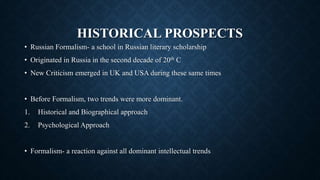
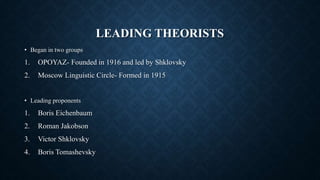

Russian Formalism emerged in the early 20th century as a reaction against previous historical, biographical, and psychological approaches to literary study. It emphasized close analysis of the formal literary elements and devices within a text over external concerns. Major Russian Formalist theorists included Victor Shklovsky, Boris Eichenbaum, and Roman Jakobson. They viewed literature as a system made up of autonomous components that make familiar things strange through defamiliarization. By the late 1920s, Russian Formalism declined due to outside pressure and doubts about its purely formal approach.


