FORMALISM

PRESENTED TO:
BY:
ROLL NO:

MAM QAMAR KHUSHI
FARIHA ASGHAR RAO
01
What is formalism?
• In literary theory, formalism refers to
critical approaches that analyze, interpret,
or evaluate the inherent features of a text.
These features include not only grammar
and syntax but also literary devices such
as meter and figures of speech. The
formalist
approach
reduces
the
importance
of
a
text’s
historical,
biographical, and cultural context.
Historical prospects
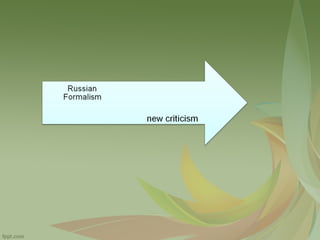
There is no one school of Formalism, and the term groups together
a number of different approaches to literature, many of which
seriously diverge from one another.
Formalism was the dominant mode of academic literary study in the
United States and United Kingdom from the end of the Second
World War through the 1970s,and particularly the Formalism of the
"New Critics," including I. A. Richards, John Crowe Ransom and T.S
Eliot. On the European continent, Formalism emerged primarily and
particularly out of the work of Roman Jacobson, Boris Eichenbaum,
and Viktor Shklovsky. Although the theories of Roman Jacobson
and New Criticism are similar in a number of respects, the two
schools largely developed in isolation from one another, and should
not be considered identical. In reality, even many of the theories
proposed by critics working within their respective schools often
diverged from one another.
• Formalism has advantage of forcing
writers to evaluate a work on its own terms
rather to rely on “accepted” notions of
writer work.
• Focus on Form, organization, structure,
Word choice, multiple language.
• Russian Formalists were interested in the
analysis of the text but their main concern
was with method as the scientific basis for
literary theory. There was thus a shift
away from the moral approach to literature
towards a scientific approach.
Basic Assumptions
•

•
•
•
•

Scientific approach focused on ‘literariness’
which can be found on the level of Form rather
than Content.
Art as a device of Defamiliarization .
A text is the sum total of its devices.
Aesthetics of deviation .
Literature has its own history, a history of
innovation in formal structures, and is not
determined by external, material history.
Practical languagepoetic language
• Practical language is used for the act of
communication

• Poetic language or literary language has
no practical function at all ,it is impractical.
Poetic language
• In a work of art, meaning of words are
violated by the artist. They do not convey
what they convey ordinarily in
communication.
‘CONTROLLED VIOLENCE’
The poet exercises a controlled violence in
in poetic language. It refers to the violence
which is constructive ,having a definite
goal.
It is a
process by which an artist
transforms one thing into something to
reach his goal.
• Viktor Shkolvsky’s critical writing was the
most prominent work of Russian
Formalism. His aim was to define the
techniques of art which writers employed
to produce specific effects. One of his
most attractive concepts was the notion of
Defamiliarization.
What is Defamiliarization?

• Defamiliarization
is the artistic
technique of presenting to audiences
common things in an unfamiliar or
strange way, in order to enhance
perception of the familiar.
for example
looking at the clouds as
a playground for angels
a bearer of tears 
or the heaven and earth divide
opposed to a simple cloud to warn us that
rain is on its way.
• seeing an object in a totally different light
is ‘Defamiliarization’
• In other words;
‘ to view an object and unravel its
layers and uses’.
Why Defamiliarization?
• Undoubtedly, the main reason for
‘defamiliarizing’ objects is to gain an
appreciation for the environment – to see
and appreciate what others don’t. By
seeing and appreciating what others don’t
makes the writer ‘creative’, perhaps even
‘original’, but more importantly makes his
readers say, “I never looked at it that way
before.”
Goal of Defamiliarization
Whether an object is rendered unfamiliar by
• the kind of language used,
• the unique portrayal of characters in the story,
• or how a particular event is illustrated,
the goal of Defamiliarization is to make the
object strange and unfamiliar so that the piece is
transformed from ordinary prose to extraordinary
art
• . An example of this is T.S. Eliot's use of Greek,
Latin, German and other languages in The
Wasteland, which forces the reader to become a
more active participant in the process by having
to make an extra effort to decode the strange
and exotic words in order to understand the
poem. One is never allowed to fall into a
comfortable lull and be a passive listener/reader
when dealing with T.S. Elliot.
Examples
• Gulliver’s travels
• Wordsworthian poetry(Daffodils,The world
is too much us,To the Cuckoo,etc)
• Keatsian Odes
• Sylvia Plath’s ‘Daddy’
Defamiliarization and Metaphors
• A Metaphor is a literary figure of speech
for comparative, visual or associative
purposes
• . The very nature of a metaphor (saying
something is something else) is reflective
of the ‘Defamiliarization’ approach. The
two are uncannily similar in certain ways.

Formalism presentation

  • 1.
    FORMALISM PRESENTED TO: BY: ROLL NO: MAMQAMAR KHUSHI FARIHA ASGHAR RAO 01
  • 2.
    What is formalism? •In literary theory, formalism refers to critical approaches that analyze, interpret, or evaluate the inherent features of a text. These features include not only grammar and syntax but also literary devices such as meter and figures of speech. The formalist approach reduces the importance of a text’s historical, biographical, and cultural context.
  • 3.
    Historical prospects There isno one school of Formalism, and the term groups together a number of different approaches to literature, many of which seriously diverge from one another. Formalism was the dominant mode of academic literary study in the United States and United Kingdom from the end of the Second World War through the 1970s,and particularly the Formalism of the "New Critics," including I. A. Richards, John Crowe Ransom and T.S Eliot. On the European continent, Formalism emerged primarily and particularly out of the work of Roman Jacobson, Boris Eichenbaum, and Viktor Shklovsky. Although the theories of Roman Jacobson and New Criticism are similar in a number of respects, the two schools largely developed in isolation from one another, and should not be considered identical. In reality, even many of the theories proposed by critics working within their respective schools often diverged from one another.
  • 5.
    • Formalism hasadvantage of forcing writers to evaluate a work on its own terms rather to rely on “accepted” notions of writer work. • Focus on Form, organization, structure, Word choice, multiple language.
  • 6.
    • Russian Formalistswere interested in the analysis of the text but their main concern was with method as the scientific basis for literary theory. There was thus a shift away from the moral approach to literature towards a scientific approach.
  • 7.
    Basic Assumptions • • • • • Scientific approachfocused on ‘literariness’ which can be found on the level of Form rather than Content. Art as a device of Defamiliarization . A text is the sum total of its devices. Aesthetics of deviation . Literature has its own history, a history of innovation in formal structures, and is not determined by external, material history.
  • 8.
    Practical languagepoetic language •Practical language is used for the act of communication • Poetic language or literary language has no practical function at all ,it is impractical.
  • 9.
    Poetic language • Ina work of art, meaning of words are violated by the artist. They do not convey what they convey ordinarily in communication.
  • 10.
    ‘CONTROLLED VIOLENCE’ The poetexercises a controlled violence in in poetic language. It refers to the violence which is constructive ,having a definite goal. It is a process by which an artist transforms one thing into something to reach his goal.
  • 11.
    • Viktor Shkolvsky’scritical writing was the most prominent work of Russian Formalism. His aim was to define the techniques of art which writers employed to produce specific effects. One of his most attractive concepts was the notion of Defamiliarization.
  • 12.
    What is Defamiliarization? •Defamiliarization is the artistic technique of presenting to audiences common things in an unfamiliar or strange way, in order to enhance perception of the familiar.
  • 13.
    for example looking atthe clouds as a playground for angels a bearer of tears or the heaven and earth divide opposed to a simple cloud to warn us that rain is on its way.
  • 14.
    • seeing anobject in a totally different light is ‘Defamiliarization’ • In other words; ‘ to view an object and unravel its layers and uses’.
  • 15.
    Why Defamiliarization? • Undoubtedly,the main reason for ‘defamiliarizing’ objects is to gain an appreciation for the environment – to see and appreciate what others don’t. By seeing and appreciating what others don’t makes the writer ‘creative’, perhaps even ‘original’, but more importantly makes his readers say, “I never looked at it that way before.”
  • 16.
    Goal of Defamiliarization Whetheran object is rendered unfamiliar by • the kind of language used, • the unique portrayal of characters in the story, • or how a particular event is illustrated, the goal of Defamiliarization is to make the object strange and unfamiliar so that the piece is transformed from ordinary prose to extraordinary art
  • 17.
    • . Anexample of this is T.S. Eliot's use of Greek, Latin, German and other languages in The Wasteland, which forces the reader to become a more active participant in the process by having to make an extra effort to decode the strange and exotic words in order to understand the poem. One is never allowed to fall into a comfortable lull and be a passive listener/reader when dealing with T.S. Elliot.
  • 18.
    Examples • Gulliver’s travels •Wordsworthian poetry(Daffodils,The world is too much us,To the Cuckoo,etc) • Keatsian Odes • Sylvia Plath’s ‘Daddy’
  • 19.
    Defamiliarization and Metaphors •A Metaphor is a literary figure of speech for comparative, visual or associative purposes • . The very nature of a metaphor (saying something is something else) is reflective of the ‘Defamiliarization’ approach. The two are uncannily similar in certain ways.