Formalism
Baya BENSALAH bensalah30@gmail.com
Text
Russian
A school of literary criticism
that emerged in Russia
around 1915,
Founders
of
Russian Formalism
Viktor Shklovsky
Boris Eichenbaum
Roman Jakobson
Vladimir Propp
Yuri Tynianov
Understand
artworks!
The focus is on form,
not content,
on language, not on
Exophora (biography, culture,
history, religion… )
"Literary works […] resemble
machines: they are the result
of an intentional human
activity in which a specific skill
transforms raw material into a
complex mechanism suitable
for a particular purpose"
(Steiner, "Russian Formalism" 18)
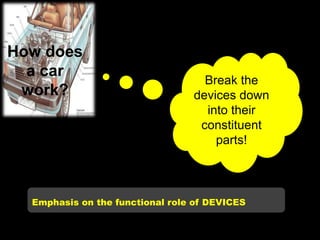
Emphasis on the functional role of DEVICES
How does
a car
work?
Break the
devices down
into their
constituent
parts!
A text is made
up of devices
Similarly…
Stylistic devices…
Literary devices…
Narrative devices…
1.Formalism's Technical terms
Fabula (Story) vs. Syuzhet (Plot)
Practical and Poetic Language,
Literature and Literariness.
Foregrounding vs. Backgrounding
Fabula
(Story)
VS.
Syuzhet (Presentation,
Plot)
Fabula (Story) :
What is the text about?
What happens?
Fight Club (1999)
An example
“is about a guy (Edward Norton) who invents an
alternate persona, Tyler Durden (Brad Pitt), in
order to give himself the courage to break out of
his mundane white collar existence.”
Fabula (Story)
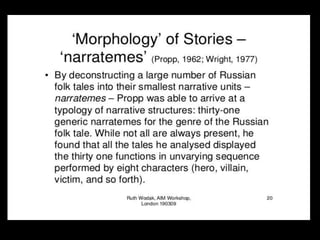
MORPHOLOGY OF THE FOLK TALE
(Propp) [1]
Syuzhet (Presentation, Plot):
How is the text arranged?
How is the story told?
“The narrative begins at its climax, which is
interrupted, and only then proceeds to the
story’s chronological beginning. From that
point on, the film contains a mix of
chronologically-ordered scenes and bits of
narrative exposition that allow us, ultimately,
to return to and understand the climax, which
is then resolved in the final minutes of the
movie. Furthermore, the narration conceals
from us for most of the film’s running time the
fact that Tyler Durden is the psychological
creation of the nameless
narrator/protagonist.”
Syuzhet (Plot)
A classic text, commonly viewed as
one fountainhead of Narratology is:
Vladimir Propp’s
Morphology of the Folktale [1]
The discipline concerned with
Fabula (Story) and Syuzhet (Plot) is
called Narratology
Narrative devices…
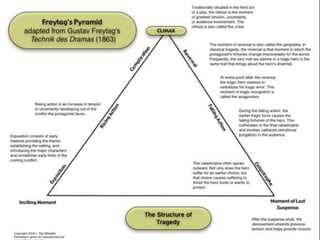
Narrative Structure
(The thirty-one functions of the Narratemes
Narrative Point of view [2]
(First/Third/Second person narrators…etc)
Characterization
(The Functions of Eight Dramatis Personae: the he
Narrative Structure
An example
Practical
and Poetic
Language
“Poetic speech is framed speech.
Prose is ordinary speech –
economical, easy, proper, the
goddess of prose [dea prosae] is
a goddess of the accurate, facile
type, of the “direct” expression of
a child” (Shklovsky 20).
Poetic Language is
“a difficult, roughened, impeded
language.”
This distinction between Poetic language and
Practical language is introduced by Shklovsky
and applies to all artistic forms.
It is basically what makes…
“Artfulness” of Art
and
“LITERARINESS” of
Literature
“The literariness or artfulness of a work of
literature, that which makes it an
aesthetic object, resides entirely in its
devices, which should also form the sole
object of literary studies. The aesthetic
value or purpose of art, embodied in the
devices, consists in creating in readers or
viewers a heightened awareness, making
them see things anew “
(Coleridge’s Freshness Of Sensation, Ezra Pound’s
Making It New).
Making It New
In Shklovsky’s terms, it is…
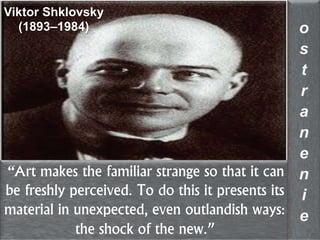
“Art makes the familiar strange so that it can
be freshly perceived. To do this it presents its
material in unexpected, even outlandish ways:
the shock of the new.”
o
s
t
r
a
n
e
n
i
e
Viktor Shklovsky
(1893–1984)
“And so, held accountable for nothing,
life fades into nothingness.
Automatization eats away at things, at
clothes, at furniture, at our wives, and at
our fear of war. [...] And so, in order to
return sensation to our limbs, in order
to make us feel objects, to make a stone
feel stony, man has been given the tool
of art.”
The purpose of art, then, is to lead us
to a knowledge of a thing through
the organ of sight instead of
recognition. By “enstranging” objects
and complicating form, the device of
art makes perception long and
“laborious.” The perceptual process
in art has a purpose all its own and
ought to be extended to its fullest.”
(5–6)
To make the familiar
strange…
[the shock of the new]
is…
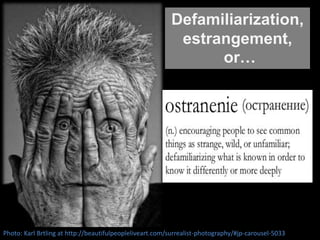
Defamiliarization,
estrangement,
or…
Photo: Karl Brtling at http://beautifulpeopleliveart.com/surrealist-photography/#jp-carousel-5033
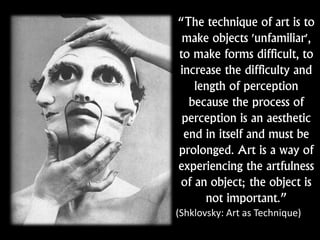
“The technique of art is to
make objects 'unfamiliar',
to make forms difficult, to
increase the difficulty and
length of perception
because the process of
perception is an aesthetic
end in itself and must be
prolonged. Art is a way of
experiencing the artfulness
of an object; the object is
not important.”
(Shklovsky: Art as Technique)
“Art exists that one may recover the
sensation of life, it exists to make one feel
things, to make the stone stoney .” (Shklovsky: Art as
Technique)
)
How is
Defamiliarization
achieved
in a text?
It is achieved through foregrounding…
“Foregrounding”
Vs.
“Backgrounding”
“the throwing into relief’ of the linguistic sign against
the background of the norms of ordinary language.”
(Wales 2001: 157) [3]
Devices used to
Foreground:
1.Unusual/Unreliable Narrators
• A Horse in Tolstoy's Kholstomer;
• A deranged person in Poe’s The
Tell-Tale Heart”
• A mentally retarded in Faulkner’s
The Sound and The Fury
2. Language:
• Neologism,
• Compounding,
• Peculiar syntactic constructions (too
simplistic, or too complex…)
• Absence or lack of punctuation,
3. Vulgarity of expressions:
(e.g., The stylistic shift between the
obscene and the sublime in Pushkin’s
'The Waggon of Life,)
4. Disrupted Narratives
(e.g., use of Stream of consciousness
Technique, Interior monologue (Woolf,
Joyce, Faulkner …)
5. Unconventional beginnings
and finals:
(e.g., Medias res, Ultimas res,
Cliffhangers…)[Note1]
[1] Vladimir Propp (1928) Morphology of the Folktale, trans. Laurence Scott, revised Louis A.
Wagner (Austin: University of Texas Press 1968).
[2] Roland Barthes, "Introduction à l’analyse structurale des récits" (1966 Introduction to the
Structural Analysis of Narrative, "Image—Music—Text, ed. and trans. Stephen Heath, 1977)
[3] Wales, K. (2001), Dictionary of Stylistics (2nd ed.) Harlow, Essex: Pearson Education Ltd.
References
[N1] Cliffhangers is an abrupt finale that does not really complete the plot and
often leaves the main characters in a precarious or difficult situation, e.g.,
Raymond Carver collection Short Cuts (1993) “Neighbors”; “Vitamins”;
“Will You Please Be Quiet Please?”
In medias res, the point of attack (the beginning of the story) is set close to the
climax of the action; in ultimas res, it occurs after the climax and near the end
(See Manfred. J 2003).

Russian formalism

  • 1.
  • 2.
    A school ofliterary criticism that emerged in Russia around 1915,
  • 3.
  • 4.
    Viktor Shklovsky Boris Eichenbaum RomanJakobson Vladimir Propp Yuri Tynianov Understand artworks!
  • 5.
    The focus ison form, not content, on language, not on Exophora (biography, culture, history, religion… )
  • 6.
    "Literary works […]resemble machines: they are the result of an intentional human activity in which a specific skill transforms raw material into a complex mechanism suitable for a particular purpose" (Steiner, "Russian Formalism" 18)
  • 7.
    Emphasis on thefunctional role of DEVICES How does a car work? Break the devices down into their constituent parts!
  • 8.
    A text ismade up of devices Similarly… Stylistic devices… Literary devices… Narrative devices…
  • 9.
    1.Formalism's Technical terms Fabula(Story) vs. Syuzhet (Plot) Practical and Poetic Language, Literature and Literariness. Foregrounding vs. Backgrounding
  • 10.
  • 11.
    Fabula (Story) : Whatis the text about? What happens?
  • 12.
  • 13.
    “is about aguy (Edward Norton) who invents an alternate persona, Tyler Durden (Brad Pitt), in order to give himself the courage to break out of his mundane white collar existence.” Fabula (Story)
  • 14.
    MORPHOLOGY OF THEFOLK TALE (Propp) [1] Syuzhet (Presentation, Plot): How is the text arranged? How is the story told?
  • 15.
    “The narrative beginsat its climax, which is interrupted, and only then proceeds to the story’s chronological beginning. From that point on, the film contains a mix of chronologically-ordered scenes and bits of narrative exposition that allow us, ultimately, to return to and understand the climax, which is then resolved in the final minutes of the movie. Furthermore, the narration conceals from us for most of the film’s running time the fact that Tyler Durden is the psychological creation of the nameless narrator/protagonist.” Syuzhet (Plot)
  • 16.
    A classic text,commonly viewed as one fountainhead of Narratology is: Vladimir Propp’s Morphology of the Folktale [1] The discipline concerned with Fabula (Story) and Syuzhet (Plot) is called Narratology
  • 18.
    Narrative devices… Narrative Structure (Thethirty-one functions of the Narratemes Narrative Point of view [2] (First/Third/Second person narrators…etc) Characterization (The Functions of Eight Dramatis Personae: the he
  • 19.
  • 21.
  • 22.
    “Poetic speech isframed speech. Prose is ordinary speech – economical, easy, proper, the goddess of prose [dea prosae] is a goddess of the accurate, facile type, of the “direct” expression of a child” (Shklovsky 20).
  • 23.
    Poetic Language is “adifficult, roughened, impeded language.” This distinction between Poetic language and Practical language is introduced by Shklovsky and applies to all artistic forms. It is basically what makes…
  • 24.
  • 25.
    “The literariness orartfulness of a work of literature, that which makes it an aesthetic object, resides entirely in its devices, which should also form the sole object of literary studies. The aesthetic value or purpose of art, embodied in the devices, consists in creating in readers or viewers a heightened awareness, making them see things anew “ (Coleridge’s Freshness Of Sensation, Ezra Pound’s Making It New).
  • 26.
    Making It New InShklovsky’s terms, it is…
  • 27.
    “Art makes thefamiliar strange so that it can be freshly perceived. To do this it presents its material in unexpected, even outlandish ways: the shock of the new.” o s t r a n e n i e Viktor Shklovsky (1893–1984)
  • 28.
    “And so, heldaccountable for nothing, life fades into nothingness. Automatization eats away at things, at clothes, at furniture, at our wives, and at our fear of war. [...] And so, in order to return sensation to our limbs, in order to make us feel objects, to make a stone feel stony, man has been given the tool of art.”
  • 29.
    The purpose ofart, then, is to lead us to a knowledge of a thing through the organ of sight instead of recognition. By “enstranging” objects and complicating form, the device of art makes perception long and “laborious.” The perceptual process in art has a purpose all its own and ought to be extended to its fullest.” (5–6)
  • 30.
    To make thefamiliar strange… [the shock of the new] is…
  • 31.
    Defamiliarization, estrangement, or… Photo: Karl Brtlingat http://beautifulpeopleliveart.com/surrealist-photography/#jp-carousel-5033
  • 32.
    “The technique ofart is to make objects 'unfamiliar', to make forms difficult, to increase the difficulty and length of perception because the process of perception is an aesthetic end in itself and must be prolonged. Art is a way of experiencing the artfulness of an object; the object is not important.” (Shklovsky: Art as Technique)
  • 33.
    “Art exists thatone may recover the sensation of life, it exists to make one feel things, to make the stone stoney .” (Shklovsky: Art as Technique) )
  • 34.
    How is Defamiliarization achieved in atext? It is achieved through foregrounding…
  • 35.
  • 36.
    “the throwing intorelief’ of the linguistic sign against the background of the norms of ordinary language.” (Wales 2001: 157) [3]
  • 37.
  • 38.
    1.Unusual/Unreliable Narrators • AHorse in Tolstoy's Kholstomer; • A deranged person in Poe’s The Tell-Tale Heart” • A mentally retarded in Faulkner’s The Sound and The Fury
  • 39.
    2. Language: • Neologism, •Compounding, • Peculiar syntactic constructions (too simplistic, or too complex…) • Absence or lack of punctuation,
  • 40.
    3. Vulgarity ofexpressions: (e.g., The stylistic shift between the obscene and the sublime in Pushkin’s 'The Waggon of Life,)
  • 41.
    4. Disrupted Narratives (e.g.,use of Stream of consciousness Technique, Interior monologue (Woolf, Joyce, Faulkner …)
  • 42.
    5. Unconventional beginnings andfinals: (e.g., Medias res, Ultimas res, Cliffhangers…)[Note1]
  • 43.
    [1] Vladimir Propp(1928) Morphology of the Folktale, trans. Laurence Scott, revised Louis A. Wagner (Austin: University of Texas Press 1968). [2] Roland Barthes, "Introduction à l’analyse structurale des récits" (1966 Introduction to the Structural Analysis of Narrative, "Image—Music—Text, ed. and trans. Stephen Heath, 1977) [3] Wales, K. (2001), Dictionary of Stylistics (2nd ed.) Harlow, Essex: Pearson Education Ltd. References [N1] Cliffhangers is an abrupt finale that does not really complete the plot and often leaves the main characters in a precarious or difficult situation, e.g., Raymond Carver collection Short Cuts (1993) “Neighbors”; “Vitamins”; “Will You Please Be Quiet Please?” In medias res, the point of attack (the beginning of the story) is set close to the climax of the action; in ultimas res, it occurs after the climax and near the end (See Manfred. J 2003).