• New Criticism era ( 1940 – 1960)
• It appeared as a reaction toward
Biographical and Traditional
Historical criticism, which
was focused on extra-text
materials, such as the biography of
the author.
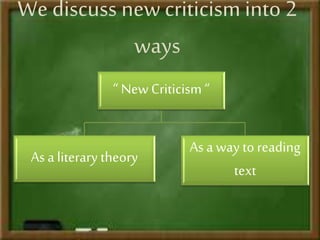
We discuss new criticism into 2 ways
“ New Criticism “
As a literary theory
As a way to
reading text
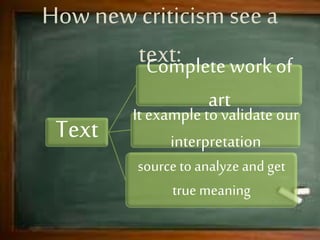
How new criticism see a text ?
Text
Complete work of art
Its example to validate our
interpretation
source to analyze and get
true meaning
What New Critics try to avoid ?
Intentional fallacy, term used in 20th-century literary
criticism to describe the problem inherent in trying to
judge a work of art by assuming the intent or purpose
of the artist who created it.
Affective fallacy, according to the followers of New
Criticism, the misconception that arises from judging
a poem by the emotional effect that it produces in
the reader. The concept of affective fallacy is a direct
attack on impressionistic criticism, which argues that
the reader’s response to a poem is the ultimate
indication of its value.
” Close reading “
The only way we can know if a given
author’s intention or a given reader’s
interpretation which actually represent
the true meaning is by carefully
examine
• For NC, the complexity of a text is created
by the multiple and often conflicting
meaning in it.
• These meaning are a product primarily of
four kinds of linguistic devices :
- paradox -ambiguity - irony- tension
Ambiguity
• It occurs when a word, image, or event
generates two or more different meaning.
# e.g. :
"Thanks for dinner. I’ve never seen
potatoes cooked like that before."
(Jonah Baldwin in the film Sleepless in
Seattle, 1993)
Paradox
• It typically arise from false assumptions,
which then lead to inconsistencies
between observed and expected
behavior.
# e.g. : "Someday you will be old enough
to start reading fairy tales again."
(C.S. Lewis to his godchild, Lucy Barfield, to
whom he dedicated The Lion, the Witch
and the Wardrobe)
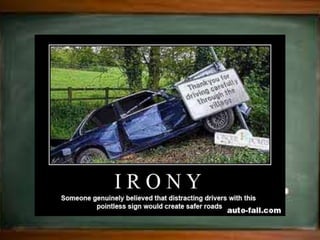
Irony
• a figure of speech in which words are used in
such a way that their intended meaning is
different from the actual meaning of the words.
# e.g. :
Once in the winter the rector would come to
dine , and her husband would beg her to go
over the list and see that no devorcees were
included, except those who had showed signs
of penitence by being remarried to very
wealthy ( Edirth Wharton’s House of Mirth
(1950)
Tension
a state of mental or emotional strain or
suspense or when there is suspense in the
story
How can New
Criticism help us
understand the text ?
• New Criticism is a powerful tool for those
of us that have problems understanding a
work of literature.
• NC formulated a method of reading, a
simple formula that will help us unlock the
meaning of a text
How do we discover
or unlock that
meaning ?
By following these (simple formula)
• Who is speaking in the text ?
( not the author, not the poet, whoever/whatever
created the text but it is created by the text itself.)
• Who is being spoken to? or
• Who is the addressee? or
• Who is the implied reader of the text?
• Where is the setting ? When it is ?
• What is the central metaphors of the text ?
The importance of metaphor in a
lit. text
• New Critics pointed out is that a text is not only
about what is seems to be talking about, it is
always something else.
# There is always something other than the literal
meaning of the text.
• Metaphors is what makes lit. language different from
the ordinary language
Those are called Formal Elements of
a text
Image, symbols, metaphors, rhyme,
meter, point of view, setting,
characterization & plot
Sometimes New Critics did believe that
the text warranted a discussion of its
psychological, sociological, or
philosophical elements because those
elements were obviously integral to the
work’s characterization or plot.
Other meanings of the word found in
Webster’s New Universal Unabridged
Dictionary include “crude” or “vulgar,” “a
quarrelsome woman,” and “a threatening
beggar.”
• Although most words can be found to have
more than one dictionary definition, a word’s
ambiguity is determined not by the dictionary
but by the context of the poem as a whole, in
terms of which alone the word’s meaning or
meanings must be judged.
THE SUMMARY
• New Critics also called their approach
objective criticism because their focus on
each text’s own formal element ensured,
they claimed, that each text —each object
being interpreted —would itself dictate
how it would be interpreted.
• For of Clifton’s poem illustrates, New Criticism
asked us to look closely at the formal elements
of the text to help us discover the poem’s theme
and to explain the ways in which those formal
elements establish it.
• New Critics believed they allowed the literary
work itself to provide the context within which
we interpret and evaluate it.
Source :
Lois Tyson- Critical Theory Today ( text book)
http://grammar.about.com/od/pq/g/paradoxterm.htm
http://www.britannica.com/search?query=paradox
http://web.calstatela.edu/faculty/jgarret/441/handout-
newcriticism.pdf
https://www.youtube.com/watch?v=hketJPkhbDI

New criticism

  • 2.
    • New Criticismera ( 1940 – 1960) • It appeared as a reaction toward Biographical and Traditional Historical criticism, which was focused on extra-text materials, such as the biography of the author.
  • 3.
    We discuss newcriticism into 2 ways “ New Criticism “ As a literary theory As a way to reading text
  • 4.
    How new criticismsee a text ? Text Complete work of art Its example to validate our interpretation source to analyze and get true meaning
  • 5.
    What New Criticstry to avoid ?
  • 6.
    Intentional fallacy, termused in 20th-century literary criticism to describe the problem inherent in trying to judge a work of art by assuming the intent or purpose of the artist who created it. Affective fallacy, according to the followers of New Criticism, the misconception that arises from judging a poem by the emotional effect that it produces in the reader. The concept of affective fallacy is a direct attack on impressionistic criticism, which argues that the reader’s response to a poem is the ultimate indication of its value.
  • 7.
    ” Close reading“ The only way we can know if a given author’s intention or a given reader’s interpretation which actually represent the true meaning is by carefully examine
  • 8.
    • For NC,the complexity of a text is created by the multiple and often conflicting meaning in it. • These meaning are a product primarily of four kinds of linguistic devices : - paradox -ambiguity - irony- tension
  • 9.
    Ambiguity • It occurswhen a word, image, or event generates two or more different meaning. # e.g. : "Thanks for dinner. I’ve never seen potatoes cooked like that before." (Jonah Baldwin in the film Sleepless in Seattle, 1993)
  • 10.
    Paradox • It typicallyarise from false assumptions, which then lead to inconsistencies between observed and expected behavior. # e.g. : "Someday you will be old enough to start reading fairy tales again." (C.S. Lewis to his godchild, Lucy Barfield, to whom he dedicated The Lion, the Witch and the Wardrobe)
  • 11.
    Irony • a figureof speech in which words are used in such a way that their intended meaning is different from the actual meaning of the words. # e.g. : Once in the winter the rector would come to dine , and her husband would beg her to go over the list and see that no devorcees were included, except those who had showed signs of penitence by being remarried to very wealthy ( Edirth Wharton’s House of Mirth (1950)
  • 13.
    Tension a state ofmental or emotional strain or suspense or when there is suspense in the story
  • 14.
    How can New Criticismhelp us understand the text ?
  • 15.
    • New Criticismis a powerful tool for those of us that have problems understanding a work of literature. • NC formulated a method of reading, a simple formula that will help us unlock the meaning of a text
  • 16.
    How do wediscover or unlock that meaning ?
  • 17.
    By following these(simple formula) • Who is speaking in the text ? ( not the author, not the poet, whoever/whatever created the text but it is created by the text itself.) • Who is being spoken to? or • Who is the addressee? or • Who is the implied reader of the text? • Where is the setting ? When it is ? • What is the central metaphors of the text ?
  • 18.
    The importance ofmetaphor in a lit. text • New Critics pointed out is that a text is not only about what is seems to be talking about, it is always something else. # There is always something other than the literal meaning of the text. • Metaphors is what makes lit. language different from the ordinary language
  • 19.
    Those are calledFormal Elements of a text Image, symbols, metaphors, rhyme, meter, point of view, setting, characterization & plot
  • 20.
    Sometimes New Criticsdid believe that the text warranted a discussion of its psychological, sociological, or philosophical elements because those elements were obviously integral to the work’s characterization or plot.
  • 21.
    Other meanings ofthe word found in Webster’s New Universal Unabridged Dictionary include “crude” or “vulgar,” “a quarrelsome woman,” and “a threatening beggar.” • Although most words can be found to have more than one dictionary definition, a word’s ambiguity is determined not by the dictionary but by the context of the poem as a whole, in terms of which alone the word’s meaning or meanings must be judged.
  • 22.
  • 23.
    • New Criticsalso called their approach objective criticism because their focus on each text’s own formal element ensured, they claimed, that each text —each object being interpreted —would itself dictate how it would be interpreted.
  • 24.
    • For ofClifton’s poem illustrates, New Criticism asked us to look closely at the formal elements of the text to help us discover the poem’s theme and to explain the ways in which those formal elements establish it. • New Critics believed they allowed the literary work itself to provide the context within which we interpret and evaluate it.
  • 25.
    Source : Lois Tyson-Critical Theory Today ( text book) http://grammar.about.com/od/pq/g/paradoxterm.htm http://www.britannica.com/search?query=paradox http://web.calstatela.edu/faculty/jgarret/441/handout- newcriticism.pdf https://www.youtube.com/watch?v=hketJPkhbDI