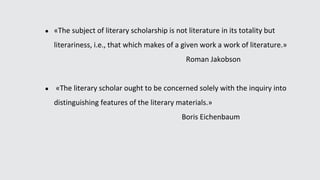
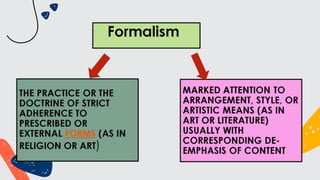
Russian Formalism was a movement in literary criticism and interpretation that emerged in Russia in the early 20th century. It was championed by philologists and literary historians who sought to move beyond psychologism and biographism in literary scholarship. The Russian Formalists analyzed the internal linguistic and structural features of literary works, rather than their content or context. They asserted that these formal elements comprise the "literariness" of a text. Though suppressed by the Soviet government in the 1930s, Russian Formalism influenced later movements like American New Criticism and theorists like Barthes, de Man, Kristeva and Jameson.