Criticism of
I. A. Richards
Prepared by Irshad Hussein
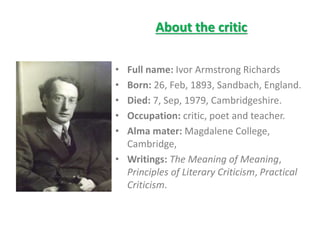
About the critic
• Full name: Ivor Armstrong Richards
• Born: 26, Feb, 1893, Sandbach, England.
• Died: 7, Sep, 1979, Cambridgeshire.
• Occupation: critic, poet and teacher.
• Alma mater: Magdalene College,
Cambridge,
• Writings: The Meaning of Meaning,
Principles of Literary Criticism, Practical
Criticism.
About the Critic
• I.A. Richards influenced both sides of the Atlantic(Europe and America)
with his valuable works in literature.
• He is considered one of the pioneers of New Criticism.
• As an iconoclast he denounced the old criticism where critics were supposed
to follow a set of rules and regulations.
• According to him Criticism is not mere application of set of rules and
intuition.
• He is widely read not only in literature but also in philosophy, psychology,
aesthetics, the fine arts and the broad principles of the various sciences.
• Some critics think, Coleridge is the only great critic with whom he may be
compared.
Works
• The Meaning of Meaning 1923
• The Principle of Literary Criticism 1924
• The Practical Criticism, 1929
• Science and Poetry
• Coleridge on Imagination
• Mencius of the Mind
• The Philosophy of Rhetoric
• Speculative Instruments
Techniques and Principles
• I.A. Richards was a devoted supporter of a close textual and verbal
study and analysis of a work of art.
• His approach is pragmatic and empirical.
• His work is a milestone in the history of literary criticism regarding
verbal and textual analysis, interpretation and evaluation.
• By his own work Richards has made literary criticism factual,
scientific and complete.
Techniques and Principles
• While preparing his book The Practical Criticism, he says “I have set
three aims before me in constructing this book”,
1. “to introduce a new kind of documentation to those who are
interested in the contemporary state culture whether as critics, as
philosophers, as teachers, as psychologists, or merely as curious
persons.”
2. “to provide a new technique for those who wish to discover for
themselves what they think and feel about poetry, and why should
like or dislike it.”
3. “to prepare way for educational methods more efficient than those
who use now in developing discrimination and the power to
understand what we hear and read.”
Qualities of a Critic
• He should grasp a strong control over words and the effect
they produce.
• He should be a learned person and be able to distinguish
experiences from one another.
• He must be a sound judge of values and have an adequate
knowledge of psychology.
• He should focus the implicit meaning through the window of
explicit wordings.
• The critic is expected to understand and expand the context
of a poem so that the poem may become intelligible and its
full value may be grasped.
Textual Analysis
• He says; a poet writes to communicate, and language
is the means of that communication. Language is made
of words, and hence a study of words is all important if
we are to understand the meaning of a work of art.
• Words carry four kinds of meaning, or to be more
precise, the total meaning of a word depends upon four
factors. These are
• Sense
• Feelings
• Tone
• Intention
Textual analysis
1. Sense; something that is communicated by the plain literal meanings
of the words.
2. Feelings; When we say something, we have a feeling about it,
“emotions, attitudes, will, desire, pleasure , unpleased and the rest.”
Words express “these feelings, these nuances of interest.”
3. Tone ; the writers attitude to his readers which is a relation between
them. The writer chooses his words and arranges them keeping in
mind the kind of readers likely to read his work.
4. Intention: it has an object, it is the writer’s aim which may be
conscious or unconscious. It refer to the emphasis, shapes the
arrangement , or draws attention to something of importance.
The Context
• The context in which a word has been used is all important.
Words have different meanings in different contexts.
• “a context is a set of entities(things/ events) related in a
certain way..”
• Words are symbols or signs and they deliver their full
meaning only in a particular context.
• Meaning is dependent on context , but the context may not
always be apparent and easily perceptible.
• Literary compositions are characterized by rich complexity in
which certain links are suppressed for concentration of
effective and forceful expression.
The context
• Sense and feeling have a mutual dependence. “The
sound of a word has much to do with the feeling it
evokes”.
1. the feeling may arise from the meaning and be
governed by it.
2. The meaning arises from the feelings evoked.
3. Sense and feeling may be related because of the
context.
• A complete poem influences a single word or phrase
contained in it either through the feelings or through
the sense.
• Hence Richards argues we need one careful reading to
find the meaning and another to grasp feeling.
Rhythm and Metre
• Rhythm results from the repetition of particular
sounds, and the expectancy this repetition arouses
in the mind.
• Metre is a specialized form of rhythm. It is rhythm
made, more regular and cast into set, and well
formed pattern. Both rhythm and metre are organic
and integral parts of a poem.
• They both determine the meaning of the words
used by the poets.
The value of Metaphor
• A metaphor is a shift, a carrying over of a word
from its normal use to a new use.
1. Sense-metaphors
2. Emotive-metaphors
• “Metaphor is a semi-surreptitious method by
which a greater variety of elements can be
brought into the fabric of the experience.”
• The metaphorical meaning arises from the inter-
relations of sense, tone, feeling and intention.
Poetic Truth
• Poetic Truth is different from scientific truth.
• It is a matter of emotional belief rather than
intellectual belief.
• It is not a matter of verification, but of attitudes
and emotional reaction.
• “it is evident that the bulk of poetry consists of
statement which only the very foolish would think
of attempting to verify. They are not the kind of
things which can be verified.”
New & Practical Criticism
• After WW-1 there emerged an Anglo-American literary critical
theory that insisted on the intrinsic value of a work of art and
focused attention on the individual work alone as an
independent unit of meaning.
• It was opposed to the critical practice of bringing historical or
biographical data to bear on the interpretation of a work.
• New Critics would usually pay relatively little attention to the
historical setting of the works which they analyzed, treating
literature as a sphere of activity of its own.
New & Practical Criticism
• Practical Criticism began in 1920’s with a series of experiments by
the Cambridge critic I.A. Richards.
• He gave poems to his students for interpretation without any
information about the poet, its title or when they were written.
• In the Practical Criticism, published in 1929, he mentioned the
results of his experiments.
• The objective of his work was to encourage students to
concentrate on 'the words on the page', rather than relying on
preconceived or received beliefs about a text.
New & Practical Criticism
• Early important works in the tradition were those of the English
critics
 I.A. Richards (Practical Criticism, 1929) and
 William Empson (Seven Types of Ambiguity, 1930)
 T.S. Eliot with his critical essays “Tradition and the Individual Talent”
(1917) and “Hamlet and His Problems” (1919).
Note:
• The movement did not have a name, however, until the appearance
of John Crowe Ransom’s The New Criticism (1941), a work that
loosely organized the principles of this basically linguistic approach
to literature.
Psychological Approach
• As a student of psychology, Richards says that poetry performs a healing
function by organizing a variety of human impulses.
• Art is a means whereby we can gain emotional balance, mental
equilibrium, peace, and rest. And it enables human mind to organize
itself.
• A society in which arts are freely cultivated, exhibits better mental and
emotional calmness than the societies in which arts not valued.
• Through art a state of mind is produced in which all the faculties are
alive and active and pleasure results from their harmonious adjustment.
• All the complex thoughts, feelings, and desires which are stimulated are
all together put into an order leading to mental peace and pleasure.
Psychological approach
• For Richards this form of close analysis of anonymous poems
was finally intended to have psychological benefits for the
students:
• By responding to all the streams of emotion and meaning in
the poems the students were to achieve what Richards called
an ‘Organized response'.
• He says catharsis does not result from the purgation of any
impulse; it results from a harmonization of opposite impulses.
• Here Richards’ psychological approach resolves the old
controversy regarding the sources of tragic pleasure and the
nature of tragic Catharsis.
I.A. richards criticism

I.A. richards criticism

  • 1.
    Criticism of I. A.Richards Prepared by Irshad Hussein
  • 2.
    About the critic •Full name: Ivor Armstrong Richards • Born: 26, Feb, 1893, Sandbach, England. • Died: 7, Sep, 1979, Cambridgeshire. • Occupation: critic, poet and teacher. • Alma mater: Magdalene College, Cambridge, • Writings: The Meaning of Meaning, Principles of Literary Criticism, Practical Criticism.
  • 3.
    About the Critic •I.A. Richards influenced both sides of the Atlantic(Europe and America) with his valuable works in literature. • He is considered one of the pioneers of New Criticism. • As an iconoclast he denounced the old criticism where critics were supposed to follow a set of rules and regulations. • According to him Criticism is not mere application of set of rules and intuition. • He is widely read not only in literature but also in philosophy, psychology, aesthetics, the fine arts and the broad principles of the various sciences. • Some critics think, Coleridge is the only great critic with whom he may be compared.
  • 4.
    Works • The Meaningof Meaning 1923 • The Principle of Literary Criticism 1924 • The Practical Criticism, 1929 • Science and Poetry • Coleridge on Imagination • Mencius of the Mind • The Philosophy of Rhetoric • Speculative Instruments
  • 5.
    Techniques and Principles •I.A. Richards was a devoted supporter of a close textual and verbal study and analysis of a work of art. • His approach is pragmatic and empirical. • His work is a milestone in the history of literary criticism regarding verbal and textual analysis, interpretation and evaluation. • By his own work Richards has made literary criticism factual, scientific and complete.
  • 6.
    Techniques and Principles •While preparing his book The Practical Criticism, he says “I have set three aims before me in constructing this book”, 1. “to introduce a new kind of documentation to those who are interested in the contemporary state culture whether as critics, as philosophers, as teachers, as psychologists, or merely as curious persons.” 2. “to provide a new technique for those who wish to discover for themselves what they think and feel about poetry, and why should like or dislike it.” 3. “to prepare way for educational methods more efficient than those who use now in developing discrimination and the power to understand what we hear and read.”
  • 7.
    Qualities of aCritic • He should grasp a strong control over words and the effect they produce. • He should be a learned person and be able to distinguish experiences from one another. • He must be a sound judge of values and have an adequate knowledge of psychology. • He should focus the implicit meaning through the window of explicit wordings. • The critic is expected to understand and expand the context of a poem so that the poem may become intelligible and its full value may be grasped.
  • 8.
    Textual Analysis • Hesays; a poet writes to communicate, and language is the means of that communication. Language is made of words, and hence a study of words is all important if we are to understand the meaning of a work of art. • Words carry four kinds of meaning, or to be more precise, the total meaning of a word depends upon four factors. These are • Sense • Feelings • Tone • Intention
  • 9.
    Textual analysis 1. Sense;something that is communicated by the plain literal meanings of the words. 2. Feelings; When we say something, we have a feeling about it, “emotions, attitudes, will, desire, pleasure , unpleased and the rest.” Words express “these feelings, these nuances of interest.” 3. Tone ; the writers attitude to his readers which is a relation between them. The writer chooses his words and arranges them keeping in mind the kind of readers likely to read his work. 4. Intention: it has an object, it is the writer’s aim which may be conscious or unconscious. It refer to the emphasis, shapes the arrangement , or draws attention to something of importance.
  • 10.
    The Context • Thecontext in which a word has been used is all important. Words have different meanings in different contexts. • “a context is a set of entities(things/ events) related in a certain way..” • Words are symbols or signs and they deliver their full meaning only in a particular context. • Meaning is dependent on context , but the context may not always be apparent and easily perceptible. • Literary compositions are characterized by rich complexity in which certain links are suppressed for concentration of effective and forceful expression.
  • 11.
    The context • Senseand feeling have a mutual dependence. “The sound of a word has much to do with the feeling it evokes”. 1. the feeling may arise from the meaning and be governed by it. 2. The meaning arises from the feelings evoked. 3. Sense and feeling may be related because of the context. • A complete poem influences a single word or phrase contained in it either through the feelings or through the sense. • Hence Richards argues we need one careful reading to find the meaning and another to grasp feeling.
  • 12.
    Rhythm and Metre •Rhythm results from the repetition of particular sounds, and the expectancy this repetition arouses in the mind. • Metre is a specialized form of rhythm. It is rhythm made, more regular and cast into set, and well formed pattern. Both rhythm and metre are organic and integral parts of a poem. • They both determine the meaning of the words used by the poets.
  • 13.
    The value ofMetaphor • A metaphor is a shift, a carrying over of a word from its normal use to a new use. 1. Sense-metaphors 2. Emotive-metaphors • “Metaphor is a semi-surreptitious method by which a greater variety of elements can be brought into the fabric of the experience.” • The metaphorical meaning arises from the inter- relations of sense, tone, feeling and intention.
  • 14.
    Poetic Truth • PoeticTruth is different from scientific truth. • It is a matter of emotional belief rather than intellectual belief. • It is not a matter of verification, but of attitudes and emotional reaction. • “it is evident that the bulk of poetry consists of statement which only the very foolish would think of attempting to verify. They are not the kind of things which can be verified.”
  • 15.
    New & PracticalCriticism • After WW-1 there emerged an Anglo-American literary critical theory that insisted on the intrinsic value of a work of art and focused attention on the individual work alone as an independent unit of meaning. • It was opposed to the critical practice of bringing historical or biographical data to bear on the interpretation of a work. • New Critics would usually pay relatively little attention to the historical setting of the works which they analyzed, treating literature as a sphere of activity of its own.
  • 16.
    New & PracticalCriticism • Practical Criticism began in 1920’s with a series of experiments by the Cambridge critic I.A. Richards. • He gave poems to his students for interpretation without any information about the poet, its title or when they were written. • In the Practical Criticism, published in 1929, he mentioned the results of his experiments. • The objective of his work was to encourage students to concentrate on 'the words on the page', rather than relying on preconceived or received beliefs about a text.
  • 17.
    New & PracticalCriticism • Early important works in the tradition were those of the English critics  I.A. Richards (Practical Criticism, 1929) and  William Empson (Seven Types of Ambiguity, 1930)  T.S. Eliot with his critical essays “Tradition and the Individual Talent” (1917) and “Hamlet and His Problems” (1919). Note: • The movement did not have a name, however, until the appearance of John Crowe Ransom’s The New Criticism (1941), a work that loosely organized the principles of this basically linguistic approach to literature.
  • 18.
    Psychological Approach • Asa student of psychology, Richards says that poetry performs a healing function by organizing a variety of human impulses. • Art is a means whereby we can gain emotional balance, mental equilibrium, peace, and rest. And it enables human mind to organize itself. • A society in which arts are freely cultivated, exhibits better mental and emotional calmness than the societies in which arts not valued. • Through art a state of mind is produced in which all the faculties are alive and active and pleasure results from their harmonious adjustment. • All the complex thoughts, feelings, and desires which are stimulated are all together put into an order leading to mental peace and pleasure.
  • 19.
    Psychological approach • ForRichards this form of close analysis of anonymous poems was finally intended to have psychological benefits for the students: • By responding to all the streams of emotion and meaning in the poems the students were to achieve what Richards called an ‘Organized response'. • He says catharsis does not result from the purgation of any impulse; it results from a harmonization of opposite impulses. • Here Richards’ psychological approach resolves the old controversy regarding the sources of tragic pleasure and the nature of tragic Catharsis.