Formalisms


(1) Russian Formalism

Definition:
The Russian Formalists were a group of writers who flourished during the period of the Russian
Revolution of 1917.

The main Characteristics:
      A new notion of form not as an envelope but viewed as “a complete thing, something
       concrete, dynamic, self-contained”
      A fundamental formalist distinction between poetic and practical language.
      The Formalists sought to isolate the study of literature from “secondary, incidental
       features” that might belong to philosophy, psychology, or history.

Main Figures:
Victor Shklovsky (1893–1984)
      His essay “Art as Technique” (1917) was one of the central statements of formalist
       theory.
Mikhail M. Bakhtin (1895–1975)
      Mikhail Bakhtin is best known for his radical philosophy of language, as well as his
       theory of the novel, underpinned by concepts such as “dialogism,” “polyphony,” and
       “carnival”.
      Bakhtin’s major work is The Dialogic Imagination: Four Essays (1930)
Roman Jakobson (1896–1982)
      The work of Roman Jakobson occupies a central and seminal place in the development of
       formalism and structuralism.
      His famous work is “Linguistics and Poetics” (1958)
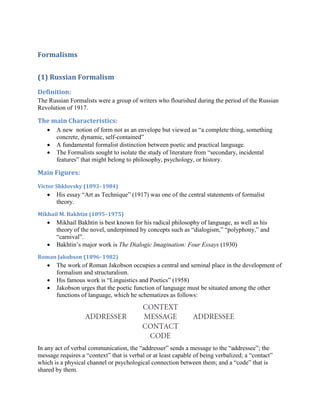
      Jakobson urges that the poetic function of language must be situated among the other
       functions of language, which he schematizes as follows:


In any act of verbal communication, the “addresser” sends a message to the “addressee”; the
message requires a “context” that is verbal or at least capable of being verbalized; a “contact”
which is a physical channel or psychological connection between them; and a “code” that is
shared by them.
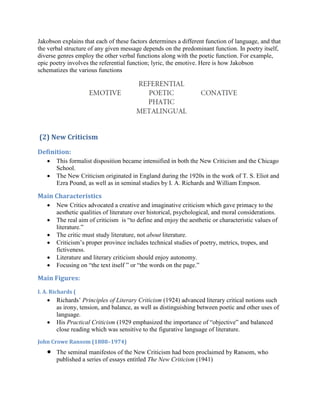
Jakobson explains that each of these factors determines a different function of language, and that
the verbal structure of any given message depends on the predominant function. In poetry itself,
diverse genres employ the other verbal functions along with the poetic function. For example,
epic poetry involves the referential function; lyric, the emotive. Here is how Jakobson
schematizes the various functions


(2) New Criticism
Definition:
      This formalist disposition became intensified in both the New Criticism and the Chicago
       School.
      The New Criticism originated in England during the 1920s in the work of T. S. Eliot and
       Ezra Pound, as well as in seminal studies by I. A. Richards and William Empson.

Main Characteristics
      New Critics advocated a creative and imaginative criticism which gave primacy to the
       aesthetic qualities of literature over historical, psychological, and moral considerations.
      The real aim of criticism is “to define and enjoy the aesthetic or characteristic values of
       literature.”
      The critic must study literature, not about literature.
      Criticism’s proper province includes technical studies of poetry, metrics, tropes, and
       fictiveness.
      Literature and literary criticism should enjoy autonomy.
      Focusing on “the text itself ” or “the words on the page.”

Main Figures:
I. A. Richards (
      Richards’ Principles of Literary Criticism (1924) advanced literary critical notions such
       as irony, tension, and balance, as well as distinguishing between poetic and other uses of
       language.
      His Practical Criticism (1929 emphasized the importance of “objective” and balanced
       close reading which was sensitive to the figurative language of literature.
John Crowe Ransom (1888–1974)
      The seminal manifestos of the New Criticism had been proclaimed by Ransom, who
       published a series of essays entitled The New Criticism (1941)
   His arguments have often been abbreviated as focusing on “the text itself ” or “the words
       on the page.”


Difference between Formalism and New Criticism
It should be said that the Russian Formalists’ emphasis on form and technique was different in
nature from that of the later New Critics. The Formalists’ analyses were far more theoretical,
seeking to understand the general nature of literature and literary devices, as well as the historical
evolution of literary techniques; the New Critics were more concerned with the practice (rather
than the theory) of close reading of individual texts.

Formalism

  • 1.
    Formalisms (1) Russian Formalism Definition: TheRussian Formalists were a group of writers who flourished during the period of the Russian Revolution of 1917. The main Characteristics:  A new notion of form not as an envelope but viewed as “a complete thing, something concrete, dynamic, self-contained”  A fundamental formalist distinction between poetic and practical language.  The Formalists sought to isolate the study of literature from “secondary, incidental features” that might belong to philosophy, psychology, or history. Main Figures: Victor Shklovsky (1893–1984)  His essay “Art as Technique” (1917) was one of the central statements of formalist theory. Mikhail M. Bakhtin (1895–1975)  Mikhail Bakhtin is best known for his radical philosophy of language, as well as his theory of the novel, underpinned by concepts such as “dialogism,” “polyphony,” and “carnival”.  Bakhtin’s major work is The Dialogic Imagination: Four Essays (1930) Roman Jakobson (1896–1982)  The work of Roman Jakobson occupies a central and seminal place in the development of formalism and structuralism.  His famous work is “Linguistics and Poetics” (1958)  Jakobson urges that the poetic function of language must be situated among the other functions of language, which he schematizes as follows: In any act of verbal communication, the “addresser” sends a message to the “addressee”; the message requires a “context” that is verbal or at least capable of being verbalized; a “contact” which is a physical channel or psychological connection between them; and a “code” that is shared by them.
  • 2.
    Jakobson explains thateach of these factors determines a different function of language, and that the verbal structure of any given message depends on the predominant function. In poetry itself, diverse genres employ the other verbal functions along with the poetic function. For example, epic poetry involves the referential function; lyric, the emotive. Here is how Jakobson schematizes the various functions (2) New Criticism Definition:  This formalist disposition became intensified in both the New Criticism and the Chicago School.  The New Criticism originated in England during the 1920s in the work of T. S. Eliot and Ezra Pound, as well as in seminal studies by I. A. Richards and William Empson. Main Characteristics  New Critics advocated a creative and imaginative criticism which gave primacy to the aesthetic qualities of literature over historical, psychological, and moral considerations.  The real aim of criticism is “to define and enjoy the aesthetic or characteristic values of literature.”  The critic must study literature, not about literature.  Criticism’s proper province includes technical studies of poetry, metrics, tropes, and fictiveness.  Literature and literary criticism should enjoy autonomy.  Focusing on “the text itself ” or “the words on the page.” Main Figures: I. A. Richards (  Richards’ Principles of Literary Criticism (1924) advanced literary critical notions such as irony, tension, and balance, as well as distinguishing between poetic and other uses of language.  His Practical Criticism (1929 emphasized the importance of “objective” and balanced close reading which was sensitive to the figurative language of literature. John Crowe Ransom (1888–1974)  The seminal manifestos of the New Criticism had been proclaimed by Ransom, who published a series of essays entitled The New Criticism (1941)
  • 3.
    His arguments have often been abbreviated as focusing on “the text itself ” or “the words on the page.” Difference between Formalism and New Criticism It should be said that the Russian Formalists’ emphasis on form and technique was different in nature from that of the later New Critics. The Formalists’ analyses were far more theoretical, seeking to understand the general nature of literature and literary devices, as well as the historical evolution of literary techniques; the New Critics were more concerned with the practice (rather than the theory) of close reading of individual texts.