DIFFERENT BRANCHES IN
FORENSIC BIOLOGY
PRESENTED BY - SHALINI SHARMA
[Volunteer-AFRS]
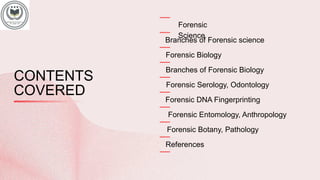
CONTENTS
COVERED
Forensic
Science
Branches of Forensic science
Forensic Biology
Branches of Forensic Biology
Forensic Serology, Odontology
Forensic DNA Fingerprinting
Forensic Entomology, Anthropology
Forensic Botany, Pathology
References
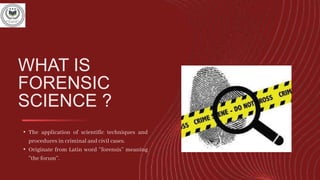
WHAT IS
FORENSIC
SCIENCE ?
• The application of scientific techniques and
procedures in criminal and civil cases.
• Originate from Latin word ''forensis'' meaning
''the forum''.
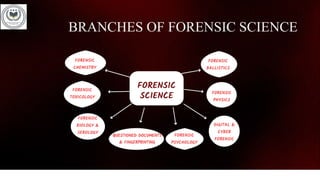
FORENSIC
SCIENCE
FORENSIC
CHEMISTRY
BRANCHES OF FORENSIC SCIENCE
FORENSIC
TOXICOLOGY
FORENSIC
BIOLOGY &
SEROLOGY
FORENSIC
PSYCHOLOGY
QUESTIONED DOCUMENTS
& FINGERPRINTING
FORENSIC
PHYSICS
FORENSIC
BALLISTICS
DIGITAL &
CYBER
FORENSIC
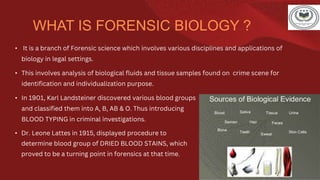
WHAT IS FORENSIC BIOLOGY ?
• It is a branch of Forensic science which involves various disciplines and applications of
biology in legal settings.
• This involves analysis of biological fluids and tissue samples found on crime scene for
identification and individualization purpose.
• In 1901, Karl Landsteiner discovered various blood groups
and classified them into A, B, AB & O. Thus introducing
BLOOD TYPING in criminal investigations.
• Dr. Leone Lattes in 1915, displayed procedure to
determine blood group of DRIED BLOOD STAINS, which
proved to be a turning point in forensics at that time.
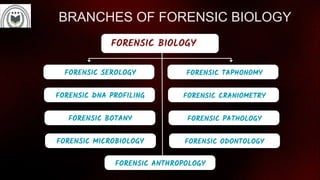
BRANCHES OF FORENSIC BIOLOGY
FORENSIC BIOLOGY
FORENSIC SEROLOGY
FORENSIC DNA PROFILING
FORENSIC BOTANY
FORENSIC MICROBIOLOGY
FORENSIC TAPHONOMY
FORENSIC CRANIOMETRY
FORENSIC PATHOLOGY
FORENSIC ODONTOLOGY
FORENSIC ANTHROPOLOGY
1) FORENSIC
SEROLOGY
• This branch of forensic includes examination and detection of various
bodily fluids like semen, blood, saliva, urine, feacal matter and vomit in
legal proceedings. It was first done by Karl Landsteiner in 1901, when
he
• Various biochemical and immunological techniques are used in
detection of these fluids on crime scene.
• Apparently, Preliminary examinations are done to ensure whether the
given fluid is blood or not. Secondly, if it is of human origin or not.
• Confirmatory tests involve finding of one's blood group with specific
proteins, enzymes and antigens.
identified various blood groups.
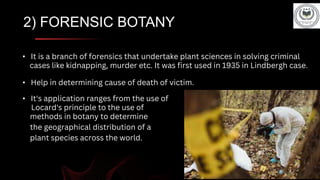
2) FORENSIC BOTANY
• It is a branch of forensics that undertake plant sciences in solving criminal
cases like kidnapping, murder etc. It was first used in 1935 in Lindbergh case.
• Help in determining cause of death of victim.
• It's application ranges from the use of
methods in botany to determine
the geographical distribution of a
plant species across the world.
Locard's principle to the use of
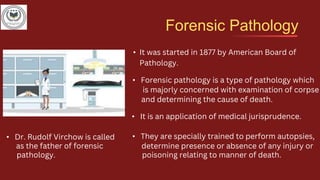
Forensic Pathology
• Forensic pathology is a type of pathology which
is majorly concerned with examination of corpse
and determining the cause of death.
• It is an application of medical jurisprudence.
• They are specially trained to perform autopsies,
determine presence or absence of any injury or
poisoning relating to manner of death.
• It was started in 1877 by American Board of
Pathology.
• Dr. Rudolf Virchow is called
as the father of forensic
pathology.
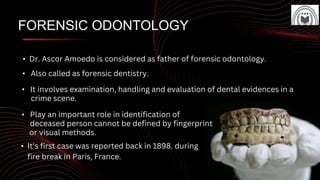
FORENSIC ODONTOLOGY
• Also called as forensic dentistry.
• It involves examination, handling and evaluation of dental evidences in a
crime scene.
• Play an important role in identification of
deceased person cannot be defined by fingerprint
or visual methods.
• Dr. Ascor Amoedo is considered as father of forensic odontology.
• It's first case was reported back in 1898. during
fire break in Paris, France.
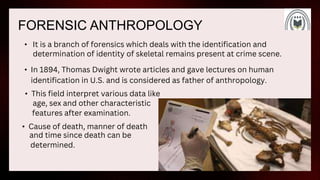
FORENSIC ANTHROPOLOGY
• It is a branch of forensics which deals with the identification and
determination of identity of skeletal remains present at crime scene.
• This field interpret various data like
features after examination.
• Cause of death, manner of death
and time since death can be
determined.
• In 1894, Thomas Dwight wrote articles and gave lectures on human
identification in U.S. and is considered as father of anthropology.
age, sex and other characteristic
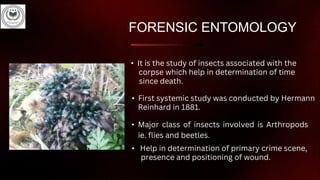
FORENSIC ENTOMOLOGY
• It is the study of insects associated with the
corpse which help in determination of time
since death.
• Major class of insects involved is Arthropods
ie. flies and beetles.
• Help in determination of primary crime scene,
presence and positioning of wound.
• First systemic study was conducted by Hermann
Reinhard in 1881.
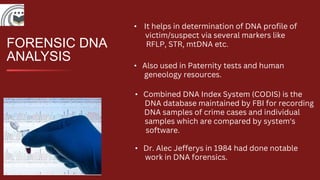
FORENSIC DNA
ANALYSIS
• It helps in determination of DNA profile of
victim/suspect via several markers like
RFLP, STR, mtDNA etc.
• Also used in Paternity tests and human
geneology resources.
• Combined DNA Index System (CODIS) is the
DNA database maintained by FBI for recording
DNA samples of crime cases and individual
samples which are compared by system's
software.
• Dr. Alec Jefferys in 1984 had done notable
work in DNA forensics.
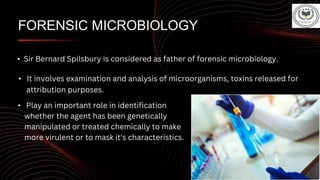
FORENSIC MICROBIOLOGY
• It involves examination and analysis of microorganisms, toxins released for
• Play an important role in identification
whether the agent has been genetically
manipulated or treated chemically to make
more virulent or to mask it's characteristics.
• Sir Bernard Spilsbury is considered as father of forensic microbiology.
attribution purposes.
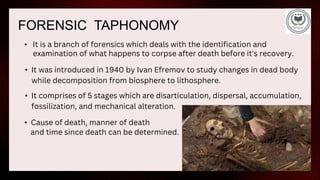
FORENSIC TAPHONOMY
• It is a branch of forensics which deals with the identification and
examination of what happens to corpse after death before it's recovery.
• Cause of death, manner of death
and time since death can be determined.
• It was introduced in 1940 by Ivan Efremov to study changes in dead body
while decomposition from biosphere to lithosphere.
• It comprises of 5 stages which are disarticulation, dispersal, accumulation,
fossilization, and mechanical alteration.
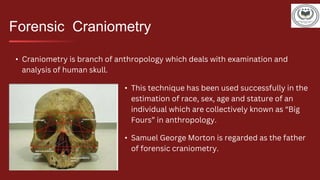
Forensic Craniometry
• Craniometry is branch of anthropology which deals with examination and
analysis of human skull.
• This technique has been used successfully in the
estimation of race, sex, age and stature of an
individual which are collectively known as “Big
Fours” in anthropology.
• Samuel George Morton is regarded as the father
of forensic craniometry.
Forensic Significance
• Help in determination of time since death of corpse.
• Cause of death along with manner of death is also estabilished.
• Link suspect to crime scene.
• DNA profiling of deceased can be determined.
• Determine primary crime scene.
Different branches in forensic biology

Different branches in forensic biology

  • 1.
    DIFFERENT BRANCHES IN FORENSICBIOLOGY PRESENTED BY - SHALINI SHARMA [Volunteer-AFRS]
  • 2.
    CONTENTS COVERED Forensic Science Branches of Forensicscience Forensic Biology Branches of Forensic Biology Forensic Serology, Odontology Forensic DNA Fingerprinting Forensic Entomology, Anthropology Forensic Botany, Pathology References
  • 3.
    WHAT IS FORENSIC SCIENCE ? •The application of scientific techniques and procedures in criminal and civil cases. • Originate from Latin word ''forensis'' meaning ''the forum''.
  • 4.
    FORENSIC SCIENCE FORENSIC CHEMISTRY BRANCHES OF FORENSICSCIENCE FORENSIC TOXICOLOGY FORENSIC BIOLOGY & SEROLOGY FORENSIC PSYCHOLOGY QUESTIONED DOCUMENTS & FINGERPRINTING FORENSIC PHYSICS FORENSIC BALLISTICS DIGITAL & CYBER FORENSIC
  • 5.
    WHAT IS FORENSICBIOLOGY ? • It is a branch of Forensic science which involves various disciplines and applications of biology in legal settings. • This involves analysis of biological fluids and tissue samples found on crime scene for identification and individualization purpose. • In 1901, Karl Landsteiner discovered various blood groups and classified them into A, B, AB & O. Thus introducing BLOOD TYPING in criminal investigations. • Dr. Leone Lattes in 1915, displayed procedure to determine blood group of DRIED BLOOD STAINS, which proved to be a turning point in forensics at that time.
  • 6.
    BRANCHES OF FORENSICBIOLOGY FORENSIC BIOLOGY FORENSIC SEROLOGY FORENSIC DNA PROFILING FORENSIC BOTANY FORENSIC MICROBIOLOGY FORENSIC TAPHONOMY FORENSIC CRANIOMETRY FORENSIC PATHOLOGY FORENSIC ODONTOLOGY FORENSIC ANTHROPOLOGY
  • 7.
    1) FORENSIC SEROLOGY • Thisbranch of forensic includes examination and detection of various bodily fluids like semen, blood, saliva, urine, feacal matter and vomit in legal proceedings. It was first done by Karl Landsteiner in 1901, when he • Various biochemical and immunological techniques are used in detection of these fluids on crime scene. • Apparently, Preliminary examinations are done to ensure whether the given fluid is blood or not. Secondly, if it is of human origin or not. • Confirmatory tests involve finding of one's blood group with specific proteins, enzymes and antigens. identified various blood groups.
  • 8.
    2) FORENSIC BOTANY •It is a branch of forensics that undertake plant sciences in solving criminal cases like kidnapping, murder etc. It was first used in 1935 in Lindbergh case. • Help in determining cause of death of victim. • It's application ranges from the use of methods in botany to determine the geographical distribution of a plant species across the world. Locard's principle to the use of
  • 9.
    Forensic Pathology • Forensicpathology is a type of pathology which is majorly concerned with examination of corpse and determining the cause of death. • It is an application of medical jurisprudence. • They are specially trained to perform autopsies, determine presence or absence of any injury or poisoning relating to manner of death. • It was started in 1877 by American Board of Pathology. • Dr. Rudolf Virchow is called as the father of forensic pathology.
  • 10.
    FORENSIC ODONTOLOGY • Alsocalled as forensic dentistry. • It involves examination, handling and evaluation of dental evidences in a crime scene. • Play an important role in identification of deceased person cannot be defined by fingerprint or visual methods. • Dr. Ascor Amoedo is considered as father of forensic odontology. • It's first case was reported back in 1898. during fire break in Paris, France.
  • 11.
    FORENSIC ANTHROPOLOGY • Itis a branch of forensics which deals with the identification and determination of identity of skeletal remains present at crime scene. • This field interpret various data like features after examination. • Cause of death, manner of death and time since death can be determined. • In 1894, Thomas Dwight wrote articles and gave lectures on human identification in U.S. and is considered as father of anthropology. age, sex and other characteristic
  • 12.
    FORENSIC ENTOMOLOGY • Itis the study of insects associated with the corpse which help in determination of time since death. • Major class of insects involved is Arthropods ie. flies and beetles. • Help in determination of primary crime scene, presence and positioning of wound. • First systemic study was conducted by Hermann Reinhard in 1881.
  • 13.
    FORENSIC DNA ANALYSIS • Ithelps in determination of DNA profile of victim/suspect via several markers like RFLP, STR, mtDNA etc. • Also used in Paternity tests and human geneology resources. • Combined DNA Index System (CODIS) is the DNA database maintained by FBI for recording DNA samples of crime cases and individual samples which are compared by system's software. • Dr. Alec Jefferys in 1984 had done notable work in DNA forensics.
  • 14.
    FORENSIC MICROBIOLOGY • Itinvolves examination and analysis of microorganisms, toxins released for • Play an important role in identification whether the agent has been genetically manipulated or treated chemically to make more virulent or to mask it's characteristics. • Sir Bernard Spilsbury is considered as father of forensic microbiology. attribution purposes.
  • 15.
    FORENSIC TAPHONOMY • Itis a branch of forensics which deals with the identification and examination of what happens to corpse after death before it's recovery. • Cause of death, manner of death and time since death can be determined. • It was introduced in 1940 by Ivan Efremov to study changes in dead body while decomposition from biosphere to lithosphere. • It comprises of 5 stages which are disarticulation, dispersal, accumulation, fossilization, and mechanical alteration.
  • 16.
    Forensic Craniometry • Craniometryis branch of anthropology which deals with examination and analysis of human skull. • This technique has been used successfully in the estimation of race, sex, age and stature of an individual which are collectively known as “Big Fours” in anthropology. • Samuel George Morton is regarded as the father of forensic craniometry.
  • 17.
    Forensic Significance • Helpin determination of time since death of corpse. • Cause of death along with manner of death is also estabilished. • Link suspect to crime scene. • DNA profiling of deceased can be determined. • Determine primary crime scene.