Forces
eastloshigh.com
• Forces are pushes or pulls.
• Forces can start objects moving, and they can
stop, speed up, slow down, or change the
direction of moving objects. They can lift
things, or cause them to turn, bend or twist.
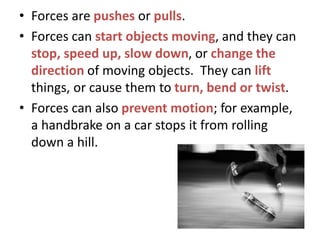
• Forces can also prevent motion; for example,
a handbrake on a car stops it from rolling
down a hill.
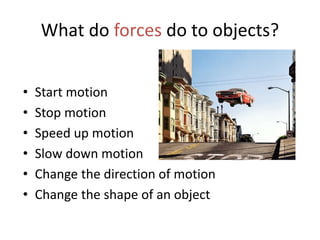
What do forces do to objects?
• Start motion
• Stop motion
• Speed up motion
• Slow down motion
• Change the direction of motion
• Change the shape of an object
What are the kinds of forces?
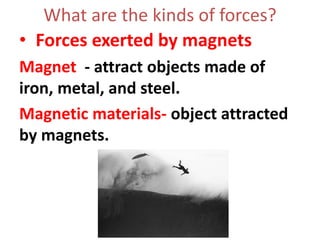
• Forces exerted by magnets
Magnet - attract objects made of
iron, metal, and steel.
Magnetic materials- object attracted
by magnets.
Gravity
•A force sends the ball
upward into the air.
The force of gravity
pulls down the ball to
the ground.
• Things fall down
because of gravity.
•Make the objects
move.
•It can make machine
move because of the
electric current that
flows from a source to
the machine.
•Make the objects
move.
•It can make machine
move because of the
electric current that
flows from a source to
the machine.
• a group of cells that can
produce electrical energy.
•Make things move and
produce heat, light and
sounds.
• The force of the wind can
lift a kite up in the sky and
keep it flying. It can
makes branches of trees
sway.
• The water current in
rivers, seas and oceans
can also make an object
move.
Do CHECK UP
TEST page 356-
357
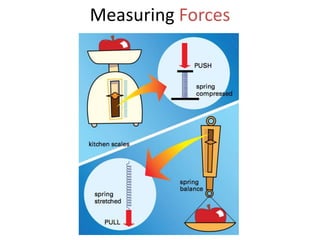
Measuring Forces
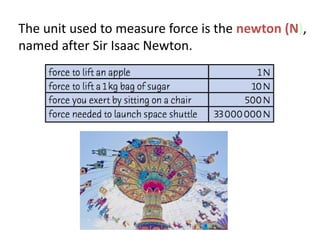
The unit used to measure force is the newton (N),
named after Sir Isaac Newton.
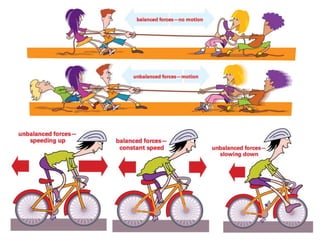
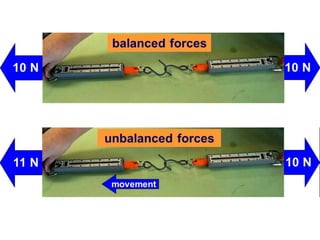
Balanced and Unbalanced Forces
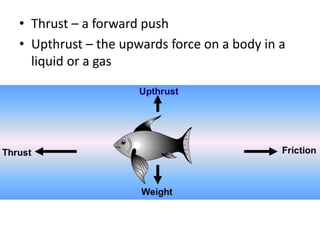
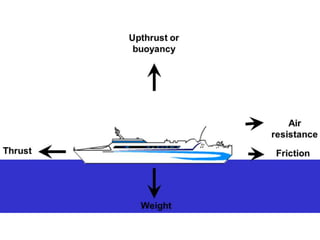
Drawing force diagrams
• Thrust – a forward push
• Upthrust – the upwards force on a body in a
liquid or a gas
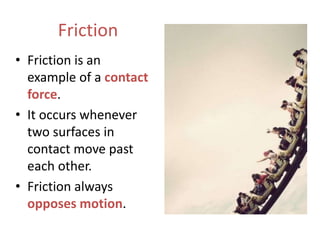
• Friction is an
example of a contact
force.
• It occurs whenever
two surfaces in
contact move past
each other.
• Friction always
opposes motion.
Friction
Mass and Weight
• In the 17th century Sir Isaac Newton came to
the conclusion that gravity is the force of
attraction between objects, and that the size
of this force depends on the mass of the
objects.
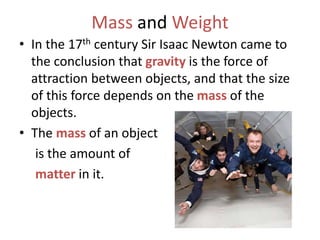
• The mass of an object
is the amount of
matter in it.
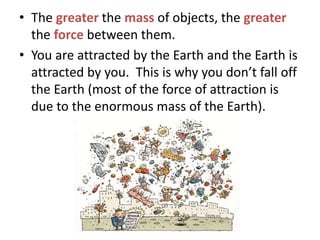
• The greater the mass of objects, the greater
the force between them.
• You are attracted by the Earth and the Earth is
attracted by you. This is why you don’t fall off
the Earth (most of the force of attraction is
due to the enormous mass of the Earth).
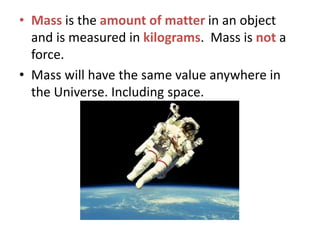
• Mass is the amount of matter in an object
and is measured in kilograms. Mass is not a
force.
• Mass will have the same value anywhere in
the Universe. Including space.
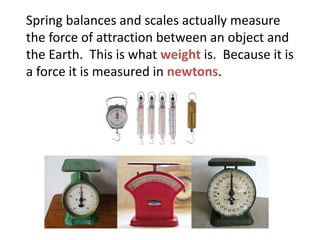
Spring balances and scales actually measure
the force of attraction between an object and
the Earth. This is what weight is. Because it is
a force it is measured in newtons.
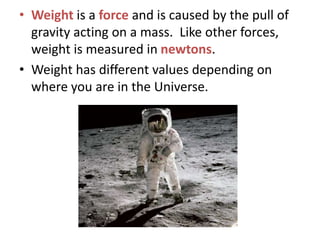
• Weight is a force and is caused by the pull of
gravity acting on a mass. Like other forces,
weight is measured in newtons.
• Weight has different values depending on
where you are in the Universe.
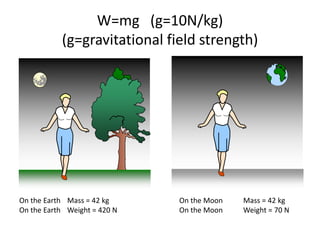
W=mg (g=10N/kg)
(g=gravitational field strength)
On the Earth Mass = 42 kg On the Moon Mass = 42 kg
On the Earth Weight = 420 N On the Moon Weight = 70 N