Force
FORCEForce: is either a push or a pull that acts on an object. Whenever you bend, twist, stretch or compress something you are using a pushing or pulling force.Force is an effect which can,Start motion,Stop motion,Change the speed or direction of motion,Change the shape or size of a body.
Unit of ForceForce is represented by the symbol F and is measured in Newton (N).The pull of the Earth on a 100 g mass is about 1 N.
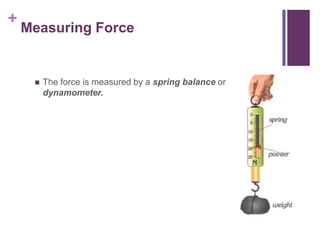
Measuring ForceThe force is measured by a spring balance or dynamometer.
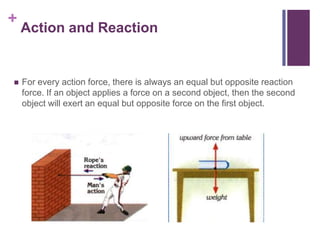
Action and ReactionFor every action force, there is always an equal but opposite reaction force. If an object applies a force on a second object, then the second object will exert an equal but opposite force on the first object.
TYPES OF FORCEThere are many different kinds of forces:Gravitational forceMagnetic forceElectrostatic forceTension Frictional force
Gravitational Force and WeightGravitational Force: The force of attraction between two objects due to their massesGravitational force depends on;The masses of the objects,The distance between them.
Gravitational Force and WeightGravitational force is directly proportional to the product of the masses: The greater the masses the greater the gravitational force. Gravitational force is inversely proportional to the distance between the masses: The larger the distance between the objects the smaller the gravitational force.The pull of the earth on a 1 kg mass is about 10 N
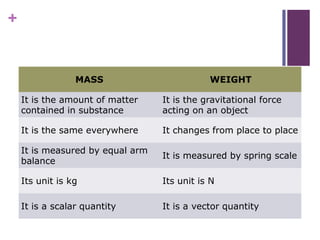
Weight Weight (w): The gravitational force acting on an object. Since it is a force it is measured by a spring scale and its unit is Newton (N).
How does weight change?The weight of an object on the earth depends on its distance from the earth's centre.Near the earth, an object of mass 1 kg has a weight of about 10 N, whereas 22 000 km away from the centre of the earth, the weight of the object reduces to 1 N.The weight of an object of 1kg weighs most at the poles (9.83 N) and least at the equator (9.78 N). A body having a weight of 600 N at the equator would have a weight of 603 N at the poles
How does weight change?
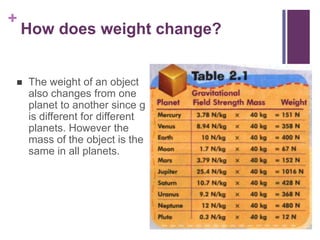
How does weight change?The weight of an object also changes from one planet to another since g is different for different planets. However the mass of the object is the same in all planets.
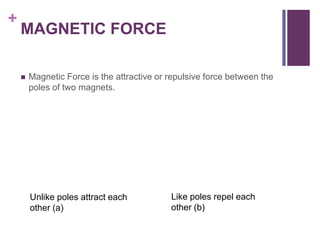
MAGNETIC FORCEMagnetic Force is the attractive or repulsive force between the poles of two magnets. Like poles repel each other (b)Unlike poles attract each other (a)
ELECTROSTATIC FORCEElectrostatic Force is the attractive or repulsive force among electrically charged objects or electric charges such as electrons and protons.
TENSIONTension (T): It is the pulling force in a rope or a chain.
FRICTIONAL FORCEFrictional force: It is an important force which only acts when two objects are touching and are applying force to one another.It is a force that slows down moving objects and brings them to rest. It always acts in a direction opposite to the direction of the force applied to the object. Walking is possible only on a frictional surface.Water also applies a frictional force to the objects moving in it.Frictional force does not depend on the area of the rubbing surfaces.
The frictional force between the object and the table depends on two factors;        a) The weight of the object.b) The roughness of the surfaces rubbing together.

Force

  • 1.
  • 2.
    FORCEForce: is eithera push or a pull that acts on an object. Whenever you bend, twist, stretch or compress something you are using a pushing or pulling force.Force is an effect which can,Start motion,Stop motion,Change the speed or direction of motion,Change the shape or size of a body.
  • 3.
    Unit of ForceForceis represented by the symbol F and is measured in Newton (N).The pull of the Earth on a 100 g mass is about 1 N.
  • 4.
    Measuring ForceThe forceis measured by a spring balance or dynamometer.
  • 5.
    Action and ReactionForevery action force, there is always an equal but opposite reaction force. If an object applies a force on a second object, then the second object will exert an equal but opposite force on the first object.
  • 6.
    TYPES OF FORCEThereare many different kinds of forces:Gravitational forceMagnetic forceElectrostatic forceTension Frictional force
  • 7.
    Gravitational Force andWeightGravitational Force: The force of attraction between two objects due to their massesGravitational force depends on;The masses of the objects,The distance between them.
  • 8.
    Gravitational Force andWeightGravitational force is directly proportional to the product of the masses: The greater the masses the greater the gravitational force. Gravitational force is inversely proportional to the distance between the masses: The larger the distance between the objects the smaller the gravitational force.The pull of the earth on a 1 kg mass is about 10 N
  • 9.
    Weight Weight (w):The gravitational force acting on an object. Since it is a force it is measured by a spring scale and its unit is Newton (N).
  • 10.
    How does weightchange?The weight of an object on the earth depends on its distance from the earth's centre.Near the earth, an object of mass 1 kg has a weight of about 10 N, whereas 22 000 km away from the centre of the earth, the weight of the object reduces to 1 N.The weight of an object of 1kg weighs most at the poles (9.83 N) and least at the equator (9.78 N). A body having a weight of 600 N at the equator would have a weight of 603 N at the poles
  • 11.
  • 12.
    How does weightchange?The weight of an object also changes from one planet to another since g is different for different planets. However the mass of the object is the same in all planets.
  • 14.
    MAGNETIC FORCEMagnetic Forceis the attractive or repulsive force between the poles of two magnets. Like poles repel each other (b)Unlike poles attract each other (a)
  • 15.
    ELECTROSTATIC FORCEElectrostatic Forceis the attractive or repulsive force among electrically charged objects or electric charges such as electrons and protons.
  • 16.
    TENSIONTension (T): Itis the pulling force in a rope or a chain.
  • 17.
    FRICTIONAL FORCEFrictional force:It is an important force which only acts when two objects are touching and are applying force to one another.It is a force that slows down moving objects and brings them to rest. It always acts in a direction opposite to the direction of the force applied to the object. Walking is possible only on a frictional surface.Water also applies a frictional force to the objects moving in it.Frictional force does not depend on the area of the rubbing surfaces.
  • 18.
    The frictional forcebetween the object and the table depends on two factors; a) The weight of the object.b) The roughness of the surfaces rubbing together.