Definitions
Force – Actionthat can be described as a push or a pull.
Exert – To apply by pushing, pulling or twisting.
Newton – Unit in which force is measured.
Balanced forces – Two forces that have no visible effect because they are exactly equal in size and opposite in direction.
Unbalanced forces – Two forces that have a visible effect because they are not exactly opposite and equal.
Contact force – Force that is exerted when two objects touch each other.
Non-contact force – Force that is exerted over a distance; also called a field force.
Friction – Contact force that a surface exerts on an object.
Tension – Contact force in a rope or cable when it is used to carry a load.
Compression – Contact force that pushes or squeezes something into a smaller space.
Gravitational force – Pulling force that bodies exert on each other over a distance due to their masses.
Weight – That gravitational force that a celestial body such as a moon or a planet exerts on an object close to its own surface.
Mass – A measure of the amount of matter that a body is made of.
Magnetic force – Force that two magnetic materials exert on each other over a distance.
Force of attraction – Pulling force that two objects exert on each other.
Force of repulsion – Pushing force that two objects exert on each other.
Like poles – Similar magnetic poles, that is, north and north or south and south.
Unlike poles – Different magnetic poles, that is, north and south.
Electrostatic force – Force that two electrically charged objects exert on each other over a distance.
Like charges – Similar electric charges, that is, positive and positive or negative and negative.
Unlike charges – Different electric charges, that is, positive and negative.
3.
Unit 1: Typesof
forces
• We can’t see forces, but we can see the effects of
forces everywhere around us.
• When we combine pushing and pulling forces, we
sometimes get a twist.
• We exert a force when we use a push, a pull or a twist
to change the shape, direction or speed of an object.
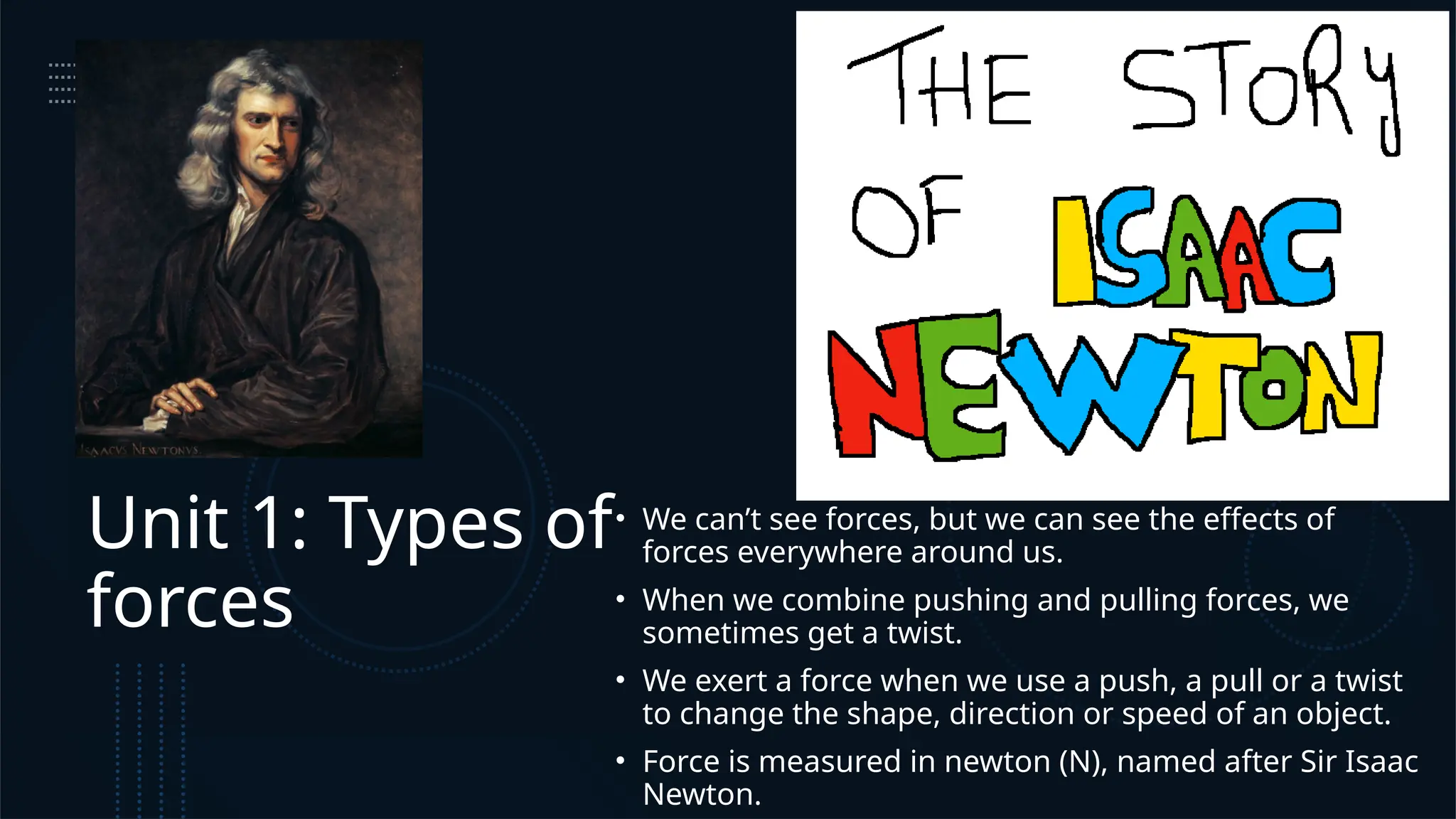
• Force is measured in newton (N), named after Sir Isaac
Newton.
4.
How do wedescribe forces?
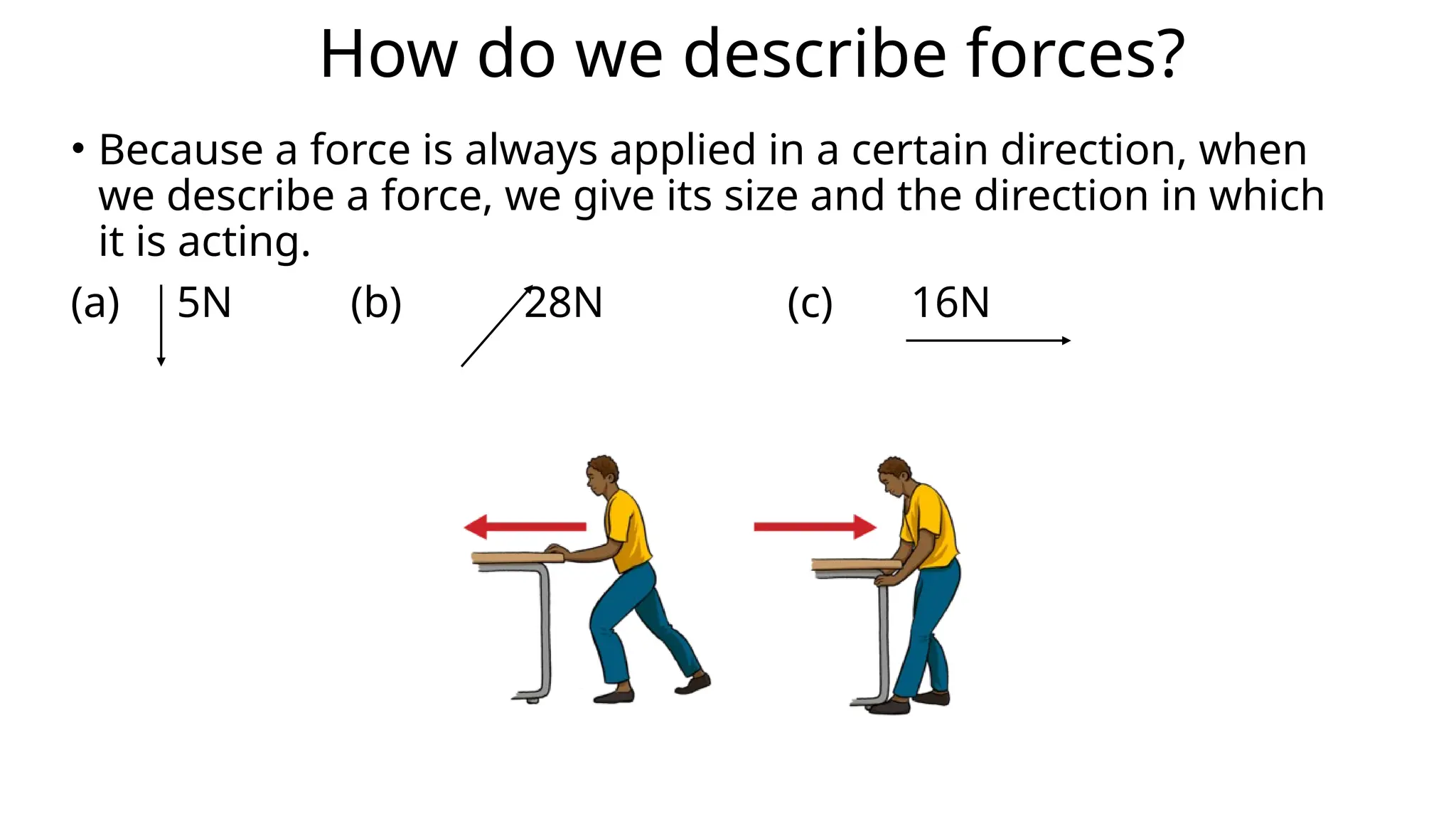
• Because a force is always applied in a certain direction, when
we describe a force, we give its size and the direction in which
it is acting.
(a) 5N (b) 28N (c) 16N
5.
Effects of forces
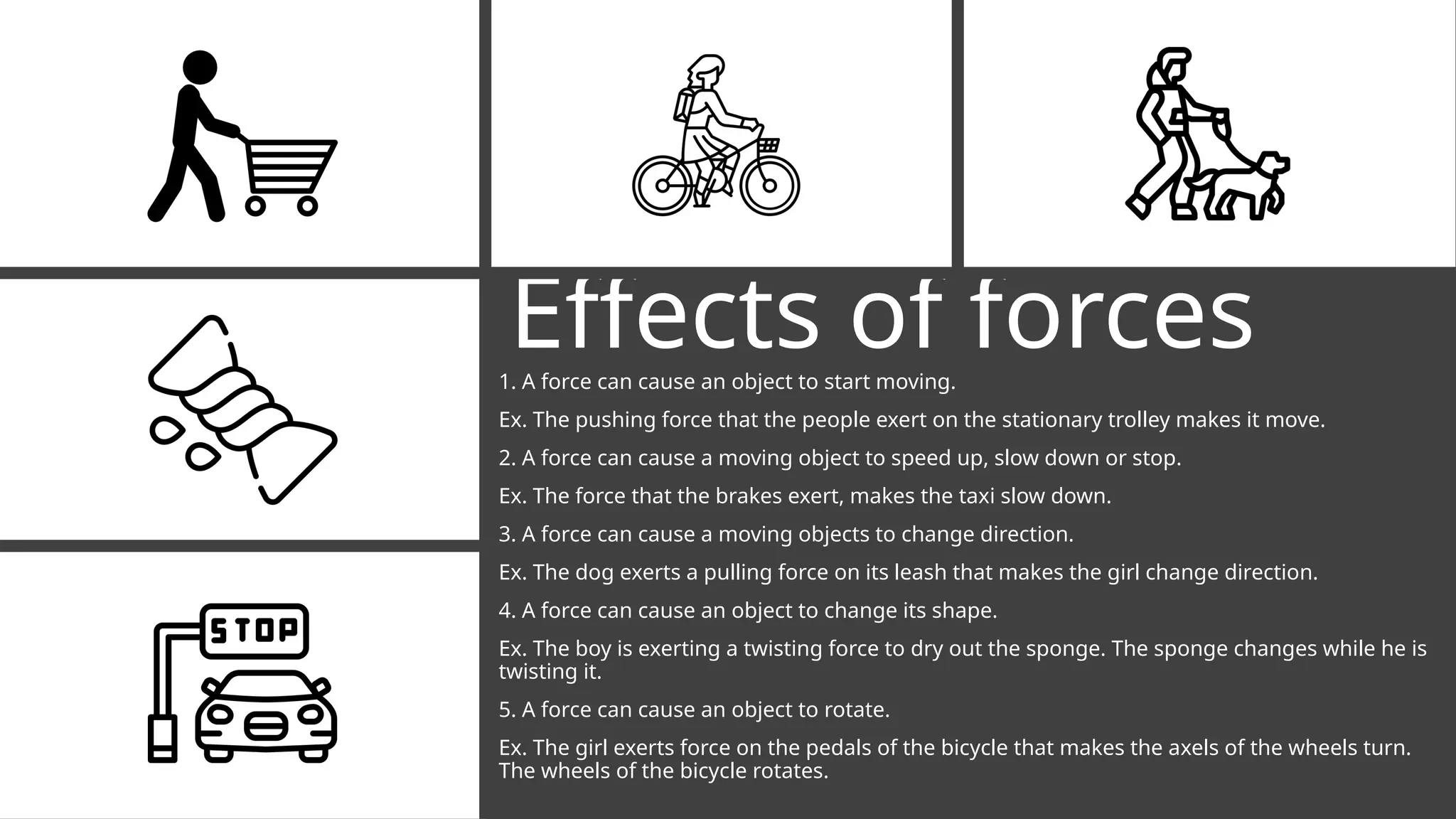
1.A force can cause an object to start moving.
Ex. The pushing force that the people exert on the stationary trolley makes it move.
2. A force can cause a moving object to speed up, slow down or stop.
Ex. The force that the brakes exert, makes the taxi slow down.
3. A force can cause a moving objects to change direction.
Ex. The dog exerts a pulling force on its leash that makes the girl change direction.
4. A force can cause an object to change its shape.
Ex. The boy is exerting a twisting force to dry out the sponge. The sponge changes while he is
twisting it.
5. A force can cause an object to rotate.
Ex. The girl exerts force on the pedals of the bicycle that makes the axels of the wheels turn.
The wheels of the bicycle rotates.
6.
Force Pairs
• Whena force is applied to an object, the object
resists this force.
• This resisting force is equal in size but opposite
in direction to the applied force.
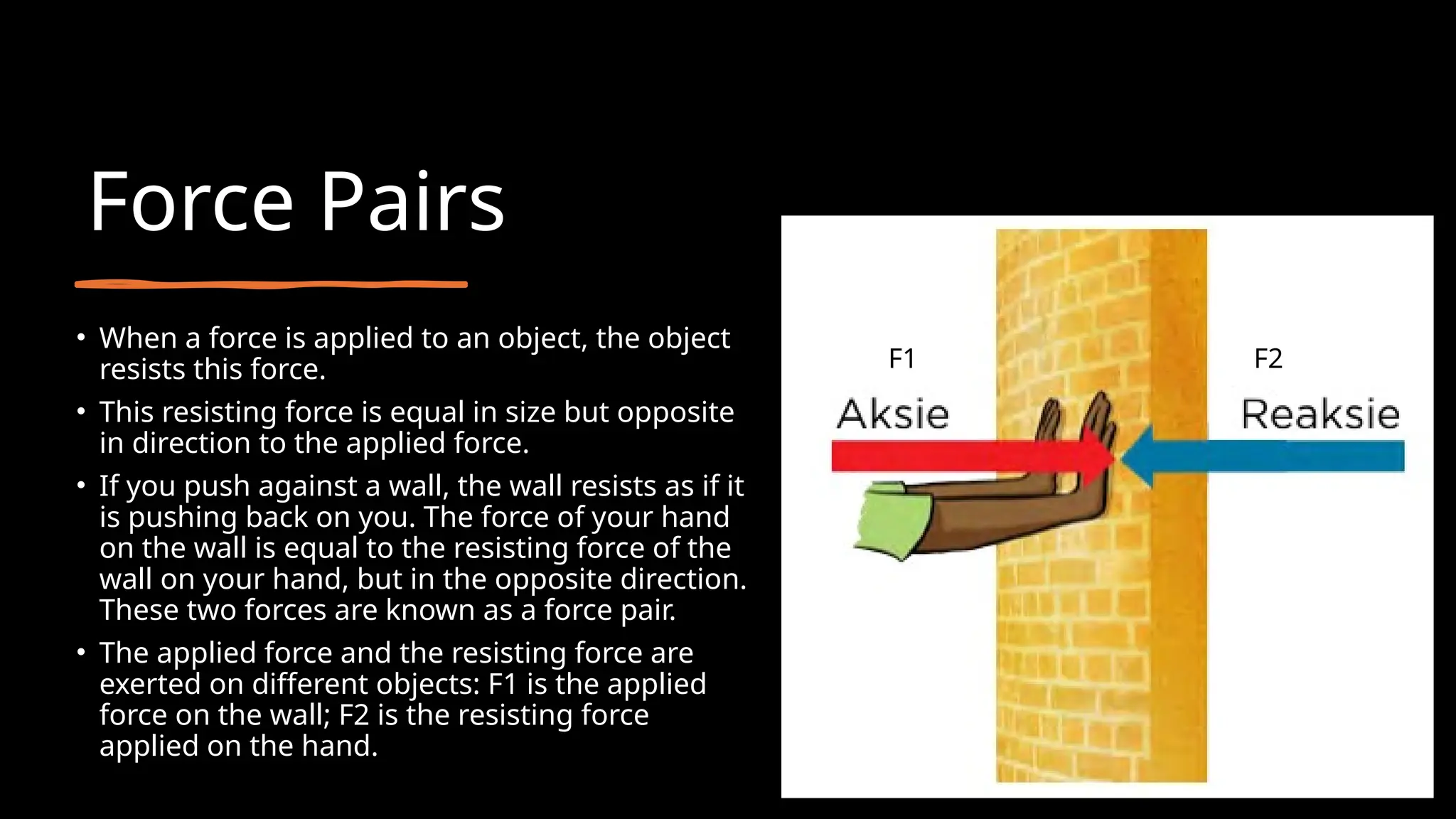
• If you push against a wall, the wall resists as if it
is pushing back on you. The force of your hand
on the wall is equal to the resisting force of the
wall on your hand, but in the opposite direction.
These two forces are known as a force pair.
• The applied force and the resisting force are
exerted on different objects: F1 is the applied
force on the wall; F2 is the resisting force
applied on the hand.
F1 F2
7.
Unit 2: Contactforces
• A contact force is exerted when two objects are in contact, so they touch each other.
• Friction, tension and compression are contact forces.
• Friction:
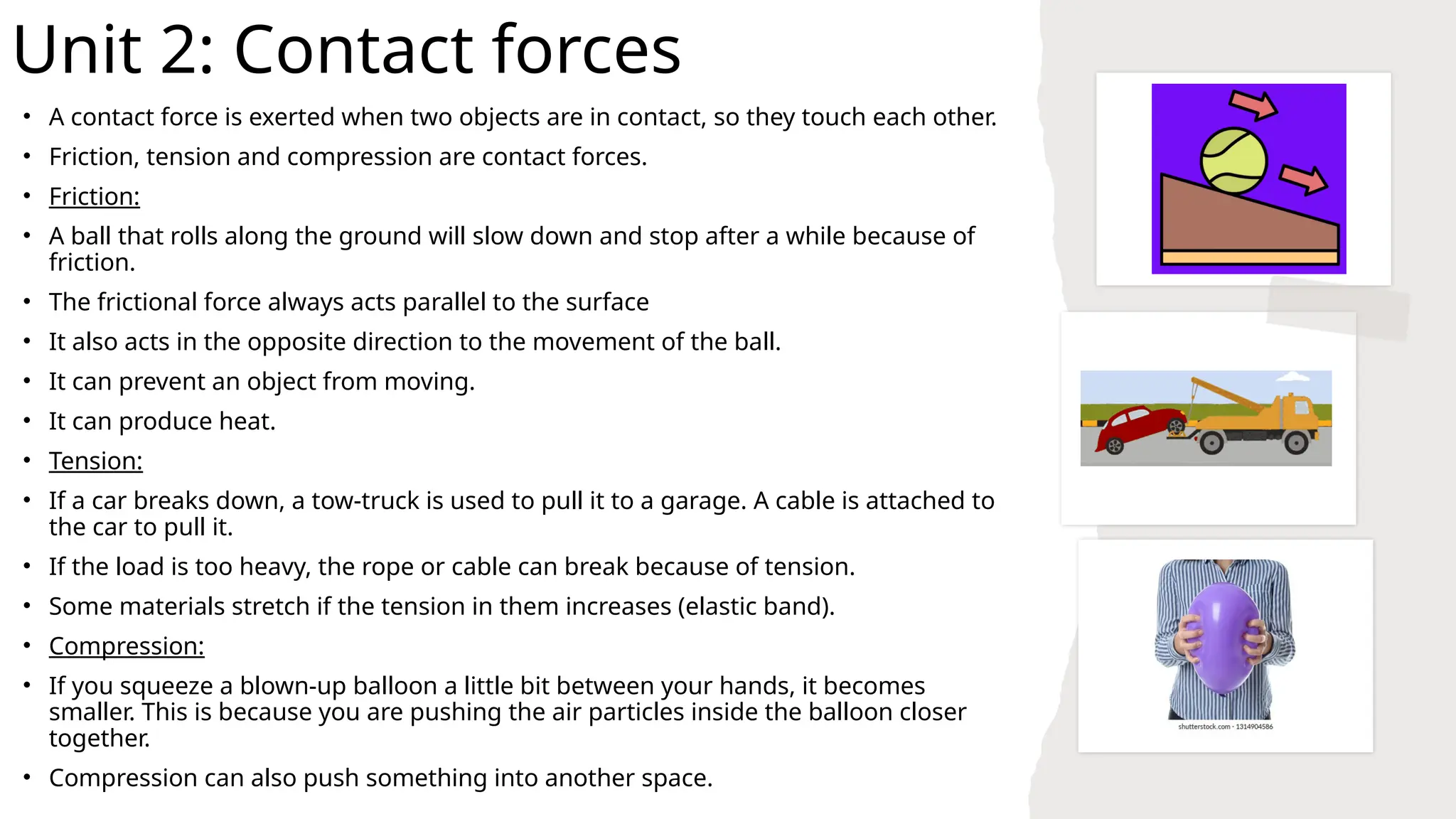
• A ball that rolls along the ground will slow down and stop after a while because of
friction.
• The frictional force always acts parallel to the surface
• It also acts in the opposite direction to the movement of the ball.
• It can prevent an object from moving.
• It can produce heat.
• Tension:
• If a car breaks down, a tow-truck is used to pull it to a garage. A cable is attached to
the car to pull it.
• If the load is too heavy, the rope or cable can break because of tension.
• Some materials stretch if the tension in them increases (elastic band).
• Compression:
• If you squeeze a blown-up balloon a little bit between your hands, it becomes
smaller. This is because you are pushing the air particles inside the balloon closer
together.
• Compression can also push something into another space.
8.
Unit 3:
Field forces
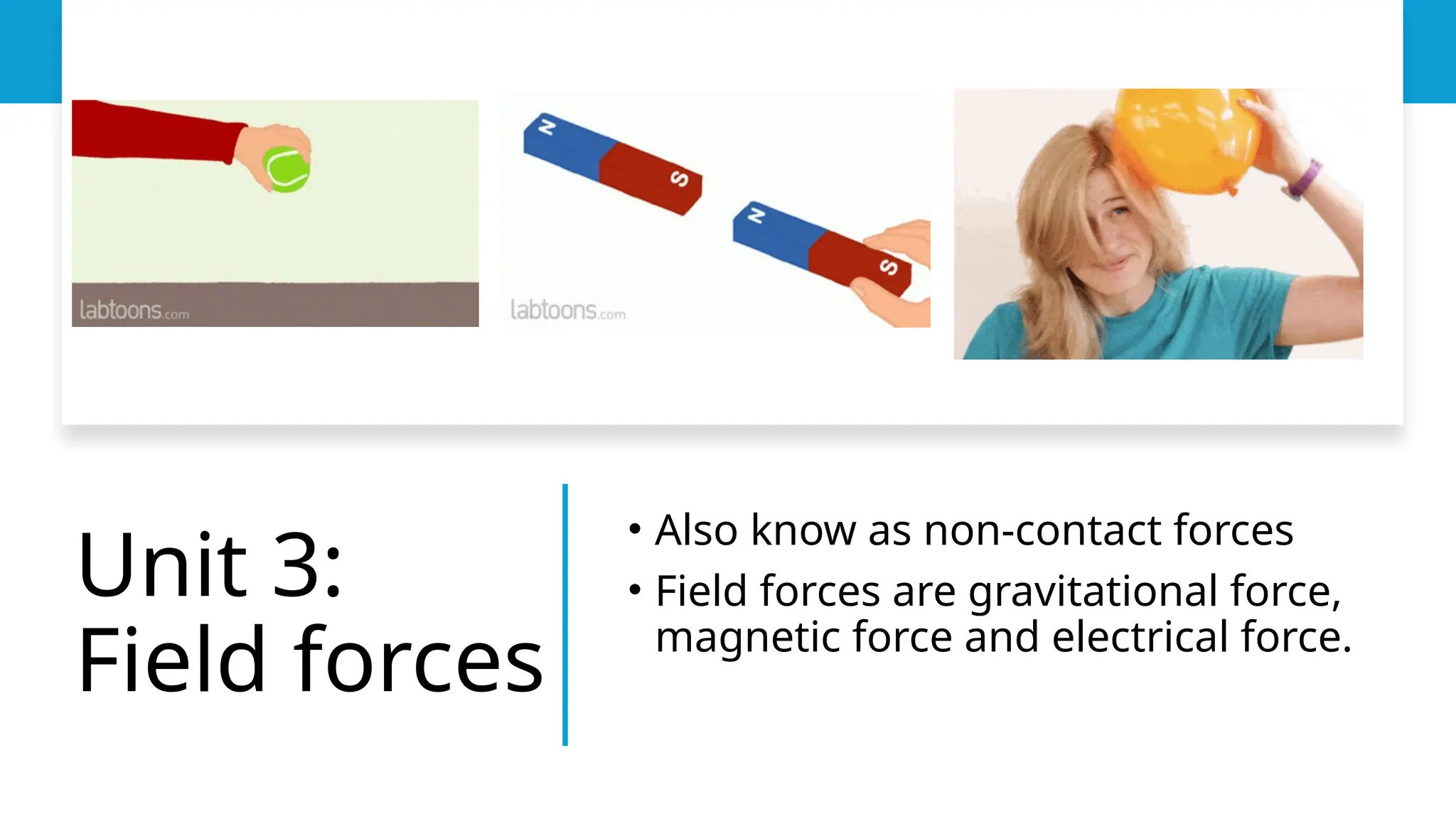
•Also know as non-contact forces
• Field forces are gravitational force,
magnetic force and electrical force.
9.
Gravitational Force:
• Pulling(attraction) force that bodies exert on each
other over a distance due to their masses.
• Matter is something that has mass and takes up space,
so all the objects you can think of have mass. Any
object in the universe will therefore exert a force of
attraction on any other object.
• Gravitational forces acts in a gravitational field.
• Gravitational force works in pairs.
• Sir Isaac Newton formulated a law that describes the
gravitational force that two objects exert on each other.
He discovered that the gravitational force becomes
smaller if we move the objects further apart. He also
noticed that the more mass two objects have, the larger
the gravitational force that they exert on each other is.
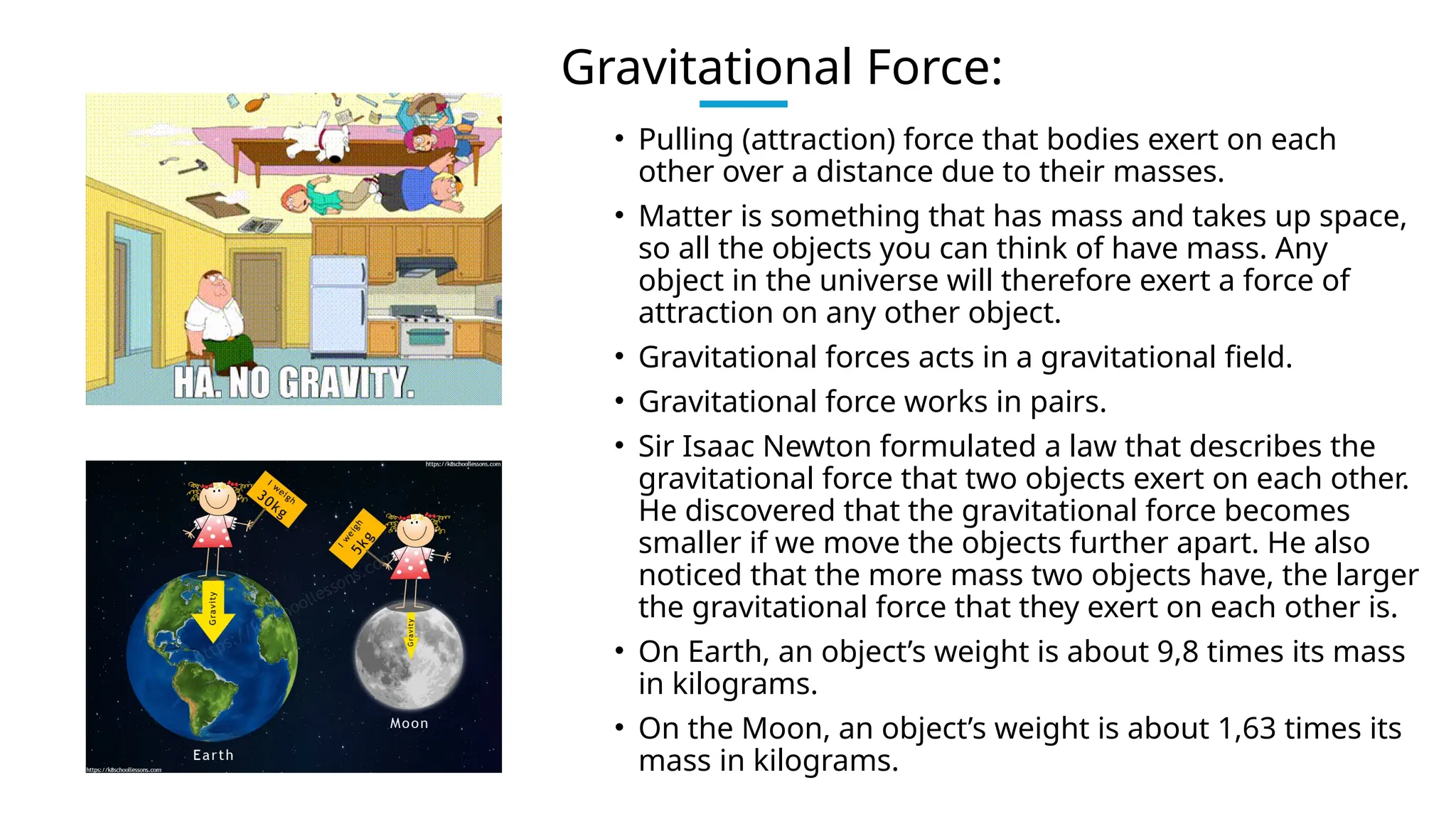
• On Earth, an object’s weight is about 9,8 times its mass
in kilograms.
• On the Moon, an object’s weight is about 1,63 times its
mass in kilograms.
10.
Magnetic
force:
• Force thattwo magnetic materials exert on each other over a
distance.
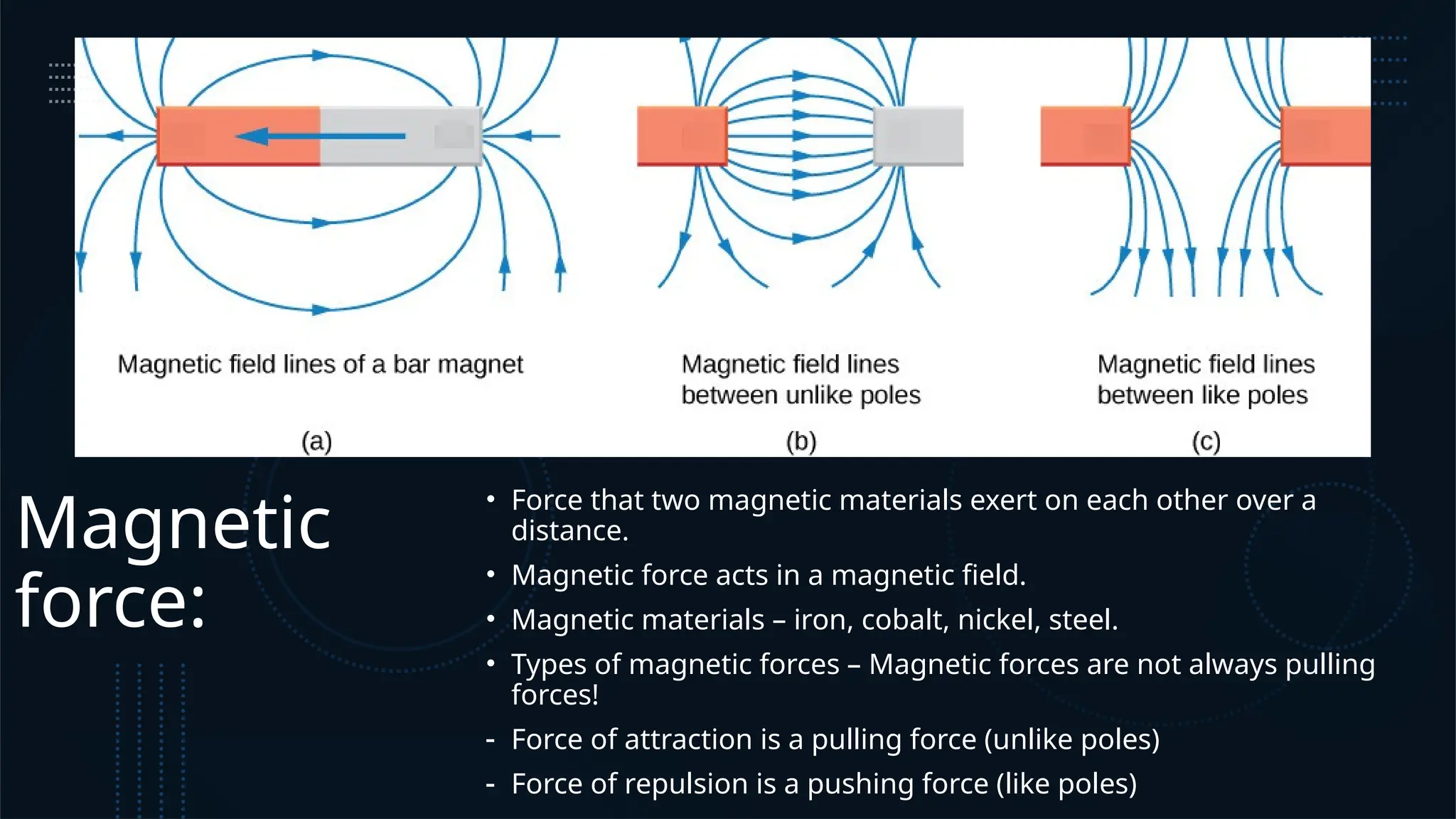
• Magnetic force acts in a magnetic field.
• Magnetic materials – iron, cobalt, nickel, steel.
• Types of magnetic forces – Magnetic forces are not always pulling
forces!
- Force of attraction is a pulling force (unlike poles)
- Force of repulsion is a pushing force (like poles)
11.
Electrostatic
force:
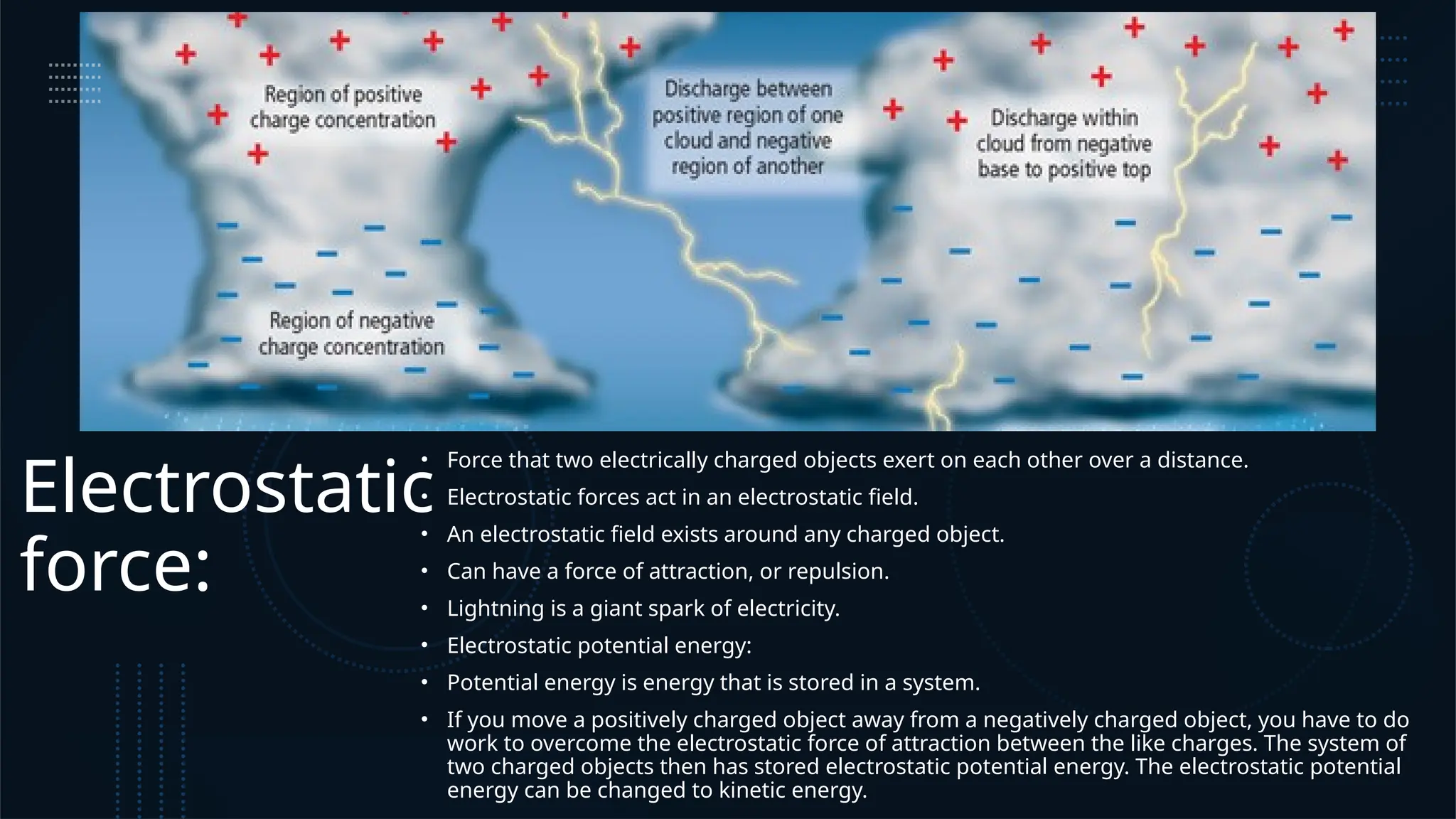
• Force thattwo electrically charged objects exert on each other over a distance.
• Electrostatic forces act in an electrostatic field.
• An electrostatic field exists around any charged object.
• Can have a force of attraction, or repulsion.
• Lightning is a giant spark of electricity.
• Electrostatic potential energy:
• Potential energy is energy that is stored in a system.
• If you move a positively charged object away from a negatively charged object, you have to do
work to overcome the electrostatic force of attraction between the like charges. The system of
two charged objects then has stored electrostatic potential energy. The electrostatic potential
energy can be changed to kinetic energy.