Physics (Forces)


Credits to Elgin Low, Marcus Au,
Chua Zong Wei, Tam Wai Hang
Force

-A push or pull
Definition from Wikipedia
a force is any influence that causes a free body to
undergo an acceleration. Force can also be
described by intuitive concepts such as a push or
pull that can cause an object with mass to change
its velocity (which includes to begin moving from
a state of rest, i.e., to accelerate, or which can
cause a flexible object to deform.
This Definition has been chosen because it is much easier to understand and suits the context as compared to Dictionary.com
SI unit of forces


The newton is the unit used to represent
force that is derived in the SI system; it is
equal to the amount of force required
to accelerate an object of mass 1
kilogram at a rate of one meter per
second.
Electrostatic Force

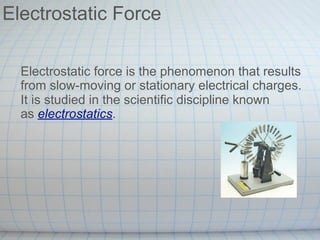
  Electrostatic force is the phenomenon that results
  from slow-moving or stationary electrical charges.
  It is studied in the scientific discipline known
  as electrostatics.
Specifically, electrostatic force is the physical reaction
that holds together the electromagnetic field created
by sub-atomic particles, such as electrons and
protons. In order for electrostatic forces to remain
cohesive, these particles need to independently
maintain both positive and negative charges and
react to each other accordingly. According to the laws
of physics, there are four primary forces that describe
the reactions of particles, one of which is
considered electromagnetic force, which results
in electrostatic force under certain conditions.
Friction (including air resistance)

No matter which direction something moves in, friction
pulls it the other way. Move something left, friction pulls
right. Move something up, friction pulls  it down.
Friction is actually a force that appears whenever two
things have contact with each other. Although two
objects might look smooth, microscopically, they're very
rough and jagged.
Friction (including air resistance)
    Friction has a lot to do with life as we know it
  here on Earth. Without it, we wouldn't be able to
  walk, sit in a chair, climb stairs, or use a mouse
     to surf the web. Everything would just keep
        slipping and falling all over the place.
Gravitational force
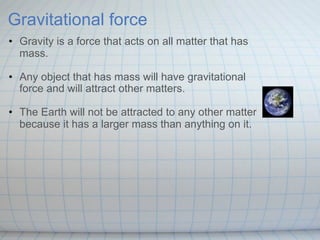
• Gravity is a force that acts on all matter that has
  mass.

• Any object that has mass will have gravitational
  force and will attract other matters.

• The Earth will not be attracted to any other matter
  because it has a larger mass than anything on it.
Gravitational force
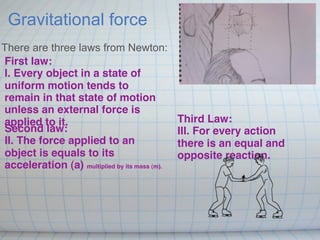
There are three laws from Newton:
First law:
I. Every object in a state of
uniform motion tends to
remain in that state of motion
unless an external force is
applied to it.                                 Third Law: 
Second law:                                    III. For every action
II. The force applied to an                    there is an equal and
object is equals to its                        opposite reaction.
acceleration (a) multiplied by its mass (m).
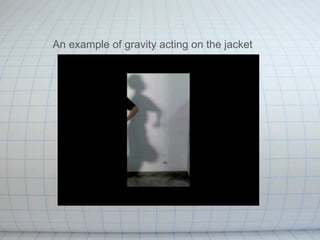
An example of gravity acting on the jacket
Magnetic Force

    When the charges are in motion, an extra
    force acts on them. This extra force is
    called the magnetic force. IT is also the
    repelling or attracting force
    between a magnet and a
    ferromagnetic material, between a
    magnet and a current-carrying
    conductor, etc.
Tension

Basically,
-magnitude of the pulling force exerted by one to another
-opposite of compression
-In physics, tension is the magnitude of the pulling force
exerted by a string, cable, chain, or similar object on
another object. It is the opposite of compression. As
tension is the magnitude of a force, it is measured
in newtons (or sometimes pounds-force) and is always
measured parallel to the string on which it applies. There
are two basic possibilities for systems of objects held by
strings.Either acceleration is zero and the system is
therefore in equilibrium or there is acceleration and
therefore a net force is present. Note that a string is
assumed to have negligible mass.

Forces presentation

  • 1.
    Physics (Forces) Credits toElgin Low, Marcus Au, Chua Zong Wei, Tam Wai Hang
  • 2.
    Force -A push orpull Definition from Wikipedia a force is any influence that causes a free body to undergo an acceleration. Force can also be described by intuitive concepts such as a push or pull that can cause an object with mass to change its velocity (which includes to begin moving from a state of rest, i.e., to accelerate, or which can cause a flexible object to deform. This Definition has been chosen because it is much easier to understand and suits the context as compared to Dictionary.com
  • 3.
    SI unit offorces The newton is the unit used to represent force that is derived in the SI system; it is equal to the amount of force required to accelerate an object of mass 1 kilogram at a rate of one meter per second.
  • 4.
    Electrostatic Force Electrostatic force is the phenomenon that results from slow-moving or stationary electrical charges. It is studied in the scientific discipline known as electrostatics.
  • 5.
    Specifically, electrostatic forceis the physical reaction that holds together the electromagnetic field created by sub-atomic particles, such as electrons and protons. In order for electrostatic forces to remain cohesive, these particles need to independently maintain both positive and negative charges and react to each other accordingly. According to the laws of physics, there are four primary forces that describe the reactions of particles, one of which is considered electromagnetic force, which results in electrostatic force under certain conditions.
  • 6.
    Friction (including airresistance) No matter which direction something moves in, friction pulls it the other way. Move something left, friction pulls right. Move something up, friction pulls  it down. Friction is actually a force that appears whenever two things have contact with each other. Although two objects might look smooth, microscopically, they're very rough and jagged.
  • 7.
    Friction (including airresistance)  Friction has a lot to do with life as we know it here on Earth. Without it, we wouldn't be able to walk, sit in a chair, climb stairs, or use a mouse to surf the web. Everything would just keep slipping and falling all over the place.
  • 8.
    Gravitational force • Gravityis a force that acts on all matter that has mass. • Any object that has mass will have gravitational force and will attract other matters. • The Earth will not be attracted to any other matter because it has a larger mass than anything on it.
  • 9.
    Gravitational force There arethree laws from Newton: First law: I. Every object in a state of uniform motion tends to remain in that state of motion unless an external force is applied to it. Third Law:  Second law: III. For every action II. The force applied to an there is an equal and object is equals to its opposite reaction. acceleration (a) multiplied by its mass (m).
  • 10.
    An example ofgravity acting on the jacket
  • 11.
    Magnetic Force When the charges are in motion, an extra force acts on them. This extra force is called the magnetic force. IT is also the repelling or attracting force between a magnet and a ferromagnetic material, between a magnet and a current-carrying conductor, etc.
  • 12.
    Tension Basically, -magnitude of thepulling force exerted by one to another -opposite of compression -In physics, tension is the magnitude of the pulling force exerted by a string, cable, chain, or similar object on another object. It is the opposite of compression. As tension is the magnitude of a force, it is measured in newtons (or sometimes pounds-force) and is always measured parallel to the string on which it applies. There are two basic possibilities for systems of objects held by strings.Either acceleration is zero and the system is therefore in equilibrium or there is acceleration and therefore a net force is present. Note that a string is assumed to have negligible mass.

Editor's Notes

  • #5 hahahahahahahahahahahahahahahahahahahahahahahahahahahahahahahahahahahahahahahahahahahahahahahahahahahahahahahahahahahahahahahahahahahahahahahahahahahahahahahahahahahahahahahahahahahahahahahahahahahahahahahahahahahahahahahahahahahahahahahahahahahahahahahahahahahahahahahahahahahahahahahahahahahahahahahahahahahahahahahahahahaha