Introduction to
Forces
Where do they come from? How are they measured?
How are they added & Subtracted?
What is a force?
 A push or pull
 Change the motion of all objects
 Anytime you see something moving, you can be
sure that a force created its motion.
Forces are Everywhere
 Without forces, sports, dancing, driving…
basically everything would be impossible.
 Forces can be shown with an arrow. The bigger
the arrow, the bigger the force.
Types of Forces
1. Gravitational Force
 Gravity keeps you on the
ground
 Gravity exists between any two
objects
 The Earth is pulling you to the
ground but you are also pulling
the earth towards yourself!
 The force of gravity on an
object creates “weight”
Types of Forces
2. Electrostatic Force
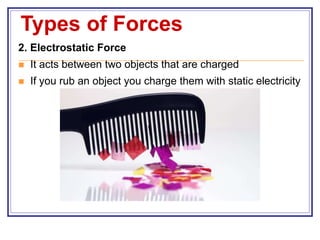
 It acts between two objects that are charged
 If you rub an object you charge them with static electricity
Types of Forces
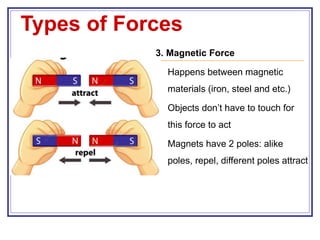
3. Magnetic Force
 Happens between magnetic
materials (iron, steel and etc.)
 Objects don’t have to touch for
this force to act
 Magnets have 2 poles: alike
poles, repel, different poles attract
Types of Forces
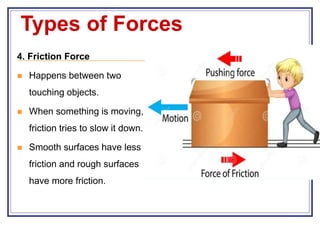
4. Friction Force
 Happens between two
touching objects.
 When something is moving,
friction tries to slow it down.
 Smooth surfaces have less
friction and rough surfaces
have more friction.
Types of Forces
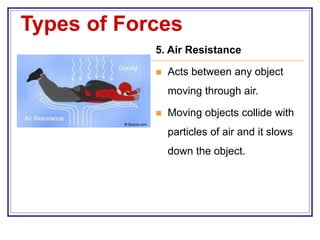
5. Air Resistance
 Acts between any object
moving through air.
 Moving objects collide with
particles of air and it slows
down the object.
Types of Forces
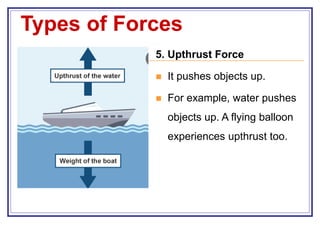
5. Upthrust Force
 It pushes objects up.
 For example, water pushes
objects up. A flying balloon
experiences upthrust too.
Types of Forces
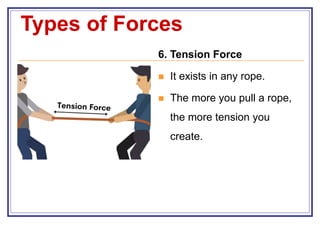
6. Tension Force
 It exists in any rope.
 The more you pull a rope,
the more tension you
create.
More about force!
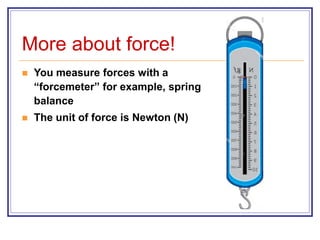
 You measure forces with a
“forcemeter” for example, spring
balance
 The unit of force is Newton (N)

Introduction to forces.pptx

  • 1.
    Introduction to Forces Where dothey come from? How are they measured? How are they added & Subtracted?
  • 2.
    What is aforce?  A push or pull  Change the motion of all objects  Anytime you see something moving, you can be sure that a force created its motion.
  • 3.
    Forces are Everywhere Without forces, sports, dancing, driving… basically everything would be impossible.  Forces can be shown with an arrow. The bigger the arrow, the bigger the force.
  • 4.
    Types of Forces 1.Gravitational Force  Gravity keeps you on the ground  Gravity exists between any two objects  The Earth is pulling you to the ground but you are also pulling the earth towards yourself!  The force of gravity on an object creates “weight”
  • 5.
    Types of Forces 2.Electrostatic Force  It acts between two objects that are charged  If you rub an object you charge them with static electricity
  • 6.
    Types of Forces 3.Magnetic Force  Happens between magnetic materials (iron, steel and etc.)  Objects don’t have to touch for this force to act  Magnets have 2 poles: alike poles, repel, different poles attract
  • 7.
    Types of Forces 4.Friction Force  Happens between two touching objects.  When something is moving, friction tries to slow it down.  Smooth surfaces have less friction and rough surfaces have more friction.
  • 8.
    Types of Forces 5.Air Resistance  Acts between any object moving through air.  Moving objects collide with particles of air and it slows down the object.
  • 9.
    Types of Forces 5.Upthrust Force  It pushes objects up.  For example, water pushes objects up. A flying balloon experiences upthrust too.
  • 10.
    Types of Forces 6.Tension Force  It exists in any rope.  The more you pull a rope, the more tension you create.
  • 11.
    More about force! You measure forces with a “forcemeter” for example, spring balance  The unit of force is Newton (N)