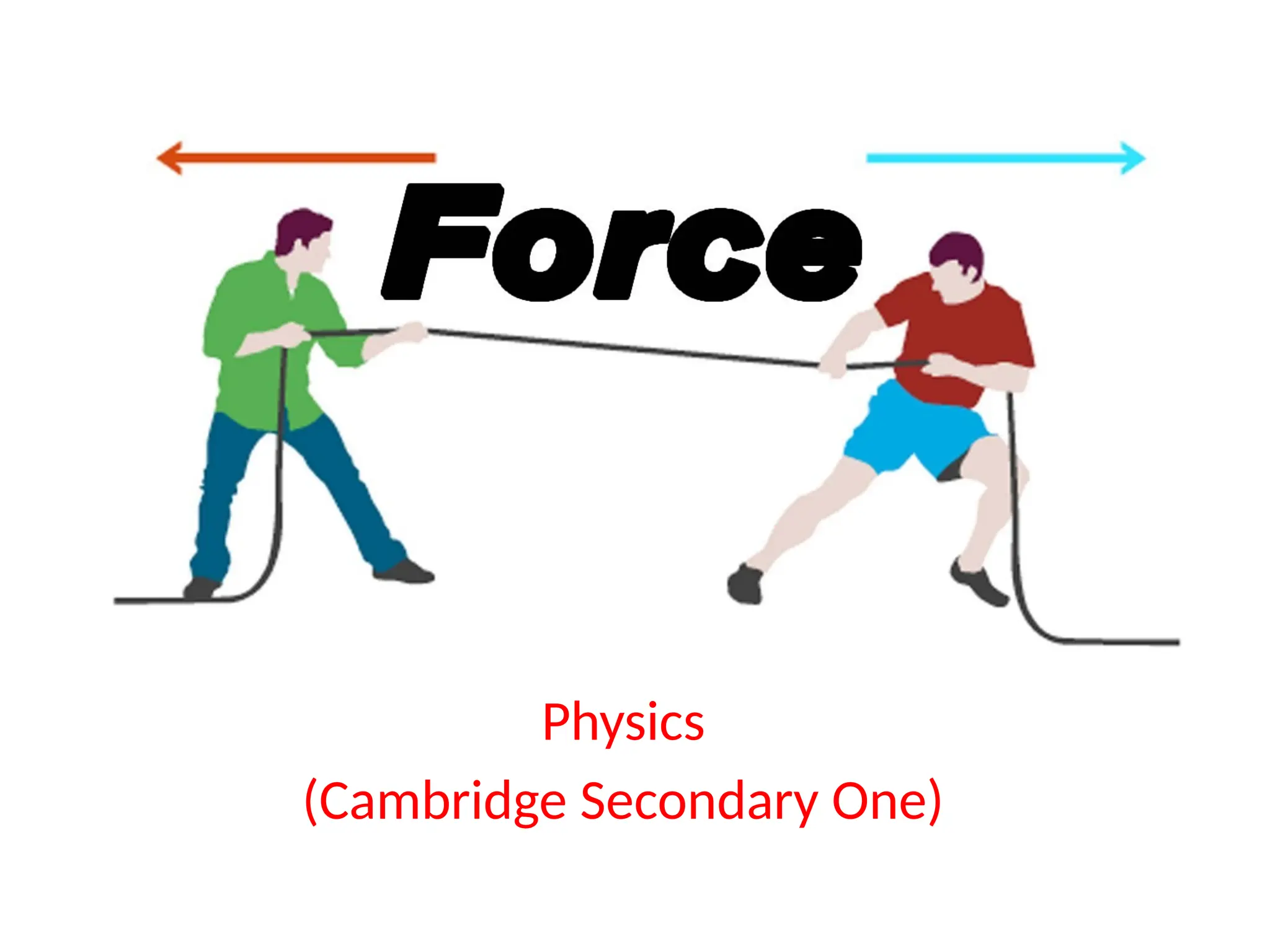
Physics
(Cambridge Secondary One)
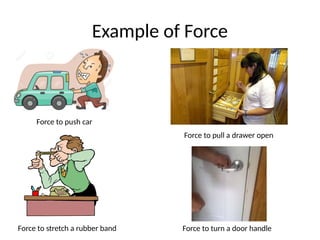
Example of Force
Force to push car
Force to pull a drawer open
Force to stretch a rubber band Force to turn a door handle
Definition
• A force is a push or pull that can change the shape of
an object or change the way that it moves
• Keywords :
 A forces changes its shape, speed and direction
 If something start to move or speeds up a
force is acting on it
 Forces can also slow things down or stop
them to moving
 Forces can change the direction of motion
Force Cannot be Seen
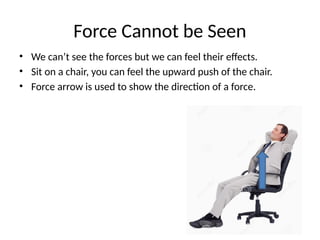
• We can’t see the forces but we can feel their effects.
• Sit on a chair, you can feel the upward push of the chair.
• Force arrow is used to show the direction of a force.
Force Arrow
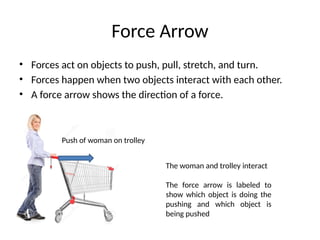
• Forces act on objects to push, pull, stretch, and turn.
• Forces happen when two objects interact with each other.
• A force arrow shows the direction of a force.
Push of woman on trolley
The woman and trolley interact
The force arrow is labeled to
show which object is doing the
pushing and which object is
being pushed
Force Arrow
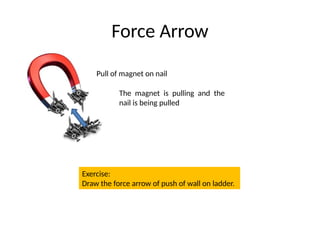
Pull of magnet on nail
The magnet is pulling and the
nail is being pulled
Exercise:
Draw the force arrow of push of wall on ladder.
Force Can Make Things Move
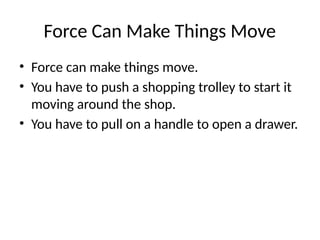
• Force can make things move.
• You have to push a shopping trolley to start it
moving around the shop.
• You have to pull on a handle to open a drawer.
Measuring Forces
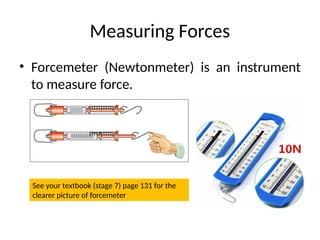
• Forcemeter (Newtonmeter) is an instrument
to measure force.
See your textbook (stage 7) page 131 for the
clearer picture of forcemeter
How a Forcemeter Works ?
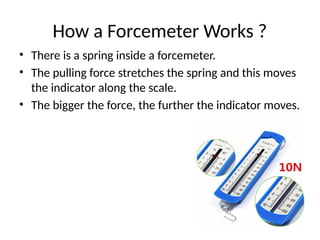
• There is a spring inside a forcemeter.
• The pulling force stretches the spring and this moves
the indicator along the scale.
• The bigger the force, the further the indicator moves.
The Unit of Force
• The unit of force is newtons (N).
• The unit is named after Isaac Newton, an
English Scientist who explained how forces
affect the way things move.
Answer the question from the textbook (stage 7) page 132
Weight – The Pull of Gravity
• We live on the earth.
• It’s difficult to get away from the earth.
• If you jump upwards, you fall back down again. The
earth’s gravity pulls you downwards.
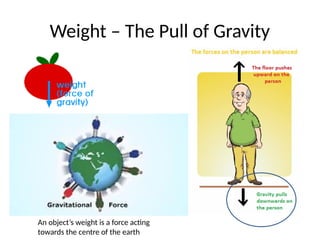
• The earth’s gravity causes a force that pulls any object
downwards. The force is called weight.
• Like any other force, weight is measured in newtons (N).
• Gravity always pulls you towards the centre of the
earth. It doesn’t matter where you are on the surface of
the earth.
Weight – The Pull of Gravity
An object’s weight is a force acting
towards the centre of the earth
Weight – The Pull of Gravity
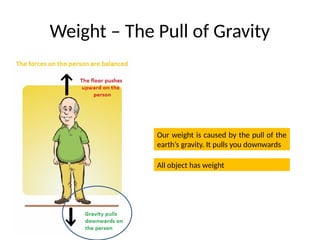
Our weight is caused by the pull of the
earth’s gravity. It pulls you downwards
All object has weight
Falling Through The Floor
• The earth’s gravity is pulling on us all the time.
• It pulls us downwards, but we don’t fall
through the floor. Why not ?
• The floor pushes upwards on us with a force.
This force is called contact force.
• Any object that you push on pushes back with
a contact force.
Contact Force
Contact Force
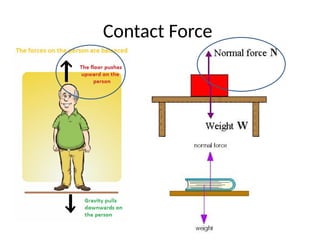
• Usually the force is big enough to balance the
pull of gravity.
• But if you stand on something that isn’t very
strong, its upward push may not be enough to
support you.
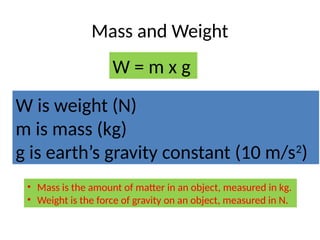
Mass and Weight
W = m x g
W is weight (N)
m is mass (kg)
g is earth’s gravity constant (10 m/s2
)
• Mass is the amount of matter in an object, measured in kg.
• Weight is the force of gravity on an object, measured in N.
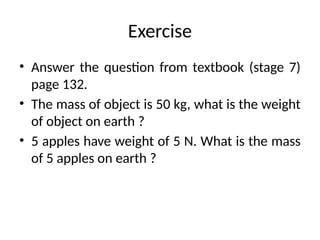
Exercise
• Answer the question from textbook (stage 7)
page 132.
• The mass of object is 50 kg, what is the weight
of object on earth ?
• 5 apples have weight of 5 N. What is the mass
of 5 apples on earth ?
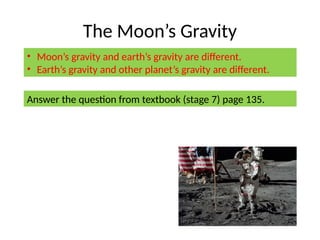
The Moon’s Gravity
• The moon’s gravity is weaker than the Earth’s.
• You weigh a lot less up there.
• You can jump much higher on the Moon but
you still fall back downwards.
• If you go far out into space, far from the earth,
moon or any other object, your weight is zero.
Your mass stays the same, however you are
still made of 50 kg of matter, for example.
The Moon’s Gravity
• Moon’s gravity and earth’s gravity are different.
• Earth’s gravity and other planet’s gravity are different.
Answer the question from textbook (stage 7) page 135.
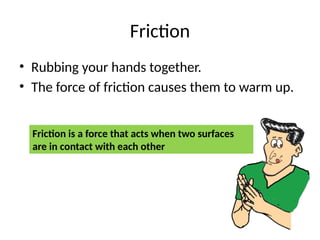
Friction
• Rubbing your hands together.
• The force of friction causes them to warm up.
Friction is a force that acts when two surfaces
are in contact with each other
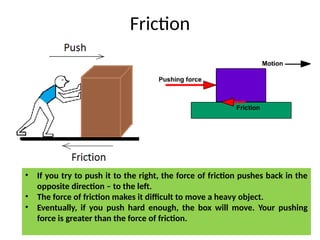
Friction
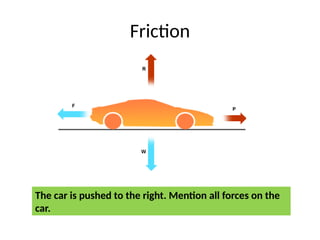
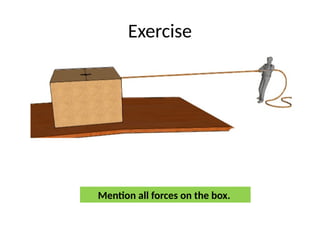
• If you try to push it to the right, the force of friction pushes back in the
opposite direction – to the left.
• The force of friction makes it difficult to move a heavy object.
• Eventually, if you push hard enough, the box will move. Your pushing
force is greater than the force of friction.
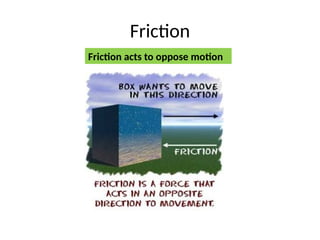
Friction
Friction acts to oppose motion
Friction
The car is pushed to the right. Mention all forces on the
car.
Friction
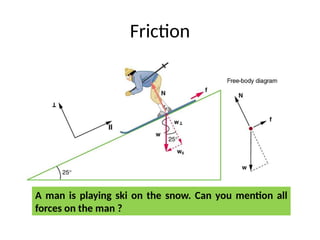
A man is playing ski on the snow. Can you mention all
forces on the man ?
Exercise
Mention all forces on the box.
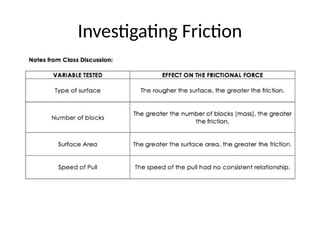
Investigating Friction
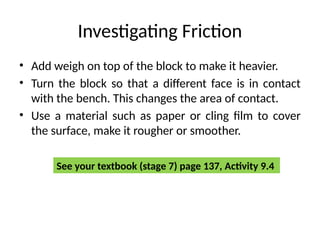
• Add weigh on top of the block to make it heavier.
• Turn the block so that a different face is in contact
with the bench. This changes the area of contact.
• Use a material such as paper or cling film to cover
the surface, make it rougher or smoother.
See your textbook (stage 7) page 137, Activity 9.4
Investigating Friction
Air Resistance
• If you drop something, it falls to the ground.
• Its weight – the pull of the Earth’s Gravity –
makes it fall.
• Air resistance : Force that acts on any object
moving through the air
Air Resistance
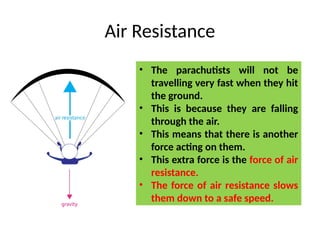
• The parachutists will not be
travelling very fast when they hit
the ground.
• This is because they are falling
through the air.
• This means that there is another
force acting on them.
• This extra force is the force of air
resistance.
• The force of air resistance slows
them down to a safe speed.
Air Resistance
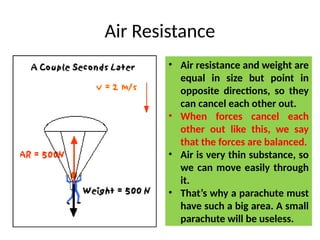
• Air resistance and weight are
equal in size but point in
opposite directions, so they
can cancel each other out.
• When forces cancel each
other out like this, we say
that the forces are balanced.
• Air is very thin substance, so
we can move easily through
it.
• That’s why a parachute must
have such a big area. A small
parachute will be useless.
Air Resistance
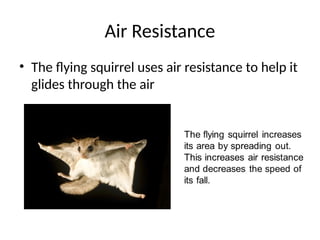
• The flying squirrel uses air resistance to help it
glides through the air
Air Resistance and Friction
• Air resistance is like friction.
• It tends to slow down anything that is moving.
• A large area gives a lot of air resistance.
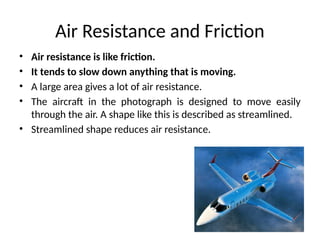
• The aircraft in the photograph is designed to move easily
through the air. A shape like this is described as streamlined.
• Streamlined shape reduces air resistance.
• Thrust : A type of force (usually in a car or plane) that
pushes the vehicle forwards
• Upthrust : The force on an object in a liquid or gas that
pushes it up
– For example : if an object is floating, the water is pushing
it up ; Balloons also experience this force because the air
below the balloons pushes it up
• If you pull something with a rope/wire/cable/piece of string
that has a weight on it, there is a force called TENSION
• Electrostatic Force
The force acts between object that are charged (have a
positive or negative)
It can attract or repel (push away)
Balanced and Unbalanced Forces
• Balanced Forces
– If the forces are the same size but in opposite
direction (equal)
– The object behaves as if there’s no force acting on
it
– If your object is moving but with a
constant/steady speed
• Unbalanced Forces
– If the forces on an object are not equal
Resultant Forces
• Resultant Force : The Single Force equivalent
to two or more forces acting on an object
End of Chapter
Answer all questions from textbook (stage 7) page 142 – 143

Physics-Force new.pptx igcse newton gravity

  • 1.
  • 2.
    Example of Force Forceto push car Force to pull a drawer open Force to stretch a rubber band Force to turn a door handle
  • 3.
    Definition • A forceis a push or pull that can change the shape of an object or change the way that it moves • Keywords :  A forces changes its shape, speed and direction  If something start to move or speeds up a force is acting on it  Forces can also slow things down or stop them to moving  Forces can change the direction of motion
  • 4.
    Force Cannot beSeen • We can’t see the forces but we can feel their effects. • Sit on a chair, you can feel the upward push of the chair. • Force arrow is used to show the direction of a force.
  • 5.
    Force Arrow • Forcesact on objects to push, pull, stretch, and turn. • Forces happen when two objects interact with each other. • A force arrow shows the direction of a force. Push of woman on trolley The woman and trolley interact The force arrow is labeled to show which object is doing the pushing and which object is being pushed
  • 6.
    Force Arrow Pull ofmagnet on nail The magnet is pulling and the nail is being pulled Exercise: Draw the force arrow of push of wall on ladder.
  • 7.
    Force Can MakeThings Move • Force can make things move. • You have to push a shopping trolley to start it moving around the shop. • You have to pull on a handle to open a drawer.
  • 8.
    Measuring Forces • Forcemeter(Newtonmeter) is an instrument to measure force. See your textbook (stage 7) page 131 for the clearer picture of forcemeter
  • 9.
    How a ForcemeterWorks ? • There is a spring inside a forcemeter. • The pulling force stretches the spring and this moves the indicator along the scale. • The bigger the force, the further the indicator moves.
  • 10.
    The Unit ofForce • The unit of force is newtons (N). • The unit is named after Isaac Newton, an English Scientist who explained how forces affect the way things move. Answer the question from the textbook (stage 7) page 132
  • 11.
    Weight – ThePull of Gravity • We live on the earth. • It’s difficult to get away from the earth. • If you jump upwards, you fall back down again. The earth’s gravity pulls you downwards. • The earth’s gravity causes a force that pulls any object downwards. The force is called weight. • Like any other force, weight is measured in newtons (N). • Gravity always pulls you towards the centre of the earth. It doesn’t matter where you are on the surface of the earth.
  • 12.
    Weight – ThePull of Gravity An object’s weight is a force acting towards the centre of the earth
  • 13.
    Weight – ThePull of Gravity Our weight is caused by the pull of the earth’s gravity. It pulls you downwards All object has weight
  • 14.
    Falling Through TheFloor • The earth’s gravity is pulling on us all the time. • It pulls us downwards, but we don’t fall through the floor. Why not ? • The floor pushes upwards on us with a force. This force is called contact force. • Any object that you push on pushes back with a contact force.
  • 15.
  • 16.
    Contact Force • Usuallythe force is big enough to balance the pull of gravity. • But if you stand on something that isn’t very strong, its upward push may not be enough to support you.
  • 17.
    Mass and Weight W= m x g W is weight (N) m is mass (kg) g is earth’s gravity constant (10 m/s2 ) • Mass is the amount of matter in an object, measured in kg. • Weight is the force of gravity on an object, measured in N.
  • 18.
    Exercise • Answer thequestion from textbook (stage 7) page 132. • The mass of object is 50 kg, what is the weight of object on earth ? • 5 apples have weight of 5 N. What is the mass of 5 apples on earth ?
  • 19.
    The Moon’s Gravity •The moon’s gravity is weaker than the Earth’s. • You weigh a lot less up there. • You can jump much higher on the Moon but you still fall back downwards. • If you go far out into space, far from the earth, moon or any other object, your weight is zero. Your mass stays the same, however you are still made of 50 kg of matter, for example.
  • 20.
    The Moon’s Gravity •Moon’s gravity and earth’s gravity are different. • Earth’s gravity and other planet’s gravity are different. Answer the question from textbook (stage 7) page 135.
  • 21.
    Friction • Rubbing yourhands together. • The force of friction causes them to warm up. Friction is a force that acts when two surfaces are in contact with each other
  • 22.
    Friction • If youtry to push it to the right, the force of friction pushes back in the opposite direction – to the left. • The force of friction makes it difficult to move a heavy object. • Eventually, if you push hard enough, the box will move. Your pushing force is greater than the force of friction.
  • 23.
  • 24.
    Friction The car ispushed to the right. Mention all forces on the car.
  • 25.
    Friction A man isplaying ski on the snow. Can you mention all forces on the man ?
  • 26.
  • 27.
    Investigating Friction • Addweigh on top of the block to make it heavier. • Turn the block so that a different face is in contact with the bench. This changes the area of contact. • Use a material such as paper or cling film to cover the surface, make it rougher or smoother. See your textbook (stage 7) page 137, Activity 9.4
  • 28.
  • 29.
    Air Resistance • Ifyou drop something, it falls to the ground. • Its weight – the pull of the Earth’s Gravity – makes it fall. • Air resistance : Force that acts on any object moving through the air
  • 30.
    Air Resistance • Theparachutists will not be travelling very fast when they hit the ground. • This is because they are falling through the air. • This means that there is another force acting on them. • This extra force is the force of air resistance. • The force of air resistance slows them down to a safe speed.
  • 31.
    Air Resistance • Airresistance and weight are equal in size but point in opposite directions, so they can cancel each other out. • When forces cancel each other out like this, we say that the forces are balanced. • Air is very thin substance, so we can move easily through it. • That’s why a parachute must have such a big area. A small parachute will be useless.
  • 32.
    Air Resistance • Theflying squirrel uses air resistance to help it glides through the air
  • 33.
    Air Resistance andFriction • Air resistance is like friction. • It tends to slow down anything that is moving. • A large area gives a lot of air resistance. • The aircraft in the photograph is designed to move easily through the air. A shape like this is described as streamlined. • Streamlined shape reduces air resistance.
  • 34.
    • Thrust :A type of force (usually in a car or plane) that pushes the vehicle forwards • Upthrust : The force on an object in a liquid or gas that pushes it up – For example : if an object is floating, the water is pushing it up ; Balloons also experience this force because the air below the balloons pushes it up • If you pull something with a rope/wire/cable/piece of string that has a weight on it, there is a force called TENSION • Electrostatic Force The force acts between object that are charged (have a positive or negative) It can attract or repel (push away)
  • 35.
    Balanced and UnbalancedForces • Balanced Forces – If the forces are the same size but in opposite direction (equal) – The object behaves as if there’s no force acting on it – If your object is moving but with a constant/steady speed • Unbalanced Forces – If the forces on an object are not equal
  • 36.
    Resultant Forces • ResultantForce : The Single Force equivalent to two or more forces acting on an object
  • 37.
    End of Chapter Answerall questions from textbook (stage 7) page 142 – 143