Name of
Force
Definition Examples
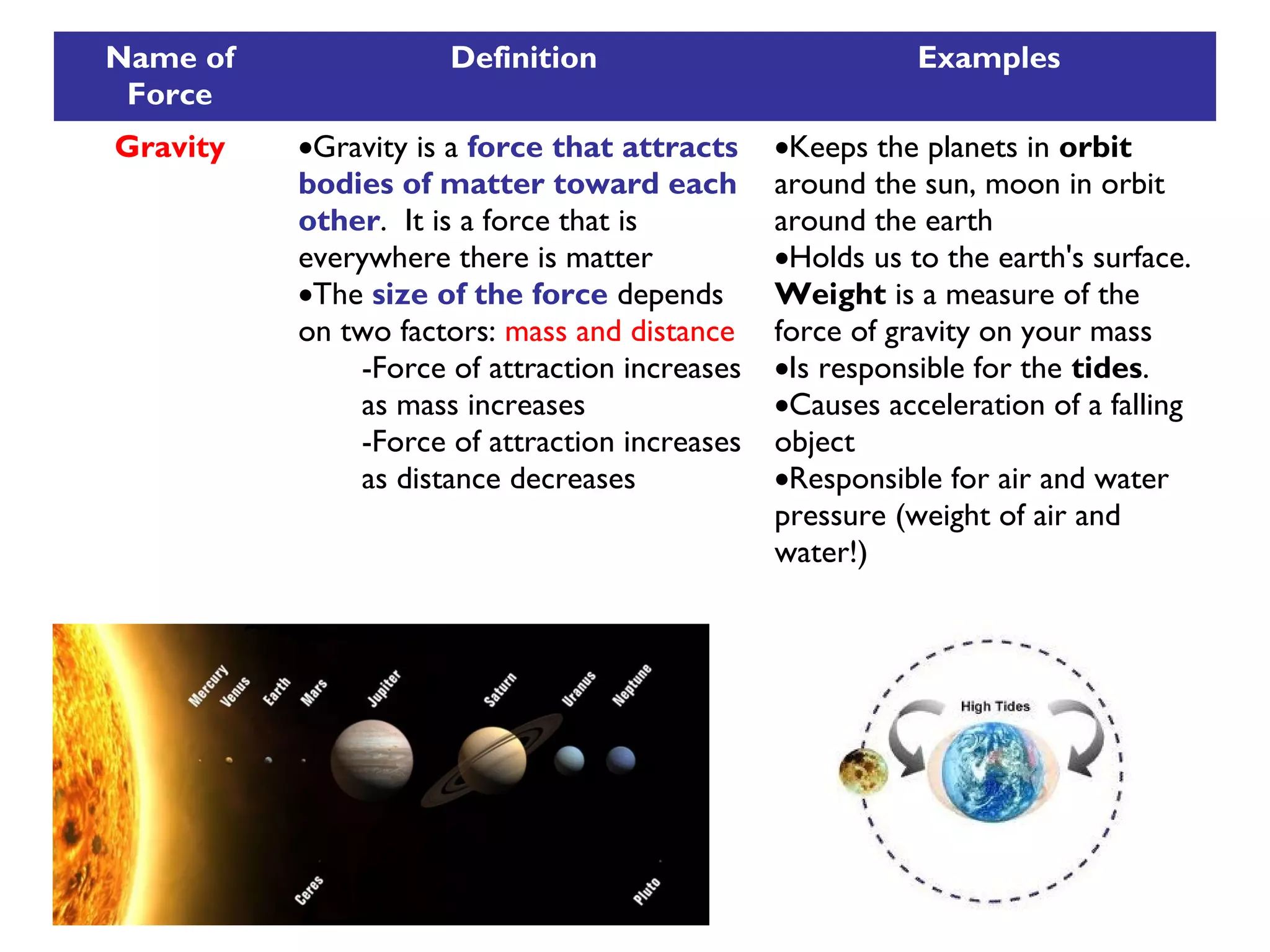
Gravity •Gravity is a force that attracts
bodies of matter toward each
other. It is a force that is
everywhere there is matter
•The size of the force depends
on two factors: mass and distance
-Force of attraction increases
as mass increases
-Force of attraction increases
as distance decreases
•Keeps the planets in orbit
around the sun, moon in orbit
around the earth
•Holds us to the earth's surface.
Weight is a measure of the
force of gravity on your mass
•Is responsible for the tides.
•Causes acceleration of a falling
object
•Responsible for air and water
pressure (weight of air and
water!)
Name of
Force
Definition Examples
Surface
Tension
•Liquid molecules are
attracted to each other (some
more than others!)
•Attraction between molecules
causes a “membrane” to form on
the surface of liquids
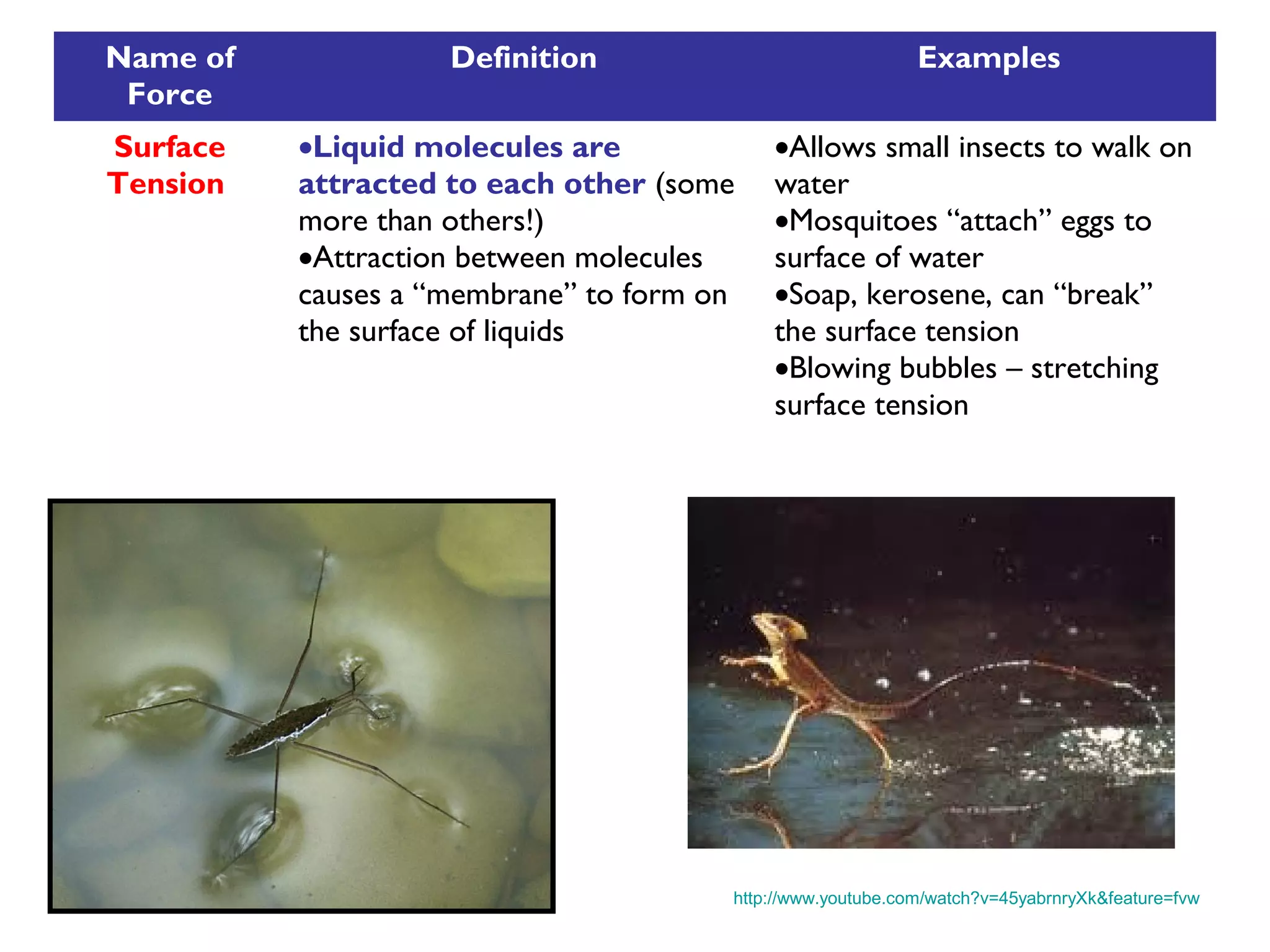
•Allows small insects to walk on
water
•Mosquitoes “attach” eggs to
surface of water
•Soap, kerosene, can “break”
the surface tension
•Blowing bubbles – stretching
surface tension
http://www.youtube.com/watch?v=45yabrnryXk&feature=fvw
Magnetic •An invisible force felt
within the space around a
magnet. 
•This space, called the
magnetic field, can either
attract (pull) or repel
(push away) other
magnets and some types
of metal.
•All magnets have two
poles. These poles are
opposites and are called
the north and south
poles. 
•Opposite poles attract,
while like poles, repel.
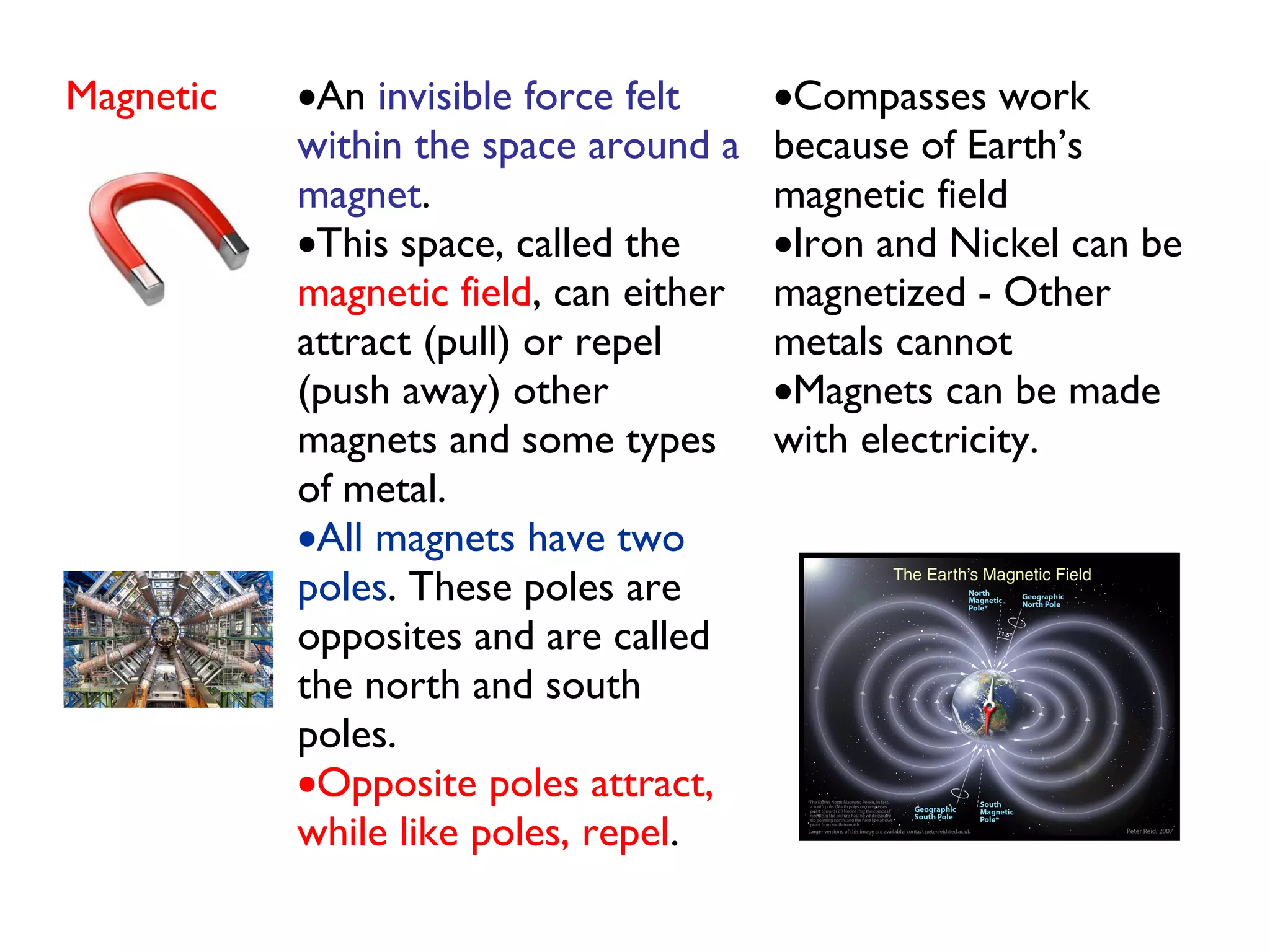
•Compasses work
because of Earth’s
magnetic field
•Iron and Nickel can be
magnetized - Other
metals cannot
•Magnets can be made
with electricity.
Electrical •A force between two
charged particles
•Opposite charges
attract, while like charges
repel.
•The size of the force
depends on two factors:
size of charge and
distance of objects
-Force of
attraction/repulsion
increases as the size of the
charge increases
-Force of
attraction/repulsion
increases as distance
decreases
•Static Electricity caused
by touching or rubbing
of two surfaces which
causes buildup of
charges
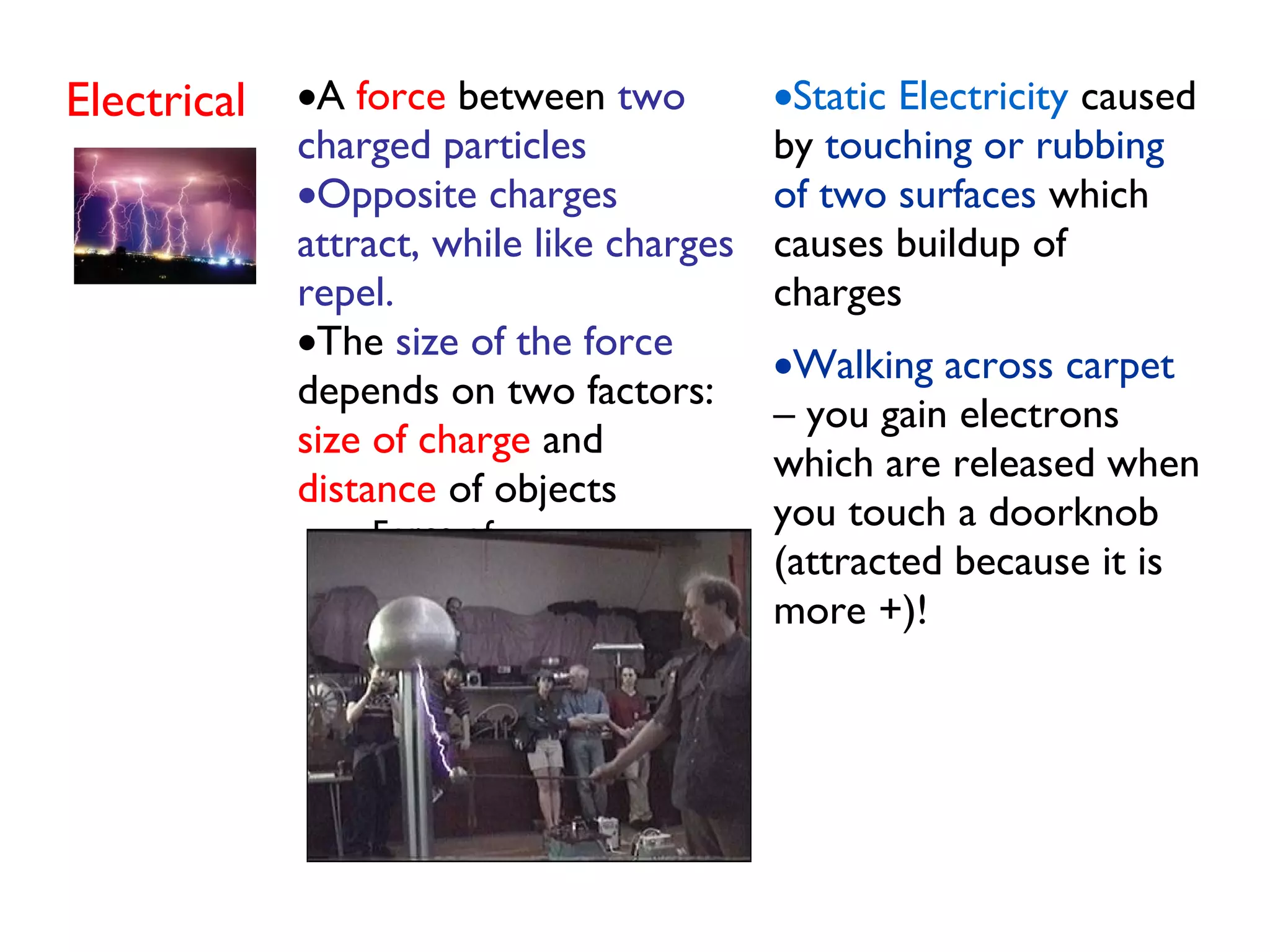
•Walking across carpet
– you gain electrons
which are released when
you touch a doorknob
(attracted because it is
more +)!
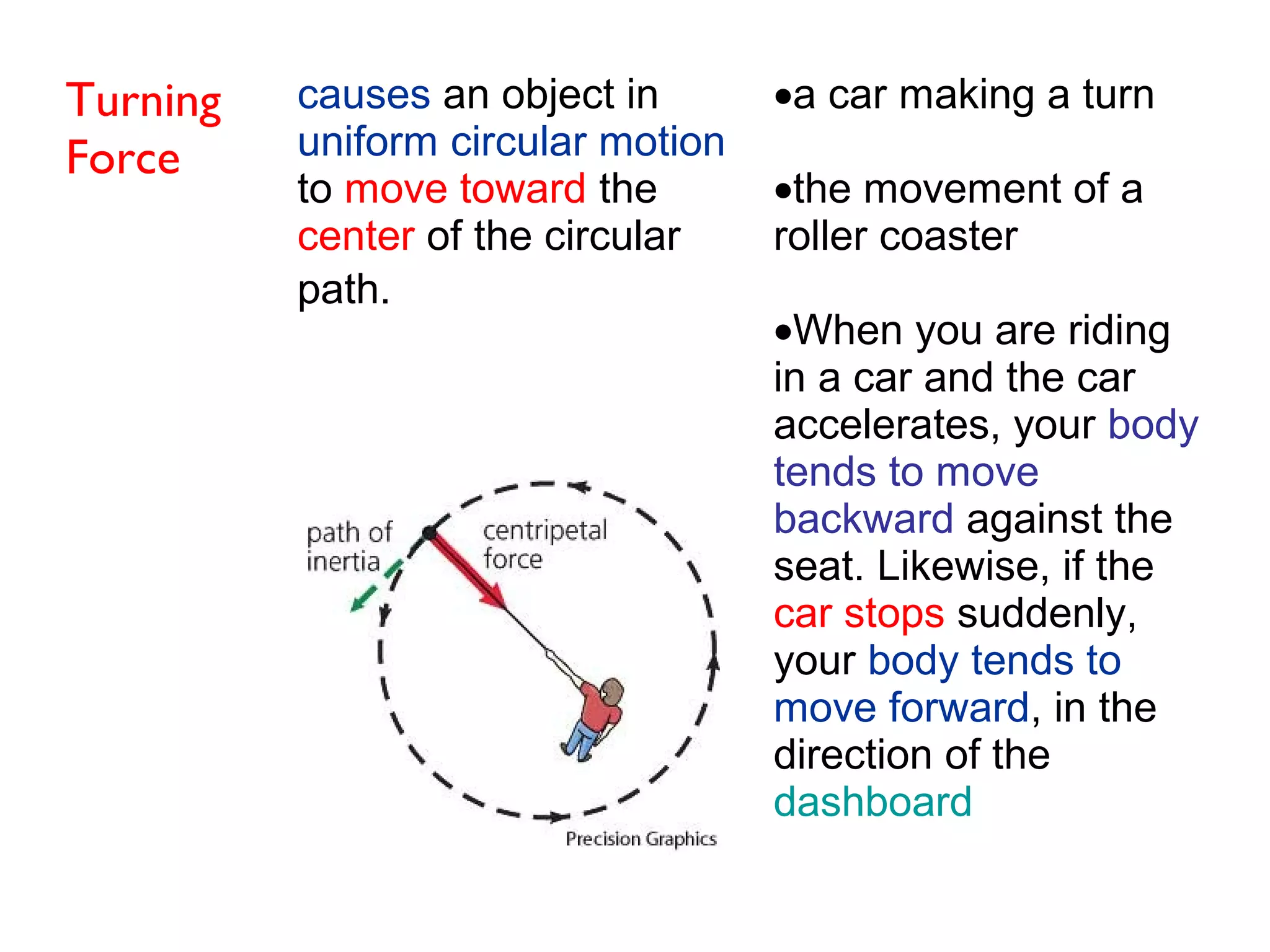
Turning
Force
causes an object in
uniform circular motion
to move toward the
center of the circular
path.
•a car making a turn
•the movement of a
roller coaster
•When you are riding
in a car and the car
accelerates, your body
tends to move
backward against the
seat. Likewise, if the
car stops suddenly,
your body tends to
move forward, in the
direction of the
dashboard
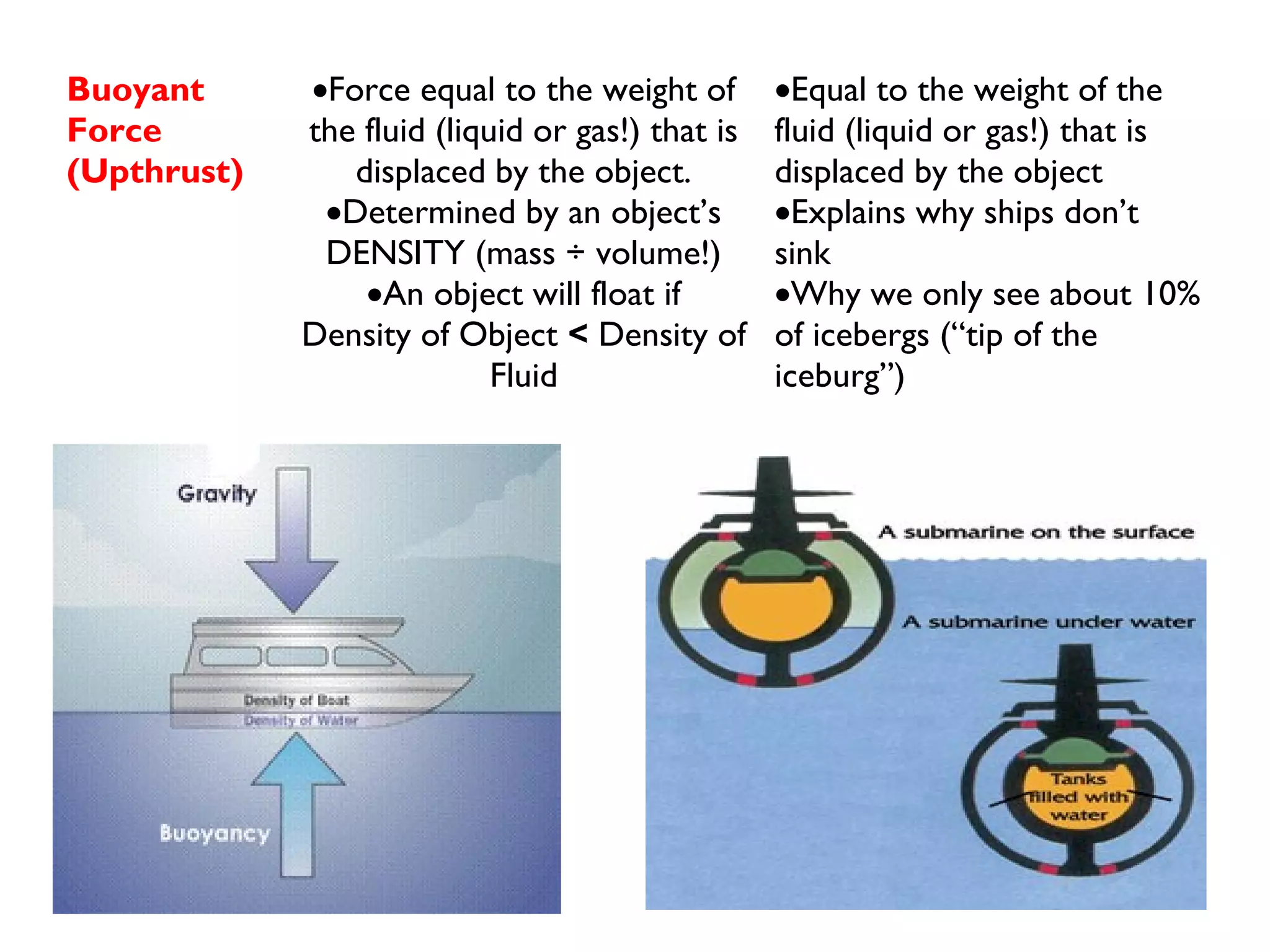
Buoyant
Force
(Upthrust)
•Force equal to the weight of
the fluid (liquid or gas!) that is
displaced by the object.
•Determined by an object’s
DENSITY (mass ÷ volume!)
•An object will float if
Density of Object < Density of
Fluid
•Equal to the weight of the
fluid (liquid or gas!) that is
displaced by the object
•Explains why ships don’t
sink
•Why we only see about 10%
of icebergs (“tip of the
iceburg”)
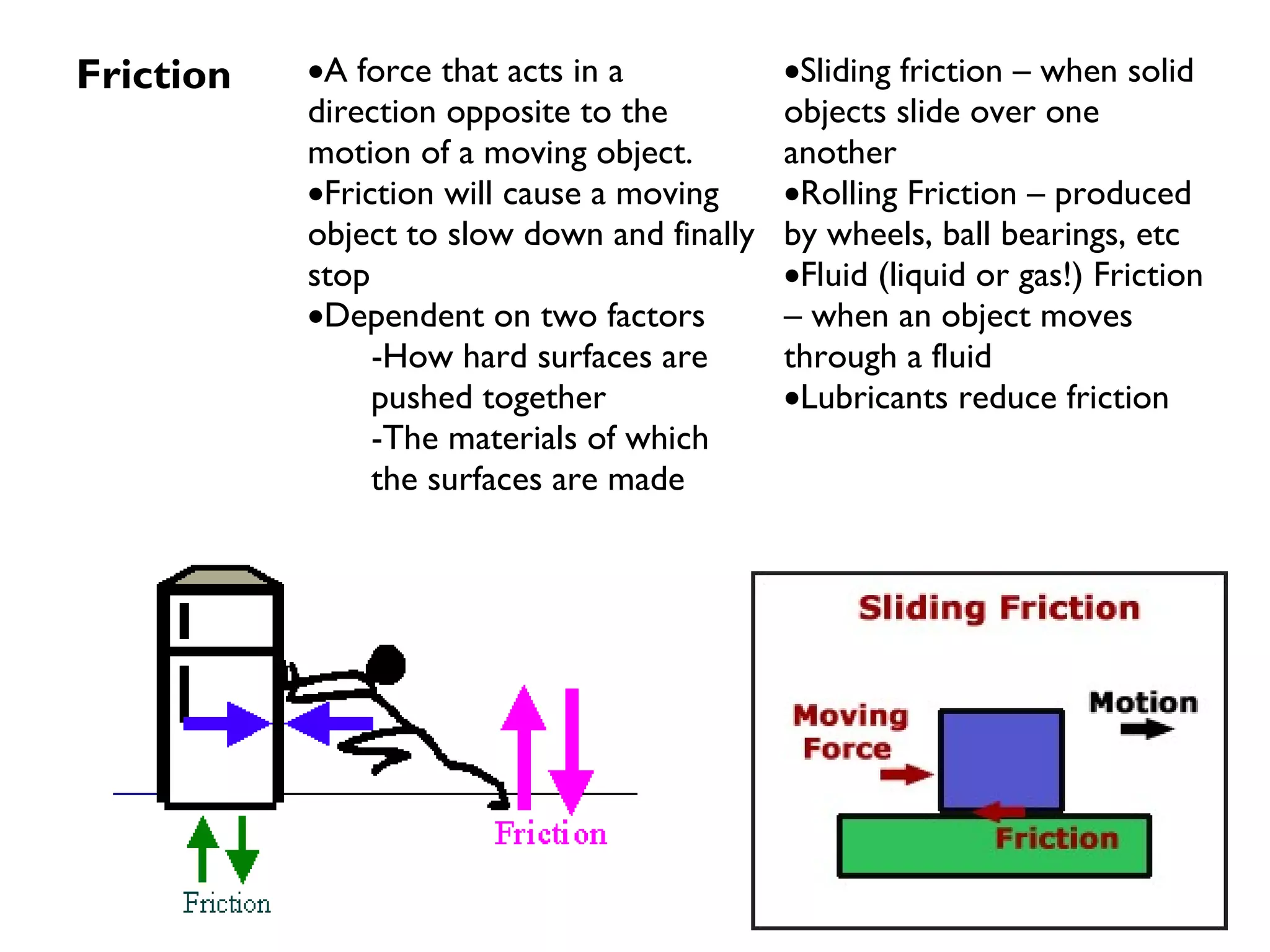
Friction •A force that acts in a
direction opposite to the
motion of a moving object.
•Friction will cause a moving
object to slow down and finally
stop
•Dependent on two factors
-How hard surfaces are
pushed together
-The materials of which
the surfaces are made
•Sliding friction – when solid
objects slide over one
another
•Rolling Friction – produced
by wheels, ball bearings, etc
•Fluid (liquid or gas!) Friction
– when an object moves
through a fluid
•Lubricants reduce friction
Friction is a force
that resists motion.
It involves objects that
are in contact with each
other.

Types of forces

  • 1.
    Name of Force Definition Examples Gravity•Gravity is a force that attracts bodies of matter toward each other. It is a force that is everywhere there is matter •The size of the force depends on two factors: mass and distance -Force of attraction increases as mass increases -Force of attraction increases as distance decreases •Keeps the planets in orbit around the sun, moon in orbit around the earth •Holds us to the earth's surface. Weight is a measure of the force of gravity on your mass •Is responsible for the tides. •Causes acceleration of a falling object •Responsible for air and water pressure (weight of air and water!)
  • 2.
    Name of Force Definition Examples Surface Tension •Liquidmolecules are attracted to each other (some more than others!) •Attraction between molecules causes a “membrane” to form on the surface of liquids •Allows small insects to walk on water •Mosquitoes “attach” eggs to surface of water •Soap, kerosene, can “break” the surface tension •Blowing bubbles – stretching surface tension http://www.youtube.com/watch?v=45yabrnryXk&feature=fvw
  • 3.
    Magnetic •An invisibleforce felt within the space around a magnet.  •This space, called the magnetic field, can either attract (pull) or repel (push away) other magnets and some types of metal. •All magnets have two poles. These poles are opposites and are called the north and south poles.  •Opposite poles attract, while like poles, repel. •Compasses work because of Earth’s magnetic field •Iron and Nickel can be magnetized - Other metals cannot •Magnets can be made with electricity.
  • 4.
    Electrical •A forcebetween two charged particles •Opposite charges attract, while like charges repel. •The size of the force depends on two factors: size of charge and distance of objects -Force of attraction/repulsion increases as the size of the charge increases -Force of attraction/repulsion increases as distance decreases •Static Electricity caused by touching or rubbing of two surfaces which causes buildup of charges •Walking across carpet – you gain electrons which are released when you touch a doorknob (attracted because it is more +)!
  • 5.
    Turning Force causes an objectin uniform circular motion to move toward the center of the circular path. •a car making a turn •the movement of a roller coaster •When you are riding in a car and the car accelerates, your body tends to move backward against the seat. Likewise, if the car stops suddenly, your body tends to move forward, in the direction of the dashboard
  • 6.
    Buoyant Force (Upthrust) •Force equal tothe weight of the fluid (liquid or gas!) that is displaced by the object. •Determined by an object’s DENSITY (mass ÷ volume!) •An object will float if Density of Object < Density of Fluid •Equal to the weight of the fluid (liquid or gas!) that is displaced by the object •Explains why ships don’t sink •Why we only see about 10% of icebergs (“tip of the iceburg”)
  • 7.
    Friction •A forcethat acts in a direction opposite to the motion of a moving object. •Friction will cause a moving object to slow down and finally stop •Dependent on two factors -How hard surfaces are pushed together -The materials of which the surfaces are made •Sliding friction – when solid objects slide over one another •Rolling Friction – produced by wheels, ball bearings, etc •Fluid (liquid or gas!) Friction – when an object moves through a fluid •Lubricants reduce friction
  • 8.
    Friction is aforce that resists motion. It involves objects that are in contact with each other.