PRESENTATION 
ON 
GRAVITY
PRESENTATION 
BY 
ANJALI. T 
PHYSICAL SCIENCE 
13386001 
ST.THOMAS TRAINING COLLEGE,MUKKOLAYKKAL
GUESS THE 
WEIGHT OF THE 
CHOCOLATE BAR 
REMEMBER TO 
INCLUDE UNIT OF 
MEASUREMENT
•It'1.5 N 
but why?
• Mass is a measure of how much matter or 
particles an object has. 
• Weight is a measure of how strongly 
gravity pulls on that matter 
• So if you were to travel to the moon, 
where gravity is weaker, what would 
change? 
• Just remember that the weight of an object 
depends on where it is, while its mass 
stays the same.
• I have two bags, both the same shape and 
size. One bag contains feathers and the 
other contains bricks. Which is heavier?.. 
• Which is heavier a ton of bricks or a ton of 
feathers?..
Gravity – what is it? 
• is an attractive force between objects 
with mass. 
• Gravity acts on the Earth by ppuulllliinngg 
objects towards its centre. 
• An object with heavier mass has a 
stronger gravitational pull = has a 
heavier weight.
Gravity – what is it? 
Which aarrrrooww iiss ppooiinnttiinngg 
tthhee wwrroonngg wwaayy??
Gravity – what is it? 
Yes, it’s this one
Who discovered it? 
• It was Sir Isaac Newton 
that ‘worked-out’ gravity. 
• 1643 – 1727 
• He was the greatest 
English mathematician of 
his generation. His work 
on optics and gravitation 
make him one of the 
greatest scientists the 
world has known.
Who discovered it? 
The story goes that he was 
sitting under an apple tree 
and an apple fell onto his 
head. He went to explore 
why it fell down and came up 
with a theory and 
mathematical equation.. He 
named it GRAVITY.
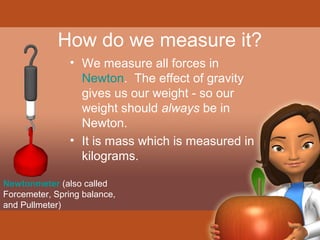
How do we measure it? 
• We measure all forces in 
Newton. The effect of gravity 
gives us our weight - so our 
weight should always be in 
Newton. 
• It is mass which is measured in 
kilograms. 
Newtonmeter (also called 
Forcemeter, Spring balance, 
and Pullmeter)
Gravity on 
Earth 
causes this 
man to 
accelerate 
downwards. 
Its effect is 
the same 
everywhere.
WEIGHT = MASS x GRAVITY 
(N) (kg)
The astronaut has a mass of 80kg 
but when will he weigh more? 
on the Moon on the Earth 
Gravity = 1.5 Gravity = 10 
Weight = 80 x1.5 
Weight = 
Weight = 80 x 10 
120 N Weight = 800 N
NAME OF 
OBJECT 
MASS 
(grams) 
To 
convert in 
to KG we 
(÷1000) 
MASS 
(Kilograms) 
The pull 
ofGravity 
is 10 so 
we (x10) 
WEIGHT 
(Newtons) 
A packet of 
crisps 
125g 
A car 
1500kg 
10 bags of 
sugar 
10,000g 
A football 
400g 
A mobile 
phone 
250N
THANK YOU

Gravity

  • 1.
  • 2.
    PRESENTATION BY ANJALI.T PHYSICAL SCIENCE 13386001 ST.THOMAS TRAINING COLLEGE,MUKKOLAYKKAL
  • 3.
    GUESS THE WEIGHTOF THE CHOCOLATE BAR REMEMBER TO INCLUDE UNIT OF MEASUREMENT
  • 4.
  • 5.
    • Mass isa measure of how much matter or particles an object has. • Weight is a measure of how strongly gravity pulls on that matter • So if you were to travel to the moon, where gravity is weaker, what would change? • Just remember that the weight of an object depends on where it is, while its mass stays the same.
  • 6.
    • I havetwo bags, both the same shape and size. One bag contains feathers and the other contains bricks. Which is heavier?.. • Which is heavier a ton of bricks or a ton of feathers?..
  • 7.
    Gravity – whatis it? • is an attractive force between objects with mass. • Gravity acts on the Earth by ppuulllliinngg objects towards its centre. • An object with heavier mass has a stronger gravitational pull = has a heavier weight.
  • 8.
    Gravity – whatis it? Which aarrrrooww iiss ppooiinnttiinngg tthhee wwrroonngg wwaayy??
  • 9.
    Gravity – whatis it? Yes, it’s this one
  • 10.
    Who discovered it? • It was Sir Isaac Newton that ‘worked-out’ gravity. • 1643 – 1727 • He was the greatest English mathematician of his generation. His work on optics and gravitation make him one of the greatest scientists the world has known.
  • 11.
    Who discovered it? The story goes that he was sitting under an apple tree and an apple fell onto his head. He went to explore why it fell down and came up with a theory and mathematical equation.. He named it GRAVITY.
  • 12.
    How do wemeasure it? • We measure all forces in Newton. The effect of gravity gives us our weight - so our weight should always be in Newton. • It is mass which is measured in kilograms. Newtonmeter (also called Forcemeter, Spring balance, and Pullmeter)
  • 14.
    Gravity on Earth causes this man to accelerate downwards. Its effect is the same everywhere.
  • 15.
    WEIGHT = MASSx GRAVITY (N) (kg)
  • 17.
    The astronaut hasa mass of 80kg but when will he weigh more? on the Moon on the Earth Gravity = 1.5 Gravity = 10 Weight = 80 x1.5 Weight = Weight = 80 x 10 120 N Weight = 800 N
  • 18.
    NAME OF OBJECT MASS (grams) To convert in to KG we (÷1000) MASS (Kilograms) The pull ofGravity is 10 so we (x10) WEIGHT (Newtons) A packet of crisps 125g A car 1500kg 10 bags of sugar 10,000g A football 400g A mobile phone 250N
  • 19.

Editor's Notes

  • #8 Teacher notes: Talk about man on the moon – did he walk normally? (No) It was the gravity that made him so light. Why didn’t the space rocket ‘fly’ off too? (It’s mass was much greater than a man!) Going to the moon is one sure way to lose weight! You might want to go further and talk about walking on Jupiter (has a much greater mass) and gravitational pull is stronger, so walking would be impossible. We would be much heavier on Jupiter! We might look very different if our planet’s mass was much greater – we would have had to evolve to cope with a much stronger gravitational pull.. maybe we’d be short and squat!
  • #9 Teacher notes: Talk about man on the moon – did he walk normally? (No) It was the gravity that made him so light. Why didn’t the space rocket ‘fly’ off too? (It’s mass was much greater than a man!) Going to the moon is one sure way to lose weight! You might want to go further and talk about walking on Jupiter (has a much greater mass) and gravitational pull is stronger, so walking would be impossible. We would be much heavier on Jupiter! We might look very different if our planet’s mass was much greater – we would have had to evolve to cope with a much stronger gravitational pull.. maybe we’d be short and squat!
  • #10 Teacher notes: Talk about man on the moon – did he walk normally? (No) It was the gravity that made him so light. Why didn’t the space rocket ‘fly’ off too? (It’s mass was much greater than a man!) Going to the moon is one sure way to lose weight! You might want to go further and talk about walking on Jupiter (has a much greater mass) and gravitational pull is stronger, so walking would be impossible. We would be much heavier on Jupiter! We might look very different if our planet’s mass was much greater – we would have had to evolve to cope with a much stronger gravitational pull.. maybe we’d be short and squat!
  • #11 Teacher Notes Although Newton and major scientists aren’t what we have to teach – it’s general knowledge. However, it’s also good to teach as another scientist (Einstein) did turn up in the 2006 SATs. Obviously, gravity wasn’t ‘discovered’ but it was Newton that formulated ideas and named it so. The apple story is not formally recorded and may be apocryphal, but it aids the memory nonetheless (and is fun).
  • #12 Teacher Notes Although Newton and major scientists aren’t what we have to teach – it’s general knowledge. However, it’s also good to teach as another scientist (Einstein) did turn up in the 2006 SATs. Obviously, gravity wasn’t ‘discovered’ but it was Newton that formulated ideas and named it so. The apple story is not formally recorded and may be apocryphal, but it aids the memory nonetheless (and is fun).