PREMATURE
LABOUR(PRETERM
LABOUR
PRESENTED BY
MRS.JOHN BRITTO MARY
(PROFESSOR IN NURSING)
DEFINITION
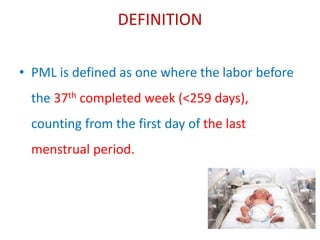
• PML is defined as one where the labor before
the 37th completed week (<259 days),
counting from the first day of the last
menstrual period.
INCIDENCE
• The prevalence widely varies and ranges
between 5-10%.
ETIOLOGY
Unknown causes
• But ,the following are, however related with
increased incidence of premature labour.
High risk factors:
1.History-
• Previous history of induced or spontaneous abortion
or preterm delivery.
• Pregnancy following assisted reproductive
techniques(ART) .
• Asymptomatic bacteriuria or recurrent urinary tract
infection, Smoking habits .
• Low socio – economic and nutritional status.
• Maternal stress.
• 2.complications in present pregnancy: may be
due to
• Maternal
• Fetal
• Placental
• Maternal –Pregnancy complications, uterine anomalies,
medical and surgical illness, chronic diseases, genital tract
infection
PREGNANCY COMPLICATIONS: Preeclampsia, APH, PROM,
Polyhydrominos.
• Uterine anomalies: Cervical incompetence, Malformation of
uterus.
• Medical and surgical illness: Acute fever, Acute pyleonephritis,
Diarrohea, Acute diabetes, Decompensated heart lesions,
severe anemia, low body mass index(LBMI).
• Genital tract infection: BACTERIAL vaginosis, Beta haemolytic
streptococcus, Bacterioides, Chlamydia, Mycoplasma.
• Fetal- Multiple pregnancy, Congenital malformations , Intra
uterine death.
• Placental- Infraction , Thrombosis , Placenta previa , or
Abruptia placenta.
• 3.Itrogenic: indicated preterm delivery due to
medical or obstetric complication.
• 4.Idiopathic(majority): premature effacement
of the cervix with irritable uterus and early
engagement of the head are often associated .
DIAGNOSIS
• Regular uterine contractions with or without pain (at least
one in every 10 minute)
• Dilatation>2cm and effacement 80% of the cervix
• Length of the cervix <2.5cm
• Pelvic pressure, backache and vaginal discharge or bleeding
INVESTIGATIONS
• Full blood count
• Urine for routine analysis,culture and
sensitivity
• Cervico vaginal swab for culture and
fibronectin
• Ultrasonography for fetal well being, cervical
length and placental location
• Serum electrolytes and glucose levels.
MANAGEMENT:
• To prevent preterm onset of labour
• To arrest preterm labour, if not
contraindicated
• Appropriate management of labour
• Effective neonatal care
FIRST STAGE:
• The patient is put to bed to prevent early
rupture of membranes.
• To ensure adequate foetal oxygenation by
giving oxygen to the mother by mask.
• Epidural analgesia is of choice.
• Labour should be carefully monitored
preferably with continuous EFM.
• Caesarean delivery is done for obstetric
reasons only.
• NICU is a sin-quanom for good outcome.
SECOND STAGE:
• The birth should be gentle and slow to avoid
rapid compression and decompression of the
heal.
• Episiotomy may be done to minimise heal
compression if there is perineal resistance.
• Tendency to delay is curtailed by low forceps. as
such, routine forceps is not indicated.
• The cord is to be clamped immediately at birth to
prevent hypervolaemia and hyperbilirubinaemia.
• To shift the baby to neonatal intensive care unit
under the care of a neonatologist.
PREDICTORS OF PREMATURE LABOUR:
• Multiple pregnancy
• History of preterm birth
• Presence of genital tract infection
• Symptoms of PTL
PREVENTION OF PML:
• Primary care is aimed to reduce the incidence
of preterm labour by reducing to high risk
factors eg.infection.
• Secondary care includes screening tests for
early detection and prophylactic treatment
eg.tocolytics.
• Tertiary care is aimed to reduce the perinatal
morbidity and mortality after the diagnosis
eg.use of corticosteroids.
 PRE TERM LABOUR

PRE TERM LABOUR

  • 1.
  • 2.
    DEFINITION • PML isdefined as one where the labor before the 37th completed week (<259 days), counting from the first day of the last menstrual period.
  • 3.
    INCIDENCE • The prevalencewidely varies and ranges between 5-10%.
  • 4.
    ETIOLOGY Unknown causes • But,the following are, however related with increased incidence of premature labour. High risk factors: 1.History- • Previous history of induced or spontaneous abortion or preterm delivery. • Pregnancy following assisted reproductive techniques(ART) . • Asymptomatic bacteriuria or recurrent urinary tract infection, Smoking habits . • Low socio – economic and nutritional status. • Maternal stress.
  • 5.
    • 2.complications inpresent pregnancy: may be due to • Maternal • Fetal • Placental
  • 6.
    • Maternal –Pregnancycomplications, uterine anomalies, medical and surgical illness, chronic diseases, genital tract infection PREGNANCY COMPLICATIONS: Preeclampsia, APH, PROM, Polyhydrominos. • Uterine anomalies: Cervical incompetence, Malformation of uterus. • Medical and surgical illness: Acute fever, Acute pyleonephritis, Diarrohea, Acute diabetes, Decompensated heart lesions, severe anemia, low body mass index(LBMI). • Genital tract infection: BACTERIAL vaginosis, Beta haemolytic streptococcus, Bacterioides, Chlamydia, Mycoplasma. • Fetal- Multiple pregnancy, Congenital malformations , Intra uterine death. • Placental- Infraction , Thrombosis , Placenta previa , or Abruptia placenta.
  • 7.
    • 3.Itrogenic: indicatedpreterm delivery due to medical or obstetric complication. • 4.Idiopathic(majority): premature effacement of the cervix with irritable uterus and early engagement of the head are often associated .
  • 8.
    DIAGNOSIS • Regular uterinecontractions with or without pain (at least one in every 10 minute) • Dilatation>2cm and effacement 80% of the cervix • Length of the cervix <2.5cm • Pelvic pressure, backache and vaginal discharge or bleeding
  • 9.
    INVESTIGATIONS • Full bloodcount • Urine for routine analysis,culture and sensitivity • Cervico vaginal swab for culture and fibronectin • Ultrasonography for fetal well being, cervical length and placental location • Serum electrolytes and glucose levels.
  • 10.
    MANAGEMENT: • To preventpreterm onset of labour • To arrest preterm labour, if not contraindicated • Appropriate management of labour • Effective neonatal care
  • 11.
    FIRST STAGE: • Thepatient is put to bed to prevent early rupture of membranes. • To ensure adequate foetal oxygenation by giving oxygen to the mother by mask. • Epidural analgesia is of choice. • Labour should be carefully monitored preferably with continuous EFM. • Caesarean delivery is done for obstetric reasons only. • NICU is a sin-quanom for good outcome.
  • 12.
    SECOND STAGE: • Thebirth should be gentle and slow to avoid rapid compression and decompression of the heal. • Episiotomy may be done to minimise heal compression if there is perineal resistance. • Tendency to delay is curtailed by low forceps. as such, routine forceps is not indicated. • The cord is to be clamped immediately at birth to prevent hypervolaemia and hyperbilirubinaemia. • To shift the baby to neonatal intensive care unit under the care of a neonatologist.
  • 13.
    PREDICTORS OF PREMATURELABOUR: • Multiple pregnancy • History of preterm birth • Presence of genital tract infection • Symptoms of PTL
  • 14.
    PREVENTION OF PML: •Primary care is aimed to reduce the incidence of preterm labour by reducing to high risk factors eg.infection. • Secondary care includes screening tests for early detection and prophylactic treatment eg.tocolytics. • Tertiary care is aimed to reduce the perinatal morbidity and mortality after the diagnosis eg.use of corticosteroids.

Editor's Notes

  • #13  hypervolaemia -medical condition where there is too much fluid in the blood. Hyperbilirubinaemia-abnormal increase of BILIRUBIN in the blood,