CONTRACTED PELVIS
Sharon Treesa Antony
Second year M.Sc Nursing
Govt. College of Nursing Kottayam
DEFINITION
 Anatomically contracted pelvis is defined as one
where the essential diameters of one or more
planes are shortened by 0.5cm.
 Obstetrically, it is a state in which there is alteration
in size or shape of the pelvis of sufficient degree a
to alter the normal mechanism of labour in an
average size baby.
ETIOLOGY
 Short women
 Nutritional and environmental defects
 Diseases or injuries affecting bones of the pelvis:
fracture, tumors, TB arthritis
 Spine: kyphosis, scoliosis, spondylolisthesis,
coccygeal deformity
 Lower limbs: poliomyelitis, hip joint disease
 Developmental defects: Naegel’s pelvis, Robert’s
pelvis, high or low assimilation pelvis
RACHITIC FLAT PELVIS
 Inlet
 Sacral promontary is pushed downwards or
forwards producing a reniform shape
 Short APD
 Cavity
 Sacrum is flat and tilted backwards
 Sharp angulation at sacrococcygeal joint
 Outlet
 Widened transverse diameter and pubic church
OSTEOMALACIC PELVIS
 Due to softening of the pubic bones
 The promontary is pushed downwards and
forwards and the lateral pelvic walls are pushed
inwards causing the anterior wall to form a beak
 Triradiate shape of inlet
 Approximation of 2 ischial tuberosities
 Markedly shortened sacrum
 Coccyx is pushed forward
ASYMMETRICAL/ OBLIQUELY CONTRACTED
PELVIS
 Naegel’s pelvis
 Scoliotic pelvis
 Disease affecting one hip or sacroiliac joint
 Tumors or fracture affecting one side of the pelvic
bones during growing age
NAEGELE’S PELVIS
 Due to arrested development of one ala of the
sacrum
 Congenital
 Acquired( osteitis of sacroiliac joint)
 Pelvis is obliquely contracted at all levels but more
marked in the outlet
 Straight iliopectineal line on the affected side
SCOLIOSIS
 Acetabulam is pushed inwards on the weight
bearing side
 Contraction of one of the oblique diameters
ROBERT’S PELVIS
 Ala of both the sides are absent
 Sacrum is fused with innominate bones
KYPHOTIC PELVIS
 Sacrum is tilted backward in the upper part and
towards the lower part, it is narrow and straight
 APD is increased at the inlet but is decreased at the
outlet
 Narrow suprapubic angle
 Pendulous abdomen
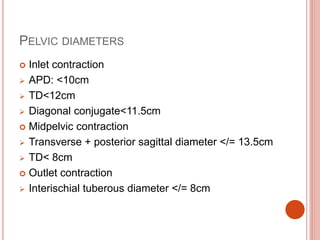
PELVIC DIAMETERS
 Inlet contraction
 APD: <10cm
 TD<12cm
 Diagonal conjugate<11.5cm
 Midpelvic contraction
 Transverse + posterior sagittal diameter </= 13.5cm
 TD< 8cm
 Outlet contraction
 Interischial tuberous diameter </= 8cm
DIAGNOSIS
 Past history
 Physical examination
 Deformities of pelvic bones, hip joint, spine
 Dystocia dystrophia sundrome
 Abdominal examination
ASSESSMENT OF PELVIS
 Clinical pelvimetry
 Sacrum: smooth, short and well curved and the
promontary cannot bereached or the sacrum may
be long or straight
 SacroSciatic notch:
The notch is sufficiently wide so that 2 fingngers can
be easily placed over the sacrspinous ligament
covering the notch
 Ischial spines: spines are usually smootha nd
difficult to palpate. They may be prominent or
encroach to the cavty
 Iliopectineallines: beaking suggestive of narroe
forepelvis
 Side walls: convergent
 Posterior surface of symphysis pubis angulation/
beaking
 Sacrococcygeal joint: mobility and hooked coccyx
 Pubic arch: shoulld accomodate palmar aspect of 2
fingers
 Diagonal conjugate : may be less
 Subpubic angle: roughly corresponds to fully
abducted middle and index fingers
 TD of outlet: by placing the knuckles between the
ischial tuberosities
 APD of outlet
 X ray pelvimetry
 CT
 MRI
 USG
CEPAHLO PELVIC DISPROPORTION
 It is a state where the normal proportion between
the size of the fetus to the pelvis is isturbed.
DIAGNOSIS
 Clinical
 Abdominal
 Abdomino vaginal method
 Imaging pelvimetry
 Cephalometry
 USG
 MRI
 X ray
EFFECTS OF CONTRACTED PELVIS
 Pregnancy
 Chance of incarceration of retroverted gravid uterus
in flat pelvis
 Abdomen becomes pendulous
 Malpresentations
 Labor
 Increased incidence of early rupture of membranes
 Cord prolapse
 Slow cervical dilatation
 Prolonged or obstructed labour
 Operative interference, PPH, Shock
 Maternal injuries
 Fetal hazards from asphyxia
MANAGEMENT OF INLET CONTRACTION
 Ascertain the degree of disproportion
 Minor inlet contraction:
spontaneous delivery
 Moderate and severe degrees:
Induction of labor
CS
Trial labor
INDUCTION OF LABOR
 2-3 week prior to EDC in multi gravida with history
previous difficult labor
ELECTIVE CS
 Major degree of inlet contraction
 Moderate degree of inlet contraction with outlet
contraction or other complicating factors like
malpresentation
TRIAL LABOUR
 It is the conduction of spontaneous labour i
moderate degree of cephalopelvic disproportion, in
an institution under supervision with watchful
expectancy, hoping for a vaginal delivery
CONTRAINDICATIONS
 Associated mid pelvic and outlet contraction
 Presence of complicating factors like primigarvida,
malpresentation, postmaturity, post caesarean
pregnancy, pre eclampsia, medical disorders like
heart disease, diabetes, TB etc
 Lack of facilities for caesarean section round the
clock
CONDUCTION OF TRIAL LABOUR
 Prefers spontaneous labor, induce only if labor
doesnot start even after due date
 NPO, maintain hydration by IVF, adequate
analgesics
 Maintain partograph
 Maternal and fetal monitoring
 In failure to progrs: amniotomy+ oxytocin after
cervix is 3cm
 Pelvic examination after membranes are ruptured
FAVOURABLE FACTORS
 Flat pelvis better than android
 Vertex
 Degree of contraction: minor
 Intact membranes till full dialatation
 Good uterine contraction
 Emotional stability of woman
UNFAVOURABLE FEATURES
 Appearance of abnormal uterine contraction
 Cervical <1cm/hour in the active phase
 Descent of fetal head < 1cm/hour
 Arrest of cervical dilation and nondescent of fetal
head inspite of oxytocin therapy
 Early rupture of membranes
 Formation of caput and evidence of excessive
mouldng
 Fetal distress
HOW LONG TRIAL TO BE CONTINUED
 Termination of trial
 Spontaneous delivery with or without episiotomy
 Forceps/ ventouse: difficult forceps delivery is to be
avoided
 Caesarean section
MIDPELVIC AND OUTLET CONTRACTION
 CPD at the outlet is defined as one where the
biparietal – suboccipitobregmatic plane fails to pass
through the bispinous and anteroposterior plane of
the outlet.
MANAGEMENT
 Elective caesarean section
 Vaginal delivery:
 In minor degrees of contraction
 with watchful expectancy
 Forceps/ventouse+ deep episiotomy
 Patograph
 Oxytocin SOS
CASES SEEN LATE IN LABOUR
 Caesarean section to avoid difficu;t forceps
 Forceps with deep episiotomy
 Syphysiotomy foolowed by ventouse
 Craniotomy if fetus is dead
THANK YOU

Contracted pelvis

  • 1.
    CONTRACTED PELVIS Sharon TreesaAntony Second year M.Sc Nursing Govt. College of Nursing Kottayam
  • 2.
    DEFINITION  Anatomically contractedpelvis is defined as one where the essential diameters of one or more planes are shortened by 0.5cm.  Obstetrically, it is a state in which there is alteration in size or shape of the pelvis of sufficient degree a to alter the normal mechanism of labour in an average size baby.
  • 3.
    ETIOLOGY  Short women Nutritional and environmental defects  Diseases or injuries affecting bones of the pelvis: fracture, tumors, TB arthritis  Spine: kyphosis, scoliosis, spondylolisthesis, coccygeal deformity  Lower limbs: poliomyelitis, hip joint disease
  • 4.
     Developmental defects:Naegel’s pelvis, Robert’s pelvis, high or low assimilation pelvis
  • 5.
    RACHITIC FLAT PELVIS Inlet  Sacral promontary is pushed downwards or forwards producing a reniform shape  Short APD  Cavity  Sacrum is flat and tilted backwards  Sharp angulation at sacrococcygeal joint  Outlet  Widened transverse diameter and pubic church
  • 6.
    OSTEOMALACIC PELVIS  Dueto softening of the pubic bones  The promontary is pushed downwards and forwards and the lateral pelvic walls are pushed inwards causing the anterior wall to form a beak  Triradiate shape of inlet  Approximation of 2 ischial tuberosities  Markedly shortened sacrum  Coccyx is pushed forward
  • 7.
    ASYMMETRICAL/ OBLIQUELY CONTRACTED PELVIS Naegel’s pelvis  Scoliotic pelvis  Disease affecting one hip or sacroiliac joint  Tumors or fracture affecting one side of the pelvic bones during growing age
  • 8.
    NAEGELE’S PELVIS  Dueto arrested development of one ala of the sacrum  Congenital  Acquired( osteitis of sacroiliac joint)  Pelvis is obliquely contracted at all levels but more marked in the outlet  Straight iliopectineal line on the affected side
  • 9.
    SCOLIOSIS  Acetabulam ispushed inwards on the weight bearing side  Contraction of one of the oblique diameters
  • 10.
    ROBERT’S PELVIS  Alaof both the sides are absent  Sacrum is fused with innominate bones
  • 11.
    KYPHOTIC PELVIS  Sacrumis tilted backward in the upper part and towards the lower part, it is narrow and straight  APD is increased at the inlet but is decreased at the outlet  Narrow suprapubic angle  Pendulous abdomen
  • 12.
    PELVIC DIAMETERS  Inletcontraction  APD: <10cm  TD<12cm  Diagonal conjugate<11.5cm  Midpelvic contraction  Transverse + posterior sagittal diameter </= 13.5cm  TD< 8cm  Outlet contraction  Interischial tuberous diameter </= 8cm
  • 13.
    DIAGNOSIS  Past history Physical examination  Deformities of pelvic bones, hip joint, spine  Dystocia dystrophia sundrome  Abdominal examination
  • 14.
    ASSESSMENT OF PELVIS Clinical pelvimetry  Sacrum: smooth, short and well curved and the promontary cannot bereached or the sacrum may be long or straight  SacroSciatic notch: The notch is sufficiently wide so that 2 fingngers can be easily placed over the sacrspinous ligament covering the notch
  • 15.
     Ischial spines:spines are usually smootha nd difficult to palpate. They may be prominent or encroach to the cavty  Iliopectineallines: beaking suggestive of narroe forepelvis
  • 16.
     Side walls:convergent  Posterior surface of symphysis pubis angulation/ beaking  Sacrococcygeal joint: mobility and hooked coccyx  Pubic arch: shoulld accomodate palmar aspect of 2 fingers  Diagonal conjugate : may be less  Subpubic angle: roughly corresponds to fully abducted middle and index fingers
  • 17.
     TD ofoutlet: by placing the knuckles between the ischial tuberosities  APD of outlet
  • 18.
     X raypelvimetry  CT  MRI  USG
  • 19.
    CEPAHLO PELVIC DISPROPORTION It is a state where the normal proportion between the size of the fetus to the pelvis is isturbed.
  • 20.
    DIAGNOSIS  Clinical  Abdominal Abdomino vaginal method  Imaging pelvimetry  Cephalometry  USG  MRI  X ray
  • 21.
    EFFECTS OF CONTRACTEDPELVIS  Pregnancy  Chance of incarceration of retroverted gravid uterus in flat pelvis  Abdomen becomes pendulous  Malpresentations
  • 22.
     Labor  Increasedincidence of early rupture of membranes  Cord prolapse  Slow cervical dilatation  Prolonged or obstructed labour  Operative interference, PPH, Shock
  • 23.
     Maternal injuries Fetal hazards from asphyxia
  • 24.
    MANAGEMENT OF INLETCONTRACTION  Ascertain the degree of disproportion  Minor inlet contraction: spontaneous delivery  Moderate and severe degrees: Induction of labor CS Trial labor
  • 25.
    INDUCTION OF LABOR 2-3 week prior to EDC in multi gravida with history previous difficult labor
  • 26.
    ELECTIVE CS  Majordegree of inlet contraction  Moderate degree of inlet contraction with outlet contraction or other complicating factors like malpresentation
  • 27.
    TRIAL LABOUR  Itis the conduction of spontaneous labour i moderate degree of cephalopelvic disproportion, in an institution under supervision with watchful expectancy, hoping for a vaginal delivery
  • 28.
    CONTRAINDICATIONS  Associated midpelvic and outlet contraction  Presence of complicating factors like primigarvida, malpresentation, postmaturity, post caesarean pregnancy, pre eclampsia, medical disorders like heart disease, diabetes, TB etc  Lack of facilities for caesarean section round the clock
  • 29.
    CONDUCTION OF TRIALLABOUR  Prefers spontaneous labor, induce only if labor doesnot start even after due date  NPO, maintain hydration by IVF, adequate analgesics  Maintain partograph  Maternal and fetal monitoring  In failure to progrs: amniotomy+ oxytocin after cervix is 3cm  Pelvic examination after membranes are ruptured
  • 30.
    FAVOURABLE FACTORS  Flatpelvis better than android  Vertex  Degree of contraction: minor  Intact membranes till full dialatation  Good uterine contraction  Emotional stability of woman
  • 31.
    UNFAVOURABLE FEATURES  Appearanceof abnormal uterine contraction  Cervical <1cm/hour in the active phase  Descent of fetal head < 1cm/hour  Arrest of cervical dilation and nondescent of fetal head inspite of oxytocin therapy  Early rupture of membranes  Formation of caput and evidence of excessive mouldng  Fetal distress
  • 32.
    HOW LONG TRIALTO BE CONTINUED  Termination of trial  Spontaneous delivery with or without episiotomy  Forceps/ ventouse: difficult forceps delivery is to be avoided  Caesarean section
  • 33.
    MIDPELVIC AND OUTLETCONTRACTION  CPD at the outlet is defined as one where the biparietal – suboccipitobregmatic plane fails to pass through the bispinous and anteroposterior plane of the outlet.
  • 34.
    MANAGEMENT  Elective caesareansection  Vaginal delivery:  In minor degrees of contraction  with watchful expectancy  Forceps/ventouse+ deep episiotomy  Patograph  Oxytocin SOS
  • 35.
    CASES SEEN LATEIN LABOUR  Caesarean section to avoid difficu;t forceps  Forceps with deep episiotomy  Syphysiotomy foolowed by ventouse  Craniotomy if fetus is dead
  • 36.