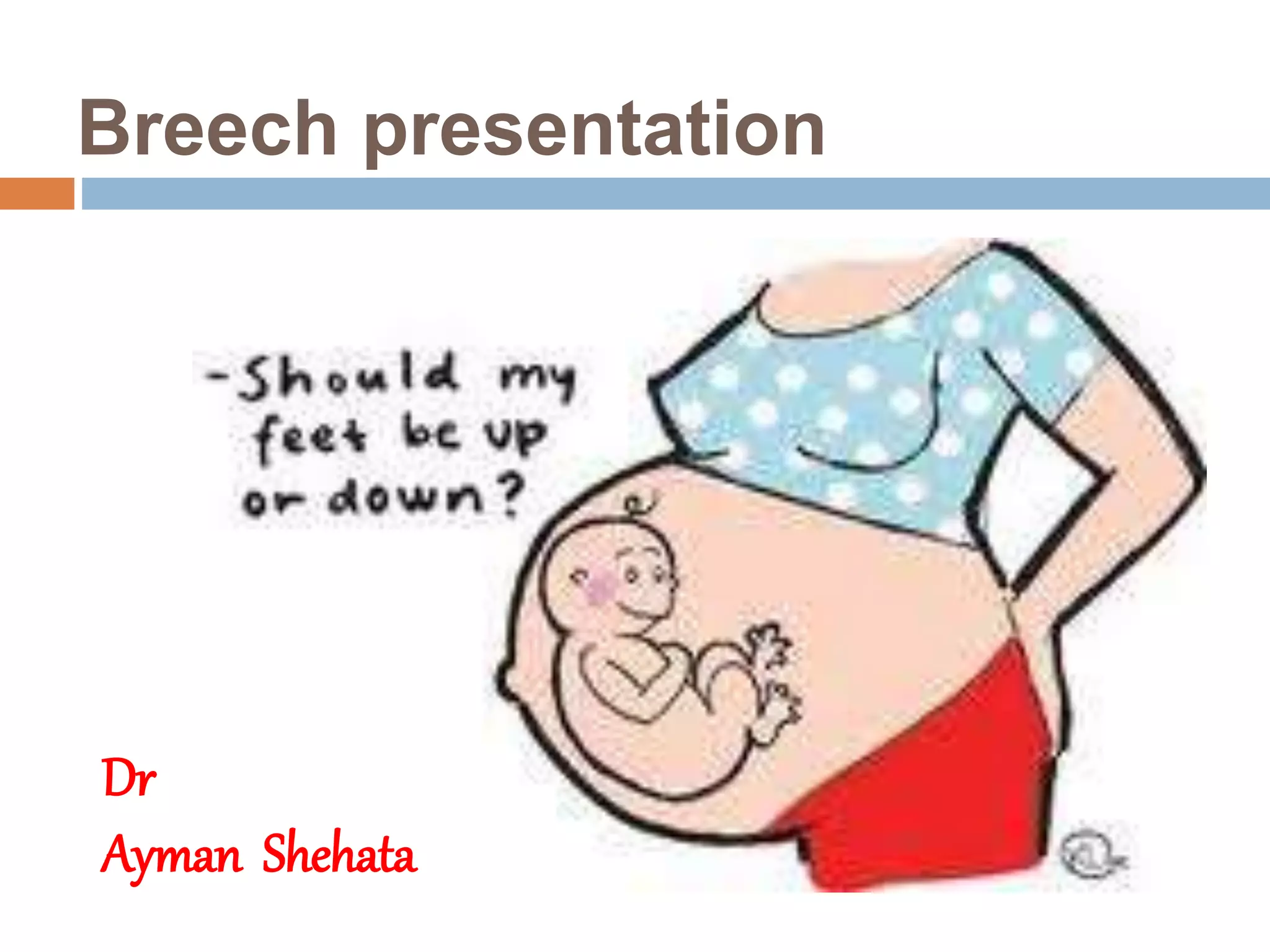
Breech presentation
Dr
Ayman Shehata
Definition
Breech presentation is
the presentation in which
the fetus is in longitudinal
lie and its buttock is the
lower most part .
Incidence
 28 weeks…25%
 Term 2-3%
 1/3 are undiagnosed in labour
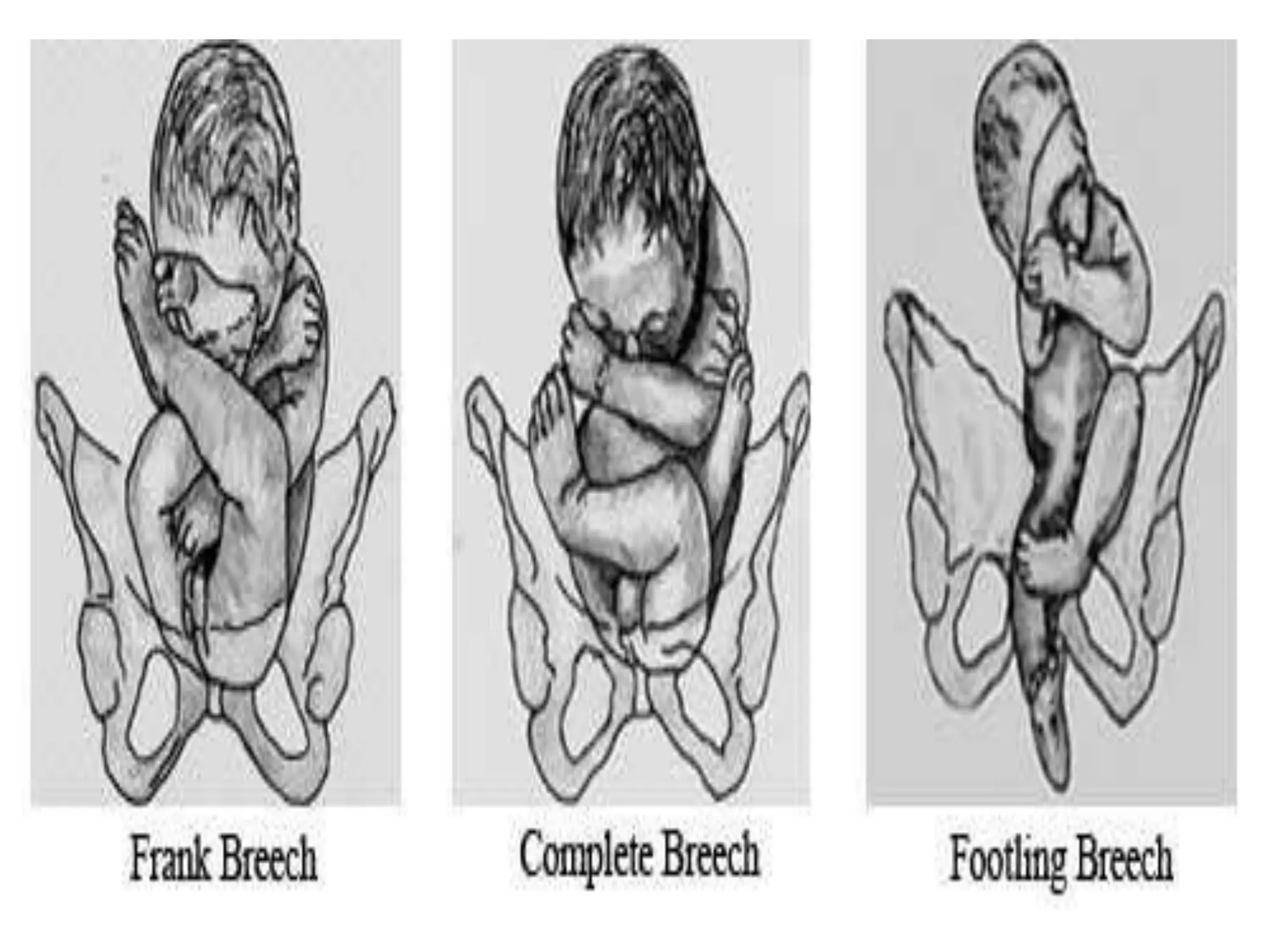
classifications
 Frank breech (65%): where the hips are
flexed and legs extended
 Complete breech (25%): where the hips and
knees are flexed and the feet are not below the
level of the fetal buttocks
 Footling breech: where one or both feet are
presenting as the lowest part of the fetus
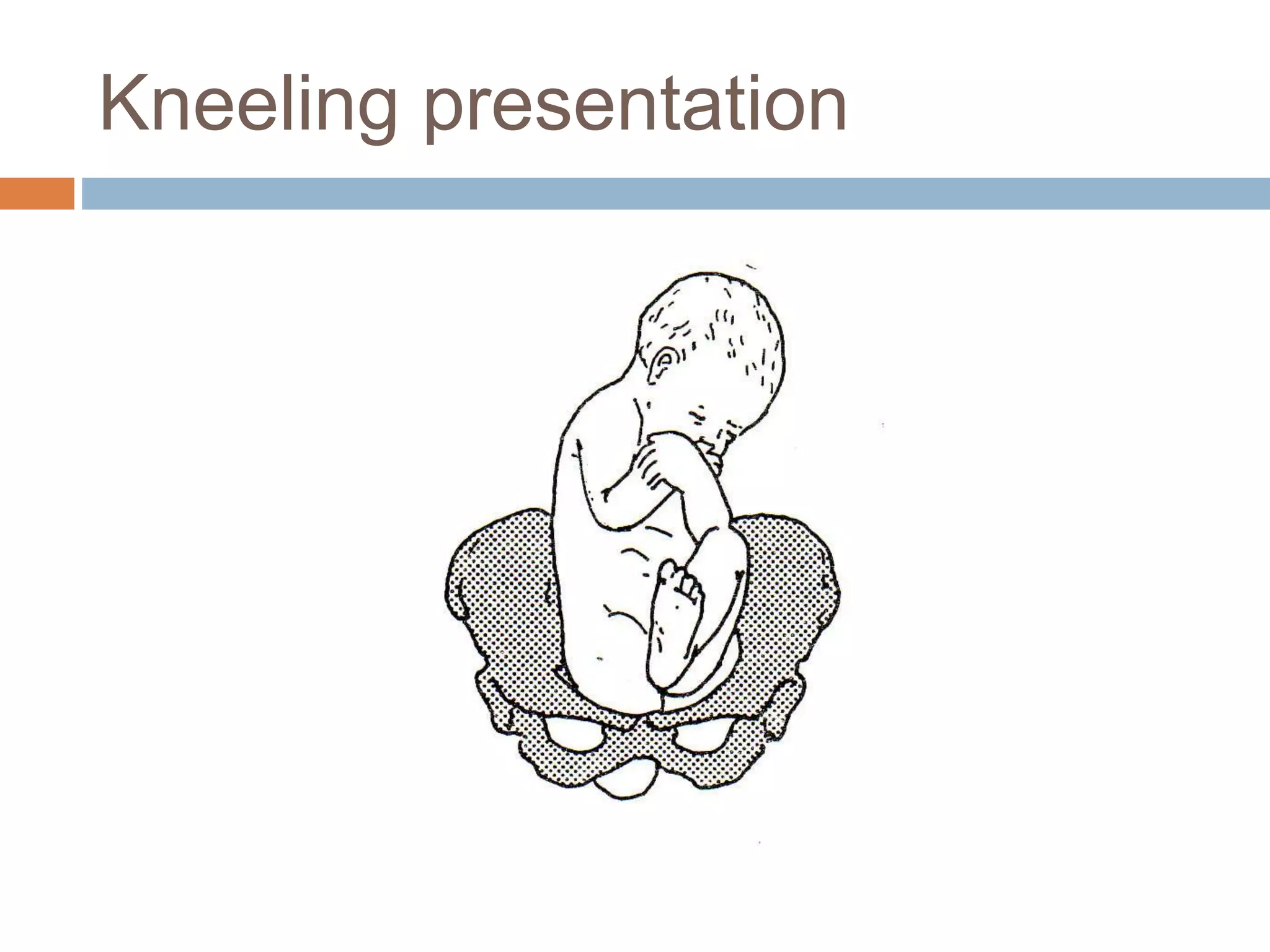
 Kneeling: kneesare the lowermost presenting
part
Kneeling presentation
Positions
the denominate is the sacrum:
 First position;
left sacro-anterior (back anterior and to left).
 Second position;
right sacro-anterior (back anterior and to right).
 Third position;
right sacro-posterior (back posterior and to right).
 Fourth position;
left sacro-posterior (back posterior and to left).
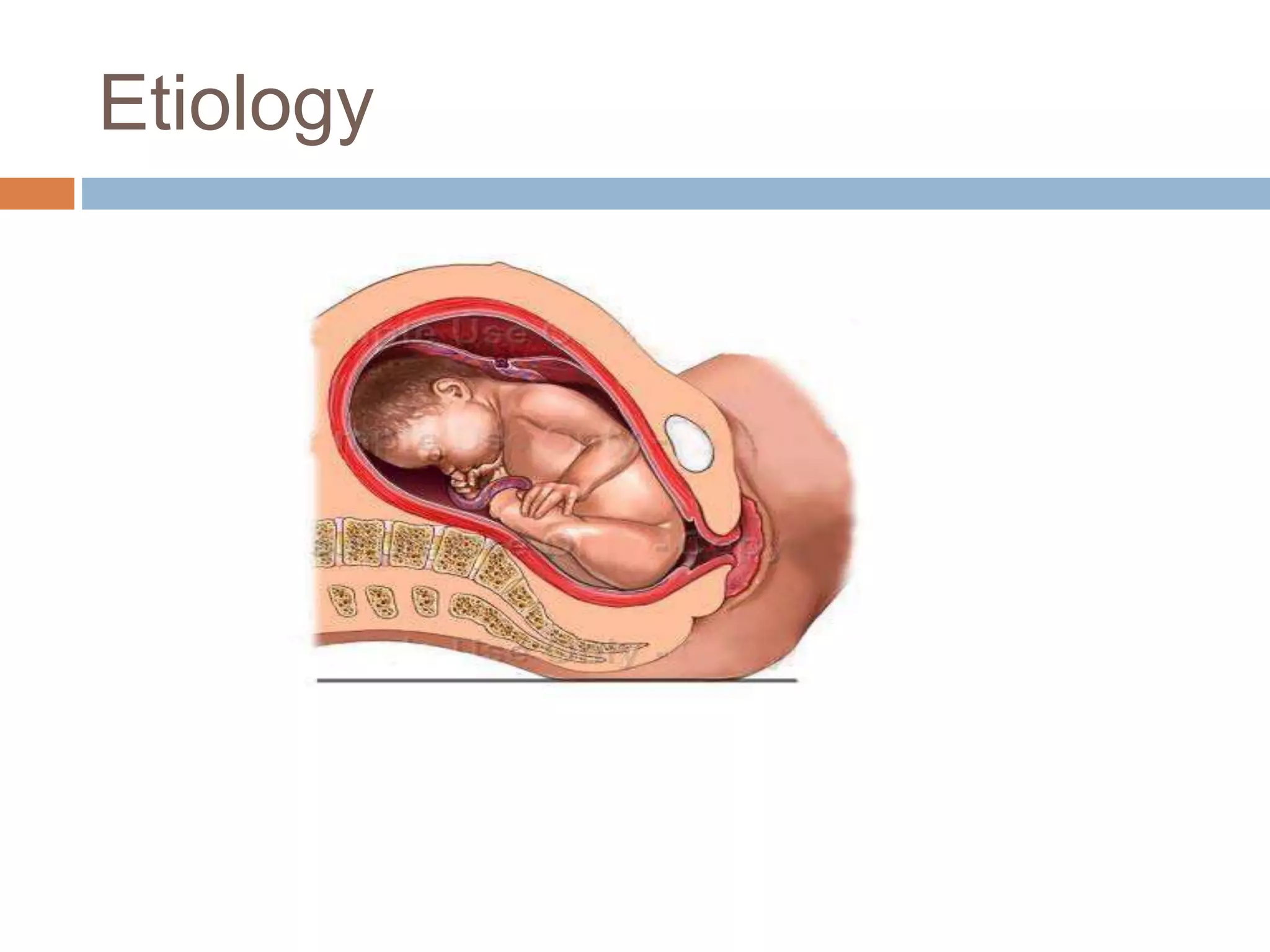
Etiology
Maternal factors
 Polyhydraminos
 Oligohydramnios
 Uterine anomalies (bicornuate, septate)
 Space occupying lesions (e.g fibroids)
 Placental abnormalities (praevia, cornual)
 Multiparity (in particular grand multiparas)
 Contracted pelvis
Fetal factors
 Prematurity
 Fetal anomalies (e.g neurological,
hydrocephalus, anenecephaly)
 Multiple pregnancy
 Fetal death
 Short umbilical cord
 Extended legs; because they splint the trunk,
and so interfere with spontaneous cephalic
version.
Mechanism of delivery
 Engagement
 Descent
 Internal rotation
 Lateral flexion
 External rotation
 Birth : breech then body then head
Diagnosis of Breech
 Clinical examination:
 abdominal
 vaginal
 Radiological examination:
 x-ray
 ultrasound scan
 CT
 MRI
Clinical Diagnosis
Abdominal examination
 Palpation
1. Fundal grips; the head is felt with its
characters.
2. Pelvic grip; the breech is felt, with its
characters.
 Auscultation
The fetal heart sounds are head just at, or above
the level of the umbilicus.
Vaginal examination
1. Slow dilatation of cervix, sausage-chapel bag of fore-
waters, and liability to premature rupture of the
membrane and prolapse of the cord.
2. After rupture of the membranes, the presenting part is
felt, that is , the two buttocks with the anus in between ,
the genitalia on one side and the sacral spines on the
opposite side.
3. In case of complete breech, the feet are felt on the
same level as the buttocks.
4. In case of breech with extended legs, the buttocks only
are felt. In case of footling presentation, the feet are at
a lower level than the buttocks. In case of knee
presentation, the knees are a lower level than the
buttocks.
Imaging Techniques
 Ultrasound
 CT
 MRI
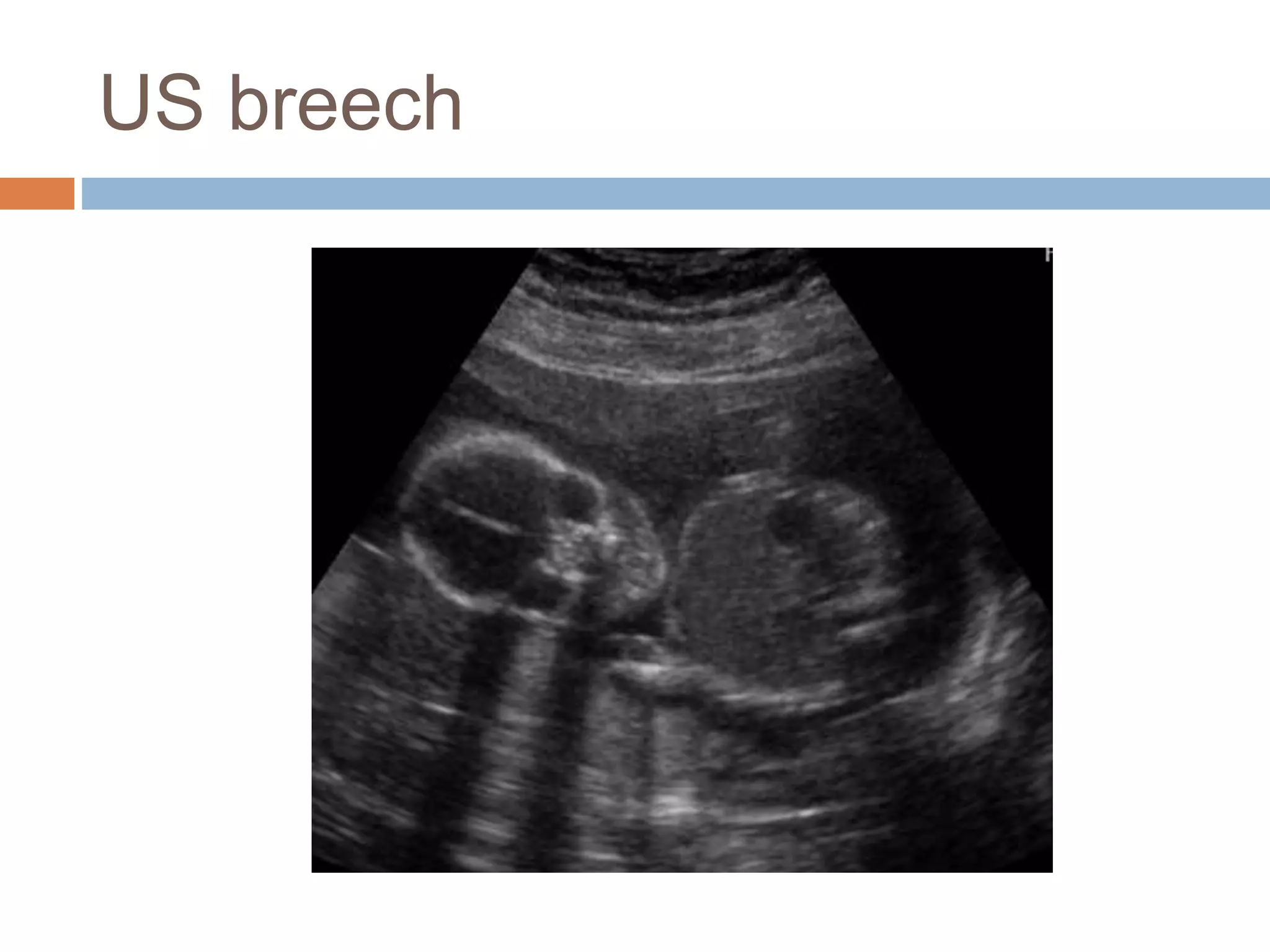
US breech
Management of Breech
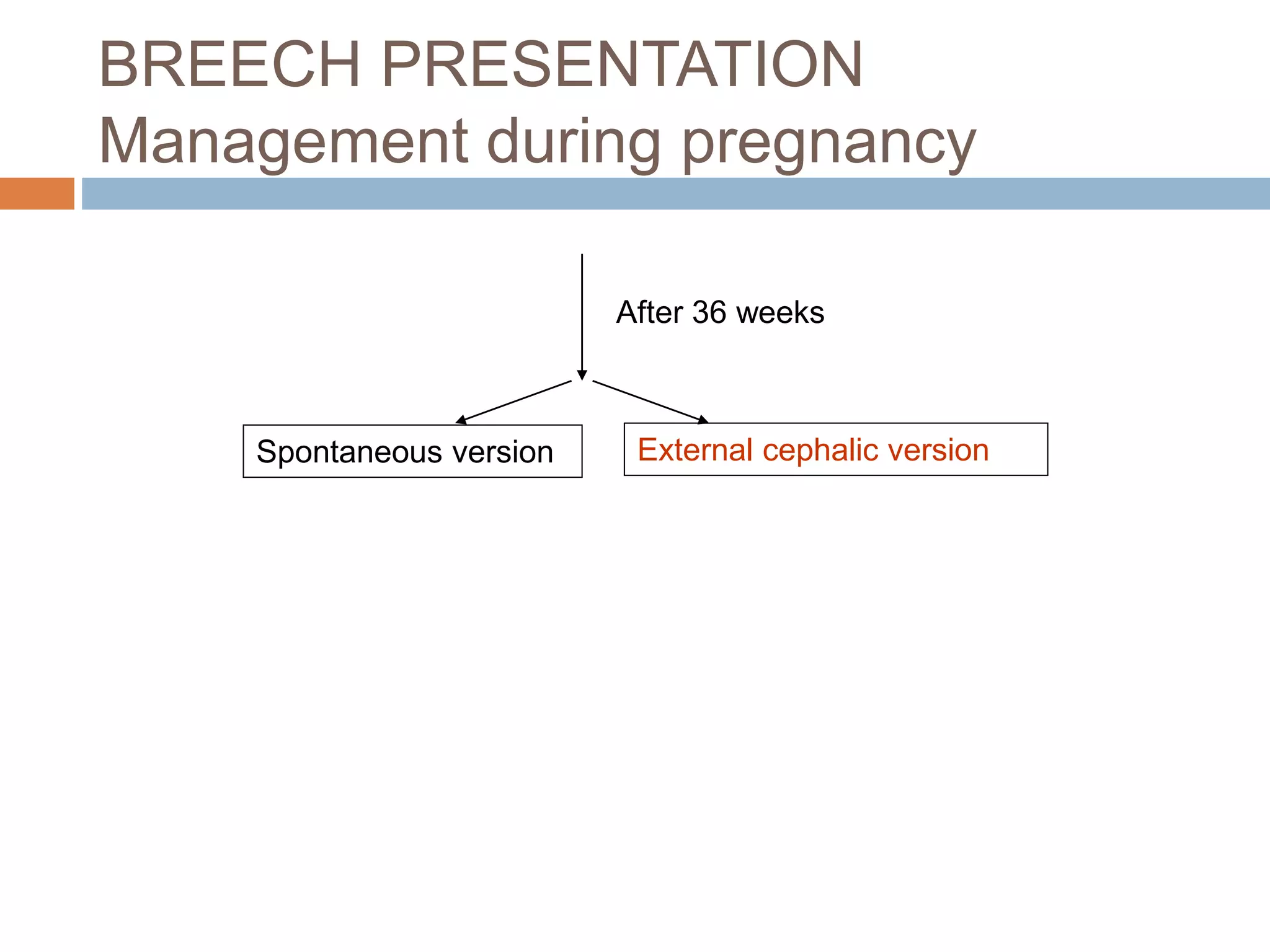
BREECH PRESENTATION
Management during pregnancy
After 36 weeks
Spontaneous version External cephalic version
Management of breech
 Management During Pregnancy:
 If persisted till 34 weeks…. Then ultrasound
scan to exclude; abnormality, Ployhydramnios,
placenta praevia.
 By completed 37 weeks External Cephalic
Version:
Version
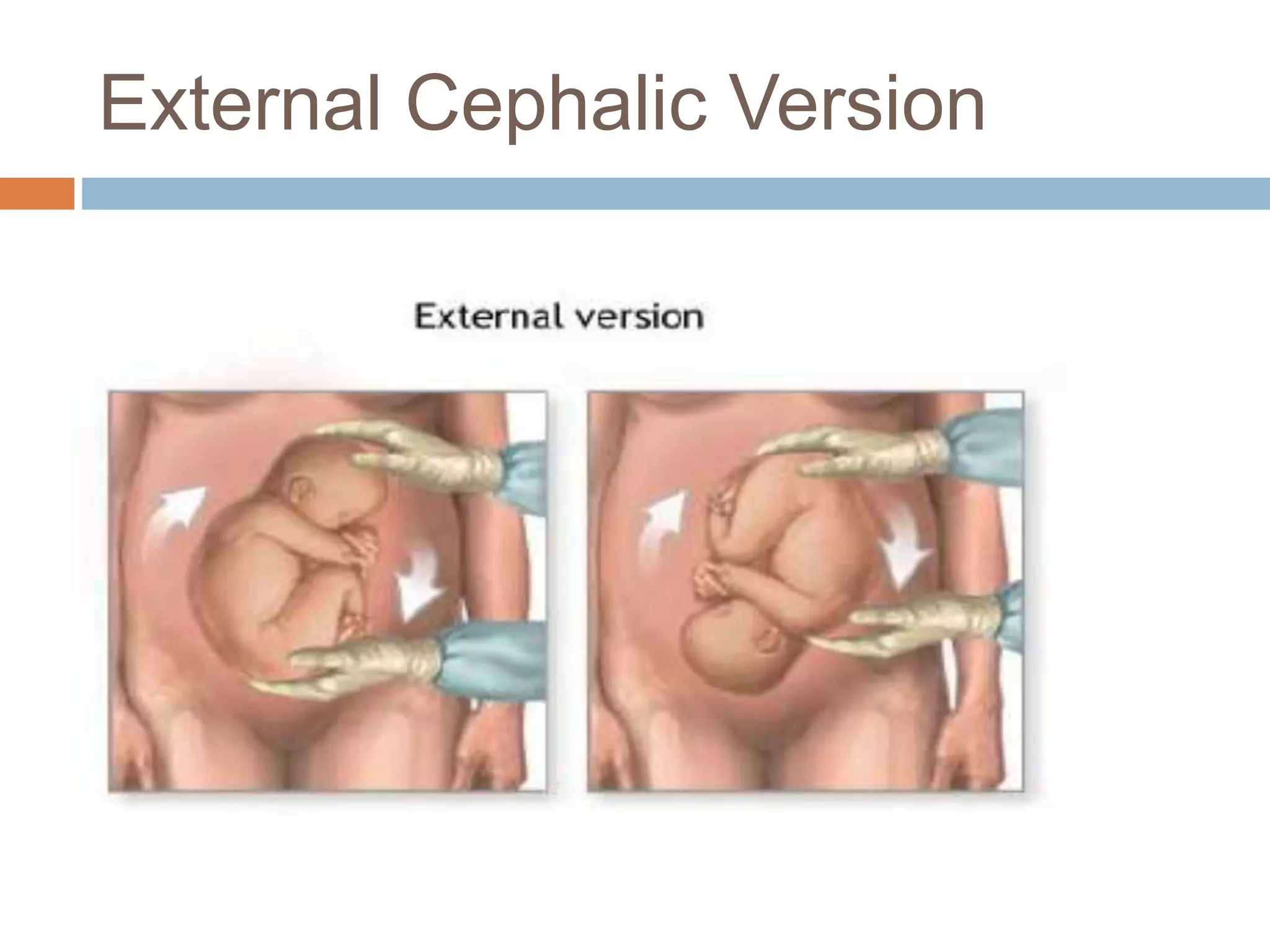
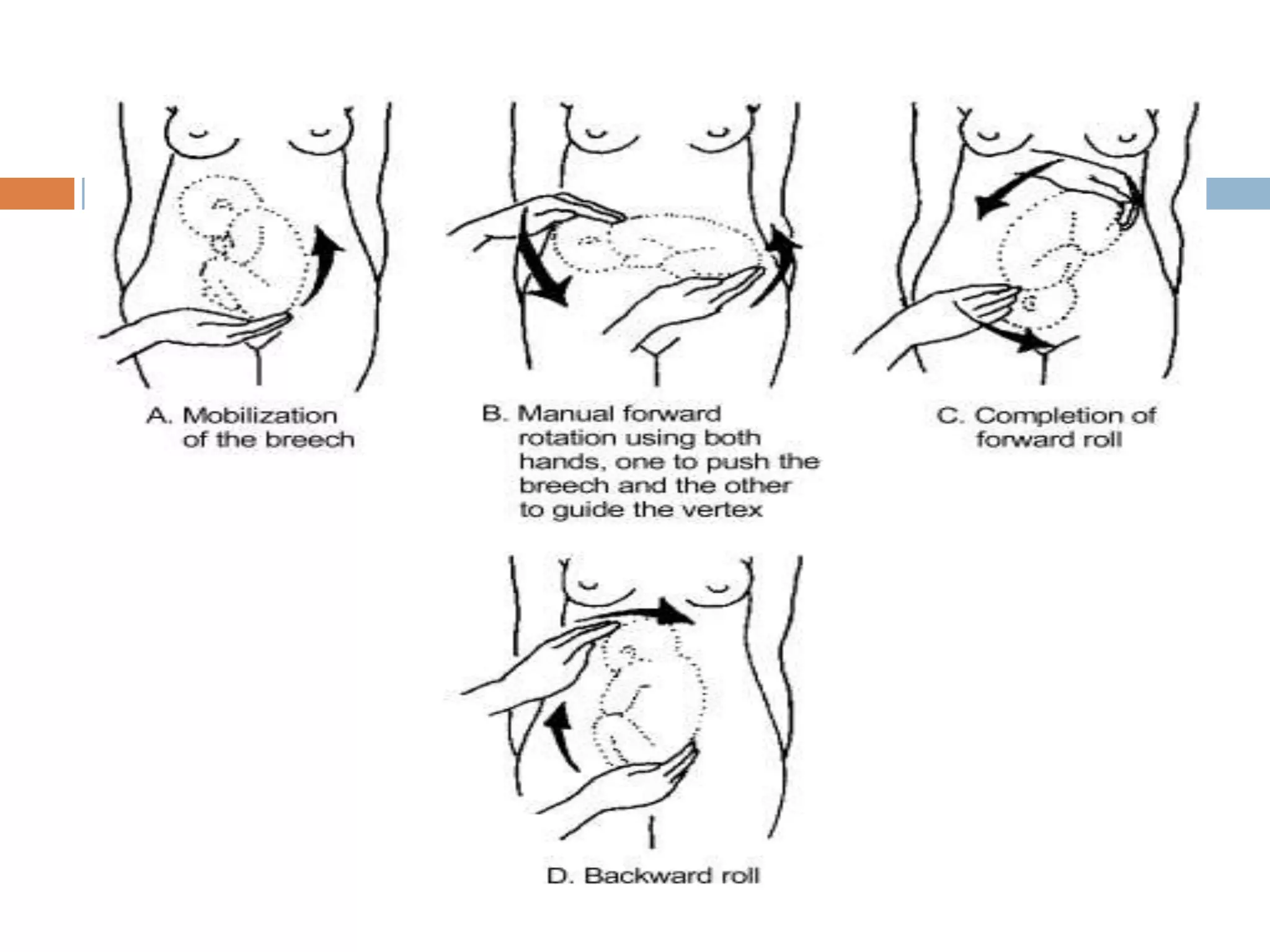
 External cephalic version
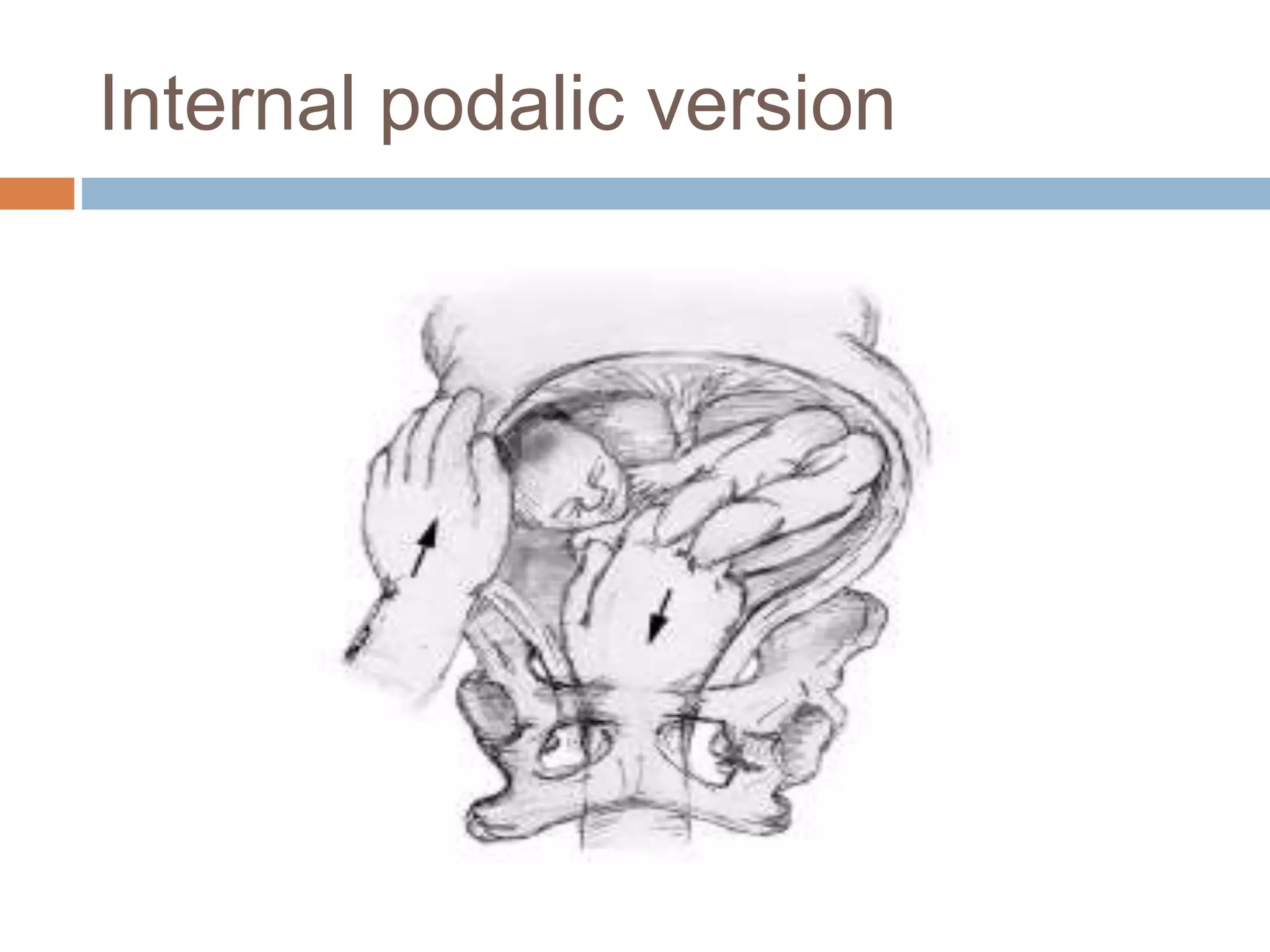
 Internal podalic version
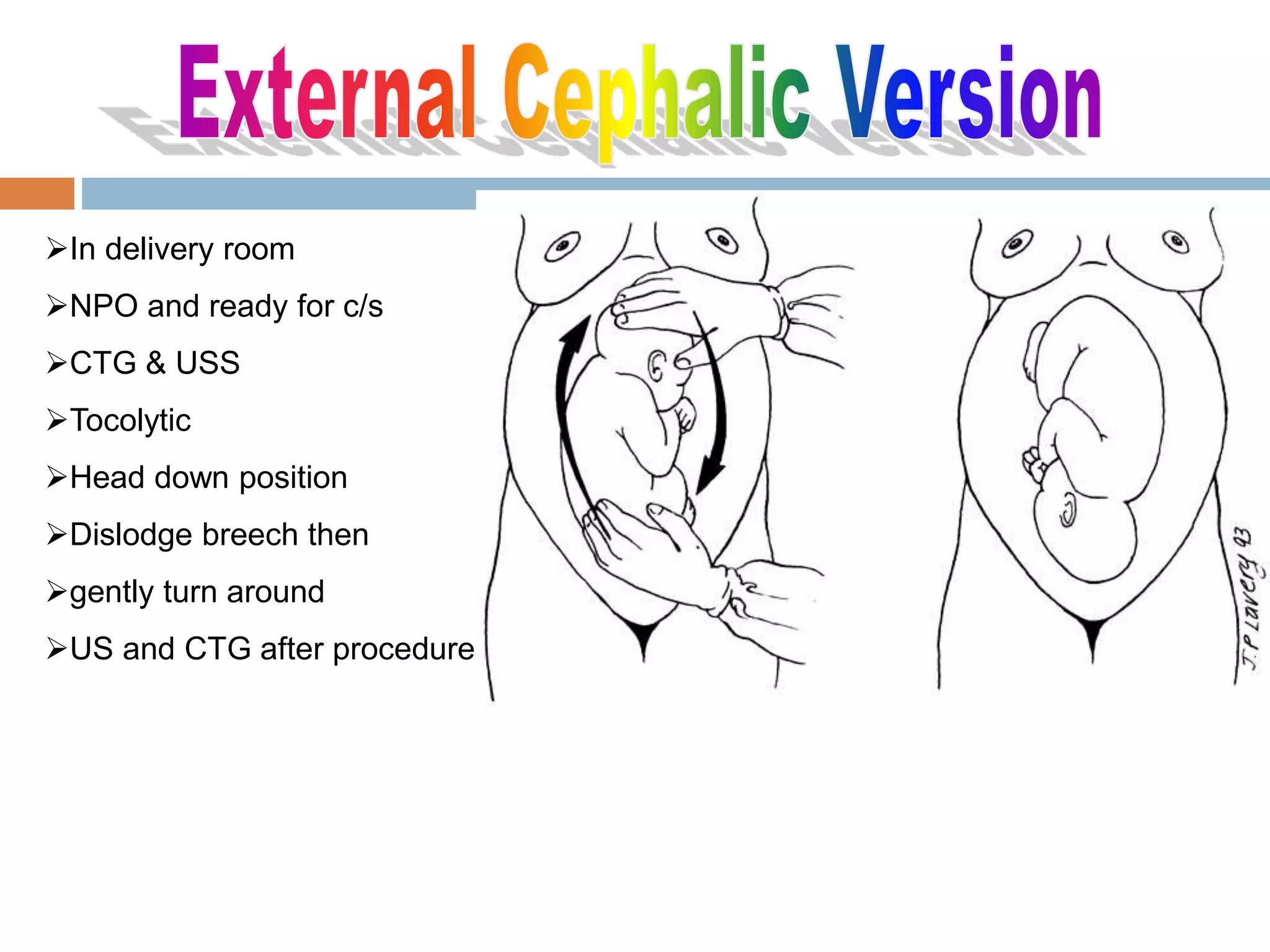
External Cephalic Version
In delivery room
NPO and ready for c/s
CTG & USS
Tocolytic
Head down position
Dislodge breech then
gently turn around
US and CTG after procedure.
Internal podalic version
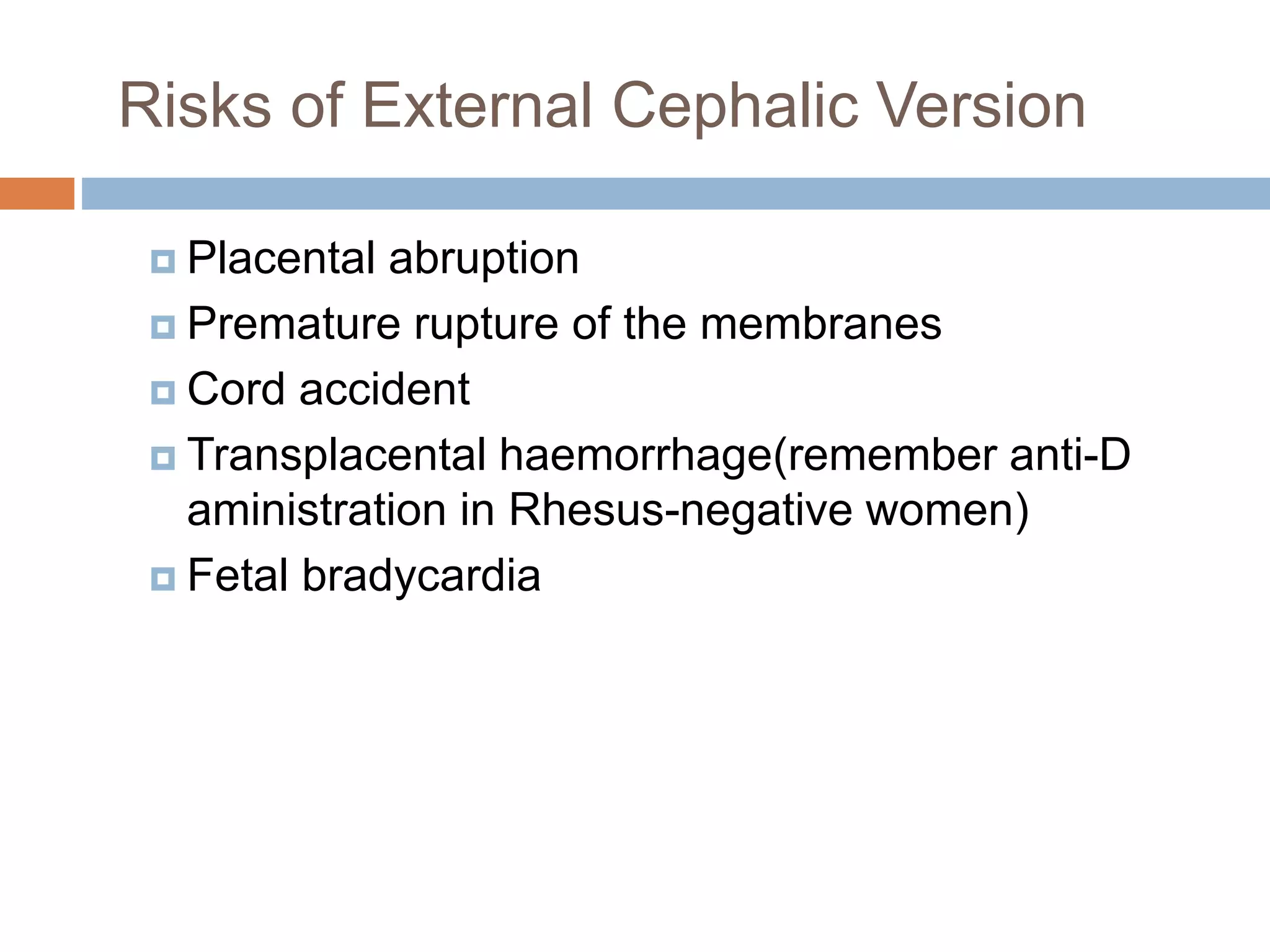
Risks of External Cephalic Version
 Placental abruption
 Premature rupture of the membranes
 Cord accident
 Transplacental haemorrhage(remember anti-D
aministration in Rhesus-negative women)
 Fetal bradycardia
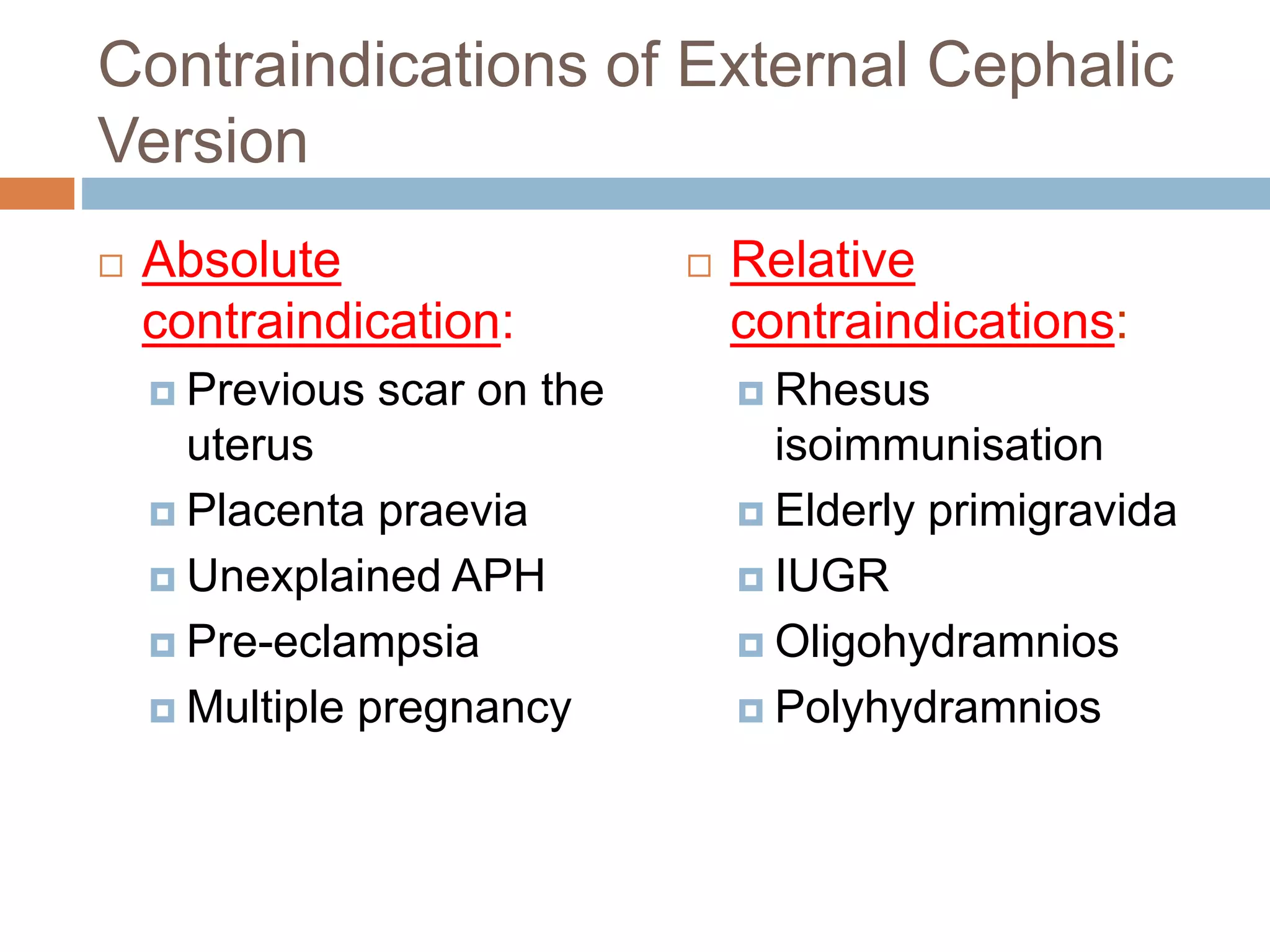
Contraindications of External Cephalic
Version
 Absolute
contraindication:
 Previous scar on the
uterus
 Placenta praevia
 Unexplained APH
 Pre-eclampsia
 Multiple pregnancy
 Relative
contraindications:
 Rhesus
isoimmunisation
 Elderly primigravida
 IUGR
 Oligohydramnios
 Polyhydramnios
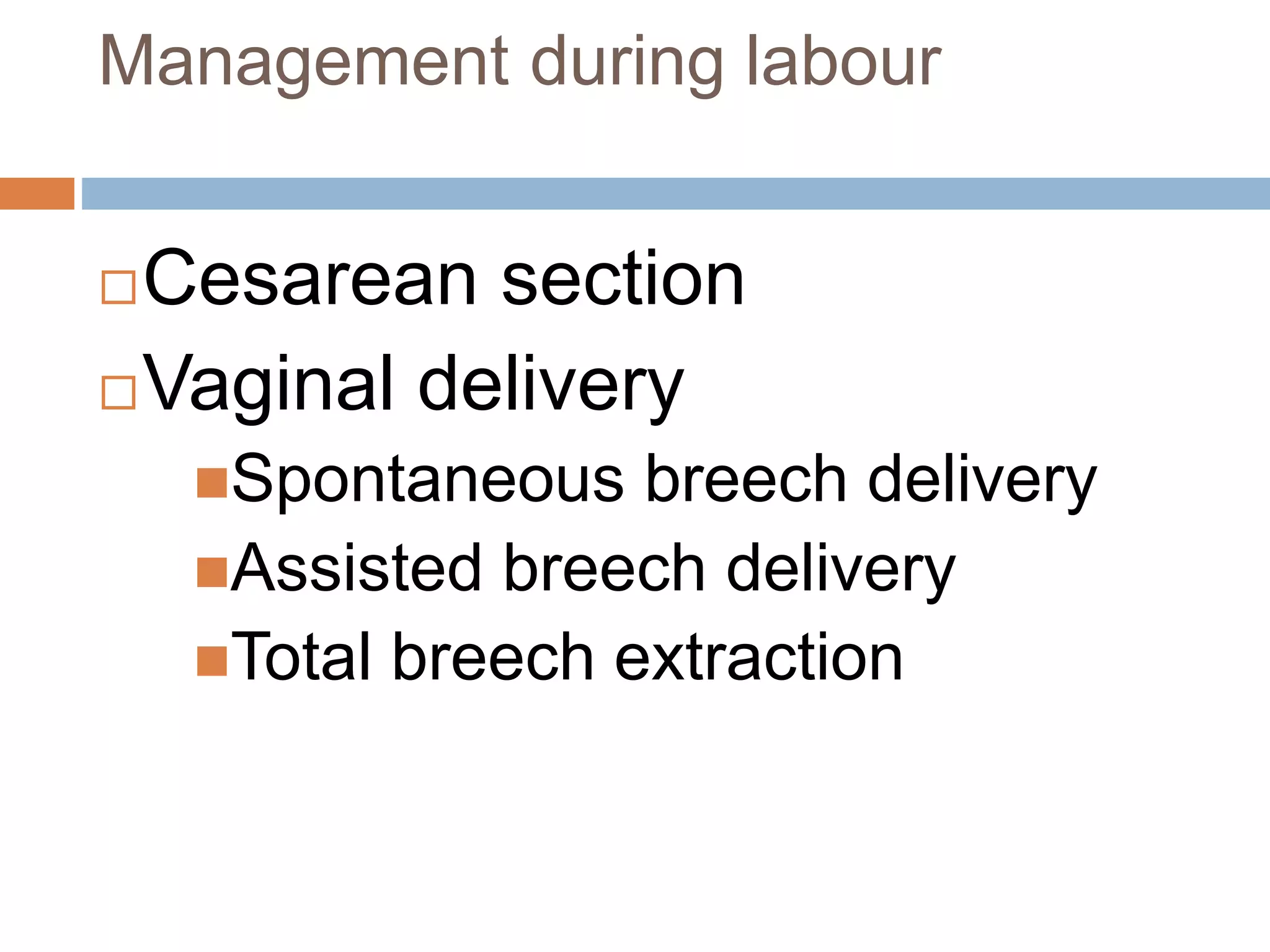
Management during labour
Cesarean section
Vaginal delivery
Spontaneous breech delivery
Assisted breech delivery
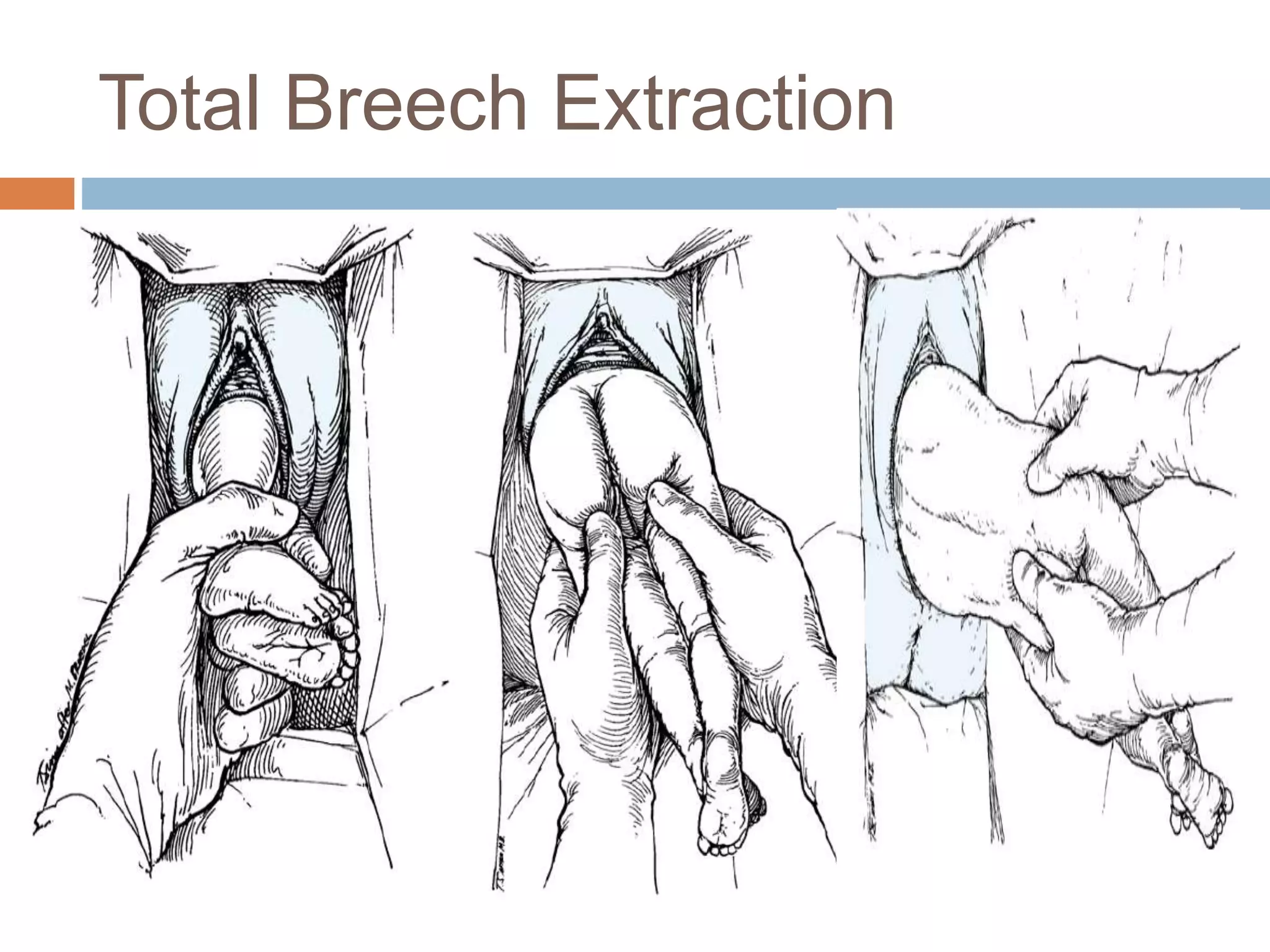
Total breech extraction
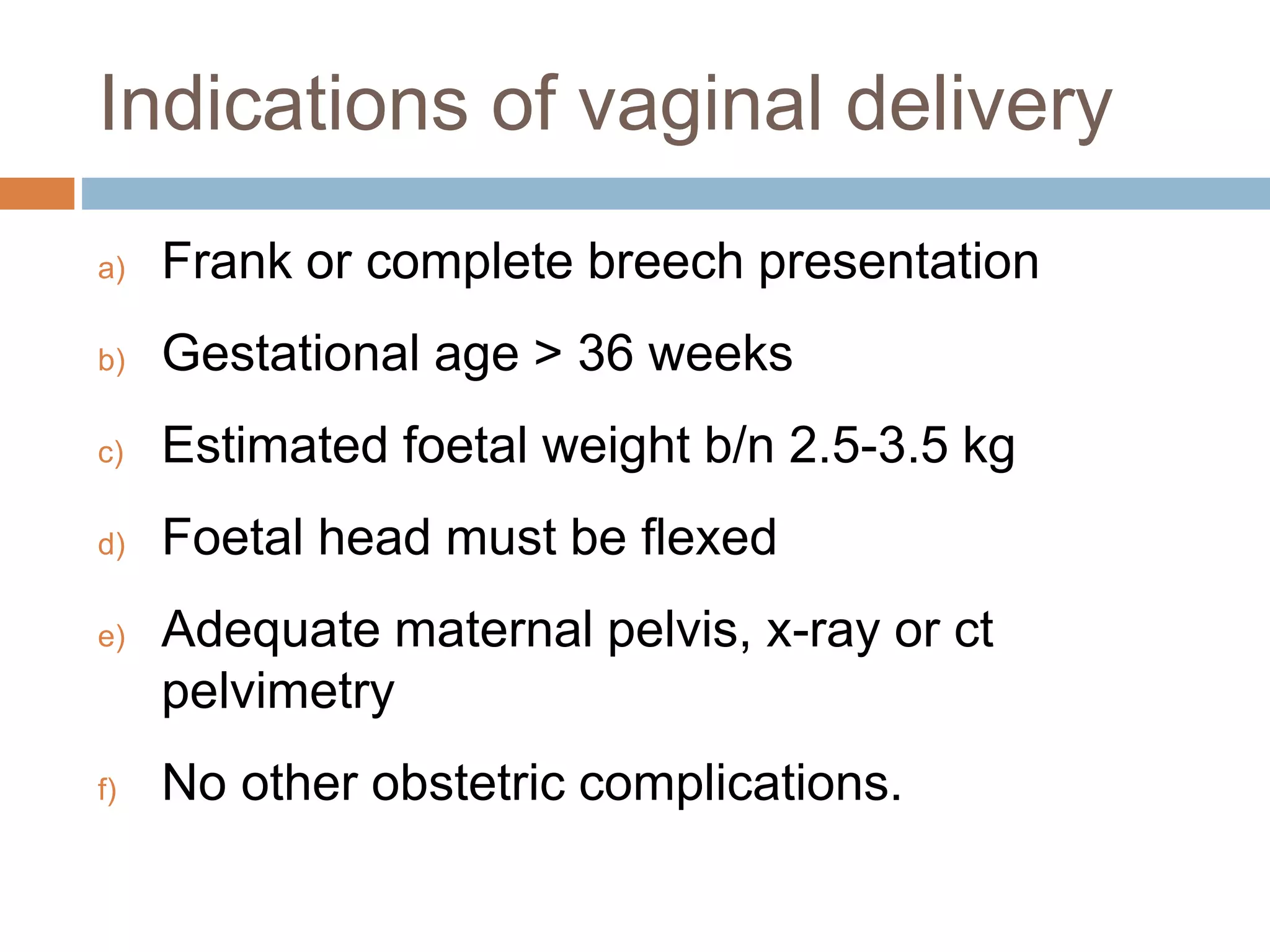
Indications of vaginal delivery
a) Frank or complete breech presentation
b) Gestational age > 36 weeks
c) Estimated foetal weight b/n 2.5-3.5 kg
d) Foetal head must be flexed
e) Adequate maternal pelvis, x-ray or ct
pelvimetry
f) No other obstetric complications.
Management during labour
During labour:
1. If there is contracted pelvic, and fetus is
living and good; do caesarean section.
2. First stage
Rest in bed and avoid repeated vaginal examination to
prevent premature rupture of the membranes. But
vaginal examination is done after rupture of
membranes to exclude cord prolapse.
Partial breech extraction or
Assisted breech delivery
Second stage :
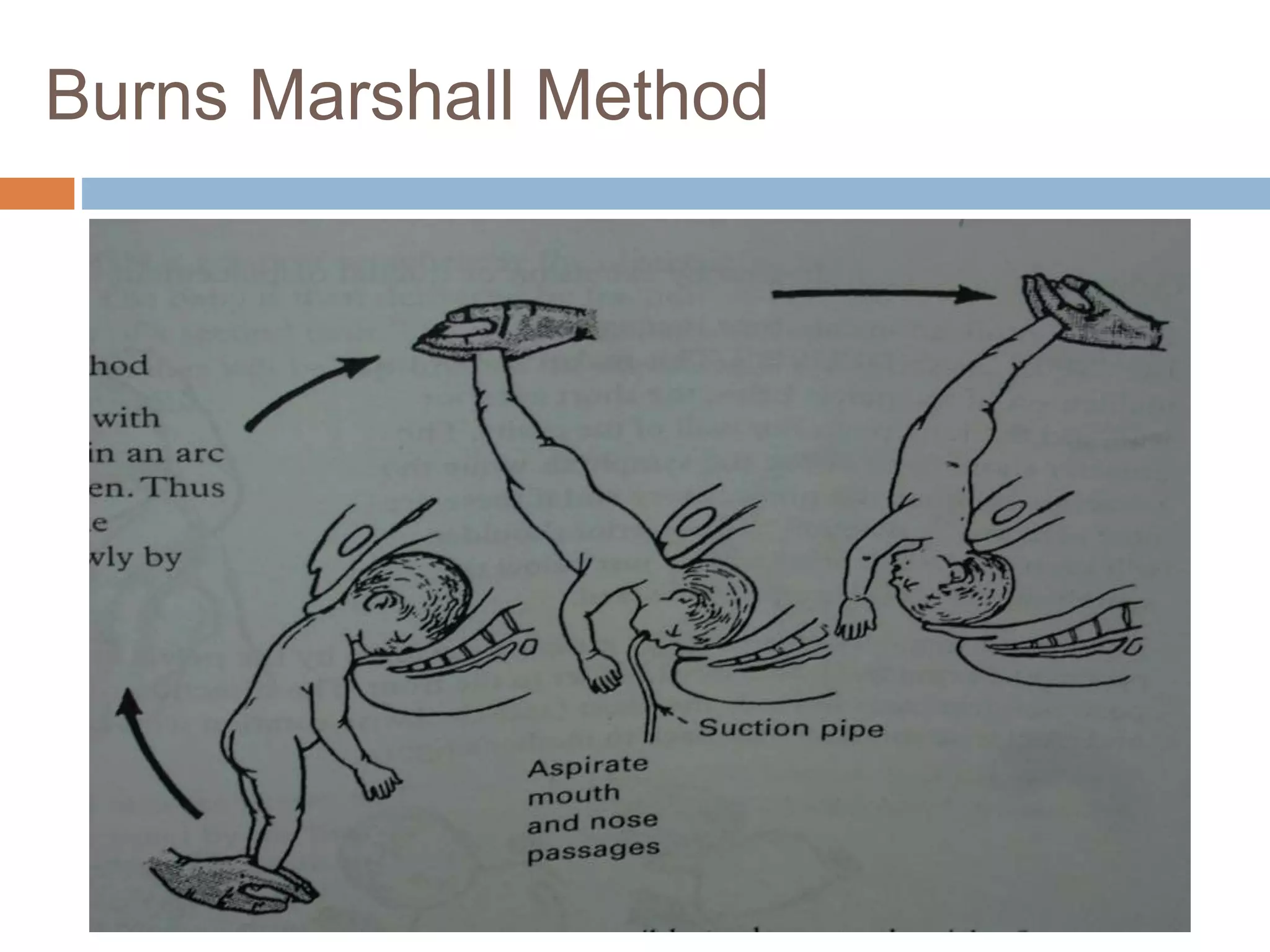
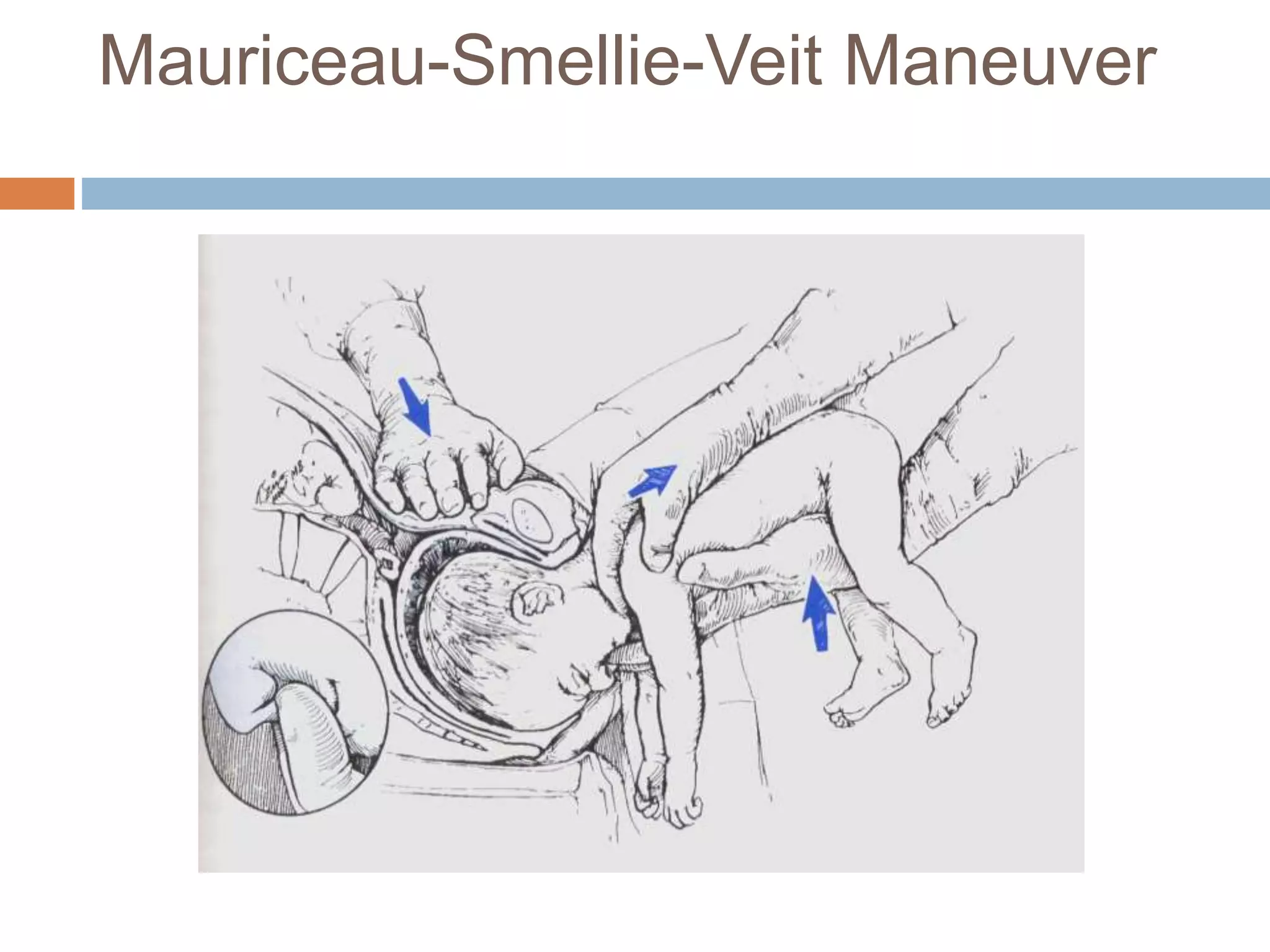
Delivery of the aftercoming head
 Burns Marshall method
 Mauriceau-Smellie-veit maneuver
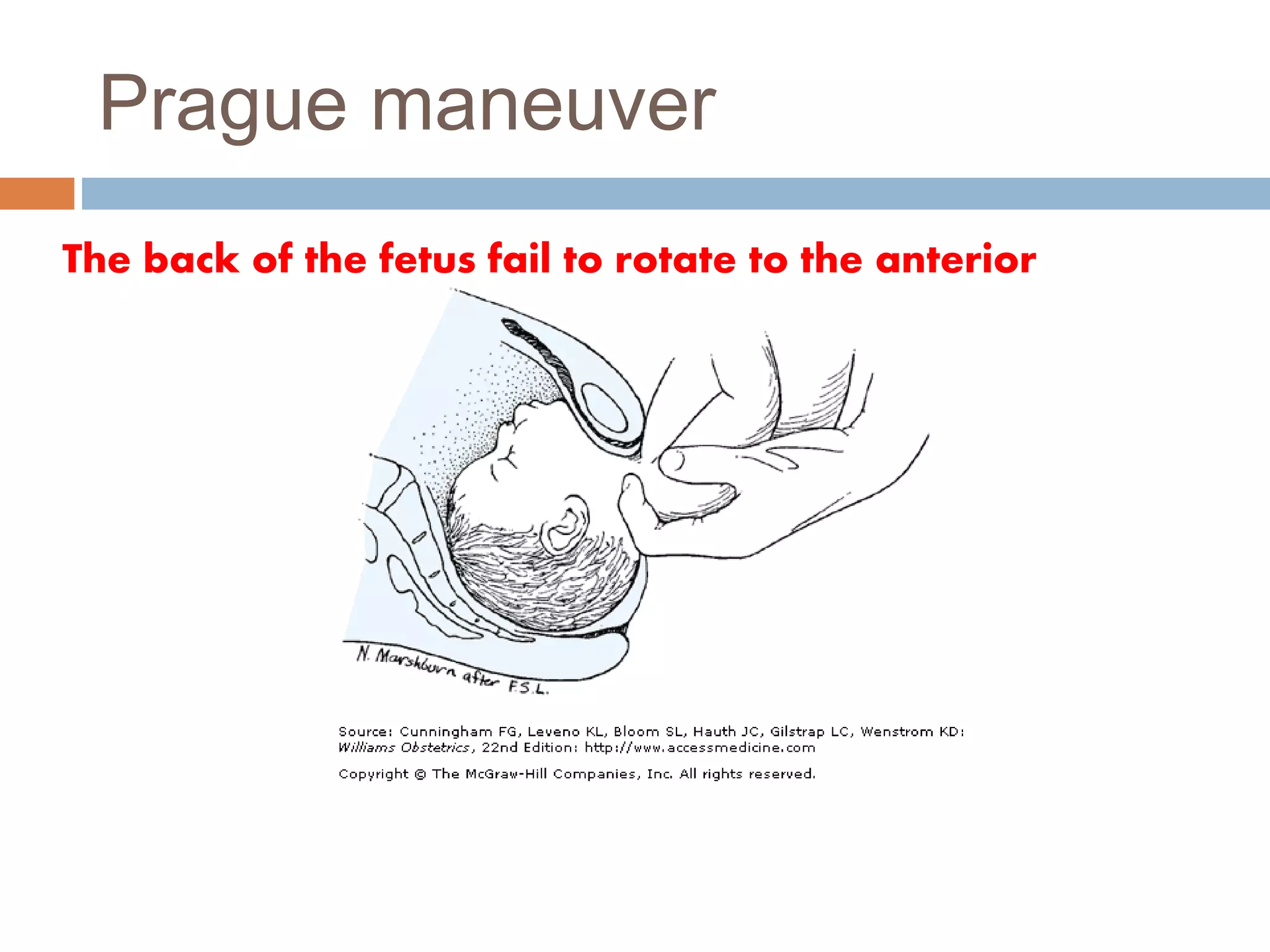
 Prague maneuver
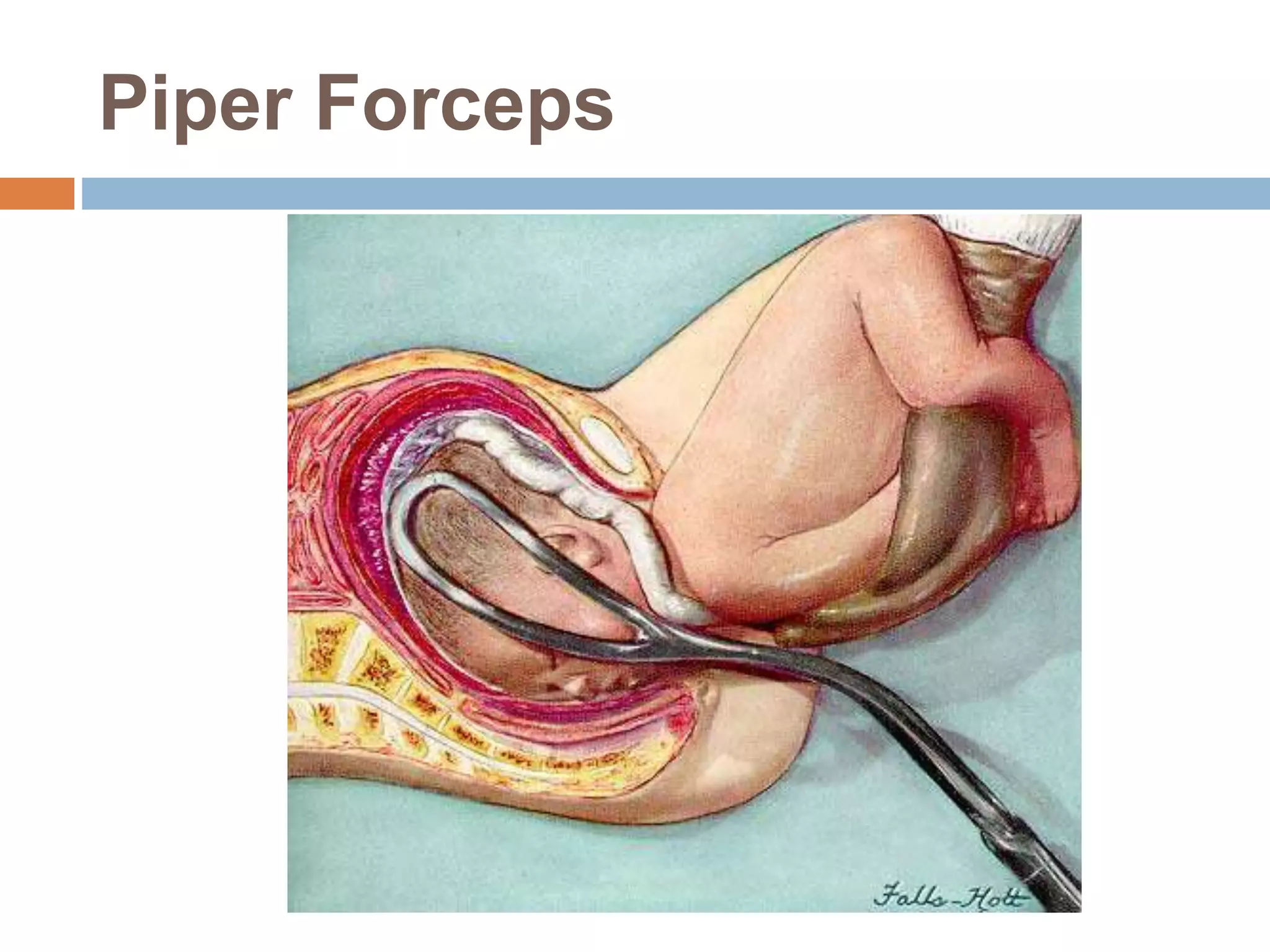
 Piper forceps
Burns Marshall Method
Mauriceau-Smellie-Veit Maneuver
Prague maneuver
The back of the fetus fail to rotate to the anterior
Piper Forceps
Total breech extraction
Indication
1. Prolonged second stage of labor
2. Twins
3. Maternal disease
4. Prolapsed cord
5. Fetal distress
Total Breech Extraction
Cesarean section
Indications:
 Large fetus
 Contraction or unfavorable shape of pelvis
 Hyperextended head(Star gazing)
 Uterine dysfunction
 Incomplete or footling presentation
 Primigravida
Indications of Cs in Breech
 Healthy preterm
 Severe fetal growth restriction
 Previous perinatal death or newborn
 complication of birth trauma
 Lack of an experienced operator
Complications of Breech
Delivery
Maternal complications
 Risk of Operative intervention
 Risk of infection due to Manipulations
 Intrauterine maneuvers : Rupture of the
uterus +/- lacerations of Cx
 Extensions of the episiotomy
 Uterine atony , Postpartum hemorrhage
Complications cont.
Fetal complications
 Preterm delivery & low birth weight & IUGR
 Prolapse cord
 Birth aphyxia
 Fetal Injuries
 Fx of humerous and clavicle
 Fx of femur
 Hematomas of sternocleidomastoid
 Separation of epiphyses of scapular,humerus or femur
 Brachial plexus
 Avulsion of upper C-spine
 Skull Fx , intracerebral injury
THAN
K
YOU

Breech presentation

  • 1.
  • 2.
    Definition Breech presentation is thepresentation in which the fetus is in longitudinal lie and its buttock is the lower most part .
  • 3.
    Incidence  28 weeks…25% Term 2-3%  1/3 are undiagnosed in labour
  • 4.
    classifications  Frank breech(65%): where the hips are flexed and legs extended  Complete breech (25%): where the hips and knees are flexed and the feet are not below the level of the fetal buttocks  Footling breech: where one or both feet are presenting as the lowest part of the fetus  Kneeling: kneesare the lowermost presenting part
  • 6.
  • 7.
    Positions the denominate isthe sacrum:  First position; left sacro-anterior (back anterior and to left).  Second position; right sacro-anterior (back anterior and to right).  Third position; right sacro-posterior (back posterior and to right).  Fourth position; left sacro-posterior (back posterior and to left).
  • 8.
  • 9.
    Maternal factors  Polyhydraminos Oligohydramnios  Uterine anomalies (bicornuate, septate)  Space occupying lesions (e.g fibroids)  Placental abnormalities (praevia, cornual)  Multiparity (in particular grand multiparas)  Contracted pelvis
  • 10.
    Fetal factors  Prematurity Fetal anomalies (e.g neurological, hydrocephalus, anenecephaly)  Multiple pregnancy  Fetal death  Short umbilical cord  Extended legs; because they splint the trunk, and so interfere with spontaneous cephalic version.
  • 11.
    Mechanism of delivery Engagement  Descent  Internal rotation  Lateral flexion  External rotation  Birth : breech then body then head
  • 12.
    Diagnosis of Breech Clinical examination:  abdominal  vaginal  Radiological examination:  x-ray  ultrasound scan  CT  MRI
  • 13.
    Clinical Diagnosis Abdominal examination Palpation 1. Fundal grips; the head is felt with its characters. 2. Pelvic grip; the breech is felt, with its characters.  Auscultation The fetal heart sounds are head just at, or above the level of the umbilicus.
  • 14.
    Vaginal examination 1. Slowdilatation of cervix, sausage-chapel bag of fore- waters, and liability to premature rupture of the membrane and prolapse of the cord. 2. After rupture of the membranes, the presenting part is felt, that is , the two buttocks with the anus in between , the genitalia on one side and the sacral spines on the opposite side. 3. In case of complete breech, the feet are felt on the same level as the buttocks. 4. In case of breech with extended legs, the buttocks only are felt. In case of footling presentation, the feet are at a lower level than the buttocks. In case of knee presentation, the knees are a lower level than the buttocks.
  • 15.
  • 16.
  • 17.
  • 18.
    BREECH PRESENTATION Management duringpregnancy After 36 weeks Spontaneous version External cephalic version
  • 19.
    Management of breech Management During Pregnancy:  If persisted till 34 weeks…. Then ultrasound scan to exclude; abnormality, Ployhydramnios, placenta praevia.  By completed 37 weeks External Cephalic Version:
  • 20.
    Version  External cephalicversion  Internal podalic version
  • 21.
  • 22.
    In delivery room NPOand ready for c/s CTG & USS Tocolytic Head down position Dislodge breech then gently turn around US and CTG after procedure.
  • 24.
  • 25.
    Risks of ExternalCephalic Version  Placental abruption  Premature rupture of the membranes  Cord accident  Transplacental haemorrhage(remember anti-D aministration in Rhesus-negative women)  Fetal bradycardia
  • 26.
    Contraindications of ExternalCephalic Version  Absolute contraindication:  Previous scar on the uterus  Placenta praevia  Unexplained APH  Pre-eclampsia  Multiple pregnancy  Relative contraindications:  Rhesus isoimmunisation  Elderly primigravida  IUGR  Oligohydramnios  Polyhydramnios
  • 27.
    Management during labour Cesareansection Vaginal delivery Spontaneous breech delivery Assisted breech delivery Total breech extraction
  • 28.
    Indications of vaginaldelivery a) Frank or complete breech presentation b) Gestational age > 36 weeks c) Estimated foetal weight b/n 2.5-3.5 kg d) Foetal head must be flexed e) Adequate maternal pelvis, x-ray or ct pelvimetry f) No other obstetric complications.
  • 29.
    Management during labour Duringlabour: 1. If there is contracted pelvic, and fetus is living and good; do caesarean section. 2. First stage Rest in bed and avoid repeated vaginal examination to prevent premature rupture of the membranes. But vaginal examination is done after rupture of membranes to exclude cord prolapse.
  • 30.
    Partial breech extractionor Assisted breech delivery Second stage : Delivery of the aftercoming head  Burns Marshall method  Mauriceau-Smellie-veit maneuver  Prague maneuver  Piper forceps
  • 31.
  • 32.
  • 33.
    Prague maneuver The backof the fetus fail to rotate to the anterior
  • 34.
  • 35.
    Total breech extraction Indication 1.Prolonged second stage of labor 2. Twins 3. Maternal disease 4. Prolapsed cord 5. Fetal distress
  • 36.
  • 37.
    Cesarean section Indications:  Largefetus  Contraction or unfavorable shape of pelvis  Hyperextended head(Star gazing)  Uterine dysfunction  Incomplete or footling presentation  Primigravida
  • 38.
    Indications of Csin Breech  Healthy preterm  Severe fetal growth restriction  Previous perinatal death or newborn  complication of birth trauma  Lack of an experienced operator
  • 39.
    Complications of Breech Delivery Maternalcomplications  Risk of Operative intervention  Risk of infection due to Manipulations  Intrauterine maneuvers : Rupture of the uterus +/- lacerations of Cx  Extensions of the episiotomy  Uterine atony , Postpartum hemorrhage
  • 40.
    Complications cont. Fetal complications Preterm delivery & low birth weight & IUGR  Prolapse cord  Birth aphyxia  Fetal Injuries  Fx of humerous and clavicle  Fx of femur  Hematomas of sternocleidomastoid  Separation of epiphyses of scapular,humerus or femur  Brachial plexus  Avulsion of upper C-spine  Skull Fx , intracerebral injury
  • 41.