FORCEPS
OPERATION
DEFINITION
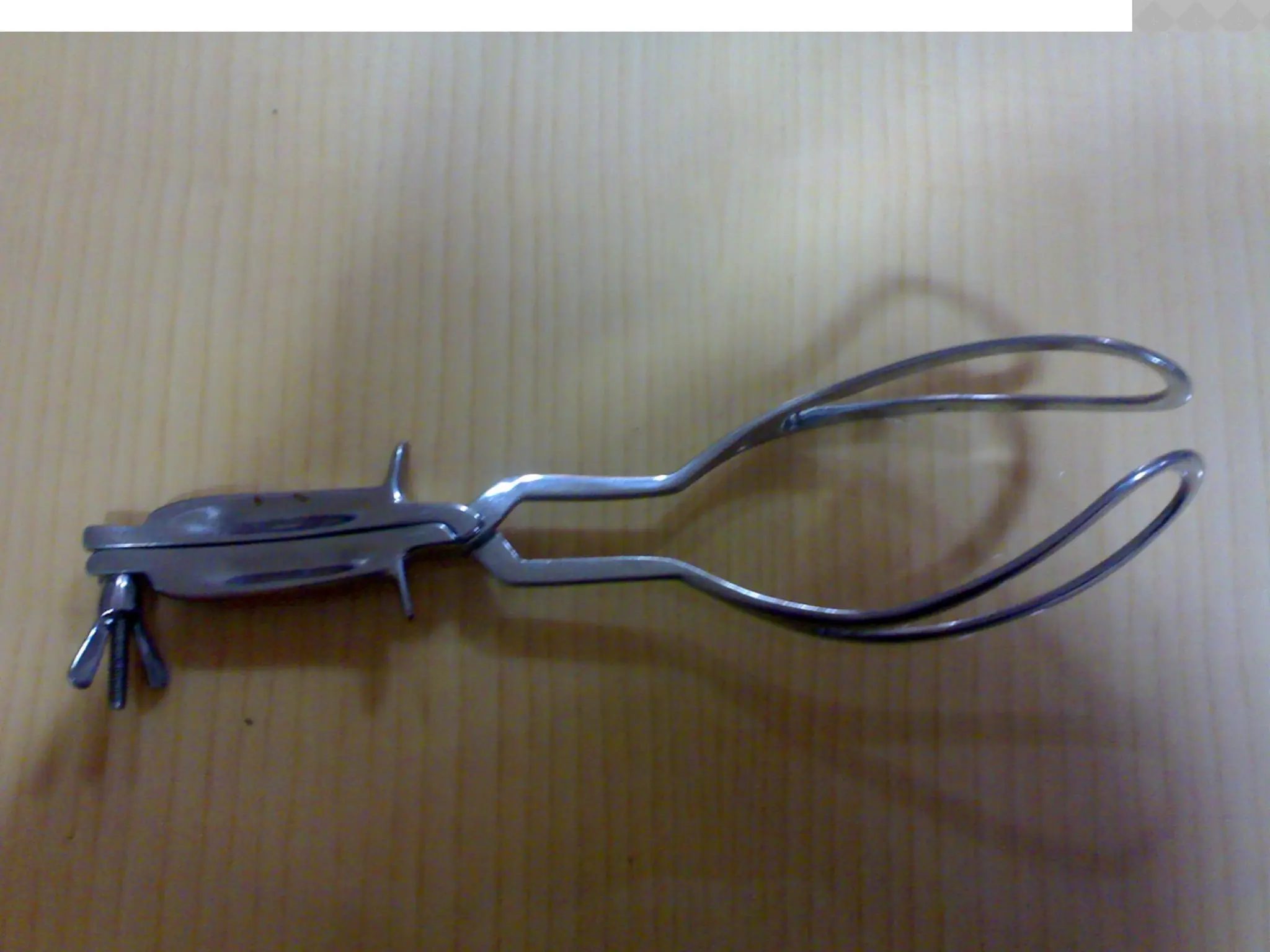
Obstetric forceps is a pair of instruments
specially designed to assist extraction of the
fetal head and thereby accomplishing the
delivery of the fetal head.
VARIETIES
 Long curved obstetric forceps
 Short curved forceps (Wrigley forceps)
 Kielland’s forceps
LONG CURVED OBSTETRIC
FORCEPS
Measurements
 Length is 37 cm
 Distance between the tips is 2.5 cm
 Widest diameter between the blades about 9
cm.
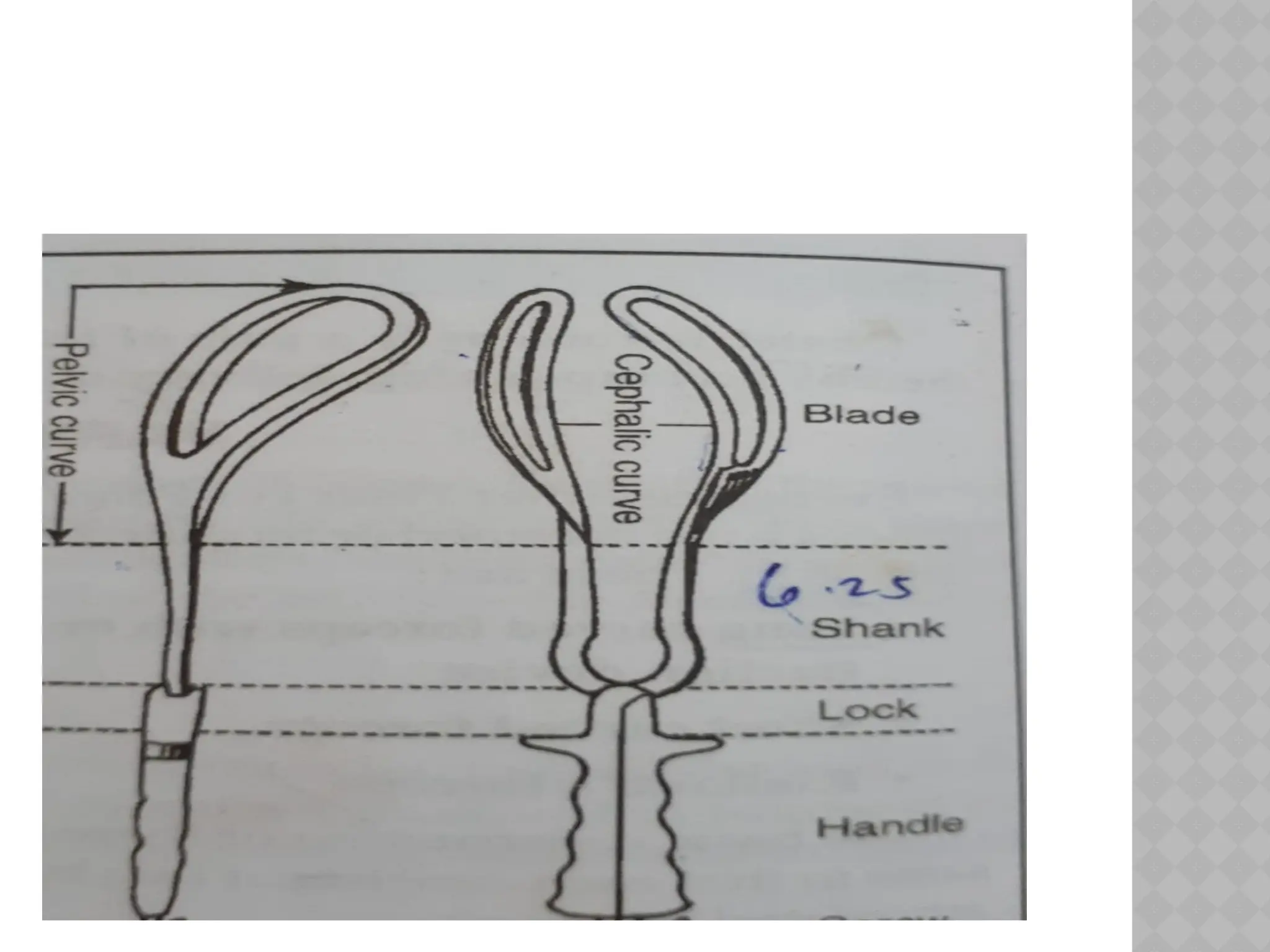
BLADES
There are 2 blades. Each blades consist of
the following parts
 Blade
 Shank-6.25 cm.
 Lock
 Handle with or with out screw-12.5 cm
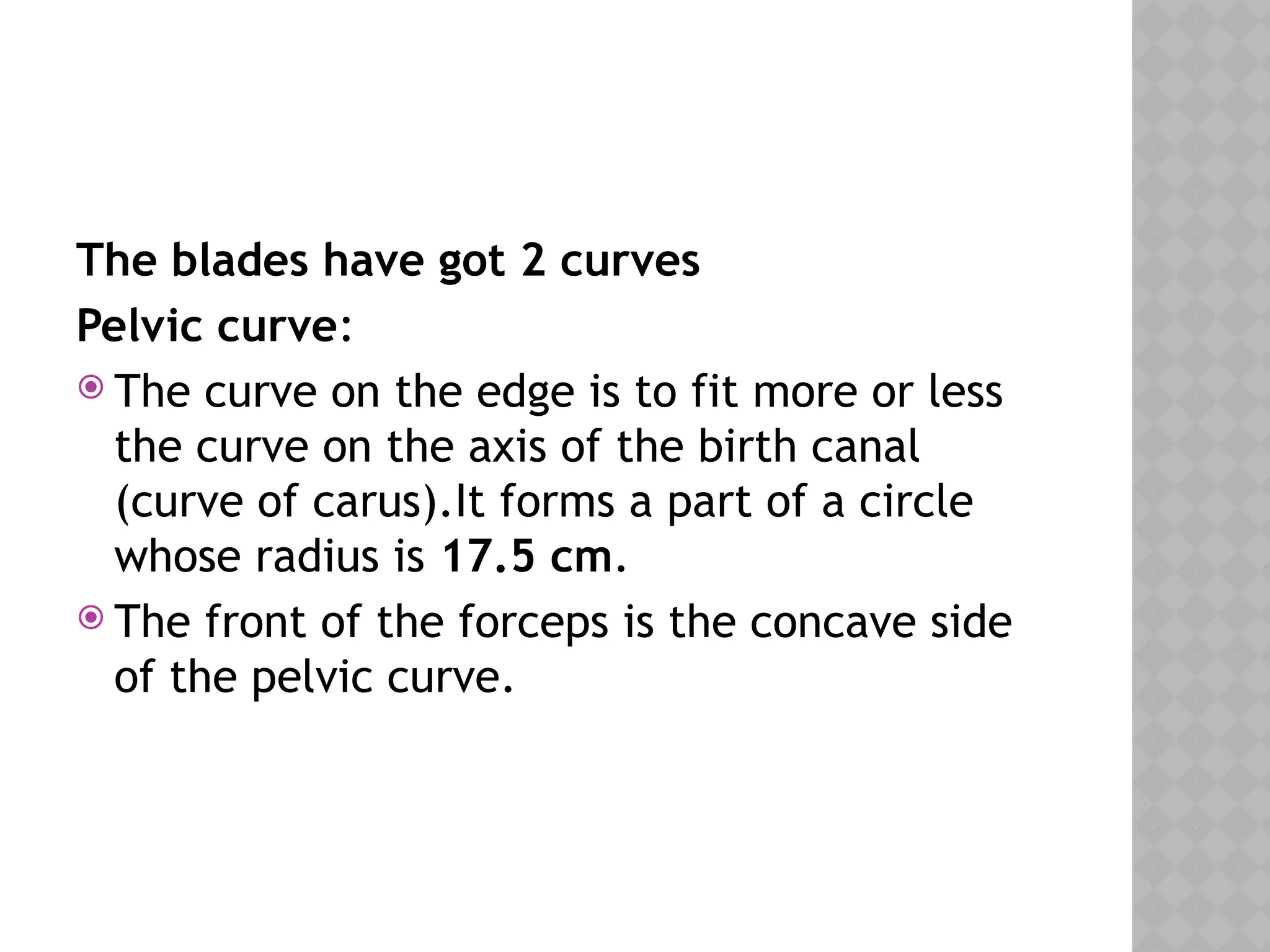
The blades have got 2 curves
Pelvic curve:
 The curve on the edge is to fit more or less
the curve on the axis of the birth canal
(curve of carus).It forms a part of a circle
whose radius is 17.5 cm.
 The front of the forceps is the concave side
of the pelvic curve.
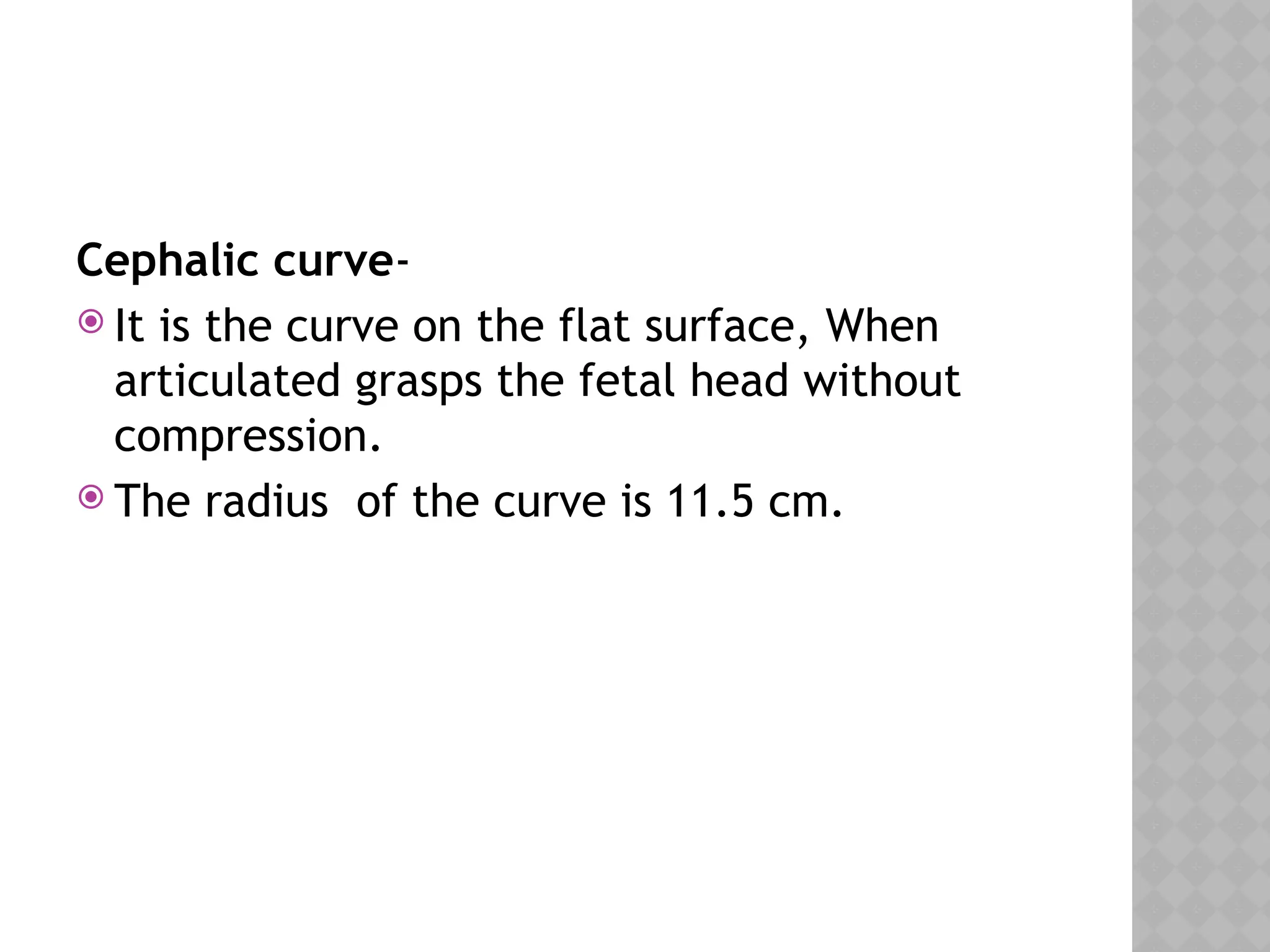
Cephalic curve-
 It is the curve on the flat surface, When
articulated grasps the fetal head without
compression.
 The radius of the curve is 11.5 cm.
HOW TO IDETIFY THE BLADES
 When articulated
Place the instrument infront of the pelvis
with the tip of the blade pointing upwards
and the concave side of the pelvic curve
forwards.
The blades corresponds to the left of the
maternal pelvis is the left blade and to the
right side is the right blade.
CONT....
 When isolated
The tip should point upwards
The cephalic curve is to be directed inwards
and the pelvic curve forwards.
CHOICE OF FORCEPS OPERATION
 Mid forceps
It is used when the head is at or near the
level of ischial spine.
 Low forceps
The head is near the pelvic floor or even
visible at the introitus.
 Outlet forceps
Applied when the head is on the perineum
TYPES OF APPLICATION OF THE
FORCEPS BLADES
 Cephalic application: The blades are applied
along the sides of the head grasping the
biparietal diameter in between the widest
part of the blades.
 Pelvic application
When the blades of the forceps are applied
on the lateral pelvic walls ignoring the
position of the head is called pelvic
application
FUNCTIONS
 The traction is the important function .The
pull required is to be 18 kg and in multipara
13 kg.
 Its compression effect on the cranium is
minimum.
 Rotation of the head can be achieved by
keilland’s forceps.
 Provide protective cage for the head
INDICATIONS
MATERNAL
 Inadequate expulsive efforts
 Maternal exhaustion
 Where expulsive efforts are to be
avoided(cardiac disease, eclampsia, cerebral
vascular disease)
FETAL
 Non reassuring fetal heart rate
 After coming head of breech
OTHERS
 Prolonged second stage of labour
 To cut short second stage in severe
preeclampsia,cardiac disease etc..
CONDITIONS TO BE FULLFILLED
FETAL AND UTERO PLACENTAL CRITERIA
 Fetal head must be engaged
 Cervix must be fully dilated
 The membranes must be ruptured
 The position and station of the head must be
known.
MATERNAL CRITERIA
 No major CPD by clinical pelvimetry
 Bladder must be emptied
 Adequate analgesia
FORCEPS
 F-favourable head position and station
 O-Open Os(fully dilated)
 R-Ruptured membranes
 C-Contractions present and Consent
 E-Engaged head ,Empty bladder
 P-Pelvimetry-no major CPD
 S-Stirrups, lithotomy position
LOW FORCEPS OPERATION
Preliminaries
 Anesthesia- Perineal infiltration with 1% lignocaine
hydrochloride.
 Catheterization
 Internal examination to assess
-the status of the cervix
-membrane status
-Presentation and position of the head
-Assessment of the pelvic outlet
 Episiotomy: done when the perineum becomes
bulged by the head.
STEPS
 Identification of the blades and their
application
 Locking of the blades
 Traction
 Removal of the blades
STEP-1:Identification of the blades and their
application
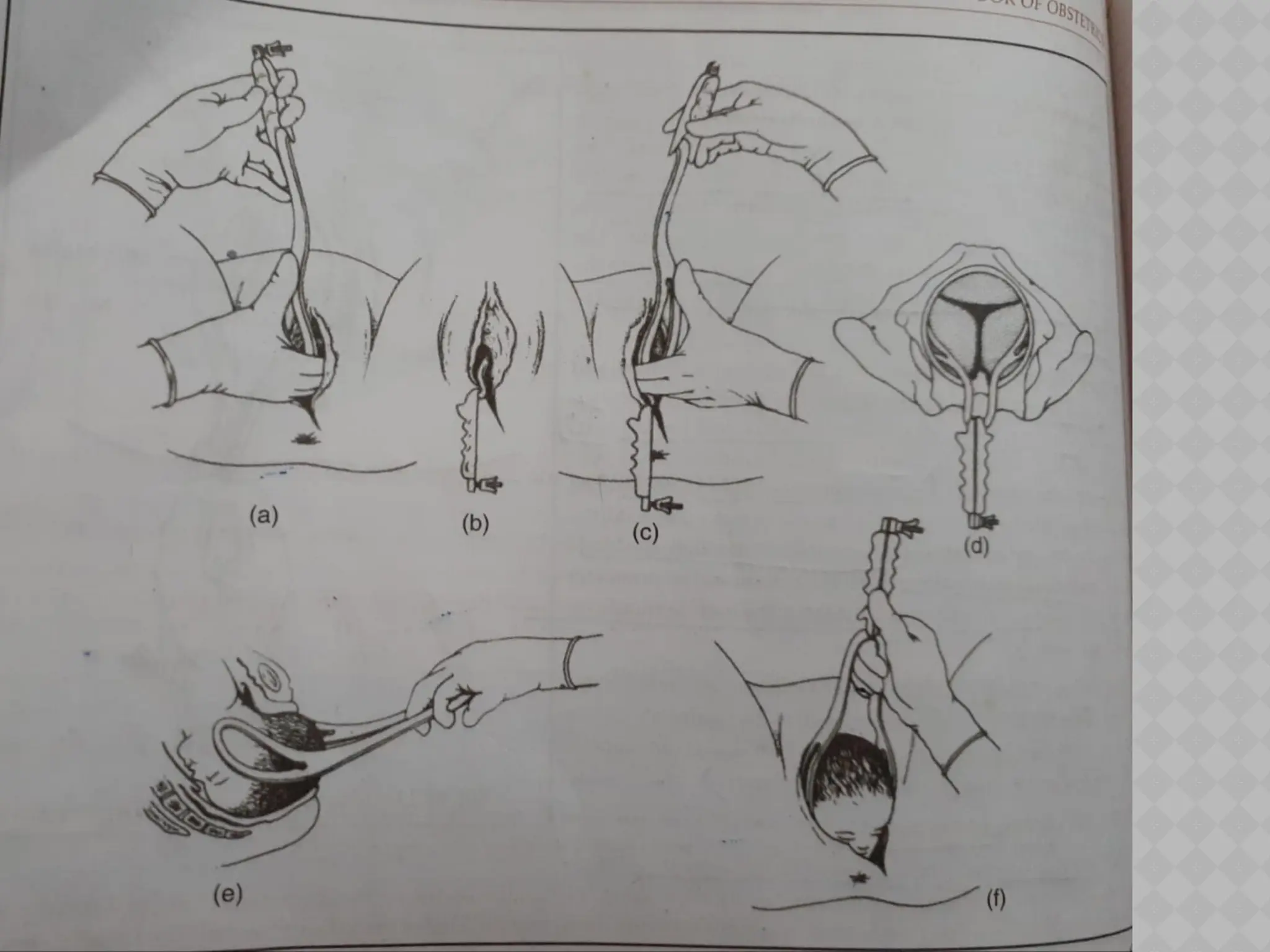
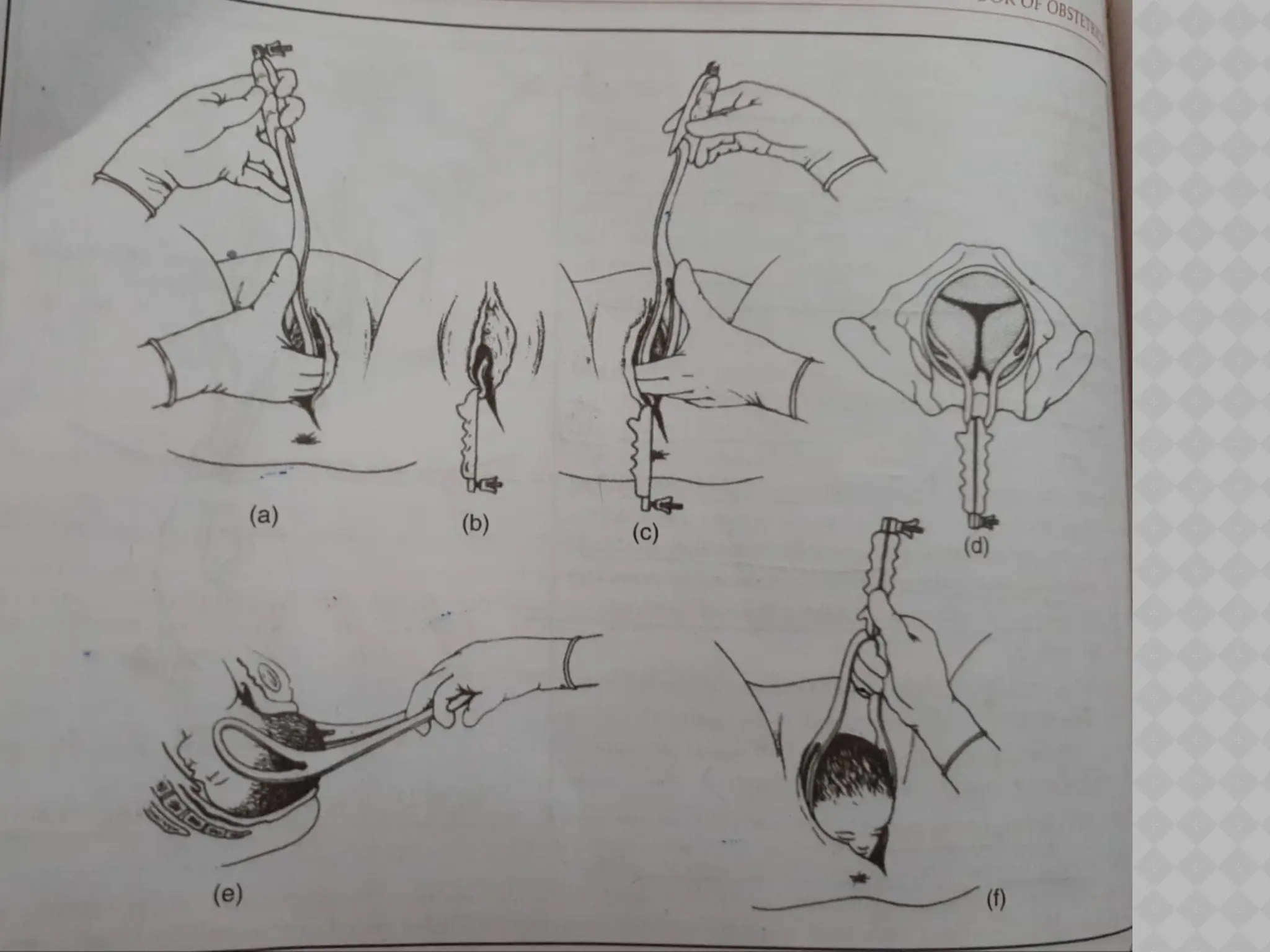
-The blade is identified and the left blade is
introduced first.
-The four fingers of the semisupinated right hand
are inserted along the left lateral vaginal wall.
 The palmer surface of the fingers rest
against the side of the head.
 The fingers are to guide the blade during
application and to protect the vaginal wall.
 The handle of the left blade is taken lightly
by three fingers of the left hand-index,
middle and thump in a pen holding manner
and is held vertically almost parallel to the
right inguinal ligament.
 The fenestrated portion of the blade is
placed on the right palm with the tip
pointing upwards.
 The right thump is placed at the junction of
the blade and the shank.
 The blade is introduced between the guiding
internal fingers and the fetal head, manipulated by
the thump.
 As the blade is pushed up and up, the handle is
carried downwards and backwards.
 Utmost gentleness is required while introducing the
blade.
 When correctly applied, the blade should be over
the parietal eminence.
 The shank should be in contact with the perineum
and the superior surface of the handle should be
directed upwards.
Introduction of the right blade
 The two fingers of the left hand are now
introduced into the right lateral wall of the
vagina alongside the baby’s head
 The right blade is introduced in the same
manner
STEP –II.LOCKING OF THE
BLADES
 When correctly applied the blades should be
articulated with ease.
STEP-III & IV-TRACTION AND
REMOVAL OF THE BLADES
 Before traction is applied, correct
application is evidenced by
-easy locking
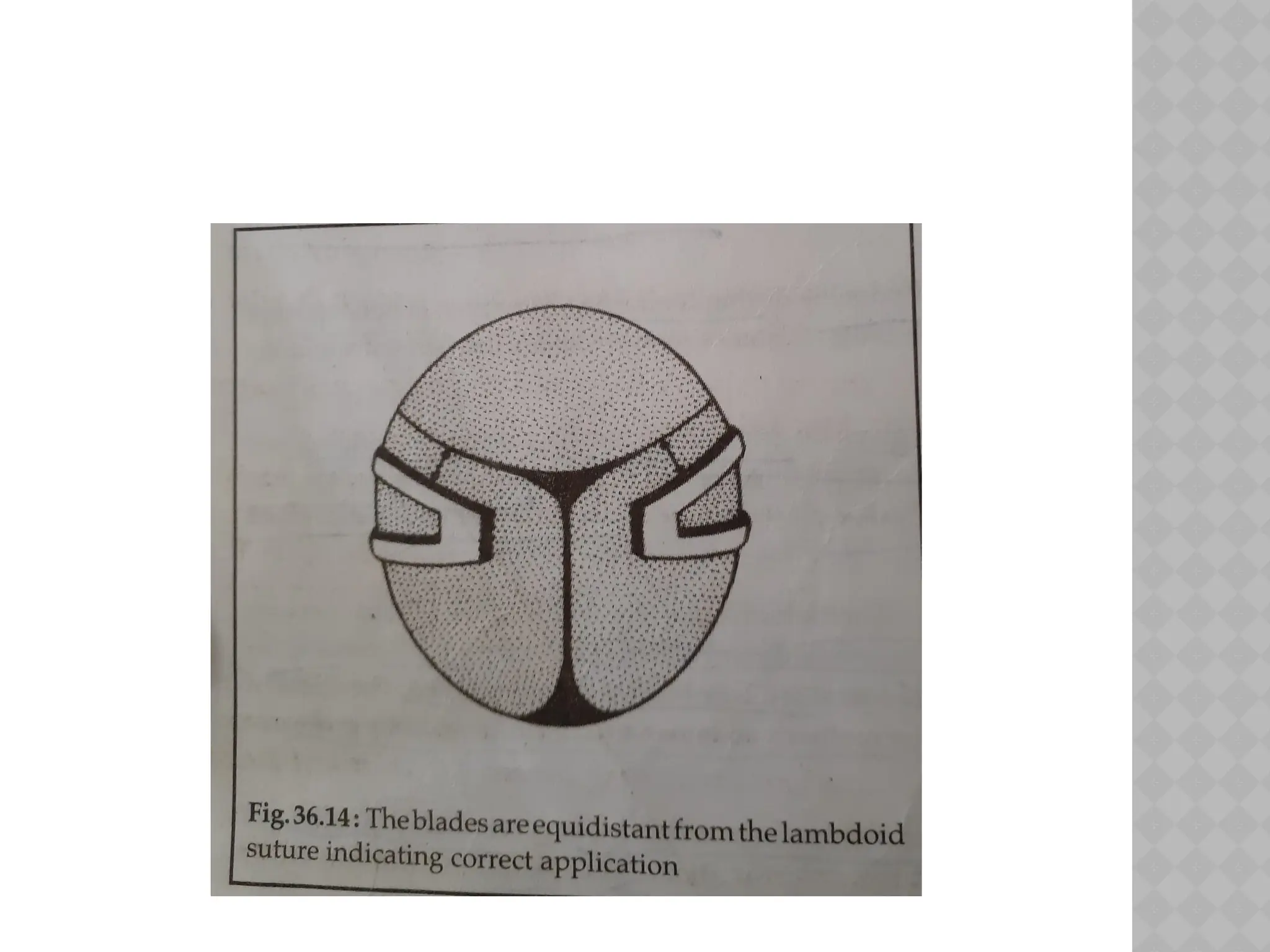
-the blades are equidistant from the lambdoid
suture
-firm grip of the head on the biparietal
diameter.
Principles-Steady but intermittent traction
should be given if possible during
contractions.
Gripping of the articulated forceps during
traction
 The traction is given by gripping the handle,
placing the middle finger in between the
shanks with the ring and index fingers on the
either side of the finger guard.
 During the final traction four fingers are
placed in between the shanks and thump
under surface of the handles.
Direction of the pull
 The direction of the pull corresponds to the long
axis of the birth canal.
 The direction of the pull is downwards and
backwards until the head comes to the perineum.
 The pull is then directed horizontally straight
towards operator till the head is almost crowned.
 The direction of the pull is gradually changed to
upwards and forwards towards mother’s abdomen
to deliver the head by extension.
 The blades are removed one after another.
CONT....
 Following the birth of the head ,usual
procedures are to be taken as in normal
delivery.
 Routine intravenous methergin 0.2 mg is to
be administered with the delivery of the
anterior shoulder.
 Episiotomy is repaired in the usual method.
KIELLAND’S FORCEPS
 It can be used in unrotated vertex or face
presentation.
 The blades are named anterior and posterior.
The anterior blade is to be introduced first .
 The blade is introduced along the sidewalls
of the pelvis and then rotated round the
fetal face to its anterior position.
 The posterior blade is inserted directly under
guidance if right hand placed between head
and the hollow of the sacrum.
CONT...
 The occiput is rotated anteriorly.
 The position is rechecked and traction is
applied.
DANGERS OF FORCEPS
OPPERATION
MATERNAL
IMMEDIATE
 Injury
 Nerve injury
 Postpartum haemorrhage
 Anaesthetic complications
 Puerperal sepsis and maternal mortality
REMOTE
 Painful perineal scars
 Dyspareunia
 Low backache
 Genital prolapse
 Stress urinary incontinence
FETAL
-IMMEDIATE
 Asphyxia
 Facial bruising
 Intracranial haemorrhage
 Cephalhaematoma
 Facial palsy
 Skull fractures
 Cervical spinal injury
-REMOTE
 Cerebral palsy.
THANK YOU

Forceps operation Procedure for nursing students OBG

  • 1.
  • 3.
    DEFINITION Obstetric forceps isa pair of instruments specially designed to assist extraction of the fetal head and thereby accomplishing the delivery of the fetal head.
  • 4.
    VARIETIES  Long curvedobstetric forceps  Short curved forceps (Wrigley forceps)  Kielland’s forceps
  • 5.
    LONG CURVED OBSTETRIC FORCEPS Measurements Length is 37 cm  Distance between the tips is 2.5 cm  Widest diameter between the blades about 9 cm.
  • 6.
    BLADES There are 2blades. Each blades consist of the following parts  Blade  Shank-6.25 cm.  Lock  Handle with or with out screw-12.5 cm
  • 8.
    The blades havegot 2 curves Pelvic curve:  The curve on the edge is to fit more or less the curve on the axis of the birth canal (curve of carus).It forms a part of a circle whose radius is 17.5 cm.  The front of the forceps is the concave side of the pelvic curve.
  • 9.
    Cephalic curve-  Itis the curve on the flat surface, When articulated grasps the fetal head without compression.  The radius of the curve is 11.5 cm.
  • 10.
    HOW TO IDETIFYTHE BLADES  When articulated Place the instrument infront of the pelvis with the tip of the blade pointing upwards and the concave side of the pelvic curve forwards. The blades corresponds to the left of the maternal pelvis is the left blade and to the right side is the right blade.
  • 11.
    CONT....  When isolated Thetip should point upwards The cephalic curve is to be directed inwards and the pelvic curve forwards.
  • 12.
    CHOICE OF FORCEPSOPERATION  Mid forceps It is used when the head is at or near the level of ischial spine.  Low forceps The head is near the pelvic floor or even visible at the introitus.  Outlet forceps Applied when the head is on the perineum
  • 13.
    TYPES OF APPLICATIONOF THE FORCEPS BLADES  Cephalic application: The blades are applied along the sides of the head grasping the biparietal diameter in between the widest part of the blades.  Pelvic application When the blades of the forceps are applied on the lateral pelvic walls ignoring the position of the head is called pelvic application
  • 14.
    FUNCTIONS  The tractionis the important function .The pull required is to be 18 kg and in multipara 13 kg.  Its compression effect on the cranium is minimum.  Rotation of the head can be achieved by keilland’s forceps.  Provide protective cage for the head
  • 15.
    INDICATIONS MATERNAL  Inadequate expulsiveefforts  Maternal exhaustion  Where expulsive efforts are to be avoided(cardiac disease, eclampsia, cerebral vascular disease) FETAL  Non reassuring fetal heart rate  After coming head of breech
  • 16.
    OTHERS  Prolonged secondstage of labour  To cut short second stage in severe preeclampsia,cardiac disease etc..
  • 17.
    CONDITIONS TO BEFULLFILLED FETAL AND UTERO PLACENTAL CRITERIA  Fetal head must be engaged  Cervix must be fully dilated  The membranes must be ruptured  The position and station of the head must be known. MATERNAL CRITERIA  No major CPD by clinical pelvimetry  Bladder must be emptied  Adequate analgesia
  • 18.
    FORCEPS  F-favourable headposition and station  O-Open Os(fully dilated)  R-Ruptured membranes  C-Contractions present and Consent  E-Engaged head ,Empty bladder  P-Pelvimetry-no major CPD  S-Stirrups, lithotomy position
  • 19.
    LOW FORCEPS OPERATION Preliminaries Anesthesia- Perineal infiltration with 1% lignocaine hydrochloride.  Catheterization  Internal examination to assess -the status of the cervix -membrane status -Presentation and position of the head -Assessment of the pelvic outlet  Episiotomy: done when the perineum becomes bulged by the head.
  • 20.
    STEPS  Identification ofthe blades and their application  Locking of the blades  Traction  Removal of the blades STEP-1:Identification of the blades and their application -The blade is identified and the left blade is introduced first. -The four fingers of the semisupinated right hand are inserted along the left lateral vaginal wall.
  • 21.
     The palmersurface of the fingers rest against the side of the head.  The fingers are to guide the blade during application and to protect the vaginal wall.  The handle of the left blade is taken lightly by three fingers of the left hand-index, middle and thump in a pen holding manner and is held vertically almost parallel to the right inguinal ligament.  The fenestrated portion of the blade is placed on the right palm with the tip pointing upwards.  The right thump is placed at the junction of the blade and the shank.
  • 23.
     The bladeis introduced between the guiding internal fingers and the fetal head, manipulated by the thump.  As the blade is pushed up and up, the handle is carried downwards and backwards.  Utmost gentleness is required while introducing the blade.  When correctly applied, the blade should be over the parietal eminence.  The shank should be in contact with the perineum and the superior surface of the handle should be directed upwards.
  • 25.
    Introduction of theright blade  The two fingers of the left hand are now introduced into the right lateral wall of the vagina alongside the baby’s head  The right blade is introduced in the same manner
  • 26.
    STEP –II.LOCKING OFTHE BLADES  When correctly applied the blades should be articulated with ease.
  • 27.
    STEP-III & IV-TRACTIONAND REMOVAL OF THE BLADES  Before traction is applied, correct application is evidenced by -easy locking -the blades are equidistant from the lambdoid suture -firm grip of the head on the biparietal diameter. Principles-Steady but intermittent traction should be given if possible during contractions.
  • 29.
    Gripping of thearticulated forceps during traction  The traction is given by gripping the handle, placing the middle finger in between the shanks with the ring and index fingers on the either side of the finger guard.  During the final traction four fingers are placed in between the shanks and thump under surface of the handles.
  • 30.
    Direction of thepull  The direction of the pull corresponds to the long axis of the birth canal.  The direction of the pull is downwards and backwards until the head comes to the perineum.  The pull is then directed horizontally straight towards operator till the head is almost crowned.  The direction of the pull is gradually changed to upwards and forwards towards mother’s abdomen to deliver the head by extension.  The blades are removed one after another.
  • 31.
    CONT....  Following thebirth of the head ,usual procedures are to be taken as in normal delivery.  Routine intravenous methergin 0.2 mg is to be administered with the delivery of the anterior shoulder.  Episiotomy is repaired in the usual method.
  • 32.
    KIELLAND’S FORCEPS  Itcan be used in unrotated vertex or face presentation.  The blades are named anterior and posterior. The anterior blade is to be introduced first .  The blade is introduced along the sidewalls of the pelvis and then rotated round the fetal face to its anterior position.  The posterior blade is inserted directly under guidance if right hand placed between head and the hollow of the sacrum.
  • 33.
    CONT...  The occiputis rotated anteriorly.  The position is rechecked and traction is applied.
  • 34.
    DANGERS OF FORCEPS OPPERATION MATERNAL IMMEDIATE Injury  Nerve injury  Postpartum haemorrhage  Anaesthetic complications  Puerperal sepsis and maternal mortality REMOTE  Painful perineal scars  Dyspareunia  Low backache
  • 35.
     Genital prolapse Stress urinary incontinence FETAL -IMMEDIATE  Asphyxia  Facial bruising  Intracranial haemorrhage  Cephalhaematoma  Facial palsy  Skull fractures  Cervical spinal injury -REMOTE  Cerebral palsy.
  • 36.