FOOD TECHNOLOGY
CARBOHYDRATES
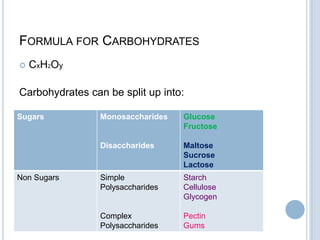
FORMULA FOR CARBOHYDRATES
 CxH2Oy
Carbohydrates can be split up into:
Sugars Monosaccharides
Disaccharides
Glucose
Fructose
Maltose
Sucrose
Lactose
Non Sugars Simple
Polysaccharides
Complex
Polysaccharides
Starch
Cellulose
Glycogen
Pectin
Gums
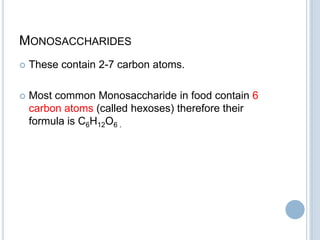
MONOSACCHARIDES
 These contain 2-7 carbon atoms.
 Most common Monosaccharide in food contain 6
carbon atoms (called hexoses) therefore their
formula is C6H12O6 .
GLUCOSE
 Found in large amounts of grapes and smaller
amounts in carrots and peas.
 Glucose syrup which is used in commercial
manufacture is not pure glucose, but a mixture of
other carbohydrates, glucose and water.
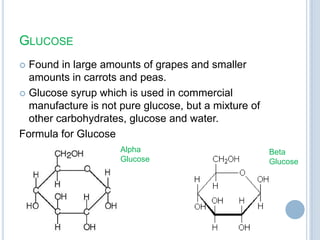
Formula for Glucose
Alpha
Glucose
Beta
Glucose
GLUCOSE CONT.
 There are two forms of glucose alpha and beta.
 It‟s important to remember that the only difference
in the two is that in alpha glucose, the hydroxyl
group (OH), is at the bottom of the structure and in
Beta glucose, the OH is at the top.
 Glucose is a reducing sugar, this means it has the
ability to break down Fehling‟s solutions to form a
brick red coloured precipitate.
 Fehling‟s solution is a mixture of 2 solutions which
have to be mixed at the time of carrying out the test
for reducing sugar.
FRUCTOSE
 Fructose is one and a half times sweeter than
glucose.
 An equal mixture of fructose and sucrose is called
invert sugar – found in honey, made when making
jam.
 The structure of Fructose changes depending on if
it is found in its own or whether it is joined with
other sugars.
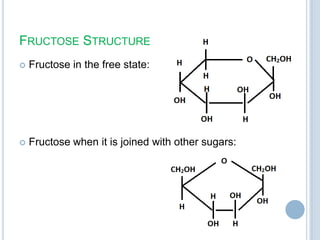
FRUCTOSE STRUCTURE
 Fructose in the free state:
 Fructose when it is joined with other sugars:
GALACTOSE
 This doesn‟t occur in foods but it is formed when
lactose if broken down during digestion.
DISACCHARIDES
 Disaccharides have the formula C12H22O11.
 These sugars are formed when two
Monosaccharides join together during a
condensation reaction (when water is eliminated).
LACTOSE
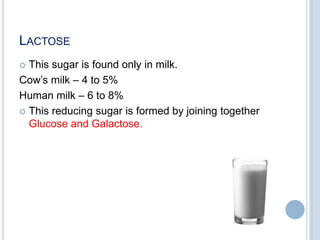
 This sugar is found only in milk.
Cow‟s milk – 4 to 5%
Human milk – 6 to 8%
 This reducing sugar is formed by joining together
Glucose and Galactose.
MALTOSE
 Is formed when two Glucose units join together.
 When the two units join, water is eliminated and the
remaining O2 atom forms a bridge between the two
glucoses.
 This bridge is called a Glycosidic Link.
 Maltose is a reducing sugar. During digestion starch
is broken down by the enzyme amylase (this
enzyme is present in our saliva).
SUCROSE
 Sucrose is not a reducing sugar.
 Sucrose is formed by 1 glucose unit joined with 1
fructose unit.
 Ordinary sugar is almost pure sucrose (caster
sugar/ sugar in tea etc).
RECAP
Glucose + Glucose = Maltose
Glucose + Fructose = Sucrose
Glucose + Galactose = Lactose
HYDROLYSIS
 It s the chemical breakdown of a molecule when it
combine with water and produces two smaller
molecules.
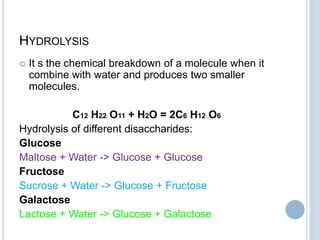
C12 H22 O11 + H2O = 2C6 H12 O6
Hydrolysis of different disaccharides:
Glucose
Maltose + Water -> Glucose + Glucose
Fructose
Sucrose + Water -> Glucose + Fructose
Galactose
Lactose + Water -> Glucose + Galactose
SIMPLE POLYSACCHARIDES
 Long chains of 1 type of monosaccharide joined
together.
 Usually insoluble in water.
 Most polysaccharides usually have a 1-4 Glycosidic
link, but sometimes 1-6 link, a 1-2 link or a 1-3 link.
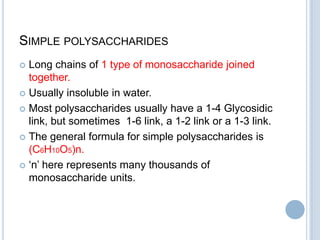
 The general formula for simple polysaccharides is
(C6H10O5)n.
 „n‟ here represents many thousands of
monosaccharide units.
STARCH
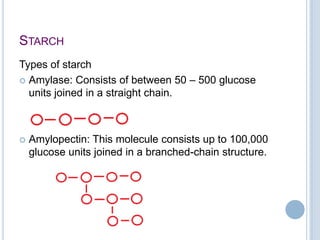
Types of starch
 Amylase: Consists of between 50 – 500 glucose
units joined in a straight chain.
 Amylopectin: This molecule consists up to 100,000
glucose units joined in a branched-chain structure.
PROPERTIES OF STARCH
 Appearance and Solubility:
Starch is a white powder which is insoluble in cold
water.
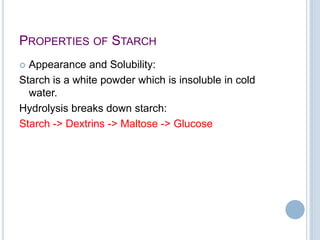
Hydrolysis breaks down starch:
Starch -> Dextrins -> Maltose -> Glucose
PROPERTIES OF STARCH CONT.
 Effect of Heat
Gelatinization (with water):
 Water penetrates the outer layers of granules and
the granules begin to swell when the temperature
rises from 60 C to 80 C.
 Granules swell up to 5x the original size – mixture
becomes viscous (thick).
 At 80 C the starch granules break up and disperse
throughout the water.
 Long chain molecules unfold and the starch/water
mixture becomes more viscous – forms a sol.
 On cooling, starch molecules form a network with
the water and produce a gel.
CELLULOSE
 Insoluble
 Long chain of glucose units – are the building
blocks of plants being found in cell walls.
 Cellulose is important for providing fibre (NSP) in
the diet.
 Non-starch polysaccharides (NSP) is necessary for
efficient passage of food through the alimentary
canal and regular emptying of the bowel.
GLYCOGEN
 Carbohydrate only found in animals
 Animals store glycogen in muscles and liver and
when required, it converts it to glucose which is
broken down to provide energy.
 Glycogen, like Amylopectin, is composed of
branched chains of glucose units.
COMPLEX POLYSACCHARIDES
 These are long chains of different
monosaccharide's joined together and often with
branches.
PECTIN
 Complex mixture of polysaccharides found in many
fruits and some root vegetables.
 Apples and the peel of citrus fruits are particularly
rich in pectin.
 Main importance: Gelling Agent (e.g. jam making)
 Pectin is broken down in fruit as fruit ripens – Jam
will not gel well if made from over ripe fruit.
 For pectin to form a really good gel, 65% of it needs
to be sugar.
 pH affects gel strengths (pH 3.0-3.5). Lemon juice
lowers this setting.
GUMS
 Tragacanth, arabic and guar – Produced by plants
and are used in food manufacturing as thickeners,
stabilizers and gelling agents in foods.
 E.g. Ice cream, salad dressing and fruit pie fillings.
 Certain seaweed extracts are used in a similar
manner.
 These include carrageenan (Irish Moss), alginates
e.g. sodium alginate and agar (agar-agar).
 Agar is also used in the preparation of
microbiological media.
THE PROPERTIES OF CARBOHYDRATES
 Sugar
The effect of heat:
Melting point of sucrose is 160 C to 161 C.
After sugar is melted and cooled slowly, it forms an
amorphous (shapeless) sugar sometimes called
“barley sugar”.
If sucrose is heated above melting point, brownish-
coloured substances called caramel is formed.
Maltose melts at about 100 C, therefore it
decomposes more easily by heat than sucrose.
THE PROPERTIES OF CARBOHYDRATES CONT..
Aeration:
A soufflé will rise because of the trapped air in the
egg whites – adding sugar will make the egg whites
more stable.
The sugar interacts with the whipped foam structure
to make the foam more elastic so that the air cells
can expand and take up more air and therefore
rise.
MODIFIED STARCH
 Also a „novel food‟
 It is classified as a smart food and is used by
manufacturers in a variety of products.
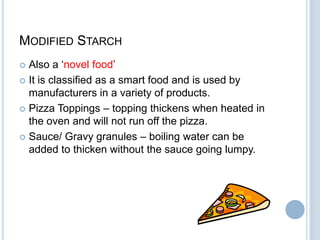
 Pizza Toppings – topping thickens when heated in
the oven and will not run off the pizza.
 Sauce/ Gravy granules – boiling water can be
added to thicken without the sauce going lumpy.
MODIFIED STARCH CONT..
 Modified starch is used as a fat replacer in low-fat
meals.
 The noodles in „pot snacks‟ are pre-gelatinised; so
boiled water will reheat and „cook‟ them.
 Modified starch is used in „cup-a-soups‟ to improve
mouth-feel, thicken then drink/soup when the boiled
water is added, and blend uniformly without lumps.
 Modified starches allow sauces to be reheated by
syneresis*. This is useful in dishes that are cooked
from frozen e.g. Lasagne.
*When a sauce that has cooled and solidified is reheated, often
goes lumpy and a watery liquid may separate from it.

Food Technology Carbohydrates

  • 1.
  • 2.
    FORMULA FOR CARBOHYDRATES CxH2Oy Carbohydrates can be split up into: Sugars Monosaccharides Disaccharides Glucose Fructose Maltose Sucrose Lactose Non Sugars Simple Polysaccharides Complex Polysaccharides Starch Cellulose Glycogen Pectin Gums
  • 3.
    MONOSACCHARIDES  These contain2-7 carbon atoms.  Most common Monosaccharide in food contain 6 carbon atoms (called hexoses) therefore their formula is C6H12O6 .
  • 4.
    GLUCOSE  Found inlarge amounts of grapes and smaller amounts in carrots and peas.  Glucose syrup which is used in commercial manufacture is not pure glucose, but a mixture of other carbohydrates, glucose and water. Formula for Glucose Alpha Glucose Beta Glucose
  • 5.
    GLUCOSE CONT.  Thereare two forms of glucose alpha and beta.  It‟s important to remember that the only difference in the two is that in alpha glucose, the hydroxyl group (OH), is at the bottom of the structure and in Beta glucose, the OH is at the top.  Glucose is a reducing sugar, this means it has the ability to break down Fehling‟s solutions to form a brick red coloured precipitate.  Fehling‟s solution is a mixture of 2 solutions which have to be mixed at the time of carrying out the test for reducing sugar.
  • 6.
    FRUCTOSE  Fructose isone and a half times sweeter than glucose.  An equal mixture of fructose and sucrose is called invert sugar – found in honey, made when making jam.  The structure of Fructose changes depending on if it is found in its own or whether it is joined with other sugars.
  • 7.
    FRUCTOSE STRUCTURE  Fructosein the free state:  Fructose when it is joined with other sugars:
  • 8.
    GALACTOSE  This doesn‟toccur in foods but it is formed when lactose if broken down during digestion.
  • 9.
    DISACCHARIDES  Disaccharides havethe formula C12H22O11.  These sugars are formed when two Monosaccharides join together during a condensation reaction (when water is eliminated).
  • 10.
    LACTOSE  This sugaris found only in milk. Cow‟s milk – 4 to 5% Human milk – 6 to 8%  This reducing sugar is formed by joining together Glucose and Galactose.
  • 11.
    MALTOSE  Is formedwhen two Glucose units join together.  When the two units join, water is eliminated and the remaining O2 atom forms a bridge between the two glucoses.  This bridge is called a Glycosidic Link.  Maltose is a reducing sugar. During digestion starch is broken down by the enzyme amylase (this enzyme is present in our saliva).
  • 12.
    SUCROSE  Sucrose isnot a reducing sugar.  Sucrose is formed by 1 glucose unit joined with 1 fructose unit.  Ordinary sugar is almost pure sucrose (caster sugar/ sugar in tea etc). RECAP Glucose + Glucose = Maltose Glucose + Fructose = Sucrose Glucose + Galactose = Lactose
  • 13.
    HYDROLYSIS  It sthe chemical breakdown of a molecule when it combine with water and produces two smaller molecules. C12 H22 O11 + H2O = 2C6 H12 O6 Hydrolysis of different disaccharides: Glucose Maltose + Water -> Glucose + Glucose Fructose Sucrose + Water -> Glucose + Fructose Galactose Lactose + Water -> Glucose + Galactose
  • 14.
    SIMPLE POLYSACCHARIDES  Longchains of 1 type of monosaccharide joined together.  Usually insoluble in water.  Most polysaccharides usually have a 1-4 Glycosidic link, but sometimes 1-6 link, a 1-2 link or a 1-3 link.  The general formula for simple polysaccharides is (C6H10O5)n.  „n‟ here represents many thousands of monosaccharide units.
  • 15.
    STARCH Types of starch Amylase: Consists of between 50 – 500 glucose units joined in a straight chain.  Amylopectin: This molecule consists up to 100,000 glucose units joined in a branched-chain structure.
  • 16.
    PROPERTIES OF STARCH Appearance and Solubility: Starch is a white powder which is insoluble in cold water. Hydrolysis breaks down starch: Starch -> Dextrins -> Maltose -> Glucose
  • 17.
    PROPERTIES OF STARCHCONT.  Effect of Heat Gelatinization (with water):  Water penetrates the outer layers of granules and the granules begin to swell when the temperature rises from 60 C to 80 C.  Granules swell up to 5x the original size – mixture becomes viscous (thick).  At 80 C the starch granules break up and disperse throughout the water.  Long chain molecules unfold and the starch/water mixture becomes more viscous – forms a sol.  On cooling, starch molecules form a network with the water and produce a gel.
  • 18.
    CELLULOSE  Insoluble  Longchain of glucose units – are the building blocks of plants being found in cell walls.  Cellulose is important for providing fibre (NSP) in the diet.  Non-starch polysaccharides (NSP) is necessary for efficient passage of food through the alimentary canal and regular emptying of the bowel.
  • 19.
    GLYCOGEN  Carbohydrate onlyfound in animals  Animals store glycogen in muscles and liver and when required, it converts it to glucose which is broken down to provide energy.  Glycogen, like Amylopectin, is composed of branched chains of glucose units.
  • 20.
    COMPLEX POLYSACCHARIDES  Theseare long chains of different monosaccharide's joined together and often with branches.
  • 21.
    PECTIN  Complex mixtureof polysaccharides found in many fruits and some root vegetables.  Apples and the peel of citrus fruits are particularly rich in pectin.  Main importance: Gelling Agent (e.g. jam making)  Pectin is broken down in fruit as fruit ripens – Jam will not gel well if made from over ripe fruit.  For pectin to form a really good gel, 65% of it needs to be sugar.  pH affects gel strengths (pH 3.0-3.5). Lemon juice lowers this setting.
  • 22.
    GUMS  Tragacanth, arabicand guar – Produced by plants and are used in food manufacturing as thickeners, stabilizers and gelling agents in foods.  E.g. Ice cream, salad dressing and fruit pie fillings.  Certain seaweed extracts are used in a similar manner.  These include carrageenan (Irish Moss), alginates e.g. sodium alginate and agar (agar-agar).  Agar is also used in the preparation of microbiological media.
  • 23.
    THE PROPERTIES OFCARBOHYDRATES  Sugar The effect of heat: Melting point of sucrose is 160 C to 161 C. After sugar is melted and cooled slowly, it forms an amorphous (shapeless) sugar sometimes called “barley sugar”. If sucrose is heated above melting point, brownish- coloured substances called caramel is formed. Maltose melts at about 100 C, therefore it decomposes more easily by heat than sucrose.
  • 24.
    THE PROPERTIES OFCARBOHYDRATES CONT.. Aeration: A soufflé will rise because of the trapped air in the egg whites – adding sugar will make the egg whites more stable. The sugar interacts with the whipped foam structure to make the foam more elastic so that the air cells can expand and take up more air and therefore rise.
  • 25.
    MODIFIED STARCH  Alsoa „novel food‟  It is classified as a smart food and is used by manufacturers in a variety of products.  Pizza Toppings – topping thickens when heated in the oven and will not run off the pizza.  Sauce/ Gravy granules – boiling water can be added to thicken without the sauce going lumpy.
  • 26.
    MODIFIED STARCH CONT.. Modified starch is used as a fat replacer in low-fat meals.  The noodles in „pot snacks‟ are pre-gelatinised; so boiled water will reheat and „cook‟ them.  Modified starch is used in „cup-a-soups‟ to improve mouth-feel, thicken then drink/soup when the boiled water is added, and blend uniformly without lumps.  Modified starches allow sauces to be reheated by syneresis*. This is useful in dishes that are cooked from frozen e.g. Lasagne. *When a sauce that has cooled and solidified is reheated, often goes lumpy and a watery liquid may separate from it.