FUNCTIONALPROPERTIESOFPROTEIN
MS. NIRUPAMA MAHANTA
MSC. FOOD SCIENCE AND NUTRITION
MOUNT CARMEL COLLEGE, BANGALORE
INTRODUCTION:
• Proteins are made up of carbon, hydrogen, nitrogen, oxygen and usually
Sulphur.
• Proteins are built up of a large number of amino acid molecules inter linked by
peptide bonds.
• Proteins for foods, in addition to providing nutrition, should also possess
specific functional properties that facilitate processing and serve as the basis of
product performance.
• Functional properties of proteins for foods connote the physicochemical
properties which govern the behavior of protein in foods.
• They contribute significantly to the physical properties of the foodstuffs
especially ability to build or stabilize gels, foams, doughs, emulsions, fibrillar
structures, foaming gelling and emulsifying properties.
MS. NIRUPAMA MAHANTA
Functional properties of proteins:
Functionality refers to any property aside from the nutritional attributes that influence usefulness
of ingredients in the food.
Functional properties of proteins are those physico-chemical properties that enable the proteins to
contribute to the desirable characteristics of the food.
Three groups of functional properties of proteins have been identified.
Hydration properties
(dependent on
protein-water
interactions), which
include properties like
swelling, adhesion,
dispersibility,
solubility and
viscosity.
Properties related to
protein-protein
interactions, which
involves the processes
of precipitation,
gelation and formation
of other structures
(like protein doughs
and fibers).
Surface properties,
which relates
primarily to surface
tension, emulsification
and foaming
characteristics of
proteins.
MS. NIRUPAMA MAHANTA
It includes include solubility, viscosity etc.
Solubility of Proteins:
Most of the functional properties are dependent on the degree to which the proteins are
soluble. The solubility behavior provides a good index of potential application of
proteins.
Proteins, which are highly soluble, may be used in applications where emulsification,
whipping and film formation are important whereas low solubility may be desired
in applications with high protein levels and when limited emulsification or
protein-protein interactions are needed.
The main advantage of insolubility is that it permits rapid and extensive dispersion of
protein molecules and particles which leads to a finely dispersed colloidal system with
homogeneous macroscopic structure and smooth texture.
Hydration properties:
MS. NIRUPAMA MAHANTA
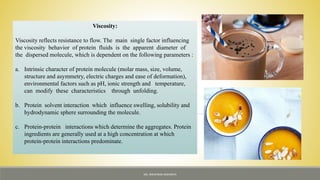
Viscosity:
Viscosity reflects resistance to flow. The main single factor influencing
the viscosity behavior of protein fluids is the apparent diameter of
the dispersed molecule, which is dependent on the following parameters :
a. Intrinsic character of protein molecule (molar mass, size, volume,
structure and asymmetry, electric charges and ease of deformation),
environmental factors such as pH, ionic strength and temperature,
can modify these characteristics through unfolding.
b. Protein solvent interaction which influence swelling, solubility and
hydrodynamic sphere surrounding the molecule.
c. Protein-protein interactions which determine the aggregates. Protein
ingredients are generally used at a high concentration at which
protein-protein interactions predominate.
MS. NIRUPAMA MAHANTA
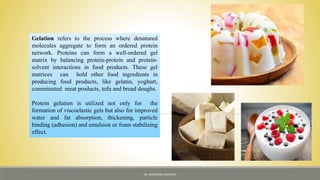
Gelation refers to the process where denatured
molecules aggregate to form an ordered protein
network. Proteins can form a well-ordered gel
matrix by balancing protein-protein and protein-
solvent interactions in food products. These gel
matrices can hold other food ingredients in
producing food products, like gelatin, yoghurt,
comminuted meat products, tofu and bread doughs.
Protein gelation is utilized not only for the
formation of viscoelastic gels but also for improved
water and fat absorption, thickening, particle
binding (adhesion) and emulsion or foam stabilizing
effect.
MS. NIRUPAMA MAHANTA
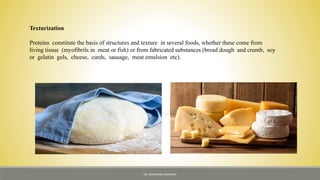
Texturization
Proteins constitute the basis of structures and texture in several foods, whether these come from
living tissue (myofibrils in meat or fish) or from fabricated substances (bread dough and crumb, soy
or gelatin gels, cheese, curds, sausage, meat emulsion etc).
MS. NIRUPAMA MAHANTA
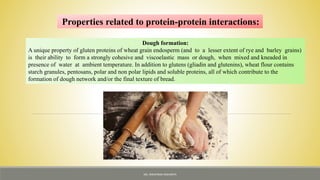
Properties related to protein-protein interactions:
Dough formation:
A unique property of gluten proteins of wheat grain endosperm (and to a lesser extent of rye and barley grains)
is their ability to form a strongly cohesive and viscoelastic mass or dough, when mixed and kneaded in
presence of water at ambient temperature. In addition to glutens (gliadin and glutenins), wheat flour contains
starch granules, pentosans, polar and non polar lipids and soluble proteins, all of which contribute to the
formation of dough network and/or the final texture of bread.
MS. NIRUPAMA MAHANTA
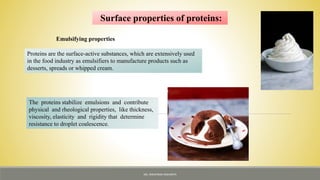
Surface properties of proteins:
Emulsifying properties
Proteins are the surface-active substances, which are extensively used
in the food industry as emulsifiers to manufacture products such as
desserts, spreads or whipped cream.
The proteins stabilize emulsions and contribute
physical and rheological properties, like thickness,
viscosity, elasticity and rigidity that determine
resistance to droplet coalescence.
MS. NIRUPAMA MAHANTA
Foaming Properties
Foam foods are usually colloidal dispersion of gas bubbles in a continuous liquid or semisolid
phase that contains a soluble surfactant. Large variety of food foams produced with proteins,
exist with widely differing textures, such as cakes, whipped creams and toppings, ice
creams etc. In many cases, gas is air (occasionally CO2) and the continuous phase is
an aqueous or suspension containing proteins.
MS. NIRUPAMA MAHANTA
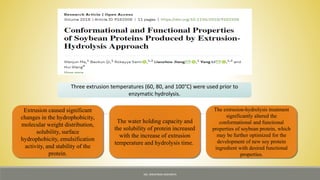
Three extrusion temperatures (60, 80, and 100°C) were used prior to
enzymatic hydrolysis.
Extrusion caused significant
changes in the hydrophobicity,
molecular weight distribution,
solubility, surface
hydrophobicity, emulsification
activity, and stability of the
protein.
The water holding capacity and
the solubility of protein increased
with the increase of extrusion
temperature and hydrolysis time.
The extrusion-hydrolysis treatment
significantly altered the
conformational and functional
properties of soybean protein, which
may be further optimized for the
development of new soy protein
ingredient with desired functional
properties.
MS. NIRUPAMA MAHANTA
REFRENCES:
• https://www.hindawi.com/journals/ijac/2018/9182508/
• John E. Kinsella & Nicholas Melachouris (2016) Functional properties of proteins in
foods: A survey, C R C Critical Reviews in Food Science and Nutrition, 7:3, 219-
280, DOI: 10.1080/10408397609527208
• https://www.sciencedirect.com/topics/biochemistry-genetics-and-molecular-
biology/functional-property-of-proteins
• https://cwsimons.com/functional-properties-of-proteins/
• Understanding food – principles and preparation by Amy brown ( third edition)
• Principles of food science – IGNOU
MS. NIRUPAMA MAHANTA

FUNCTIONAL PROPERTIES OF PROTEIN

  • 1.
    FUNCTIONALPROPERTIESOFPROTEIN MS. NIRUPAMA MAHANTA MSC.FOOD SCIENCE AND NUTRITION MOUNT CARMEL COLLEGE, BANGALORE
  • 2.
    INTRODUCTION: • Proteins aremade up of carbon, hydrogen, nitrogen, oxygen and usually Sulphur. • Proteins are built up of a large number of amino acid molecules inter linked by peptide bonds. • Proteins for foods, in addition to providing nutrition, should also possess specific functional properties that facilitate processing and serve as the basis of product performance. • Functional properties of proteins for foods connote the physicochemical properties which govern the behavior of protein in foods. • They contribute significantly to the physical properties of the foodstuffs especially ability to build or stabilize gels, foams, doughs, emulsions, fibrillar structures, foaming gelling and emulsifying properties. MS. NIRUPAMA MAHANTA
  • 3.
    Functional properties ofproteins: Functionality refers to any property aside from the nutritional attributes that influence usefulness of ingredients in the food. Functional properties of proteins are those physico-chemical properties that enable the proteins to contribute to the desirable characteristics of the food. Three groups of functional properties of proteins have been identified. Hydration properties (dependent on protein-water interactions), which include properties like swelling, adhesion, dispersibility, solubility and viscosity. Properties related to protein-protein interactions, which involves the processes of precipitation, gelation and formation of other structures (like protein doughs and fibers). Surface properties, which relates primarily to surface tension, emulsification and foaming characteristics of proteins. MS. NIRUPAMA MAHANTA
  • 4.
    It includes includesolubility, viscosity etc. Solubility of Proteins: Most of the functional properties are dependent on the degree to which the proteins are soluble. The solubility behavior provides a good index of potential application of proteins. Proteins, which are highly soluble, may be used in applications where emulsification, whipping and film formation are important whereas low solubility may be desired in applications with high protein levels and when limited emulsification or protein-protein interactions are needed. The main advantage of insolubility is that it permits rapid and extensive dispersion of protein molecules and particles which leads to a finely dispersed colloidal system with homogeneous macroscopic structure and smooth texture. Hydration properties: MS. NIRUPAMA MAHANTA
  • 5.
    Viscosity: Viscosity reflects resistanceto flow. The main single factor influencing the viscosity behavior of protein fluids is the apparent diameter of the dispersed molecule, which is dependent on the following parameters : a. Intrinsic character of protein molecule (molar mass, size, volume, structure and asymmetry, electric charges and ease of deformation), environmental factors such as pH, ionic strength and temperature, can modify these characteristics through unfolding. b. Protein solvent interaction which influence swelling, solubility and hydrodynamic sphere surrounding the molecule. c. Protein-protein interactions which determine the aggregates. Protein ingredients are generally used at a high concentration at which protein-protein interactions predominate. MS. NIRUPAMA MAHANTA
  • 6.
    Gelation refers tothe process where denatured molecules aggregate to form an ordered protein network. Proteins can form a well-ordered gel matrix by balancing protein-protein and protein- solvent interactions in food products. These gel matrices can hold other food ingredients in producing food products, like gelatin, yoghurt, comminuted meat products, tofu and bread doughs. Protein gelation is utilized not only for the formation of viscoelastic gels but also for improved water and fat absorption, thickening, particle binding (adhesion) and emulsion or foam stabilizing effect. MS. NIRUPAMA MAHANTA
  • 7.
    Texturization Proteins constitute thebasis of structures and texture in several foods, whether these come from living tissue (myofibrils in meat or fish) or from fabricated substances (bread dough and crumb, soy or gelatin gels, cheese, curds, sausage, meat emulsion etc). MS. NIRUPAMA MAHANTA
  • 8.
    Properties related toprotein-protein interactions: Dough formation: A unique property of gluten proteins of wheat grain endosperm (and to a lesser extent of rye and barley grains) is their ability to form a strongly cohesive and viscoelastic mass or dough, when mixed and kneaded in presence of water at ambient temperature. In addition to glutens (gliadin and glutenins), wheat flour contains starch granules, pentosans, polar and non polar lipids and soluble proteins, all of which contribute to the formation of dough network and/or the final texture of bread. MS. NIRUPAMA MAHANTA
  • 9.
    Surface properties ofproteins: Emulsifying properties Proteins are the surface-active substances, which are extensively used in the food industry as emulsifiers to manufacture products such as desserts, spreads or whipped cream. The proteins stabilize emulsions and contribute physical and rheological properties, like thickness, viscosity, elasticity and rigidity that determine resistance to droplet coalescence. MS. NIRUPAMA MAHANTA
  • 10.
    Foaming Properties Foam foodsare usually colloidal dispersion of gas bubbles in a continuous liquid or semisolid phase that contains a soluble surfactant. Large variety of food foams produced with proteins, exist with widely differing textures, such as cakes, whipped creams and toppings, ice creams etc. In many cases, gas is air (occasionally CO2) and the continuous phase is an aqueous or suspension containing proteins. MS. NIRUPAMA MAHANTA
  • 11.
    Three extrusion temperatures(60, 80, and 100°C) were used prior to enzymatic hydrolysis. Extrusion caused significant changes in the hydrophobicity, molecular weight distribution, solubility, surface hydrophobicity, emulsification activity, and stability of the protein. The water holding capacity and the solubility of protein increased with the increase of extrusion temperature and hydrolysis time. The extrusion-hydrolysis treatment significantly altered the conformational and functional properties of soybean protein, which may be further optimized for the development of new soy protein ingredient with desired functional properties. MS. NIRUPAMA MAHANTA
  • 12.
    REFRENCES: • https://www.hindawi.com/journals/ijac/2018/9182508/ • JohnE. Kinsella & Nicholas Melachouris (2016) Functional properties of proteins in foods: A survey, C R C Critical Reviews in Food Science and Nutrition, 7:3, 219- 280, DOI: 10.1080/10408397609527208 • https://www.sciencedirect.com/topics/biochemistry-genetics-and-molecular- biology/functional-property-of-proteins • https://cwsimons.com/functional-properties-of-proteins/ • Understanding food – principles and preparation by Amy brown ( third edition) • Principles of food science – IGNOU MS. NIRUPAMA MAHANTA
  • 13.