Carbohydrates
and their
functional
properties in
food products
In general, the definition of
carbohydrates is organic compounds
that contain carbon, hydrogen and
oxygen atoms, and in general the
elements hydrogen and oxygen in the
composition produce H2O. In the body,
carbohydrates can be formed from
several amino acids and some from fatty
glycerol
Defenition of Carboydrates
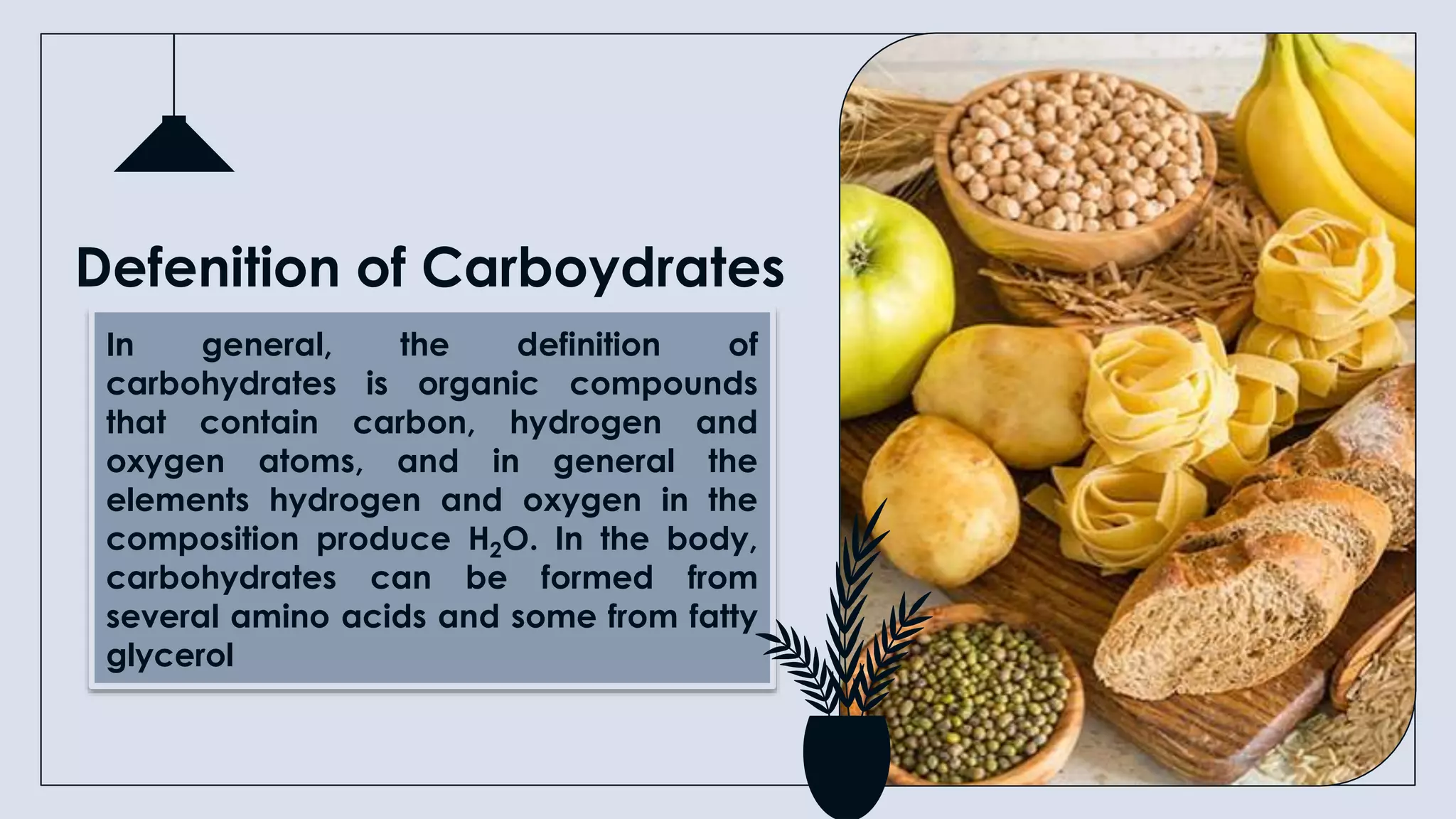
Many foods contain some carbohydrates,
but the amounts of sugars, starch and fibre
differ.
Sugars are naturally present in foods such
as milk, fruits, vegetables and honey. In
the UK, sugar beet and sugar cane are the
most common sources of sugar. Honey,
treacle and golden syrup are also popular.
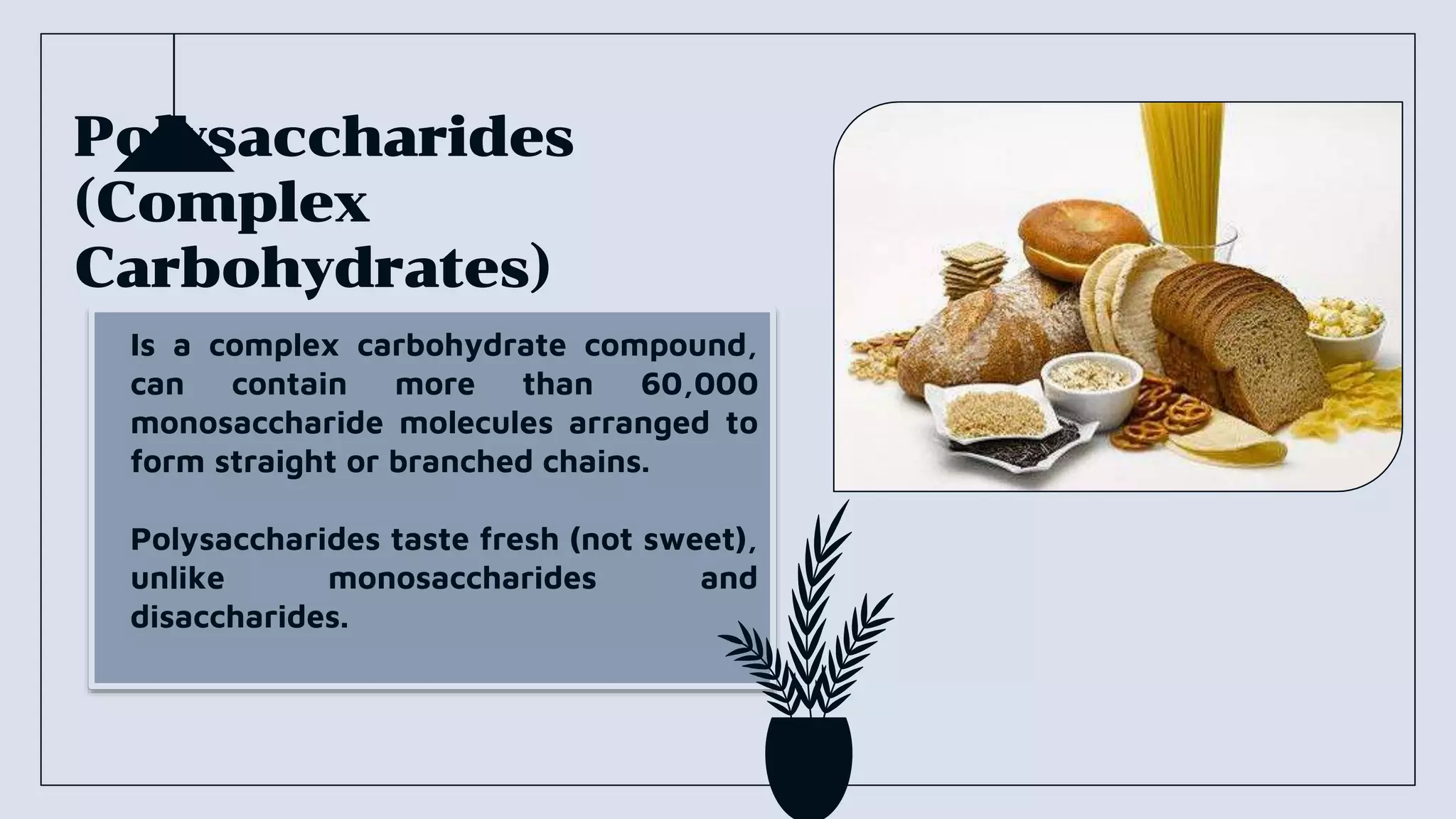
Starch is present in foods such as potatoes,
bread, rice and pasta.
Carboydrates in Food
Properties of Carbohydrates
01
03
02
04
Carbohydrates are classified into polysaccharides,
disaccharides and monosaccharides
When carbohydrates are burned in the body, it
releases energy CO2 and water.
Starch is insoluble in cold water, but when heated it
forms a gelatin-like substance which is easily
digested.
Some carbohydrates can be synthesized in the body
from fat and protein stored in the body
Properties of Carbohydrates
05
07
06
A small amount of carbohydrates can be stored in
the body in the liver and muscle tissue as glycogen.
When carbohydrates are burned in the body, it
releases energy CO2 and water.
If most of the carbohydrates absorbed by the body
are not used immediately, they are converted to fat
and stored as adipose tissue to meet energy needs
when needed later
The classification of carbohydrates most often used in
nutrition is based on the number of molecules.
Carbohydra
tes
Complex
Carbohydrate
s
Simple
Carbohydrate
s
Monosacchari
des
Disaccharides
Polysaccharid
es
Gluctose
Fructose
Galactose
Sucrose
Lactose
Maltose
Starch
Glycogen
Fiber
These are the simplest carbohydrate
molecules.
The most commonly occurring
monosaccharides in food are glucose,
fructose and galactose.
Monosaccharides
(Simple
Carbohydrates)
Monosaccarides
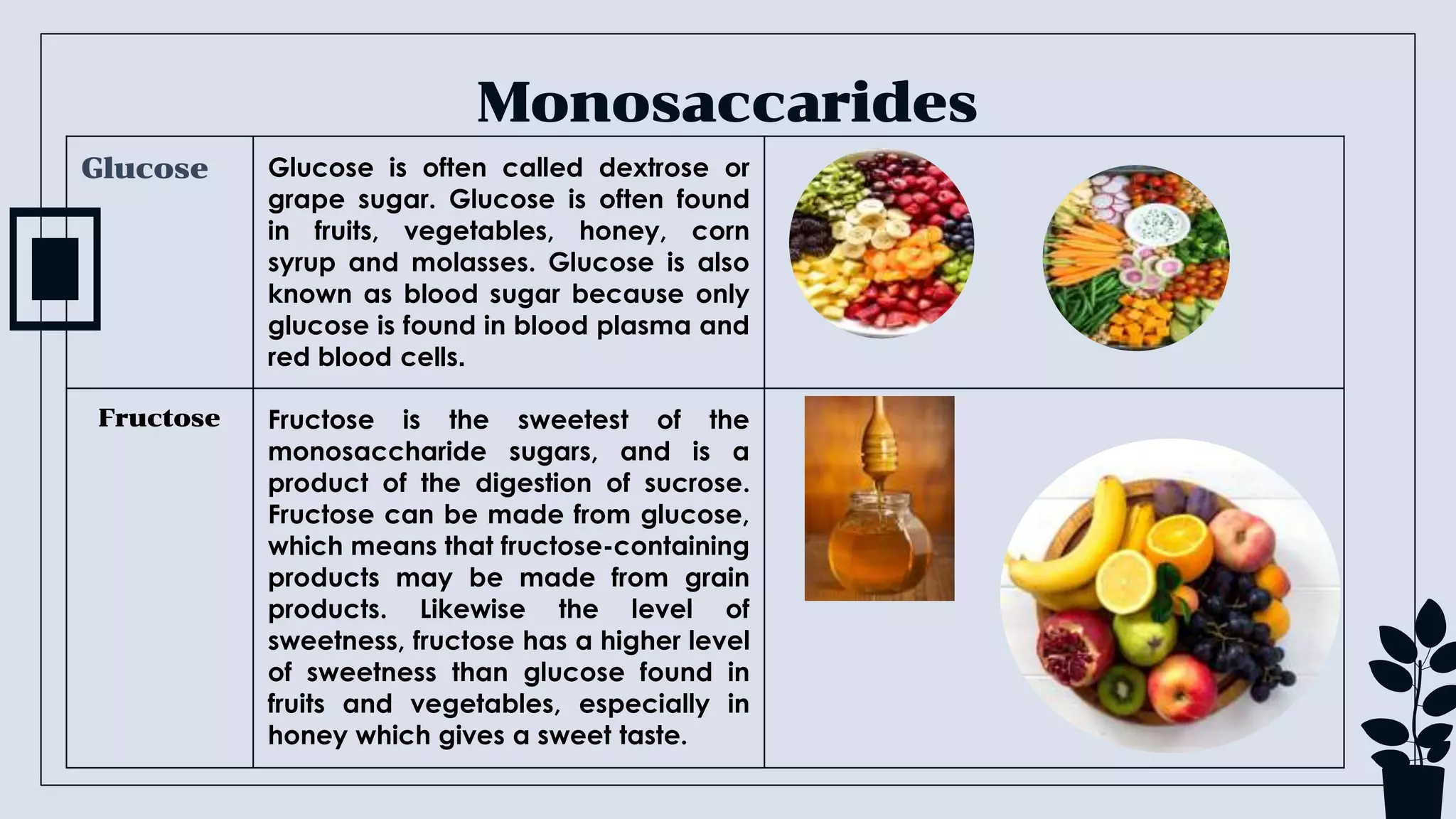
Glucose Glucose is often called dextrose or
grape sugar. Glucose is often found
in fruits, vegetables, honey, corn
syrup and molasses. Glucose is also
known as blood sugar because only
glucose is found in blood plasma and
red blood cells.
Fructose Fructose is the sweetest of the
monosaccharide sugars, and is a
product of the digestion of sucrose.
Fructose can be made from glucose,
which means that fructose-containing
products may be made from grain
products. Likewise the level of
sweetness, fructose has a higher level
of sweetness than glucose found in
fruits and vegetables, especially in
honey which gives a sweet taste.
Monosaccarides
Galactose Galactose is not found free in
nature, but is the result of the
digestion of lactose (milk sugar).
Although the main source of
galactose is milk, nuts also contain
some galactose. Physiologically, it
is a filling material for nerve tissue
and is produced from glucose
during lactation in lactose
synthesis.
These are formed when two
monosaccharide molecules join together,
with the elimination of one molecule of
water.
Examples of disaccharides are:
● sucrose (glucose and fructose);
● lactose (glucose and galactose);
● maltose (2 molecules of glucose).
Disaccharides
(Simple
Carbohydrates)
Disaccharides
Sucrose Sucrose is composed of one unit of
glucose and one unit of fructose.
Granulated sugar and brown sugar
produced from sugarcane are almost 100%
composed of sucrose, while brown sugar
from palm still contains small amounts of
glucose or fructose. Sucrose is widely used
in food processing, for example syrup, jam,
jelly and others. Consuming large amounts
of sucrose can cause tooth decay and can
lead to
Lactose Mostly found in milk, in the body lactose is
rather difficult to digest when compared to
sucrose and maltose. Lactose is the least
sweet tasting sugar and is more poorly
soluble than other disaccharides.
Disaccharides
Maltose Also called malt sugar,
maltose does not occur
naturally. Maltose is
produced by fermenting
grains and is present in
beer and some processed
cereals which are found
in corn syrup.
Is a complex carbohydrate compound,
can contain more than 60,000
monosaccharide molecules arranged to
form straight or branched chains.
Polysaccharides taste fresh (not sweet),
unlike monosaccharides and
disaccharides.
Polysaccharides
(Complex
Carbohydrates)
Polysaccharides
Starch It is the main source of energy for adults
throughout the world's population,
especially in developing countries
because it is consumed as a staple food.
Besides being a food rich in starch, it also
contains protein, vitamins, fiber and
several other important nutrients.
Sources: tubers, cereals and seeds are
abundant sources of starch because they
are easy to obtain for consumption.
Starch does not dissolve in cold water,
but dissolves in hot water to form a very
concentrated liquid like a paste; this event
is called "gelatinization".
Polysaccharides
Glycogen Glycogen is "animal starch",
formed from bonds of 1000
molecules, soluble in water
(vegetable starch does not dissolve
in water) and when it reacts with
iodine it produces a red color.
Glycogen is found in the muscles
of animals, humans and fish. When
animals are slaughtered, cramps
occur and then glycogen is broken
down into lactic acid during post
mortum. Glycogen is stored in the
liver and muscles as an energy
reserve, which can be converted
back into glucose when needed.
Sources: widely found in sprouts,
cereals, milk, corn syrup.
Polysaccharides
Fiber
Fibre is present in whole grains,
fruits and vegetables, especially
the outer covering of seeds.
It is a mixture of substances
(mainly complex carbohydrates)
which cannot be digested in the
small intestine.
There are two types of fibre:
Soluble fibre - found in fruit,
vegetables, pulses and oats.
Insoluble fibre - found in cereals
such as bread and pasta.
The Function of Carbohydrates
1. Energy Sources
2. Main function: provide energy for the body. One gram
of carbohydrates provides 4 kcalories.
3. Gives a sweet taste to food. Especially
monosaccharides and disaccharides.
4. Protein saverIf food carbohydrates are insufficient,
then protein will be used to meet energy needs.
5. Regulator of fat metabolismCarbohydrates prevent
incomplete fat oxidation
6. Help expel fecesCarbohydrates help expel feces in a
number of waysRegulates intestinal peristalsis and
forms feces.
7. Gives a feeling of fullnes.
One of the advantages of carbohydrates is their large
volume. This is caused by the presence of cellulose
content in food ingredients. This large volume of food
can provide a feeling of satiety.
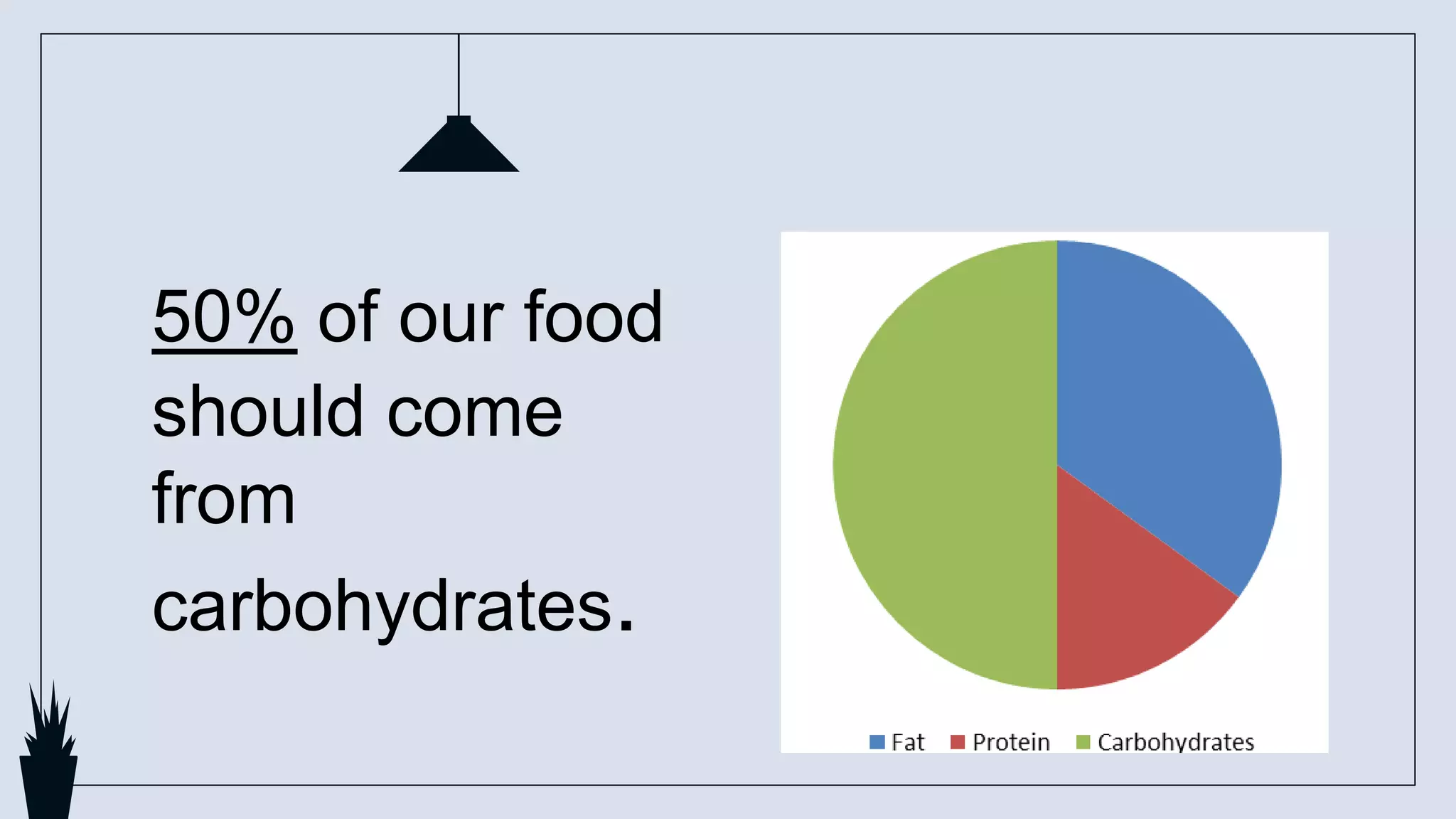
50% of our food
should come
from
carbohydrates.
Effects of Carbohydrate Excess and
Deficiency as Energy Substances
1. Obesity (overweight)
2. Cardiovascular disease
3. Diabetes Mellitus
4. Lactose intolerance
5. Galactosemia
6. Marasmus
Too much …..
Carbohydrate will be converted
into fat and stored under the
skin leading to weight gain!
Observe the image below
1 2 3
Picture 1 Picture 2 Picture 3
22
1. Look and observe the pictures, they are children of the same age but
have different nutritional status.
2. Make a discussion group consisting of 5 people! Discuss what are the
real differences in the nutritional status of the 3 children in the picture.
3.Take note of any differences you get!
4. Write down the observations in the following table
Carbohydrates and their
functional properties in food
products
Carbohydrates perform different
functions in food products.
They can:
help to cause the colour change of
bread, toast and bakery products;
contribute to the chewiness, colour
and sweet flavour of caramel;
thicken products such as sauces and
custards.
The Maillard Reaction
Foods which are baked, grilled or roasted undergo
colour, odour and flavour changes.
This is primarily due to a group of reactions
involving amino acids (from protein) and reducing
sugars (e.g. glucose, fructose). These reactions
contribute to the colour and flavour of many foods
such as toast, bread and croissants.
This group of reactions is collectively known as the
Maillard reaction, after the Frenchman who
discovered it.
This reaction can also take place in foods with high
protein content, such as meats.
Maillard reaction
Browning
Non enzymic
Frying a steak
Sausage rolls
Glazed pastry
Enhance colour
Meaty savoury
flavour
Flavour
Food science
Carbohydrate
function Characteristics
Cheese and Onion
Triangle
Koftas
Carbohydrate as
reducing sugar
reacts with proteins
to bring about
browning
Dextrinisation
When foods containing starch are heated (without
the presence of water) they can also produce
brown compounds due to dextrinisation.
Dextrinisation occurs when the heat breaks the
large starch polysaccharides into smaller
molecules known as dextrins.
Many of these dextrins can also produce a brown
colour. Toast is a good example to illustrate
dextrinisation.
Dextrinisation
Browning
Baking bread
Grilling toast
Oven baked
croutons
Pastry browning
Starch
Polysaccharide
chain breaks
down to shorter
chains, known as
dextrins due to
dry heat
Surface
browning
occurs –
flavour
becomes
slightly
sweeter
Crispness
(reduced by
exposure to
Food science
Examples
Carbohydrate
function
Characteristics
RECIPE
Shortbread
RECIPE
Scrummy scones
RECIPE
Tasty toast
Recipes
11-14 L2C Scone based pizza
Scone based pizza
Caramelisation
When sucrose (table sugar) is heated above its
melting point it undergoes physical and chemical
changes to produce caramel.
This happens more readily without water.
However, syrups will caramelise with rapid
heating.
This process is used extensively in the
production of confectionery. Overheating will
cause the substance to become bitter and dark.
Maillard, dextrinisation and caramelisation
reactions are all examples of non-enzymic
browning reactions.
Caramelisation
Browning
Non enzymic
Heat applied to dry
sugars on Crème brulee
Sugar syrup as in crème
caramel sauce
Muffins
Croquembouche
Flapjack
Crumble topping
Parsnips roasted
Onions
Sugar is decomposed by high
temperature and browns
In syrup the colour changes
from clear to darker brown
Flavour become sweeter but
then bitter as breakdown leads
to carbonisation (burnt)
Used to enhance
colour contrast as
in puddings above
Contributes to
golden hue of
baked goods
containing sugar
Develop flavour
and colour of veg
Food science Examples
Carbohydrate
function
Characteristics
RECIPE
Banana crumble-top
muffins
11-14-l2c/dutch-
apple-cake/
11-14-l2c/fruity-
flapjacks/
11-14-l2c/tropical-granola-bars/
Gelatinisation
When starch is mixed with water and
heated, the starch granules swell and
eventually rupture, absorbing liquid, which
thickens the mixture.
On cooling, if enough starch is used, a gel
forms. This process is used in the
production of blancmange.
Traditionally, English blancmange utilises
cornflour as a source of starch, whilst
French blancmange uses gelatine, which is
a protein and gels by a different process.
Thanks!
Do you have any questions?

Carbohydratess.pptx

  • 1.
  • 2.
    In general, thedefinition of carbohydrates is organic compounds that contain carbon, hydrogen and oxygen atoms, and in general the elements hydrogen and oxygen in the composition produce H2O. In the body, carbohydrates can be formed from several amino acids and some from fatty glycerol Defenition of Carboydrates
  • 3.
    Many foods containsome carbohydrates, but the amounts of sugars, starch and fibre differ. Sugars are naturally present in foods such as milk, fruits, vegetables and honey. In the UK, sugar beet and sugar cane are the most common sources of sugar. Honey, treacle and golden syrup are also popular. Starch is present in foods such as potatoes, bread, rice and pasta. Carboydrates in Food
  • 4.
    Properties of Carbohydrates 01 03 02 04 Carbohydratesare classified into polysaccharides, disaccharides and monosaccharides When carbohydrates are burned in the body, it releases energy CO2 and water. Starch is insoluble in cold water, but when heated it forms a gelatin-like substance which is easily digested. Some carbohydrates can be synthesized in the body from fat and protein stored in the body
  • 5.
    Properties of Carbohydrates 05 07 06 Asmall amount of carbohydrates can be stored in the body in the liver and muscle tissue as glycogen. When carbohydrates are burned in the body, it releases energy CO2 and water. If most of the carbohydrates absorbed by the body are not used immediately, they are converted to fat and stored as adipose tissue to meet energy needs when needed later
  • 6.
    The classification ofcarbohydrates most often used in nutrition is based on the number of molecules. Carbohydra tes Complex Carbohydrate s Simple Carbohydrate s Monosacchari des Disaccharides Polysaccharid es Gluctose Fructose Galactose Sucrose Lactose Maltose Starch Glycogen Fiber
  • 7.
    These are thesimplest carbohydrate molecules. The most commonly occurring monosaccharides in food are glucose, fructose and galactose. Monosaccharides (Simple Carbohydrates)
  • 8.
    Monosaccarides Glucose Glucose isoften called dextrose or grape sugar. Glucose is often found in fruits, vegetables, honey, corn syrup and molasses. Glucose is also known as blood sugar because only glucose is found in blood plasma and red blood cells. Fructose Fructose is the sweetest of the monosaccharide sugars, and is a product of the digestion of sucrose. Fructose can be made from glucose, which means that fructose-containing products may be made from grain products. Likewise the level of sweetness, fructose has a higher level of sweetness than glucose found in fruits and vegetables, especially in honey which gives a sweet taste.
  • 9.
    Monosaccarides Galactose Galactose isnot found free in nature, but is the result of the digestion of lactose (milk sugar). Although the main source of galactose is milk, nuts also contain some galactose. Physiologically, it is a filling material for nerve tissue and is produced from glucose during lactation in lactose synthesis.
  • 10.
    These are formedwhen two monosaccharide molecules join together, with the elimination of one molecule of water. Examples of disaccharides are: ● sucrose (glucose and fructose); ● lactose (glucose and galactose); ● maltose (2 molecules of glucose). Disaccharides (Simple Carbohydrates)
  • 11.
    Disaccharides Sucrose Sucrose iscomposed of one unit of glucose and one unit of fructose. Granulated sugar and brown sugar produced from sugarcane are almost 100% composed of sucrose, while brown sugar from palm still contains small amounts of glucose or fructose. Sucrose is widely used in food processing, for example syrup, jam, jelly and others. Consuming large amounts of sucrose can cause tooth decay and can lead to Lactose Mostly found in milk, in the body lactose is rather difficult to digest when compared to sucrose and maltose. Lactose is the least sweet tasting sugar and is more poorly soluble than other disaccharides.
  • 12.
    Disaccharides Maltose Also calledmalt sugar, maltose does not occur naturally. Maltose is produced by fermenting grains and is present in beer and some processed cereals which are found in corn syrup.
  • 13.
    Is a complexcarbohydrate compound, can contain more than 60,000 monosaccharide molecules arranged to form straight or branched chains. Polysaccharides taste fresh (not sweet), unlike monosaccharides and disaccharides. Polysaccharides (Complex Carbohydrates)
  • 14.
    Polysaccharides Starch It isthe main source of energy for adults throughout the world's population, especially in developing countries because it is consumed as a staple food. Besides being a food rich in starch, it also contains protein, vitamins, fiber and several other important nutrients. Sources: tubers, cereals and seeds are abundant sources of starch because they are easy to obtain for consumption. Starch does not dissolve in cold water, but dissolves in hot water to form a very concentrated liquid like a paste; this event is called "gelatinization".
  • 15.
    Polysaccharides Glycogen Glycogen is"animal starch", formed from bonds of 1000 molecules, soluble in water (vegetable starch does not dissolve in water) and when it reacts with iodine it produces a red color. Glycogen is found in the muscles of animals, humans and fish. When animals are slaughtered, cramps occur and then glycogen is broken down into lactic acid during post mortum. Glycogen is stored in the liver and muscles as an energy reserve, which can be converted back into glucose when needed. Sources: widely found in sprouts, cereals, milk, corn syrup.
  • 16.
    Polysaccharides Fiber Fibre is presentin whole grains, fruits and vegetables, especially the outer covering of seeds. It is a mixture of substances (mainly complex carbohydrates) which cannot be digested in the small intestine. There are two types of fibre: Soluble fibre - found in fruit, vegetables, pulses and oats. Insoluble fibre - found in cereals such as bread and pasta.
  • 17.
    The Function ofCarbohydrates 1. Energy Sources 2. Main function: provide energy for the body. One gram of carbohydrates provides 4 kcalories. 3. Gives a sweet taste to food. Especially monosaccharides and disaccharides. 4. Protein saverIf food carbohydrates are insufficient, then protein will be used to meet energy needs. 5. Regulator of fat metabolismCarbohydrates prevent incomplete fat oxidation 6. Help expel fecesCarbohydrates help expel feces in a number of waysRegulates intestinal peristalsis and forms feces. 7. Gives a feeling of fullnes. One of the advantages of carbohydrates is their large volume. This is caused by the presence of cellulose content in food ingredients. This large volume of food can provide a feeling of satiety.
  • 18.
    50% of ourfood should come from carbohydrates.
  • 19.
    Effects of CarbohydrateExcess and Deficiency as Energy Substances 1. Obesity (overweight) 2. Cardiovascular disease 3. Diabetes Mellitus 4. Lactose intolerance 5. Galactosemia 6. Marasmus
  • 20.
    Too much ….. Carbohydratewill be converted into fat and stored under the skin leading to weight gain!
  • 21.
    Observe the imagebelow 1 2 3
  • 22.
    Picture 1 Picture2 Picture 3 22 1. Look and observe the pictures, they are children of the same age but have different nutritional status. 2. Make a discussion group consisting of 5 people! Discuss what are the real differences in the nutritional status of the 3 children in the picture. 3.Take note of any differences you get! 4. Write down the observations in the following table
  • 23.
    Carbohydrates and their functionalproperties in food products Carbohydrates perform different functions in food products. They can: help to cause the colour change of bread, toast and bakery products; contribute to the chewiness, colour and sweet flavour of caramel; thicken products such as sauces and custards.
  • 24.
    The Maillard Reaction Foodswhich are baked, grilled or roasted undergo colour, odour and flavour changes. This is primarily due to a group of reactions involving amino acids (from protein) and reducing sugars (e.g. glucose, fructose). These reactions contribute to the colour and flavour of many foods such as toast, bread and croissants. This group of reactions is collectively known as the Maillard reaction, after the Frenchman who discovered it. This reaction can also take place in foods with high protein content, such as meats.
  • 25.
    Maillard reaction Browning Non enzymic Fryinga steak Sausage rolls Glazed pastry Enhance colour Meaty savoury flavour Flavour Food science Carbohydrate function Characteristics Cheese and Onion Triangle Koftas Carbohydrate as reducing sugar reacts with proteins to bring about browning
  • 26.
    Dextrinisation When foods containingstarch are heated (without the presence of water) they can also produce brown compounds due to dextrinisation. Dextrinisation occurs when the heat breaks the large starch polysaccharides into smaller molecules known as dextrins. Many of these dextrins can also produce a brown colour. Toast is a good example to illustrate dextrinisation.
  • 27.
    Dextrinisation Browning Baking bread Grilling toast Ovenbaked croutons Pastry browning Starch Polysaccharide chain breaks down to shorter chains, known as dextrins due to dry heat Surface browning occurs – flavour becomes slightly sweeter Crispness (reduced by exposure to Food science Examples Carbohydrate function Characteristics RECIPE Shortbread RECIPE Scrummy scones RECIPE Tasty toast Recipes 11-14 L2C Scone based pizza Scone based pizza
  • 28.
    Caramelisation When sucrose (tablesugar) is heated above its melting point it undergoes physical and chemical changes to produce caramel. This happens more readily without water. However, syrups will caramelise with rapid heating. This process is used extensively in the production of confectionery. Overheating will cause the substance to become bitter and dark. Maillard, dextrinisation and caramelisation reactions are all examples of non-enzymic browning reactions.
  • 29.
    Caramelisation Browning Non enzymic Heat appliedto dry sugars on Crème brulee Sugar syrup as in crème caramel sauce Muffins Croquembouche Flapjack Crumble topping Parsnips roasted Onions Sugar is decomposed by high temperature and browns In syrup the colour changes from clear to darker brown Flavour become sweeter but then bitter as breakdown leads to carbonisation (burnt) Used to enhance colour contrast as in puddings above Contributes to golden hue of baked goods containing sugar Develop flavour and colour of veg Food science Examples Carbohydrate function Characteristics RECIPE Banana crumble-top muffins 11-14-l2c/dutch- apple-cake/ 11-14-l2c/fruity- flapjacks/ 11-14-l2c/tropical-granola-bars/
  • 30.
    Gelatinisation When starch ismixed with water and heated, the starch granules swell and eventually rupture, absorbing liquid, which thickens the mixture. On cooling, if enough starch is used, a gel forms. This process is used in the production of blancmange. Traditionally, English blancmange utilises cornflour as a source of starch, whilst French blancmange uses gelatine, which is a protein and gels by a different process.
  • 31.
    Thanks! Do you haveany questions?