FOOD TECHNOLOGY
Past Exam Questions
FOOD TECHNOLOGY EXAM
 These past exam questions are to prepare students
studying A2 Food Technology!
 You will get to choose a question from Section 1
and Section 2 of your choice, then answer one
question from either section.
 Each question is worth 24 marks.
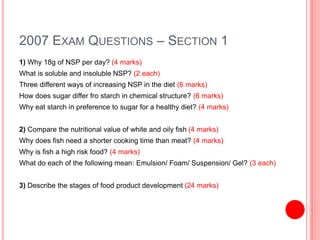
2007 EXAM QUESTIONS – SECTION 1
1) Why 18g of NSP per day? (4 marks)
What is soluble and insoluble NSP? (2 each)
Three different ways of increasing NSP in the diet (6 marks)
How does sugar differ fro starch in chemical structure? (6 marks)
Why eat starch in preference to sugar for a healthy diet? (4 marks)
2) Compare the nutritional value of white and oily fish (4 marks)
Why does fish need a shorter cooking time than meat? (4 marks)
Why is fish a high risk food? (4 marks)
What do each of the following mean: Emulsion/ Foam/ Suspension/ Gel? (3 each)
3) Describe the stages of food product development (24 marks)
2007 EXAM QUESTIONS – SECTION 2
4) Explain each of the following in relation to ethical food production: factory
farming/ growth promoters/ genetic engineering/ regional and international
influences (6 each)
5) Describe how food manufacturers maintain uniformity when producing large
quantities of baked products (8 marks)
Explain Just in Time production (6 marks)
How can manufacturers make their factories more energy efficient? (10 marks)
6) How does MAP extend shelf life? (8 marks)
What are the advantages of MAP? (8 marks)
Explain each of the following: risk assessment/ HACCP/ Assured safe catering/
Critical path analysis (2 each)
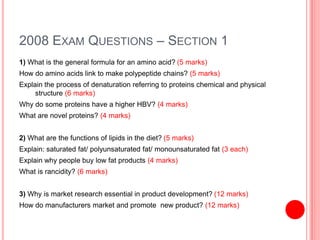
2008 EXAM QUESTIONS – SECTION 1
1) What is the general formula for an amino acid? (5 marks)
How do amino acids link to make polypeptide chains? (5 marks)
Explain the process of denaturation referring to proteins chemical and physical
structure (6 marks)
Why do some proteins have a higher HBV? (4 marks)
What are novel proteins? (4 marks)
2) What are the functions of lipids in the diet? (5 marks)
Explain: saturated fat/ polyunsaturated fat/ monounsaturated fat (3 each)
Explain why people buy low fat products (4 marks)
What is rancidity? (6 marks)
3) Why is market research essential in product development? (12 marks)
How do manufacturers market and promote new product? (12 marks)
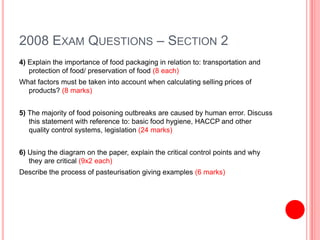
2008 EXAM QUESTIONS – SECTION 2
4) Explain the importance of food packaging in relation to: transportation and
protection of food/ preservation of food (8 each)
What factors must be taken into account when calculating selling prices of
products? (8 marks)
5) The majority of food poisoning outbreaks are caused by human error. Discuss
this statement with reference to: basic food hygiene, HACCP and other
quality control systems, legislation (24 marks)
6) Using the diagram on the paper, explain the critical control points and why
they are critical (9x2 each)
Describe the process of pasteurisation giving examples (6 marks)
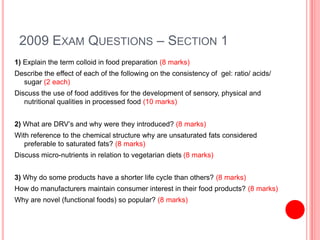
2009 EXAM QUESTIONS – SECTION 1
1) Explain the term colloid in food preparation (8 marks)
Describe the effect of each of the following on the consistency of gel: ratio/ acids/
sugar (2 each)
Discuss the use of food additives for the development of sensory, physical and
nutritional qualities in processed food (10 marks)
2) What are DRV’s and why were they introduced? (8 marks)
With reference to the chemical structure why are unsaturated fats considered
preferable to saturated fats? (8 marks)
Discuss micro-nutrients in relation to vegetarian diets (8 marks)
3) Why do some products have a shorter life cycle than others? (8 marks)
How do manufacturers maintain consumer interest in their food products? (8 marks)
Why are novel (functional foods) so popular? (8 marks)
2009 EXAM QUESTIONS – SECTION 2
4) Describe 3 different methods of market research and state the positives and
negatives of each (3x4 each)
Explain the increase in purchase of ethical food products (12 marks)
5) With reference to the article, why do manufacturers need to be thorough in
testing for microbiological sources of contamination (8 marks)
How might manufacturers prevent the following entering food: metals/ wood and
stones/ insects/ chemicals? (3 each)
Why do factories have low and high risk areas? (4 marks)
6) How is ICT used in manufacturing and retailing of food? (8 marks)
Describe how cheese is manufactured make specific reference to micro-
organisms and enzymes (10 marks)
Explain why processing evaporated milk results in different organoleptic
properties to pasteurised milk (6 marks)
2010 EXAM QUESTIONS – SECTION 1
1) Describe with reference to the physical structures, the differences in the
nutritional composition of: monosaccharides, polysaccharides, non starch
polysaccharides (12 marks)
Explain the value of sugar substitutes and sweeteners to a diabetic’s diet (6 marks)
It is believed by some that keeping a food diary can aid dietary planning. Consider
the extent to which this is good advice (10 marks)
2) The diet of young people in the UK has become of great concern. Read the
article and discuss in detail the issues raised (12 marks)
Explain why the following are used by manufacturers: emulsifiers and stabilisers,
preservatives, antioxidants, nutritional supplements (4 each)
3) Is red meat taken from the neck of the animal best suited for stewing or braising?
(2 marks)
Is mackerel or herring best suited for grilling or barbequing? (2 marks)
Is cod or haddock best suited for frying or microwaving? (2 marks)
Compare and contrast the nutritional differences in the following: chicken, beef, red
kidney beans and quorn (12 marks)
The media had the power to influence consumer food choices, do you believe this
statement to be true? (10 marks)
2010 EXAM QUESTIONS – SECTION 2
4) Explain in detail the following preservation methods: UHT, drying, canning,
vacuum packing (4 each)
Discuss the positives and negatives to the environment preserving fresh foods
by the methods named above (12 marks)
5) Explain the meaning of gelatinisation and retrogradation (8 marks)
Why do manufacturers use modified starch? (8 marks)
Describe how new product development in the food industry has been enhanced
by scientific and technological innovation in recent years (12 marks)
6) Explain the following methods of freezing: plate, blast, cryogenic (4 each)
Frozen ready meals are very popular despite being associated with several
health risks. Explain these risks and why frozen meals continue to be popular
(10 marks)
How does current food labelling legislation protect the consumer? (6 marks)
2011 EXAM QUESTIONS – SECTION 1
1) To what extent do you think that people are misunderstanding what it means
to eat healthily? (16 marks)
Describe the following processes in relation to starch: gelatinisation,
retrogradation and syneresis (4 each)
2) Discuss why there is still and need to use food additives (16 marks)
Explain what is meant by fatty acids (3 marks)
Explain what is meant by triglycerides (3 marks)
Describe the process of hydrogenation in relation to trans fats (6 marks)
3) To what extent do the food choices of ethnic and religious groups influence
food products available on the market in Britain today? (16 marks)
Describe the effect of heat, mechanical action and acid on egg white in relation
to the chemical structure of protein (12 marks)
2011 EXAM QUESTIONS – SECTION 2
4) How might Listeria be minimised in the production of ready to eat
products (16 marks)
Explain how MAP and vacuum packaging extend the shelf life of foods.
Refer to packaging materials (12 marks)
5) To what extent do you agree with the suggestion that date marking
produces food waste? (10 marks)
What do you understand by the terms HACCP and Safer Food Better
Business? (10 marks)
Why do manufacturers study existing food products as part of market
research (8 marks)
6) With reference to the article, why do so many new products such as
functional foods fail within their first year of being on the market? (16
marks)
Explain the following; bottling, canning, UHT (4 each)
REVISION
Look at the ‘Food Technology – Revision Questions’
PowerPoint for access to 1 and 2 mark questions.

Food Technology - Exam Questions

  • 1.
  • 2.
    FOOD TECHNOLOGY EXAM These past exam questions are to prepare students studying A2 Food Technology!  You will get to choose a question from Section 1 and Section 2 of your choice, then answer one question from either section.  Each question is worth 24 marks.
  • 3.
    2007 EXAM QUESTIONS– SECTION 1 1) Why 18g of NSP per day? (4 marks) What is soluble and insoluble NSP? (2 each) Three different ways of increasing NSP in the diet (6 marks) How does sugar differ fro starch in chemical structure? (6 marks) Why eat starch in preference to sugar for a healthy diet? (4 marks) 2) Compare the nutritional value of white and oily fish (4 marks) Why does fish need a shorter cooking time than meat? (4 marks) Why is fish a high risk food? (4 marks) What do each of the following mean: Emulsion/ Foam/ Suspension/ Gel? (3 each) 3) Describe the stages of food product development (24 marks)
  • 4.
    2007 EXAM QUESTIONS– SECTION 2 4) Explain each of the following in relation to ethical food production: factory farming/ growth promoters/ genetic engineering/ regional and international influences (6 each) 5) Describe how food manufacturers maintain uniformity when producing large quantities of baked products (8 marks) Explain Just in Time production (6 marks) How can manufacturers make their factories more energy efficient? (10 marks) 6) How does MAP extend shelf life? (8 marks) What are the advantages of MAP? (8 marks) Explain each of the following: risk assessment/ HACCP/ Assured safe catering/ Critical path analysis (2 each)
  • 5.
    2008 EXAM QUESTIONS– SECTION 1 1) What is the general formula for an amino acid? (5 marks) How do amino acids link to make polypeptide chains? (5 marks) Explain the process of denaturation referring to proteins chemical and physical structure (6 marks) Why do some proteins have a higher HBV? (4 marks) What are novel proteins? (4 marks) 2) What are the functions of lipids in the diet? (5 marks) Explain: saturated fat/ polyunsaturated fat/ monounsaturated fat (3 each) Explain why people buy low fat products (4 marks) What is rancidity? (6 marks) 3) Why is market research essential in product development? (12 marks) How do manufacturers market and promote new product? (12 marks)
  • 6.
    2008 EXAM QUESTIONS– SECTION 2 4) Explain the importance of food packaging in relation to: transportation and protection of food/ preservation of food (8 each) What factors must be taken into account when calculating selling prices of products? (8 marks) 5) The majority of food poisoning outbreaks are caused by human error. Discuss this statement with reference to: basic food hygiene, HACCP and other quality control systems, legislation (24 marks) 6) Using the diagram on the paper, explain the critical control points and why they are critical (9x2 each) Describe the process of pasteurisation giving examples (6 marks)
  • 7.
    2009 EXAM QUESTIONS– SECTION 1 1) Explain the term colloid in food preparation (8 marks) Describe the effect of each of the following on the consistency of gel: ratio/ acids/ sugar (2 each) Discuss the use of food additives for the development of sensory, physical and nutritional qualities in processed food (10 marks) 2) What are DRV’s and why were they introduced? (8 marks) With reference to the chemical structure why are unsaturated fats considered preferable to saturated fats? (8 marks) Discuss micro-nutrients in relation to vegetarian diets (8 marks) 3) Why do some products have a shorter life cycle than others? (8 marks) How do manufacturers maintain consumer interest in their food products? (8 marks) Why are novel (functional foods) so popular? (8 marks)
  • 8.
    2009 EXAM QUESTIONS– SECTION 2 4) Describe 3 different methods of market research and state the positives and negatives of each (3x4 each) Explain the increase in purchase of ethical food products (12 marks) 5) With reference to the article, why do manufacturers need to be thorough in testing for microbiological sources of contamination (8 marks) How might manufacturers prevent the following entering food: metals/ wood and stones/ insects/ chemicals? (3 each) Why do factories have low and high risk areas? (4 marks) 6) How is ICT used in manufacturing and retailing of food? (8 marks) Describe how cheese is manufactured make specific reference to micro- organisms and enzymes (10 marks) Explain why processing evaporated milk results in different organoleptic properties to pasteurised milk (6 marks)
  • 9.
    2010 EXAM QUESTIONS– SECTION 1 1) Describe with reference to the physical structures, the differences in the nutritional composition of: monosaccharides, polysaccharides, non starch polysaccharides (12 marks) Explain the value of sugar substitutes and sweeteners to a diabetic’s diet (6 marks) It is believed by some that keeping a food diary can aid dietary planning. Consider the extent to which this is good advice (10 marks) 2) The diet of young people in the UK has become of great concern. Read the article and discuss in detail the issues raised (12 marks) Explain why the following are used by manufacturers: emulsifiers and stabilisers, preservatives, antioxidants, nutritional supplements (4 each) 3) Is red meat taken from the neck of the animal best suited for stewing or braising? (2 marks) Is mackerel or herring best suited for grilling or barbequing? (2 marks) Is cod or haddock best suited for frying or microwaving? (2 marks) Compare and contrast the nutritional differences in the following: chicken, beef, red kidney beans and quorn (12 marks) The media had the power to influence consumer food choices, do you believe this statement to be true? (10 marks)
  • 10.
    2010 EXAM QUESTIONS– SECTION 2 4) Explain in detail the following preservation methods: UHT, drying, canning, vacuum packing (4 each) Discuss the positives and negatives to the environment preserving fresh foods by the methods named above (12 marks) 5) Explain the meaning of gelatinisation and retrogradation (8 marks) Why do manufacturers use modified starch? (8 marks) Describe how new product development in the food industry has been enhanced by scientific and technological innovation in recent years (12 marks) 6) Explain the following methods of freezing: plate, blast, cryogenic (4 each) Frozen ready meals are very popular despite being associated with several health risks. Explain these risks and why frozen meals continue to be popular (10 marks) How does current food labelling legislation protect the consumer? (6 marks)
  • 11.
    2011 EXAM QUESTIONS– SECTION 1 1) To what extent do you think that people are misunderstanding what it means to eat healthily? (16 marks) Describe the following processes in relation to starch: gelatinisation, retrogradation and syneresis (4 each) 2) Discuss why there is still and need to use food additives (16 marks) Explain what is meant by fatty acids (3 marks) Explain what is meant by triglycerides (3 marks) Describe the process of hydrogenation in relation to trans fats (6 marks) 3) To what extent do the food choices of ethnic and religious groups influence food products available on the market in Britain today? (16 marks) Describe the effect of heat, mechanical action and acid on egg white in relation to the chemical structure of protein (12 marks)
  • 12.
    2011 EXAM QUESTIONS– SECTION 2 4) How might Listeria be minimised in the production of ready to eat products (16 marks) Explain how MAP and vacuum packaging extend the shelf life of foods. Refer to packaging materials (12 marks) 5) To what extent do you agree with the suggestion that date marking produces food waste? (10 marks) What do you understand by the terms HACCP and Safer Food Better Business? (10 marks) Why do manufacturers study existing food products as part of market research (8 marks) 6) With reference to the article, why do so many new products such as functional foods fail within their first year of being on the market? (16 marks) Explain the following; bottling, canning, UHT (4 each)
  • 13.
    REVISION Look at the‘Food Technology – Revision Questions’ PowerPoint for access to 1 and 2 mark questions.