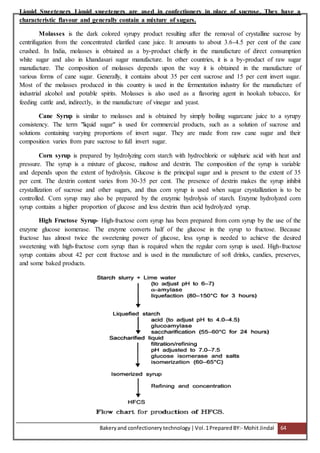
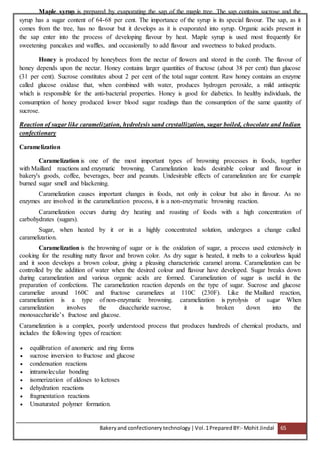
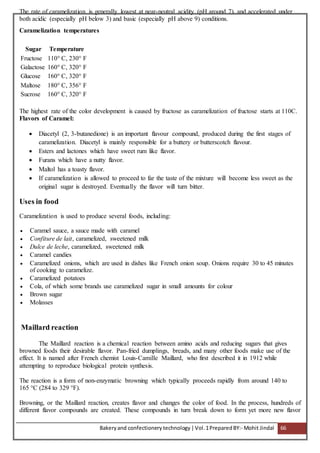
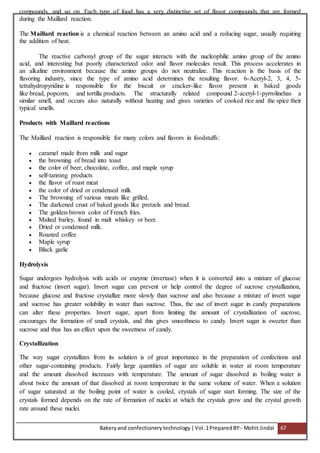
BAKERY AND CONFECTIONERY TECHNOLOGY
DETAILED CONTENTS
1. Introduction – Status of Bakery industry in India (02 hrs)
2. Raw Materials for Bakery Products (05 hrs)
Flour, sugar, shortening, yeast, salt and leavening agents as raw material for bakery products, their
role and PFA specifications of these raw materials
3. Manufacturing of Bakery Products (15 hrs)
Different types of bread and preparation of bread using different methods, quality evaluation of
bread, staling of bread
Different types of biscuits and preparation of biscuits using different methods, quality evaluation of
biscuits
Different types of cakes and pastries, preparation of cakes and pastries using different methods,
quality evaluation of cakes, different types of toppings
Preparation of other bakery products: rusks, crackers, buns, muffins, pizza and kulcha
Types of additives used in bakery products
4. Confectionery Products (05 hrs)
Introduction, classification of confectionery products, confectionery ingredients like starch, fats, colours,
flavours additives. Brief account of sweeteners like Gur, refined sugar, beet sugar, white sugar and liquid
sweeteners like Molasses, corn syrup, high fructose syrup, maple syrup. Reaction of sugar like
caramelization, hydrolysis sand crystallization, sugar boiled, chocolate and Indian confectionary
5. Layout, setting up of units and hygienic conditions required in bakery plant, operation and
maintenance of bakery equipment (05 hrs)
LIST OF PRACTICALS
1. Quality analysis of raw materials used in bakery and confectionery industry according to PFA
standards
2. Preparation and evaluation of bakery and confectionery products:
a) Bread
b) Cakes
c) Biscuits
d) Buns
e) Pizza
f) Candy like ginger
g) Kulcha
3. Study and analysis of the production charts used for different products by bakery industries
4. Visits to bakery and confectionery industry
Bakeryand confectionery technology |Vol.1PreparedBY:- Mohit Jindal 2
Bakery products, due to high nutrient value and affordability, are an item of huge consumption. Due to the
rapid population rise, the rising foreign influence, the emergence of a female working population and the
fluctuating eating habits of people, they have gained popularity among people, contributing significantly to
the growth trajectory of the bakery industry. The Indian bakery industry is dominated by the small-scale
sector with an estimated 50,000 small and medium-size producers, along with 15 units in the organized
sector. Apart from the nature of the industry, which gravitates to the markets and caters to the local tastes,
the industry is widely dispersed also due to the reservation policies (relating to the small scale industries) of
the government.
Biscuits and bread which are considered to be the major bakery product and they account for 82% of all
bakery production. The unorganized sector accounts for about half of the total biscuit production estimated
at 1.5 million tonnes. The bakery segment in India can be classified into the three broad segments of bread,
biscuits and cakes. The bakery industry is one such industry in India, which is growing as never before.
With market size of Rs 1500 billion in 2014-2015, the industry is growing at CAGR of around 12-15 per
cent. Bakery industry is widely dominated by unorganized players which accounts for 90 percent of the
total share
History of baking
The first evidence of baking occurred when humans took wild grass grains, soaked them in water, and mixed
everything together, mashing it into a kind of broth-like paste. The paste was cooked by pouring it onto a
flat, hot rock, resulting in a bread-like substance.
Later, when humans mastered fire, the paste was roasted on hot embers, which made bread-making
easier, as it could now be made any time fire was created.
The world's oldest oven was discovered in Croatia in 2014 dating back 6500 years ago.
The Ancient Egyptians baked bread using yeast.
Bread baking began in Ancient Greece around 600 BC, leading to the invention of enclosed ovens.
Beginning around 300 BC, the pastry cook became an occupation for Romans (known as the
pastillarium) and became a respected profession because pastries were considered decadent, and Romans
loved festivity and celebration. Thus, pastries were often cooked especially for large banquets, and any
pastry cook who could invent new types of tasty treats was highly prized.
The Romans baked bread in an oven with its own chimney, and had mills to grind grain into flour.
Bakery products are these types of products in which the baking is an essential unit operation during
its manufacturing. Bakery products are greatly influenced by the formula and quality of ingredients such as
water, flour, fat, sugars, salt, yeast, etc.
Bakery:-
Baking:-
Oven:-
Bakeryand confectionery technology |Vol.1PreparedBY:- Mohit Jindal 3
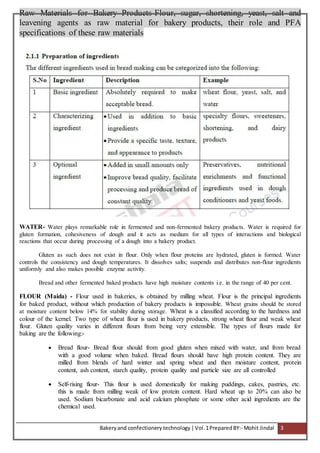
Raw Materials for Bakery Products-Flour, sugar, shortening, yeast, salt and
leavening agents as raw material for bakery products, their role and PFA
specifications of these raw materials
WATER- Water plays remarkable role in fermented and non-fermented bakery products. Water is required for
gluten formation, cohesiveness of dough and it acts as medium for all types of interactions and biological
reactions that occur during processing of a dough into a bakery product.
Gluten as such does not exist in flour. Only when flour proteins are hydrated, gluten is formed. Water
controls the consistency and dough temperatures. It dissolves salts; suspends and distributes non-flour ingredients
uniformly and also makes possible enzyme activity.
Bread and other fermented baked products have high moisture contents i.e. in the range of 40 per cent.
FLOUR (Maida) - Flour used in bakeries, is obtained by milling wheat. Flour is the principal ingredients
for baked product, without which production of bakery products is impossible. Wheat grains should be stored
at moisture content below 14% for stability during storage. Wheat is a classified according to the hardness and
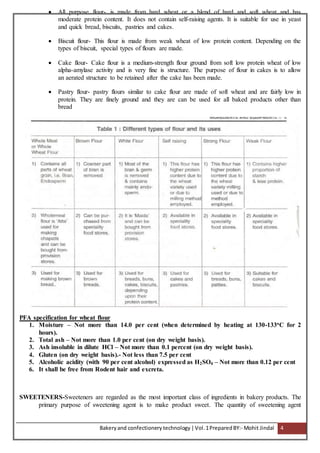
colour of the kernel. Two type of wheat flour is used in bakery products, strong wheat flour and weak wheat
flour. Gluten quality varies in different flours from being very extensible. The types of flours made for
baking are the following:-
 Bread flour- Bread flour should from good gluten when mixed with water, and from bread
with a good volume when baked. Bread flours should have high protein content. They are
milled from blends of hard winter and spring wheat and then moisture content, protein
content, ash content, starch quality, protein quality and particle size are all controlled
 Self-rising flour- This flour is used domestically for making puddings, cakes, pastries, etc.
this is made from milling weak of low protein content. Hard wheat up to 20% can also be
used. Sodium bicarbonate and acid calcium phosphate or some other acid ingredients are the
chemical used.
Bakeryand confectionery technology |Vol.1PreparedBY:- Mohit Jindal 4
 All purpose flour- is made from hard wheat or a blend of hard and soft wheat and has
moderate protein content. It does not contain self-raising agents. It is suitable for use in yeast
and quick bread, biscuits, pastries and cakes.
 Biscuit flour- This flour is made from weak wheat of low protein content. Depending on the
types of biscuit, special types of flours are made.
 Cake flour- Cake flour is a medium-strength flour ground from soft low protein wheat of low
alpha-amylase activity and is very fine is structure. The purpose of flour in cakes is to allow
an aerated structure to be retained after the cake has been made.
 Pastry flour- pastry flours similar to cake flour are made of soft wheat and are fairly low in
protein. They are finely ground and they are can be used for all baked products other than
bread
PFA specification for wheat flour
1. Moisture – Not more than 14.0 per cent (when determined by heating at 130-133oC for 2
hours).
2. Total ash – Not more than 1.0 per cent (on dry weight basis).
3. Ash insoluble in dilute HCl – Not more than 0.1 percent (on dry weight basis).
4. Gluten (on dry weight basis).- Not less than 7.5 per cent
5. Alcoholic acidity (with 90 per cent alcohol) expressed as H2SO4 – Not more than 0.12 per cent
6. It shall be free from Rodent hair and excreta.
SWEETENERS-Sweeteners are regarded as the most important class of ingredients in bakery products. The
primary purpose of sweetening agent is to make product sweet. The quantity of sweetening agent
Bakeryand confectionery technology |Vol.1PreparedBY:- Mohit Jindal 5
added is usually such that it has significant effect on the texture and appearance of the product as
well as on flavour.
Sugar is act as a tenderizing agent in baked products. In fermented products sugar also act a
food of baker’s yeast. The sweetening agents used in bakery products and in particular cookie/biscuit
making has varied functions and may be divided into three categories:
1. Sucrose and invert sugar
2. Derivatives of cornstarch
3. Other sweeteners.
1. Sucrose and invert sugar - In bakery products formation the function of sucrose is not only as a nutritive
sweetener, but also as texturiser, colouring agent and as a means of controlling spread. Cookie/biscuit maker
prefers to use some amount of invert sugar in some cookie formulae, as it assists in retaining moisture and
promotes chewiness. Invert sugar also contributes to a richer, more appealing crust, colour, as it caramelizes
more readily.
2. Derivatives of corn starch-Corn sugar are approximately two-third as sweet as sucrose; therefore, additional
quantities of corn sugar are necessary to
obtain comparable sweetness. Corn
sweeteners contain both dextrose and
fructose which readily participate in the
classic non-enzymatic browning.
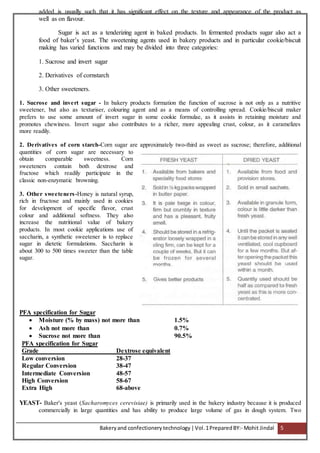
3. Other sweeteners-Honey is natural syrup,
rich in fructose and mainly used in cookies
for development of specific flavor, crust
colour and additional softness. They also
increase the nutritional value of bakery
products. In most cookie applications use of
saccharin, a synthetic sweetener is to replace
sugar in dietetic formulations. Saccharin is
about 300 to 500 times sweeter than the table
sugar.
PFA specification for Sugar
 Moisture (% by mass) not more than 1.5%
 Ash not more than 0.7%
 Sucrose not more than 90.5%
PFA specification for Sugar
Grade Dextrose equivalent
Low conversion 28-37
Regular Conversion 38-47
Intermediate Conversion 48-57
High Conversion 58-67
Extra High 68-above
YEAST- Baker's yeast (Sacharomyces cerevisiae) is primarily used in the bakery industry because it is produced
commercially in large quantities and has ability to produce large volume of gas in dough system. Two
Bakeryand confectionery technology |Vol.1PreparedBY:- Mohit Jindal 6
types of baker's yeast are produced commercially, namely wet compressed yeast (WCY) and active dry
yeast (ADY). Some countries also produce another form of baker’s yeast called instant yeast (IDY).
It is dry and porous and hence can be mixed with flour without any need for dispersion in water
as is required in the case of WCY and ADY. Generally about 1.0% of ADY or 4.0% WCY (flour basis) is
used while mixing dough for manufacture of bread. The functions of baker’s yeast are:
1. to produce required volume of gas
2. to impart desirable flavour and aroma and
3. to develop spongy texture of fermented products
The primary function of yeast is to leaven the dough to produce a porous product. The yeast
ferments sugar, producing carbon dioxide and ethanol. The gas-producing power of the yeast is
influenced by temperature, pH, and alcohol concentration, nature of carbohydrate supply, osmotic
pressure and yeast concentration. The optimum pH for gas production by the yeast is 5.5, but the
yeast is quite tolerant to changes in pH, and the gas production is 80% of the optimum value in the
pH ranges 3.7-8.0. Besides contribution to bread loaf volume by production of CO2
, the role of yeast
fermentation is to influence the texture of the dough, to contribute to flavor and aroma, and finally to
enhance the nutritional value of the bread
PFA specification for Yeast
WCY should have a creamy white colour and odour characteristic of good baker's yeast and a
fine even structure. It should not be slimy, moldy, no signs of deterioration and should be free from
starch adulteration and other extraneous matter. It should be free from starch and adulteration.
ADY should be in the form of granules, pellets or flakes. It should contain edible starch up to
10% of biomass may be added as per Indian standards.
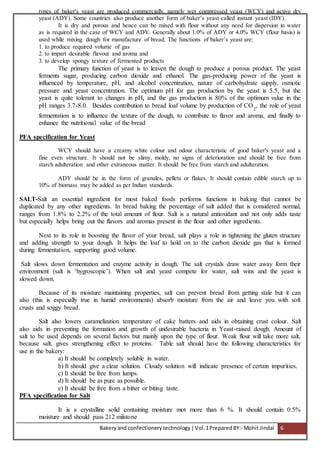
SALT-Salt an essential ingredient for most baked foods performs functions in baking that cannot be
duplicated by any other ingredients. In bread baking the percentage of salt added that is considered normal,
ranges from 1.8% to 2.2% of the total amount of flour. Salt is a natural antioxidant and not only adds taste
but especially helps bring out the flavors and aromas present in the flour and other ingredients.
Next to its role in boosting the flavor of your bread, salt plays a role in tightening the gluten structure
and adding strength to your dough. It helps the loaf to hold on to the carbon dioxide gas that is formed
during fermentation, supporting good volume.
Salt slows down fermentation and enzyme activity in dough. The salt crystals draw water away form their
environment (salt is ‘hygroscopic’). When salt and yeast compete for water, salt wins and the yeast is
slowed down.
Because of its moisture maintaining properties, salt can prevent bread from getting stale but it can
also (this is especially true in humid environments) absorb moisture from the air and leave you with soft
crusts and soggy bread.
Salt also lowers caramelization temperature of cake batters and aids in obtaining crust colour. Salt
also aids in preventing the formation and growth of undesirable bacteria in Yeast-raised dough. Amount of
salt to be used depends on several factors but mainly upon the type of flour. Weak flour will take more salt,
because salt, gives strengthening effect to proteins. Table salt should have the following characteristics for
use in the bakery:
a) It should be completely soluble in water.
b) It should give a clear solution. Cloudy solution will indicate presence of certain impurities.
c) It should be free from lumps.
d) It should be as pure as possible.
e) It should be free from a bitter or biting taste.
PFA specification for Salt
It is a crystalline solid containing moisture mot more than 6 %. It should contain 0.5%
moisture and should pass 212 milstone
Bakeryand confectionery technology |Vol.1PreparedBY:- Mohit Jindal 7
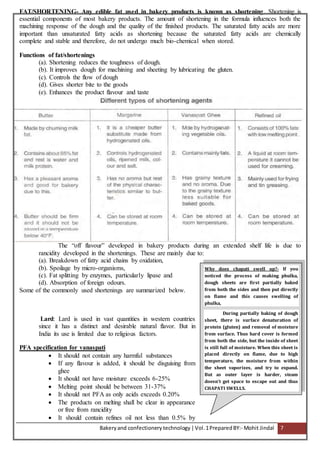
FAT/SHORTENING- Any edible fat used in bakery products is known as shortening. Shortening is
essential components of most bakery products. The amount of shortening in the formula influences both the
machining response of the dough and the quality of the finished products. The saturated fatty acids are more
important than unsaturated fatty acids as shortening because the saturated fatty acids are chemically
complete and stable and therefore, do not undergo much bio-chemical when stored.
Functions of fat/shortenings
(a). Shortening reduces the toughness of dough.
(b). It improves dough for machining and sheeting by lubricating the gluten.
(c). Controls the flow of dough
(d). Gives shorter bite to the goods
(e). Enhances the product flavour and taste
The “off flavour” developed in bakery products during an extended shelf life is due to
rancidity developed in the shortenings. These are mainly due to:
(a). Breakdown of fatty acid chains by oxidation,
(b). Spoilage by micro-organisms,
(c). Fat splitting by enzymes, particularly lipase and
(d). Absorption of foreign odours.
Some of the commonly used shortenings are summarized below.
Lard: Lard is used in vast quantities in western countries
since it has a distinct and desirable natural flavor. But in
India its use is limited due to religious factors.
PFA specification for vanaspati
 It should not contain any harmful substances
 If any flavour is added, it should be disguising from
ghee
 It should not have moisture exceeds 6-25%
 Melting point should be between 31-37%
 It should not PFA as only acids exceeds 0.20%
 The products on melting shall be clear in appearance
or free from rancidity
 It should contain refines oil not less than 0.5% by
Why does chapati swell up?- If you
noticed the process of making phulka,
dough sheets are first partially baked
from both the sides and then put directly
on flame and this causes swelling of
phulka,
During partially baking of dough
sheet, there is surface denaturation of
protein (gluten) and removal of moisture
from surface. Thus hard cover is formed
from both the side, but the inside of sheet
is still full of moisture. When this sheet is
placed directly on flame, due to high
temperature, the moisture from within
the sheet vaporizes, and try to expand.
But as outer layer is harder, steam
doesn’t get space to escape out and thus
CHAPATI SWELLS.
Bakeryand confectionery technology |Vol.1PreparedBY:- Mohit Jindal 8
weight.
 No antioxidant is added
LEAVENING AGENTS- Leavening agents aerates a mixture and thereby lightens it. They also improve
the texture and appearance of baked products. Leavening action may be produced by mechanical,
chemical and biological means. In cookies leavening action is generally achieved by chemical and
mechanical means. In cookies biological method of leavening is not practiced because the higher
amount of sugars and shortening do not permit the efficient growth of yeast. Types of leavening:
The leavening of baked products may be brought about by four general methods:
1. By means of air (mechanical)
a. By creaming action- The old fashioned pound cake is a representative of the class of cake
raised by this process, where the air is ‗whipped‘ into the shortening and sugar during
creaming and expands when heated in the oven to cause the cake to rise.
b. By beaten eggs- We all know that when eggs are beaten they become fluffy and foamy
because of the whipped in air.
2. Liberating carbon dioxide gas in the dough by means of yeast action- An example of this
method is bread.
3. Water vapour – As the temperature of a cake batter or bread dough increases (in the oven)
water is changed into water vapour (and some eventually steam), thus exerting a greater
pressure.
4. Producing leavening action by use of chemicals- Examples of such chemicals are:
a. Baking Soda
b. Baking Powder
c. Sodium bicarbonate
d. Ammonium bicarbonate
1. Ammonium Bicarbonate: Ammonium bicarbonate, often use in cookies, decomposes at
high temperature into ammonia, carbon dioxide, and stem. Its usage increases spread and
gives a large, more desirable “crack” in sugar cookies. But, it cannot be employed in moist,
large volume bakery products as ammonia retention producers an objectionable strong
pungent flavour and odour.
2. Sodium Bicarbonate: Sodium bicarbonates generate carbon dioxide and water in the oven
by reaction with acids in the flour, leaving the sodium carbonate as the residual salt. Sodium
carbonate has an unpleasant flavour and can react with fats to cause soapy tastes. Sodium
carbonate has marked softening action on gluten causing spread and also darkening the
product.
3. Baking powder: Baking powder is the leavening agent produced by mixing an acid reacting
material and sodium bicarbonate with or without starch or flour as filler. Since all baking powder
must consist of baking soda the only way in which these can differ is in the type of acid
ingredient used. Banking powder is classified as slow acting and fast acting.
The fast-acting powders give off most of their gas volume during the first few minutes
of contact with product.
On the other hand, the slow-acting powders give up very little of their gas volume at
low temperatures-they require the heat of the oven to react completely. Since banking time of
cookie is short, therefore, it requires fast acting powder for better results. On the other hand
cake where baking time is more requires slow-acting baking powder Double acting Baking
Powder: This type of powder consists of two acid ingredients- one fast acting and one slow acting
Bakeryand confectionery technology |Vol.1PreparedBY:- Mohit Jindal 9
4 Baking soda: Baking Soda is known chemically as sodium bicarbonate and has the formula
NaHCO3. Baking Soda will liberate carbon dioxide, a leavening gas, when heated. It will also
liberate this same gas, when it is mixed with an acid, either hot or cold. When baking soda is
heated the products formed are carbon dioxide, water and sodium carbonate (washing soda). The
chemical action is as follows:
2NaHCO3 CO2+H 2O+Na 2CO3
Heat
From the above chemical action we can see that if soda alone is used as a leavening agent a
residue of washing soda will remain in the cake. This residue, when present in excess, gives the
cakes a dark colour and unpleasant taste. Level of banking soda recommended for cookies is
0.4% on flour weight basis.
PFA specification for Baking Powder
The products should be in form of free white powder and free from any odour
Co2 by mass=12%
Arsenic= 1.1%
Healthy metal=10%
MILK- While using milk in bakery products, it should be considered in two parts. These refer to 1) water 2)
total solid contents in. Milk contributes towards eating qualities. The water in milk combines with the other
ingredients. Flour require water to develop structure, sugar to be a tenderizer, moisture must be present.
Thus the moisture of the milk combined with other ingredients may contribute to both toughness and
tenderness in the products.
The milk solids have a binding effect on the flour protein, creating a toughening effect. They also
contain lactose which helps to regulate crust color. They improve the flavour and are important moisture
retaining agents. Advantages of using Milk solids in Bread Production:
There are several advantages that could be derived from adding milk solids in the bread dough. These are
listed below:
1) Increased Absorption and Dough Strengthening
2) Increased Mixing Tolerance
3) Longer Fermentation
4) Better Crust Colour
5) Better Grain and Texture
6) Increased Loaf Volume
7) Better keeping Quality
8) Better Nutrition
PFA specification for Milk Powder
 Flavour and odour good
 Moisture (%by weight) 4%
 Total milk solids 96%
 Solubility index 15 ml for roller dry and 2 ml for spray dry
 Total ash 7.3%
 Fat 2.6%
 Titrable acidity 12%
 Bacterial count 5000
Other than these ingredients are also used in bakery industries as minor ingredients like spices,
flavorings, food color, coca, and chocolate etc. These ingredients are mainly used to improve the
flaovour of the bakery products
Bakeryand confectionery technology |Vol.1PreparedBY:- Mohit Jindal 10
Spices
The spices are used in comparatively small quantities in the baked products. These are quite important
ingredients-even indispensable, as their presence, even though in small quantities does improve the eating
qualities of the products as well as the physical characteristics.
Flavorings
Flavour may be defined as the sensation of smell and taste mingled. Flavour is an important ingredient in a
sweet goods formula. Flavour is really the ingredient which helps the baker to add uniqueness to his product.
Appearance may be an eye-catching factor in the first sale of any baked product but flavour holds the key to
all subsequent sales. The general accepted components of taste are: ―Sweetness, sourness, saltiness and
bitterness.
Food Colours
The use of colour is important as the use of flavour. The eyes appeal of the product is enhanced by the use of
colour. The correct colour should be used to complement directly the flavour added in the product.
Cocoa and chocolate
Cocoa and chocolate are used vary widely in the production and finishing of cakes, pastries, pies and
cookies. They provide for variety of products and the characteristic flavour and colour in the product and
also supply body and bulk to the cake mix or icing.
Bakeryand confectionery technology |Vol.1PreparedBY:- Mohit Jindal 11
Manufacturing of Bakery Products- Different types of bread and preparation of
bread using different methods, quality evaluation of bread, staling of bread
The basic recipe for bread making should include wheat flour, yeast, salt and water. If any one of these basic
ingredients is missing, the acceptable product cannot be prepared. Other ingredients are known as optional,
for example, fat, sugar, milk and milk product, malt and malt product, oxidants (such as ascorbic acid and
potassium bromate), surfactants and anti-microbial agents. Each of these ingredients has specific role to play
in bread making.
Sr. No Ingredients Percentage
1. Flour 100
2. Yeast 2-4
3. Salt 2
4. Sugar 6
5. Fat 2
6. Water 60
BREAD MAKING PROCEDURE
The following steps are generally considered essential for the production of good quality bread.
1. SELECTION OF INGEDEINTS-The basic recipe for bread making should include wheat flour,
yeast, salt and water. If any one of these basic ingredients is missing, the acceptable product cannot
be prepared. Other ingredients are known as optional, for example, fat, sugar, milk and milk product,
malt and malt product, oxidants (such as ascorbic acid and potassium bromate), surfactants and anti-
microbial agents.
2. WEIGHING-The next step is weighing of different ingredients as per formulation. Minor ingredients
have to be weighed more precisely. Salt, sugar, oxidizing agents and yeast are added in solution
form. Yeast is added as a suspension, which is mixed well each time before dispensing. Sequence of
addition of ingredients also affects the dough characteristics. Generally shortening and salt are added
after the clean up stage.
3. PREPARATION OF RAW MATERIAL-The flour is generally sieved before using in bread
primarily for following reasons:
a. To aerate the flour
b. To remove coarse particles and other impurities
c. To make flour more homogeneous.
4. MIXING-Mixing of flour and ingredients involves i.e. hydration & blending, dough development
and dough breakdown. The process of mixing begins with hydration of the formula ingredients.
During mixing dough developed in different stages. The mixing time varies with the type of flour,
type of mixer, speed of mixing arm, presence of salt or shortening, additive, particle size as well as
damaged starch content of flour. Various stages of mixing are explained below:
a. Initial hydration stage-At this stage ingredient is blended and homogenised. The dough
begins to wet and sticky.
b. Pick up stage-At this stage the hydration of ingredients is advanced and they are aggregated
into wet mass. The wet mass is uneven and wet. The gluten begins to develop in the dough
system.
c. Clean up stage-Further mixing develops the gluten network in the dough. Dough becomes
extensible and elastic.
Bakeryand confectionery technology |Vol.1PreparedBY:- Mohit Jindal 12
d. Development stage-The dough becomes more viscoelastic in nature. It gives silky and shine
character.
e. Optimum stage-This is the optimum mixing stage. Dough at this stage is elastic, silky and
smooth. Forms thin membrane of uniform thickness when stretched without breaking. It is
the right stage to process dough for bread making.
f. Break down stage-Beyond optimum stage the dough becomes increasingly soft, smooth and
highly extensive. Dough also becomes sticky and demonstrates poor machine ability. This is
generally referred to as the dough being ‘broken down’. Such dough will create problem in
dough handling and frequent break down in the plants and ultimately results into processing
losses.
5. FERMENTATION-Fermentation is achieved by yeast (Saccaromyces cerevisiae). The yeast in
dough breaks down the 1sugars to carbon dioxide and ethanol. The gas produced during fermentation
leavens the dough into foam. When fermented dough is baked, the foam structure gets converted into
sponge structure that is responsible for aerated structure of breadcrumb. The conditions under which
fermentation occurs affect the rate of carbon dioxide production and flavour development in the
dough.
The temperature and relative humidity conditions are particularly important for yeast activity
and gas production. In the temperature range of 20 to 40ºC, the yeast fermentation rate is doubled for
each 10ºC rise in temperature. Above 40ºC yeast cells are started to get killed. The yeast performs
well at 30-35ºC and relative humidity of 85 % and above. The optimum pH range for yeast is 4 to 6.
Below pH 4 the yeast activity begins to diminish and it is inactivated below pH 3. Osmotic pressure
also affects the activity of yeast.
6. KNOCK BACK-Punching of dough in between the fermentation periods increases gas retaining
capacity of the dough. The knock back has the objectives of equalizing dough temperature
throughout the mass, reducing the effect of excessive accumulation of carbon dioxide within the
dough mass and introduces atmospheric oxygen for the stimulation of yeast activity. The knock back
also aids in the mechanical development of gluten by the stretching and folding action. Usually
knock back is done when 2/3 of the normal fermentation time is over.
7. DOUGH MAKE-UP-The function of dough make-up is to transform the fermented bulk dough into
properly sealed and moulded dough piece, when baked after proofing it yields the desired finished
product. Dough make-up includes
i. Scaling or dividing: - The dough is divided into individual pieces of predetermined uniform weight
and size. The weight of the dough to be taken depends on the final weight of the bread required.
Dividing should be done within the shortest time in order to ensure the uniform weight.
ii. Rounding- When the dough piece leaves the divider, it is irregular in shape. The function of the
rounder is to impart a new continuous surface skin that will retain the gas as well as reduce the
stickiness. Rounder are of two types i.e. umbrella and bowl type.
iii. Intermediate proofing- When the dough piece leaves the rounder, it may be not properly degassed.
The dough may be less extensibility and tears easily. It is rubbery and will not mould easily. To
restore more flexible, pliable structure, it is necessary to let the dough piece rest while fermentation
proceeds. Average time at this stage ranges from 5 to 20 min.
iv. Moulding- Moulder receives pieces of dough from the inter-mediate proofer and shapes them into
cylinders ready to be placed in the pans.
Moulding involves three separate steps;
Bakeryand confectionery technology |Vol.1PreparedBY:- Mohit Jindal 13
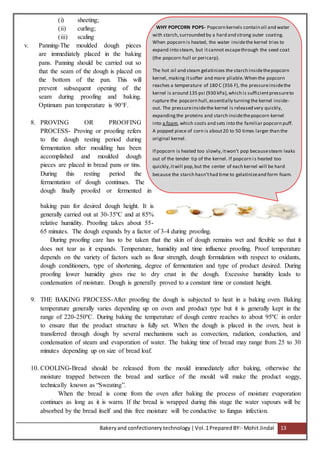
WHY POPCORN POPS- Popcorn kernels contain oil and water
with starch,surrounded by a hard and strong outer coating.
When popcorn is heated, the water insidethe kernel tries to
expand into steam, but itcannot escapethrough the seed coat
(the popcorn hull or pericarp).
The hot oil and steam gelatinizes the starch insidethepopcorn
kernel, making itsofter and more pliable.When the popcorn
reaches a temperature of 180 C (356 F), the pressureinsidethe
kernel is around 135 psi (930 kPa),which is sufficientpressureto
rupture the popcorn hull,essentially turningthe kernel inside-
out. The pressureinsidethe kernel is released very quickly,
expanding the proteins and starch insidethepopcorn kernel
into a foam, which cools and sets into the familiar popcorn puff.
A popped piece of corn is about20 to 50 times larger than the
original kernel.
If popcorn is heated too slowly,itwon't pop becausesteam leaks
out of the tender tip of the kernel. If popcorn is heated too
quickly,itwill pop,but the center of each kernel will be hard
because the starch hasn'thad time to gelatinizeand form foam.
(i) sheeting;
(ii) curling;
(iii) scaling
v. Panning-The moulded dough pieces
are immediately placed in the baking
pans. Panning should be carried out so
that the seam of the dough is placed on
the bottom of the pan. This will
prevent subsequent opening of the
seam during proofing and baking.
Optimum pan temperature is 90°F.
8. PROVING OR PROOFING
PROCESS- Proving or proofing refers
to the dough resting period during
fermentation after moulding has been
accomplished and moulded dough
pieces are placed in bread pans or tins.
During this resting period the
fermentation of dough continues. The
dough finally proofed or fermented in
baking pan for desired dough height. It is
generally carried out at 30-35ºC and at 85%
relative humidity. Proofing takes about 55-
65 minutes. The dough expands by a factor of 3-4 during proofing.
During proofing care has to be taken that the skin of dough remains wet and flexible so that it
does not tear as it expands. Temperature, humidity and time influence proofing. Proof temperature
depends on the variety of factors such as flour strength, dough formulation with respect to oxidants,
dough conditioners, type of shortening, degree of fermentation and type of product desired. During
proofing lower humidity gives rise to dry crust in the dough. Excessive humidity leads to
condensation of moisture. Dough is generally proved to a constant time or constant height.
9. THE BAKING PROCESS-After proofing the dough is subjected to heat in a baking oven. Baking
temperature generally varies depending up on oven and product type but it is generally kept in the
range of 220-250ºC. During baking the temperature of dough centre reaches to about 95ºC in order
to ensure that the product structure is fully set. When the dough is placed in the oven, heat is
transferred through dough by several mechanisms such as convection, radiation, conduction, and
condensation of steam and evaporation of water. The baking time of bread may range from 25 to 30
minutes depending up on size of bread loaf.
10. COOLING-Bread should be released from the mould immediately after baking, otherwise the
moisture trapped between the bread and surface of the mould will make the product soggy,
technically known as “Sweating”.
When the bread is come from the oven after baking the process of moisture evaporation
continues as long as it is warm. If the bread is wrapped during this stage the water vapours will be
absorbed by the bread itself and this free moisture will be conductive to fungus infection.
Bakeryand confectionery technology |Vol.1PreparedBY:- Mohit Jindal 14
Bread is cooled prior to packaging to facilitate slicing and to prevent condensation of
moisture in the wrapper. Desirable temperature of bread during slicing is 95-105°F.
11. PACKING-Bread is packed in order to preserve its freshness and to protect it from the hazards of
external contamination. The bread should allow to breath but not unduly exposed. Wax paper or
indented propylene material is good to use as a packing material for bread.
Flow diagram for Bread making
Selection of raw material
Weighing
Preparation of raw material
Mixing
Fermentation
Knockback
Dough make up (Scaling, rounding, inter-mediator proof, moulding)
Proving or proofing
Baking
Cooling
Slicing
Packing
Bakeryand confectionery technology |Vol.1PreparedBY:- Mohit Jindal 15
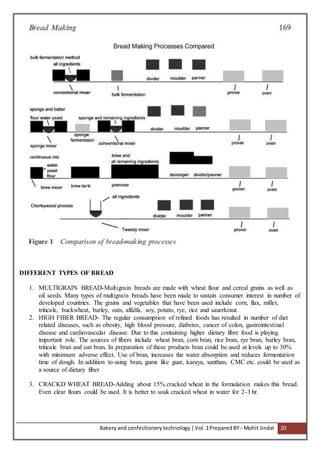
DIFERENT METHODS OF BREAD MAKING PROCESSES
Several bread making processes are available around the world and great varieties of breads are produced
using these processes. Bread making processes have been modified to suit modern and fast processing of
wheat flour into bread. The earlier processes had requirements of long fermentation and large space
requirements. The recently developed processes are no time to minimum time processes, which are fast,
labour and space effective. However, all these processes have single aim to convert wheat flour and other
ingredients into palatable bread products. The bread making processes have following common processing
steps for converting wheat flour into bread.
1. Mixing of flour with other ingredients to develop a dough or gluten network. Each of bread making
method has a requirement of mixer for kneading the ingredients together to form cohesive
2. Fermentation to mature or ripen the dough.
3. Baking to transform aerated dough into baked product.
MAJOR BREAD MAKING PROCESSES
The processes used for commercial production of bread differ principally in achieving dough
development. These may be classified into three broad processing groups although there are numerous
variations and also elements of overlap between each of the individual groups.
12. LONG FERMENTATION PROCESSES:
13. RAPID PROCESS
14. MECHANICAL DOUGH DEVELOPMENT PROCESS:
15. MECHANICAL DOUGH DEVELOPMENT PROCESS:
Here a primary function of mixing is to impart significant quantities of energy to facilitate dough
development, and the dough moves without delay from mixer to divider. The dough is developed by high
level of energy imparted at the stage of mixing.
Advantages and limitations of Mechanical Dough Development & Chemical Dough Development
process
Advantages:
1. A drastic reduction in processing time.
2. Space savings from the elimination of long bulk fermentation.
3. Improved process control and reduced wastage in the event of plant breakdowns
4. More consistent product quality.
5. Financial savings from higher dough yield through the addition of extra water and retention of flour
solids that are normally fermented by yeast in long fermentation
Limitations:
1. Faster working of the dough is required because of the higher dough temperatures used.
2. A second mixing will be required for the incorporation of fruit into fruited breads and buns.
3. In some views, a reduction of bread crumbs flavour because of the shorter processing times.
4. Use of chemicals not considered wholesome by consumers.
Processes where length of bulk fermentation is kept longer give better flavour in the product. If
increased flavour is required in breadcrumb made by the CBP or no-time dough or chemically developed
dough, then the use of a sponge or a flour brew is recommended. Bulk fermentation after the completion of
dough mixing in these processes is not recommended because of the adverse changes that occur in the dough
and the loss of subsequent bread quality.
LONG FERMENTATION PROCESSES:
Straight dough bulk fermentation process and Sponge & dough process are example, which falls
under this group. In these processes resting periods (floortime) for the dough in bulk after mixing and before
dividing are longer. In the case of straight dough method all the ingredients are mixed in one step, whereas
Bakeryand confectionery technology |Vol.1PreparedBY:- Mohit Jindal 16
in sponge and dough process, a part of the dough formulation receives a prolonged fermentation
period before being added back to the remainder of the ingredients for further mixing to form the final
dough.
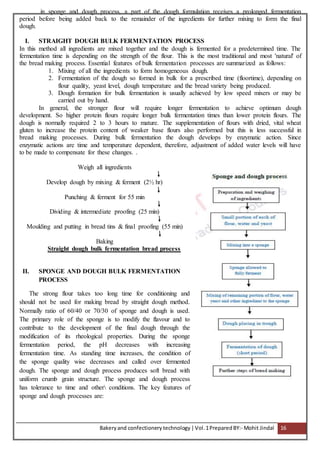
I. STRAIGHT DOUGH BULK FERMENTATION PROCESS
In this method all ingredients are mixed together and the dough is fermented for a predetermined time. The
fermentation time is depending on the strength of the flour. This is the most traditional and most 'natural' of
the bread making process. Essential features of bulk fermentation processes are summarized as follows:
1. Mixing of all the ingredients to form homogeneous dough.
2. Fermentation of the dough so formed in bulk for a prescribed time (floortime), depending on
flour quality, yeast level, dough temperature and the bread variety being produced.
3. Dough formation for bulk fermentation is usually achieved by low speed mixers or may be
carried out by hand.
In general, the stronger flour will require longer fermentation to achieve optimum dough
development. So higher protein flours require longer bulk fermentation times than lower protein flours. The
dough is normally required 2 to 3 hours to mature. The supplementation of flours with dried, vital wheat
gluten to increase the protein content of weaker base flours also performed but this is less successful in
bread making processes. During bulk fermentation the dough develops by enzymatic action. Since
enzymatic actions are time and temperature dependent, therefore, adjustment of added water levels will have
to be made to compensate for these changes. .
Weigh all ingredients
Develop dough by mixing & ferment (2½ hr)
Punching & ferment for 55 min
Dividing & intermediate proofing (25 min)
Moulding and putting in bread tins & final proofing (55 min)
Baking
Straight dough bulk fermentation bread process
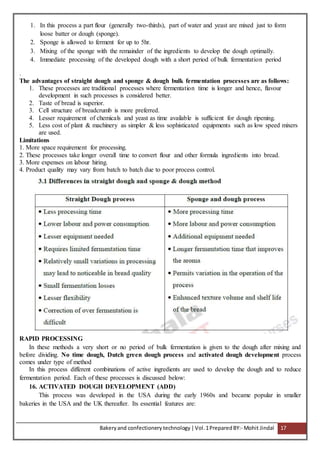
II. SPONGE AND DOUGH BULK FERMENTATION
PROCESS
The strong flour takes too long time for conditioning and
should not be used for making bread by straight dough method.
Normally ratio of 60/40 or 70/30 of sponge and dough is used.
The primary role of the sponge is to modify the flavour and to
contribute to the development of the final dough through the
modification of its rheological properties. During the sponge
fermentation period, the pH decreases with increasing
fermentation time. As standing time increases, the condition of
the sponge quality wise decreases and called over fermented
dough. The sponge and dough process produces soft bread with
uniform crumb grain structure. The sponge and dough process
has tolerance to time and other conditions. The key features of
sponge and dough processes are:
Bakeryand confectionery technology |Vol.1PreparedBY:- Mohit Jindal 17
1. In this process a part flour (generally two-thirds), part of water and yeast are mixed just to form
loose batter or dough (sponge).
2. Sponge is allowed to ferment for up to 5hr.
3. Mixing of the sponge with the remainder of the ingredients to develop the dough optimally.
4. Immediate processing of the developed dough with a short period of bulk fermentation period
.
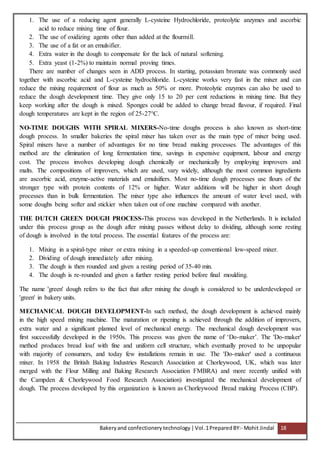
The advantages of straight dough and sponge & dough bulk fermentation processes are as follows:
1. These processes are traditional processes where fermentation time is longer and hence, flavour
development in such processes is considered better.
2. Taste of bread is superior.
3. Cell structure of breadcrumb is more preferred.
4. Lesser requirement of chemicals and yeast as time available is sufficient for dough ripening.
5. Less cost of plant & machinery as simpler & less sophisticated equipments such as low speed mixers
are used.
Limitations
1. More space requirement for processing.
2. These processes take longer overall time to convert flour and other formula ingredients into bread.
3. More expenses on labour hiring.
4. Product quality may vary from batch to batch due to poor process control.
RAPID PROCESSING
In these methods a very short or no period of bulk fermentation is given to the dough after mixing and
before dividing. No time dough, Dutch green dough process and activated dough development process
comes under type of method
In this process different combinations of active ingredients are used to develop the dough and to reduce
fermentation period. Each of these processes is discussed below:
16. ACTIVATED DOUGH DEVELOPMENT (ADD)
This process was developed in the USA during the early 1960s and became popular in smaller
bakeries in the USA and the UK thereafter. Its essential features are:
Bakeryand confectionery technology |Vol.1PreparedBY:- Mohit Jindal 18
1. The use of a reducing agent generally L-cysteine Hydrochloride, proteolytic anzymes and ascorbic
acid to reduce mixing time of flour.
2. The use of oxidizing agents other than added at the flourmill.
3. The use of a fat or an emulsifier.
4. Extra water in the dough to compensate for the lack of natural softening.
5. Extra yeast (1-2%) to maintain normal proving times.
There are number of changes seen in ADD process. In starting, potassium bromate was commonly used
together with ascorbic acid and L-cysteine hydrochloride. L-cysteine works very fast in the mixer and can
reduce the mixing requirement of flour as much as 50% or more. Proteolytic enzymes can also be used to
reduce the dough development time. They give only 15 to 20 per cent reductions in mixing time. But they
keep working after the dough is mixed. Sponges could be added to change bread flavour, if required. Final
dough temperatures are kept in the region of 25-27°C.
NO-TIME DOUGHS WITH SPIRAL MIXERS-No-time doughs process is also known as short-time
dough process. In smaller bakeries the spiral mixer has taken over as the main type of mixer being used.
Spiral mixers have a number of advantages for no time bread making processes. The advantages of this
method are the elimination of long fermentation time, savings in expensive equipment, labour and energy
cost. The process involves developing dough chemically or mechanically by employing improvers and
malts. The compositions of improvers, which are used, vary widely, although the most common ingredients
are ascorbic acid, enzyme-active materials and emulsifiers. Most no-time dough processes use flours of the
stronger type with protein contents of 12% or higher. Water additions will be higher in short dough
processes than in bulk fermentation. The mixer type also influences the amount of water level used, with
some doughs being softer and stickier when taken out of one machine compared with another.
THE DUTCH GREEN DOUGH PROCESS-This process was developed in the Netherlands. It is included
under this process group as the dough after mixing passes without delay to dividing, although some resting
of dough is involved in the total process. The essential features of the process are:
1. Mixing in a spiral-type mixer or extra mixing in a speeded-up conventional low-speed mixer.
2. Dividing of dough immediately after mixing.
3. The dough is then rounded and given a resting period of 35-40 min.
4. The dough is re-rounded and given a further resting period before final moulding.
The name 'green' dough refers to the fact that after mixing the dough is considered to be underdeveloped or
'green' in bakery units.
MECHANICAL DOUGH DEVELOPMENT-In such method, the dough development is achieved mainly
in the high speed mixing machine. The maturation or ripening is achieved through the addition of improvers,
extra water and a significant planned level of mechanical energy. The mechanical dough development was
first successfully developed in the 1950s. This process was given the name of ‘Do-maker’. The 'Do-maker'
method produces bread loaf with fine and uniform cell structure, which eventually proved to be unpopular
with majority of consumers, and today few installations remain in use. The 'Do-maker' used a continuous
mixer. In 1958 the British Baking Industries Research Association at Chorleywood, UK, which was later
merged with the Flour Milling and Baking Research Association FMBRA) and more recently unified with
the Campden & Chorleywood Food Research Association) investigated the mechanical development of
dough. The process developed by this organization is known as Chorleywood Bread making Process (CBP).
Bakeryand confectionery technology |Vol.1PreparedBY:- Mohit Jindal 19
CHORLEYWOOD BREAD PROCESS (CBP)-The principle involved in the production of fermented
foods by the CBP remain the same as those first published by the Chorleywood team in 1961, although the
practices have changed with changes in ingredients and mixing equipment. The essential features of the CBP
are:
1. Mixing and dough development takes place in a single
operation lasting between 2 and 5 minute at a fixed energy
input of 11Wh/kg of dough.
2. A combination of fast and slow acting oxidizing agents such
as potassium bromate and potassium iodate.
3. Addition of a high melting point fat, emulsifier or fat and
emulsifier combination.
4. Use of extra water to adjust dough consistency to be
comparable with that from bulk fermentation;
5. Use of extra yeast to maintain final proof times comparable
with those obtained with bulk fermentation;
6. Control of mixer headspace atmosphere to achieve given
bread cell structures.
The main difference between the CBP and bulk fermentation
processes lies in the rapid development of the dough in the mixer
rather than through a prolonged resting period. The aim of both
processes is to modify the protein network in the dough to improve
its ability to retain gas from yeast fermentation in the prover. In the
case of the CBP this is achieved within 5 min of starting the mixing
process.
FROZEN DOUGH PROCESS-This process is generally used for
retail or household baking for fresh bread, rolls and Danish pastries.
The end product cost could be maintained at par with the method of
production by saving on labour and other overheads. The frozen
doughs require longer proof time due to decreased yeast cells during
freezing cycle. The doughs are made usually from strong flour or by
using additional vital dry gluten. The presence of emulsifiers and
oxidants overcome the deleterious effect during freezing.
MICROWAVE PROCESS-Microwave baking of bread though initiated in 1960s, it actually picked up
during 90s. In this process the heating begins immediately and it is very fast. The heating depends greatly on
moisture, mass, dielectric properties, geometry, etc. The processing cost could be reduced and capacity
increased by this process. The microwaves fall in the frequency range of 300 MH (106) to 300 GHz (109).
Heating is caused due to the ionic induction and dipole movement influenced by rapidly changing polarity of
electric field. The microwave heating is quite expensive in terms of equipment and operation cost.
5 fun facts about bread
1. Bakers used to be fined if
their loaves were underweight
so they added an extra loaf to
every dozen, hence the term
“Baker’s Dozen.”
2. Scandinavian traditions
hold that if a boy and girl eat
from the same loaf, they are
bound to fall in love.
3. Superstition says it is bad
luck to turn a loaf of bread
upside down or cut an unbaked
loaf.
4. Assuming a sandwich was
eaten for breakfast, lunch, and
dinner, it would take 168 days
to eat the amount of bread
produced from one bushel of
wheat. A family of four could live
10 years off the bread produced
by one acre of wheat.
5. The inner part of the bread
incased in the crust is called the
“crumb” hence why small bits of
this part of the bread are called
“crumbs.
Bakeryand confectionery technology |Vol.1PreparedBY:- Mohit Jindal 20
DIFFERENT TYPES OF BREAD
1. MULTIGRAIN BREAD-Multigrain breads are made with wheat flour and cereal grains as well as
oil seeds. Many types of multigrain breads have been made to sustain consumer interest in number of
developed countries. The grains and vegetables that have been used include corn, flax, millet,
triticale, buckwheat, barley, oats, alfalfa, soy, potato, rye, rice and sauerkraut.
2. HIGH FIBER BREAD- The regular consumption of refined foods has resulted in number of diet
related diseases, such as obesity, high blood pressure, diabetes, cancer of colon, gastrointestinal
disease and cardiovascular disease. Due to this containing higher dietary fibre food is playing
important role. The sources of fibers include wheat bran, corn bran, rice bran, rye bran, barley bran,
triticale bran and oat bran. In preparation of these products bran could be used at levels up to 30%
with minimum adverse effect. Use of bran, increases the water absorption and reduces fermentation
time of dough. In addition to using bran, gums like guar, karaya, xanthan, CMC etc. could be used as
a source of dietary fiber
3. CRACKD WHEAT BREAD-Adding about 15% cracked wheat in the formulation makes this bread.
Even clear flours could be used. It is better to soak cracked wheat in water for 2-3 hr.
Bakeryand confectionery technology |Vol.1PreparedBY:- Mohit Jindal 21
Typical recipe (%)
Clear flour 72
White flour 14
Cracked wheat 14
Water 64
Salt 2.0
Sugar 5.0
Yeast 2.5
Fat 2.0
4. MILK BREAD-Milk bread should contain at least 6.0% milk solids. Milk solids could be added as
skimmed or whole milk solids, or milk, which is sterilized, or condensed milk when preparing milk
powder, the following points is to be considered.
1. Fat content in the milk
2. Lactose unfermented by yeast. Hence, adds to colour and sweetness.
3. Protein of milk has a volume depressing effect due to the presence of free sulfhydryl
groups, which acts as reducing agents.
4. Milk improves the nutritional quality.
5. Incorporation of higher amounts of oxidants helps in overcoming the deleterious
effect of milk protein.
5. HIGH PROTEIN BREAD-Wheat flour has a good carrying capacity and hence it could be fortified
with respect to calories, protein, salt, carbohydrates, vitamins and minerals required for special target
groups. There is a greater scope to produce high protein breads using protein rich oilseed meals.
Normal white pan bread contains only 6 to 10% proteins. Any of the defatted oilseed meals contain
protein ranging from 40-60%. High protein material increases the water absorption capacity and also
improves the keeping quality.
6. WHEAT GERM BREAD-Wheat germ bread must contain at least 10% of germ. Wheat germ, which
is a by-product of flour milling, is nutritionally many superiors to other protein sources. It contains as
high as 30% protein of quality similar to the protein of eggs or milk. It is also a rich source of
vitamins and minerals and richest known source of tocopherol. It has been found that toasting of
germ not only improves taste and colour but also the keeping quality
7. SUGAR FREE BREAD-In sugar free breads; sugar is replaced with enzyme active flour (2.0%).
Formulation of sugar free bread is given below:
Ingredients (%)
Wheat flour 100
Yeast 2 g
Salt 15
Malt 2
Ascorbic acid 100 ppm
The taste of such breads will be bland. Hence, other natural sugars like sorbitol could be
used. Sorbitol has sweetness of 60% of sucrose. Hence, diabetic patients could use breads
made with sorbitol and the quality of bread compares well with normal bread.
8. LOW CALORIE BREAD-Low calorie breads are made using cereal brans and fat substitutes.
Sucrose esters have been found to be a good substitute for fat. The demand for low fat/low
calorie/light foods is increasing considerably in other parts of the world. Using proper surfactant
maltodextrin or sucrose ester makes low or no fat bakery products. The other ingredients that could
replace fat are modified starches, dextrins, fibers, enzymes and emulsifiers.
Bakeryand confectionery technology |Vol.1PreparedBY:- Mohit Jindal 22
9. GLUTEN FREE BREAD-A small segment of population suffers from dietary wheat intolerance,
which includes disturbances known as celiac disease. The symptoms may include cramps, diarrhea
etc. and the responsible factor has been found to be gliadin. Using wheat starch or any other non-
wheat flours and gluten substitutes consisting of pre gelatinized starch, guar gum and carboxyl
methylcellulose could make gluten free breads. Use of emulsifiers like, mono and di-glycerides and
sodium stearoyl lactylate have been found to be beneficial in improving the quality of bread.
ASSESSMENT OF BREAD QUALITY
An expert panel generally assesses quality of bread, which is a subjective judgment. Objective methods have
also been evolved to judge the quality of bread. The techniques for assessing bread quality usually fall into
three broad categories: external, internal and texture/eating quality.
External quality attributes of bread
1. Volume
2. Symmetry of shape
3. Bloom
4. Crust color
5. Evenness of bake
6. Oven break
The external quality attributes include product dimensions, volume, appearance, colour and crust
characteristics. The critical dimensions for most bread are their length and height, with breadth being of
lesser importance. Devices for measuring product dimensions off-line can be simple and include graduated
rulers and tapes. It is possible to measure product height and shape on-line using image analysis techniques.
Measurement of height will often be used together with width as a basis for an estimation of volume where
the product shape makes such estimates meaningful, for example with rectangular pan breads.
The most common method of assessing whole bread volume is by using a seed displacement method.
The apparatus comprises a container of known volume, which has previously been calibrated with a suitable
seed, usually rapeseed or pearl barley, into which the product is introduced. The seed is reintroduced and the
product displaces a volume of seed equivalent to its own volume. It is important to keep such apparatus
regularly calibrated with suitable ‘dummy’ products of known volume since the bulk density of seeds may
change with time. The external appearance of the product quite often is a major factor, which attracts the
consumer. The consumers prefer golden brown crust color all around. The presence of undesirable surface
blemishes reduces the loaf quality score.
Internal quality attributes of bread
1. Color
2. Structure
3. Texture
4. Flavour and aroma
5. Moistness
6. Cleanliness
7. Crumb clarity and elasticity
Internal quality attributes of bread are usually refers to size, number and distribution of cells in the crumb,
the crumb colour and any major quality defects, such as unwanted holes of dense patches, visible in a cross-
section of the product.
Texture/eating quality of flavour
Texture and eating quality are important properties of bread products and are different from one another.
Crumb softness or firmness is the texture property, which has attracted most attention in bread assessment
because of its close association with human perception of freshness. The bread internal quality may be
judged by squeezing the loaf. A fresh loaf will be softer and spring back as the squeezing is withdrawn.
Texture analyzer can also judge freshness of crumb also.
Bakeryand confectionery technology |Vol.1PreparedBY:- Mohit Jindal 23
BREAD STALING
Bread staling, broadly, includes all changes, except
microbial that occur in bread after baking. Changes occur in both
crumb and crust of the bread, however, crumb firmness is more
correlated with bread staling. The moisture migration, change in
the structure of starch and retrogradation due to various physical
factor, are the major causes of the staling. A 60-100ºC, it is
possible to reverse most of the stale character of bread due to the
heat reversible character of starch retrogradation. Staling is more
rapid in white bread than in whole wheat and rye bread. This is
probably due to the fact that the whole wheat and rye breads are
generally higher in protein and pentosans content than normal
white bread.
Bread stored at -22°C remained acceptable even after
40days; however, the bread stored for longer period or at
temperatures above -220C developed an off dour. Refrigerated
storage accelerates the rate of staling and after prolonged storage
(after 5 days) both conditions (refrigerated and room conditions)
produce the same degree of staling. The only advantage of
refrigerated bread would be that, the bread stored at room
temperature become moldy whereas that stored at refrigerated
temperature did not have any mold growth after 7 days of storage.
CRUST STALING
The crust of fresh bread is crisp, brittle and somewhat dry.
On staling it becomes soft, tough and leathery. This is caused due
to migration of moisture from the moist center crumb to the crust.
The hygroscopic crust readily absorbs moisture which diffuses
outwards and becomes soft and leathery. The excess humidity,
above 80% R.H.in the bread store is also undesirable. Preventing
the evaporation of water from crust to the atmosphere can inhibit
the staling rate of crust. The bread if packed in the moisture proof
wax coated paper or film, which does not permit the moisture
from interior of the loaf to pass through crust into the atmosphere,
stays fresh for longer time.
CRUMB STALING
When starch is heated with sufficient quantity of water, at
a particular temperature the starch granules swell and the whole
mass becomes a thick paste called gel. The process is known as’
gelatinization’. At this stage starch can hold about 6 times water
of its own weigh. Because at this stage the starch present in
swallow state but when starch cool down it shrink and loose the
moisture. The result of this migration of moisture from the starch
to the gluten is claimed to be largely responsible for the
development of staleness in bread. The starch cells absorb more water when bread is fresh and have alpha-
pattern which on lowering of temperature, changes slowly to the beta pattern, which holds less water. As the
crumb of bread stales it becomes drier, less elastic, crumbly and harsh textured. It also looses the fresh
flavour and aroma.
5 fun facts about bread
1. The ancient Greeks were
already producing more than 80
types of bread in 2500 B.C.
2. Bread was so important to
the Egyptian way of life that it
was used as a type of currency.
They revered it so much they
would often place it in the tombs
of their dead.
3. Bakers were powerful credit
brokers during the middle Ages
in France. They often loaned out
bread as currency and as a form
of credit. King Louis IV said, “He
who controls a nation’s bread is
a greater ruler than he who
controls their souls.”
4. Napoleon gave common
bread its name when he
demanded a loaf of dark rye
bread for his horse during the
Prussian campaign. “Pain pour
Nicole,” he ordered, which
meant “Bread for Nicole,” his
horse. To Germanic ears, the
request sounded like
“Pumpernickel,” which is the
term we use today for this
traditional loaf.
5. in Britain, the ceremony of
First Footing is traditionally
observed in the early hours of
New Year’s Day. A piece of bread
is left outside a door, with a
piece of coal and a silver coin,
and is supposed to bring you
food, warmth and riches in the
year ahead.
Bakeryand confectionery technology |Vol.1PreparedBY:- Mohit Jindal 24
The following characteristic changes take place during the staling of bread.
10. Change in taste and aroma
11. Increased hardness of crumb
12. Increased opacity of crumb
13. Increased crumbliness of crumb
14. Increased starch crystallization of crumb
15. Decreased absorptive capacity of crumb
16. Decreased susceptibility of crumb to amylases
Bread faults and remedies
BREAD FAULTS
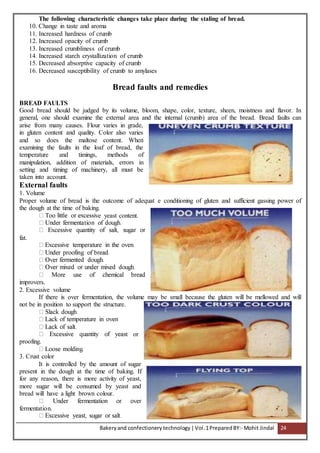
Good bread should be judged by its volume, bloom, shape, color, texture, sheen, moistness and flavor. In
general, one should examine the external area and the internal (crumb) area of the bread. Bread faults can
arise from many causes. Flour varies in grade,
in gluten content and quality. Color also varies
and so does the maltose content. When
examining the faults in the loaf of bread, the
temperature and timings, methods of
manipulation, addition of materials, errors in
setting and timing of machinery, all must be
taken into account.
External faults
1. Volume
Proper volume of bread is the outcome of adequat e conditioning of gluten and sufficient gassing power of
the dough at the time of baking.
ve yeast content.
fat.
improvers.
2. Excessive volume
If there is over fermentation, the volume may be small because the gluten will be mellowed and will
not be in position to support the structure.
t or
proofing.
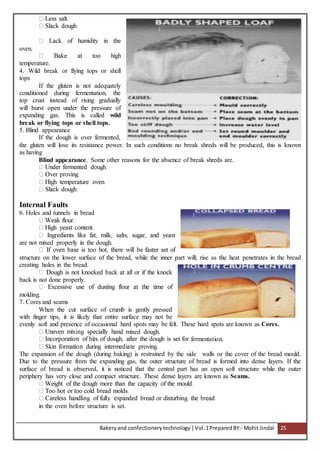
3. Crust color
It is controlled by the amount of sugar
present in the dough at the time of baking. If
for any reason, there is more activity of yeast,
more sugar will be consumed by yeast and
bread will have a light brown colour.
fermentation.
Bakeryand confectionery technology |Vol.1PreparedBY:- Mohit Jindal 25
oven.
temperature.
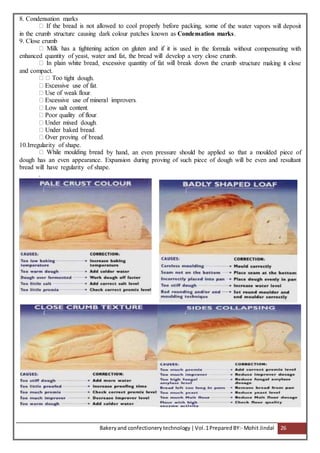
4. Wild break or flying tops or shell
tops
If the gluten is not adequately
conditioned during fermentation, the
top crust instead of rising gradually
will burst open under the pressure of
expanding gas. This is called wild
break or flying tops or shell tops.
5. Blind appearance
If the dough is over fermented,
the gluten will lose its resistance power. In such conditions no break shreds will be produced, this is known
as having
Blind appearance. Some other reasons for the absence of break shreds are.
Internal Faults
6. Holes and tunnels in bread
are not mixed properly in the dough.
structure on the lower surface of the bread, while the inner part will; rise as the heat penetrates in the bread
creating holes in the bread.
back is not done properly.
molding.
7. Cores and seams
When the cut surface of crumb is gently pressed
with finger tips, it is likely that entire surface may not be
evenly soft and presence of occasional hard spots may be felt. These hard spots are known as Cores.
d mixed dough.
fermentation.
The expansion of the dough (during baking) is restrained by the side walls or the cover of the bread mould.
Due to the pressure from the expanding gas, the outer structure of bread is formed into dense layers. If the
surface of bread is observed, it is noticed that the central part has an open soft structure while the outer
periphery has very close and compact structure. These dense layers are known as Seams.
in the oven before structure is set.
Bakeryand confectionery technology |Vol.1PreparedBY:- Mohit Jindal 26
8. Condensation marks
the water vapors will deposit
in the crumb structure causing dark colour patches known as Condensation marks.
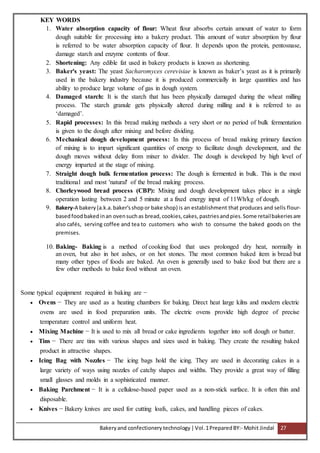
9. Close crumb
used in the formula without compensating with
enhanced quantity of yeast, water and fat, the bread will develop a very close crumb.
crumb structure making it close
and compact.
ight dough.
10.Irregularity of shape.
by hand, an even pressure should be applied so that a moulded piece of
dough has an even appearance. Expansion during proving of such piece of dough will be even and resultant
bread will have regularity of shape.
.
Bakeryand confectionery technology |Vol.1PreparedBY:- Mohit Jindal 27
KEY WORDS
1. Water absorption capacity of flour: Wheat flour absorbs certain amount of water to form
dough suitable for processing into a bakery product. This amount of water absorption by flour
is referred to be water absorption capacity of flour. It depends upon the protein, pentosnase,
damage starch and enzyme contents of flour.
2. Shortening: Any edible fat used in bakery products is known as shortening.
3. Baker's yeast: The yeast Sacharomyces cerevisiae is known as baker’s yeast as it is primarily
used in the bakery industry because it is produced commercially in large quantities and has
ability to produce large volume of gas in dough system.
4. Damaged starch: It is the starch that has been physically damaged during the wheat milling
process. The starch granule gets physically altered during milling and it is referred to as
‘damaged’.
5. Rapid processes: In this bread making methods a very short or no period of bulk fermentation
is given to the dough after mixing and before dividing.
6. Mechanical dough development process: In this process of bread making primary function
of mixing is to impart significant quantities of energy to facilitate dough development, and the
dough moves without delay from mixer to divider. The dough is developed by high level of
energy imparted at the stage of mixing.
7. Straight dough bulk fermentation process: The dough is fermented in bulk. This is the most
traditional and most 'natural' of the bread making process.
8. Chorleywood bread process (CBP): Mixing and dough development takes place in a single
operation lasting between 2 and 5 minute at a fixed energy input of 11Wh/kg of dough.
9. Bakery-A bakery (a.k.a. baker'sshop or bake shop) is an establishment that produces and sells flour-
basedfood bakedinan ovensuchas bread,cookies,cakes,pastriesandpies.Some retailbakeriesare
also cafés, serving coffee and tea to customers who wish to consume the baked goods on the
premises.
10. Baking- Baking is a method of cooking food that uses prolonged dry heat, normally in
an oven, but also in hot ashes, or on hot stones. The most common baked item is bread but
many other types of foods are baked. An oven is generally used to bake food but there are a
few other methods to bake food without an oven.
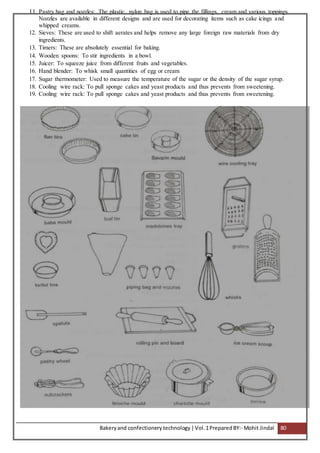
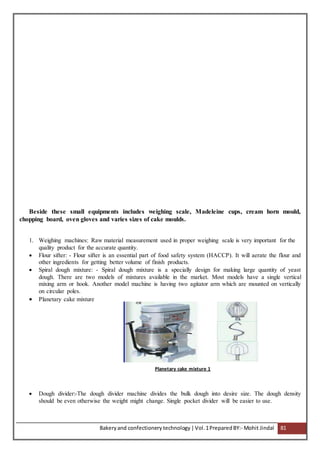
Some typical equipment required in baking are −
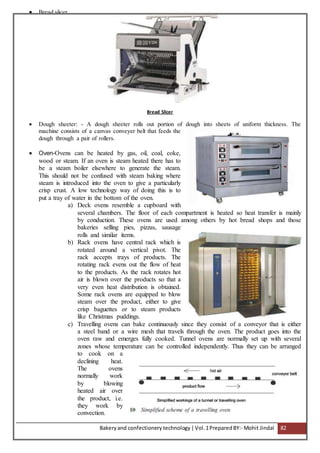
 Ovens − They are used as a heating chambers for baking. Direct heat large kilns and modern electric
ovens are used in food preparation units. The electric ovens provide high degree of precise
temperature control and uniform heat.
 Mixing Machine − It is used to mix all bread or cake ingredients together into soft dough or batter.
 Tins − There are tins with various shapes and sizes used in baking. They create the resulting baked
product in attractive shapes.
 Icing Bag with Nozzles − The icing bags hold the icing. They are used in decorating cakes in a
large variety of ways using nozzles of catchy shapes and widths. They provide a great way of filling
small glasses and molds in a sophisticated manner.
 Baking Parchment − It is a cellulose-based paper used as a non-stick surface. It is often thin and
disposable.
 Knives − Bakery knives are used for cutting loafs, cakes, and handling pieces of cakes.
Bakeryand confectionery technology |Vol.1PreparedBY:- Mohit Jindal 28
 Cake Stands − They are required to keep cakes of multiple tiers. Some of them are rotary. They
provide circular motion that makes the process of cake decoration easy.
 Spatula − They are flat tip spoons, used to fold the batter and fill the icing bag. Spatulas often have
rubber tips.
Different Products related to cereals
 Dalia − Coarsely broken wheat. It is used to prepare a porridge-like snack.
 Semolina (Suji) − Finely broken wheat. It is used to prepare Halwa or Upma.
 Beaten Rice (Poha) − Dry, flat, flaky rice used in preparing various snacks.
 Puffed Rice (Murmura) − It is roasted rice in special kiln to make it puffed. It is used to make a
spicy snack called Chiwda.
 Jaggery (Gud) − thick boiled and solidified pulp of sugarcane juice. It is added in lentils and veg
dishes to balance hot and sour taste.
 Vermicelli (Semiyan) Long and thin spaghetti made of wheat flour. They are used for cooking a
dessert named kheer and a snack named Upma.
Basic Terms Used in Bakery Industry
 Beating (Vigorously mixing foods to incorporate air and develop gluten. Use Paddle attachment)
 Blending (Mixing two or more ingredients to evenly distribute. Use Paddle attachment)
 Creaming (Combining softened fat and sugar while incorporating air. Use Paddle attachment,
medium speed)
 Cutting (Incorporating solid fat into dry ingredients until lumps of desired size occur. Use pastry
cutter or fingers, Paddle attachment)
 Folding (Very gently incorporating ingredients such as whipped cream or eggs with dry ingredients
or batter. Use Spatula)
 Kneading (Working a dough to produce gluten by repeatedly folding the dough onto itself. Use
hands or Dough Hook)
 Stirring (Gently mixing ingredients by hand until blended. Use whisk, spoon or spatula)
 Sifting (Using a fine mesh to pass dry ingredients though to remove lumps and aerate. Use sifter)
 Whipping (Beating vigorously to incorporate air. Use whisk or Whisk attachment)
Bakeryand confectionery technology |Vol.1PreparedBY:- Mohit Jindal 29
Different types of biscuits and preparation of biscuits using
different methods, quality evaluation of biscuits
Biscuits and biscuit like products have been consumed by humans for hundreds, perhaps thousands, of years.
Although in existence for a very long time, the difference, the difference between a biscuit, cookie and a
cracker is still often less than clear. This is due to a recognized overlap between the boundaries used to
define each of the categories.
Biscuit are small baked products made principally from flour, sugar and fat. They have a moisture
content less than 4% and packed in a moisture proof container have a long life, perhaps 6 months or
more.
HISTORY- The term ‘biscuit’ is derived from the Latin ‘bis coctus’ or the Old French ‘bescoit’, meaning
twice cooked. It is thought that biscuits have been baked for thousands of years and were originally baked in
a hot oven and then cooled in a cool oven, although this process would not be found in modern processing
factories. The raw materials used for biscuit manufacture is flour, sweeteners, shortening, milk, leavening
agents and other miscellaneous products.
Cookies were at one time referred to as small cakes or sweet biscuits. The Dutch have provided bakers and
confectioners with the word kocke which means small cake. The Americans began to use the word cookie,
whereas the English continue to use the word biscuit for the same product. There are more varieties of
cookies than any other baked product because there are so many different shapes, sizes, textures and flavors
that are possible.
What is meant by the terms biscuits, cookies and crackers?
The name ‘biscuit’ is regarded differently based upon geographic location. In the USA the term
‘biscuit’ describes a chemically leavened product which has no true parallel. In contrast, those products
recognized in the UK as ‘biscuit’ would be termed ‘cookies’ or ‘crackers’ in the USA.
Particularly in the USA, the term cookie is a sweet or hardly sweet thin to small chunky product, again
baked to low moisture content and with long shelf life. In other countries, like the UK, a cookie is usually a
more irregularly shaped biscuit formed, for example, by wire cutting the dough.
There is generally more agreement on the meaning of the term cracker. This is a flaky or open textured thin,
dry product which is not sweet but may taste of cheese or some other salty flavour.
CLASSIFICATION OF BISCUITS
There are basically two type of biscuit dough, hard and soft dough. The difference is determined by the
amount of water required to make dough.
Bakeryand confectionery technology |Vol.1PreparedBY:- Mohit Jindal 30
Biscuits may be classified in various ways.
1. Based on the texture and hardness.
2. Based on the method of forming dough and dough pieces e.g. fermented, develop laminated, cut,
moulded extruded, deposited, wire cut, co extruded etc
3. The enrichment of recipe based on fat and sugar.
In the UK, biscuits are separated into those made from:
HARD DOUGH BISCUITS
Hard dough has high water and relative low fat and sugar contents. In hard doughs the gluten is partially
developed. The dough is tough and extensible (it can be pulled out without immediate breaking).The biscuit
are either crackers or in a group known as semi-sweet and hard sweet. In this category the biscuits that can
be included are:
1) Water biscuits have a simple recipe mostly of flour, fat, salt and water in the ratio of
100:6.5:1:29. The dough is under developed and crumbly or in balls after mixing. Mostly Jewish
community prepares water biscuits. No flavor is added in biscuits.
2) Gluco biscuits-In India gluco biscuits are manufactured in the largest quantities and because of
lower cost it is most popular among children. A typical recipe of these biscuits is given below.
Recipe
Wheat flour 100 parts
Sugar 33 kg
Salt 1.1kg
SMS 4.2g
SMP l.5kg
Shortening 24kg
Invert syrup 15 kg
Ammonium 0.6
Water 10 liter
Flavour Vanilla
Preparation
1) Wheat flour is passed through a sifter removes all the dirt, stones etc.
2) Sugar is ground and fat is incorporated in molten form
3) Mixing: Ammonium bicarbonate, sugar syrup and water are mixed thoroughly in a high-speed mixer
for a couple of minutes. Shortening and flavour are creamed for a few minutes. In dry mixing, maida,
salt, sugar, SMS paste, SMP and vitamins premix are mixed. The mixing time is about 3-5 minutes
4) Shaping and conveying to oven. The Rotary molder is used for shaping operation. This operation
involved feed roll rubber roll and die roll and extraction belt and panning table belt.
5) Baking: The biscuits baked in an oven that has different temperature zone e.g. 1200C, 3500C and
150°C.
6) Cooling: In cooling, two cooling conveyors are used. The cooling time is around 4 minutes.
7) Packing: The biscuits are packed in BOPP or any other moisture proof packaging materials.
Bakeryand confectionery technology |Vol.1PreparedBY:- Mohit Jindal 31
SOFT DOUGH BISCUITS
Short doughs, which are soft enough to be just pourable, are called as soft doughs. It contains much less
water and relatively high level of fat and sugar. The dough is short (breaks when it is pulled out). The
biscuits are of the soft eating types which are often refereed as cookies. Pieces are formed by extrusion or by
same machine as wire cut. The dough is pressed out either continuously or intermittently on the oven band
that may be raised up and then dropped if discrete deposits are requires. Jams and Jelly can be added on the
top of dough deposit.
1. Sponge batter drops biscuits.
2. Fermented soft dough biscuits
In the US, biscuits are classified based on their method of processing, especially they way in which they
are shaped, with four main categories:
1. Sheeting or cutting (also called cutting machine dough) – This method is used for hard dough,
where it is passed through a series of rollers to obtain the desired thickness. The biscuit shapes are
cut out of the sheets using a die which may be plastic or metal. The dough needs to be strong and
elastic so that the biscuits hold their shape when the scrap is removed from around the cut biscuits.
2. Rotary moulding – This method is used for short dough and requires a dough with a relatively stiff
consistency that is not sticky. The dough is compressed into dies mounted on the surface of a roller,
with excess dough scrapped off. The moulded dough piece maintains it shape as it is pushed out of
the die onto the baking sheet.
3. Wire cutting – Short dough is extruded through a die and sliced with a tight wire at appropriate
intervals. The pressure placed on the dough in the extruder and the thickness of the wire vary
dependent on the dough properties.
4. Depositing – Soft dough is shaped by depositing due to its semi fluid consistency and lack of
cohesiveness. The dough is extruded through a nozzle and dropped onto a baking sheet. To achieve
uniformity in the size and shape of biscuits, the flow of dough is cut off at regular intervals.
CLASSIFICATION OF COOKIES (TYPES OF COOKIES)
Cookies are chemically leavened baked
products with top surface broken by fairly
wide cracks somewhat evenly spaced to give
uniformly sized islands. They have richer
crust colour and a moisture content ranging
from 1 to 4 percent. Cookies differ from
biscuits in respect to their crispness, bite,
taste, texture and level of ingredients used.
Cookies are generally crisper and contain
larger amount of sugars and shortenings than
biscuits. Cookies can be classified into four
major groups depending upon the kind of
equipment used to form the individual
places.
Bakeryand confectionery technology |Vol.1PreparedBY:- Mohit Jindal 32
A. Deposit Cookies
B. Rotary-moulded cookies
C. Wire-cut cookies and
D. Cutting machine cookies
DEPOSIT COOKIES
This category of cookies is made from very soft dough deposited directly onto the oven band by a forming
machine. Deposit cookies contain about 35 to 45 percent sugar, 60 to 70 percent shortening and unbleached
soft wheat flour with 8 to 8.5 percent proteins and 0.35 to 0.40 percent ash.
ROTARY-MOULDED COOKIES
Rotary-moulded cookies are made from crumbly dough pressed into a form on a rotation cylinder, later
removed and deposited onto the oven belt. Rotary moulded dough is often high in sugar and fat but low in
water content. For rotary moulded cookies, the dough consistency must be such that it will feed uniformly
and readily fill all of the crevices of the die cavity under the pressures existing in the feeding hopper. During
baking, dough spread is minimum. Lecithin at about 0.4 per cent level is added to improve mach inability.
WIRE-CUT COOKIES
Wire-cut cookies are extruded products of slightly stiff dough extruded through a die and cut by an
oscillating wire. It is necessary to have the wire cut dough sufficiently cohesive to hold together as it is
extruded through an orifice, and yet it must be relatively non-sticky and short enough, so that it separates
cleanly as it is cut by the wire. Advantages of the Wire-cut cookies over rotary moulded cookies are more
open grain and softer texture, and, as compared to deposit cookies, a more uniformly shaped cookie.
Disadvantages over the rotary moulded piece are the lack of potential for making a surface design and
somewhat less uniformity of size and shape.
CUTTING MACHINECOOKIES
Cutting cookies are those cut into appropriate shapes from a sheeted cookie-dough. For cutting cookies, the
dough must be properly developed to provide tensile strength and extensibility for sheeting. Dough with
slightly less fat and sugar but more water is used than rotary moulded dough.
PROCESS FOR COOKIE MAKING
Typical cookie making process can be described as follows.
A. Preparation of Ingredients
B. Mixing of Dough
C. Cutting and shaping the Dough
D. Baking
E. Cooling
F. Packaging
PREPARATION OF INGREDIENTS
Soft wheat flour with particles less than 38μ gives the most desirable cookies. Therefore, flour fraction with
38μ particle size should be used. All the ingredients should be weighed separately according to the recipe.
Bakeryand confectionery technology |Vol.1PreparedBY:- Mohit Jindal 33
Water requirement depends upon the recipe and it is never constant. It also depends on the flour quality as
water retention capacity of flours varies due to varying degree of starch damage.
MIXING OF DOUGH
The mixing requirements vary for different products and also depend upon the raw material. Cookie dough
are usually mixed in upright horizontal mixers, low speed and short time cycles are used for mixing cookie
dough, because gluten strength is neither necessary nor desirable for sweet dough.
Generally, two methods are followed for mixing of cookie dough.
1. Creaming method
2. All-in-one method.
1. Creaming method
In this method, fat and sugar are blended to form a smooth homogeneous cream. The creaming helps to
develop uniform mixing of ingredients. This adds air to the product. To cream aerating agents like beaten
egg is added to enrich the dough. In this, mixing is continued till the dough develops.
2. “All in one” method
It involves the mixing of all the ingredients in a single step. This method is simple and easy in operation. All
in one mixing facilitates better dissolution of sugars in the dough.
CUTTING AND SHAPING THE DOUGH
There are three general methods of forming of shaping cookie dough.
1. Pressing the dough into a die cavity and extracting it onto a moving belt
2. Extruding the dough or batter, which may be formed in fancy shapes by moving the orifice, and
which may either be cut off by an oscillating wire or deposited on the moving oven belt without
cutting.
3. Cutting shapes from sheets of dough. If the dough is to be formed into a sheet to maintain its
continuity and uniform thickness so that it does not tear.
BAKING-Cookies are generally baked in traveling belt oven. The recommended temperature for most
cookies is a 165 to 195 degree C.
COOLING-Hot cookies must be cooled uniformly before they are packed or sent for any secondary
treatment. The cooling is achieved by transferring the cookies in a single layer to a canvas conveyor and
allowing them to travel on the belt for double the baking time.
PACKAGING
Crackers
Biscuits can be classified based upon their formulation, their method of manufacture, their dough rheology
and/ or finished product texture or their name.
Hard dough is that possessing a continuous, three dimensional gluten network formed during mixing and
processing. Such dough is usually elastic with some degree of extensibility.
All cookies are classified as ‘short dough’. Short dough is distinct from hard dough in that the former are
neither elastic nor extensible. There are two major types of crackers:-
Bakeryand confectionery technology |Vol.1PreparedBY:- Mohit Jindal 34
SODA CRACKERS
The term ‘soda’ or ‘saltine’ describes a very particular type of cracker. The soda cracker is an
unsweetened, long fermented and laminated dough product. A typical soda cracker is a square biscuit
approximately 50Χ50 mm with a thickness of 4mm. The cracker usually weighs 3-3.5 g and has a moisture
content of 2.5%. The cracker is usually bland in flavour but with a unique crisp texture. An additional
feature of the product is the nine docker holes arranged in three rows of three which serve to tie the layers of
dough together at those points. The internal structure of the product consists of a series of layers between
each docking hole generated by lamination during the manufacturing process
Soda crackers are made from dough that is lean relative to the other products of this category. A typical
formulation has 8-10% shortening in the dough, up to 0-5% yeast, plus salt, and optionally, malt or malt
syrup. The crackers are produced in a sponge and dough process with a lengthy sponge fermentation
followed by neutralization with soda before sponge mixing and fermentation. The pH of the product does
not drop appreciably during the dough fermentation, resulting in a slightly alkaline product; hence, the name
‘soda’ cracker.
1) Mixing-Soda biscuits are prepared by fermented slurry and then it is mixed with rest of the batch for
dough mixing. Slurry is fermented for 2-3 hrs only.
2) Fermentation- After preparation of the slurry, batch ingredients are added in the slurry and mixed for 6-
7 minutes using vertical mixer. The dough is ready for further processing.
3) Sheeting and laminating- There is a cluttering roll and rubber roll on the lower side for putting up the
pressure. A laminating machine helps to make 8-10 layers. This imports good puffing and crispness to
the biscuits.
4) Shaping and cutting-Now sheet passes through the cutting roller.
5) Baking-After cutting the biscuits is baked in an oven. The baking time is around 3-4 minutes.
6) Oil spray-To improve the shining of the biscuits coconut oil is sprayed on both sides of the biscuits
which gives better appearance and eating quality to the biscuits.
7) Cooling-Cooling conveyor at room temperatures does the cooling of the biscuits. The cooling time is
about 3 minutes. At the end of the cooling conveyer which detects metal pieces if contaminated from any
part broken part.
8) Packing-The biscuits are packed in BOPP wrap and then sealed.
CREAM CRACKERS
Cream crackers originated in the 1880s from an Irish firm named Jacobs. Although the product name
implies that there is cream in the product, there is none. The cracker is similar to a soda cracker in that it is
created from an unsweetened but long fermented, laminated dough. However, there are a significant number
of differences between the two products. The cream cracker is usually relatively large (65Χ75 mm) and
rectangular in shape. Its surface is pale with lightly browned blisters on both the top and bottom surfaces.
The finished moisture content is approximately 3-4%, slightly higher than for saltines.
SNACK CRACKERS
This group of biscuits may also be termed savoury or fat sprayed crackers. They are made in a wide variety
of sizes and shapes. The products may also be salted or dusted with a flavored powder after the oil spraying.
The products in this group may be generated by a range of manufacturing methods. Generally snack
crackers are chemically leavened product have final 6.5 pH.
Bakeryand confectionery technology |Vol.1PreparedBY:- Mohit Jindal 35
In general, they have a more dense structure than that of either saltines or cream crackers and a relatively
soft bite. Snack crackers have a finished moisture content that should not exceed 2%. The flavor of the
product comes primarily from the fat spray and the topping applied. Surface oil sprays improve the mouth
feel and enhance the appearance. It is common for a small amount of sugar or syrup to be included in the
formulation. The sweetener acts to reduce the dry mouth feel and also as a flavor enhancer.
MANUFACTURING TECHNOLOGY of (biscuits, cookie, and crackers)
The manufacturing process used to produce all biscuits, cookie, and crackers consists of a mixing
step, a shaping or forming step and a baking step. The mixing and baking steps are common to the
manufacture of all types of these products. The processing steps used to produce these products are as
follows:
MIXING
Mixing is commonly defined as a process designed to blend separate materials into a uniform, homogeneous
mixture. One or more of the functions is required for the formation of cookie and cracker dough. These
processes are accomplished with three principal types of mixers: vertical spindle mixers, horizontal drum
mixers, and continuous mixers.
THE FORMING PROCESS
While the same mixing and baking process there are following three steps processes used to form cookie and
cracker dough:
(1) Sheeting & Cutting
(2) Rotary moulding
(3) Extrusion
1) SHEETING AND CUTTING
After mixing, the dough is fed into a hopper, below which lie the sheeting rollers. There typically are three
rollers below the hopper arranged in a triangular fashion. At least one of the top two rollers known as
forcing rollers is grooved. The gauging roller, which is always smooth, serves to deliver the dough to the
conveyor belt. The purpose of the sheeting unit is converting the dough into a sheet of even thickness having
the width of the processing line.
After the gauging of dough sheet, it is normal to relax the dough before cutting. The relaxation is
accomplished by transferring the dough to a conveyor, still moving in the same direction, but at a slower
speed.
Once the dough has been relaxed it passes onto the cutting operation. Two different types of cutting methods
exist: reciprocating cutters and rotary cutters. The reciprocating cutters are heavy block cutters that stamp
out one or more pieces at a time. The cutter head may have a dual action.
The second type of cutter, the rotary cutter, consists of a rotating metal cylinder. On the face of the roll are
formed the desired shapes with a sharp metal edge. As the cutter rotates with the dough conveyor, the metal
edges cut into the dough sheet to form the product. The product pieces are then conveyed into the oven.
Bakeryand confectionery technology |Vol.1PreparedBY:- Mohit Jindal 36
As a result of either cutting process, from 20 to 60% of the dough sheet remains as scrap. The scrap dough is
lifted way from the cut dough pieces and returned either to the mixer or to the sheeter.
2) ROTARY MOULDING
Three rollers are placed in a triangular arrangement below a dough hopper. A roller called the forcing or
feed roller has deep grooves designed to pull dough down from the hopper. The dough is forced into the
cavities of the engraved roller by the forcing roller. A scraper blade is mounted against the engraved roller to
remove any excess dough and return it to the hopper via the forcing roller. The extraction roller applies
pressure to the engraved roller via the belt, causing the dough pieces are dropped from the take away belt
into pans or directly onto the baking belt.
The rotary moulding process is suitable only for dry, crumbly dough.
3) EXTRUSION
There are two types of devices used in the production of extruded cookies: wire cut machines and bar/rout
press. Both systems are very similar in design. A hopper is placed over a system of two or three rollers that
force dough into a pressure chamber. The rollers may run continuously or intermittently to force dough out
of the pressure chamber at the die.
For wire cut cookies, the dough is extruded through a row of dies and a wire or blade mounted on a frame
moves through the dough just below the die nozzle outlet. The cut dough pieces then drop into a conveyor
band for transport to the oven. The wire cut machines operate at rates of up to 100 strokes per minute.
Unlike the wire cut machine, the base of the pressure chamber has a die plate that is inclined in the direction
of the extrusion. A continuous ribbon of dough is extruded from a nozzle which cut into individual pieces by
a vertically operating guillotine before the oven or after baking.
4) BAKING
The cookie and cracker industry relies almost exclusively on band or traveling ovens to bake its products.
The band oven is essentially an insulated, heated tunnel equipped with a continuous conveyor. The ovens
vary both in length (from 30 to 150m) and in band width (from 1.0 to 1.5 m). The most common type is the
direct-fired oven in which gas is burned inside the baking chamber itself.
The recommended temperature pattern for most cookies is a fairly low temperature (150-165°C) in the
first zone, which is also called puffing zone. Where the fat melts and un-dissolved sugars, chemicals
produce gas, resulting in the cookie increasing in volume. A considerable high temperature (200-205°C) in
the intermediate zone is provided where setting and baking of cookie takes place due to coagulation of
proteins and gelatinization of starch. In final zone slightly lower temperature is recommended to give
desired colour and flavour to the cookies. The baking time of cookies is recommended between 10 to 15
minutes. Because after 15 minutes of baking the cookie diameter become constant and, the loss of volatile
matters increases.
5) COOLING
Hot cookies must be cooled uniformly before they are packed or sent for any secondary treatment. The
cooling is achieved by transferring the cookies in a single layer to a canvas conveyor and allowing them to
travel on the belt for double the baking time.
Bakeryand confectionery technology |Vol.1PreparedBY:- Mohit Jindal 37
The normal method of cooling products is to place them on an open conveyor and transfer them a distance
1.5-2 times the length of the oven. The products cool naturally in the ambient factory atmosphere. In a few
cases, it is necessary to provide forced air to aid the cooling process.
PACKAGING
The cookies have the following quality characteristics those affect the packaging and shelf life of the
product.
1. Low moisture content and hence the product has to be protected from moisture pickup during
storage.
2. The product has crispness and therefore, it is brittle and hence should be protected from breakage
during handling and transport.
3. The product is rich in fat and thus it should be protected from air to prevent development of fat
rancidity and off flavour.
Keeping in view the above properties, packaging of cookies is done in unit packs consisting of paper,
aluminum foil and polyethylene. Corrugated fiberboard boxes are used for bulk handling. These boxes are
used to contain the small packs.
ROLL OF INGREDIENTS
Flour –
 Soft wheat (pastry flours) flours are ideally suited
 Protein – 8 to 10 %
 Ash - <0.4 %
Sugar –
 Finely & coarse granulated sugar is used.
 Bold crystal sugar affects the colour of cookies.
 Many cookies produced by replacing HFCS to sugar.
 Malt syrup or any other type of malt used as flavour ingredients.
 Invert syrup used for soft cookies.
Shortening –
 All type of shortening suitable.
 Should be care taken for balance of all ingredients.
 Butter should be used in equal parts with the shortening.
 Shortening mellows gluten helps to spread the cookies.
 For richer type cookies 0.25 % to 0.3 % lecithin is preferable.
Egg –
 Egg yolk alone will produce a tender cookie rather the whole egg.
 Care should be taken to supplement them with water or milk or both.
 Egg yolk contributes to color.
Milk solid-
 It controls the cookies spread along with the normal functions.
Chemical liveners-
 Sodium & ammonium bicarbonate contribute aerated structure
 And increase cookies spread.
Bakeryand confectionery technology |Vol.1PreparedBY:- Mohit Jindal 38
Faults and causes
Faults Causes
Lack of spread Too fine granulation of sugar.
Adding all sugar at one time & Too hot oven
Excessive mixing & Acidic dough
Excessive spread Excessive sugar & Alkaline batter
Too stiff batter & Too cool oven
Excessive pan grease & Improper or excessive fat
Fall during baking Excessive leavening &Improper size
Too soft batter & Weak flour
Tough cookie Insufficient shortening
Over creamed batter & Too strong flour
Sticking out pans Too soft flour & sugar spots in dough
Excessive egg content
Too slack a batter & unclean pans
Colour fat it Excessive sodium bicarbonate
Excessive ammonium bicarbonate
Lose of flavour Over baking & improper storage
Fast baking & Lack of moisture
KEY WORDS
Biscuit: A flat, crisp and baked product with low moisture content.
Cookies: A baked product similar to biscuit but it has uniform cracks on the top surface of the product.
Cookies are also rich in fat and sugar contents.
Crackers: Cracker is a term reserved for biscuit of low sugar and fat content. Crackers are usually made
from developed dough whereas cookies are made from weaker flour.
Hard dough biscuit: In hard dough biscuit the gluten is partially developed and to some extent extensible
depending on the percentage of sugar and fat in the composition.
Soft dough biscuit: The dough is mixed with excess of water and it remains just pourable dough i.e. very
loose dough from which the biscuits are baked.
Shortening: It refers to the fat used in bakery application. The fat is called shortening because of its action
on gluten. It does not allow the gluten to develop fully and the term shortening is given to bakery fat.
Bakeryand confectionery technology |Vol.1PreparedBY:- Mohit Jindal 39
Different types of cakes and pastries, preparation of cakes and pastries
using different methods, quality evaluation of cakes, different types of
toppings
Cakes
The basic ingredients of a cake are divided into two types-the one that give the structure to the cake
flour, eggs and milk and the ones that make the cake tender-sugar, shortening and baking powder. Quality of
cake depends on three factors
(i) Quality and type of ingredients
(ii) Formula balance in which the ingredients are combined and
(iii) The conditions of mixing and baking.
Formula balance depends on the type of cake manufactured. Each ingredients used in different types
of cake contributes on the quality. Any basic change in one of the ingredients requires a counter balancing
adjustment in the other ingredient.
The ingredients can be classified as follows:
(i) Structure building material: flour, egg and mild powder.
(ii) Softener/ Tenderizer: Sugar, fat and baking powder.
(iii) Moistener: Milk, water and egg.
The cake formulation should have a right balance of the above ingredients. If cake contains too much
tenderizer such as fat, sugar, etc. The structure is weakened to that extent that it collapses. Too much baking
powder also results in collapse of cake in the center. Excess liquid in the cake causes toughness of the
structure.
Types of Cakes-Cakes are generally classified into two major groups. The twodiffer from one another based
on the type and proportions of ingredients used, way of mixing, baking time, temperature and the way of
cooling
 Shortened Cake-These cakes contain fats or shortenings. Include butter cakes and pound cakes.There
are various ways of combining the ingredients for shortened cakes; all are based on the conventional
method by creaming of sugarand fats to produce tender cake with a light, delicate texture. Good
quality butter cake layer should bake flat; meaning it has the proper balance of tougheners to
tenderizers (Batter type, pound type, fruit cake etc.)
 Un-shortened cake-These cakes contain no or little fats or shortenings. Texture range from dense and
spongy to light and airy, or from crispy and dry to melt-in-mouth tender depending on the
proportions of ingredients. Three types can be broadly categorized.
1. No fat cakes: angel food cakes, meringues and pound cakes
2. Only fat is egg yolk: sponge cakes, jelly roll cakes
3. Oil and fat in addition to egg yolks: chiffon and genoises
Cake Making Techniques
Sugar batter or creaming method: Fat and sugar added little at a time are creamed together till light and
fluffy, and the mixture falls from the spoon with a little jerk. To this beaten egg is added a little at a time
and mixed. Fold in flour into the mixture. Milk is used to make up the mixture to drop batter consistency.
The mixture is poured in a prepared cake tin and baked.
Flour batter method:Equal quantity of flour and fat are creamed together. The weight of broken eggs and
its equivalent weight of sugar is taken. Egg is beaten while adding sugar gradually till it is light and
frothy. This is added to creamed mixture lightly avoiding over beating. Sugar, if left over, is made into
solution and added to the mixture and the left over flour is folded in. This mixture is put in a prepared
Bakeryand confectionery technology |Vol.1PreparedBY:- Mohit Jindal 40
cake tin and baked.
Flour sugar batter method: The method is very similar to the flour batter process, with the exception
that a solution / mixture of eggs and sugar is made instead of a sponge. This solution is added to the
creamed fat and flour in a number of additions (little by little) for the sugar batter method or in a steady
stream. The remaining flour is added at the final stage. Milk is used to make up to drop batter consistency
Boiling method:In this method egg and sugar are beaten to a stiff froth over a water bath. In whipping
of eggs andsugar, aeration takes place. The fat is melted. The flour is folded in the egg mixture lightly
adding melted fat alternatively with flour. The whole mixture is made to drop batter consistency adding
water if required. The mixture is poured in prepared cake tin and baked. By this method better volume is
achieved than the ordinary sponge method. Also the cake is light, tender, spongy and delicious. It is baked
for a short time. This method is suitable for special cakessuch as Medeira and Genoese sponge cake. It is
not a suitable method for fruit cake because the melted fat is so soft that the fruits may sink to the bottom.
Blending method: It is a simple method and more popularly used in western countries where egg
powders are used in the cake formula. This consists of beating together the total quantity of flour, fat,
shortening, salt, baking powder, milk,sugar, colour, eggs and essence. It is made with high grade fat and
special flour. It is called mixer or blender method where ingredients are added together in mixing machine
and blended into a cake batter. Labour and time wise it is an economical method.
Allinhigh speedmethod: in this method all ingredients are and beaten together. The product may not be
very satisfactory.
Continuous cake making method: This method is applicable for large scale production where machines
are used for continuous production.
General Precautions In Preparation
 Measure and weigh ingredients accurately. Have them at room temperature for best results.
 Sift dry ingredients well for good aeration.
 Cream fat in one direction for better incorporation and retention of air.
 Prepare cake tin before beginning to mix the cake.
 Grease tin lightly and dust with flour tapping out any excess.
 If cake requires long baking time, line the tin with grease proof paper.
 Lightly fold-in flour into the creamed mixture.
 Do not beat the mixture after adding flour. This makes cakes compact, tough and heavy.
 Avoid over handling the batter.
 Fruits if used be cleaned, washed and dried.
 To avoid sinking of the dried fruit, dredged the fruit with a little flour.
 Add flavouring to fat as it absorbs flavours better.
 Fill batter in cake tin only till 1/2 to 2/3 for better baking.
 Scoop out a little batter from the center to form a small depression before baking to avoid
peaked cakes.
 Bake at optimum temperature depending upon the capacity and brand of the oven (170 to 180° C
Cake faults and causes
Bakeryand confectionery technology |Vol.1PreparedBY:- Mohit Jindal 41
Faults Causes
Sinking of fruits  Weak or insufficient flour.
 Insufficient egg.
 Too light mixing.
 Over creaming.
 Insufficient mixing.
 Cool oven resulting in slow baking.
 Fruit too heavy.
 Very wet not dry
 Syrup not removed.
 Insufficient acid in batter.
 Too much baking powder.
 Cake mixture too thin.
 Fruit added before flour.
Collapsed / Sunken cake
(Shape fault)
 Baking tin disturbed or moved in the oven while baking,
 Drop in temperature due to frequent opening of the door of
oven.
 Too much liquid, baking powder, under baking.
 Checking too early for doneness, excess sugar.
Peaked / humped cake
(Shape faults)
 Insufficient fat and excess baking powder.
 Oven temperature too high.
 Too small a tin for the batter.
 Too strong flour, too much egg.
Heavy cake (Structural
faults)
 Too little baking powder, too much flour.
 Mixture not creamed enough and flour mixed too vigorously,
over handling.
 Oven temperature too low / slow.
Dry and Crumbly cake
(Structural faults)
 Too much baking powder or flour.
 Not enough fat and liquid.
 No egg or too little egg.
 Insufficient egg in relation to fat.
Cracked top (Structural  Over baking – Too long in the oven, Oven too hot.
 Cake tin too small.
Bakeryand confectionery technology |Vol.1PreparedBY:- Mohit Jindal 42
fault)
 Too much flour, insufficient liquid.
Sticky top  Humidity – crust collects moisture from the air and becomes
sticky – especially if they are high in sugar.
 Insufficient cooling – stored when it still warm.
 Under baked or oven temperature too low. Thin batter – excess
liquid / moistening agent.
Cake sticks to pan  Pan / tin not greased and dusted properly.
 Delay in moulding – cake left in the pan too long.
Coarse texture, holes and
tunnels
(Faulty structure and
texture)
 Under baking.
 Oven too hot.
 Improper mixing.
 Bad scaling.
 Insufficient action.
Tender crumb (Faulty
Texture)
 Too much fat in relation to egg.
Discoloured crumb  Badly balanced baking powder – excess alkali.
Cake with flat top (Shape
fault)
 Too much baking powder or sugar
PRODUCTION OF CAKES
Cakes are essentially produced by leavening agents and by air incorporation. A high fat and low
water content characterize pastry. The major operations required to manufacture cakes and pastry are
described below.
MIXING
The mixing of cake formula ingredients is carried out stage by stage process. The objective during
mixing remains to avoid gluten development. Thus, fat and sugar are blended first to a light, aerated cream
and then egg is added in the second stage. The addition of egg is critical. It should be done carefully
otherwise dense, low volume cake is baked. Finally flour is added along with baking powder and any fruits.
The aim of mixing is to achieve homogeneity of all the ingredients. During mixing aeration and creation of
fine air bubbles is important to give good volume and textural property to the cake.
BAKING
Cake batter should be baked at right temperature for even colour of the crust without making the
crust thick. The temperature conditions in the oven should be controlled to avoid burning of crust of the
cake. As the cake batter is heated in the oven its viscosity increases. During baking the air obtained from
creaming and beating is joined by the carbon dioxide given off by the baking powder or soda. This provides
foam structure to the batter. As the temperature of the system increases further the starch gelatinizes and the
free water become bound. All these reactions are responsible for setting of the cake texture.
Bakeryand confectionery technology |Vol.1PreparedBY:- Mohit Jindal 43
PACKAGING OF CAKES AND PASTRIES
Most cakes will have high equilibrium relative humidity and consequently tend to dry out fairly rapidly
under normal conditions of storage. The staling of cakes is attributed to two factors. First is due to the
movement of moisture through the cake. The second factor is a staling process similar that of bread that is
due to changes in amylopectin fraction of the starch. The maximum staling of cake occurs between 20° C
and 25°C. Hence, the packaging requirements of cake and pastry are:
1. Prevention of excessive drying out. This is limited by the need to prevent the microorganism growth
such as moulds and yeast.
2. Retention of aroma of product
3. Cakes and pastry are more susceptible to crushing than bread and as a result they require packages
which would provide greater physical protection.
4. They also require packaging materials having grease resistance and aroma barrier properties
Chief quality characteristicsofcakes are as follows:
External Internal
 Volume Grain
 Colour of crust Colour of Crumb
 Symmetry of form Aroma
 Character of crust Taste
 Texture
Volume
It is rather difficult to set standards for volume of cakes which will vary according to different types
of cakes and also according to consumer preference. However, the cakes should not have a pinched
appearance and should not appear over extended too. A well risen cake will have a pleasing appearance with
slight convex top surface. Although, the relative weight of a particular volume of cake will differ in different
types of cakes, but a cake should not appear too small or too large for its weight.
Colour of crust
The crust should have a pleasing golden brown colour. Too dark or too light or dull colour is not
desirable. Crust must have a uniform colour, free from dark streaks or sugar spots or grease spots.
Symmetry of form
Cakes should have a symmetrical appearance. Peaking, crack on top surface, low sides, sunken or
high center, burst, caved in bottom or uneven top are undesirable characteristics of cakes.
Character of crust
Crust of a good cake should be thin and tender. Thick, rubbery, sticky or over moist, too tender,
tough or blistery crust is indicative of poor quality of cakes.
Texture
Texture denotes the pliability and smoothness of the crumb as felt by sense of touch. It depends on
the physical condition of the crumb and type of grain. A good texture is soft and velvety without weakness
and should not be crumbly. Rough, harsh, too compact, lumpy or too loose texture is not desirable.
Grain
The grain is the structure formed by the extended gluten strands including the area they surround.
Grain will vary according to the type of cake. However; uniformity of the size of cell and thin cell walls are
desirable qualities. Coarseness, thick cell walls, uneven size of cells, large holes and tunnels are indicative of
poor grain. Grain should not be too open or too close.
Colour of crumb
Crumb should have a lively, lustrous and uniform colour. It should be free from any streaks or dark
patches. Grey, non-uniform, dark, light or dull colour of crumb will be undesirable.
Aroma
Aroma of good cake should be pleasant, rich, sweet and natural. It is not desirable to have any
foreign aroma i.e. aroma not produced by normal ingredients of cake. Flat, musty, strong or sharp aroma is
indicative of poor quality of cake.
Taste
Taste of a cake should be pleasant, sweet and satisfying. Cakes should not leave any unpleasant after
taste in the mouth, should not have a blend taste and should also not have any foreign taste i.e. taste which
Bakeryand confectionery technology |Vol.1PreparedBY:- Mohit Jindal 44
cannot be acquired by the use of normal ingredients of cakes. Use of excessive salt or soda will also
adversely affect the taste.
Pastry
It is dough often used for preparing both, sweet and savory meals. It contains flour, shortening like butter or
oil, sugar, water, and salt. A filling is put inside the pastry and it is baked to get resulting food with crispy
coat. There are various pastries made such as short crust pastry, puff pastry, and Filo pastry. For example,
pastry is used for pies, puffs, croissants, and tarts.
Based on the method of mixing pastries are classified as follows:-
1. Short crust pastry
2. Puff pastry
3. Flaky pastry
4. Choux pastry
SHORT CRUST PASTRY
It is based on a "half-fat-to-flour" ratio (by weight). In this type of pastry, fat content is generally 40-80
percent. If the fat content is low, small quantity of leavening agent (Baking Powder) should be used to
impart tender eating quality. Mixing operation of short crust pastry is very important. It should be carried
out in a manner that gluten is not unduly developed; otherwise pastry will become hard and not remain
tender as it should be. Small doughs could be mixed with a pallet knife by, what is known as "Cutting
and folding" movements of pallet knife.
These are following steps used for making short crust pastry given below:-
 Flour is sieved (with baking powder, milk solids).
 Now Chilled fat is cut into small pieces and mixed with the flour.
 Then flour and fat are rubbed gently with the tips of fingers till the Whole mass resembles bread
crumbs. If sugar is desired to be added, it should be added and mixed now. Sugar content in this
pastry varies from about 10% to 50%.
 Salt is dissolved in part of chilled water and added. Remaining water, with the flavour is added
gradually and mixed with a pallet knife by "Cutting & Mixing" method. Egg yolks should be
thoroughly blended before mixing to ensure even mixing.
 After mixing, the dough should be rested in cool place (refrigerator) for half an hour to one hour
before sheeting for makeup. During the entire operation of making short crust pastry the aim should
be to keep the fat evenly distributed in the dough mass till the product goes to oven for baking.
 Baking of short crust pastry is done at medium temperature (190-195 Deg.C) and the baking time
will depend on the type of product being baked.
PUFF PASTRY
Puff pastry, also referred to as "pâte feuilletée," is a light, flaky, mechanically
leavened pastry containing several layers of fat which is in solid state at 20 °C (68 °F). In raw form, puff
pastry is laminated dough composed of two elements: a "dough packet", détrempe and a "butter packet" or
other solid fat, the beurrage.
Bakeryand confectionery technology |Vol.1PreparedBY:- Mohit Jindal 45
In classic puff pastry, an envelope is formed by placing the beurrage inside the détrempe. In "inverse
puff" pastry, an envelope is formed by placing the détrempe inside the beurrage. Fat used for making puff
pastry should have high melting point. Dough for making puff pastry should be mixed with chilled water in
order to prevent fat from melting. Some food acid like lemon juice is used in the dough in order to impart
better extensibility to the dough. Fat should be added last in the dough because if fat is added before flour
will absorb less water and gluten may not develop sufficient strength.
Production
The production of puff pastry dough can be time-consuming, because it must be kept at a temperature of
approximately 16 °C (60 °F) to keep shortening from becoming runny, and must rest in between folds to
allow gluten strands time to link up and thus retain layering.
 Mixing of ingredients for puff pastry is flour, salt, lemon juice, chilled
water and shortening. Consistency of the dough should be such that it
could be sheeted easily. Too tight or too loose dough will be difficult to
process.
 After mixing, the dough should be relaxed in cool place covered with
moist cloth which will prevent it from crusting.
 After half an hour of relaxation period, dough is sheeted into a square
 Then the chilled margarine block is covered by four folds of the dough on the top side.
 This block should be relaxed in cool place for about 20 min. This relaxation period will ease the
stress on the dough.
 After proper relaxation of the dough, it is turned upside down (so that the top side having four folds
is down in contact with the table top) and converted into desired size and width.
 Now we have a dough and fat mass in which very fine layers of dough are interspersed with very
thin layers of fat. This mass is known as "PUFF PASTRY" from which various products are made
such as vegetable/jam puffs, Cream rolls etc.
 After final sheeting and folding, the pastry should be relaxed in cool place for a minimum of one hr.
FLAKY PASTRY
Flaky pastry can be used for making pie crust, vegetable puffs, cream rolls etc. Flaky pastry is a
light, flaky, unleavened pastry, similar to a puff pastry. The main difference is that, in a flaky pastry, large
lumps of shortening (approximately 1-in./2½ cm. across), are mixed into the dough, as opposed to a large
rectangle of shortening with a puff pastry. The dough is then rolled and folded in a similar manner to the
puff pastry.
Proportion of fat could be 50-70% for layering and 5-10% fat could be mixed in the dough. Higher
amounts of fat either mixed in the dough or layered will make the pastry too fragile to handle.
 Dough is made with flour, salt, food acid, chilled water and fat.
 Dough is relaxed for about half an hour.
 Then the dough is sheeted into a rectangular shape and marked into three equal parts lengthwise.
 Now fat is divided into three portions.
 One portion of fat is evenly spread onto two-third portion of sheeted dough leaving out half an ihch
space on the edges.
 Now one-third part of the dough (on which fat is not being spread) is folded over the middle one-
third part (on which fat is being spread). The remaining one third portion (with fat) is folded over it.
We have now alternate layers of dough and fat.
 Relax the dough for 20-25 min. in cool place covered with moist cloth in order to prevent it from
crusting.
Bakeryand confectionery technology |Vol.1PreparedBY:- Mohit Jindal 46
 The dough is again sheeted into rectangular shape and the process is repeated twice more.
 After final sheeting and folding, the pastry should be relaxed for about an hour before sheeting for
makeup.
 After makeup and before placing it in the oven the pastry should be relaxed on baking sheets for 20-
30 min. This will stabilize the position of layers and rise of the product in the oven will be even.
CHOUX PASTRY
Choux pastry has altogether different kind of characteristics. This is an almost hollow shell which is
crisp eating. Shells can be filled with fresh cream or butter cream or custard cream and then coated
with fondant icing. Pastry can be made in the shape of eclairs, swans, cream puffs etc.
 Water and fat is boiled together.
 The pan is taken off heat and all the flour is added at a time and mixed thoroughly to avoid
lump formation.
 The entire mass is again cooked for some time on slow heat till the mixture starts leaving the
bottom of the pan.
 Now the pan is taken off fire and whisked eggs are added gradually beating the mixture
thoroughly so as to form a homogeneous smooth paste of piping consistency. Adequate
whisking of this paste will ensure desirable rise of the pastry during baking.
 Baking operation of choux pastry is very important. Initially it should be baked at high
temperature (230 oC) so that it achieves maximum rise. Then the temperature is reduced: to
about 150 oC and it is tracked until structure is stabilized and shells become crisp.
Theory of icing
Icings are used to make cake more attractive, appetizing giving a face lift. Icings are sweet coverings
– plain or with vivid pattern in which sugar is the main ingredient. Cake decoration is the form of creative
art, manipulative skill with a bag and pipe, skill in the use of color, knowledge of form and design, and
primary good taste.
Type of icing depends upon the material used in the preparation and method of mixing. Icings are classified
under two groups.
 Cooked icing which like flat icing include fondant which are melted by heated and when cooked set
like a firm coating.
 Uncooked icing, aerated composed of a creamed mixture of shortening, confectioners’ sugar,
water, salt, flavour, egg etc. These are suitable for spreading and piping where aeration or whipping
is used to produce icing of stiff, non flowing consistency e.g. royal icing, butter icing etc.
Ingredients used for cake decoration
The basic and functional ingredients of icing are sugar, water, egg white, gelatin, gum, modified starches
and shortening.
Sugar: Various types of sugar are used in the preparation of icing, powdered sugar, confectioners’ sugar are
used. Invert sugar, corn sugar and glucose are used in flat icing to control the size of sugar particles.
Powdered sugar / icing sugar used should be very fine.
Shortening: Emulsified or hydrogenated shortening should be used in cream type icing. Shortening should
be neutral in taste & flavour. Butter in combination with shortening can be used for its characteristic flavour.
Butter cannot be creamed to give volume as shortening.
Bakeryand confectionery technology |Vol.1PreparedBY:- Mohit Jindal 47
Eggs: Should be fresh, the white of an egg is used in royal icing. Eggs contribute to volume, taste and
flavour of the icing.
Stabilizers: Used in icing, to absorb excess moisture. By holding the moisture a stabilizer can
avoid sugarcrystallization and eliminate stickiness, during hot humid weather. Vegetables, gums, tapioca
starch, pectin and wheat or corn starch.
Sugar is dissolved in water for the preparation of icings and it can be boiled. Flavours and colour are
used. Salt helps to enhance the taste and flavour of the other ingredients. Gelatinge, gum, modified starches
are used in marsh mellows.
Uncooked, glace or water icing: This icing is made by adding very hot water to icing sugar until it is
approximately the same consistency as fondant. Another method is to add stock syrup to icing sugar and to
add a small quantity of glucose.
Cooked Icing:
Fondant: A flat icing contain minute sucrose crystals suspended in a saturated sugar syrup with sufficient
invert sugar or glucose to prevent the growth of crystals. Fondant is made with sugar, water, corn syrup and
flavour. All the ingredients are mixed to a thick paste consistency and heated to about 1100F. Double boiler
are used to avoid overheating, otherwise it will cause stickiness in icing and also cause difficulty in setting.
It should be covered with thin film of water to prevent crust formation.
Soft icing: Is a blend of fondant with whipped marsh mellow or boiled meringue which makes soft eating
icings which are easy to handle. A very good icing is made by blending two parts fondant with one party
royal icing. It sets quickly, giving a short icing with good appearance.
Invert sugar, honey, molasses and glucose are hygroscopic and help to retain moisture and impart a
characteristic flavour to the product. Sugar lowers the caramelization point of the batter, allowing the
cake crust to colour at a lower temperature. Burnt sugar (caramel) is used in cakes to impart flavour and
colour
Bakeryand confectionery technology |Vol.1PreparedBY:- Mohit Jindal 48
Pizza
Pizza is oven-baked flat bread generally topped with tomato sauce and cheese.
It is said that the soldiers of Darius the Great (521-486 BC) emperor of Persia baked a kind of flat
bread on their shields and then covered it with cheese and dates when on campaign. The modern pizza was
invented in Naples, Italy, and the dish and its variants have since become popular in many areas of the
world. Chicago style pizza is made in a pan or dish with the cheese going in first and then sauce on top. The
crust is then formed up the side of the pan – even with crusts with sauce in between, known as a stuffed
crust‘
The St Louis style pizza is a thin crust pizza using local Provel cheese in place of Mozzarella. This
product is crisp with a seasoning of oregano, other spices and a slightly sweet sauce.
Hawaiian pizza uses pineapple and Canadian bacon, giving a rather sweeter product.
British pizzas probably started from a point where they would be unrecognizable to either Italians or
Americans.
PIZZA (BASE) Base
Ingredients Percent Actual wt in g.
Flour 100 1000
Yeast (C) 2-3 20-30
Water (V) 60 600
Salt 2 20
Sugar 3-5 30-50
Shortening 2-6 20-60
Egg yolk (Optional) 6-8 60-80
Corn grits (Optional) 2 20
Toppings: - A pizza with various toppings
 Chili pepper
 Corn
 Fresh tomato
 Garlic
 Ground beef
 Jalapeño
 Mushroom
 Onion
 Pepperoni
 Pineapple
 Sausage
 Seafood
 Spinach
 Sun-dried tomato
 Tomato
Procedure
1. Mix dough as for bread and ferment for about 30 min.
2. Knock back the dough and let relax for 15 min.
3. Divide the dough into pieces of 120 gm. weight or according to the size of desired pizza. Round each
piece and let relax for 10 min.
4. Sheet each piece into round shape like a chapatti of about six inches diameter or according to the size
of desired pizza. Place on baking sheet and dock with a fork.
5. Proof for about 10 min. and bake at 200 degree C for only 3-4 minutes so that there is very light
colour in the bottom while the top surface remains white.
6. This pizza base can be stored in refrigerator in polythene bag for short duration of 3-4 days. Acetic
acid and calcium propionate in normal quantities as preservative should be used if pizza base is
required to be stored for longer periods.
Bakeryand confectionery technology |Vol.1PreparedBY:- Mohit Jindal 49
PIZZA SAUCE
Ingredients Actual wt. in g.
Tomatos puree 2000
Or
Tomatoes 3000
Onion 500
Garlic 100
Salt and pepper to taste
Tomato ketchup 200
Acetic acid (10% strength) 10 ml.
Chili sauce 100
Ginger 50
Corn flour 30
Water 50
Ajinomoto As desired
Sugar According to taste
Condiments & Spices Optional
Procedure
1. Boil the tomatoes and take out the puree.
2. Chop onion and garlic and grate ginger.
3. Boil tomato puree, onion, garlic and ginger till it becomes thick.
4. Add tomato ketchup, chili sauce, salt and pepper, and other ingredients
5. Add corn flour mixed with water and boil the sauce till it acquires spreading consistency.
It is advisable to prepare the sauce one day in advance and refrigerate it so that it sets into a thick mass
which will be convenient to spread. If it is desired to store sauce for longer periods, sodium benzoate (1 gm.
per kg. of sauce) mixed with little water may be added before adding corn flour.
MAKE UP OF PIZZA
1. Turn the pizza base upside down, that is, the part which was in contact with the baking sheet should
be turned up.
2. Brush the surface very lightly with melted butter or oil.
3. Spread the pizza sauce evenly.
4. Spread finely chopped onion, capsicums (cut into small pieces or into rings) or whatever other filling
is desired. If desired the vegetables may be sauté in butter before placing on pizza.
5. Spread grated cheese liberally and bake at 205o C
Different kinds of fillings can be used according to individual preference such as mushrooms, mince
meat, prawns, fish, chicken etc. However; the makeup of pizza sauce, more or less remains the same.
Pizza is also made with fresh dough. The dough is sheeted so that it is somewhat thinner in the center
and edges are thick. Brush with melted butter or oil and top with sauce, fillings and cheese. If spongy pizza
is desired, proof it for a while before baking.
Muffin
The term muffin typically refers to an individual sized quick bread product which can be sweet or savory.
Or
a small quick bread made with flour or cornmeal, eggs, milk, etc., and baked in a pan containing a series of
cuplike molds.
But Quick breads leavened by using carbon dioxide produced by a chemical reaction of baking powder
which contain an acid and sodium bicarbonate. Less development of gluten is required in quick breads than
Bakeryand confectionery technology |Vol.1PreparedBY:- Mohit Jindal 50
in yeast breads. Leavening action is faster than in yeast breads and the leavening agent, when used, is
baking powder or baking soda and sour milk. Examples of quick breads are biscuits, muffins, popovers,
waffles, griddle cakes, etc.
Muffin a term connected with moufflet, an old French word applied to bread, meaning soft. The word
muffin first appeared in print in the early 18th century, and recipes began to be published in the middle of
the 18th century. There has always been some confusion between muffins, crumpets (A crumpet is
a griddle cake made from flour and yeast.) in recipes and in name. Muffin' usually meant a bread like
product (sometimes simply made from whatever bread dough was available), as opposed to the more
pancake-like crumpets.
The ingredients of all quick breads are flours, milk, salt and shortenings. The additional ingredients are
egg, baking powder and sugar. Apart from the kind and proportion of ingredients used in the mix, the
success of quick bread preparation depends on the technique used in mixing them. The method used for
mixing are stirring, creaming (working sugar into fat to incorporate air which results in foam), beating,
kneading, cutting in (incorporating fat into flour mix), and folding (incorporating one ingredient with
another). These techniques require suitable equipment.
The amount of liquid used in a flour mixture depends upon the nature of the product. For example, the
ratio by volume of flour to liquid is 1.5:1 in waffles, 2:1 in muffins and 2:3/4 in biscuits.
Muffins usually combine flour, milk, salt, shortening, egg, sugar, and baking powder. The proportion of
flour to milk is 2:1 by volume. The mixing of the ingredients consists of stirring a mixture of milk, egg and
melted shortening or oil into the combined dry ingredients (muffin method). An alternative is to cut fat into
the dry ingredients before milk and egg are added. The batter should not be smooth. Over-mixing decreases
tenderness with peaked tunnels that go towards the peak. Muffins from poorly mixed batter are light, even
textured and have a pebbly surface. Once the muffin batter has been mixed, it is transferred to baking cups at
once and the muffins are baked in a hot oven (218°C) for 20-25 min.
Muffins
 In Great Britain, a muffin is a traditional light-textured roll, round and flat, which is made with yeast
dough.
 In North America muffins are entirely different. The raising (leavening) agent is baking powder and
the muffins are cooked in deep patty (muffin) tins. Cornmeal and bran are sometimes substituted for
some of the flour
 In England muffins were once called "tea cakes," a small yeast cake usually sweetened with a bit of
sugar.
 In America muffins are served primarily for breakfast or as an accompaniment to dinner
Basic or Plain Muffins
o Maida 250 gram
o salt 6 gram
o sugar 35 gram
o double acting baking powder 10 gram
o melted shortening 50 gram
o egg 1
o milk 200 ml
Bakeryand confectionery technology |Vol.1PreparedBY:- Mohit Jindal 51
Method:
1. Preheat the oven to 190oC
2. Sift together dry ingredients, flour, baking powder sugar and salt.
3. Combine wet ingredients, eggs, milk and melted fat.
4. Add wet to dry and stir only until flour is moistened. Do not overmix.
5. Fill greased muffin pans 2/3 full.
6. Bake in hot oven at 205 to 210 oC for 20 minutes, or until done.
A rusk is a hard, dry biscuit or twice-baked bread. It is sometimes used as a baby teething food. In the
United Kingdom, the name also refers to a wheat-based food additive. n India rusk (or toast biscuit) is a
traditional dried bread. It is also known askhasta(Hindi)russ or cake rusk in Hindi/Urdu or katti
toos in Bengali. It is commonly eaten after having been dipped in coffee or tea.
Rusks are not just a Greek specialty—they are popular in many different countries across the globe. In
France, they are called biscotte and sold in packages in markets; Germany's version is referred to
as zweiback, which when translated means baked twice.
In Russia, rusks are called sookhar' and can either be made from leftover stale bread or a bread similar to
challah—this version is more like a cookie and served with milk or coffee, while the plainer rusk is added to
soups in place of serving bread on the side. The United States' versions of rusks are melba toast and biscotti.
Ingredients for Rusk Recipe
o Refined flour (maida) 2 cups
o Fresh yeast 1½ teaspoons
o Castor oil A pinch + cup
o Salt 1 teaspoon
o Olive oil 2 tablespoons
o Milk for washing
Method
1. Take yeast in a bowl. Add a pinch castor sugar (finely granulated white or pale golden sugar.) and 2
tablespoons warm water, mix and set aside to activate.
2. Take flour in another bowl. Add ¼ cup castor sugar and salt and mix. Make a well in the center, add
activated yeast and whisk well with an electric beater.
3. Add olive oil and whisk to form soft dough. Cover and set aside to prove for 15-20 minutes.
4. Grease a baking tin with some butter and dust with some flour.
5. Transfer the dough onto worktop and knock back to release excess air.
6. Transfer the dough into the greased baking tin and level it out. Cover with cling film and set aside to
prove for 15-20 minutes.
7. Preheat oven to 180° C.
8. Brush some milk on top. Place the tin in the preheated oven and bake for 15-20 minutes. Remove
from oven, cool and demould.
9. Slice and bake again at 120° C for at least for 30 minutes.
Bakeryand confectionery technology |Vol.1PreparedBY:- Mohit Jindal 52
CONFECTIONERY PRODUCTS
Bakeryand confectionery technology |Vol.1PreparedBY:- Mohit Jindal 53
Introduction, classification of confectionery products, confectionery ingredients
like starch, fats, colours, flavors additives. Brief account of sweeteners like Gur,
refined sugar, beet sugar, white sugar and liquid sweeteners like Molasses, corn
syrup, high fructose syrup, maple syrup. Reaction of sugar like caramelization,
hydrolysis sand crystallization, sugar boiled, chocolate and Indian confectionary
Introduction
The commercial production of confectionery started in the 19th Century and its development has
been phenomenal. The development of the organized confectionery industry in India is of recent origin. It
mainly developed during the Second World War and immediate post-war years following the cessation of
imports and increase in internal demand. The production of confectionery in the organized sector is of the
order of about 35,000 tonnes.
Confectionery is the art of making confections, which are food items that are rich in sugar and
carbohydrates. Exact definitions are difficult. In general, though, confectionery is divided into two broad and
somewhat overlapping categories, bakers' confections and sugar confections.
Bakers' confectionery, also called flour confections, includes principally sweet pastries, cakes, and
similar baked goods. In the Middle East and Asia, flour-based confections are more dominant.
Sugar confectionery includes sweets, candied nuts, chocolates, chewing gum, and other confections
that are made primarily of sugar. In some cases, chocolate confections (confections made of chocolate) are
treated as a separate category, as are sugar-free versions of sugar confections. The words candy (US and
Canada), sweets (UK and Ireland) are common words for the most common varieties of sugar confectionery.
Confectionery Ingredients: - A variety of ingredients are employed in the manufacture of candy. The chief
among them are sugar and syrups, starch and its derivatives, fats, flavors, colours, gums, pectin and gelatin.
In addition, in chocolate confectionery, cocoa products are used.
 Starch and Its Derivatives- In the confectionery industry, maize starch powder and its derivatives
like liquid glucose, thin-boiling starch, dextrin, dextrose, sorbitol, and malto-dextrin, are being used
in large quantities. In our country, there is negligible use of these products except for liquid glucose
which is used in substantial amounts. Liquid glucose is mostly used in toffee, chocolate, lollipops,
lozenges, chewing gum, and bubble gum. Liquid glucose is more expensive than sugar. But it
effectively controls the crystallization of other sugars, which is a very important factor in
confectionery manufacture.
Maize starch powder itself is used in the manufacture of chewing gum, pastries and panned
sweets. In India, starch is generally used as a dusting powder in the confectionery industry.
 Confectionery Fats- Confectionery fats can be divided into two categories: Fats for general and
traditional functions and fats associated with chocolate confectionery. Fats play an important part
in providing the desired textural property, which can be adjusted by the amount of fat used and how
it is mixed. Fats lubricate the ingredients, thus improving their overall eating qualities, which are
dependent on moisturisation and tenderness.
Confectionery fats should have a sharp melting point at approximately body temperature, be
stable against all types of rancidity. In Indian ghee is the traditional confectionery fat. In the fresh
condition ghee has an attractive aroma but because of its cheapness, vanaspati has almost replaced
Bakeryand confectionery technology |Vol.1PreparedBY:- Mohit Jindal 54
ghee. Indian confectionery products where the structure is furnished by ghee or vanaspati lose their
structure, especially during, the summer months, (min to oil seepage. By appropriate hydrogenation,
a fat of required functional properties should be obtained to overcome this defect.
 Colours in Confectionery- To increase attractiveness and variety to confectionery, addition of
colours and flavors becomes necessary. Colours are used to supplement deficiencies in colour,
increase eye appeal and be suggestive of the flavour employed.
Colours used should be harmless, readily soluble in water, and should not be affected by the
action of acids, alkalis, temperature and light. There are two classes of colour used in
confectionery—natural and synthetic. There is much concern regarding the use of synthetic colours.
Natural colours like those obtained from black and purple grapes, red beet, florets of
safflower, rind of ripe fruits, and from some insects, as also turmeric and saffron, are useful as
colorants. In the case of artificial colour, only the permitted colours are to be used and it is better to
use only mild colours.
 Flavours in Confectionery A wide variety of flavours are used in confectionery. They belong to
three main categories: natural, synthetic and blends.
Natural flavours are prepared mainly from the skins and peels of fruits, and from roots, etc.
The most popular natural flavour is vanilla. Other important natural flavours are those of lemon,
orange, coffee and cocoa.
Synthetic flavours can be used when the desired flavours cannot be completely extracted
from natural raw materials or are too expensive. To simulate natural flavour, acids such as citric,
tartaric and malic, are used. Synthetic flavours are powerful and should be used with caution.
There are also flavours prepared by blending natural and synthetic materials. It is better to use
blends rather than any pure or synthetic flavours.
 Gums, Pectin and Gelatin in Confectionery- Chewiness and softness of the softer candies, such as
marshmallows, gumdrops and jellies are depended on gums, pectin and gelatin. These are valuable as
binders, fillers, stabilizers, and coatings.
Gums, in general, are odourless and tasteless. They form viscous solutions or show jelling
properties as the material cools. Gums also prevent crystal growth and emulsify fat to avoid fat
separation in candies.
Gelatin is used in the confectionery industry because of its elastic consistency and its power
of holding air and water. It also inhibits the crystallization or graining of sugar.
 Cocoa is a very important raw material in confectionery. Because of its rich brown colour, exotic
taste and aroma, it is a favourite material for bakers, ice-cream producers and other food
manufacturers. Its most important use is in the production of chocolate and chocolate coated or
enrobed confectionery.
The art of making sugar (sucrose) from sugarcane had its birth in India. India had even earlier been the
largest producer of sweetening agents out of sugarcane. The cultivated sugarcane is Saccharum officinarum,
which is a hybrid of the wild species.
Generally 17 types of sugars are available.
1. Lactose: This obtained from milk
2. Xylose: This sugar obtained from wood
Bakeryand confectionery technology |Vol.1PreparedBY:- Mohit Jindal 55
3. Glucose: This sugar is obtained from grapes.
4. Fructose: This sugar is obtained from fruits.
5. Maltose: This sugar is obtained from malt.
6. Candy sugar: The sugar obtained by melting, filtration and crystallization of white sugar. Its Size
having 2 to 5cm
7. Raw sugar: This sugar obtained from sugar cane by defecation process. Only lime used for its
purification.
 Pol – 96.5%
 Colour – 700 to 1500 IU (IU international units for sugar colour. i.e ICUMSA
– International Commission for Uniform Methods of Sugar Analysis)
 Uses – it is used for production of refine sugar.
8. Plantation White Sugar: This sugar obtained from sugar cane by double Sulphitation process.
Lime and sulphur dioxide gas used for its purification.
o Pol – 99%
o Colour – less than 150 IU
o Uses – it is used for food and beverages.
9. Refined Sugar: This Sugar obtained by purification of raw sugar.
o Pol – 99.9%
o Colour – less than 45 IU
o Uses – it is used for food and beverage in medical formation as a chemical.
10. Cube Sugar: Refined sugar is can be form readily soluble in water, but do not break during
packing.
Size of sugar – 2 to 5cm
Uses – it is used for food in Star hotels.
11. Icing sugar: Finally powered white sugar or refined sugar mixes with 5 to 6 % of starch.
Uses – This is used in Decoration of Bakery.
12. Invert Sugar: The inversion of plantation white sugar either by acid or enzymes gives 1:1 molar
mixed of Glucose and fructose.
13. Organic Sugar: This sugar obtained from sugarcane which has cultivated without use of any
chemical and fertilizers.
14. Khandasari Sugar: This manufacturing process is similar to white sugar. This is produced by open
boiling, crystals are minute.
Pol – 99.0%
Colour – 400 to 800 IU
Uses – Sharp odor used for preparation of sweets.
Bakeryand confectionery technology |Vol.1PreparedBY:- Mohit Jindal 56
15. Caramel Sugar: This is syrup of sugar. It is obtained by heating in mixture of sugar and Malt,
Glucose, and other Nitrogenous substance.
Uses – it is used in Bakery, Confectionary, Beverages and sweet meats.
16. Gur / Jaggery: This is mainly sucrose. It contains upto 12% of Glucose 7 Fructose. It is also
contains Minerals including iron.
17. Honey: This almost completely on invert sugar (Glucose & Fructose having 1:1 ratio),
26%sucrose, essential oil and hence its flavor.
Sugar from Cane
Bakeryand confectionery technology |Vol.1PreparedBY:- Mohit Jindal 57
Sugarcane contains 12-15 per cent sugars (sucrose, glucose and fructose). In India, 80-90 per cent of sugarcane is
used for the manufacture of three products widely used in food, viz., gur, open pan sugar or khandasari, and
vacuum pan sugar or white sugar. The largest quantity, ranging between 50-60 per cent of the cane production, is
used for the production of gur, 25-30 per cent for white sugar, and 5 per cent for khandasari. The cane juice
is acidic (pH 5.0-5.4) and, in addition to sugars, contains minerals (0.4-0.7 per cent), and vitamins. The
vitamins present are thiamine, 53; riboflavin 31; niacin, 49; pantothenic acid, 2,180; biotin, 22; and vitamin
D, 17611g/100 g.
Gur - Gur is mainly obtained from sugarcane. Gur is also obtained from palmyra, date palm, and coconut.
Jaggery (Gur):
Manufacturing of Jaggery is from sugar cane followed by clarification and concentration process. It is
Uncentrifuged sugar (i.e Without separation of molasses) with minimum sucrose 70 to 80% by mass. It is
also called as Gur.
Bakeryand confectionery technology |Vol.1PreparedBY:- Mohit Jindal 58
Main steps in jaggery making process:
 Extraction of Juice
 Clarification of juice
 Concentration of juice
Extraction of Juice:
Generally three roller mills used for juice
extraction. It is driven by electrical motor or
diesel engine. This extraction of juice is in
the range of 60 to 70%. After extraction of
juice, suspended matters are removed by
cotton cloth or finer mesh screen.
Clarification of juice:
 The sugar juice contains colloidal
matter, inorganic salts, fiber, various
nitrogenous substances, lipids, gums, wax
organic acid, inorganic acid, pectin etc. All
these impurities removed totally or partially
in this clarification process.
 In the clarification process generally
used two types of clarificants are used they
are Organic Clarificants and Inorganic
Clarificants. In organic clarificants are
form vegetable origin like Bendi, Sulkali and
Doela. Inorganic clarificants used like Lime,
Hydrous Power and super phosphate.
 The screen juice taken in open pan and firing starts slowly so that dissolved air escaped and gummy,
colloidal substances get coagulated by the adding of clarificants as per requirement. It comes at top
surface of the juice know as scum and it is removing continuously. In this process temperature
requirement is 70oC to 800
 First added vegetable origin simultaneously small quantity of lime water is added to reduce the
acidity of juice but not to the extent to make juice neutrals because taste and colour of gur produced
will be inferior. In this lime process pH maintained 6.2 to 6.5. In some cases super phosphate.
P2O5, and 0.25% concentrated hydrous power are also added to obtain good colour
of Gur (jaggey). While juice temperature rising scum is removed by perforated strainers.
Concentration of juice:
 After clarification completed by vigorous boiling, temperature of boiling mass is around 110 to
115o Boiling take place about 2 to 3 hours. The stage at which semi fluid material is formed then it
is transferred rectangular boxes or Bucket shape boxes as per requirement. This mass is allowed to
cool for solid form.
Bakeryand confectionery technology |Vol.1PreparedBY:- Mohit Jindal 59
Composition and specification of Jaggery (Gur):
 It contains all the nutrients and substances present in cane juice. The nutrient value of jaggery is
slightly higher than that of crystalline sugar because it contains all constituents which are normally
separated in molasses in manufacturing of sugar.
 Recovery of jaggery in the range from 8 to 12% that depending upon the total solids in cane.
 Jaggery graded in the market according to basis of colour, taste, hardness and crystalinity which is
judged by visual appearance. While in practically graded of jaggery should be consider sucrose %,
reducing sugar, moisture and colour.
Specifications Of Jaggery
S.No. Characteristic Grade 1 Grade 2
1 Sucrose % by mass( Min) 80 70
2 Reducing Sugars% by mass (max) 10 20
3 Moisture % by mass ( max ) 5 7
4 Water Solubility % by mass (max) 1.5 2
5 Sulphited Ash % (max) 3.5 5
6 Ash Insoluble in dilute HCL % by mass (max) 0.3 0.3
7 Sulphur Dioxide In PPM 5 5
Note: Total Sugars expressed as invert sugar on dry basis shall be 90% from both grade 1 & grade 2
Storage of jaggery:
Jaggery is consumed throughout the year in daily regular practice. The jaggery detoriates faster in monsoon
season when relative humidity is more than 70%. During this season gur absorbs moisture from the
atmosphere and becomes viscous and dark colour. Hence jaggery blocks packed in gunny bags along with
water proof sheet.
Organic Jaggery making Process:
In Manufacturing of organic Jaggery taking care from growing of sugar cane. In sugar cane
cultivation maximum used only natural organic fertilizers like cow dung.
The difference between organic and commercial jaggery making is mainly in clarification process.
In organic jaggery making process used only organic clarificants and little bit of lime to decrease the
acidity of juice. So organic jaggery colour having dark when compare with commercial jaggery.
Special types of gur are manufactured by decolorizing clarified cane juice by the use of sodium
hydrosulphite, or by activated carbon obtained from paddy husk. Gur contains 65-85 per cent sucrose, 10-15
per cent invert sugar, and 2.5 per cent ash.
Bakeryand confectionery technology |Vol.1PreparedBY:- Mohit Jindal 60
Raw Sugar- in India, sugar from sugarcane is
obtained in three forms. They are raw sugar,
refined sugar, and white sugar. Raw sugar is made
by crushing the sugarcane and extracting the juice
by pressure. The juice from the mills is dark green
in colour, turbid and acidic (pH 5.0-5.4). The
sucrose content varies from 10-18 per cent.
The raw sugar so obtained consists of brown
crystals with an adhering film of molasses. It
contains 96-97 per cent sucrose, 0.75 to 1.0 per
cent reducing sugar, and 0.5 to 0.75 per cent of
moisture, the remaining being organic non-sugars.
Raw Sugar is producing from sugar cane or
beet by ordinary process known as Defecation
process. According to Peter Rein raw sugar can
be defined as “Brown sugar produced in a raw
sugar mill generally destined for further
processing to refined sugar”.
 It is Unwashed centrifugal sugar with
minimum polarization 96.5o .
 Raw sugar surrounded by the original film
of molasses, to be further refined or reprocessed
for making it direct consumption sugar.
The main steps in raw sugar making process:
1. Mill sanitation:
The first important operation in the raw sugar manufacture is the “sanitation”. Every unit from mills to
conveyors is kept clean to prevent the bacterial infection. To control the growth of dextran the good quality
mill sanitation chemicals should be used in optimum dose. The growth of dextran should be controlled
through proper sanitation.
2. Defecation Process:
 This is the oldest & cheapest method of juice clarification
 In this process lime & heat are two basic agents.
 The lime and heat treatment forms a heavy precipitate of complex composition.
 Contains in soluble lime salts, coagulated albumin, and varying proportion of the fats, waxes and
gums.
 Phosphoric acid is added to increase P2O5 content of juice to 300 ppm.
 Then lime added to neutralize organic acids,
 Besides insoluble tricalcium phosphate [Ca3 (PO4) 2] is also formed which occludes colloids &
suspended impurities.
Bakeryand confectionery technology |Vol.1PreparedBY:- Mohit Jindal 61
3. Settling:
The limed juice is heated up to 1020 C to 1030 C & then sent to clarifier for settling & further filtration
purpose. The different types of clarifier design to carry out this separation as completely and rapidly as
possible. Normally settling aid is added so as to maintain the juice free from suspended matter and turbidity.
4. Evaporation :
The clarified juice sent to evaporator bodies to increase its solid concentration. After evaporation it is
called syrup.
5. Crystallization :
Straight there m/c boiling scheme is followed for raw sugar manufacture cane has to be taken to ensure
uniformity and proper size of sugar grains. The raw sugar crystals are surrendered by thin film of molasses
and thus having brownish appearance. .
A massecuite is boiled on B- seed footing while the C- sugar is melted and used for A-boiling. Raw
sugar has constant pol and free from undesirable impurities.
6. Centrifuging and drying:
No washing of” A massecuite” sugar in the Centrifugal to be followed. After centrifuging, the raw
sugar dying flowed by cooling on hopper by blowing hot and cold air. Bagging temp should be maintained
near to room temperature to prevent caking of raw sugar. The raw sugar should be quickly moved to refined
sugar process as far as possible or otherwise to be stored in humid proof godown.
SPECIFICATIONS OF RAW SUGAR
Sr.No. Characteristic Requirement
1 POL ( min in %) 95.6
2 R.S. by mass ( max in %) 1
3 Sulphited ash % by mass (max %) 0.8
3 Ash % by mass ( max in %) 0.8
4 Safety factor ( min in %) 0.3
5
Crystal size ( material to be retain on 0.5mm IS
sieve %)
95
6 Sulphur dioxide ( max in ppm) 20
Bakeryand confectionery technology |Vol.1PreparedBY:- Mohit Jindal 62
Refined Sugar: - Refined Sugar is produced by sugar cane or
beet via raw sugar. (i.e From sugar cane or beet, first produced
raw sugar by ordinary process known as Defecation process.
Then raw Sugar is following further process like melting,
clarification and decolourization to produced refined sugar.)
Refined sugar Vs White sugar:
Refined sugar is better than plantation white sugar
because it contain less impurity, less colour value of ICUMSA.
As well as it is suitable for long time storage.
Basic Steps in Refined Sugar Making Process:
1. Affination:
It is a process for higher colour Raw Sugar. For good
quality raw sugar there is no need to doing this process. The
main aim of affination process is to obtain affinated sugar over
99 purity & containing minimum colour and ash. In this
process above 60% colour is removed mechanically depending
on input colour of raw sugar.
2. Melting:
Raw sugar (low colour & good quality) or Affinated
raw sugar is melted to 60 to 65oBx in a special melter.
3. Clarification:
Clarification process helps to removing impurities and eliminates maximum colour of melt.
Generally refineries are following two types of clarification processes. They are
a )Melt Phosfloatation
b) Melt Carbonation
4. Decolorisation:
The Clarified melt passed through adsorption columns which are made up of different types of
colour absorbents like granular activated carbon namely lead & trail column. The liquor coming out from
leaf column is known as intermediate liquor which pumped again to top of trail column. The liquor coming
out from trail column is termed as decolouried or fine liquor. The following colour absorbents also used in
decolourization process. For further decolourisation & demineralization after filtration this melt treated
with different types, such as Granular Activated Carbon, Powdered carbon, Bone char / Bone black, Synthod
– 38, Ion exchange resins
5. Crystallization and centrifuging:
The fine or decolourized liquor is feeding to first massecuite and syrup separated from this
massecuite is using as feed for second boiling, syrup from second boiling is feeding for third massecuite
Bakeryand confectionery technology |Vol.1PreparedBY:- Mohit Jindal 63
boiling, and so on. White massecuites (R1, R2 & R3 grades) are discharged from vacuum pans to enclosed
receiver and then sent to white centrifugal machines for crystal and molasses separation.
6. Drying ,Cooling :
Wet sugar from white centrifugal was conveyed through hoppers for the process of sugar drying-
cooling. These hoppers having hot and cold air arrangements. The sugar comes from hoppers to be maintain
less than 40°C temperature and moisture having less than 0.04%. Sugar have conveyed to a vibratory screen
for lump separation and then followed by gradation process in sugar grader.
7. Sugar Packing:
Sugar from bins automatically weighed and filled in bags and sewn in automatic or manual sewing
machine. Packed bags have transported by belt conveyor to sugar warehouse and stacked manually or
automatically.
White Sugar In India, most of the sugar manufactured from sugarcane is white or direct-consumption sugar.
In this case, sugar is made from cane syrup directly without the intervening step of making raw sugar. The
lime-treated cane juice, obtained as in the manufacture of raw sugar, is treated with sulphur dioxide
(sulphitation) or carbon dioxide (carbonation). The former process is more commonly practiced in India.
The rest of the process is something of a repetition of the raw sugar manufacturing processes.
Sulphitation produces a near white to yellow sugar, whereas the carbonation process gives a whiter product
comparing favorably with refined sugar. The recovery of sugar varies from 9.5 to 11.5 per cent.
Beet Sugar In the manufacture of beet sugar, most of the methods employed in cane sugar manufacture are
used. Beet sugar is produced in a one-stage process from beet to refined sugar. Sugar present in beet is
extracted by membrane diffusion.
The thin juice obtained from the diffusion process is heavily limed and carbon dioxide is passed. The
precipitate formed is quickly filtered off and carbon dioxide is again passed through the clear filtrate to
precipitate residual lime salts. This is followed by a second filtration, after which the carbonated juice is
treated with sulphur dioxide. The sulphated juice is boiled to remove gas and again filtered to remove all the
precipitate. The purified thin juice is processed to the refined sugar product in much the same manner as the
process used for making refined sugar from sugarcane.
Sugar beet
Harvesting
Washing
Slicing
Diffusing
Sucrose liquor
Carbonation
Boiling
Product
Bakeryand confectionery technology |Vol.1PreparedBY:- Mohit Jindal 64
Liquid Sweeteners Liquid sweeteners are used in confectionery in place of sucrose. They have a
characteristic flavour and generally contain a mixture of sugars.
Molasses is the dark colored syrupy product resulting after the removal of crystalline sucrose by
centrifugation from the concentrated clarified cane juice. It amounts to about 3.6-4.5 per cent of the cane
crushed. In India, molasses is obtained as a by-product chiefly in the manufacture of direct consumption
white sugar and also in khandasari sugar manufacture. In other countries, it is a by-product of raw sugar
manufacture. The composition of molasses depends upon the way it is obtained in the manufacture of
various forms of cane sugar. Generally, it contains about 35 per cent sucrose and 15 per cent invert sugar.
Most of the molasses produced in this country is used in the fermentation industry for the manufacture of
industrial alcohol and potable spirits. Molasses is also used as a flavoring agent in hookah tobacco, for
feeding cattle and, indirectly, in the manufacture of vinegar and yeast.
Cane Syrup is similar to molasses and is obtained by simply boiling sugarcane juice to a syrupy
consistency. The term "liquid sugar" is used for commercial products, such as a solution of sucrose and
solutions containing varying proportions of invert sugar. They are made from raw cane sugar and their
composition varies from pure sucrose to full invert sugar.
Corn syrup is prepared by hydrolyzing corn starch with hydrochloric or sulphuric acid with heat and
pressure. The syrup is a mixture of glucose, maltose and dextrin. The composition of the syrup is variable
and depends upon the extent of hydrolysis. Glucose is the principal sugar and is present to the extent of 35
per cent. The dextrin content varies from 30-35 per cent. The presence of dextrin makes the syrup inhibit
crystallization of sucrose and other sugars, and thus corn syrup is used when sugar crystallization is to be
controlled. Corn syrup may also be prepared by the enzymic hydrolysis of starch. Enzyme hydrolyzed corn
syrup contains a higher proportion of glucose and less dextrin than acid hydrolyzed syrup.
High Fructose Syrup- High-fructose corn syrup has been prepared from corn syrup by the use of the
enzyme glucose isomerase. The enzyme converts half of the glucose in the syrup to fructose. Because
fructose has almost twice the sweetening power of glucose, less syrup is needed to achieve the desired
sweetening with high-fructose corn syrup than is required when the regular corn syrup is used. High-fructose
syrup contains about 42 per cent fructose and is used in the manufacture of soft drinks, candies, preserves,
and some baked products.
Bakeryand confectionery technology |Vol.1PreparedBY:- Mohit Jindal 65
Maple syrup is prepared by evaporating the sap of the maple tree. The sap contains sucrose and the
syrup has a sugar content of 64-68 per cent. The importance of the syrup is its special flavour. The sap, as it
comes from the tree, has no flavour but it develops as it is evaporated into syrup. Organic acids present in
the sap enter into the process of developing flavour by heat. Maple syrup is used most frequently for
sweetening pancakes and waffles, and occasionally to add flavour and sweetness to baked products.
Honey is produced by honeybees from the nectar of flowers and stored in the comb. The flavour of
honey depends upon the nectar. Honey contains larger quantities of fructose (about 38 per cent) than glucose
(31 per cent). Sucrose constitutes about 2 per cent of the total sugar content. Raw honey contains an enzyme
called glucose oxidase that, when combined with water, produces hydrogen peroxide, a mild antiseptic
which is responsible for the anti-bacterial properties. Honey is good for diabetics. In healthy individuals, the
consumption of honey produced lower blood sugar readings than the consumption of the same quantity of
sucrose.
Reaction of sugar like caramelization, hydrolysis sand crystallization, sugar boiled, chocolate and Indian
confectionary
Caramelization
Caramelization is one of the most important types of browning processes in foods, together
with Maillard reactions and enzymatic browning. Caramelization leads desirable colour and flavour in
bakery's goods, coffee, beverages, beer and peanuts. Undesirable effects of caramelization are for example
burned sugar smell and blackening.
Caramelization causes important changes in foods, not only in colour but also in flavour. As no
enzymes are involved in the caramelization process, it is a non-enzymatic browning reaction.
Caramelization occurs during dry heating and roasting of foods with a high concentration of
carbohydrates (sugars).
Sugar, when heated by it or in a highly concentrated solution, undergoes a change called
caramelization.
Caramelization is the browning of sugar or is the oxidation of sugar, a process used extensively in
cooking for the resulting nutty flavor and brown color. As dry sugar is heated, it melts to a colourless liquid
and it soon develops a brown colour, giving a pleasing characteristic caramel aroma. Caramelization can be
controlled by the addition of water when the desired colour and flavour have developed. Sugar breaks down
during caramelization and various organic acids are formed. Caramelization of sugar is useful in the
preparation of confections. The caramelization reaction depends on the type of sugar. Sucrose and glucose
caramelize around 160C and fructose caramelizes at 110C (230F). Like the Maillard reaction,
caramelization is a type of non-enzymatic browning. caramelization is pyrolysis of sugar When
caramelization involves the disaccharide sucrose, it is broken down into the
monosaccharide’s fructose and glucose.
Caramelization is a complex, poorly understood process that produces hundreds of chemical products, and
includes the following types of reaction:
 equilibration of anomeric and ring forms
 sucrose inversion to fructose and glucose
 condensation reactions
 intramolecular bonding
 isomerization of aldoses to ketoses
 dehydration reactions
 fragmentation reactions
 Unsaturated polymer formation.
Bakeryand confectionery technology |Vol.1PreparedBY:- Mohit Jindal 66
The rate of caramelization is generally lowest at near-neutral acidity (pH around 7), and accelerated under
both acidic (especially pH below 3) and basic (especially pH above 9) conditions.
Caramelization temperatures
Sugar Temperature
Fructose 110° C, 230° F
Galactose 160° C, 320° F
Glucose 160° C, 320° F
Maltose 180° C, 356° F
Sucrose 160° C, 320° F
The highest rate of the color development is caused by fructose as caramelization of fructose starts at 110C.
Flavors of Caramel:
 Diacetyl (2, 3-butanedione) is an important flavour compound, produced during the first stages of
caramelization. Diacetyl is mainly responsible for a buttery or butterscotch flavour.
 Esters and lactones which have sweet rum like flavor.
 Furans which have a nutty flavor.
 Maltol has a toasty flavor.
 If caramelization is allowed to proceed to far the taste of the mixture will become less sweet as the
original sugar is destroyed. Eventually the flavor will turn bitter.
Uses in food
Caramelization is used to produce several foods, including:
 Caramel sauce, a sauce made with caramel
 Confiture de lait, caramelized, sweetened milk
 Dulce de leche, caramelized, sweetened milk
 Caramel candies
 Caramelized onions, which are used in dishes like French onion soup. Onions require 30 to 45 minutes
of cooking to caramelize.
 Caramelized potatoes
 Cola, of which some brands use caramelized sugar in small amounts for colour
 Brown sugar
 Molasses
Maillard reaction
The Maillard reaction is a chemical reaction between amino acids and reducing sugars that gives
browned foods their desirable flavor. Pan-fried dumplings, breads, and many other foods make use of the
effect. It is named after French chemist Louis-Camille Maillard, who first described it in 1912 while
attempting to reproduce biological protein synthesis.
The reaction is a form of non-enzymatic browning which typically proceeds rapidly from around 140 to
165 °C (284 to 329 °F).
Browning, or the Maillard reaction, creates flavor and changes the color of food. In the process, hundreds of
different flavor compounds are created. These compounds in turn break down to form yet more new flavor
Bakeryand confectionery technology |Vol.1PreparedBY:- Mohit Jindal 67
compounds, and so on. Each type of food has a very distinctive set of flavor compounds that are formed
during the Maillard reaction.
The Maillard reaction is a chemical reaction between an amino acid and a reducing sugar, usually requiring
the addition of heat.
The reactive carbonyl group of the sugar interacts with the nucleophilic amino group of the amino
acid, and interesting but poorly characterized odor and flavor molecules result. This process accelerates in
an alkaline environment because the amino groups do not neutralize. This reaction is the basis of the
flavoring industry, since the type of amino acid determines the resulting flavor. 6-Acetyl-2, 3, 4, 5-
tetrahydropyridine is responsible for the biscuit or cracker-like flavor present in baked goods
like bread, popcorn, and tortilla products. The structurally related compound 2-acetyl-1-pyrrolinehas a
similar smell, and occurs also naturally without heating and gives varieties of cooked rice and the spice their
typical smells.
Products with Maillard reactions
The Maillard reaction is responsible for many colors and flavors in foodstuffs:
 caramel made from milk and sugar
 the browning of bread into toast
 the color of beer, chocolate, coffee, and maple syrup
 self-tanning products
 the flavor of roast meat
 the color of dried or condensed milk
 The browning of various meats like grilled.
 The darkened crust of baked goods like pretzels and bread.
 The golden-brown color of French fries.
 Malted barley, found in malt whiskey or beer.
 Dried or condensed milk.
 Roasted coffee
 Maple syrup
 Black garlic
Hydrolysis
Sugar undergoes hydrolysis with acids or enzyme (invertase) when it is converted into a mixture of glucose
and fructose (invert sugar). Invert sugar can prevent or help control the degree of sucrose crystallization,
because glucose and fructose crystallize more slowly than sucrose and also because a mixture of invert sugar
and sucrose has greater solubility in water than sucrose. Thus, the use of invert sugar in candy preparations
can alter these properties. Invert sugar, apart from limiting the amount of crystallization of sucrose,
encourages the formation of small crystals, and this gives smoothness to candy. Invert sugar is sweeter than
sucrose and thus has an effect upon the sweetness of candy.
Crystallization
The way sugar crystallizes from its solution is of great importance in the preparation of confections and
other sugar-containing products. Fairly large quantities of sugar are soluble in water at room temperature
and the amount dissolved increases with temperature. The amount of sugar dissolved in boiling water is
about twice the amount of that dissolved at room temperature in the same volume of water. When a solution
of sugar saturated at the boiling point of water is cooled, crystals of sugar start forming. The size of the
crystals formed depends on the rate of formation of nuclei at which the crystals grow and the crystal growth
rate around these nuclei.
Bakeryand confectionery technology |Vol.1PreparedBY:- Mohit Jindal 68
In the preparation of candies, the size of crystals formed and the speed of crystallization are very
important in achieving the right structure. If the crystal formation is rapid, the size of the crystals is large
and if the crystals formed are small the finished product has a smooth velvety structure. Considerable care is
required to prepare such confections. The presence of glucose in sugar solution interferes with the
crystallization of sucrose.
Addition of free glucose, corn syrup or honey to sugar solutions in candy preparations promotes the
formation of many tiny crystals. In the alternative, ingredients like cream of tartar, lemon juice or vinegar,
which bring about inversion, may be added to the sugar solution, causing crystallization to occur less
rapidly. Fats also are useful in inhibiting the rate of growth of crystals and preventing their formation. They
coat the sugar crystals and make it difficult for additional sugar to precipitate onto the existing crystals.
Sugar-Boiled Confectionery
Sugar candy is any candy whose primary ingredient is sugar. The main types of sugar candies are hard
candies, fondants, caramels, jellies, and nougats. From boiled sugar solution, two types of confectionery are
prepared:
 Crystalline
 Non-crystalline (amorphous).
The temperature of boiling sugar solution, ingredients, and the method of handling the super cooled sugar
solution, determine the nature of the end product.
Crystalline Confectionery: - Considerable care is required in the preparation of crystalline candy with a
smooth and velvety structure. Crystalline candies are chewed easily and they may be cut with a knife.
Amorphous candies, in contrast, have a heterogeneous structure and crack into pieces rather than being cut
into desired shapes with a knife (e.g., toffee and brittles). Caramels, the softest of the amorphous candies,
however, may be cut. The principal crystalline candies are fondant and fudge. Fondant and fudge are
crystalline confectionery.
Crystalline candies are not as hard as crystals of the mineral variety, but derive their name and their
texture from their microscopically organized sugar structure, formed through a process of crystallization,
which makes them easy to bite or cut into. Fudge, creams, and fondant are examples of crystalline candies.
Crystalline confectionery is made by adding ingredients such as inert sugar, glucose or corn syrup,
which aid the formation of fine sugar crystals from sugar syrup. The candy mixture is then concentrated by
boiling (112-1520C) to achieve the desired consistency. The concentrated product is then poured onto a flat
surface, allowed to cool to about 400C and beaten continuously to incorporate air to get a creamy stiff mass.
Ripening of the creamy mans over 24 hours soften the candy sufficiently to give the final product with soft
yet firm and smooth texture.
Amorphous candies have a disorganized crystalline structure. They usually have higher sugar
concentrations, and the texture may be chewy, hard, or brittle. Examples of amorphous candies include
toffee, brittles and caramel. Hard candies, such as lollipops, caramels, nut brittles and toffees are all
examples of amorphous candies, even though some of them are as hard as rocks and resemble crystals in
their overall appearance.
Amorphous confectionery is made by preventing crystallization of the sugar either by cooking the
sugar solution at higher temperatures (120-1550C) and allowing the product to harden quickly or by adding
large amounts of ingredient, which inhibit crystallization, such as corn syrup fats or concentrated milk
products. Brittles are made by melting sugar and caramelized sugar. Toffees are made from sugar solution
Bakeryand confectionery technology |Vol.1PreparedBY:- Mohit Jindal 69
with added lemon juice or vinegar.
Candy Toffee Chocolate
Definition
In the average usage, the term
candy is used to refer to any
and all sweets. However it
usually refers to Hard boiled
candy.
Toffee is a type of candy, in
which sugar or molasses is
mixed with butter and
occasionally flour, and heated
to the point of caramelizing.
Toffee is sometimes mixed
with nuts or raisins.
Chocolate is a processed,
typically sweetened food
produced from the seed of the
tropical Theobroma cacao tree.
Ingredients
Sugar, Water/Milk, Various
flavoring and nuts.
Sugar/Molasses, Butter,
Flour, Nuts or raisins.
Cocoa, Milk, Nuts or Raisins.
Creation Candy is made by dissolving Sugar is mixed with butter, The seeds are fermented, dried,
Bakeryand confectionery technology |Vol.1PreparedBY:- Mohit Jindal 70
Process sugar in water or milk to form
a syrup, which is boiled until it
reaches the desired
concentration or starts to
caramelize. The type of candy
depends on the ingredients and
how long the mixture is boiled.
and occasionally flour. It is
then boiled until it
caramelizes and reaches the
hard crack stage. Here it is
often mixed with nuts or
raisins, then cooled.
then cleaned, and roasted. The
shell is then removed and made
into cocoa nibs, which are
liquefied then molded, and may
be processed into cocoa solids
and cocoa butter. The chocolate
is then made from varying
quantities of solids and butter.
Types
Caramel candy, toffee, fudge,
praline, tablet, gumdrops, jelly
beans, rock candy, lollipops,
taffy, cotton candy, candy
canes, peppermint sticks,
peanut brittle, chocolate-coated
raisins or peanuts, hard candy
and candy bars.
English toffee, honeycomb
toffee,
Soft toffee, brittle toffee, etc.
Dark Chocolate, Milk Chocolate
and White Chocolate.
Types of sweets
Fondants and creams
Fondant is made by boiling a sugar solution with the optional addition of glucose syrup. The mixture is
boiled to a temperature in the range of 116-121°C, cooled, and then beaten in order to control the
crystallization process and reduce the size of the crystals.
Creams are fondants which have been diluted with a weak sugar solution or water. These products are not
very stable due to their high water content, and therefore have a shorter shelf-life than many other sugar
confectionery products. Both fondants and creams are commonly used as soft centres for chocolates and
other sweets.
Gelatin sweets
These sweets include gums, jellies, pastilles, and marshmallows. They are distinct from other sweets as they
have a rather spongy texture which is set by gelatin.
Toffee and caramels
Bakeryand confectionery technology |Vol.1PreparedBY:- Mohit Jindal 71
These are made from sugar solutions with the addition of ingredients such as milk-solids and fats. Toffees
have lower moisture content than caramels and consequently have a harder texture. As the product does not
need to be clear, it is possible to use unrefined sugar such as jaggery or gur, instead of white granular sugar.
Hard-boiled sweets
These are made from a concentrated solution of sugar which has been heated and then cooled to form a solid
mass containing less than 2 per cent moisture. Within this group of products there is a wide scope to create
many different colours, flavours and shapes through the use of added flavourings and colourings.
Chocolate Confectionery
The cocoa tree generally grows in the shadow of other trees such as banana trees. The fruit of the cocoa tree
is the cocoa pod, and inside this pod are the beans, covered in
a pulp which serves the important role of an initial
fermentation. Once the cocoa pods are gathered, they are
opened and the harvested beans are dried out in the sun to
ensure they are fully fermented. Once thoroughly dried (after
several days), they are then put in canvas sacks to be
transported by boat.
All varieties of cocoa originate from the Upper Amazon. The
first variety to be domesticated was the Criollo bean, found
in Mexico and Central America. The Criollo bean is fine
cocoa with a good aroma, but the tree is fragile and not very
productive. Currently, it accounts for just 1% of the global production of chocolate. Another variety of bean,
the Nacional, has a floral 'Arriba' aroma and is only grown in Ecuador. The most tapped variety of bean is
the Forastero which alone accounts for 80% of global chocolate production and is mainly found in Africa
and Brazil. Lastly, the Trinitario (20% of production) is a hybrid of the Forastero and Criollo beans.
Bakeryand confectionery technology |Vol.1PreparedBY:- Mohit Jindal 72
The fruit of the cocoa tree - the 'pod' - resembles a little rugby ball around 20 centimetres long. The pods
grow on the tree trunk and the large branches in flower clusters which bear flower buds, flowers and fruit
simultaneously all year round at different stages of their growth.
Chocolate is a highly nutritive and widely appreciated confectionery. Chocolate is made from non-alkalized
cocoa liquor by mixing with sucrose, cocoa butter and aroma substances including milk solids, nuts, coffee
paste, etc. The ingredients are processed through several steps to yield a final
product 'which melts in the mouth but not in hand', the various processing
steps include:
Harvesting Cocoa & Cocoa processing
Chocolate production starts with harvesting coca in a forest. Cocoa comes
from tropical evergreen Cocoa trees, such as Theobroma Cocoa, which grow
in the wet lowland tropics of Central and South America, West Africa and
Southeast Asia (within 20 C of the equator) (Walter,1981) . Cocoa needs to
be harvested manually in the forest. The seed pods of coca will first be
collected; the beans will be selected and placed in piles. These cocoa beans
will then be ready to be shipped to the manufacturer for mass production.
Plucking and opening the Pods
Cocoa beans grow in pods that sprout off of the trunk and branches of cocoa trees. The pods are about the
size of a football. The pods start out green and turn orange when they're ripe. When the pods are ripe, the
cocoa pods are collected into baskets; the pods are taken to a processing house.
Fermenting the cocoa seeds
They are split open and the cocoa beans are removed. Now the
beans undergo the fermentation processing. They are either
placed in large, shallow, heated trays or covered with large
banana leaves. If the climate is right, they may be simply heated
by the sun. During fermentation is when the beans turn brown.
This process may take five or eight days.
Drying the cocoa seeds
After fermentation, the cocoa seeds must be dried before they can
be scooped into sacks and shipped to chocolate manufacturers.
Farmers simply spread the fermented seeds on trays and leave
them in the sun to dry. The drying process usually takes about a week and results in seeds that are about half
of their original weight.
Manufacturing Chocolate
Step #1: Roasting and Winnowing the Cocoa
Now the dry cocoa beans are roasted. This develops the colour and
flavour of the beans.The outer shell of the beans is removed, and the
inner cocoa bean meat is broken into small pieces called "cocoa
nibs."
Top seven cocoa producing countries
Cocoa Pods
Open Cocoa Pod
Bakeryand confectionery technology |Vol.1PreparedBY:- Mohit Jindal 73
The roasting process makes the shells of the cocoa brittle, and cocoa nibs pass through a series of sieves,
which strain and sort the nibs according to size in a process called "winnowing".
Step #2: Grinding the Cocoa Nibs
Grinding is the process by which cocoa nibs are ground into " cocoa liquor", which is also known as
unsweetened chocolate or cocoa mass. The grinding process generates heat and the dry granular consistency
of the cocoa nib is then turned into a
liquid as the high amount of fat contained
in the nib melts. The cocoa liquor is
mixed with cocoa butter and sugar. In the
case of milk chocolate, fresh, sweetened
condensed or roller-dry low-heat
powdered whole milk is added,
depending on the individual
manufacturer's formula and
manufacturing methods.
Step #3: Blending Cocoa liquor and
molding Chocolate
After the mixing process, the blend is
further refined to bring the particle size
of the added milk and sugar down to the
desired fineness. The Cocoa powder or
'mass' is blended back with the butter and
liquor in varying quantities to make
different types of chocolate. The basic
blends with ingredients roughly in order
of highest quantity first are as follows:
Milk Chocolate - sugar, milk or milk
powder, cocoa powder, cocoa liquor,
cocoa butter, Lethicin and Vanilla.
White Chocolate- sugar, milk or milk
powder, cocoa liquor, cocoa butter,
Lethicin and Vanilla.
Plain Dark Chocolate - cocoa powder, cocoa liquor, cocoa butter, sugar, Lethicin and Vanilla.
Step #4:Refining- Single or multiple refining rollers with provision for controlling temperature are used to
disintegrate the chocolate paste into a smooth-textured mass of fine particles. The refined mass has a fat
content of about 23-28% and the particle size in range of 35-75 micro meters.
Step #5: Ripening- The refined chocolate mass is a dry powder at room
temperature with a harsh, sour flavour Storing the mixture in warm chambers at 45-500C for about 24 hours
ripens it The chocolate mass attains a dough consistency.
Step #6: Conching- This is a mixing process in which the ripened chocolate mass is mixed, ground and
kneaded to produce chocolate mass with a fine flavour, desired texture and smoothness. It is a two stage
Cocoa Pods
Bakeryand confectionery technology |Vol.1PreparedBY:- Mohit Jindal 74
process. In the first stage of conching the chocolate mass is heated at 800C for 6-12 hours. Moisture and a
portion of volatile compounds such as methanol, ethanol, isopropanol and ethyl acetate are expelled and the
fat is uniformly distributed so that each cocoa particle is coated with a film of fat. In the second and final
stage of conching, the mass is liquefied by adding cocoa butter and thus homogenized. Lecithin is added to
reduce the viscosity of the mass.
Step #7: Tempering and molding-
The tempering step involves an initial cooling of the molten chocolate from about 50°C to 18°C within 10
minutes with constant stirring. The mass is kept at this temperature for another 10 minutes to facilitate the
formation of stable beta-form of cocoa butter. During this process, the chocolate is cooled and then warmed,
then cooled further and warmed once again, and so on until it reaches the correct temperature, creating an
even crystallization of the ingredients throughout the chocolate. If done well, tempering is what gives the
chocolate its smooth texture and snap when broken in two. After the chocolate is properly tempered, it is
ready for additional ingredient inclusions such as almonds, coffee beans, or sea salt. The chocolate is then
poured into molds, which form the shape of the bar. The chocolate cools until it becomes solid and is then
removed from the molds as chocolate bars. Once the bars are cooled, they are wrapped in their inner
wrapper to keep the chocolate fresh for 12-24 months.
Indian Confectionery
Bakeryand confectionery technology |Vol.1PreparedBY:- Mohit Jindal 75
Indian confectionery products (sweetmeats), occupy a privileged place in our social customs. There are
many varieties of preparations, each with its own unique texture, flavour and other sensory attributes. The
types of sweetmeats differ from region to region; each region has distinct regional preferences in the
products produced.
Traditional Indian confectioneries are essentially cottage or home-scale preparations. Certain
confections like candy-type products based on coconut and sugar or jaggery are prepared only in
households. The data on the quantity of total production of sweetmeats are not available since the industry is
not organized.
Classes of Indian Confectionery
Indian confection may be broadly classified under four groups depending on the base ingredients
used:
1. Khoa (open pan concentrated milk)-based products like burfi, pedhas, gulab jamoon, kalakand, etc.
Khoa is a major raw material of Indian confectionery. It is made by the slow evaporation of milk in
open kettles, with constant stirring. Its moisture content is about 30 per cent and its stability is very
limited (2-4 days).
2. Channa (acid-precipitated casein)-based products, like sandesh, rosogolla, rasamallai, chamcham,
channa kheer, etc. Channa is another major raw material for many Indian confections. It is prepared
by precipitation of milk by the addition of aged milk whey or lactic and citric acids. For many
sweetmeats, such as rosogolla, aged whey is preferred. The average yield of channa ranges from 16-
18 per cent for cow milk and 22-24 per cent for buffalo milk. Channa contains about 50 per cent
moisture and its storage life is 2 days if properly packed and stored.
3. Flour, sugar and fat-based products like sohan halwa, shone papadi, 'mysorepak, laddoo, boondi,
jalebi, etc.
4. Others like walnut burfi and other nut candies, sajappa, shrikhand, etc.
Major ingredients used in Indian confectionery are khoa, channa, besan (Bengal-gram flour), sugar,
vanaspati, ghee, edible oils, maida, dried fruits, and occasionally milk. The sugar content of Indian
sweetmeats is invariably high, lying between 35 and 55 per cent.
You should know
What is the difference between Candy and Toffee?
Definition:
Candy: Candy is a confection whose primary ingredient is sugar. The term candy is used to describe various
types of sweets. Candy may be made with different ingredients, but sugar is the main ingredient.
Toffee: Toffee is a hard, chewy candy. Toffee is a type of candy. Toffee is made with sugar and butter.
Bakeryand confectionery technology |Vol.1PreparedBY:- Mohit Jindal 76
Layout, setting up of units and hygienic conditions required in bakery plant, operation and
maintenance of bakery equipment
The bakery section is one of the most important units in a catering establishment. Nowadays the people
are passionate to have fast food and ready-to-eat food items in their diet. The bakery products are one of the most
soled products among them. At the same time bakers have been convinced to maintain the quality product and to
produce new variety of consumer choice. So it requires that the bakers should have keen interest, so involvement
and have through knowledge in the bakery industry.
The organization of a bakery will vary according to the size and type of the establishment, customer
expectation as well as the variety and size of menu and the type of service given. Often the quality and quantity
of production determine the number of persons required to run the section. In a small bakery unit, there will be a
head chief, pastry man, confectioner, baker and one or more assistant to get the job done.
Duties and responsibilities
In a small bakery unit the head chief carries the full responsibilities of the department. He should have a deep
knowledge in bakery products, present market trends, consumer needs, capable to control and coordinate the
staff, to plan the menus, and controls expenditure and waste to meet the profit percentage required.
 The pastry man has to prepare hot and cold products, sweet sauces, pastries, gateaux and cakes.
 The confectioner needs great skill, experience and artistry. He has to prepare marzipan, chocolate, sugar
work, decorative and display items, patties flours, wedding, birthday, and celebration cakes and ice-
cream varieties.
 The baker makes all the yeast goods such as bread, rolls and buns, fancy products, biscuits and cookies.
Besides, he has to tend the ovens.
 In private sectors, the production manager carries all the production of bakery goods, quality and
quantity control, prevention of wastage of ingredients and losses due to bakery.
 The assistant manager has to assist the production manager.
 The supervisor has to supervise the production at the various stages of manufacturing. And he has to
prepare the daily production report for the production manager as well as mention any other points which
require attention in or around the plant. His main responsibility is to check the weight of each product
and maintain the same quality throughout the production.
 The purchase officer will receive the instructions from the managers of various departments and will
purchase the requirement for the production and maintenance purpose. He has to check and maintain the
stock register for receiving and issuing the ingredients.
 The sales manager takes the roll to market their products and create the interest among the people to buy
the products with the help of sales man and canvassers.
Bakeryand confectionery technology |Vol.1PreparedBY:- Mohit Jindal 77
 The maintenance manager maintains all the major equipments as well as the electricity, water supply,
lighting and ventilation, building repairs and vehicle in correct condition. When you plan to start a small
bakery or confectionary unit, you should consider the following points:
1. Population and purchasing capacity of the area.
2. Material availability in that area
3. Transport facility
4. Electricity and other fuels availability.
5. Availability of water
6. Communication
7. Customer needs and expectations
8. Government procedures and legal aspects of the industry.
The factory is long and, for the most part, normally on only one floor. The reason for the length is
principally due to the oven. Tunnel ovens have baking bands that are usually between 800 to 1400 mm (31-
55 in) in width 150 m in length but 60 m (about 200 feet; is probably the average length. Ideally, and
normally, the ingredients are scored and handled at one end of the factory. Next to the ingredients store is
the mixing area and next to that are the continuous production plants. The baking plants feed cooling
conveyors, which are often multilayered to save space, and the baked and cooled biscuits are then packed
using high speed machines. In some factories secondary processes are involved after baking.
Bakeryand confectionery technology |Vol.1PreparedBY:- Mohit Jindal 78
Hygienic condition required
Bakeryand confectionery technology |Vol.1PreparedBY:- Mohit Jindal 79
Biscuits will be unfit or unpleasant to eat if they are contaminated in the course of their manufacture and
packaging. Contaminated means that unwanted material becomes included in or on them. Some forms of
contamination may be positively dangerous to the health of those who eat the biscuits. It is therefore important
that the problem of contamination is considered because it is the basis of food hygiene which is the responsibility
of all who work with food. The sources of contamination are people, emptying containers, small equipments,
plant machinery, building and general factory area etc.
There are some precaution should be done before, during and after processing:-
 At the end of each production run all machines should be cleaned immediately so that buildup of dough
or other materials does not become hard, or mouldy and an attraction for insects.
 All food machinery should be mounted off the floor so that the floor can be thoroughly swept or washed
at regular intervals.
 Covers for the moving parts of machinery should be properly fixed at all times and kept in good repair.
 All surfaces should be wiped down regularly and washed with warm water and detergent if necessar.
 Fabric conveyors should he checked regularly to watch for frayed edges or seams.
 If a machine is not to be used for some time it should be covered with a dust sheet.
 Drip trays and other catch containers must be emptied and cleaned regularly, but certainly at the end of
each production run.
 Particular care should be taken that mineral lubricating oils and greases do not contaminate food. Leaking
motors, gearboxes or bearings should he report without delay for engineering maintenance.
Buildings and general factory areas are a maior source of contamination is from insects, animals and
birds. Also dirt or loose particles falling from overhead areas offer potential hazards.
 Flying insects and birds must be excluded from the factory by using screens over ventilation fans and
windows which open.
 Open doorways should have plastic scrip or air curtains to prevent entry of insects and birds.
 Doors to the outside should fit closely to the floor so that animals cannot enter at night or other times.
 Rodent control system should be regularly maintained.
 Good lighting should be maintained in all production areas and plastic screening, where appropriate,
should be used to prevent glass falling on to the product if light bulbs or tubes are broken.
Bakery equipments
Nowadays many modern equipment and tools are used in the bake shop industry because the modern
technology continues to develop more and more specialized and technology advanced tools to reduce labor.
Much of our baker’s art and craft involves simple tools. Large machines like mixtures, oven and dough kneader
need a high level skill. The large equipment helps the production in large quantities with greater speed besides
reducing the labor cost.
The bakery tools and equipments are classified under two categories:
1. Small equipment
2. Large equipment
Small equipment and their use
1. Mixing bowls: A variety of stainless steel bowls are used for whipping eggs, mixing of creams and
storage purpose.
2. Muffin pan: The different size of baking pans with cup shaped indentation for baking muffins.
3. Table scraper: Use to cut pieces of dough. It is available in plastic or metals.
4. Baking tray: Use for baking goods. It is available in various sizes.
5. Pastry brush: Use to brush the items with egg wash, glaze etc.
6. Bread moulds: various size of mould is used to prepare a variety of breads.
7. Bread knife: Bread knife is a flexible rounded tipped tool used in pastry section for spreading cream,
glaze on cakes for mixing and bowl scraping.
8. Sieves: These are used to shift aerates and helps remove any large foreign raw materials from dry
ingredients.
9. Hand blender: To whisk small quantities of egg or cream
10. Sugar thermometer: Used to measure the temperature of the sugar or the density of the sugar syrup.
Bakeryand confectionery technology |Vol.1PreparedBY:- Mohit Jindal 80
11. Pastry bag and nozzles: The plastic, nylon bag is used to pipe the fillings, cream and various toppings.
Nozzles are available in different designs and are used for decorating items such as cake icings and
whipped creams.
12. Sieves: These are used to shift aerates and helps remove any large foreign raw materials from dry
ingredients.
13. Timers: These are absolutely essential for baking.
14. Wooden spoons: To stir ingredients in a bowl.
15. Juicer: To squeeze juice from different fruits and vegetables.
16. Hand blender: To whisk small quantities of egg or cream
17. Sugar thermometer: Used to measure the temperature of the sugar or the density of the sugar syrup.
18. Cooling wire rack: To pull sponge cakes and yeast products and thus prevents from sweetening.
19. Cooling wire rack: To pull sponge cakes and yeast products and thus prevents from sweetening.
Bakeryand confectionery technology |Vol.1PreparedBY:- Mohit Jindal 81
Beside these small equipments includes weighing scale, Madeleine cups, cream horn mould,
chopping board, oven gloves and varies sizes of cake moulds.
1. Weighing machines: Raw material measurement used in proper weighing scale is very important for the
quality product for the accurate quantity.
 Flour sifter: - Flour sifter is an essential part of food safety system (HACCP). It will aerate the flour and
other ingredients for getting better volume of finish products.
 Spiral dough mixture: - Spiral dough mixture is a specially design for making large quantity of yeast
dough. There are two models of mixtures available in the market. Most models have a single vertical
mixing arm or hook. Another model machine is having two agitator arm which are mounted on vertically
on circular poles.
 Planetary cake mixture
Planetary cake mixture 1
 Dough divider:-The dough divider machine divides the bulk dough into desire size. The dough density
should be even otherwise the weight might change. Single pocket divider will be easier to use.
Bakeryand confectionery technology |Vol.1PreparedBY:- Mohit Jindal 82
 Bread slicer
Bread Slicer
 Dough sheeter: - A dough sheeter rolls out portion of dough into sheets of uniform thickness. The
machine consists of a canvas conveyer belt that feeds the
dough through a pair of rollers.
 Oven-Ovens can be heated by gas, oil, coal, coke,
wood or steam. If an oven is steam heated there has to
be a steam boiler elsewhere to generate the steam.
This should not be confused with steam baking where
steam is introduced into the oven to give a particularly
crisp crust. A low technology way of doing this is to
put a tray of water in the bottom of the oven.
a) Deck ovens resemble a cupboard with
several chambers. The floor of each compartment is heated so heat transfer is mainly
by conduction. These ovens are used among others by hot bread shops and those
bakeries selling pies, pizzas, sausage
rolls and similar items.
b) Rack ovens have central rack which is
rotated around a vertical pivot. The
rack accepts trays of products. The
rotating rack evens out the flow of heat
to the products. As the rack rotates hot
air is blown over the products so that a
very even heat distribution is obtained.
Some rack ovens are equipped to blow
steam over the product, either to give
crisp baguettes or to steam products
like Christmas puddings.
c) Travelling ovens can bake continuously since they consist of a conveyor that is either
a steel band or a wire mesh that travels through the oven. The product goes into the
oven raw and emerges fully cooked. Tunnel ovens are normally set up with several
zones whose temperature can be controlled independently. Thus they can be arranged
to cook on a
declining heat.
The ovens
normally work
by blowing
heated air over
the product, i.e.
they work by
convection.
Bakeryand confectionery technology |Vol.1PreparedBY:- Mohit Jindal 83

BAKERY AND CONFECTIONERY TECHNOLOGY notes

  • 1.
    BAKERY AND CONFECTIONERYTECHNOLOGY DETAILED CONTENTS 1. Introduction – Status of Bakery industry in India (02 hrs) 2. Raw Materials for Bakery Products (05 hrs) Flour, sugar, shortening, yeast, salt and leavening agents as raw material for bakery products, their role and PFA specifications of these raw materials 3. Manufacturing of Bakery Products (15 hrs) Different types of bread and preparation of bread using different methods, quality evaluation of bread, staling of bread Different types of biscuits and preparation of biscuits using different methods, quality evaluation of biscuits Different types of cakes and pastries, preparation of cakes and pastries using different methods, quality evaluation of cakes, different types of toppings Preparation of other bakery products: rusks, crackers, buns, muffins, pizza and kulcha Types of additives used in bakery products 4. Confectionery Products (05 hrs) Introduction, classification of confectionery products, confectionery ingredients like starch, fats, colours, flavours additives. Brief account of sweeteners like Gur, refined sugar, beet sugar, white sugar and liquid sweeteners like Molasses, corn syrup, high fructose syrup, maple syrup. Reaction of sugar like caramelization, hydrolysis sand crystallization, sugar boiled, chocolate and Indian confectionary 5. Layout, setting up of units and hygienic conditions required in bakery plant, operation and maintenance of bakery equipment (05 hrs) LIST OF PRACTICALS 1. Quality analysis of raw materials used in bakery and confectionery industry according to PFA standards 2. Preparation and evaluation of bakery and confectionery products: a) Bread b) Cakes c) Biscuits d) Buns e) Pizza f) Candy like ginger g) Kulcha 3. Study and analysis of the production charts used for different products by bakery industries 4. Visits to bakery and confectionery industry
  • 2.
    Bakeryand confectionery technology|Vol.1PreparedBY:- Mohit Jindal 2 Bakery products, due to high nutrient value and affordability, are an item of huge consumption. Due to the rapid population rise, the rising foreign influence, the emergence of a female working population and the fluctuating eating habits of people, they have gained popularity among people, contributing significantly to the growth trajectory of the bakery industry. The Indian bakery industry is dominated by the small-scale sector with an estimated 50,000 small and medium-size producers, along with 15 units in the organized sector. Apart from the nature of the industry, which gravitates to the markets and caters to the local tastes, the industry is widely dispersed also due to the reservation policies (relating to the small scale industries) of the government. Biscuits and bread which are considered to be the major bakery product and they account for 82% of all bakery production. The unorganized sector accounts for about half of the total biscuit production estimated at 1.5 million tonnes. The bakery segment in India can be classified into the three broad segments of bread, biscuits and cakes. The bakery industry is one such industry in India, which is growing as never before. With market size of Rs 1500 billion in 2014-2015, the industry is growing at CAGR of around 12-15 per cent. Bakery industry is widely dominated by unorganized players which accounts for 90 percent of the total share History of baking The first evidence of baking occurred when humans took wild grass grains, soaked them in water, and mixed everything together, mashing it into a kind of broth-like paste. The paste was cooked by pouring it onto a flat, hot rock, resulting in a bread-like substance. Later, when humans mastered fire, the paste was roasted on hot embers, which made bread-making easier, as it could now be made any time fire was created. The world's oldest oven was discovered in Croatia in 2014 dating back 6500 years ago. The Ancient Egyptians baked bread using yeast. Bread baking began in Ancient Greece around 600 BC, leading to the invention of enclosed ovens. Beginning around 300 BC, the pastry cook became an occupation for Romans (known as the pastillarium) and became a respected profession because pastries were considered decadent, and Romans loved festivity and celebration. Thus, pastries were often cooked especially for large banquets, and any pastry cook who could invent new types of tasty treats was highly prized. The Romans baked bread in an oven with its own chimney, and had mills to grind grain into flour. Bakery products are these types of products in which the baking is an essential unit operation during its manufacturing. Bakery products are greatly influenced by the formula and quality of ingredients such as water, flour, fat, sugars, salt, yeast, etc. Bakery:- Baking:- Oven:-
  • 3.
    Bakeryand confectionery technology|Vol.1PreparedBY:- Mohit Jindal 3 Raw Materials for Bakery Products-Flour, sugar, shortening, yeast, salt and leavening agents as raw material for bakery products, their role and PFA specifications of these raw materials WATER- Water plays remarkable role in fermented and non-fermented bakery products. Water is required for gluten formation, cohesiveness of dough and it acts as medium for all types of interactions and biological reactions that occur during processing of a dough into a bakery product. Gluten as such does not exist in flour. Only when flour proteins are hydrated, gluten is formed. Water controls the consistency and dough temperatures. It dissolves salts; suspends and distributes non-flour ingredients uniformly and also makes possible enzyme activity. Bread and other fermented baked products have high moisture contents i.e. in the range of 40 per cent. FLOUR (Maida) - Flour used in bakeries, is obtained by milling wheat. Flour is the principal ingredients for baked product, without which production of bakery products is impossible. Wheat grains should be stored at moisture content below 14% for stability during storage. Wheat is a classified according to the hardness and colour of the kernel. Two type of wheat flour is used in bakery products, strong wheat flour and weak wheat flour. Gluten quality varies in different flours from being very extensible. The types of flours made for baking are the following:-  Bread flour- Bread flour should from good gluten when mixed with water, and from bread with a good volume when baked. Bread flours should have high protein content. They are milled from blends of hard winter and spring wheat and then moisture content, protein content, ash content, starch quality, protein quality and particle size are all controlled  Self-rising flour- This flour is used domestically for making puddings, cakes, pastries, etc. this is made from milling weak of low protein content. Hard wheat up to 20% can also be used. Sodium bicarbonate and acid calcium phosphate or some other acid ingredients are the chemical used.
  • 4.
    Bakeryand confectionery technology|Vol.1PreparedBY:- Mohit Jindal 4  All purpose flour- is made from hard wheat or a blend of hard and soft wheat and has moderate protein content. It does not contain self-raising agents. It is suitable for use in yeast and quick bread, biscuits, pastries and cakes.  Biscuit flour- This flour is made from weak wheat of low protein content. Depending on the types of biscuit, special types of flours are made.  Cake flour- Cake flour is a medium-strength flour ground from soft low protein wheat of low alpha-amylase activity and is very fine is structure. The purpose of flour in cakes is to allow an aerated structure to be retained after the cake has been made.  Pastry flour- pastry flours similar to cake flour are made of soft wheat and are fairly low in protein. They are finely ground and they are can be used for all baked products other than bread PFA specification for wheat flour 1. Moisture – Not more than 14.0 per cent (when determined by heating at 130-133oC for 2 hours). 2. Total ash – Not more than 1.0 per cent (on dry weight basis). 3. Ash insoluble in dilute HCl – Not more than 0.1 percent (on dry weight basis). 4. Gluten (on dry weight basis).- Not less than 7.5 per cent 5. Alcoholic acidity (with 90 per cent alcohol) expressed as H2SO4 – Not more than 0.12 per cent 6. It shall be free from Rodent hair and excreta. SWEETENERS-Sweeteners are regarded as the most important class of ingredients in bakery products. The primary purpose of sweetening agent is to make product sweet. The quantity of sweetening agent
  • 5.
    Bakeryand confectionery technology|Vol.1PreparedBY:- Mohit Jindal 5 added is usually such that it has significant effect on the texture and appearance of the product as well as on flavour. Sugar is act as a tenderizing agent in baked products. In fermented products sugar also act a food of baker’s yeast. The sweetening agents used in bakery products and in particular cookie/biscuit making has varied functions and may be divided into three categories: 1. Sucrose and invert sugar 2. Derivatives of cornstarch 3. Other sweeteners. 1. Sucrose and invert sugar - In bakery products formation the function of sucrose is not only as a nutritive sweetener, but also as texturiser, colouring agent and as a means of controlling spread. Cookie/biscuit maker prefers to use some amount of invert sugar in some cookie formulae, as it assists in retaining moisture and promotes chewiness. Invert sugar also contributes to a richer, more appealing crust, colour, as it caramelizes more readily. 2. Derivatives of corn starch-Corn sugar are approximately two-third as sweet as sucrose; therefore, additional quantities of corn sugar are necessary to obtain comparable sweetness. Corn sweeteners contain both dextrose and fructose which readily participate in the classic non-enzymatic browning. 3. Other sweeteners-Honey is natural syrup, rich in fructose and mainly used in cookies for development of specific flavor, crust colour and additional softness. They also increase the nutritional value of bakery products. In most cookie applications use of saccharin, a synthetic sweetener is to replace sugar in dietetic formulations. Saccharin is about 300 to 500 times sweeter than the table sugar. PFA specification for Sugar  Moisture (% by mass) not more than 1.5%  Ash not more than 0.7%  Sucrose not more than 90.5% PFA specification for Sugar Grade Dextrose equivalent Low conversion 28-37 Regular Conversion 38-47 Intermediate Conversion 48-57 High Conversion 58-67 Extra High 68-above YEAST- Baker's yeast (Sacharomyces cerevisiae) is primarily used in the bakery industry because it is produced commercially in large quantities and has ability to produce large volume of gas in dough system. Two
  • 6.
    Bakeryand confectionery technology|Vol.1PreparedBY:- Mohit Jindal 6 types of baker's yeast are produced commercially, namely wet compressed yeast (WCY) and active dry yeast (ADY). Some countries also produce another form of baker’s yeast called instant yeast (IDY). It is dry and porous and hence can be mixed with flour without any need for dispersion in water as is required in the case of WCY and ADY. Generally about 1.0% of ADY or 4.0% WCY (flour basis) is used while mixing dough for manufacture of bread. The functions of baker’s yeast are: 1. to produce required volume of gas 2. to impart desirable flavour and aroma and 3. to develop spongy texture of fermented products The primary function of yeast is to leaven the dough to produce a porous product. The yeast ferments sugar, producing carbon dioxide and ethanol. The gas-producing power of the yeast is influenced by temperature, pH, and alcohol concentration, nature of carbohydrate supply, osmotic pressure and yeast concentration. The optimum pH for gas production by the yeast is 5.5, but the yeast is quite tolerant to changes in pH, and the gas production is 80% of the optimum value in the pH ranges 3.7-8.0. Besides contribution to bread loaf volume by production of CO2 , the role of yeast fermentation is to influence the texture of the dough, to contribute to flavor and aroma, and finally to enhance the nutritional value of the bread PFA specification for Yeast WCY should have a creamy white colour and odour characteristic of good baker's yeast and a fine even structure. It should not be slimy, moldy, no signs of deterioration and should be free from starch adulteration and other extraneous matter. It should be free from starch and adulteration. ADY should be in the form of granules, pellets or flakes. It should contain edible starch up to 10% of biomass may be added as per Indian standards. SALT-Salt an essential ingredient for most baked foods performs functions in baking that cannot be duplicated by any other ingredients. In bread baking the percentage of salt added that is considered normal, ranges from 1.8% to 2.2% of the total amount of flour. Salt is a natural antioxidant and not only adds taste but especially helps bring out the flavors and aromas present in the flour and other ingredients. Next to its role in boosting the flavor of your bread, salt plays a role in tightening the gluten structure and adding strength to your dough. It helps the loaf to hold on to the carbon dioxide gas that is formed during fermentation, supporting good volume. Salt slows down fermentation and enzyme activity in dough. The salt crystals draw water away form their environment (salt is ‘hygroscopic’). When salt and yeast compete for water, salt wins and the yeast is slowed down. Because of its moisture maintaining properties, salt can prevent bread from getting stale but it can also (this is especially true in humid environments) absorb moisture from the air and leave you with soft crusts and soggy bread. Salt also lowers caramelization temperature of cake batters and aids in obtaining crust colour. Salt also aids in preventing the formation and growth of undesirable bacteria in Yeast-raised dough. Amount of salt to be used depends on several factors but mainly upon the type of flour. Weak flour will take more salt, because salt, gives strengthening effect to proteins. Table salt should have the following characteristics for use in the bakery: a) It should be completely soluble in water. b) It should give a clear solution. Cloudy solution will indicate presence of certain impurities. c) It should be free from lumps. d) It should be as pure as possible. e) It should be free from a bitter or biting taste. PFA specification for Salt It is a crystalline solid containing moisture mot more than 6 %. It should contain 0.5% moisture and should pass 212 milstone
  • 7.
    Bakeryand confectionery technology|Vol.1PreparedBY:- Mohit Jindal 7 FAT/SHORTENING- Any edible fat used in bakery products is known as shortening. Shortening is essential components of most bakery products. The amount of shortening in the formula influences both the machining response of the dough and the quality of the finished products. The saturated fatty acids are more important than unsaturated fatty acids as shortening because the saturated fatty acids are chemically complete and stable and therefore, do not undergo much bio-chemical when stored. Functions of fat/shortenings (a). Shortening reduces the toughness of dough. (b). It improves dough for machining and sheeting by lubricating the gluten. (c). Controls the flow of dough (d). Gives shorter bite to the goods (e). Enhances the product flavour and taste The “off flavour” developed in bakery products during an extended shelf life is due to rancidity developed in the shortenings. These are mainly due to: (a). Breakdown of fatty acid chains by oxidation, (b). Spoilage by micro-organisms, (c). Fat splitting by enzymes, particularly lipase and (d). Absorption of foreign odours. Some of the commonly used shortenings are summarized below. Lard: Lard is used in vast quantities in western countries since it has a distinct and desirable natural flavor. But in India its use is limited due to religious factors. PFA specification for vanaspati  It should not contain any harmful substances  If any flavour is added, it should be disguising from ghee  It should not have moisture exceeds 6-25%  Melting point should be between 31-37%  It should not PFA as only acids exceeds 0.20%  The products on melting shall be clear in appearance or free from rancidity  It should contain refines oil not less than 0.5% by Why does chapati swell up?- If you noticed the process of making phulka, dough sheets are first partially baked from both the sides and then put directly on flame and this causes swelling of phulka, During partially baking of dough sheet, there is surface denaturation of protein (gluten) and removal of moisture from surface. Thus hard cover is formed from both the side, but the inside of sheet is still full of moisture. When this sheet is placed directly on flame, due to high temperature, the moisture from within the sheet vaporizes, and try to expand. But as outer layer is harder, steam doesn’t get space to escape out and thus CHAPATI SWELLS.
  • 8.
    Bakeryand confectionery technology|Vol.1PreparedBY:- Mohit Jindal 8 weight.  No antioxidant is added LEAVENING AGENTS- Leavening agents aerates a mixture and thereby lightens it. They also improve the texture and appearance of baked products. Leavening action may be produced by mechanical, chemical and biological means. In cookies leavening action is generally achieved by chemical and mechanical means. In cookies biological method of leavening is not practiced because the higher amount of sugars and shortening do not permit the efficient growth of yeast. Types of leavening: The leavening of baked products may be brought about by four general methods: 1. By means of air (mechanical) a. By creaming action- The old fashioned pound cake is a representative of the class of cake raised by this process, where the air is ‗whipped‘ into the shortening and sugar during creaming and expands when heated in the oven to cause the cake to rise. b. By beaten eggs- We all know that when eggs are beaten they become fluffy and foamy because of the whipped in air. 2. Liberating carbon dioxide gas in the dough by means of yeast action- An example of this method is bread. 3. Water vapour – As the temperature of a cake batter or bread dough increases (in the oven) water is changed into water vapour (and some eventually steam), thus exerting a greater pressure. 4. Producing leavening action by use of chemicals- Examples of such chemicals are: a. Baking Soda b. Baking Powder c. Sodium bicarbonate d. Ammonium bicarbonate 1. Ammonium Bicarbonate: Ammonium bicarbonate, often use in cookies, decomposes at high temperature into ammonia, carbon dioxide, and stem. Its usage increases spread and gives a large, more desirable “crack” in sugar cookies. But, it cannot be employed in moist, large volume bakery products as ammonia retention producers an objectionable strong pungent flavour and odour. 2. Sodium Bicarbonate: Sodium bicarbonates generate carbon dioxide and water in the oven by reaction with acids in the flour, leaving the sodium carbonate as the residual salt. Sodium carbonate has an unpleasant flavour and can react with fats to cause soapy tastes. Sodium carbonate has marked softening action on gluten causing spread and also darkening the product. 3. Baking powder: Baking powder is the leavening agent produced by mixing an acid reacting material and sodium bicarbonate with or without starch or flour as filler. Since all baking powder must consist of baking soda the only way in which these can differ is in the type of acid ingredient used. Banking powder is classified as slow acting and fast acting. The fast-acting powders give off most of their gas volume during the first few minutes of contact with product. On the other hand, the slow-acting powders give up very little of their gas volume at low temperatures-they require the heat of the oven to react completely. Since banking time of cookie is short, therefore, it requires fast acting powder for better results. On the other hand cake where baking time is more requires slow-acting baking powder Double acting Baking Powder: This type of powder consists of two acid ingredients- one fast acting and one slow acting
  • 9.
    Bakeryand confectionery technology|Vol.1PreparedBY:- Mohit Jindal 9 4 Baking soda: Baking Soda is known chemically as sodium bicarbonate and has the formula NaHCO3. Baking Soda will liberate carbon dioxide, a leavening gas, when heated. It will also liberate this same gas, when it is mixed with an acid, either hot or cold. When baking soda is heated the products formed are carbon dioxide, water and sodium carbonate (washing soda). The chemical action is as follows: 2NaHCO3 CO2+H 2O+Na 2CO3 Heat From the above chemical action we can see that if soda alone is used as a leavening agent a residue of washing soda will remain in the cake. This residue, when present in excess, gives the cakes a dark colour and unpleasant taste. Level of banking soda recommended for cookies is 0.4% on flour weight basis. PFA specification for Baking Powder The products should be in form of free white powder and free from any odour Co2 by mass=12% Arsenic= 1.1% Healthy metal=10% MILK- While using milk in bakery products, it should be considered in two parts. These refer to 1) water 2) total solid contents in. Milk contributes towards eating qualities. The water in milk combines with the other ingredients. Flour require water to develop structure, sugar to be a tenderizer, moisture must be present. Thus the moisture of the milk combined with other ingredients may contribute to both toughness and tenderness in the products. The milk solids have a binding effect on the flour protein, creating a toughening effect. They also contain lactose which helps to regulate crust color. They improve the flavour and are important moisture retaining agents. Advantages of using Milk solids in Bread Production: There are several advantages that could be derived from adding milk solids in the bread dough. These are listed below: 1) Increased Absorption and Dough Strengthening 2) Increased Mixing Tolerance 3) Longer Fermentation 4) Better Crust Colour 5) Better Grain and Texture 6) Increased Loaf Volume 7) Better keeping Quality 8) Better Nutrition PFA specification for Milk Powder  Flavour and odour good  Moisture (%by weight) 4%  Total milk solids 96%  Solubility index 15 ml for roller dry and 2 ml for spray dry  Total ash 7.3%  Fat 2.6%  Titrable acidity 12%  Bacterial count 5000 Other than these ingredients are also used in bakery industries as minor ingredients like spices, flavorings, food color, coca, and chocolate etc. These ingredients are mainly used to improve the flaovour of the bakery products
  • 10.
    Bakeryand confectionery technology|Vol.1PreparedBY:- Mohit Jindal 10 Spices The spices are used in comparatively small quantities in the baked products. These are quite important ingredients-even indispensable, as their presence, even though in small quantities does improve the eating qualities of the products as well as the physical characteristics. Flavorings Flavour may be defined as the sensation of smell and taste mingled. Flavour is an important ingredient in a sweet goods formula. Flavour is really the ingredient which helps the baker to add uniqueness to his product. Appearance may be an eye-catching factor in the first sale of any baked product but flavour holds the key to all subsequent sales. The general accepted components of taste are: ―Sweetness, sourness, saltiness and bitterness. Food Colours The use of colour is important as the use of flavour. The eyes appeal of the product is enhanced by the use of colour. The correct colour should be used to complement directly the flavour added in the product. Cocoa and chocolate Cocoa and chocolate are used vary widely in the production and finishing of cakes, pastries, pies and cookies. They provide for variety of products and the characteristic flavour and colour in the product and also supply body and bulk to the cake mix or icing.
  • 11.
    Bakeryand confectionery technology|Vol.1PreparedBY:- Mohit Jindal 11 Manufacturing of Bakery Products- Different types of bread and preparation of bread using different methods, quality evaluation of bread, staling of bread The basic recipe for bread making should include wheat flour, yeast, salt and water. If any one of these basic ingredients is missing, the acceptable product cannot be prepared. Other ingredients are known as optional, for example, fat, sugar, milk and milk product, malt and malt product, oxidants (such as ascorbic acid and potassium bromate), surfactants and anti-microbial agents. Each of these ingredients has specific role to play in bread making. Sr. No Ingredients Percentage 1. Flour 100 2. Yeast 2-4 3. Salt 2 4. Sugar 6 5. Fat 2 6. Water 60 BREAD MAKING PROCEDURE The following steps are generally considered essential for the production of good quality bread. 1. SELECTION OF INGEDEINTS-The basic recipe for bread making should include wheat flour, yeast, salt and water. If any one of these basic ingredients is missing, the acceptable product cannot be prepared. Other ingredients are known as optional, for example, fat, sugar, milk and milk product, malt and malt product, oxidants (such as ascorbic acid and potassium bromate), surfactants and anti- microbial agents. 2. WEIGHING-The next step is weighing of different ingredients as per formulation. Minor ingredients have to be weighed more precisely. Salt, sugar, oxidizing agents and yeast are added in solution form. Yeast is added as a suspension, which is mixed well each time before dispensing. Sequence of addition of ingredients also affects the dough characteristics. Generally shortening and salt are added after the clean up stage. 3. PREPARATION OF RAW MATERIAL-The flour is generally sieved before using in bread primarily for following reasons: a. To aerate the flour b. To remove coarse particles and other impurities c. To make flour more homogeneous. 4. MIXING-Mixing of flour and ingredients involves i.e. hydration & blending, dough development and dough breakdown. The process of mixing begins with hydration of the formula ingredients. During mixing dough developed in different stages. The mixing time varies with the type of flour, type of mixer, speed of mixing arm, presence of salt or shortening, additive, particle size as well as damaged starch content of flour. Various stages of mixing are explained below: a. Initial hydration stage-At this stage ingredient is blended and homogenised. The dough begins to wet and sticky. b. Pick up stage-At this stage the hydration of ingredients is advanced and they are aggregated into wet mass. The wet mass is uneven and wet. The gluten begins to develop in the dough system. c. Clean up stage-Further mixing develops the gluten network in the dough. Dough becomes extensible and elastic.
  • 12.
    Bakeryand confectionery technology|Vol.1PreparedBY:- Mohit Jindal 12 d. Development stage-The dough becomes more viscoelastic in nature. It gives silky and shine character. e. Optimum stage-This is the optimum mixing stage. Dough at this stage is elastic, silky and smooth. Forms thin membrane of uniform thickness when stretched without breaking. It is the right stage to process dough for bread making. f. Break down stage-Beyond optimum stage the dough becomes increasingly soft, smooth and highly extensive. Dough also becomes sticky and demonstrates poor machine ability. This is generally referred to as the dough being ‘broken down’. Such dough will create problem in dough handling and frequent break down in the plants and ultimately results into processing losses. 5. FERMENTATION-Fermentation is achieved by yeast (Saccaromyces cerevisiae). The yeast in dough breaks down the 1sugars to carbon dioxide and ethanol. The gas produced during fermentation leavens the dough into foam. When fermented dough is baked, the foam structure gets converted into sponge structure that is responsible for aerated structure of breadcrumb. The conditions under which fermentation occurs affect the rate of carbon dioxide production and flavour development in the dough. The temperature and relative humidity conditions are particularly important for yeast activity and gas production. In the temperature range of 20 to 40ºC, the yeast fermentation rate is doubled for each 10ºC rise in temperature. Above 40ºC yeast cells are started to get killed. The yeast performs well at 30-35ºC and relative humidity of 85 % and above. The optimum pH range for yeast is 4 to 6. Below pH 4 the yeast activity begins to diminish and it is inactivated below pH 3. Osmotic pressure also affects the activity of yeast. 6. KNOCK BACK-Punching of dough in between the fermentation periods increases gas retaining capacity of the dough. The knock back has the objectives of equalizing dough temperature throughout the mass, reducing the effect of excessive accumulation of carbon dioxide within the dough mass and introduces atmospheric oxygen for the stimulation of yeast activity. The knock back also aids in the mechanical development of gluten by the stretching and folding action. Usually knock back is done when 2/3 of the normal fermentation time is over. 7. DOUGH MAKE-UP-The function of dough make-up is to transform the fermented bulk dough into properly sealed and moulded dough piece, when baked after proofing it yields the desired finished product. Dough make-up includes i. Scaling or dividing: - The dough is divided into individual pieces of predetermined uniform weight and size. The weight of the dough to be taken depends on the final weight of the bread required. Dividing should be done within the shortest time in order to ensure the uniform weight. ii. Rounding- When the dough piece leaves the divider, it is irregular in shape. The function of the rounder is to impart a new continuous surface skin that will retain the gas as well as reduce the stickiness. Rounder are of two types i.e. umbrella and bowl type. iii. Intermediate proofing- When the dough piece leaves the rounder, it may be not properly degassed. The dough may be less extensibility and tears easily. It is rubbery and will not mould easily. To restore more flexible, pliable structure, it is necessary to let the dough piece rest while fermentation proceeds. Average time at this stage ranges from 5 to 20 min. iv. Moulding- Moulder receives pieces of dough from the inter-mediate proofer and shapes them into cylinders ready to be placed in the pans. Moulding involves three separate steps;
  • 13.
    Bakeryand confectionery technology|Vol.1PreparedBY:- Mohit Jindal 13 WHY POPCORN POPS- Popcorn kernels contain oil and water with starch,surrounded by a hard and strong outer coating. When popcorn is heated, the water insidethe kernel tries to expand into steam, but itcannot escapethrough the seed coat (the popcorn hull or pericarp). The hot oil and steam gelatinizes the starch insidethepopcorn kernel, making itsofter and more pliable.When the popcorn reaches a temperature of 180 C (356 F), the pressureinsidethe kernel is around 135 psi (930 kPa),which is sufficientpressureto rupture the popcorn hull,essentially turningthe kernel inside- out. The pressureinsidethe kernel is released very quickly, expanding the proteins and starch insidethepopcorn kernel into a foam, which cools and sets into the familiar popcorn puff. A popped piece of corn is about20 to 50 times larger than the original kernel. If popcorn is heated too slowly,itwon't pop becausesteam leaks out of the tender tip of the kernel. If popcorn is heated too quickly,itwill pop,but the center of each kernel will be hard because the starch hasn'thad time to gelatinizeand form foam. (i) sheeting; (ii) curling; (iii) scaling v. Panning-The moulded dough pieces are immediately placed in the baking pans. Panning should be carried out so that the seam of the dough is placed on the bottom of the pan. This will prevent subsequent opening of the seam during proofing and baking. Optimum pan temperature is 90°F. 8. PROVING OR PROOFING PROCESS- Proving or proofing refers to the dough resting period during fermentation after moulding has been accomplished and moulded dough pieces are placed in bread pans or tins. During this resting period the fermentation of dough continues. The dough finally proofed or fermented in baking pan for desired dough height. It is generally carried out at 30-35ºC and at 85% relative humidity. Proofing takes about 55- 65 minutes. The dough expands by a factor of 3-4 during proofing. During proofing care has to be taken that the skin of dough remains wet and flexible so that it does not tear as it expands. Temperature, humidity and time influence proofing. Proof temperature depends on the variety of factors such as flour strength, dough formulation with respect to oxidants, dough conditioners, type of shortening, degree of fermentation and type of product desired. During proofing lower humidity gives rise to dry crust in the dough. Excessive humidity leads to condensation of moisture. Dough is generally proved to a constant time or constant height. 9. THE BAKING PROCESS-After proofing the dough is subjected to heat in a baking oven. Baking temperature generally varies depending up on oven and product type but it is generally kept in the range of 220-250ºC. During baking the temperature of dough centre reaches to about 95ºC in order to ensure that the product structure is fully set. When the dough is placed in the oven, heat is transferred through dough by several mechanisms such as convection, radiation, conduction, and condensation of steam and evaporation of water. The baking time of bread may range from 25 to 30 minutes depending up on size of bread loaf. 10. COOLING-Bread should be released from the mould immediately after baking, otherwise the moisture trapped between the bread and surface of the mould will make the product soggy, technically known as “Sweating”. When the bread is come from the oven after baking the process of moisture evaporation continues as long as it is warm. If the bread is wrapped during this stage the water vapours will be absorbed by the bread itself and this free moisture will be conductive to fungus infection.
  • 14.
    Bakeryand confectionery technology|Vol.1PreparedBY:- Mohit Jindal 14 Bread is cooled prior to packaging to facilitate slicing and to prevent condensation of moisture in the wrapper. Desirable temperature of bread during slicing is 95-105°F. 11. PACKING-Bread is packed in order to preserve its freshness and to protect it from the hazards of external contamination. The bread should allow to breath but not unduly exposed. Wax paper or indented propylene material is good to use as a packing material for bread. Flow diagram for Bread making Selection of raw material Weighing Preparation of raw material Mixing Fermentation Knockback Dough make up (Scaling, rounding, inter-mediator proof, moulding) Proving or proofing Baking Cooling Slicing Packing
  • 15.
    Bakeryand confectionery technology|Vol.1PreparedBY:- Mohit Jindal 15 DIFERENT METHODS OF BREAD MAKING PROCESSES Several bread making processes are available around the world and great varieties of breads are produced using these processes. Bread making processes have been modified to suit modern and fast processing of wheat flour into bread. The earlier processes had requirements of long fermentation and large space requirements. The recently developed processes are no time to minimum time processes, which are fast, labour and space effective. However, all these processes have single aim to convert wheat flour and other ingredients into palatable bread products. The bread making processes have following common processing steps for converting wheat flour into bread. 1. Mixing of flour with other ingredients to develop a dough or gluten network. Each of bread making method has a requirement of mixer for kneading the ingredients together to form cohesive 2. Fermentation to mature or ripen the dough. 3. Baking to transform aerated dough into baked product. MAJOR BREAD MAKING PROCESSES The processes used for commercial production of bread differ principally in achieving dough development. These may be classified into three broad processing groups although there are numerous variations and also elements of overlap between each of the individual groups. 12. LONG FERMENTATION PROCESSES: 13. RAPID PROCESS 14. MECHANICAL DOUGH DEVELOPMENT PROCESS: 15. MECHANICAL DOUGH DEVELOPMENT PROCESS: Here a primary function of mixing is to impart significant quantities of energy to facilitate dough development, and the dough moves without delay from mixer to divider. The dough is developed by high level of energy imparted at the stage of mixing. Advantages and limitations of Mechanical Dough Development & Chemical Dough Development process Advantages: 1. A drastic reduction in processing time. 2. Space savings from the elimination of long bulk fermentation. 3. Improved process control and reduced wastage in the event of plant breakdowns 4. More consistent product quality. 5. Financial savings from higher dough yield through the addition of extra water and retention of flour solids that are normally fermented by yeast in long fermentation Limitations: 1. Faster working of the dough is required because of the higher dough temperatures used. 2. A second mixing will be required for the incorporation of fruit into fruited breads and buns. 3. In some views, a reduction of bread crumbs flavour because of the shorter processing times. 4. Use of chemicals not considered wholesome by consumers. Processes where length of bulk fermentation is kept longer give better flavour in the product. If increased flavour is required in breadcrumb made by the CBP or no-time dough or chemically developed dough, then the use of a sponge or a flour brew is recommended. Bulk fermentation after the completion of dough mixing in these processes is not recommended because of the adverse changes that occur in the dough and the loss of subsequent bread quality. LONG FERMENTATION PROCESSES: Straight dough bulk fermentation process and Sponge & dough process are example, which falls under this group. In these processes resting periods (floortime) for the dough in bulk after mixing and before dividing are longer. In the case of straight dough method all the ingredients are mixed in one step, whereas
  • 16.
    Bakeryand confectionery technology|Vol.1PreparedBY:- Mohit Jindal 16 in sponge and dough process, a part of the dough formulation receives a prolonged fermentation period before being added back to the remainder of the ingredients for further mixing to form the final dough. I. STRAIGHT DOUGH BULK FERMENTATION PROCESS In this method all ingredients are mixed together and the dough is fermented for a predetermined time. The fermentation time is depending on the strength of the flour. This is the most traditional and most 'natural' of the bread making process. Essential features of bulk fermentation processes are summarized as follows: 1. Mixing of all the ingredients to form homogeneous dough. 2. Fermentation of the dough so formed in bulk for a prescribed time (floortime), depending on flour quality, yeast level, dough temperature and the bread variety being produced. 3. Dough formation for bulk fermentation is usually achieved by low speed mixers or may be carried out by hand. In general, the stronger flour will require longer fermentation to achieve optimum dough development. So higher protein flours require longer bulk fermentation times than lower protein flours. The dough is normally required 2 to 3 hours to mature. The supplementation of flours with dried, vital wheat gluten to increase the protein content of weaker base flours also performed but this is less successful in bread making processes. During bulk fermentation the dough develops by enzymatic action. Since enzymatic actions are time and temperature dependent, therefore, adjustment of added water levels will have to be made to compensate for these changes. . Weigh all ingredients Develop dough by mixing & ferment (2½ hr) Punching & ferment for 55 min Dividing & intermediate proofing (25 min) Moulding and putting in bread tins & final proofing (55 min) Baking Straight dough bulk fermentation bread process II. SPONGE AND DOUGH BULK FERMENTATION PROCESS The strong flour takes too long time for conditioning and should not be used for making bread by straight dough method. Normally ratio of 60/40 or 70/30 of sponge and dough is used. The primary role of the sponge is to modify the flavour and to contribute to the development of the final dough through the modification of its rheological properties. During the sponge fermentation period, the pH decreases with increasing fermentation time. As standing time increases, the condition of the sponge quality wise decreases and called over fermented dough. The sponge and dough process produces soft bread with uniform crumb grain structure. The sponge and dough process has tolerance to time and other conditions. The key features of sponge and dough processes are:
  • 17.
    Bakeryand confectionery technology|Vol.1PreparedBY:- Mohit Jindal 17 1. In this process a part flour (generally two-thirds), part of water and yeast are mixed just to form loose batter or dough (sponge). 2. Sponge is allowed to ferment for up to 5hr. 3. Mixing of the sponge with the remainder of the ingredients to develop the dough optimally. 4. Immediate processing of the developed dough with a short period of bulk fermentation period . The advantages of straight dough and sponge & dough bulk fermentation processes are as follows: 1. These processes are traditional processes where fermentation time is longer and hence, flavour development in such processes is considered better. 2. Taste of bread is superior. 3. Cell structure of breadcrumb is more preferred. 4. Lesser requirement of chemicals and yeast as time available is sufficient for dough ripening. 5. Less cost of plant & machinery as simpler & less sophisticated equipments such as low speed mixers are used. Limitations 1. More space requirement for processing. 2. These processes take longer overall time to convert flour and other formula ingredients into bread. 3. More expenses on labour hiring. 4. Product quality may vary from batch to batch due to poor process control. RAPID PROCESSING In these methods a very short or no period of bulk fermentation is given to the dough after mixing and before dividing. No time dough, Dutch green dough process and activated dough development process comes under type of method In this process different combinations of active ingredients are used to develop the dough and to reduce fermentation period. Each of these processes is discussed below: 16. ACTIVATED DOUGH DEVELOPMENT (ADD) This process was developed in the USA during the early 1960s and became popular in smaller bakeries in the USA and the UK thereafter. Its essential features are:
  • 18.
    Bakeryand confectionery technology|Vol.1PreparedBY:- Mohit Jindal 18 1. The use of a reducing agent generally L-cysteine Hydrochloride, proteolytic anzymes and ascorbic acid to reduce mixing time of flour. 2. The use of oxidizing agents other than added at the flourmill. 3. The use of a fat or an emulsifier. 4. Extra water in the dough to compensate for the lack of natural softening. 5. Extra yeast (1-2%) to maintain normal proving times. There are number of changes seen in ADD process. In starting, potassium bromate was commonly used together with ascorbic acid and L-cysteine hydrochloride. L-cysteine works very fast in the mixer and can reduce the mixing requirement of flour as much as 50% or more. Proteolytic enzymes can also be used to reduce the dough development time. They give only 15 to 20 per cent reductions in mixing time. But they keep working after the dough is mixed. Sponges could be added to change bread flavour, if required. Final dough temperatures are kept in the region of 25-27°C. NO-TIME DOUGHS WITH SPIRAL MIXERS-No-time doughs process is also known as short-time dough process. In smaller bakeries the spiral mixer has taken over as the main type of mixer being used. Spiral mixers have a number of advantages for no time bread making processes. The advantages of this method are the elimination of long fermentation time, savings in expensive equipment, labour and energy cost. The process involves developing dough chemically or mechanically by employing improvers and malts. The compositions of improvers, which are used, vary widely, although the most common ingredients are ascorbic acid, enzyme-active materials and emulsifiers. Most no-time dough processes use flours of the stronger type with protein contents of 12% or higher. Water additions will be higher in short dough processes than in bulk fermentation. The mixer type also influences the amount of water level used, with some doughs being softer and stickier when taken out of one machine compared with another. THE DUTCH GREEN DOUGH PROCESS-This process was developed in the Netherlands. It is included under this process group as the dough after mixing passes without delay to dividing, although some resting of dough is involved in the total process. The essential features of the process are: 1. Mixing in a spiral-type mixer or extra mixing in a speeded-up conventional low-speed mixer. 2. Dividing of dough immediately after mixing. 3. The dough is then rounded and given a resting period of 35-40 min. 4. The dough is re-rounded and given a further resting period before final moulding. The name 'green' dough refers to the fact that after mixing the dough is considered to be underdeveloped or 'green' in bakery units. MECHANICAL DOUGH DEVELOPMENT-In such method, the dough development is achieved mainly in the high speed mixing machine. The maturation or ripening is achieved through the addition of improvers, extra water and a significant planned level of mechanical energy. The mechanical dough development was first successfully developed in the 1950s. This process was given the name of ‘Do-maker’. The 'Do-maker' method produces bread loaf with fine and uniform cell structure, which eventually proved to be unpopular with majority of consumers, and today few installations remain in use. The 'Do-maker' used a continuous mixer. In 1958 the British Baking Industries Research Association at Chorleywood, UK, which was later merged with the Flour Milling and Baking Research Association FMBRA) and more recently unified with the Campden & Chorleywood Food Research Association) investigated the mechanical development of dough. The process developed by this organization is known as Chorleywood Bread making Process (CBP).
  • 19.
    Bakeryand confectionery technology|Vol.1PreparedBY:- Mohit Jindal 19 CHORLEYWOOD BREAD PROCESS (CBP)-The principle involved in the production of fermented foods by the CBP remain the same as those first published by the Chorleywood team in 1961, although the practices have changed with changes in ingredients and mixing equipment. The essential features of the CBP are: 1. Mixing and dough development takes place in a single operation lasting between 2 and 5 minute at a fixed energy input of 11Wh/kg of dough. 2. A combination of fast and slow acting oxidizing agents such as potassium bromate and potassium iodate. 3. Addition of a high melting point fat, emulsifier or fat and emulsifier combination. 4. Use of extra water to adjust dough consistency to be comparable with that from bulk fermentation; 5. Use of extra yeast to maintain final proof times comparable with those obtained with bulk fermentation; 6. Control of mixer headspace atmosphere to achieve given bread cell structures. The main difference between the CBP and bulk fermentation processes lies in the rapid development of the dough in the mixer rather than through a prolonged resting period. The aim of both processes is to modify the protein network in the dough to improve its ability to retain gas from yeast fermentation in the prover. In the case of the CBP this is achieved within 5 min of starting the mixing process. FROZEN DOUGH PROCESS-This process is generally used for retail or household baking for fresh bread, rolls and Danish pastries. The end product cost could be maintained at par with the method of production by saving on labour and other overheads. The frozen doughs require longer proof time due to decreased yeast cells during freezing cycle. The doughs are made usually from strong flour or by using additional vital dry gluten. The presence of emulsifiers and oxidants overcome the deleterious effect during freezing. MICROWAVE PROCESS-Microwave baking of bread though initiated in 1960s, it actually picked up during 90s. In this process the heating begins immediately and it is very fast. The heating depends greatly on moisture, mass, dielectric properties, geometry, etc. The processing cost could be reduced and capacity increased by this process. The microwaves fall in the frequency range of 300 MH (106) to 300 GHz (109). Heating is caused due to the ionic induction and dipole movement influenced by rapidly changing polarity of electric field. The microwave heating is quite expensive in terms of equipment and operation cost. 5 fun facts about bread 1. Bakers used to be fined if their loaves were underweight so they added an extra loaf to every dozen, hence the term “Baker’s Dozen.” 2. Scandinavian traditions hold that if a boy and girl eat from the same loaf, they are bound to fall in love. 3. Superstition says it is bad luck to turn a loaf of bread upside down or cut an unbaked loaf. 4. Assuming a sandwich was eaten for breakfast, lunch, and dinner, it would take 168 days to eat the amount of bread produced from one bushel of wheat. A family of four could live 10 years off the bread produced by one acre of wheat. 5. The inner part of the bread incased in the crust is called the “crumb” hence why small bits of this part of the bread are called “crumbs.
  • 20.
    Bakeryand confectionery technology|Vol.1PreparedBY:- Mohit Jindal 20 DIFFERENT TYPES OF BREAD 1. MULTIGRAIN BREAD-Multigrain breads are made with wheat flour and cereal grains as well as oil seeds. Many types of multigrain breads have been made to sustain consumer interest in number of developed countries. The grains and vegetables that have been used include corn, flax, millet, triticale, buckwheat, barley, oats, alfalfa, soy, potato, rye, rice and sauerkraut. 2. HIGH FIBER BREAD- The regular consumption of refined foods has resulted in number of diet related diseases, such as obesity, high blood pressure, diabetes, cancer of colon, gastrointestinal disease and cardiovascular disease. Due to this containing higher dietary fibre food is playing important role. The sources of fibers include wheat bran, corn bran, rice bran, rye bran, barley bran, triticale bran and oat bran. In preparation of these products bran could be used at levels up to 30% with minimum adverse effect. Use of bran, increases the water absorption and reduces fermentation time of dough. In addition to using bran, gums like guar, karaya, xanthan, CMC etc. could be used as a source of dietary fiber 3. CRACKD WHEAT BREAD-Adding about 15% cracked wheat in the formulation makes this bread. Even clear flours could be used. It is better to soak cracked wheat in water for 2-3 hr.
  • 21.
    Bakeryand confectionery technology|Vol.1PreparedBY:- Mohit Jindal 21 Typical recipe (%) Clear flour 72 White flour 14 Cracked wheat 14 Water 64 Salt 2.0 Sugar 5.0 Yeast 2.5 Fat 2.0 4. MILK BREAD-Milk bread should contain at least 6.0% milk solids. Milk solids could be added as skimmed or whole milk solids, or milk, which is sterilized, or condensed milk when preparing milk powder, the following points is to be considered. 1. Fat content in the milk 2. Lactose unfermented by yeast. Hence, adds to colour and sweetness. 3. Protein of milk has a volume depressing effect due to the presence of free sulfhydryl groups, which acts as reducing agents. 4. Milk improves the nutritional quality. 5. Incorporation of higher amounts of oxidants helps in overcoming the deleterious effect of milk protein. 5. HIGH PROTEIN BREAD-Wheat flour has a good carrying capacity and hence it could be fortified with respect to calories, protein, salt, carbohydrates, vitamins and minerals required for special target groups. There is a greater scope to produce high protein breads using protein rich oilseed meals. Normal white pan bread contains only 6 to 10% proteins. Any of the defatted oilseed meals contain protein ranging from 40-60%. High protein material increases the water absorption capacity and also improves the keeping quality. 6. WHEAT GERM BREAD-Wheat germ bread must contain at least 10% of germ. Wheat germ, which is a by-product of flour milling, is nutritionally many superiors to other protein sources. It contains as high as 30% protein of quality similar to the protein of eggs or milk. It is also a rich source of vitamins and minerals and richest known source of tocopherol. It has been found that toasting of germ not only improves taste and colour but also the keeping quality 7. SUGAR FREE BREAD-In sugar free breads; sugar is replaced with enzyme active flour (2.0%). Formulation of sugar free bread is given below: Ingredients (%) Wheat flour 100 Yeast 2 g Salt 15 Malt 2 Ascorbic acid 100 ppm The taste of such breads will be bland. Hence, other natural sugars like sorbitol could be used. Sorbitol has sweetness of 60% of sucrose. Hence, diabetic patients could use breads made with sorbitol and the quality of bread compares well with normal bread. 8. LOW CALORIE BREAD-Low calorie breads are made using cereal brans and fat substitutes. Sucrose esters have been found to be a good substitute for fat. The demand for low fat/low calorie/light foods is increasing considerably in other parts of the world. Using proper surfactant maltodextrin or sucrose ester makes low or no fat bakery products. The other ingredients that could replace fat are modified starches, dextrins, fibers, enzymes and emulsifiers.
  • 22.
    Bakeryand confectionery technology|Vol.1PreparedBY:- Mohit Jindal 22 9. GLUTEN FREE BREAD-A small segment of population suffers from dietary wheat intolerance, which includes disturbances known as celiac disease. The symptoms may include cramps, diarrhea etc. and the responsible factor has been found to be gliadin. Using wheat starch or any other non- wheat flours and gluten substitutes consisting of pre gelatinized starch, guar gum and carboxyl methylcellulose could make gluten free breads. Use of emulsifiers like, mono and di-glycerides and sodium stearoyl lactylate have been found to be beneficial in improving the quality of bread. ASSESSMENT OF BREAD QUALITY An expert panel generally assesses quality of bread, which is a subjective judgment. Objective methods have also been evolved to judge the quality of bread. The techniques for assessing bread quality usually fall into three broad categories: external, internal and texture/eating quality. External quality attributes of bread 1. Volume 2. Symmetry of shape 3. Bloom 4. Crust color 5. Evenness of bake 6. Oven break The external quality attributes include product dimensions, volume, appearance, colour and crust characteristics. The critical dimensions for most bread are their length and height, with breadth being of lesser importance. Devices for measuring product dimensions off-line can be simple and include graduated rulers and tapes. It is possible to measure product height and shape on-line using image analysis techniques. Measurement of height will often be used together with width as a basis for an estimation of volume where the product shape makes such estimates meaningful, for example with rectangular pan breads. The most common method of assessing whole bread volume is by using a seed displacement method. The apparatus comprises a container of known volume, which has previously been calibrated with a suitable seed, usually rapeseed or pearl barley, into which the product is introduced. The seed is reintroduced and the product displaces a volume of seed equivalent to its own volume. It is important to keep such apparatus regularly calibrated with suitable ‘dummy’ products of known volume since the bulk density of seeds may change with time. The external appearance of the product quite often is a major factor, which attracts the consumer. The consumers prefer golden brown crust color all around. The presence of undesirable surface blemishes reduces the loaf quality score. Internal quality attributes of bread 1. Color 2. Structure 3. Texture 4. Flavour and aroma 5. Moistness 6. Cleanliness 7. Crumb clarity and elasticity Internal quality attributes of bread are usually refers to size, number and distribution of cells in the crumb, the crumb colour and any major quality defects, such as unwanted holes of dense patches, visible in a cross- section of the product. Texture/eating quality of flavour Texture and eating quality are important properties of bread products and are different from one another. Crumb softness or firmness is the texture property, which has attracted most attention in bread assessment because of its close association with human perception of freshness. The bread internal quality may be judged by squeezing the loaf. A fresh loaf will be softer and spring back as the squeezing is withdrawn. Texture analyzer can also judge freshness of crumb also.
  • 23.
    Bakeryand confectionery technology|Vol.1PreparedBY:- Mohit Jindal 23 BREAD STALING Bread staling, broadly, includes all changes, except microbial that occur in bread after baking. Changes occur in both crumb and crust of the bread, however, crumb firmness is more correlated with bread staling. The moisture migration, change in the structure of starch and retrogradation due to various physical factor, are the major causes of the staling. A 60-100ºC, it is possible to reverse most of the stale character of bread due to the heat reversible character of starch retrogradation. Staling is more rapid in white bread than in whole wheat and rye bread. This is probably due to the fact that the whole wheat and rye breads are generally higher in protein and pentosans content than normal white bread. Bread stored at -22°C remained acceptable even after 40days; however, the bread stored for longer period or at temperatures above -220C developed an off dour. Refrigerated storage accelerates the rate of staling and after prolonged storage (after 5 days) both conditions (refrigerated and room conditions) produce the same degree of staling. The only advantage of refrigerated bread would be that, the bread stored at room temperature become moldy whereas that stored at refrigerated temperature did not have any mold growth after 7 days of storage. CRUST STALING The crust of fresh bread is crisp, brittle and somewhat dry. On staling it becomes soft, tough and leathery. This is caused due to migration of moisture from the moist center crumb to the crust. The hygroscopic crust readily absorbs moisture which diffuses outwards and becomes soft and leathery. The excess humidity, above 80% R.H.in the bread store is also undesirable. Preventing the evaporation of water from crust to the atmosphere can inhibit the staling rate of crust. The bread if packed in the moisture proof wax coated paper or film, which does not permit the moisture from interior of the loaf to pass through crust into the atmosphere, stays fresh for longer time. CRUMB STALING When starch is heated with sufficient quantity of water, at a particular temperature the starch granules swell and the whole mass becomes a thick paste called gel. The process is known as’ gelatinization’. At this stage starch can hold about 6 times water of its own weigh. Because at this stage the starch present in swallow state but when starch cool down it shrink and loose the moisture. The result of this migration of moisture from the starch to the gluten is claimed to be largely responsible for the development of staleness in bread. The starch cells absorb more water when bread is fresh and have alpha- pattern which on lowering of temperature, changes slowly to the beta pattern, which holds less water. As the crumb of bread stales it becomes drier, less elastic, crumbly and harsh textured. It also looses the fresh flavour and aroma. 5 fun facts about bread 1. The ancient Greeks were already producing more than 80 types of bread in 2500 B.C. 2. Bread was so important to the Egyptian way of life that it was used as a type of currency. They revered it so much they would often place it in the tombs of their dead. 3. Bakers were powerful credit brokers during the middle Ages in France. They often loaned out bread as currency and as a form of credit. King Louis IV said, “He who controls a nation’s bread is a greater ruler than he who controls their souls.” 4. Napoleon gave common bread its name when he demanded a loaf of dark rye bread for his horse during the Prussian campaign. “Pain pour Nicole,” he ordered, which meant “Bread for Nicole,” his horse. To Germanic ears, the request sounded like “Pumpernickel,” which is the term we use today for this traditional loaf. 5. in Britain, the ceremony of First Footing is traditionally observed in the early hours of New Year’s Day. A piece of bread is left outside a door, with a piece of coal and a silver coin, and is supposed to bring you food, warmth and riches in the year ahead.
  • 24.
    Bakeryand confectionery technology|Vol.1PreparedBY:- Mohit Jindal 24 The following characteristic changes take place during the staling of bread. 10. Change in taste and aroma 11. Increased hardness of crumb 12. Increased opacity of crumb 13. Increased crumbliness of crumb 14. Increased starch crystallization of crumb 15. Decreased absorptive capacity of crumb 16. Decreased susceptibility of crumb to amylases Bread faults and remedies BREAD FAULTS Good bread should be judged by its volume, bloom, shape, color, texture, sheen, moistness and flavor. In general, one should examine the external area and the internal (crumb) area of the bread. Bread faults can arise from many causes. Flour varies in grade, in gluten content and quality. Color also varies and so does the maltose content. When examining the faults in the loaf of bread, the temperature and timings, methods of manipulation, addition of materials, errors in setting and timing of machinery, all must be taken into account. External faults 1. Volume Proper volume of bread is the outcome of adequat e conditioning of gluten and sufficient gassing power of the dough at the time of baking. ve yeast content. fat. improvers. 2. Excessive volume If there is over fermentation, the volume may be small because the gluten will be mellowed and will not be in position to support the structure. t or proofing. 3. Crust color It is controlled by the amount of sugar present in the dough at the time of baking. If for any reason, there is more activity of yeast, more sugar will be consumed by yeast and bread will have a light brown colour. fermentation.
  • 25.
    Bakeryand confectionery technology|Vol.1PreparedBY:- Mohit Jindal 25 oven. temperature. 4. Wild break or flying tops or shell tops If the gluten is not adequately conditioned during fermentation, the top crust instead of rising gradually will burst open under the pressure of expanding gas. This is called wild break or flying tops or shell tops. 5. Blind appearance If the dough is over fermented, the gluten will lose its resistance power. In such conditions no break shreds will be produced, this is known as having Blind appearance. Some other reasons for the absence of break shreds are. Internal Faults 6. Holes and tunnels in bread are not mixed properly in the dough. structure on the lower surface of the bread, while the inner part will; rise as the heat penetrates in the bread creating holes in the bread. back is not done properly. molding. 7. Cores and seams When the cut surface of crumb is gently pressed with finger tips, it is likely that entire surface may not be evenly soft and presence of occasional hard spots may be felt. These hard spots are known as Cores. d mixed dough. fermentation. The expansion of the dough (during baking) is restrained by the side walls or the cover of the bread mould. Due to the pressure from the expanding gas, the outer structure of bread is formed into dense layers. If the surface of bread is observed, it is noticed that the central part has an open soft structure while the outer periphery has very close and compact structure. These dense layers are known as Seams. in the oven before structure is set.
  • 26.
    Bakeryand confectionery technology|Vol.1PreparedBY:- Mohit Jindal 26 8. Condensation marks the water vapors will deposit in the crumb structure causing dark colour patches known as Condensation marks. 9. Close crumb used in the formula without compensating with enhanced quantity of yeast, water and fat, the bread will develop a very close crumb. crumb structure making it close and compact. ight dough. 10.Irregularity of shape. by hand, an even pressure should be applied so that a moulded piece of dough has an even appearance. Expansion during proving of such piece of dough will be even and resultant bread will have regularity of shape. .
  • 27.
    Bakeryand confectionery technology|Vol.1PreparedBY:- Mohit Jindal 27 KEY WORDS 1. Water absorption capacity of flour: Wheat flour absorbs certain amount of water to form dough suitable for processing into a bakery product. This amount of water absorption by flour is referred to be water absorption capacity of flour. It depends upon the protein, pentosnase, damage starch and enzyme contents of flour. 2. Shortening: Any edible fat used in bakery products is known as shortening. 3. Baker's yeast: The yeast Sacharomyces cerevisiae is known as baker’s yeast as it is primarily used in the bakery industry because it is produced commercially in large quantities and has ability to produce large volume of gas in dough system. 4. Damaged starch: It is the starch that has been physically damaged during the wheat milling process. The starch granule gets physically altered during milling and it is referred to as ‘damaged’. 5. Rapid processes: In this bread making methods a very short or no period of bulk fermentation is given to the dough after mixing and before dividing. 6. Mechanical dough development process: In this process of bread making primary function of mixing is to impart significant quantities of energy to facilitate dough development, and the dough moves without delay from mixer to divider. The dough is developed by high level of energy imparted at the stage of mixing. 7. Straight dough bulk fermentation process: The dough is fermented in bulk. This is the most traditional and most 'natural' of the bread making process. 8. Chorleywood bread process (CBP): Mixing and dough development takes place in a single operation lasting between 2 and 5 minute at a fixed energy input of 11Wh/kg of dough. 9. Bakery-A bakery (a.k.a. baker'sshop or bake shop) is an establishment that produces and sells flour- basedfood bakedinan ovensuchas bread,cookies,cakes,pastriesandpies.Some retailbakeriesare also cafés, serving coffee and tea to customers who wish to consume the baked goods on the premises. 10. Baking- Baking is a method of cooking food that uses prolonged dry heat, normally in an oven, but also in hot ashes, or on hot stones. The most common baked item is bread but many other types of foods are baked. An oven is generally used to bake food but there are a few other methods to bake food without an oven. Some typical equipment required in baking are −  Ovens − They are used as a heating chambers for baking. Direct heat large kilns and modern electric ovens are used in food preparation units. The electric ovens provide high degree of precise temperature control and uniform heat.  Mixing Machine − It is used to mix all bread or cake ingredients together into soft dough or batter.  Tins − There are tins with various shapes and sizes used in baking. They create the resulting baked product in attractive shapes.  Icing Bag with Nozzles − The icing bags hold the icing. They are used in decorating cakes in a large variety of ways using nozzles of catchy shapes and widths. They provide a great way of filling small glasses and molds in a sophisticated manner.  Baking Parchment − It is a cellulose-based paper used as a non-stick surface. It is often thin and disposable.  Knives − Bakery knives are used for cutting loafs, cakes, and handling pieces of cakes.
  • 28.
    Bakeryand confectionery technology|Vol.1PreparedBY:- Mohit Jindal 28  Cake Stands − They are required to keep cakes of multiple tiers. Some of them are rotary. They provide circular motion that makes the process of cake decoration easy.  Spatula − They are flat tip spoons, used to fold the batter and fill the icing bag. Spatulas often have rubber tips. Different Products related to cereals  Dalia − Coarsely broken wheat. It is used to prepare a porridge-like snack.  Semolina (Suji) − Finely broken wheat. It is used to prepare Halwa or Upma.  Beaten Rice (Poha) − Dry, flat, flaky rice used in preparing various snacks.  Puffed Rice (Murmura) − It is roasted rice in special kiln to make it puffed. It is used to make a spicy snack called Chiwda.  Jaggery (Gud) − thick boiled and solidified pulp of sugarcane juice. It is added in lentils and veg dishes to balance hot and sour taste.  Vermicelli (Semiyan) Long and thin spaghetti made of wheat flour. They are used for cooking a dessert named kheer and a snack named Upma. Basic Terms Used in Bakery Industry  Beating (Vigorously mixing foods to incorporate air and develop gluten. Use Paddle attachment)  Blending (Mixing two or more ingredients to evenly distribute. Use Paddle attachment)  Creaming (Combining softened fat and sugar while incorporating air. Use Paddle attachment, medium speed)  Cutting (Incorporating solid fat into dry ingredients until lumps of desired size occur. Use pastry cutter or fingers, Paddle attachment)  Folding (Very gently incorporating ingredients such as whipped cream or eggs with dry ingredients or batter. Use Spatula)  Kneading (Working a dough to produce gluten by repeatedly folding the dough onto itself. Use hands or Dough Hook)  Stirring (Gently mixing ingredients by hand until blended. Use whisk, spoon or spatula)  Sifting (Using a fine mesh to pass dry ingredients though to remove lumps and aerate. Use sifter)  Whipping (Beating vigorously to incorporate air. Use whisk or Whisk attachment)
  • 29.
    Bakeryand confectionery technology|Vol.1PreparedBY:- Mohit Jindal 29 Different types of biscuits and preparation of biscuits using different methods, quality evaluation of biscuits Biscuits and biscuit like products have been consumed by humans for hundreds, perhaps thousands, of years. Although in existence for a very long time, the difference, the difference between a biscuit, cookie and a cracker is still often less than clear. This is due to a recognized overlap between the boundaries used to define each of the categories. Biscuit are small baked products made principally from flour, sugar and fat. They have a moisture content less than 4% and packed in a moisture proof container have a long life, perhaps 6 months or more. HISTORY- The term ‘biscuit’ is derived from the Latin ‘bis coctus’ or the Old French ‘bescoit’, meaning twice cooked. It is thought that biscuits have been baked for thousands of years and were originally baked in a hot oven and then cooled in a cool oven, although this process would not be found in modern processing factories. The raw materials used for biscuit manufacture is flour, sweeteners, shortening, milk, leavening agents and other miscellaneous products. Cookies were at one time referred to as small cakes or sweet biscuits. The Dutch have provided bakers and confectioners with the word kocke which means small cake. The Americans began to use the word cookie, whereas the English continue to use the word biscuit for the same product. There are more varieties of cookies than any other baked product because there are so many different shapes, sizes, textures and flavors that are possible. What is meant by the terms biscuits, cookies and crackers? The name ‘biscuit’ is regarded differently based upon geographic location. In the USA the term ‘biscuit’ describes a chemically leavened product which has no true parallel. In contrast, those products recognized in the UK as ‘biscuit’ would be termed ‘cookies’ or ‘crackers’ in the USA. Particularly in the USA, the term cookie is a sweet or hardly sweet thin to small chunky product, again baked to low moisture content and with long shelf life. In other countries, like the UK, a cookie is usually a more irregularly shaped biscuit formed, for example, by wire cutting the dough. There is generally more agreement on the meaning of the term cracker. This is a flaky or open textured thin, dry product which is not sweet but may taste of cheese or some other salty flavour. CLASSIFICATION OF BISCUITS There are basically two type of biscuit dough, hard and soft dough. The difference is determined by the amount of water required to make dough.
  • 30.
    Bakeryand confectionery technology|Vol.1PreparedBY:- Mohit Jindal 30 Biscuits may be classified in various ways. 1. Based on the texture and hardness. 2. Based on the method of forming dough and dough pieces e.g. fermented, develop laminated, cut, moulded extruded, deposited, wire cut, co extruded etc 3. The enrichment of recipe based on fat and sugar. In the UK, biscuits are separated into those made from: HARD DOUGH BISCUITS Hard dough has high water and relative low fat and sugar contents. In hard doughs the gluten is partially developed. The dough is tough and extensible (it can be pulled out without immediate breaking).The biscuit are either crackers or in a group known as semi-sweet and hard sweet. In this category the biscuits that can be included are: 1) Water biscuits have a simple recipe mostly of flour, fat, salt and water in the ratio of 100:6.5:1:29. The dough is under developed and crumbly or in balls after mixing. Mostly Jewish community prepares water biscuits. No flavor is added in biscuits. 2) Gluco biscuits-In India gluco biscuits are manufactured in the largest quantities and because of lower cost it is most popular among children. A typical recipe of these biscuits is given below. Recipe Wheat flour 100 parts Sugar 33 kg Salt 1.1kg SMS 4.2g SMP l.5kg Shortening 24kg Invert syrup 15 kg Ammonium 0.6 Water 10 liter Flavour Vanilla Preparation 1) Wheat flour is passed through a sifter removes all the dirt, stones etc. 2) Sugar is ground and fat is incorporated in molten form 3) Mixing: Ammonium bicarbonate, sugar syrup and water are mixed thoroughly in a high-speed mixer for a couple of minutes. Shortening and flavour are creamed for a few minutes. In dry mixing, maida, salt, sugar, SMS paste, SMP and vitamins premix are mixed. The mixing time is about 3-5 minutes 4) Shaping and conveying to oven. The Rotary molder is used for shaping operation. This operation involved feed roll rubber roll and die roll and extraction belt and panning table belt. 5) Baking: The biscuits baked in an oven that has different temperature zone e.g. 1200C, 3500C and 150°C. 6) Cooling: In cooling, two cooling conveyors are used. The cooling time is around 4 minutes. 7) Packing: The biscuits are packed in BOPP or any other moisture proof packaging materials.
  • 31.
    Bakeryand confectionery technology|Vol.1PreparedBY:- Mohit Jindal 31 SOFT DOUGH BISCUITS Short doughs, which are soft enough to be just pourable, are called as soft doughs. It contains much less water and relatively high level of fat and sugar. The dough is short (breaks when it is pulled out). The biscuits are of the soft eating types which are often refereed as cookies. Pieces are formed by extrusion or by same machine as wire cut. The dough is pressed out either continuously or intermittently on the oven band that may be raised up and then dropped if discrete deposits are requires. Jams and Jelly can be added on the top of dough deposit. 1. Sponge batter drops biscuits. 2. Fermented soft dough biscuits In the US, biscuits are classified based on their method of processing, especially they way in which they are shaped, with four main categories: 1. Sheeting or cutting (also called cutting machine dough) – This method is used for hard dough, where it is passed through a series of rollers to obtain the desired thickness. The biscuit shapes are cut out of the sheets using a die which may be plastic or metal. The dough needs to be strong and elastic so that the biscuits hold their shape when the scrap is removed from around the cut biscuits. 2. Rotary moulding – This method is used for short dough and requires a dough with a relatively stiff consistency that is not sticky. The dough is compressed into dies mounted on the surface of a roller, with excess dough scrapped off. The moulded dough piece maintains it shape as it is pushed out of the die onto the baking sheet. 3. Wire cutting – Short dough is extruded through a die and sliced with a tight wire at appropriate intervals. The pressure placed on the dough in the extruder and the thickness of the wire vary dependent on the dough properties. 4. Depositing – Soft dough is shaped by depositing due to its semi fluid consistency and lack of cohesiveness. The dough is extruded through a nozzle and dropped onto a baking sheet. To achieve uniformity in the size and shape of biscuits, the flow of dough is cut off at regular intervals. CLASSIFICATION OF COOKIES (TYPES OF COOKIES) Cookies are chemically leavened baked products with top surface broken by fairly wide cracks somewhat evenly spaced to give uniformly sized islands. They have richer crust colour and a moisture content ranging from 1 to 4 percent. Cookies differ from biscuits in respect to their crispness, bite, taste, texture and level of ingredients used. Cookies are generally crisper and contain larger amount of sugars and shortenings than biscuits. Cookies can be classified into four major groups depending upon the kind of equipment used to form the individual places.
  • 32.
    Bakeryand confectionery technology|Vol.1PreparedBY:- Mohit Jindal 32 A. Deposit Cookies B. Rotary-moulded cookies C. Wire-cut cookies and D. Cutting machine cookies DEPOSIT COOKIES This category of cookies is made from very soft dough deposited directly onto the oven band by a forming machine. Deposit cookies contain about 35 to 45 percent sugar, 60 to 70 percent shortening and unbleached soft wheat flour with 8 to 8.5 percent proteins and 0.35 to 0.40 percent ash. ROTARY-MOULDED COOKIES Rotary-moulded cookies are made from crumbly dough pressed into a form on a rotation cylinder, later removed and deposited onto the oven belt. Rotary moulded dough is often high in sugar and fat but low in water content. For rotary moulded cookies, the dough consistency must be such that it will feed uniformly and readily fill all of the crevices of the die cavity under the pressures existing in the feeding hopper. During baking, dough spread is minimum. Lecithin at about 0.4 per cent level is added to improve mach inability. WIRE-CUT COOKIES Wire-cut cookies are extruded products of slightly stiff dough extruded through a die and cut by an oscillating wire. It is necessary to have the wire cut dough sufficiently cohesive to hold together as it is extruded through an orifice, and yet it must be relatively non-sticky and short enough, so that it separates cleanly as it is cut by the wire. Advantages of the Wire-cut cookies over rotary moulded cookies are more open grain and softer texture, and, as compared to deposit cookies, a more uniformly shaped cookie. Disadvantages over the rotary moulded piece are the lack of potential for making a surface design and somewhat less uniformity of size and shape. CUTTING MACHINECOOKIES Cutting cookies are those cut into appropriate shapes from a sheeted cookie-dough. For cutting cookies, the dough must be properly developed to provide tensile strength and extensibility for sheeting. Dough with slightly less fat and sugar but more water is used than rotary moulded dough. PROCESS FOR COOKIE MAKING Typical cookie making process can be described as follows. A. Preparation of Ingredients B. Mixing of Dough C. Cutting and shaping the Dough D. Baking E. Cooling F. Packaging PREPARATION OF INGREDIENTS Soft wheat flour with particles less than 38μ gives the most desirable cookies. Therefore, flour fraction with 38μ particle size should be used. All the ingredients should be weighed separately according to the recipe.
  • 33.
    Bakeryand confectionery technology|Vol.1PreparedBY:- Mohit Jindal 33 Water requirement depends upon the recipe and it is never constant. It also depends on the flour quality as water retention capacity of flours varies due to varying degree of starch damage. MIXING OF DOUGH The mixing requirements vary for different products and also depend upon the raw material. Cookie dough are usually mixed in upright horizontal mixers, low speed and short time cycles are used for mixing cookie dough, because gluten strength is neither necessary nor desirable for sweet dough. Generally, two methods are followed for mixing of cookie dough. 1. Creaming method 2. All-in-one method. 1. Creaming method In this method, fat and sugar are blended to form a smooth homogeneous cream. The creaming helps to develop uniform mixing of ingredients. This adds air to the product. To cream aerating agents like beaten egg is added to enrich the dough. In this, mixing is continued till the dough develops. 2. “All in one” method It involves the mixing of all the ingredients in a single step. This method is simple and easy in operation. All in one mixing facilitates better dissolution of sugars in the dough. CUTTING AND SHAPING THE DOUGH There are three general methods of forming of shaping cookie dough. 1. Pressing the dough into a die cavity and extracting it onto a moving belt 2. Extruding the dough or batter, which may be formed in fancy shapes by moving the orifice, and which may either be cut off by an oscillating wire or deposited on the moving oven belt without cutting. 3. Cutting shapes from sheets of dough. If the dough is to be formed into a sheet to maintain its continuity and uniform thickness so that it does not tear. BAKING-Cookies are generally baked in traveling belt oven. The recommended temperature for most cookies is a 165 to 195 degree C. COOLING-Hot cookies must be cooled uniformly before they are packed or sent for any secondary treatment. The cooling is achieved by transferring the cookies in a single layer to a canvas conveyor and allowing them to travel on the belt for double the baking time. PACKAGING Crackers Biscuits can be classified based upon their formulation, their method of manufacture, their dough rheology and/ or finished product texture or their name. Hard dough is that possessing a continuous, three dimensional gluten network formed during mixing and processing. Such dough is usually elastic with some degree of extensibility. All cookies are classified as ‘short dough’. Short dough is distinct from hard dough in that the former are neither elastic nor extensible. There are two major types of crackers:-
  • 34.
    Bakeryand confectionery technology|Vol.1PreparedBY:- Mohit Jindal 34 SODA CRACKERS The term ‘soda’ or ‘saltine’ describes a very particular type of cracker. The soda cracker is an unsweetened, long fermented and laminated dough product. A typical soda cracker is a square biscuit approximately 50Χ50 mm with a thickness of 4mm. The cracker usually weighs 3-3.5 g and has a moisture content of 2.5%. The cracker is usually bland in flavour but with a unique crisp texture. An additional feature of the product is the nine docker holes arranged in three rows of three which serve to tie the layers of dough together at those points. The internal structure of the product consists of a series of layers between each docking hole generated by lamination during the manufacturing process Soda crackers are made from dough that is lean relative to the other products of this category. A typical formulation has 8-10% shortening in the dough, up to 0-5% yeast, plus salt, and optionally, malt or malt syrup. The crackers are produced in a sponge and dough process with a lengthy sponge fermentation followed by neutralization with soda before sponge mixing and fermentation. The pH of the product does not drop appreciably during the dough fermentation, resulting in a slightly alkaline product; hence, the name ‘soda’ cracker. 1) Mixing-Soda biscuits are prepared by fermented slurry and then it is mixed with rest of the batch for dough mixing. Slurry is fermented for 2-3 hrs only. 2) Fermentation- After preparation of the slurry, batch ingredients are added in the slurry and mixed for 6- 7 minutes using vertical mixer. The dough is ready for further processing. 3) Sheeting and laminating- There is a cluttering roll and rubber roll on the lower side for putting up the pressure. A laminating machine helps to make 8-10 layers. This imports good puffing and crispness to the biscuits. 4) Shaping and cutting-Now sheet passes through the cutting roller. 5) Baking-After cutting the biscuits is baked in an oven. The baking time is around 3-4 minutes. 6) Oil spray-To improve the shining of the biscuits coconut oil is sprayed on both sides of the biscuits which gives better appearance and eating quality to the biscuits. 7) Cooling-Cooling conveyor at room temperatures does the cooling of the biscuits. The cooling time is about 3 minutes. At the end of the cooling conveyer which detects metal pieces if contaminated from any part broken part. 8) Packing-The biscuits are packed in BOPP wrap and then sealed. CREAM CRACKERS Cream crackers originated in the 1880s from an Irish firm named Jacobs. Although the product name implies that there is cream in the product, there is none. The cracker is similar to a soda cracker in that it is created from an unsweetened but long fermented, laminated dough. However, there are a significant number of differences between the two products. The cream cracker is usually relatively large (65Χ75 mm) and rectangular in shape. Its surface is pale with lightly browned blisters on both the top and bottom surfaces. The finished moisture content is approximately 3-4%, slightly higher than for saltines. SNACK CRACKERS This group of biscuits may also be termed savoury or fat sprayed crackers. They are made in a wide variety of sizes and shapes. The products may also be salted or dusted with a flavored powder after the oil spraying. The products in this group may be generated by a range of manufacturing methods. Generally snack crackers are chemically leavened product have final 6.5 pH.
  • 35.
    Bakeryand confectionery technology|Vol.1PreparedBY:- Mohit Jindal 35 In general, they have a more dense structure than that of either saltines or cream crackers and a relatively soft bite. Snack crackers have a finished moisture content that should not exceed 2%. The flavor of the product comes primarily from the fat spray and the topping applied. Surface oil sprays improve the mouth feel and enhance the appearance. It is common for a small amount of sugar or syrup to be included in the formulation. The sweetener acts to reduce the dry mouth feel and also as a flavor enhancer. MANUFACTURING TECHNOLOGY of (biscuits, cookie, and crackers) The manufacturing process used to produce all biscuits, cookie, and crackers consists of a mixing step, a shaping or forming step and a baking step. The mixing and baking steps are common to the manufacture of all types of these products. The processing steps used to produce these products are as follows: MIXING Mixing is commonly defined as a process designed to blend separate materials into a uniform, homogeneous mixture. One or more of the functions is required for the formation of cookie and cracker dough. These processes are accomplished with three principal types of mixers: vertical spindle mixers, horizontal drum mixers, and continuous mixers. THE FORMING PROCESS While the same mixing and baking process there are following three steps processes used to form cookie and cracker dough: (1) Sheeting & Cutting (2) Rotary moulding (3) Extrusion 1) SHEETING AND CUTTING After mixing, the dough is fed into a hopper, below which lie the sheeting rollers. There typically are three rollers below the hopper arranged in a triangular fashion. At least one of the top two rollers known as forcing rollers is grooved. The gauging roller, which is always smooth, serves to deliver the dough to the conveyor belt. The purpose of the sheeting unit is converting the dough into a sheet of even thickness having the width of the processing line. After the gauging of dough sheet, it is normal to relax the dough before cutting. The relaxation is accomplished by transferring the dough to a conveyor, still moving in the same direction, but at a slower speed. Once the dough has been relaxed it passes onto the cutting operation. Two different types of cutting methods exist: reciprocating cutters and rotary cutters. The reciprocating cutters are heavy block cutters that stamp out one or more pieces at a time. The cutter head may have a dual action. The second type of cutter, the rotary cutter, consists of a rotating metal cylinder. On the face of the roll are formed the desired shapes with a sharp metal edge. As the cutter rotates with the dough conveyor, the metal edges cut into the dough sheet to form the product. The product pieces are then conveyed into the oven.
  • 36.
    Bakeryand confectionery technology|Vol.1PreparedBY:- Mohit Jindal 36 As a result of either cutting process, from 20 to 60% of the dough sheet remains as scrap. The scrap dough is lifted way from the cut dough pieces and returned either to the mixer or to the sheeter. 2) ROTARY MOULDING Three rollers are placed in a triangular arrangement below a dough hopper. A roller called the forcing or feed roller has deep grooves designed to pull dough down from the hopper. The dough is forced into the cavities of the engraved roller by the forcing roller. A scraper blade is mounted against the engraved roller to remove any excess dough and return it to the hopper via the forcing roller. The extraction roller applies pressure to the engraved roller via the belt, causing the dough pieces are dropped from the take away belt into pans or directly onto the baking belt. The rotary moulding process is suitable only for dry, crumbly dough. 3) EXTRUSION There are two types of devices used in the production of extruded cookies: wire cut machines and bar/rout press. Both systems are very similar in design. A hopper is placed over a system of two or three rollers that force dough into a pressure chamber. The rollers may run continuously or intermittently to force dough out of the pressure chamber at the die. For wire cut cookies, the dough is extruded through a row of dies and a wire or blade mounted on a frame moves through the dough just below the die nozzle outlet. The cut dough pieces then drop into a conveyor band for transport to the oven. The wire cut machines operate at rates of up to 100 strokes per minute. Unlike the wire cut machine, the base of the pressure chamber has a die plate that is inclined in the direction of the extrusion. A continuous ribbon of dough is extruded from a nozzle which cut into individual pieces by a vertically operating guillotine before the oven or after baking. 4) BAKING The cookie and cracker industry relies almost exclusively on band or traveling ovens to bake its products. The band oven is essentially an insulated, heated tunnel equipped with a continuous conveyor. The ovens vary both in length (from 30 to 150m) and in band width (from 1.0 to 1.5 m). The most common type is the direct-fired oven in which gas is burned inside the baking chamber itself. The recommended temperature pattern for most cookies is a fairly low temperature (150-165°C) in the first zone, which is also called puffing zone. Where the fat melts and un-dissolved sugars, chemicals produce gas, resulting in the cookie increasing in volume. A considerable high temperature (200-205°C) in the intermediate zone is provided where setting and baking of cookie takes place due to coagulation of proteins and gelatinization of starch. In final zone slightly lower temperature is recommended to give desired colour and flavour to the cookies. The baking time of cookies is recommended between 10 to 15 minutes. Because after 15 minutes of baking the cookie diameter become constant and, the loss of volatile matters increases. 5) COOLING Hot cookies must be cooled uniformly before they are packed or sent for any secondary treatment. The cooling is achieved by transferring the cookies in a single layer to a canvas conveyor and allowing them to travel on the belt for double the baking time.
  • 37.
    Bakeryand confectionery technology|Vol.1PreparedBY:- Mohit Jindal 37 The normal method of cooling products is to place them on an open conveyor and transfer them a distance 1.5-2 times the length of the oven. The products cool naturally in the ambient factory atmosphere. In a few cases, it is necessary to provide forced air to aid the cooling process. PACKAGING The cookies have the following quality characteristics those affect the packaging and shelf life of the product. 1. Low moisture content and hence the product has to be protected from moisture pickup during storage. 2. The product has crispness and therefore, it is brittle and hence should be protected from breakage during handling and transport. 3. The product is rich in fat and thus it should be protected from air to prevent development of fat rancidity and off flavour. Keeping in view the above properties, packaging of cookies is done in unit packs consisting of paper, aluminum foil and polyethylene. Corrugated fiberboard boxes are used for bulk handling. These boxes are used to contain the small packs. ROLL OF INGREDIENTS Flour –  Soft wheat (pastry flours) flours are ideally suited  Protein – 8 to 10 %  Ash - <0.4 % Sugar –  Finely & coarse granulated sugar is used.  Bold crystal sugar affects the colour of cookies.  Many cookies produced by replacing HFCS to sugar.  Malt syrup or any other type of malt used as flavour ingredients.  Invert syrup used for soft cookies. Shortening –  All type of shortening suitable.  Should be care taken for balance of all ingredients.  Butter should be used in equal parts with the shortening.  Shortening mellows gluten helps to spread the cookies.  For richer type cookies 0.25 % to 0.3 % lecithin is preferable. Egg –  Egg yolk alone will produce a tender cookie rather the whole egg.  Care should be taken to supplement them with water or milk or both.  Egg yolk contributes to color. Milk solid-  It controls the cookies spread along with the normal functions. Chemical liveners-  Sodium & ammonium bicarbonate contribute aerated structure  And increase cookies spread.
  • 38.
    Bakeryand confectionery technology|Vol.1PreparedBY:- Mohit Jindal 38 Faults and causes Faults Causes Lack of spread Too fine granulation of sugar. Adding all sugar at one time & Too hot oven Excessive mixing & Acidic dough Excessive spread Excessive sugar & Alkaline batter Too stiff batter & Too cool oven Excessive pan grease & Improper or excessive fat Fall during baking Excessive leavening &Improper size Too soft batter & Weak flour Tough cookie Insufficient shortening Over creamed batter & Too strong flour Sticking out pans Too soft flour & sugar spots in dough Excessive egg content Too slack a batter & unclean pans Colour fat it Excessive sodium bicarbonate Excessive ammonium bicarbonate Lose of flavour Over baking & improper storage Fast baking & Lack of moisture KEY WORDS Biscuit: A flat, crisp and baked product with low moisture content. Cookies: A baked product similar to biscuit but it has uniform cracks on the top surface of the product. Cookies are also rich in fat and sugar contents. Crackers: Cracker is a term reserved for biscuit of low sugar and fat content. Crackers are usually made from developed dough whereas cookies are made from weaker flour. Hard dough biscuit: In hard dough biscuit the gluten is partially developed and to some extent extensible depending on the percentage of sugar and fat in the composition. Soft dough biscuit: The dough is mixed with excess of water and it remains just pourable dough i.e. very loose dough from which the biscuits are baked. Shortening: It refers to the fat used in bakery application. The fat is called shortening because of its action on gluten. It does not allow the gluten to develop fully and the term shortening is given to bakery fat.
  • 39.
    Bakeryand confectionery technology|Vol.1PreparedBY:- Mohit Jindal 39 Different types of cakes and pastries, preparation of cakes and pastries using different methods, quality evaluation of cakes, different types of toppings Cakes The basic ingredients of a cake are divided into two types-the one that give the structure to the cake flour, eggs and milk and the ones that make the cake tender-sugar, shortening and baking powder. Quality of cake depends on three factors (i) Quality and type of ingredients (ii) Formula balance in which the ingredients are combined and (iii) The conditions of mixing and baking. Formula balance depends on the type of cake manufactured. Each ingredients used in different types of cake contributes on the quality. Any basic change in one of the ingredients requires a counter balancing adjustment in the other ingredient. The ingredients can be classified as follows: (i) Structure building material: flour, egg and mild powder. (ii) Softener/ Tenderizer: Sugar, fat and baking powder. (iii) Moistener: Milk, water and egg. The cake formulation should have a right balance of the above ingredients. If cake contains too much tenderizer such as fat, sugar, etc. The structure is weakened to that extent that it collapses. Too much baking powder also results in collapse of cake in the center. Excess liquid in the cake causes toughness of the structure. Types of Cakes-Cakes are generally classified into two major groups. The twodiffer from one another based on the type and proportions of ingredients used, way of mixing, baking time, temperature and the way of cooling  Shortened Cake-These cakes contain fats or shortenings. Include butter cakes and pound cakes.There are various ways of combining the ingredients for shortened cakes; all are based on the conventional method by creaming of sugarand fats to produce tender cake with a light, delicate texture. Good quality butter cake layer should bake flat; meaning it has the proper balance of tougheners to tenderizers (Batter type, pound type, fruit cake etc.)  Un-shortened cake-These cakes contain no or little fats or shortenings. Texture range from dense and spongy to light and airy, or from crispy and dry to melt-in-mouth tender depending on the proportions of ingredients. Three types can be broadly categorized. 1. No fat cakes: angel food cakes, meringues and pound cakes 2. Only fat is egg yolk: sponge cakes, jelly roll cakes 3. Oil and fat in addition to egg yolks: chiffon and genoises Cake Making Techniques Sugar batter or creaming method: Fat and sugar added little at a time are creamed together till light and fluffy, and the mixture falls from the spoon with a little jerk. To this beaten egg is added a little at a time and mixed. Fold in flour into the mixture. Milk is used to make up the mixture to drop batter consistency. The mixture is poured in a prepared cake tin and baked. Flour batter method:Equal quantity of flour and fat are creamed together. The weight of broken eggs and its equivalent weight of sugar is taken. Egg is beaten while adding sugar gradually till it is light and frothy. This is added to creamed mixture lightly avoiding over beating. Sugar, if left over, is made into solution and added to the mixture and the left over flour is folded in. This mixture is put in a prepared
  • 40.
    Bakeryand confectionery technology|Vol.1PreparedBY:- Mohit Jindal 40 cake tin and baked. Flour sugar batter method: The method is very similar to the flour batter process, with the exception that a solution / mixture of eggs and sugar is made instead of a sponge. This solution is added to the creamed fat and flour in a number of additions (little by little) for the sugar batter method or in a steady stream. The remaining flour is added at the final stage. Milk is used to make up to drop batter consistency Boiling method:In this method egg and sugar are beaten to a stiff froth over a water bath. In whipping of eggs andsugar, aeration takes place. The fat is melted. The flour is folded in the egg mixture lightly adding melted fat alternatively with flour. The whole mixture is made to drop batter consistency adding water if required. The mixture is poured in prepared cake tin and baked. By this method better volume is achieved than the ordinary sponge method. Also the cake is light, tender, spongy and delicious. It is baked for a short time. This method is suitable for special cakessuch as Medeira and Genoese sponge cake. It is not a suitable method for fruit cake because the melted fat is so soft that the fruits may sink to the bottom. Blending method: It is a simple method and more popularly used in western countries where egg powders are used in the cake formula. This consists of beating together the total quantity of flour, fat, shortening, salt, baking powder, milk,sugar, colour, eggs and essence. It is made with high grade fat and special flour. It is called mixer or blender method where ingredients are added together in mixing machine and blended into a cake batter. Labour and time wise it is an economical method. Allinhigh speedmethod: in this method all ingredients are and beaten together. The product may not be very satisfactory. Continuous cake making method: This method is applicable for large scale production where machines are used for continuous production. General Precautions In Preparation  Measure and weigh ingredients accurately. Have them at room temperature for best results.  Sift dry ingredients well for good aeration.  Cream fat in one direction for better incorporation and retention of air.  Prepare cake tin before beginning to mix the cake.  Grease tin lightly and dust with flour tapping out any excess.  If cake requires long baking time, line the tin with grease proof paper.  Lightly fold-in flour into the creamed mixture.  Do not beat the mixture after adding flour. This makes cakes compact, tough and heavy.  Avoid over handling the batter.  Fruits if used be cleaned, washed and dried.  To avoid sinking of the dried fruit, dredged the fruit with a little flour.  Add flavouring to fat as it absorbs flavours better.  Fill batter in cake tin only till 1/2 to 2/3 for better baking.  Scoop out a little batter from the center to form a small depression before baking to avoid peaked cakes.  Bake at optimum temperature depending upon the capacity and brand of the oven (170 to 180° C Cake faults and causes
  • 41.
    Bakeryand confectionery technology|Vol.1PreparedBY:- Mohit Jindal 41 Faults Causes Sinking of fruits  Weak or insufficient flour.  Insufficient egg.  Too light mixing.  Over creaming.  Insufficient mixing.  Cool oven resulting in slow baking.  Fruit too heavy.  Very wet not dry  Syrup not removed.  Insufficient acid in batter.  Too much baking powder.  Cake mixture too thin.  Fruit added before flour. Collapsed / Sunken cake (Shape fault)  Baking tin disturbed or moved in the oven while baking,  Drop in temperature due to frequent opening of the door of oven.  Too much liquid, baking powder, under baking.  Checking too early for doneness, excess sugar. Peaked / humped cake (Shape faults)  Insufficient fat and excess baking powder.  Oven temperature too high.  Too small a tin for the batter.  Too strong flour, too much egg. Heavy cake (Structural faults)  Too little baking powder, too much flour.  Mixture not creamed enough and flour mixed too vigorously, over handling.  Oven temperature too low / slow. Dry and Crumbly cake (Structural faults)  Too much baking powder or flour.  Not enough fat and liquid.  No egg or too little egg.  Insufficient egg in relation to fat. Cracked top (Structural  Over baking – Too long in the oven, Oven too hot.  Cake tin too small.
  • 42.
    Bakeryand confectionery technology|Vol.1PreparedBY:- Mohit Jindal 42 fault)  Too much flour, insufficient liquid. Sticky top  Humidity – crust collects moisture from the air and becomes sticky – especially if they are high in sugar.  Insufficient cooling – stored when it still warm.  Under baked or oven temperature too low. Thin batter – excess liquid / moistening agent. Cake sticks to pan  Pan / tin not greased and dusted properly.  Delay in moulding – cake left in the pan too long. Coarse texture, holes and tunnels (Faulty structure and texture)  Under baking.  Oven too hot.  Improper mixing.  Bad scaling.  Insufficient action. Tender crumb (Faulty Texture)  Too much fat in relation to egg. Discoloured crumb  Badly balanced baking powder – excess alkali. Cake with flat top (Shape fault)  Too much baking powder or sugar PRODUCTION OF CAKES Cakes are essentially produced by leavening agents and by air incorporation. A high fat and low water content characterize pastry. The major operations required to manufacture cakes and pastry are described below. MIXING The mixing of cake formula ingredients is carried out stage by stage process. The objective during mixing remains to avoid gluten development. Thus, fat and sugar are blended first to a light, aerated cream and then egg is added in the second stage. The addition of egg is critical. It should be done carefully otherwise dense, low volume cake is baked. Finally flour is added along with baking powder and any fruits. The aim of mixing is to achieve homogeneity of all the ingredients. During mixing aeration and creation of fine air bubbles is important to give good volume and textural property to the cake. BAKING Cake batter should be baked at right temperature for even colour of the crust without making the crust thick. The temperature conditions in the oven should be controlled to avoid burning of crust of the cake. As the cake batter is heated in the oven its viscosity increases. During baking the air obtained from creaming and beating is joined by the carbon dioxide given off by the baking powder or soda. This provides foam structure to the batter. As the temperature of the system increases further the starch gelatinizes and the free water become bound. All these reactions are responsible for setting of the cake texture.
  • 43.
    Bakeryand confectionery technology|Vol.1PreparedBY:- Mohit Jindal 43 PACKAGING OF CAKES AND PASTRIES Most cakes will have high equilibrium relative humidity and consequently tend to dry out fairly rapidly under normal conditions of storage. The staling of cakes is attributed to two factors. First is due to the movement of moisture through the cake. The second factor is a staling process similar that of bread that is due to changes in amylopectin fraction of the starch. The maximum staling of cake occurs between 20° C and 25°C. Hence, the packaging requirements of cake and pastry are: 1. Prevention of excessive drying out. This is limited by the need to prevent the microorganism growth such as moulds and yeast. 2. Retention of aroma of product 3. Cakes and pastry are more susceptible to crushing than bread and as a result they require packages which would provide greater physical protection. 4. They also require packaging materials having grease resistance and aroma barrier properties Chief quality characteristicsofcakes are as follows: External Internal  Volume Grain  Colour of crust Colour of Crumb  Symmetry of form Aroma  Character of crust Taste  Texture Volume It is rather difficult to set standards for volume of cakes which will vary according to different types of cakes and also according to consumer preference. However, the cakes should not have a pinched appearance and should not appear over extended too. A well risen cake will have a pleasing appearance with slight convex top surface. Although, the relative weight of a particular volume of cake will differ in different types of cakes, but a cake should not appear too small or too large for its weight. Colour of crust The crust should have a pleasing golden brown colour. Too dark or too light or dull colour is not desirable. Crust must have a uniform colour, free from dark streaks or sugar spots or grease spots. Symmetry of form Cakes should have a symmetrical appearance. Peaking, crack on top surface, low sides, sunken or high center, burst, caved in bottom or uneven top are undesirable characteristics of cakes. Character of crust Crust of a good cake should be thin and tender. Thick, rubbery, sticky or over moist, too tender, tough or blistery crust is indicative of poor quality of cakes. Texture Texture denotes the pliability and smoothness of the crumb as felt by sense of touch. It depends on the physical condition of the crumb and type of grain. A good texture is soft and velvety without weakness and should not be crumbly. Rough, harsh, too compact, lumpy or too loose texture is not desirable. Grain The grain is the structure formed by the extended gluten strands including the area they surround. Grain will vary according to the type of cake. However; uniformity of the size of cell and thin cell walls are desirable qualities. Coarseness, thick cell walls, uneven size of cells, large holes and tunnels are indicative of poor grain. Grain should not be too open or too close. Colour of crumb Crumb should have a lively, lustrous and uniform colour. It should be free from any streaks or dark patches. Grey, non-uniform, dark, light or dull colour of crumb will be undesirable. Aroma Aroma of good cake should be pleasant, rich, sweet and natural. It is not desirable to have any foreign aroma i.e. aroma not produced by normal ingredients of cake. Flat, musty, strong or sharp aroma is indicative of poor quality of cake. Taste Taste of a cake should be pleasant, sweet and satisfying. Cakes should not leave any unpleasant after taste in the mouth, should not have a blend taste and should also not have any foreign taste i.e. taste which
  • 44.
    Bakeryand confectionery technology|Vol.1PreparedBY:- Mohit Jindal 44 cannot be acquired by the use of normal ingredients of cakes. Use of excessive salt or soda will also adversely affect the taste. Pastry It is dough often used for preparing both, sweet and savory meals. It contains flour, shortening like butter or oil, sugar, water, and salt. A filling is put inside the pastry and it is baked to get resulting food with crispy coat. There are various pastries made such as short crust pastry, puff pastry, and Filo pastry. For example, pastry is used for pies, puffs, croissants, and tarts. Based on the method of mixing pastries are classified as follows:- 1. Short crust pastry 2. Puff pastry 3. Flaky pastry 4. Choux pastry SHORT CRUST PASTRY It is based on a "half-fat-to-flour" ratio (by weight). In this type of pastry, fat content is generally 40-80 percent. If the fat content is low, small quantity of leavening agent (Baking Powder) should be used to impart tender eating quality. Mixing operation of short crust pastry is very important. It should be carried out in a manner that gluten is not unduly developed; otherwise pastry will become hard and not remain tender as it should be. Small doughs could be mixed with a pallet knife by, what is known as "Cutting and folding" movements of pallet knife. These are following steps used for making short crust pastry given below:-  Flour is sieved (with baking powder, milk solids).  Now Chilled fat is cut into small pieces and mixed with the flour.  Then flour and fat are rubbed gently with the tips of fingers till the Whole mass resembles bread crumbs. If sugar is desired to be added, it should be added and mixed now. Sugar content in this pastry varies from about 10% to 50%.  Salt is dissolved in part of chilled water and added. Remaining water, with the flavour is added gradually and mixed with a pallet knife by "Cutting & Mixing" method. Egg yolks should be thoroughly blended before mixing to ensure even mixing.  After mixing, the dough should be rested in cool place (refrigerator) for half an hour to one hour before sheeting for makeup. During the entire operation of making short crust pastry the aim should be to keep the fat evenly distributed in the dough mass till the product goes to oven for baking.  Baking of short crust pastry is done at medium temperature (190-195 Deg.C) and the baking time will depend on the type of product being baked. PUFF PASTRY Puff pastry, also referred to as "pâte feuilletée," is a light, flaky, mechanically leavened pastry containing several layers of fat which is in solid state at 20 °C (68 °F). In raw form, puff pastry is laminated dough composed of two elements: a "dough packet", détrempe and a "butter packet" or other solid fat, the beurrage.
  • 45.
    Bakeryand confectionery technology|Vol.1PreparedBY:- Mohit Jindal 45 In classic puff pastry, an envelope is formed by placing the beurrage inside the détrempe. In "inverse puff" pastry, an envelope is formed by placing the détrempe inside the beurrage. Fat used for making puff pastry should have high melting point. Dough for making puff pastry should be mixed with chilled water in order to prevent fat from melting. Some food acid like lemon juice is used in the dough in order to impart better extensibility to the dough. Fat should be added last in the dough because if fat is added before flour will absorb less water and gluten may not develop sufficient strength. Production The production of puff pastry dough can be time-consuming, because it must be kept at a temperature of approximately 16 °C (60 °F) to keep shortening from becoming runny, and must rest in between folds to allow gluten strands time to link up and thus retain layering.  Mixing of ingredients for puff pastry is flour, salt, lemon juice, chilled water and shortening. Consistency of the dough should be such that it could be sheeted easily. Too tight or too loose dough will be difficult to process.  After mixing, the dough should be relaxed in cool place covered with moist cloth which will prevent it from crusting.  After half an hour of relaxation period, dough is sheeted into a square  Then the chilled margarine block is covered by four folds of the dough on the top side.  This block should be relaxed in cool place for about 20 min. This relaxation period will ease the stress on the dough.  After proper relaxation of the dough, it is turned upside down (so that the top side having four folds is down in contact with the table top) and converted into desired size and width.  Now we have a dough and fat mass in which very fine layers of dough are interspersed with very thin layers of fat. This mass is known as "PUFF PASTRY" from which various products are made such as vegetable/jam puffs, Cream rolls etc.  After final sheeting and folding, the pastry should be relaxed in cool place for a minimum of one hr. FLAKY PASTRY Flaky pastry can be used for making pie crust, vegetable puffs, cream rolls etc. Flaky pastry is a light, flaky, unleavened pastry, similar to a puff pastry. The main difference is that, in a flaky pastry, large lumps of shortening (approximately 1-in./2½ cm. across), are mixed into the dough, as opposed to a large rectangle of shortening with a puff pastry. The dough is then rolled and folded in a similar manner to the puff pastry. Proportion of fat could be 50-70% for layering and 5-10% fat could be mixed in the dough. Higher amounts of fat either mixed in the dough or layered will make the pastry too fragile to handle.  Dough is made with flour, salt, food acid, chilled water and fat.  Dough is relaxed for about half an hour.  Then the dough is sheeted into a rectangular shape and marked into three equal parts lengthwise.  Now fat is divided into three portions.  One portion of fat is evenly spread onto two-third portion of sheeted dough leaving out half an ihch space on the edges.  Now one-third part of the dough (on which fat is not being spread) is folded over the middle one- third part (on which fat is being spread). The remaining one third portion (with fat) is folded over it. We have now alternate layers of dough and fat.  Relax the dough for 20-25 min. in cool place covered with moist cloth in order to prevent it from crusting.
  • 46.
    Bakeryand confectionery technology|Vol.1PreparedBY:- Mohit Jindal 46  The dough is again sheeted into rectangular shape and the process is repeated twice more.  After final sheeting and folding, the pastry should be relaxed for about an hour before sheeting for makeup.  After makeup and before placing it in the oven the pastry should be relaxed on baking sheets for 20- 30 min. This will stabilize the position of layers and rise of the product in the oven will be even. CHOUX PASTRY Choux pastry has altogether different kind of characteristics. This is an almost hollow shell which is crisp eating. Shells can be filled with fresh cream or butter cream or custard cream and then coated with fondant icing. Pastry can be made in the shape of eclairs, swans, cream puffs etc.  Water and fat is boiled together.  The pan is taken off heat and all the flour is added at a time and mixed thoroughly to avoid lump formation.  The entire mass is again cooked for some time on slow heat till the mixture starts leaving the bottom of the pan.  Now the pan is taken off fire and whisked eggs are added gradually beating the mixture thoroughly so as to form a homogeneous smooth paste of piping consistency. Adequate whisking of this paste will ensure desirable rise of the pastry during baking.  Baking operation of choux pastry is very important. Initially it should be baked at high temperature (230 oC) so that it achieves maximum rise. Then the temperature is reduced: to about 150 oC and it is tracked until structure is stabilized and shells become crisp. Theory of icing Icings are used to make cake more attractive, appetizing giving a face lift. Icings are sweet coverings – plain or with vivid pattern in which sugar is the main ingredient. Cake decoration is the form of creative art, manipulative skill with a bag and pipe, skill in the use of color, knowledge of form and design, and primary good taste. Type of icing depends upon the material used in the preparation and method of mixing. Icings are classified under two groups.  Cooked icing which like flat icing include fondant which are melted by heated and when cooked set like a firm coating.  Uncooked icing, aerated composed of a creamed mixture of shortening, confectioners’ sugar, water, salt, flavour, egg etc. These are suitable for spreading and piping where aeration or whipping is used to produce icing of stiff, non flowing consistency e.g. royal icing, butter icing etc. Ingredients used for cake decoration The basic and functional ingredients of icing are sugar, water, egg white, gelatin, gum, modified starches and shortening. Sugar: Various types of sugar are used in the preparation of icing, powdered sugar, confectioners’ sugar are used. Invert sugar, corn sugar and glucose are used in flat icing to control the size of sugar particles. Powdered sugar / icing sugar used should be very fine. Shortening: Emulsified or hydrogenated shortening should be used in cream type icing. Shortening should be neutral in taste & flavour. Butter in combination with shortening can be used for its characteristic flavour. Butter cannot be creamed to give volume as shortening.
  • 47.
    Bakeryand confectionery technology|Vol.1PreparedBY:- Mohit Jindal 47 Eggs: Should be fresh, the white of an egg is used in royal icing. Eggs contribute to volume, taste and flavour of the icing. Stabilizers: Used in icing, to absorb excess moisture. By holding the moisture a stabilizer can avoid sugarcrystallization and eliminate stickiness, during hot humid weather. Vegetables, gums, tapioca starch, pectin and wheat or corn starch. Sugar is dissolved in water for the preparation of icings and it can be boiled. Flavours and colour are used. Salt helps to enhance the taste and flavour of the other ingredients. Gelatinge, gum, modified starches are used in marsh mellows. Uncooked, glace or water icing: This icing is made by adding very hot water to icing sugar until it is approximately the same consistency as fondant. Another method is to add stock syrup to icing sugar and to add a small quantity of glucose. Cooked Icing: Fondant: A flat icing contain minute sucrose crystals suspended in a saturated sugar syrup with sufficient invert sugar or glucose to prevent the growth of crystals. Fondant is made with sugar, water, corn syrup and flavour. All the ingredients are mixed to a thick paste consistency and heated to about 1100F. Double boiler are used to avoid overheating, otherwise it will cause stickiness in icing and also cause difficulty in setting. It should be covered with thin film of water to prevent crust formation. Soft icing: Is a blend of fondant with whipped marsh mellow or boiled meringue which makes soft eating icings which are easy to handle. A very good icing is made by blending two parts fondant with one party royal icing. It sets quickly, giving a short icing with good appearance. Invert sugar, honey, molasses and glucose are hygroscopic and help to retain moisture and impart a characteristic flavour to the product. Sugar lowers the caramelization point of the batter, allowing the cake crust to colour at a lower temperature. Burnt sugar (caramel) is used in cakes to impart flavour and colour
  • 48.
    Bakeryand confectionery technology|Vol.1PreparedBY:- Mohit Jindal 48 Pizza Pizza is oven-baked flat bread generally topped with tomato sauce and cheese. It is said that the soldiers of Darius the Great (521-486 BC) emperor of Persia baked a kind of flat bread on their shields and then covered it with cheese and dates when on campaign. The modern pizza was invented in Naples, Italy, and the dish and its variants have since become popular in many areas of the world. Chicago style pizza is made in a pan or dish with the cheese going in first and then sauce on top. The crust is then formed up the side of the pan – even with crusts with sauce in between, known as a stuffed crust‘ The St Louis style pizza is a thin crust pizza using local Provel cheese in place of Mozzarella. This product is crisp with a seasoning of oregano, other spices and a slightly sweet sauce. Hawaiian pizza uses pineapple and Canadian bacon, giving a rather sweeter product. British pizzas probably started from a point where they would be unrecognizable to either Italians or Americans. PIZZA (BASE) Base Ingredients Percent Actual wt in g. Flour 100 1000 Yeast (C) 2-3 20-30 Water (V) 60 600 Salt 2 20 Sugar 3-5 30-50 Shortening 2-6 20-60 Egg yolk (Optional) 6-8 60-80 Corn grits (Optional) 2 20 Toppings: - A pizza with various toppings  Chili pepper  Corn  Fresh tomato  Garlic  Ground beef  Jalapeño  Mushroom  Onion  Pepperoni  Pineapple  Sausage  Seafood  Spinach  Sun-dried tomato  Tomato Procedure 1. Mix dough as for bread and ferment for about 30 min. 2. Knock back the dough and let relax for 15 min. 3. Divide the dough into pieces of 120 gm. weight or according to the size of desired pizza. Round each piece and let relax for 10 min. 4. Sheet each piece into round shape like a chapatti of about six inches diameter or according to the size of desired pizza. Place on baking sheet and dock with a fork. 5. Proof for about 10 min. and bake at 200 degree C for only 3-4 minutes so that there is very light colour in the bottom while the top surface remains white. 6. This pizza base can be stored in refrigerator in polythene bag for short duration of 3-4 days. Acetic acid and calcium propionate in normal quantities as preservative should be used if pizza base is required to be stored for longer periods.
  • 49.
    Bakeryand confectionery technology|Vol.1PreparedBY:- Mohit Jindal 49 PIZZA SAUCE Ingredients Actual wt. in g. Tomatos puree 2000 Or Tomatoes 3000 Onion 500 Garlic 100 Salt and pepper to taste Tomato ketchup 200 Acetic acid (10% strength) 10 ml. Chili sauce 100 Ginger 50 Corn flour 30 Water 50 Ajinomoto As desired Sugar According to taste Condiments & Spices Optional Procedure 1. Boil the tomatoes and take out the puree. 2. Chop onion and garlic and grate ginger. 3. Boil tomato puree, onion, garlic and ginger till it becomes thick. 4. Add tomato ketchup, chili sauce, salt and pepper, and other ingredients 5. Add corn flour mixed with water and boil the sauce till it acquires spreading consistency. It is advisable to prepare the sauce one day in advance and refrigerate it so that it sets into a thick mass which will be convenient to spread. If it is desired to store sauce for longer periods, sodium benzoate (1 gm. per kg. of sauce) mixed with little water may be added before adding corn flour. MAKE UP OF PIZZA 1. Turn the pizza base upside down, that is, the part which was in contact with the baking sheet should be turned up. 2. Brush the surface very lightly with melted butter or oil. 3. Spread the pizza sauce evenly. 4. Spread finely chopped onion, capsicums (cut into small pieces or into rings) or whatever other filling is desired. If desired the vegetables may be sauté in butter before placing on pizza. 5. Spread grated cheese liberally and bake at 205o C Different kinds of fillings can be used according to individual preference such as mushrooms, mince meat, prawns, fish, chicken etc. However; the makeup of pizza sauce, more or less remains the same. Pizza is also made with fresh dough. The dough is sheeted so that it is somewhat thinner in the center and edges are thick. Brush with melted butter or oil and top with sauce, fillings and cheese. If spongy pizza is desired, proof it for a while before baking. Muffin The term muffin typically refers to an individual sized quick bread product which can be sweet or savory. Or a small quick bread made with flour or cornmeal, eggs, milk, etc., and baked in a pan containing a series of cuplike molds. But Quick breads leavened by using carbon dioxide produced by a chemical reaction of baking powder which contain an acid and sodium bicarbonate. Less development of gluten is required in quick breads than
  • 50.
    Bakeryand confectionery technology|Vol.1PreparedBY:- Mohit Jindal 50 in yeast breads. Leavening action is faster than in yeast breads and the leavening agent, when used, is baking powder or baking soda and sour milk. Examples of quick breads are biscuits, muffins, popovers, waffles, griddle cakes, etc. Muffin a term connected with moufflet, an old French word applied to bread, meaning soft. The word muffin first appeared in print in the early 18th century, and recipes began to be published in the middle of the 18th century. There has always been some confusion between muffins, crumpets (A crumpet is a griddle cake made from flour and yeast.) in recipes and in name. Muffin' usually meant a bread like product (sometimes simply made from whatever bread dough was available), as opposed to the more pancake-like crumpets. The ingredients of all quick breads are flours, milk, salt and shortenings. The additional ingredients are egg, baking powder and sugar. Apart from the kind and proportion of ingredients used in the mix, the success of quick bread preparation depends on the technique used in mixing them. The method used for mixing are stirring, creaming (working sugar into fat to incorporate air which results in foam), beating, kneading, cutting in (incorporating fat into flour mix), and folding (incorporating one ingredient with another). These techniques require suitable equipment. The amount of liquid used in a flour mixture depends upon the nature of the product. For example, the ratio by volume of flour to liquid is 1.5:1 in waffles, 2:1 in muffins and 2:3/4 in biscuits. Muffins usually combine flour, milk, salt, shortening, egg, sugar, and baking powder. The proportion of flour to milk is 2:1 by volume. The mixing of the ingredients consists of stirring a mixture of milk, egg and melted shortening or oil into the combined dry ingredients (muffin method). An alternative is to cut fat into the dry ingredients before milk and egg are added. The batter should not be smooth. Over-mixing decreases tenderness with peaked tunnels that go towards the peak. Muffins from poorly mixed batter are light, even textured and have a pebbly surface. Once the muffin batter has been mixed, it is transferred to baking cups at once and the muffins are baked in a hot oven (218°C) for 20-25 min. Muffins  In Great Britain, a muffin is a traditional light-textured roll, round and flat, which is made with yeast dough.  In North America muffins are entirely different. The raising (leavening) agent is baking powder and the muffins are cooked in deep patty (muffin) tins. Cornmeal and bran are sometimes substituted for some of the flour  In England muffins were once called "tea cakes," a small yeast cake usually sweetened with a bit of sugar.  In America muffins are served primarily for breakfast or as an accompaniment to dinner Basic or Plain Muffins o Maida 250 gram o salt 6 gram o sugar 35 gram o double acting baking powder 10 gram o melted shortening 50 gram o egg 1 o milk 200 ml
  • 51.
    Bakeryand confectionery technology|Vol.1PreparedBY:- Mohit Jindal 51 Method: 1. Preheat the oven to 190oC 2. Sift together dry ingredients, flour, baking powder sugar and salt. 3. Combine wet ingredients, eggs, milk and melted fat. 4. Add wet to dry and stir only until flour is moistened. Do not overmix. 5. Fill greased muffin pans 2/3 full. 6. Bake in hot oven at 205 to 210 oC for 20 minutes, or until done. A rusk is a hard, dry biscuit or twice-baked bread. It is sometimes used as a baby teething food. In the United Kingdom, the name also refers to a wheat-based food additive. n India rusk (or toast biscuit) is a traditional dried bread. It is also known askhasta(Hindi)russ or cake rusk in Hindi/Urdu or katti toos in Bengali. It is commonly eaten after having been dipped in coffee or tea. Rusks are not just a Greek specialty—they are popular in many different countries across the globe. In France, they are called biscotte and sold in packages in markets; Germany's version is referred to as zweiback, which when translated means baked twice. In Russia, rusks are called sookhar' and can either be made from leftover stale bread or a bread similar to challah—this version is more like a cookie and served with milk or coffee, while the plainer rusk is added to soups in place of serving bread on the side. The United States' versions of rusks are melba toast and biscotti. Ingredients for Rusk Recipe o Refined flour (maida) 2 cups o Fresh yeast 1½ teaspoons o Castor oil A pinch + cup o Salt 1 teaspoon o Olive oil 2 tablespoons o Milk for washing Method 1. Take yeast in a bowl. Add a pinch castor sugar (finely granulated white or pale golden sugar.) and 2 tablespoons warm water, mix and set aside to activate. 2. Take flour in another bowl. Add ¼ cup castor sugar and salt and mix. Make a well in the center, add activated yeast and whisk well with an electric beater. 3. Add olive oil and whisk to form soft dough. Cover and set aside to prove for 15-20 minutes. 4. Grease a baking tin with some butter and dust with some flour. 5. Transfer the dough onto worktop and knock back to release excess air. 6. Transfer the dough into the greased baking tin and level it out. Cover with cling film and set aside to prove for 15-20 minutes. 7. Preheat oven to 180° C. 8. Brush some milk on top. Place the tin in the preheated oven and bake for 15-20 minutes. Remove from oven, cool and demould. 9. Slice and bake again at 120° C for at least for 30 minutes.
  • 52.
    Bakeryand confectionery technology|Vol.1PreparedBY:- Mohit Jindal 52 CONFECTIONERY PRODUCTS
  • 53.
    Bakeryand confectionery technology|Vol.1PreparedBY:- Mohit Jindal 53 Introduction, classification of confectionery products, confectionery ingredients like starch, fats, colours, flavors additives. Brief account of sweeteners like Gur, refined sugar, beet sugar, white sugar and liquid sweeteners like Molasses, corn syrup, high fructose syrup, maple syrup. Reaction of sugar like caramelization, hydrolysis sand crystallization, sugar boiled, chocolate and Indian confectionary Introduction The commercial production of confectionery started in the 19th Century and its development has been phenomenal. The development of the organized confectionery industry in India is of recent origin. It mainly developed during the Second World War and immediate post-war years following the cessation of imports and increase in internal demand. The production of confectionery in the organized sector is of the order of about 35,000 tonnes. Confectionery is the art of making confections, which are food items that are rich in sugar and carbohydrates. Exact definitions are difficult. In general, though, confectionery is divided into two broad and somewhat overlapping categories, bakers' confections and sugar confections. Bakers' confectionery, also called flour confections, includes principally sweet pastries, cakes, and similar baked goods. In the Middle East and Asia, flour-based confections are more dominant. Sugar confectionery includes sweets, candied nuts, chocolates, chewing gum, and other confections that are made primarily of sugar. In some cases, chocolate confections (confections made of chocolate) are treated as a separate category, as are sugar-free versions of sugar confections. The words candy (US and Canada), sweets (UK and Ireland) are common words for the most common varieties of sugar confectionery. Confectionery Ingredients: - A variety of ingredients are employed in the manufacture of candy. The chief among them are sugar and syrups, starch and its derivatives, fats, flavors, colours, gums, pectin and gelatin. In addition, in chocolate confectionery, cocoa products are used.  Starch and Its Derivatives- In the confectionery industry, maize starch powder and its derivatives like liquid glucose, thin-boiling starch, dextrin, dextrose, sorbitol, and malto-dextrin, are being used in large quantities. In our country, there is negligible use of these products except for liquid glucose which is used in substantial amounts. Liquid glucose is mostly used in toffee, chocolate, lollipops, lozenges, chewing gum, and bubble gum. Liquid glucose is more expensive than sugar. But it effectively controls the crystallization of other sugars, which is a very important factor in confectionery manufacture. Maize starch powder itself is used in the manufacture of chewing gum, pastries and panned sweets. In India, starch is generally used as a dusting powder in the confectionery industry.  Confectionery Fats- Confectionery fats can be divided into two categories: Fats for general and traditional functions and fats associated with chocolate confectionery. Fats play an important part in providing the desired textural property, which can be adjusted by the amount of fat used and how it is mixed. Fats lubricate the ingredients, thus improving their overall eating qualities, which are dependent on moisturisation and tenderness. Confectionery fats should have a sharp melting point at approximately body temperature, be stable against all types of rancidity. In Indian ghee is the traditional confectionery fat. In the fresh condition ghee has an attractive aroma but because of its cheapness, vanaspati has almost replaced
  • 54.
    Bakeryand confectionery technology|Vol.1PreparedBY:- Mohit Jindal 54 ghee. Indian confectionery products where the structure is furnished by ghee or vanaspati lose their structure, especially during, the summer months, (min to oil seepage. By appropriate hydrogenation, a fat of required functional properties should be obtained to overcome this defect.  Colours in Confectionery- To increase attractiveness and variety to confectionery, addition of colours and flavors becomes necessary. Colours are used to supplement deficiencies in colour, increase eye appeal and be suggestive of the flavour employed. Colours used should be harmless, readily soluble in water, and should not be affected by the action of acids, alkalis, temperature and light. There are two classes of colour used in confectionery—natural and synthetic. There is much concern regarding the use of synthetic colours. Natural colours like those obtained from black and purple grapes, red beet, florets of safflower, rind of ripe fruits, and from some insects, as also turmeric and saffron, are useful as colorants. In the case of artificial colour, only the permitted colours are to be used and it is better to use only mild colours.  Flavours in Confectionery A wide variety of flavours are used in confectionery. They belong to three main categories: natural, synthetic and blends. Natural flavours are prepared mainly from the skins and peels of fruits, and from roots, etc. The most popular natural flavour is vanilla. Other important natural flavours are those of lemon, orange, coffee and cocoa. Synthetic flavours can be used when the desired flavours cannot be completely extracted from natural raw materials or are too expensive. To simulate natural flavour, acids such as citric, tartaric and malic, are used. Synthetic flavours are powerful and should be used with caution. There are also flavours prepared by blending natural and synthetic materials. It is better to use blends rather than any pure or synthetic flavours.  Gums, Pectin and Gelatin in Confectionery- Chewiness and softness of the softer candies, such as marshmallows, gumdrops and jellies are depended on gums, pectin and gelatin. These are valuable as binders, fillers, stabilizers, and coatings. Gums, in general, are odourless and tasteless. They form viscous solutions or show jelling properties as the material cools. Gums also prevent crystal growth and emulsify fat to avoid fat separation in candies. Gelatin is used in the confectionery industry because of its elastic consistency and its power of holding air and water. It also inhibits the crystallization or graining of sugar.  Cocoa is a very important raw material in confectionery. Because of its rich brown colour, exotic taste and aroma, it is a favourite material for bakers, ice-cream producers and other food manufacturers. Its most important use is in the production of chocolate and chocolate coated or enrobed confectionery. The art of making sugar (sucrose) from sugarcane had its birth in India. India had even earlier been the largest producer of sweetening agents out of sugarcane. The cultivated sugarcane is Saccharum officinarum, which is a hybrid of the wild species. Generally 17 types of sugars are available. 1. Lactose: This obtained from milk 2. Xylose: This sugar obtained from wood
  • 55.
    Bakeryand confectionery technology|Vol.1PreparedBY:- Mohit Jindal 55 3. Glucose: This sugar is obtained from grapes. 4. Fructose: This sugar is obtained from fruits. 5. Maltose: This sugar is obtained from malt. 6. Candy sugar: The sugar obtained by melting, filtration and crystallization of white sugar. Its Size having 2 to 5cm 7. Raw sugar: This sugar obtained from sugar cane by defecation process. Only lime used for its purification.  Pol – 96.5%  Colour – 700 to 1500 IU (IU international units for sugar colour. i.e ICUMSA – International Commission for Uniform Methods of Sugar Analysis)  Uses – it is used for production of refine sugar. 8. Plantation White Sugar: This sugar obtained from sugar cane by double Sulphitation process. Lime and sulphur dioxide gas used for its purification. o Pol – 99% o Colour – less than 150 IU o Uses – it is used for food and beverages. 9. Refined Sugar: This Sugar obtained by purification of raw sugar. o Pol – 99.9% o Colour – less than 45 IU o Uses – it is used for food and beverage in medical formation as a chemical. 10. Cube Sugar: Refined sugar is can be form readily soluble in water, but do not break during packing. Size of sugar – 2 to 5cm Uses – it is used for food in Star hotels. 11. Icing sugar: Finally powered white sugar or refined sugar mixes with 5 to 6 % of starch. Uses – This is used in Decoration of Bakery. 12. Invert Sugar: The inversion of plantation white sugar either by acid or enzymes gives 1:1 molar mixed of Glucose and fructose. 13. Organic Sugar: This sugar obtained from sugarcane which has cultivated without use of any chemical and fertilizers. 14. Khandasari Sugar: This manufacturing process is similar to white sugar. This is produced by open boiling, crystals are minute. Pol – 99.0% Colour – 400 to 800 IU Uses – Sharp odor used for preparation of sweets.
  • 56.
    Bakeryand confectionery technology|Vol.1PreparedBY:- Mohit Jindal 56 15. Caramel Sugar: This is syrup of sugar. It is obtained by heating in mixture of sugar and Malt, Glucose, and other Nitrogenous substance. Uses – it is used in Bakery, Confectionary, Beverages and sweet meats. 16. Gur / Jaggery: This is mainly sucrose. It contains upto 12% of Glucose 7 Fructose. It is also contains Minerals including iron. 17. Honey: This almost completely on invert sugar (Glucose & Fructose having 1:1 ratio), 26%sucrose, essential oil and hence its flavor. Sugar from Cane
  • 57.
    Bakeryand confectionery technology|Vol.1PreparedBY:- Mohit Jindal 57 Sugarcane contains 12-15 per cent sugars (sucrose, glucose and fructose). In India, 80-90 per cent of sugarcane is used for the manufacture of three products widely used in food, viz., gur, open pan sugar or khandasari, and vacuum pan sugar or white sugar. The largest quantity, ranging between 50-60 per cent of the cane production, is used for the production of gur, 25-30 per cent for white sugar, and 5 per cent for khandasari. The cane juice is acidic (pH 5.0-5.4) and, in addition to sugars, contains minerals (0.4-0.7 per cent), and vitamins. The vitamins present are thiamine, 53; riboflavin 31; niacin, 49; pantothenic acid, 2,180; biotin, 22; and vitamin D, 17611g/100 g. Gur - Gur is mainly obtained from sugarcane. Gur is also obtained from palmyra, date palm, and coconut. Jaggery (Gur): Manufacturing of Jaggery is from sugar cane followed by clarification and concentration process. It is Uncentrifuged sugar (i.e Without separation of molasses) with minimum sucrose 70 to 80% by mass. It is also called as Gur.
  • 58.
    Bakeryand confectionery technology|Vol.1PreparedBY:- Mohit Jindal 58 Main steps in jaggery making process:  Extraction of Juice  Clarification of juice  Concentration of juice Extraction of Juice: Generally three roller mills used for juice extraction. It is driven by electrical motor or diesel engine. This extraction of juice is in the range of 60 to 70%. After extraction of juice, suspended matters are removed by cotton cloth or finer mesh screen. Clarification of juice:  The sugar juice contains colloidal matter, inorganic salts, fiber, various nitrogenous substances, lipids, gums, wax organic acid, inorganic acid, pectin etc. All these impurities removed totally or partially in this clarification process.  In the clarification process generally used two types of clarificants are used they are Organic Clarificants and Inorganic Clarificants. In organic clarificants are form vegetable origin like Bendi, Sulkali and Doela. Inorganic clarificants used like Lime, Hydrous Power and super phosphate.  The screen juice taken in open pan and firing starts slowly so that dissolved air escaped and gummy, colloidal substances get coagulated by the adding of clarificants as per requirement. It comes at top surface of the juice know as scum and it is removing continuously. In this process temperature requirement is 70oC to 800  First added vegetable origin simultaneously small quantity of lime water is added to reduce the acidity of juice but not to the extent to make juice neutrals because taste and colour of gur produced will be inferior. In this lime process pH maintained 6.2 to 6.5. In some cases super phosphate. P2O5, and 0.25% concentrated hydrous power are also added to obtain good colour of Gur (jaggey). While juice temperature rising scum is removed by perforated strainers. Concentration of juice:  After clarification completed by vigorous boiling, temperature of boiling mass is around 110 to 115o Boiling take place about 2 to 3 hours. The stage at which semi fluid material is formed then it is transferred rectangular boxes or Bucket shape boxes as per requirement. This mass is allowed to cool for solid form.
  • 59.
    Bakeryand confectionery technology|Vol.1PreparedBY:- Mohit Jindal 59 Composition and specification of Jaggery (Gur):  It contains all the nutrients and substances present in cane juice. The nutrient value of jaggery is slightly higher than that of crystalline sugar because it contains all constituents which are normally separated in molasses in manufacturing of sugar.  Recovery of jaggery in the range from 8 to 12% that depending upon the total solids in cane.  Jaggery graded in the market according to basis of colour, taste, hardness and crystalinity which is judged by visual appearance. While in practically graded of jaggery should be consider sucrose %, reducing sugar, moisture and colour. Specifications Of Jaggery S.No. Characteristic Grade 1 Grade 2 1 Sucrose % by mass( Min) 80 70 2 Reducing Sugars% by mass (max) 10 20 3 Moisture % by mass ( max ) 5 7 4 Water Solubility % by mass (max) 1.5 2 5 Sulphited Ash % (max) 3.5 5 6 Ash Insoluble in dilute HCL % by mass (max) 0.3 0.3 7 Sulphur Dioxide In PPM 5 5 Note: Total Sugars expressed as invert sugar on dry basis shall be 90% from both grade 1 & grade 2 Storage of jaggery: Jaggery is consumed throughout the year in daily regular practice. The jaggery detoriates faster in monsoon season when relative humidity is more than 70%. During this season gur absorbs moisture from the atmosphere and becomes viscous and dark colour. Hence jaggery blocks packed in gunny bags along with water proof sheet. Organic Jaggery making Process: In Manufacturing of organic Jaggery taking care from growing of sugar cane. In sugar cane cultivation maximum used only natural organic fertilizers like cow dung. The difference between organic and commercial jaggery making is mainly in clarification process. In organic jaggery making process used only organic clarificants and little bit of lime to decrease the acidity of juice. So organic jaggery colour having dark when compare with commercial jaggery. Special types of gur are manufactured by decolorizing clarified cane juice by the use of sodium hydrosulphite, or by activated carbon obtained from paddy husk. Gur contains 65-85 per cent sucrose, 10-15 per cent invert sugar, and 2.5 per cent ash.
  • 60.
    Bakeryand confectionery technology|Vol.1PreparedBY:- Mohit Jindal 60 Raw Sugar- in India, sugar from sugarcane is obtained in three forms. They are raw sugar, refined sugar, and white sugar. Raw sugar is made by crushing the sugarcane and extracting the juice by pressure. The juice from the mills is dark green in colour, turbid and acidic (pH 5.0-5.4). The sucrose content varies from 10-18 per cent. The raw sugar so obtained consists of brown crystals with an adhering film of molasses. It contains 96-97 per cent sucrose, 0.75 to 1.0 per cent reducing sugar, and 0.5 to 0.75 per cent of moisture, the remaining being organic non-sugars. Raw Sugar is producing from sugar cane or beet by ordinary process known as Defecation process. According to Peter Rein raw sugar can be defined as “Brown sugar produced in a raw sugar mill generally destined for further processing to refined sugar”.  It is Unwashed centrifugal sugar with minimum polarization 96.5o .  Raw sugar surrounded by the original film of molasses, to be further refined or reprocessed for making it direct consumption sugar. The main steps in raw sugar making process: 1. Mill sanitation: The first important operation in the raw sugar manufacture is the “sanitation”. Every unit from mills to conveyors is kept clean to prevent the bacterial infection. To control the growth of dextran the good quality mill sanitation chemicals should be used in optimum dose. The growth of dextran should be controlled through proper sanitation. 2. Defecation Process:  This is the oldest & cheapest method of juice clarification  In this process lime & heat are two basic agents.  The lime and heat treatment forms a heavy precipitate of complex composition.  Contains in soluble lime salts, coagulated albumin, and varying proportion of the fats, waxes and gums.  Phosphoric acid is added to increase P2O5 content of juice to 300 ppm.  Then lime added to neutralize organic acids,  Besides insoluble tricalcium phosphate [Ca3 (PO4) 2] is also formed which occludes colloids & suspended impurities.
  • 61.
    Bakeryand confectionery technology|Vol.1PreparedBY:- Mohit Jindal 61 3. Settling: The limed juice is heated up to 1020 C to 1030 C & then sent to clarifier for settling & further filtration purpose. The different types of clarifier design to carry out this separation as completely and rapidly as possible. Normally settling aid is added so as to maintain the juice free from suspended matter and turbidity. 4. Evaporation : The clarified juice sent to evaporator bodies to increase its solid concentration. After evaporation it is called syrup. 5. Crystallization : Straight there m/c boiling scheme is followed for raw sugar manufacture cane has to be taken to ensure uniformity and proper size of sugar grains. The raw sugar crystals are surrendered by thin film of molasses and thus having brownish appearance. . A massecuite is boiled on B- seed footing while the C- sugar is melted and used for A-boiling. Raw sugar has constant pol and free from undesirable impurities. 6. Centrifuging and drying: No washing of” A massecuite” sugar in the Centrifugal to be followed. After centrifuging, the raw sugar dying flowed by cooling on hopper by blowing hot and cold air. Bagging temp should be maintained near to room temperature to prevent caking of raw sugar. The raw sugar should be quickly moved to refined sugar process as far as possible or otherwise to be stored in humid proof godown. SPECIFICATIONS OF RAW SUGAR Sr.No. Characteristic Requirement 1 POL ( min in %) 95.6 2 R.S. by mass ( max in %) 1 3 Sulphited ash % by mass (max %) 0.8 3 Ash % by mass ( max in %) 0.8 4 Safety factor ( min in %) 0.3 5 Crystal size ( material to be retain on 0.5mm IS sieve %) 95 6 Sulphur dioxide ( max in ppm) 20
  • 62.
    Bakeryand confectionery technology|Vol.1PreparedBY:- Mohit Jindal 62 Refined Sugar: - Refined Sugar is produced by sugar cane or beet via raw sugar. (i.e From sugar cane or beet, first produced raw sugar by ordinary process known as Defecation process. Then raw Sugar is following further process like melting, clarification and decolourization to produced refined sugar.) Refined sugar Vs White sugar: Refined sugar is better than plantation white sugar because it contain less impurity, less colour value of ICUMSA. As well as it is suitable for long time storage. Basic Steps in Refined Sugar Making Process: 1. Affination: It is a process for higher colour Raw Sugar. For good quality raw sugar there is no need to doing this process. The main aim of affination process is to obtain affinated sugar over 99 purity & containing minimum colour and ash. In this process above 60% colour is removed mechanically depending on input colour of raw sugar. 2. Melting: Raw sugar (low colour & good quality) or Affinated raw sugar is melted to 60 to 65oBx in a special melter. 3. Clarification: Clarification process helps to removing impurities and eliminates maximum colour of melt. Generally refineries are following two types of clarification processes. They are a )Melt Phosfloatation b) Melt Carbonation 4. Decolorisation: The Clarified melt passed through adsorption columns which are made up of different types of colour absorbents like granular activated carbon namely lead & trail column. The liquor coming out from leaf column is known as intermediate liquor which pumped again to top of trail column. The liquor coming out from trail column is termed as decolouried or fine liquor. The following colour absorbents also used in decolourization process. For further decolourisation & demineralization after filtration this melt treated with different types, such as Granular Activated Carbon, Powdered carbon, Bone char / Bone black, Synthod – 38, Ion exchange resins 5. Crystallization and centrifuging: The fine or decolourized liquor is feeding to first massecuite and syrup separated from this massecuite is using as feed for second boiling, syrup from second boiling is feeding for third massecuite
  • 63.
    Bakeryand confectionery technology|Vol.1PreparedBY:- Mohit Jindal 63 boiling, and so on. White massecuites (R1, R2 & R3 grades) are discharged from vacuum pans to enclosed receiver and then sent to white centrifugal machines for crystal and molasses separation. 6. Drying ,Cooling : Wet sugar from white centrifugal was conveyed through hoppers for the process of sugar drying- cooling. These hoppers having hot and cold air arrangements. The sugar comes from hoppers to be maintain less than 40°C temperature and moisture having less than 0.04%. Sugar have conveyed to a vibratory screen for lump separation and then followed by gradation process in sugar grader. 7. Sugar Packing: Sugar from bins automatically weighed and filled in bags and sewn in automatic or manual sewing machine. Packed bags have transported by belt conveyor to sugar warehouse and stacked manually or automatically. White Sugar In India, most of the sugar manufactured from sugarcane is white or direct-consumption sugar. In this case, sugar is made from cane syrup directly without the intervening step of making raw sugar. The lime-treated cane juice, obtained as in the manufacture of raw sugar, is treated with sulphur dioxide (sulphitation) or carbon dioxide (carbonation). The former process is more commonly practiced in India. The rest of the process is something of a repetition of the raw sugar manufacturing processes. Sulphitation produces a near white to yellow sugar, whereas the carbonation process gives a whiter product comparing favorably with refined sugar. The recovery of sugar varies from 9.5 to 11.5 per cent. Beet Sugar In the manufacture of beet sugar, most of the methods employed in cane sugar manufacture are used. Beet sugar is produced in a one-stage process from beet to refined sugar. Sugar present in beet is extracted by membrane diffusion. The thin juice obtained from the diffusion process is heavily limed and carbon dioxide is passed. The precipitate formed is quickly filtered off and carbon dioxide is again passed through the clear filtrate to precipitate residual lime salts. This is followed by a second filtration, after which the carbonated juice is treated with sulphur dioxide. The sulphated juice is boiled to remove gas and again filtered to remove all the precipitate. The purified thin juice is processed to the refined sugar product in much the same manner as the process used for making refined sugar from sugarcane. Sugar beet Harvesting Washing Slicing Diffusing Sucrose liquor Carbonation Boiling Product
  • 64.
    Bakeryand confectionery technology|Vol.1PreparedBY:- Mohit Jindal 64 Liquid Sweeteners Liquid sweeteners are used in confectionery in place of sucrose. They have a characteristic flavour and generally contain a mixture of sugars. Molasses is the dark colored syrupy product resulting after the removal of crystalline sucrose by centrifugation from the concentrated clarified cane juice. It amounts to about 3.6-4.5 per cent of the cane crushed. In India, molasses is obtained as a by-product chiefly in the manufacture of direct consumption white sugar and also in khandasari sugar manufacture. In other countries, it is a by-product of raw sugar manufacture. The composition of molasses depends upon the way it is obtained in the manufacture of various forms of cane sugar. Generally, it contains about 35 per cent sucrose and 15 per cent invert sugar. Most of the molasses produced in this country is used in the fermentation industry for the manufacture of industrial alcohol and potable spirits. Molasses is also used as a flavoring agent in hookah tobacco, for feeding cattle and, indirectly, in the manufacture of vinegar and yeast. Cane Syrup is similar to molasses and is obtained by simply boiling sugarcane juice to a syrupy consistency. The term "liquid sugar" is used for commercial products, such as a solution of sucrose and solutions containing varying proportions of invert sugar. They are made from raw cane sugar and their composition varies from pure sucrose to full invert sugar. Corn syrup is prepared by hydrolyzing corn starch with hydrochloric or sulphuric acid with heat and pressure. The syrup is a mixture of glucose, maltose and dextrin. The composition of the syrup is variable and depends upon the extent of hydrolysis. Glucose is the principal sugar and is present to the extent of 35 per cent. The dextrin content varies from 30-35 per cent. The presence of dextrin makes the syrup inhibit crystallization of sucrose and other sugars, and thus corn syrup is used when sugar crystallization is to be controlled. Corn syrup may also be prepared by the enzymic hydrolysis of starch. Enzyme hydrolyzed corn syrup contains a higher proportion of glucose and less dextrin than acid hydrolyzed syrup. High Fructose Syrup- High-fructose corn syrup has been prepared from corn syrup by the use of the enzyme glucose isomerase. The enzyme converts half of the glucose in the syrup to fructose. Because fructose has almost twice the sweetening power of glucose, less syrup is needed to achieve the desired sweetening with high-fructose corn syrup than is required when the regular corn syrup is used. High-fructose syrup contains about 42 per cent fructose and is used in the manufacture of soft drinks, candies, preserves, and some baked products.
  • 65.
    Bakeryand confectionery technology|Vol.1PreparedBY:- Mohit Jindal 65 Maple syrup is prepared by evaporating the sap of the maple tree. The sap contains sucrose and the syrup has a sugar content of 64-68 per cent. The importance of the syrup is its special flavour. The sap, as it comes from the tree, has no flavour but it develops as it is evaporated into syrup. Organic acids present in the sap enter into the process of developing flavour by heat. Maple syrup is used most frequently for sweetening pancakes and waffles, and occasionally to add flavour and sweetness to baked products. Honey is produced by honeybees from the nectar of flowers and stored in the comb. The flavour of honey depends upon the nectar. Honey contains larger quantities of fructose (about 38 per cent) than glucose (31 per cent). Sucrose constitutes about 2 per cent of the total sugar content. Raw honey contains an enzyme called glucose oxidase that, when combined with water, produces hydrogen peroxide, a mild antiseptic which is responsible for the anti-bacterial properties. Honey is good for diabetics. In healthy individuals, the consumption of honey produced lower blood sugar readings than the consumption of the same quantity of sucrose. Reaction of sugar like caramelization, hydrolysis sand crystallization, sugar boiled, chocolate and Indian confectionary Caramelization Caramelization is one of the most important types of browning processes in foods, together with Maillard reactions and enzymatic browning. Caramelization leads desirable colour and flavour in bakery's goods, coffee, beverages, beer and peanuts. Undesirable effects of caramelization are for example burned sugar smell and blackening. Caramelization causes important changes in foods, not only in colour but also in flavour. As no enzymes are involved in the caramelization process, it is a non-enzymatic browning reaction. Caramelization occurs during dry heating and roasting of foods with a high concentration of carbohydrates (sugars). Sugar, when heated by it or in a highly concentrated solution, undergoes a change called caramelization. Caramelization is the browning of sugar or is the oxidation of sugar, a process used extensively in cooking for the resulting nutty flavor and brown color. As dry sugar is heated, it melts to a colourless liquid and it soon develops a brown colour, giving a pleasing characteristic caramel aroma. Caramelization can be controlled by the addition of water when the desired colour and flavour have developed. Sugar breaks down during caramelization and various organic acids are formed. Caramelization of sugar is useful in the preparation of confections. The caramelization reaction depends on the type of sugar. Sucrose and glucose caramelize around 160C and fructose caramelizes at 110C (230F). Like the Maillard reaction, caramelization is a type of non-enzymatic browning. caramelization is pyrolysis of sugar When caramelization involves the disaccharide sucrose, it is broken down into the monosaccharide’s fructose and glucose. Caramelization is a complex, poorly understood process that produces hundreds of chemical products, and includes the following types of reaction:  equilibration of anomeric and ring forms  sucrose inversion to fructose and glucose  condensation reactions  intramolecular bonding  isomerization of aldoses to ketoses  dehydration reactions  fragmentation reactions  Unsaturated polymer formation.
  • 66.
    Bakeryand confectionery technology|Vol.1PreparedBY:- Mohit Jindal 66 The rate of caramelization is generally lowest at near-neutral acidity (pH around 7), and accelerated under both acidic (especially pH below 3) and basic (especially pH above 9) conditions. Caramelization temperatures Sugar Temperature Fructose 110° C, 230° F Galactose 160° C, 320° F Glucose 160° C, 320° F Maltose 180° C, 356° F Sucrose 160° C, 320° F The highest rate of the color development is caused by fructose as caramelization of fructose starts at 110C. Flavors of Caramel:  Diacetyl (2, 3-butanedione) is an important flavour compound, produced during the first stages of caramelization. Diacetyl is mainly responsible for a buttery or butterscotch flavour.  Esters and lactones which have sweet rum like flavor.  Furans which have a nutty flavor.  Maltol has a toasty flavor.  If caramelization is allowed to proceed to far the taste of the mixture will become less sweet as the original sugar is destroyed. Eventually the flavor will turn bitter. Uses in food Caramelization is used to produce several foods, including:  Caramel sauce, a sauce made with caramel  Confiture de lait, caramelized, sweetened milk  Dulce de leche, caramelized, sweetened milk  Caramel candies  Caramelized onions, which are used in dishes like French onion soup. Onions require 30 to 45 minutes of cooking to caramelize.  Caramelized potatoes  Cola, of which some brands use caramelized sugar in small amounts for colour  Brown sugar  Molasses Maillard reaction The Maillard reaction is a chemical reaction between amino acids and reducing sugars that gives browned foods their desirable flavor. Pan-fried dumplings, breads, and many other foods make use of the effect. It is named after French chemist Louis-Camille Maillard, who first described it in 1912 while attempting to reproduce biological protein synthesis. The reaction is a form of non-enzymatic browning which typically proceeds rapidly from around 140 to 165 °C (284 to 329 °F). Browning, or the Maillard reaction, creates flavor and changes the color of food. In the process, hundreds of different flavor compounds are created. These compounds in turn break down to form yet more new flavor
  • 67.
    Bakeryand confectionery technology|Vol.1PreparedBY:- Mohit Jindal 67 compounds, and so on. Each type of food has a very distinctive set of flavor compounds that are formed during the Maillard reaction. The Maillard reaction is a chemical reaction between an amino acid and a reducing sugar, usually requiring the addition of heat. The reactive carbonyl group of the sugar interacts with the nucleophilic amino group of the amino acid, and interesting but poorly characterized odor and flavor molecules result. This process accelerates in an alkaline environment because the amino groups do not neutralize. This reaction is the basis of the flavoring industry, since the type of amino acid determines the resulting flavor. 6-Acetyl-2, 3, 4, 5- tetrahydropyridine is responsible for the biscuit or cracker-like flavor present in baked goods like bread, popcorn, and tortilla products. The structurally related compound 2-acetyl-1-pyrrolinehas a similar smell, and occurs also naturally without heating and gives varieties of cooked rice and the spice their typical smells. Products with Maillard reactions The Maillard reaction is responsible for many colors and flavors in foodstuffs:  caramel made from milk and sugar  the browning of bread into toast  the color of beer, chocolate, coffee, and maple syrup  self-tanning products  the flavor of roast meat  the color of dried or condensed milk  The browning of various meats like grilled.  The darkened crust of baked goods like pretzels and bread.  The golden-brown color of French fries.  Malted barley, found in malt whiskey or beer.  Dried or condensed milk.  Roasted coffee  Maple syrup  Black garlic Hydrolysis Sugar undergoes hydrolysis with acids or enzyme (invertase) when it is converted into a mixture of glucose and fructose (invert sugar). Invert sugar can prevent or help control the degree of sucrose crystallization, because glucose and fructose crystallize more slowly than sucrose and also because a mixture of invert sugar and sucrose has greater solubility in water than sucrose. Thus, the use of invert sugar in candy preparations can alter these properties. Invert sugar, apart from limiting the amount of crystallization of sucrose, encourages the formation of small crystals, and this gives smoothness to candy. Invert sugar is sweeter than sucrose and thus has an effect upon the sweetness of candy. Crystallization The way sugar crystallizes from its solution is of great importance in the preparation of confections and other sugar-containing products. Fairly large quantities of sugar are soluble in water at room temperature and the amount dissolved increases with temperature. The amount of sugar dissolved in boiling water is about twice the amount of that dissolved at room temperature in the same volume of water. When a solution of sugar saturated at the boiling point of water is cooled, crystals of sugar start forming. The size of the crystals formed depends on the rate of formation of nuclei at which the crystals grow and the crystal growth rate around these nuclei.
  • 68.
    Bakeryand confectionery technology|Vol.1PreparedBY:- Mohit Jindal 68 In the preparation of candies, the size of crystals formed and the speed of crystallization are very important in achieving the right structure. If the crystal formation is rapid, the size of the crystals is large and if the crystals formed are small the finished product has a smooth velvety structure. Considerable care is required to prepare such confections. The presence of glucose in sugar solution interferes with the crystallization of sucrose. Addition of free glucose, corn syrup or honey to sugar solutions in candy preparations promotes the formation of many tiny crystals. In the alternative, ingredients like cream of tartar, lemon juice or vinegar, which bring about inversion, may be added to the sugar solution, causing crystallization to occur less rapidly. Fats also are useful in inhibiting the rate of growth of crystals and preventing their formation. They coat the sugar crystals and make it difficult for additional sugar to precipitate onto the existing crystals. Sugar-Boiled Confectionery Sugar candy is any candy whose primary ingredient is sugar. The main types of sugar candies are hard candies, fondants, caramels, jellies, and nougats. From boiled sugar solution, two types of confectionery are prepared:  Crystalline  Non-crystalline (amorphous). The temperature of boiling sugar solution, ingredients, and the method of handling the super cooled sugar solution, determine the nature of the end product. Crystalline Confectionery: - Considerable care is required in the preparation of crystalline candy with a smooth and velvety structure. Crystalline candies are chewed easily and they may be cut with a knife. Amorphous candies, in contrast, have a heterogeneous structure and crack into pieces rather than being cut into desired shapes with a knife (e.g., toffee and brittles). Caramels, the softest of the amorphous candies, however, may be cut. The principal crystalline candies are fondant and fudge. Fondant and fudge are crystalline confectionery. Crystalline candies are not as hard as crystals of the mineral variety, but derive their name and their texture from their microscopically organized sugar structure, formed through a process of crystallization, which makes them easy to bite or cut into. Fudge, creams, and fondant are examples of crystalline candies. Crystalline confectionery is made by adding ingredients such as inert sugar, glucose or corn syrup, which aid the formation of fine sugar crystals from sugar syrup. The candy mixture is then concentrated by boiling (112-1520C) to achieve the desired consistency. The concentrated product is then poured onto a flat surface, allowed to cool to about 400C and beaten continuously to incorporate air to get a creamy stiff mass. Ripening of the creamy mans over 24 hours soften the candy sufficiently to give the final product with soft yet firm and smooth texture. Amorphous candies have a disorganized crystalline structure. They usually have higher sugar concentrations, and the texture may be chewy, hard, or brittle. Examples of amorphous candies include toffee, brittles and caramel. Hard candies, such as lollipops, caramels, nut brittles and toffees are all examples of amorphous candies, even though some of them are as hard as rocks and resemble crystals in their overall appearance. Amorphous confectionery is made by preventing crystallization of the sugar either by cooking the sugar solution at higher temperatures (120-1550C) and allowing the product to harden quickly or by adding large amounts of ingredient, which inhibit crystallization, such as corn syrup fats or concentrated milk products. Brittles are made by melting sugar and caramelized sugar. Toffees are made from sugar solution
  • 69.
    Bakeryand confectionery technology|Vol.1PreparedBY:- Mohit Jindal 69 with added lemon juice or vinegar. Candy Toffee Chocolate Definition In the average usage, the term candy is used to refer to any and all sweets. However it usually refers to Hard boiled candy. Toffee is a type of candy, in which sugar or molasses is mixed with butter and occasionally flour, and heated to the point of caramelizing. Toffee is sometimes mixed with nuts or raisins. Chocolate is a processed, typically sweetened food produced from the seed of the tropical Theobroma cacao tree. Ingredients Sugar, Water/Milk, Various flavoring and nuts. Sugar/Molasses, Butter, Flour, Nuts or raisins. Cocoa, Milk, Nuts or Raisins. Creation Candy is made by dissolving Sugar is mixed with butter, The seeds are fermented, dried,
  • 70.
    Bakeryand confectionery technology|Vol.1PreparedBY:- Mohit Jindal 70 Process sugar in water or milk to form a syrup, which is boiled until it reaches the desired concentration or starts to caramelize. The type of candy depends on the ingredients and how long the mixture is boiled. and occasionally flour. It is then boiled until it caramelizes and reaches the hard crack stage. Here it is often mixed with nuts or raisins, then cooled. then cleaned, and roasted. The shell is then removed and made into cocoa nibs, which are liquefied then molded, and may be processed into cocoa solids and cocoa butter. The chocolate is then made from varying quantities of solids and butter. Types Caramel candy, toffee, fudge, praline, tablet, gumdrops, jelly beans, rock candy, lollipops, taffy, cotton candy, candy canes, peppermint sticks, peanut brittle, chocolate-coated raisins or peanuts, hard candy and candy bars. English toffee, honeycomb toffee, Soft toffee, brittle toffee, etc. Dark Chocolate, Milk Chocolate and White Chocolate. Types of sweets Fondants and creams Fondant is made by boiling a sugar solution with the optional addition of glucose syrup. The mixture is boiled to a temperature in the range of 116-121°C, cooled, and then beaten in order to control the crystallization process and reduce the size of the crystals. Creams are fondants which have been diluted with a weak sugar solution or water. These products are not very stable due to their high water content, and therefore have a shorter shelf-life than many other sugar confectionery products. Both fondants and creams are commonly used as soft centres for chocolates and other sweets. Gelatin sweets These sweets include gums, jellies, pastilles, and marshmallows. They are distinct from other sweets as they have a rather spongy texture which is set by gelatin. Toffee and caramels
  • 71.
    Bakeryand confectionery technology|Vol.1PreparedBY:- Mohit Jindal 71 These are made from sugar solutions with the addition of ingredients such as milk-solids and fats. Toffees have lower moisture content than caramels and consequently have a harder texture. As the product does not need to be clear, it is possible to use unrefined sugar such as jaggery or gur, instead of white granular sugar. Hard-boiled sweets These are made from a concentrated solution of sugar which has been heated and then cooled to form a solid mass containing less than 2 per cent moisture. Within this group of products there is a wide scope to create many different colours, flavours and shapes through the use of added flavourings and colourings. Chocolate Confectionery The cocoa tree generally grows in the shadow of other trees such as banana trees. The fruit of the cocoa tree is the cocoa pod, and inside this pod are the beans, covered in a pulp which serves the important role of an initial fermentation. Once the cocoa pods are gathered, they are opened and the harvested beans are dried out in the sun to ensure they are fully fermented. Once thoroughly dried (after several days), they are then put in canvas sacks to be transported by boat. All varieties of cocoa originate from the Upper Amazon. The first variety to be domesticated was the Criollo bean, found in Mexico and Central America. The Criollo bean is fine cocoa with a good aroma, but the tree is fragile and not very productive. Currently, it accounts for just 1% of the global production of chocolate. Another variety of bean, the Nacional, has a floral 'Arriba' aroma and is only grown in Ecuador. The most tapped variety of bean is the Forastero which alone accounts for 80% of global chocolate production and is mainly found in Africa and Brazil. Lastly, the Trinitario (20% of production) is a hybrid of the Forastero and Criollo beans.
  • 72.
    Bakeryand confectionery technology|Vol.1PreparedBY:- Mohit Jindal 72 The fruit of the cocoa tree - the 'pod' - resembles a little rugby ball around 20 centimetres long. The pods grow on the tree trunk and the large branches in flower clusters which bear flower buds, flowers and fruit simultaneously all year round at different stages of their growth. Chocolate is a highly nutritive and widely appreciated confectionery. Chocolate is made from non-alkalized cocoa liquor by mixing with sucrose, cocoa butter and aroma substances including milk solids, nuts, coffee paste, etc. The ingredients are processed through several steps to yield a final product 'which melts in the mouth but not in hand', the various processing steps include: Harvesting Cocoa & Cocoa processing Chocolate production starts with harvesting coca in a forest. Cocoa comes from tropical evergreen Cocoa trees, such as Theobroma Cocoa, which grow in the wet lowland tropics of Central and South America, West Africa and Southeast Asia (within 20 C of the equator) (Walter,1981) . Cocoa needs to be harvested manually in the forest. The seed pods of coca will first be collected; the beans will be selected and placed in piles. These cocoa beans will then be ready to be shipped to the manufacturer for mass production. Plucking and opening the Pods Cocoa beans grow in pods that sprout off of the trunk and branches of cocoa trees. The pods are about the size of a football. The pods start out green and turn orange when they're ripe. When the pods are ripe, the cocoa pods are collected into baskets; the pods are taken to a processing house. Fermenting the cocoa seeds They are split open and the cocoa beans are removed. Now the beans undergo the fermentation processing. They are either placed in large, shallow, heated trays or covered with large banana leaves. If the climate is right, they may be simply heated by the sun. During fermentation is when the beans turn brown. This process may take five or eight days. Drying the cocoa seeds After fermentation, the cocoa seeds must be dried before they can be scooped into sacks and shipped to chocolate manufacturers. Farmers simply spread the fermented seeds on trays and leave them in the sun to dry. The drying process usually takes about a week and results in seeds that are about half of their original weight. Manufacturing Chocolate Step #1: Roasting and Winnowing the Cocoa Now the dry cocoa beans are roasted. This develops the colour and flavour of the beans.The outer shell of the beans is removed, and the inner cocoa bean meat is broken into small pieces called "cocoa nibs." Top seven cocoa producing countries Cocoa Pods Open Cocoa Pod
  • 73.
    Bakeryand confectionery technology|Vol.1PreparedBY:- Mohit Jindal 73 The roasting process makes the shells of the cocoa brittle, and cocoa nibs pass through a series of sieves, which strain and sort the nibs according to size in a process called "winnowing". Step #2: Grinding the Cocoa Nibs Grinding is the process by which cocoa nibs are ground into " cocoa liquor", which is also known as unsweetened chocolate or cocoa mass. The grinding process generates heat and the dry granular consistency of the cocoa nib is then turned into a liquid as the high amount of fat contained in the nib melts. The cocoa liquor is mixed with cocoa butter and sugar. In the case of milk chocolate, fresh, sweetened condensed or roller-dry low-heat powdered whole milk is added, depending on the individual manufacturer's formula and manufacturing methods. Step #3: Blending Cocoa liquor and molding Chocolate After the mixing process, the blend is further refined to bring the particle size of the added milk and sugar down to the desired fineness. The Cocoa powder or 'mass' is blended back with the butter and liquor in varying quantities to make different types of chocolate. The basic blends with ingredients roughly in order of highest quantity first are as follows: Milk Chocolate - sugar, milk or milk powder, cocoa powder, cocoa liquor, cocoa butter, Lethicin and Vanilla. White Chocolate- sugar, milk or milk powder, cocoa liquor, cocoa butter, Lethicin and Vanilla. Plain Dark Chocolate - cocoa powder, cocoa liquor, cocoa butter, sugar, Lethicin and Vanilla. Step #4:Refining- Single or multiple refining rollers with provision for controlling temperature are used to disintegrate the chocolate paste into a smooth-textured mass of fine particles. The refined mass has a fat content of about 23-28% and the particle size in range of 35-75 micro meters. Step #5: Ripening- The refined chocolate mass is a dry powder at room temperature with a harsh, sour flavour Storing the mixture in warm chambers at 45-500C for about 24 hours ripens it The chocolate mass attains a dough consistency. Step #6: Conching- This is a mixing process in which the ripened chocolate mass is mixed, ground and kneaded to produce chocolate mass with a fine flavour, desired texture and smoothness. It is a two stage Cocoa Pods
  • 74.
    Bakeryand confectionery technology|Vol.1PreparedBY:- Mohit Jindal 74 process. In the first stage of conching the chocolate mass is heated at 800C for 6-12 hours. Moisture and a portion of volatile compounds such as methanol, ethanol, isopropanol and ethyl acetate are expelled and the fat is uniformly distributed so that each cocoa particle is coated with a film of fat. In the second and final stage of conching, the mass is liquefied by adding cocoa butter and thus homogenized. Lecithin is added to reduce the viscosity of the mass. Step #7: Tempering and molding- The tempering step involves an initial cooling of the molten chocolate from about 50°C to 18°C within 10 minutes with constant stirring. The mass is kept at this temperature for another 10 minutes to facilitate the formation of stable beta-form of cocoa butter. During this process, the chocolate is cooled and then warmed, then cooled further and warmed once again, and so on until it reaches the correct temperature, creating an even crystallization of the ingredients throughout the chocolate. If done well, tempering is what gives the chocolate its smooth texture and snap when broken in two. After the chocolate is properly tempered, it is ready for additional ingredient inclusions such as almonds, coffee beans, or sea salt. The chocolate is then poured into molds, which form the shape of the bar. The chocolate cools until it becomes solid and is then removed from the molds as chocolate bars. Once the bars are cooled, they are wrapped in their inner wrapper to keep the chocolate fresh for 12-24 months. Indian Confectionery
  • 75.
    Bakeryand confectionery technology|Vol.1PreparedBY:- Mohit Jindal 75 Indian confectionery products (sweetmeats), occupy a privileged place in our social customs. There are many varieties of preparations, each with its own unique texture, flavour and other sensory attributes. The types of sweetmeats differ from region to region; each region has distinct regional preferences in the products produced. Traditional Indian confectioneries are essentially cottage or home-scale preparations. Certain confections like candy-type products based on coconut and sugar or jaggery are prepared only in households. The data on the quantity of total production of sweetmeats are not available since the industry is not organized. Classes of Indian Confectionery Indian confection may be broadly classified under four groups depending on the base ingredients used: 1. Khoa (open pan concentrated milk)-based products like burfi, pedhas, gulab jamoon, kalakand, etc. Khoa is a major raw material of Indian confectionery. It is made by the slow evaporation of milk in open kettles, with constant stirring. Its moisture content is about 30 per cent and its stability is very limited (2-4 days). 2. Channa (acid-precipitated casein)-based products, like sandesh, rosogolla, rasamallai, chamcham, channa kheer, etc. Channa is another major raw material for many Indian confections. It is prepared by precipitation of milk by the addition of aged milk whey or lactic and citric acids. For many sweetmeats, such as rosogolla, aged whey is preferred. The average yield of channa ranges from 16- 18 per cent for cow milk and 22-24 per cent for buffalo milk. Channa contains about 50 per cent moisture and its storage life is 2 days if properly packed and stored. 3. Flour, sugar and fat-based products like sohan halwa, shone papadi, 'mysorepak, laddoo, boondi, jalebi, etc. 4. Others like walnut burfi and other nut candies, sajappa, shrikhand, etc. Major ingredients used in Indian confectionery are khoa, channa, besan (Bengal-gram flour), sugar, vanaspati, ghee, edible oils, maida, dried fruits, and occasionally milk. The sugar content of Indian sweetmeats is invariably high, lying between 35 and 55 per cent. You should know What is the difference between Candy and Toffee? Definition: Candy: Candy is a confection whose primary ingredient is sugar. The term candy is used to describe various types of sweets. Candy may be made with different ingredients, but sugar is the main ingredient. Toffee: Toffee is a hard, chewy candy. Toffee is a type of candy. Toffee is made with sugar and butter.
  • 76.
    Bakeryand confectionery technology|Vol.1PreparedBY:- Mohit Jindal 76 Layout, setting up of units and hygienic conditions required in bakery plant, operation and maintenance of bakery equipment The bakery section is one of the most important units in a catering establishment. Nowadays the people are passionate to have fast food and ready-to-eat food items in their diet. The bakery products are one of the most soled products among them. At the same time bakers have been convinced to maintain the quality product and to produce new variety of consumer choice. So it requires that the bakers should have keen interest, so involvement and have through knowledge in the bakery industry. The organization of a bakery will vary according to the size and type of the establishment, customer expectation as well as the variety and size of menu and the type of service given. Often the quality and quantity of production determine the number of persons required to run the section. In a small bakery unit, there will be a head chief, pastry man, confectioner, baker and one or more assistant to get the job done. Duties and responsibilities In a small bakery unit the head chief carries the full responsibilities of the department. He should have a deep knowledge in bakery products, present market trends, consumer needs, capable to control and coordinate the staff, to plan the menus, and controls expenditure and waste to meet the profit percentage required.  The pastry man has to prepare hot and cold products, sweet sauces, pastries, gateaux and cakes.  The confectioner needs great skill, experience and artistry. He has to prepare marzipan, chocolate, sugar work, decorative and display items, patties flours, wedding, birthday, and celebration cakes and ice- cream varieties.  The baker makes all the yeast goods such as bread, rolls and buns, fancy products, biscuits and cookies. Besides, he has to tend the ovens.  In private sectors, the production manager carries all the production of bakery goods, quality and quantity control, prevention of wastage of ingredients and losses due to bakery.  The assistant manager has to assist the production manager.  The supervisor has to supervise the production at the various stages of manufacturing. And he has to prepare the daily production report for the production manager as well as mention any other points which require attention in or around the plant. His main responsibility is to check the weight of each product and maintain the same quality throughout the production.  The purchase officer will receive the instructions from the managers of various departments and will purchase the requirement for the production and maintenance purpose. He has to check and maintain the stock register for receiving and issuing the ingredients.  The sales manager takes the roll to market their products and create the interest among the people to buy the products with the help of sales man and canvassers.
  • 77.
    Bakeryand confectionery technology|Vol.1PreparedBY:- Mohit Jindal 77  The maintenance manager maintains all the major equipments as well as the electricity, water supply, lighting and ventilation, building repairs and vehicle in correct condition. When you plan to start a small bakery or confectionary unit, you should consider the following points: 1. Population and purchasing capacity of the area. 2. Material availability in that area 3. Transport facility 4. Electricity and other fuels availability. 5. Availability of water 6. Communication 7. Customer needs and expectations 8. Government procedures and legal aspects of the industry. The factory is long and, for the most part, normally on only one floor. The reason for the length is principally due to the oven. Tunnel ovens have baking bands that are usually between 800 to 1400 mm (31- 55 in) in width 150 m in length but 60 m (about 200 feet; is probably the average length. Ideally, and normally, the ingredients are scored and handled at one end of the factory. Next to the ingredients store is the mixing area and next to that are the continuous production plants. The baking plants feed cooling conveyors, which are often multilayered to save space, and the baked and cooled biscuits are then packed using high speed machines. In some factories secondary processes are involved after baking.
  • 78.
    Bakeryand confectionery technology|Vol.1PreparedBY:- Mohit Jindal 78 Hygienic condition required
  • 79.
    Bakeryand confectionery technology|Vol.1PreparedBY:- Mohit Jindal 79 Biscuits will be unfit or unpleasant to eat if they are contaminated in the course of their manufacture and packaging. Contaminated means that unwanted material becomes included in or on them. Some forms of contamination may be positively dangerous to the health of those who eat the biscuits. It is therefore important that the problem of contamination is considered because it is the basis of food hygiene which is the responsibility of all who work with food. The sources of contamination are people, emptying containers, small equipments, plant machinery, building and general factory area etc. There are some precaution should be done before, during and after processing:-  At the end of each production run all machines should be cleaned immediately so that buildup of dough or other materials does not become hard, or mouldy and an attraction for insects.  All food machinery should be mounted off the floor so that the floor can be thoroughly swept or washed at regular intervals.  Covers for the moving parts of machinery should be properly fixed at all times and kept in good repair.  All surfaces should be wiped down regularly and washed with warm water and detergent if necessar.  Fabric conveyors should he checked regularly to watch for frayed edges or seams.  If a machine is not to be used for some time it should be covered with a dust sheet.  Drip trays and other catch containers must be emptied and cleaned regularly, but certainly at the end of each production run.  Particular care should be taken that mineral lubricating oils and greases do not contaminate food. Leaking motors, gearboxes or bearings should he report without delay for engineering maintenance. Buildings and general factory areas are a maior source of contamination is from insects, animals and birds. Also dirt or loose particles falling from overhead areas offer potential hazards.  Flying insects and birds must be excluded from the factory by using screens over ventilation fans and windows which open.  Open doorways should have plastic scrip or air curtains to prevent entry of insects and birds.  Doors to the outside should fit closely to the floor so that animals cannot enter at night or other times.  Rodent control system should be regularly maintained.  Good lighting should be maintained in all production areas and plastic screening, where appropriate, should be used to prevent glass falling on to the product if light bulbs or tubes are broken. Bakery equipments Nowadays many modern equipment and tools are used in the bake shop industry because the modern technology continues to develop more and more specialized and technology advanced tools to reduce labor. Much of our baker’s art and craft involves simple tools. Large machines like mixtures, oven and dough kneader need a high level skill. The large equipment helps the production in large quantities with greater speed besides reducing the labor cost. The bakery tools and equipments are classified under two categories: 1. Small equipment 2. Large equipment Small equipment and their use 1. Mixing bowls: A variety of stainless steel bowls are used for whipping eggs, mixing of creams and storage purpose. 2. Muffin pan: The different size of baking pans with cup shaped indentation for baking muffins. 3. Table scraper: Use to cut pieces of dough. It is available in plastic or metals. 4. Baking tray: Use for baking goods. It is available in various sizes. 5. Pastry brush: Use to brush the items with egg wash, glaze etc. 6. Bread moulds: various size of mould is used to prepare a variety of breads. 7. Bread knife: Bread knife is a flexible rounded tipped tool used in pastry section for spreading cream, glaze on cakes for mixing and bowl scraping. 8. Sieves: These are used to shift aerates and helps remove any large foreign raw materials from dry ingredients. 9. Hand blender: To whisk small quantities of egg or cream 10. Sugar thermometer: Used to measure the temperature of the sugar or the density of the sugar syrup.
  • 80.
    Bakeryand confectionery technology|Vol.1PreparedBY:- Mohit Jindal 80 11. Pastry bag and nozzles: The plastic, nylon bag is used to pipe the fillings, cream and various toppings. Nozzles are available in different designs and are used for decorating items such as cake icings and whipped creams. 12. Sieves: These are used to shift aerates and helps remove any large foreign raw materials from dry ingredients. 13. Timers: These are absolutely essential for baking. 14. Wooden spoons: To stir ingredients in a bowl. 15. Juicer: To squeeze juice from different fruits and vegetables. 16. Hand blender: To whisk small quantities of egg or cream 17. Sugar thermometer: Used to measure the temperature of the sugar or the density of the sugar syrup. 18. Cooling wire rack: To pull sponge cakes and yeast products and thus prevents from sweetening. 19. Cooling wire rack: To pull sponge cakes and yeast products and thus prevents from sweetening.
  • 81.
    Bakeryand confectionery technology|Vol.1PreparedBY:- Mohit Jindal 81 Beside these small equipments includes weighing scale, Madeleine cups, cream horn mould, chopping board, oven gloves and varies sizes of cake moulds. 1. Weighing machines: Raw material measurement used in proper weighing scale is very important for the quality product for the accurate quantity.  Flour sifter: - Flour sifter is an essential part of food safety system (HACCP). It will aerate the flour and other ingredients for getting better volume of finish products.  Spiral dough mixture: - Spiral dough mixture is a specially design for making large quantity of yeast dough. There are two models of mixtures available in the market. Most models have a single vertical mixing arm or hook. Another model machine is having two agitator arm which are mounted on vertically on circular poles.  Planetary cake mixture Planetary cake mixture 1  Dough divider:-The dough divider machine divides the bulk dough into desire size. The dough density should be even otherwise the weight might change. Single pocket divider will be easier to use.
  • 82.
    Bakeryand confectionery technology|Vol.1PreparedBY:- Mohit Jindal 82  Bread slicer Bread Slicer  Dough sheeter: - A dough sheeter rolls out portion of dough into sheets of uniform thickness. The machine consists of a canvas conveyer belt that feeds the dough through a pair of rollers.  Oven-Ovens can be heated by gas, oil, coal, coke, wood or steam. If an oven is steam heated there has to be a steam boiler elsewhere to generate the steam. This should not be confused with steam baking where steam is introduced into the oven to give a particularly crisp crust. A low technology way of doing this is to put a tray of water in the bottom of the oven. a) Deck ovens resemble a cupboard with several chambers. The floor of each compartment is heated so heat transfer is mainly by conduction. These ovens are used among others by hot bread shops and those bakeries selling pies, pizzas, sausage rolls and similar items. b) Rack ovens have central rack which is rotated around a vertical pivot. The rack accepts trays of products. The rotating rack evens out the flow of heat to the products. As the rack rotates hot air is blown over the products so that a very even heat distribution is obtained. Some rack ovens are equipped to blow steam over the product, either to give crisp baguettes or to steam products like Christmas puddings. c) Travelling ovens can bake continuously since they consist of a conveyor that is either a steel band or a wire mesh that travels through the oven. The product goes into the oven raw and emerges fully cooked. Tunnel ovens are normally set up with several zones whose temperature can be controlled independently. Thus they can be arranged to cook on a declining heat. The ovens normally work by blowing heated air over the product, i.e. they work by convection.
  • 83.
    Bakeryand confectionery technology|Vol.1PreparedBY:- Mohit Jindal 83