SEMINAR ON
NATURAL COLOR PIGMENTS USED IN FOOD
PROCESSING
Presented By
Mr. Chavan Darshan S.
M. Tech (Food Technology)
Department of Technology,
Shivaji University,
Kolhapur.
INTRODUCTION
Food color is any substance that is added to food
to change or enhance its color.
Types of colors: 1) Natural color
2) Synthetic color
3) Lakes and dyes
Natural colors are pigments made by living organisms.
 Most common plant pigments are carotenoids,
chlorophylls, anthocyanins and betalains
Used as additives, color intensifiers, antioxidants, etc
Natural colors will be a boon for the preservation of
biodiversity.
FOOD LAWS AND REGULATIONS
 The Food and Drug Act of 1906 in the United States
established a voluntary certification program regulating
the addition of colors to our foods.
 The Food, Drug & Cosmetic (FD&C) Act of 1938,
regulating what color enhancers could be added to not
only in foods, but also in drugs and cosmetics.
 In India, FSSAI is monitoring the regulation of addition
of coloring additive to food.
 There are 26 colors permitted to be used in food and 28
to be used in cosmetics and pharmaceuticals.
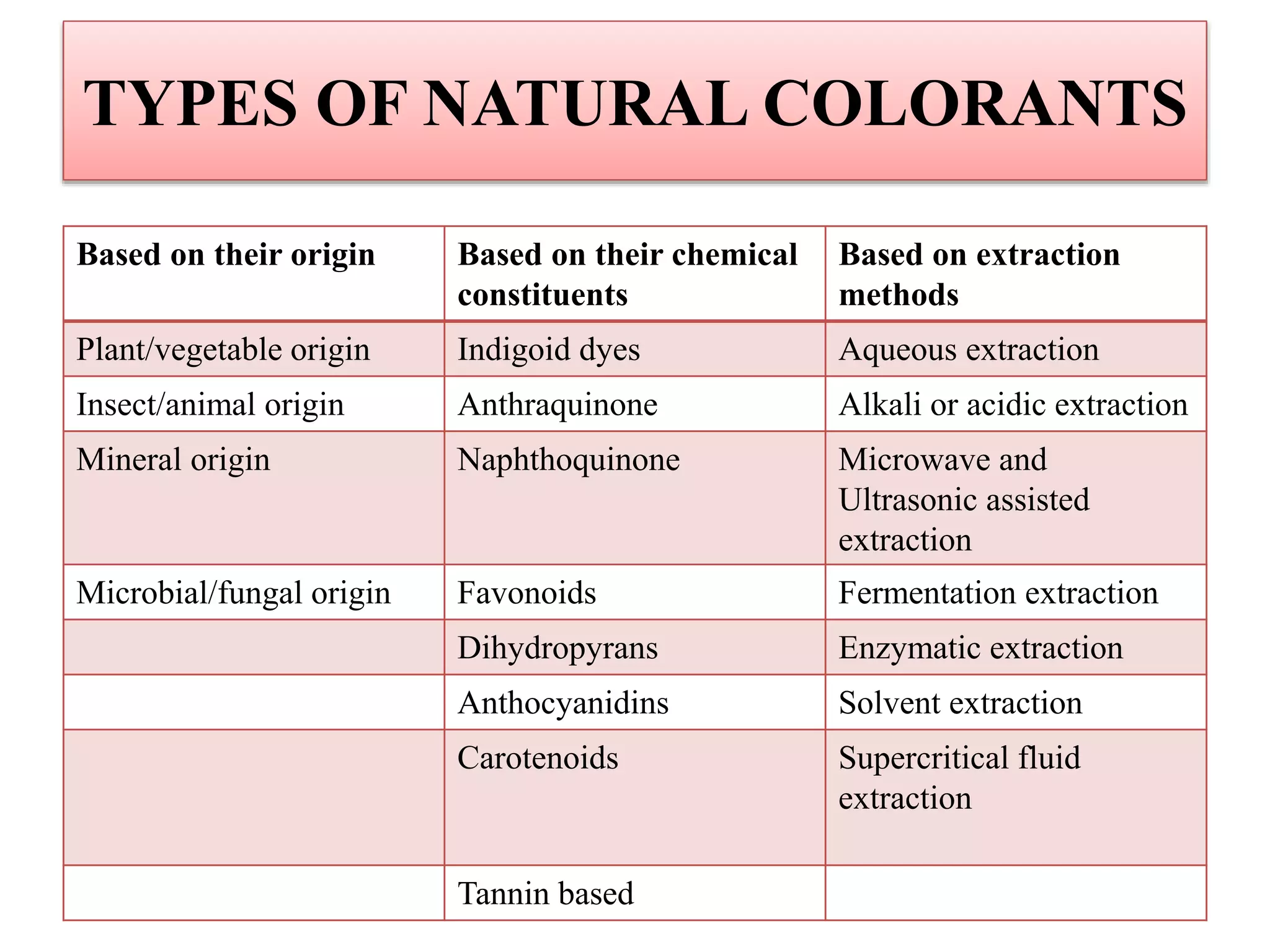
Based on their origin Based on their chemical
constituents
Based on extraction
methods
Plant/vegetable origin Indigoid dyes Aqueous extraction
Insect/animal origin Anthraquinone Alkali or acidic extraction
Mineral origin Naphthoquinone Microwave and
Ultrasonic assisted
extraction
Microbial/fungal origin Favonoids Fermentation extraction
Dihydropyrans Enzymatic extraction
Anthocyanidins Solvent extraction
Carotenoids Supercritical fluid
extraction
Tannin based
TYPES OF NATURAL COLORANTS
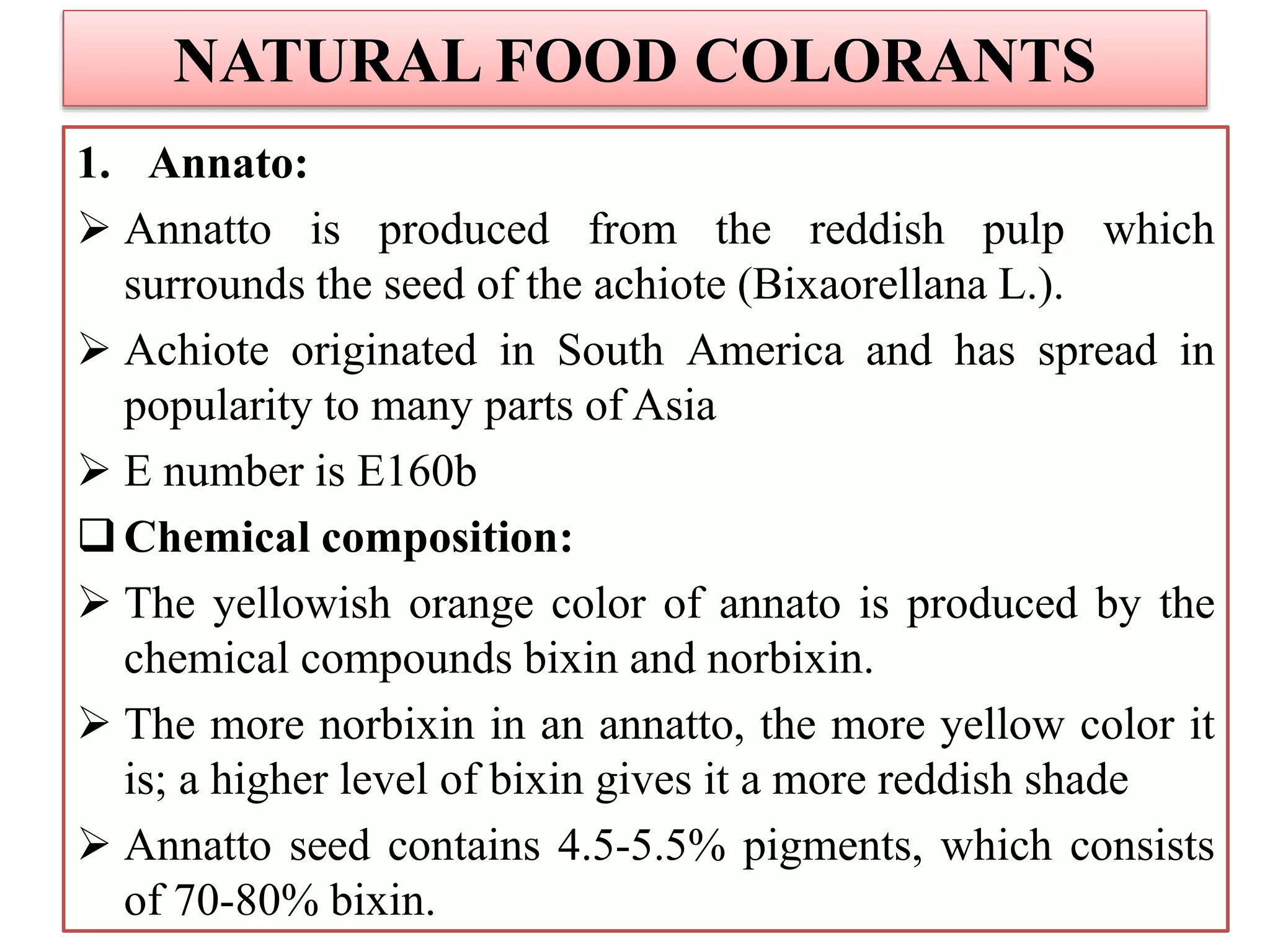
NATURAL FOOD COLORANTS
1. Annato:
 Annatto is produced from the reddish pulp which
surrounds the seed of the achiote (Bixaorellana L.).
 Achiote originated in South America and has spread in
popularity to many parts of Asia
 E number is E160b
Chemical composition:
 The yellowish orange color of annato is produced by the
chemical compounds bixin and norbixin.
 The more norbixin in an annatto, the more yellow color it
is; a higher level of bixin gives it a more reddish shade
 Annatto seed contains 4.5-5.5% pigments, which consists
of 70-80% bixin.
Fig. 1 Chemical structure of Bixin
 Molecular formula of bixin is C25H30O4
Applications:
 Food coloring – chees, dairy spreads, butter,
margarine, custards, cakes, snack foods, sausages
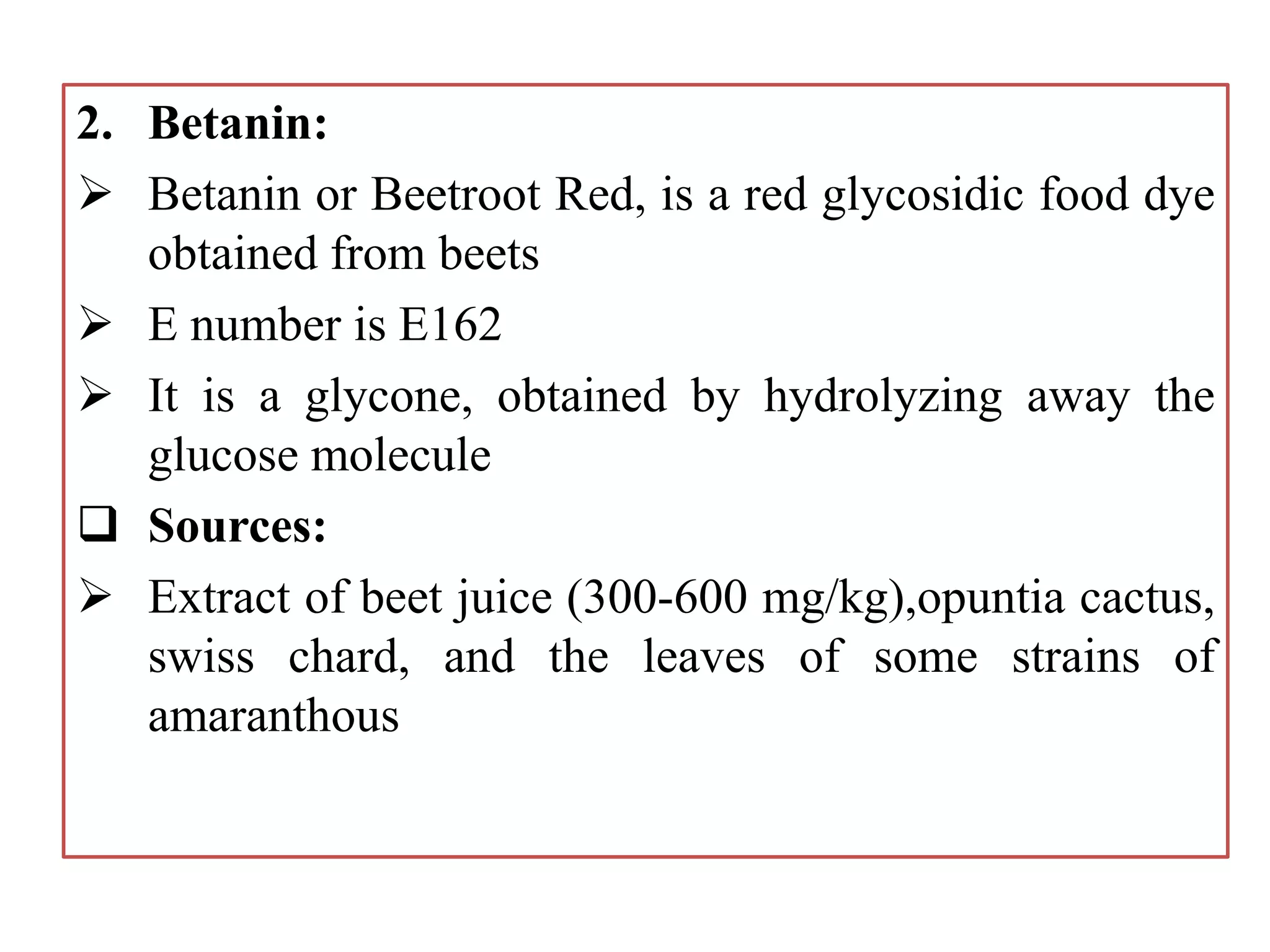
2. Betanin:
 Betanin or Beetroot Red, is a red glycosidic food dye
obtained from beets
 E number is E162
 It is a glycone, obtained by hydrolyzing away the
glucose molecule
 Sources:
 Extract of beet juice (300-600 mg/kg),opuntia cactus,
swiss chard, and the leaves of some strains of
amaranthous
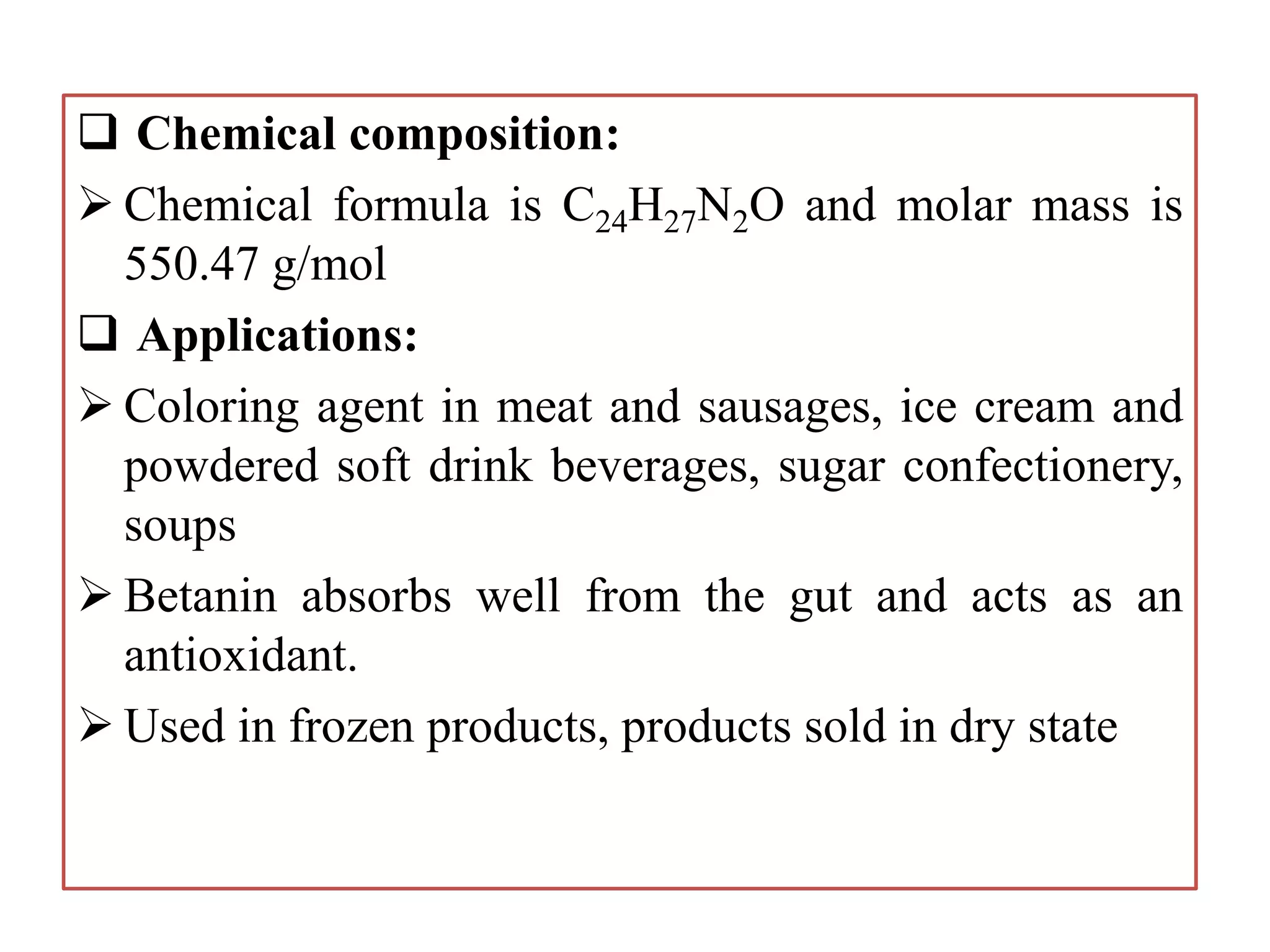
 Chemical composition:
 Chemical formula is C24H27N2O and molar mass is
550.47 g/mol
 Applications:
 Coloring agent in meat and sausages, ice cream and
powdered soft drink beverages, sugar confectionery,
soups
 Betanin absorbs well from the gut and acts as an
antioxidant.
 Used in frozen products, products sold in dry state
3. Caramel:
 It is a dark color, bitter-taste liquid
 E number is E150
 Prepared by controlled heat treatment of
carbohydrates
 Physical properties of caramel:
 It’s color is a colloid.
 In soft drinks retard the formation of certain types of
flock
 Prevent oxidation of the flavoring components in
bottled beverages
 It’s color has excellent microbiological stability
 Uses :
 Food colorings
 Stabilizer in beers
 Emulsifier
 Foaming properties
4. Carmine:
 It also called Crimson Lake
 E number is E120
 Obtained from the carmine acid
 Production:
 Carmine acid is extracted by boiling dried insects of
cochineal in water and then treating with alum,
cream of tartar and potassium hydrogen oxalate
 Coloring and animal matters present in the liquid are
precipitated
 In another method egg white, fish glue, or gelatin
are sometimes added before precipitation
 Quality is affected by the temperature and the degree
of illumination
Uses :
Food products – yoghurt, juice
Staining agent
Manufacture of artificial flowers, paints, crimson
ink, rouge, and other cosmetics
 Food dye - juices, ice cream, yogurt, and candy,
cosmetic products such as eye shadow and lipstick
5. Carotenoids:
 It is an orange photosynthetic pigment important for
photosynthesis
 Microbes such as Myxococcus, Streptomyces,
Mycobacterium, Agrobacterium and Sulfolobus
(responsible for orange color of carrot)
 Dietary source - Sweet potatoes, Carrots, Mangoes,
Apricots, Spinach,, Beet, Broccoli, Winter squash,
Pumpkin.
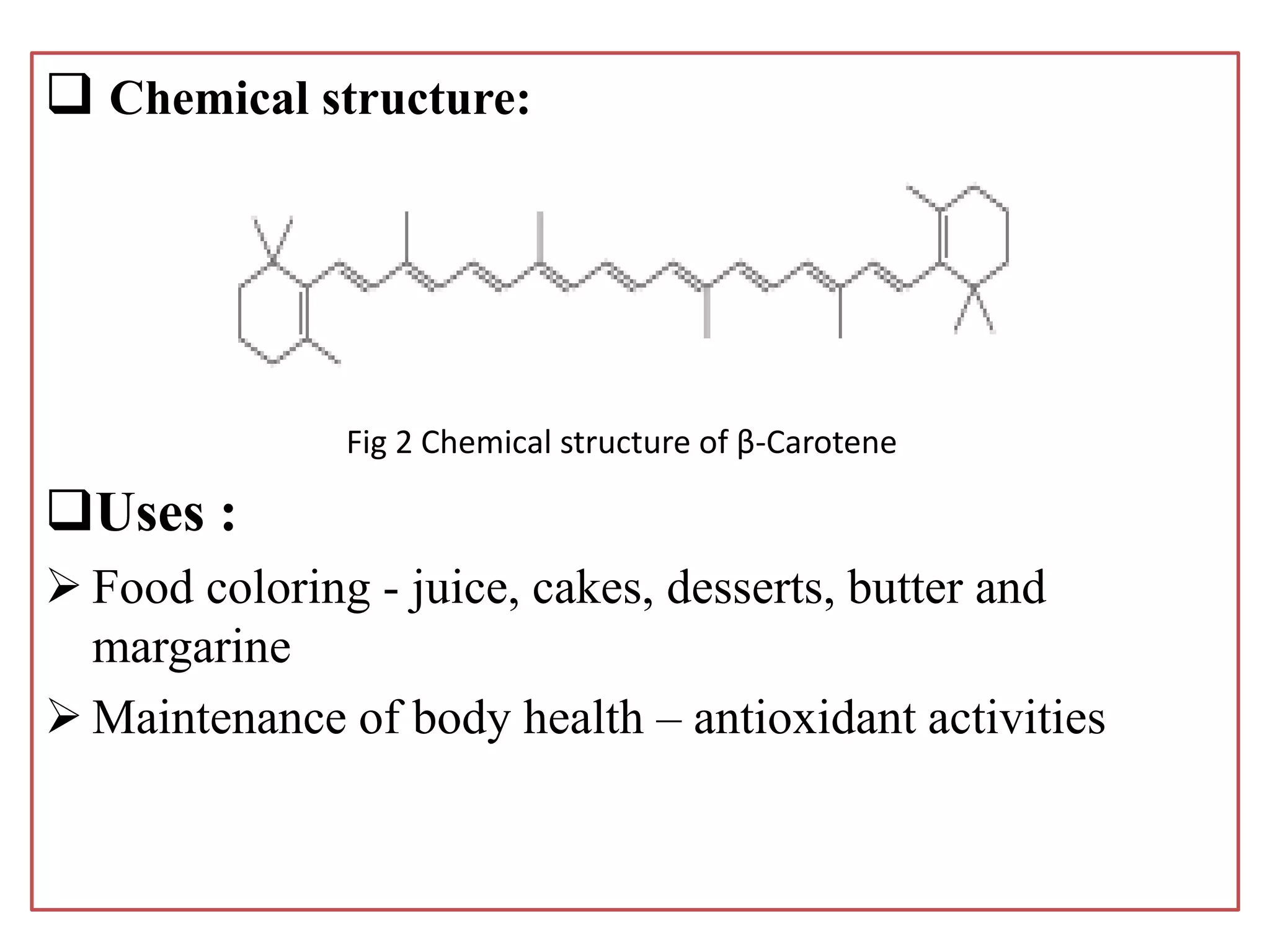
 It is found in plants in two primary forms i.e α-carotene
and β-carotene
 E number of β-Carotene is E160a
 β-Carotene is the more common form and found in
yellow, orange, and green leafy fruits and vegetables
 Capable of producing colors from pale yellow to dark
orange
 Chemical structure:
Fig 2 Chemical structure of β-Carotene
Uses :
 Food coloring - juice, cakes, desserts, butter and
margarine
 Maintenance of body health – antioxidant activities
6. Curcumin:
 It is a polyphenol derived from the Curcuma
longa plant
 It’s E number is E100
 It can exist in at least two tautomeric forms, keto
and enol
 It contains polyphenols are connected by two α,β-
unsaturated carbonyl groups
 Uses:
 Ingredient in dietary supplement
 Flavoring for foods
 Food additive
7. Anthocyanin:
 Anthocyanins are flavonoids commonly found in
nature
 Offer good light, heat and pH stability in most
applications and can apply with pasteurization and
UHT treatment
 Pigments are extracted from red cabbage,
strawberries, red rasp berries, blackberry, cherry
 These pigments are responsible for the red, purple,
and blue colors
 Uses:
 Food colorings - Beverages, fruit fillings, Snacks,
dairy products and confectionery
8. Chlorophyll:
 It is naturally occurring pigment present in all
photosynthetic plants, including algae and some
bacteria.
 Utilized by all higher plants for photosynthesis
 Chlorophyll is a cyclic tetrapyrrole with coordinated
magnesium in the center
 Two forms of chlorophyll i.e. chlorophyll a and
chlorophyll b
 Uses:
 The major portion of both oil-soluble and water-
soluble forms is used in dairy products, edible
oils, soups, chewing gum, sugar confections
,drinks
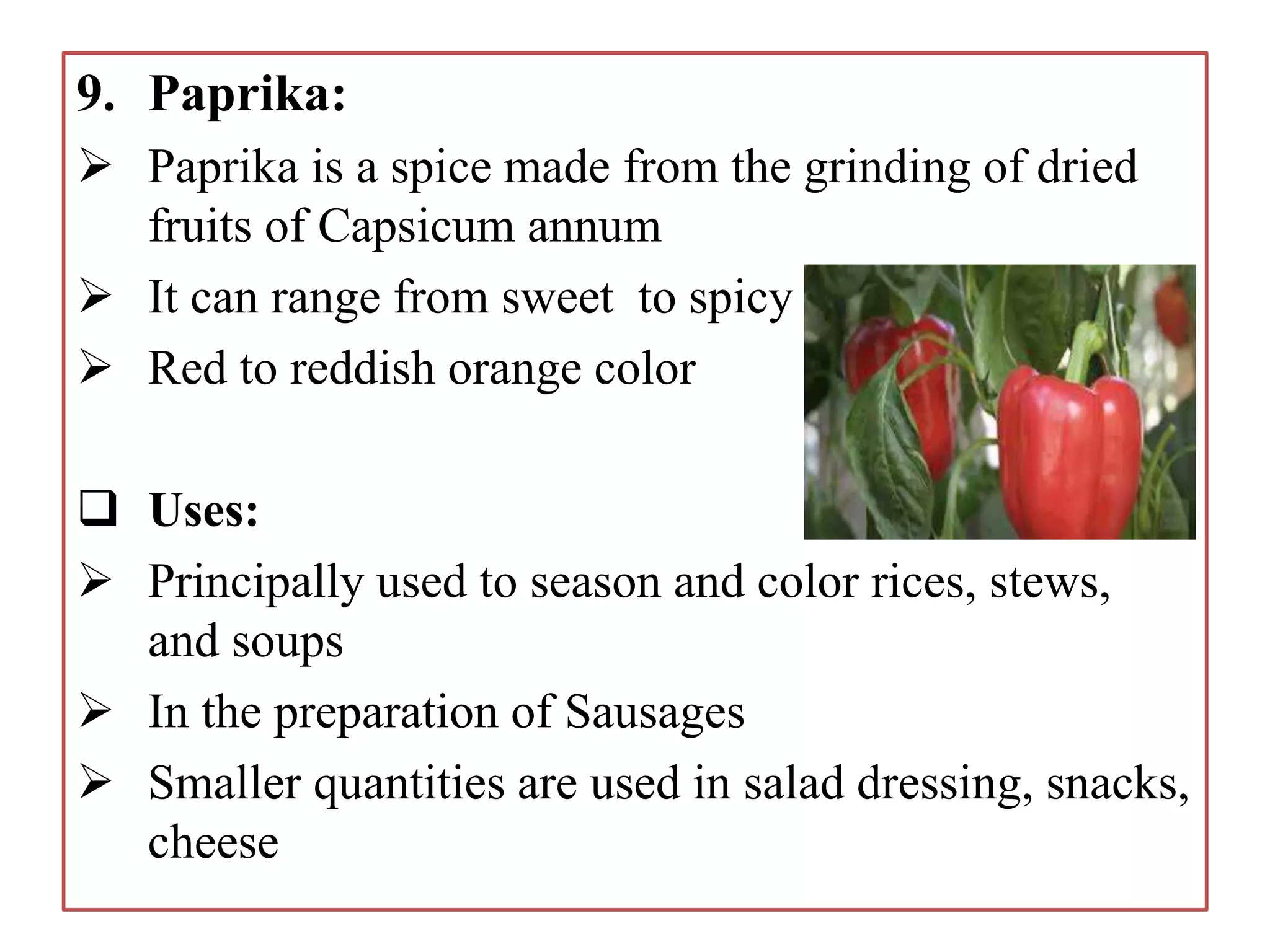
9. Paprika:
 Paprika is a spice made from the grinding of dried
fruits of Capsicum annum
 It can range from sweet to spicy
 Red to reddish orange color
 Uses:
 Principally used to season and color rices, stews,
and soups
 In the preparation of Sausages
 Smaller quantities are used in salad dressing, snacks,
cheese
10. Lycopene:
 It is a bright red carotene and carotenoid pigment
found in tomatoes, carrots, watermelons, onion,
and papayas
 It is a symmetrical tetraterpene assembled from
eight isoprene units
Summary
 The use of Natural colorants may show benefits over
synthetic colors
 Natural colors or dyes are less toxic, less polluting,
less health hazardous, non-carcinogenic and non-
poisonous and prevent chronic diseases such as
prostate cancer
 Most of them are water-soluble (anthocyanins), which
facilitates their incorporation into aqueous food
systems
 The use of these colorants in food products may also
face some problems due to their instability during
processing due to their sensitivity to temperature,
oxygen, light and pH
THANK YOU

Natural color pigments used in food processing

  • 1.
    SEMINAR ON NATURAL COLORPIGMENTS USED IN FOOD PROCESSING Presented By Mr. Chavan Darshan S. M. Tech (Food Technology) Department of Technology, Shivaji University, Kolhapur.
  • 2.
    INTRODUCTION Food color isany substance that is added to food to change or enhance its color. Types of colors: 1) Natural color 2) Synthetic color 3) Lakes and dyes Natural colors are pigments made by living organisms.  Most common plant pigments are carotenoids, chlorophylls, anthocyanins and betalains Used as additives, color intensifiers, antioxidants, etc Natural colors will be a boon for the preservation of biodiversity.
  • 3.
    FOOD LAWS ANDREGULATIONS  The Food and Drug Act of 1906 in the United States established a voluntary certification program regulating the addition of colors to our foods.  The Food, Drug & Cosmetic (FD&C) Act of 1938, regulating what color enhancers could be added to not only in foods, but also in drugs and cosmetics.  In India, FSSAI is monitoring the regulation of addition of coloring additive to food.  There are 26 colors permitted to be used in food and 28 to be used in cosmetics and pharmaceuticals.
  • 4.
    Based on theirorigin Based on their chemical constituents Based on extraction methods Plant/vegetable origin Indigoid dyes Aqueous extraction Insect/animal origin Anthraquinone Alkali or acidic extraction Mineral origin Naphthoquinone Microwave and Ultrasonic assisted extraction Microbial/fungal origin Favonoids Fermentation extraction Dihydropyrans Enzymatic extraction Anthocyanidins Solvent extraction Carotenoids Supercritical fluid extraction Tannin based TYPES OF NATURAL COLORANTS
  • 5.
    NATURAL FOOD COLORANTS 1.Annato:  Annatto is produced from the reddish pulp which surrounds the seed of the achiote (Bixaorellana L.).  Achiote originated in South America and has spread in popularity to many parts of Asia  E number is E160b Chemical composition:  The yellowish orange color of annato is produced by the chemical compounds bixin and norbixin.  The more norbixin in an annatto, the more yellow color it is; a higher level of bixin gives it a more reddish shade  Annatto seed contains 4.5-5.5% pigments, which consists of 70-80% bixin.
  • 6.
    Fig. 1 Chemicalstructure of Bixin  Molecular formula of bixin is C25H30O4 Applications:  Food coloring – chees, dairy spreads, butter, margarine, custards, cakes, snack foods, sausages
  • 7.
    2. Betanin:  Betaninor Beetroot Red, is a red glycosidic food dye obtained from beets  E number is E162  It is a glycone, obtained by hydrolyzing away the glucose molecule  Sources:  Extract of beet juice (300-600 mg/kg),opuntia cactus, swiss chard, and the leaves of some strains of amaranthous
  • 8.
     Chemical composition: Chemical formula is C24H27N2O and molar mass is 550.47 g/mol  Applications:  Coloring agent in meat and sausages, ice cream and powdered soft drink beverages, sugar confectionery, soups  Betanin absorbs well from the gut and acts as an antioxidant.  Used in frozen products, products sold in dry state
  • 9.
    3. Caramel:  Itis a dark color, bitter-taste liquid  E number is E150  Prepared by controlled heat treatment of carbohydrates  Physical properties of caramel:  It’s color is a colloid.  In soft drinks retard the formation of certain types of flock  Prevent oxidation of the flavoring components in bottled beverages  It’s color has excellent microbiological stability
  • 10.
     Uses : Food colorings  Stabilizer in beers  Emulsifier  Foaming properties
  • 11.
    4. Carmine:  Italso called Crimson Lake  E number is E120  Obtained from the carmine acid  Production:  Carmine acid is extracted by boiling dried insects of cochineal in water and then treating with alum, cream of tartar and potassium hydrogen oxalate  Coloring and animal matters present in the liquid are precipitated  In another method egg white, fish glue, or gelatin are sometimes added before precipitation  Quality is affected by the temperature and the degree of illumination
  • 12.
    Uses : Food products– yoghurt, juice Staining agent Manufacture of artificial flowers, paints, crimson ink, rouge, and other cosmetics  Food dye - juices, ice cream, yogurt, and candy, cosmetic products such as eye shadow and lipstick
  • 13.
    5. Carotenoids:  Itis an orange photosynthetic pigment important for photosynthesis  Microbes such as Myxococcus, Streptomyces, Mycobacterium, Agrobacterium and Sulfolobus (responsible for orange color of carrot)  Dietary source - Sweet potatoes, Carrots, Mangoes, Apricots, Spinach,, Beet, Broccoli, Winter squash, Pumpkin.  It is found in plants in two primary forms i.e α-carotene and β-carotene  E number of β-Carotene is E160a  β-Carotene is the more common form and found in yellow, orange, and green leafy fruits and vegetables  Capable of producing colors from pale yellow to dark orange
  • 14.
     Chemical structure: Fig2 Chemical structure of β-Carotene Uses :  Food coloring - juice, cakes, desserts, butter and margarine  Maintenance of body health – antioxidant activities
  • 15.
    6. Curcumin:  Itis a polyphenol derived from the Curcuma longa plant  It’s E number is E100  It can exist in at least two tautomeric forms, keto and enol  It contains polyphenols are connected by two α,β- unsaturated carbonyl groups  Uses:  Ingredient in dietary supplement  Flavoring for foods  Food additive
  • 16.
    7. Anthocyanin:  Anthocyaninsare flavonoids commonly found in nature  Offer good light, heat and pH stability in most applications and can apply with pasteurization and UHT treatment  Pigments are extracted from red cabbage, strawberries, red rasp berries, blackberry, cherry  These pigments are responsible for the red, purple, and blue colors  Uses:  Food colorings - Beverages, fruit fillings, Snacks, dairy products and confectionery
  • 17.
    8. Chlorophyll:  Itis naturally occurring pigment present in all photosynthetic plants, including algae and some bacteria.  Utilized by all higher plants for photosynthesis  Chlorophyll is a cyclic tetrapyrrole with coordinated magnesium in the center  Two forms of chlorophyll i.e. chlorophyll a and chlorophyll b  Uses:  The major portion of both oil-soluble and water- soluble forms is used in dairy products, edible oils, soups, chewing gum, sugar confections ,drinks
  • 18.
    9. Paprika:  Paprikais a spice made from the grinding of dried fruits of Capsicum annum  It can range from sweet to spicy  Red to reddish orange color  Uses:  Principally used to season and color rices, stews, and soups  In the preparation of Sausages  Smaller quantities are used in salad dressing, snacks, cheese
  • 19.
    10. Lycopene:  Itis a bright red carotene and carotenoid pigment found in tomatoes, carrots, watermelons, onion, and papayas  It is a symmetrical tetraterpene assembled from eight isoprene units
  • 20.
    Summary  The useof Natural colorants may show benefits over synthetic colors  Natural colors or dyes are less toxic, less polluting, less health hazardous, non-carcinogenic and non- poisonous and prevent chronic diseases such as prostate cancer  Most of them are water-soluble (anthocyanins), which facilitates their incorporation into aqueous food systems  The use of these colorants in food products may also face some problems due to their instability during processing due to their sensitivity to temperature, oxygen, light and pH
  • 21.