FOOD TECHNOLOGY 
Micro-organisms in Food Production
FOOD SAFETY IN INDUSTRY 
Microbial Risk Assessment 
Why do manufacturers carry out regular microbiological tests on 
products? 
 They have a legal responsibility to their consumers to ensure 
foods are fit for human consumption and of a high standard. 
 Consumers will remain loyal if the company has a good 
reputation. 
 In order to regulate their practices, microbiological testing is built 
into the manufacturing process as part of the Quality Assurance 
programme. 
 This testing enables the manufacturer to sample each batch of 
product to check for any contamination and identify it’s source. 
 If a batch proves to produce too many undesirable bacteria, 
producing dangerous levels of toxins, the batch can be removed 
from the shelves until the contamination source can be identified.
FOOD SAFETY IN INDUSTRY CONT.. 
How is Microbial Testing carried out? 
 A sample is taken from a batch of product. 
 The sample is made into a liquid solution using a stomacher 
which mirrors the action of the stomach by pulverising food. 
 This liquid is then smeared onto agar jelly and left to incubate 
for several days. 
 The dishes are then placed under a strong microscope and 
colonies of micro-organisms are identified and counted. The 
counting is done using a clicker pen and a grid (may be 
computers now).
FOOD SAFETY IN INDUSTRY CONT.. 
How are the results of microbiological testing used? 
 If large amounts of pathogens are identified, the products may 
be deemed unsafe for human consumption and removed from 
circulation. 
 Use by and Best before dates are calculated by micro-biologists 
who plot the rate of bacteria growth in certain 
conditions and mathematically predict the point at which a 
product becomes unfit for human consumption. They will 
always be cautious in their estimation.
THE USE OF MICROORGANISMS IN FOOD 
MANUFACTURE: YOGURT 
 Yogurt is milk, often concentrated or with added 
milk powder, which has developed a characteristic 
acidity. 
 The flavour of yogurt is made by 2 microorganisms, 
-Lactobacillus 
- Streptococcus 
 These two microorganisms must be in equal 
amounts and one must not out grow the other 
(bitter/ too acid product made)
HOW IS YOGURT MADE? 
 Ingredients in yoghurt: 
Milk, bacteria, fruit flavours, stabilizers and thickeners 
 Yogurt is homogenised then pasteurised at 90°C for 
30 minutes or by HTST (high temperature, short 
time) method to kill microorganisms. 
 It s then cooled to 44°C then inoculated with the 
starter culture. 
To make set yogurt – the mix is incubated at 44°C for 
1 ½ hours, then poured into containers which are 
warm until the yogurt has coagulated. It is then 
cooled to 5°C- 8°C until consumed within 14 days.
HOW IS YOGURT MADE? CONT.. 
To make stirred yogurt – the incubation is at a slightly 
lower temperature. The yogurt becomes thicker but 
not coagulated, it is then continuously stirred to 
prevent a curd from forming. Fruit and syrup are 
metered into containers followed by the yogurt mix, 
it is then cooled and stored. 
New developments: 
 Frozen yogurt, long life yogurt 
 Bio yogurt - a health advantage as there are more 
living cultures. The microorganism Bifidobacterium 
bifidium helps the stomach problems.
HOW MICROORGANISMS ARE USED FOR 
CHEESE 
 Cheddar 
Pasteurised milk is placed in a large stainless Vat (tub). 
Lactic acid forming bacteria (Lactococcus cremoris and Lactococcus 
lactis) is added together with colouring. 
Milk held slightly above room temperature (25°C) and lactic acid is 
produced to about 0.17% - 0.2%. 
Rennet (enzyme) is added to coagulate protein at approximately 20 
minutes. 
The temperature of Vat is now about 40°C to make curd contract and 
expel the liquid which is drained. 
The curd is cut into slabs (30cm x 60cm) 
‘Cheddering’ involves piling up slabs and turning them every 15 
minutes for a firm temperature 
The slabs are chopped into pieces again, allowing extra liquid to be 
removed. 
Salt is added and the cheddar is stored at 10°C for 3 months to ripen 
or cure.
HOW MICROORGANISMS ARE USED FOR 
CHEESE CONT.. 
 Blue Cheese 
It is not pressed but gently packed into moulds so that 
penicillium blue mould can grow through the 
cheese lumps. 
The mould produces proteolytic enzymes and often 
ammonia is released which is a characteristic of the 
flavour of some of these cheeses.
HOW MICROORGANISMS ARE USED FOR 
CHEESE CONT.. 
 Camembert and Brie 
It is a soft cheese. 
Penicillium camembertii (mould) which produces 
white growth allows the mould to grow. 
Enzymes from mould act on the curd and produces 
soft and creamy texture of ripened cheese. 
Shelf life is short.
QUORN 
 Mycoprotein is the ingredient common to all 
QuornTM products. 
 It is a healthy meat-free source of protein and is 
also a good source of dietary fibre. 
 Mycoprotein is low in fat and saturate and contains 
no cholesterol and no trans fats at all.
MYCOPROTEIN 
Fusarium Venenatum: 
 The principle ingredient of Mycoprotein is an 
ascomycota, one of the largest groups within the 
fungi family, which also includes truffles and marels. 
 It is one of a genus of filamentous fungi, meaning it 
is comprised of a web of finely spun strands 
(hyphae). 
Texture of Mycoprotein: 
 Products made with Mycoprotein have a meat-like 
texture because the harvested strands (hyphae) 
have a similar structure to animal muscle cells (i.e 
they are filamentous with a high length/diameter 
ratio).
HOW MYCOPROTEIN IS MADE 
 Made in 40 metre high fermenters which run 
continuously for 5 weeks at a time. 
 The fermenter is sterilised and filled with a water 
and glucose solution. 
 A batch of fusarium venenatum is introduced. 
 Once the organism starts to grow a continuous feed 
of nutrients, including potassium, magnesium and 
phosphate as well as trace elements, are added to 
the solution. 
 The pH balance, temperature, nutrient 
concentration and oxygen are all constantly 
adjusted in order to achieve the optimum growth 
rate.
HOW MYCOPROTEIN IS MADE CONT.. 
 The organism and nutrients combine to form 
Mycoprotein solids and these are removed 
continuously from the fermenter after an average 
residence time of 5 to 6 hours. 
 Once removed, the Mycoprotein is heated to 65°C 
to breakdown the nucleic acid. 
 Water is then removed in centrifuges, leaving the 
Mycoprotein looking rather like pastry dough. 
 The Mycoprotein is then mixed with a little free 
range egg and seasoning to help bind the mix. 
 It is then steam cooked for about 30 minutes and 
then chilled, before being chopped into pieces or 
mince.
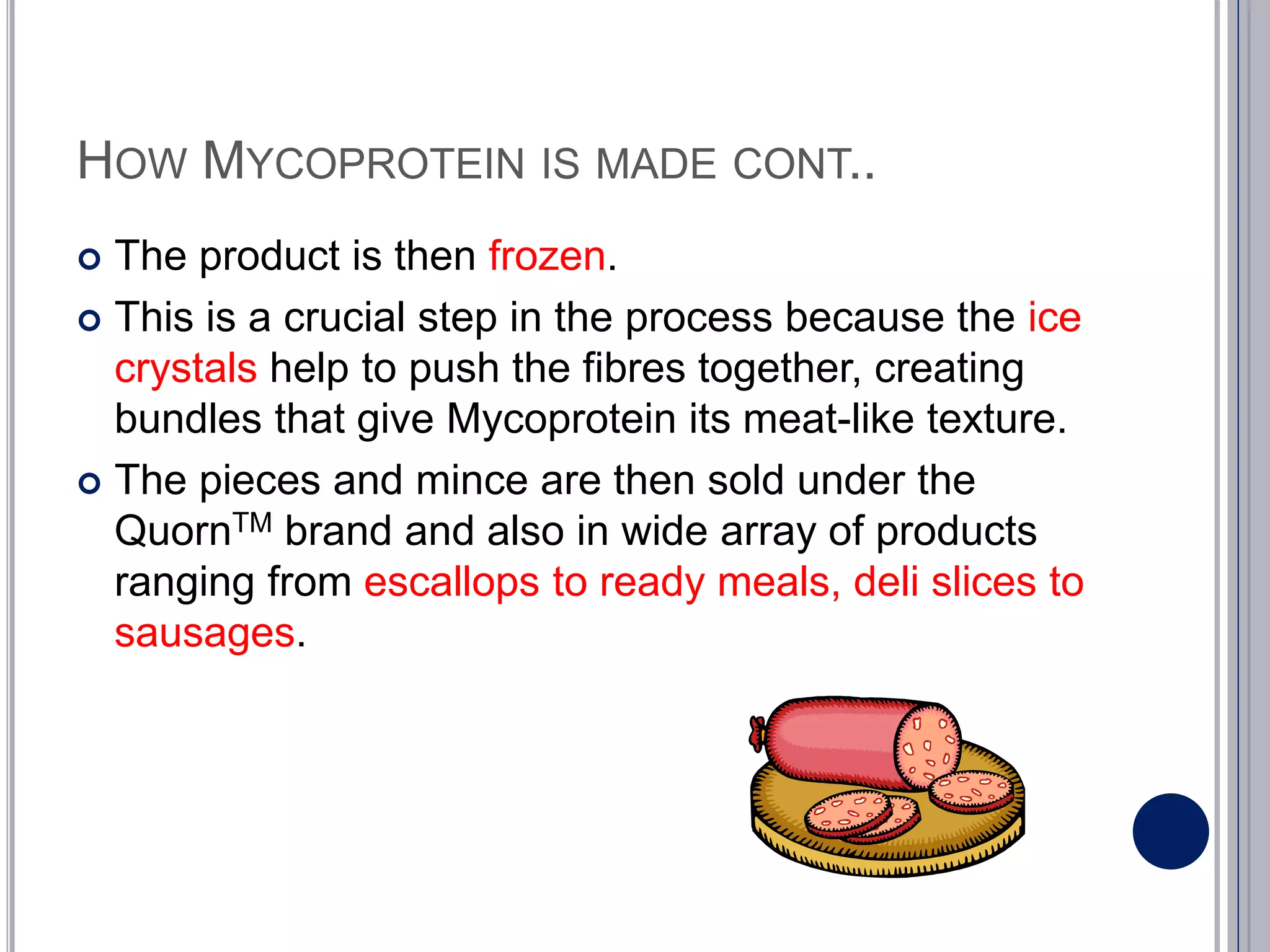
HOW MYCOPROTEIN IS MADE CONT.. 
 The product is then frozen. 
 This is a crucial step in the process because the ice 
crystals help to push the fibres together, creating 
bundles that give Mycoprotein its meat-like texture. 
 The pieces and mince are then sold under the 
QuornTM brand and also in wide array of products 
ranging from escallops to ready meals, deli slices to 
sausages.
FOOD POISONING 
The increased use of microwaves: 
 Food cooked in a microwave doesn’t always heat 
up as evenly as it should. 
 Because of this, cold spots can remain in the food. 
If you happen to be cooking a piece of frozen 
chicken infected with the Salmonella bacteria, the 
bacteria may not be killed in the cold spots which 
can result in a bad case of food poisoning when the 
food is eaten.
FOOD POISONING CONT.. 
The increase in the market share of cook chill 
foods: 
 These products require a short cooking time and 
often can be cooked from frozen. If they are not 
heated until piping hot right through then they may 
cause food poisoning. 
The increase in eating out: 
 More people are eating out either in take aways or 
restaurants. Although the council has responsibility 
for the hygiene of these establishments there may 
be times when the hygiene is not as it should be. 
Often individuals will order a take away and reheat 
it at some point.
FOOD POISONING CONT.. 
How it is caused: 
 Lack of cooking knowledge at home 
 More ready meals 
 More take aways 
 Lack of trained catering staff 
 More eating out 
 More foreign food transported from around the 
world 
 Factory farming
LOOK AT THE BACTERIA SLIDE FOR MORE 
INFO ON: 
 Salmonella 
 Listeria Monocytogenes 
 Campylobactor 
 Staphylococcus Aureus 
 Escherichia Coli (E Coli) 
 Clostridium Perfingens 
 Clostridium Botulinum 
 Bacillus Cereus

Food Technology Micro-organisms in Food Production

  • 1.
  • 2.
    FOOD SAFETY ININDUSTRY Microbial Risk Assessment Why do manufacturers carry out regular microbiological tests on products?  They have a legal responsibility to their consumers to ensure foods are fit for human consumption and of a high standard.  Consumers will remain loyal if the company has a good reputation.  In order to regulate their practices, microbiological testing is built into the manufacturing process as part of the Quality Assurance programme.  This testing enables the manufacturer to sample each batch of product to check for any contamination and identify it’s source.  If a batch proves to produce too many undesirable bacteria, producing dangerous levels of toxins, the batch can be removed from the shelves until the contamination source can be identified.
  • 3.
    FOOD SAFETY ININDUSTRY CONT.. How is Microbial Testing carried out?  A sample is taken from a batch of product.  The sample is made into a liquid solution using a stomacher which mirrors the action of the stomach by pulverising food.  This liquid is then smeared onto agar jelly and left to incubate for several days.  The dishes are then placed under a strong microscope and colonies of micro-organisms are identified and counted. The counting is done using a clicker pen and a grid (may be computers now).
  • 4.
    FOOD SAFETY ININDUSTRY CONT.. How are the results of microbiological testing used?  If large amounts of pathogens are identified, the products may be deemed unsafe for human consumption and removed from circulation.  Use by and Best before dates are calculated by micro-biologists who plot the rate of bacteria growth in certain conditions and mathematically predict the point at which a product becomes unfit for human consumption. They will always be cautious in their estimation.
  • 5.
    THE USE OFMICROORGANISMS IN FOOD MANUFACTURE: YOGURT  Yogurt is milk, often concentrated or with added milk powder, which has developed a characteristic acidity.  The flavour of yogurt is made by 2 microorganisms, -Lactobacillus - Streptococcus  These two microorganisms must be in equal amounts and one must not out grow the other (bitter/ too acid product made)
  • 6.
    HOW IS YOGURTMADE?  Ingredients in yoghurt: Milk, bacteria, fruit flavours, stabilizers and thickeners  Yogurt is homogenised then pasteurised at 90°C for 30 minutes or by HTST (high temperature, short time) method to kill microorganisms.  It s then cooled to 44°C then inoculated with the starter culture. To make set yogurt – the mix is incubated at 44°C for 1 ½ hours, then poured into containers which are warm until the yogurt has coagulated. It is then cooled to 5°C- 8°C until consumed within 14 days.
  • 7.
    HOW IS YOGURTMADE? CONT.. To make stirred yogurt – the incubation is at a slightly lower temperature. The yogurt becomes thicker but not coagulated, it is then continuously stirred to prevent a curd from forming. Fruit and syrup are metered into containers followed by the yogurt mix, it is then cooled and stored. New developments:  Frozen yogurt, long life yogurt  Bio yogurt - a health advantage as there are more living cultures. The microorganism Bifidobacterium bifidium helps the stomach problems.
  • 8.
    HOW MICROORGANISMS AREUSED FOR CHEESE  Cheddar Pasteurised milk is placed in a large stainless Vat (tub). Lactic acid forming bacteria (Lactococcus cremoris and Lactococcus lactis) is added together with colouring. Milk held slightly above room temperature (25°C) and lactic acid is produced to about 0.17% - 0.2%. Rennet (enzyme) is added to coagulate protein at approximately 20 minutes. The temperature of Vat is now about 40°C to make curd contract and expel the liquid which is drained. The curd is cut into slabs (30cm x 60cm) ‘Cheddering’ involves piling up slabs and turning them every 15 minutes for a firm temperature The slabs are chopped into pieces again, allowing extra liquid to be removed. Salt is added and the cheddar is stored at 10°C for 3 months to ripen or cure.
  • 9.
    HOW MICROORGANISMS AREUSED FOR CHEESE CONT..  Blue Cheese It is not pressed but gently packed into moulds so that penicillium blue mould can grow through the cheese lumps. The mould produces proteolytic enzymes and often ammonia is released which is a characteristic of the flavour of some of these cheeses.
  • 10.
    HOW MICROORGANISMS AREUSED FOR CHEESE CONT..  Camembert and Brie It is a soft cheese. Penicillium camembertii (mould) which produces white growth allows the mould to grow. Enzymes from mould act on the curd and produces soft and creamy texture of ripened cheese. Shelf life is short.
  • 11.
    QUORN  Mycoproteinis the ingredient common to all QuornTM products.  It is a healthy meat-free source of protein and is also a good source of dietary fibre.  Mycoprotein is low in fat and saturate and contains no cholesterol and no trans fats at all.
  • 12.
    MYCOPROTEIN Fusarium Venenatum:  The principle ingredient of Mycoprotein is an ascomycota, one of the largest groups within the fungi family, which also includes truffles and marels.  It is one of a genus of filamentous fungi, meaning it is comprised of a web of finely spun strands (hyphae). Texture of Mycoprotein:  Products made with Mycoprotein have a meat-like texture because the harvested strands (hyphae) have a similar structure to animal muscle cells (i.e they are filamentous with a high length/diameter ratio).
  • 13.
    HOW MYCOPROTEIN ISMADE  Made in 40 metre high fermenters which run continuously for 5 weeks at a time.  The fermenter is sterilised and filled with a water and glucose solution.  A batch of fusarium venenatum is introduced.  Once the organism starts to grow a continuous feed of nutrients, including potassium, magnesium and phosphate as well as trace elements, are added to the solution.  The pH balance, temperature, nutrient concentration and oxygen are all constantly adjusted in order to achieve the optimum growth rate.
  • 14.
    HOW MYCOPROTEIN ISMADE CONT..  The organism and nutrients combine to form Mycoprotein solids and these are removed continuously from the fermenter after an average residence time of 5 to 6 hours.  Once removed, the Mycoprotein is heated to 65°C to breakdown the nucleic acid.  Water is then removed in centrifuges, leaving the Mycoprotein looking rather like pastry dough.  The Mycoprotein is then mixed with a little free range egg and seasoning to help bind the mix.  It is then steam cooked for about 30 minutes and then chilled, before being chopped into pieces or mince.
  • 15.
    HOW MYCOPROTEIN ISMADE CONT..  The product is then frozen.  This is a crucial step in the process because the ice crystals help to push the fibres together, creating bundles that give Mycoprotein its meat-like texture.  The pieces and mince are then sold under the QuornTM brand and also in wide array of products ranging from escallops to ready meals, deli slices to sausages.
  • 16.
    FOOD POISONING Theincreased use of microwaves:  Food cooked in a microwave doesn’t always heat up as evenly as it should.  Because of this, cold spots can remain in the food. If you happen to be cooking a piece of frozen chicken infected with the Salmonella bacteria, the bacteria may not be killed in the cold spots which can result in a bad case of food poisoning when the food is eaten.
  • 17.
    FOOD POISONING CONT.. The increase in the market share of cook chill foods:  These products require a short cooking time and often can be cooked from frozen. If they are not heated until piping hot right through then they may cause food poisoning. The increase in eating out:  More people are eating out either in take aways or restaurants. Although the council has responsibility for the hygiene of these establishments there may be times when the hygiene is not as it should be. Often individuals will order a take away and reheat it at some point.
  • 18.
    FOOD POISONING CONT.. How it is caused:  Lack of cooking knowledge at home  More ready meals  More take aways  Lack of trained catering staff  More eating out  More foreign food transported from around the world  Factory farming
  • 19.
    LOOK AT THEBACTERIA SLIDE FOR MORE INFO ON:  Salmonella  Listeria Monocytogenes  Campylobactor  Staphylococcus Aureus  Escherichia Coli (E Coli)  Clostridium Perfingens  Clostridium Botulinum  Bacillus Cereus