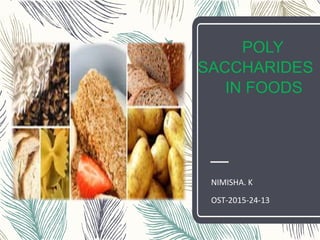

POLY
SACCHARIDES
IN FOODS
NIMISHA. K
OST-2015-24-13
POLYSACCHARIDES
– Polysaccharides consist of repeating units of
monosaccharides or their derivatives held
together by glycosidic linkages
– They are of two types;
1. Homopolysaccharides
2. Heteropolysaccharides
NATURALPOLISACHARIDESOF PLANT ORIGIN
– The commercial polysaccharide hydrocolloids are derived from gums,
mucilages, exudates, and extracts of plant origin
Types of polysaccharides Example
Seaweed extracts Agar-agar, carrageenan, Irish moss,
alginate, laminarin, furcellaran
Lichen extracts Icelandic moss
Plant extract Pectin, arabinogalactan (larch gum)
Plant exudates Gum arabic, karaya gum, gum ghatti
(Indian gum)
Seed mucilages and gums Locust bean gum, guar gum, tamarind
mucilage
Plant starches Cereals, potatoes, artichokes
Other natural hydrocolloids Salep mannan
FUNCTIONAL PROPERTIES OF
POLYSACCHARIDES
– Foam formation
– Foam stability
– Emulsifiability
– Water solubility for ingredients
– Water binding capacity
– Gelling activity
– Precipitation prevention
– Protein stabilization
STARCH
– Starch is found in most parts of a plant as a reserve store
of carbohydrate
– It is usually present in the seed and root in large amounts
– Cereals contain approximately 70% ,pulses 60% and
potatoes 22%
– Starch consists of long chains of glucose units present in
two forms :
1. Amylose
2. Amylopectin
Amylose
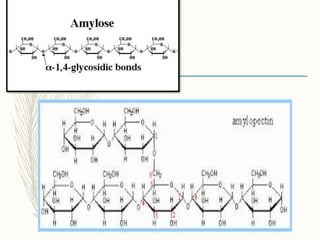
– It is a large molecule made up of 200 or more glucose
units inked by 1,4 glucosidic linkages
– They are present as linear chains which can bond to each
other by hydrogen bonds and form a gel
– Amylose does not have a sweet taste, slightly soluble, has
good thickening ability and represents 20-30% of the
total starch in most grains
Amylopectin
– Like amylose is made up of glucose units only
– 2 types of linkages are seen in amylopecin – 1,4 alpha
glucosidic linkages as in amylose and occational 1,6
alpha glucosidic linkages, resulting in a very large
branched polysaccharide
– The molecules of amylopectin is very large and because
of its branched structure is sparingly soluble , not sweet
and is the predominant form in the starch granule with
low gelling ability
Types of food starches 1.unmodified
starches
– Starches from different plant sources differ in the size,
shape, gelatinization temperature ,gel forming ability and
texture
– In the food industry, the behavior of different starches as
thickening agents and gelling or setting agents in an
important consideration while selecting the starch
– Starches can be extracted from grains, roots, tubers and
pith of trees in a comparative pure form to be used in
commercial food products
– Eg : corn flour ,rice flour ,wheat flour
2.Modified starches
Pre gelatinized starch
– these starches have been cooked till they are gelatinized
and then they are roller dried after the starch granules
are swollen. when water is added to the dehydrated
starch, It swells to a desired thickness without heating
Eg: instant pudding mixes ,baby cereals
Acid modified or thin boiled starch
– starch is chemically modified by treating it with very
dilute hydrochloric acid or nitric acid at temperatures
below gelatinization
– Starch is hydrolyzed and gets fragmented
– Its solubility increases and thickening ability decreases
Oxidised starches
– these are chemically modified thin boiling starches which
have been treated with an alkali such as sodium hypo-
chlorite
– The starch granule is mildly oxidized and forms a soft gel
Cross linked starches
– are formed when OH groups on 2 different molecule in
the same granule are substituted by alkalis such as acetic
anhydride or succinic anhydride
– The greater the amount of cross-linking the lesser the
tendency to retrograde
– Gels formed using cross-linked starches show minimal
retro gradation during storage
Starch phosphates
– starch is chemically esterifies with sodium
tripolyphosphate
– The starch phosphates formed improve the texture of
starch pastes and increases its stability
– These pastes have excellent clarity and reduced synersis
or weeping
– They have high freeze thaw stability
– Eg: CMC
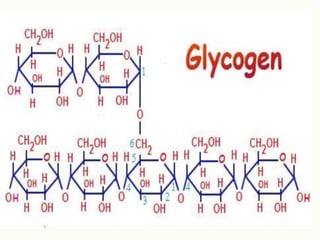
GLYCOGEN
– Has a similar structure to amylopectin
– Only difference is that glycogen is more branched that is
every 10 glycosal residues
– Due to this high branched structure, glucose is released
rapidly from glycogen stores
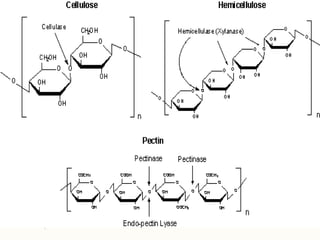
Cellulose and Hemicellulose
– Cellulose is a major constituent of plant cell walls,
consists of long linear chains of glucose with beta(1-
4)linkages
– Hemicellulose is any of several heteropolymers such as
arabinoxylans, present along with cellulose in almost all
plant cell walls. As percent content of hemicellulose
increase in animal feed, the voluntary feed intake
decreases
Pectic substances
– Any of a group of complex colloidal carbohydrate
derivatives of plant origin that contain a large proportion
of units derived from glactouronic acid and include
protopectins, pectins, pectinic acid. Pectic substances
contribute to a plant tissues turgor. Pectic substances
that are extracted from plants commercially or in the
laboratory are called pectins
– Amidated pectin is a modified form of pectin. Here some
of the galacturonic acid is converted with ammonia to
carboxylic acid
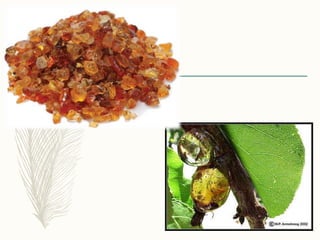
Plant gums
– Are adhesive substances that are carbohydrates in nature
and are usually produced as exudates from the bark of
trees or shrubs
– Some plant gums such as gum arabic are soluble in water
dissolving to give clear solution
– Eg : guar gum
Other polysaccharides
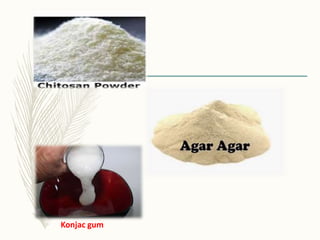
1. Galactomannans or gums : E g: beta-mannan, carob, guar
and taragum. A food additive derivative from beans and
seeds
2. Glucomannan or konjac gum : a food additive extracted
from konjac plant
3. Seaweed polysaccharides : Eg: agar-agar food additives
derived from marine algae
4. Chitin and Chitosan : dietary supplements , derived from
shells of crustaceans
5. Inulin : wheat, onions, chicory root, leeks; a food additive
Konjac gum
IN FOOD INDUSTRY
Polysaccharides are important class of compounds used in food industry
1. To stabilize emulsions and aerated systems (Stabilizers)
2. To thicken and gel aqueous phases (Thickeners)
3. To provide distinctive structural and textural attributes (Modifiers)
4. To provide distinctive sensory attributes (Mouth-feelers)
APPLICATIONS
1. Quality improvement of food stuffs
2. Development of substitutes
3. Improvement of certain products
4. Economy in using valuable raw material
Polysaccharides in foods- Nimisha Kaikkolante

Polysaccharides in foods- Nimisha Kaikkolante

  • 1.
  • 2.
    POLYSACCHARIDES – Polysaccharides consistof repeating units of monosaccharides or their derivatives held together by glycosidic linkages – They are of two types; 1. Homopolysaccharides 2. Heteropolysaccharides
  • 3.
    NATURALPOLISACHARIDESOF PLANT ORIGIN –The commercial polysaccharide hydrocolloids are derived from gums, mucilages, exudates, and extracts of plant origin Types of polysaccharides Example Seaweed extracts Agar-agar, carrageenan, Irish moss, alginate, laminarin, furcellaran Lichen extracts Icelandic moss Plant extract Pectin, arabinogalactan (larch gum) Plant exudates Gum arabic, karaya gum, gum ghatti (Indian gum) Seed mucilages and gums Locust bean gum, guar gum, tamarind mucilage Plant starches Cereals, potatoes, artichokes Other natural hydrocolloids Salep mannan
  • 4.
    FUNCTIONAL PROPERTIES OF POLYSACCHARIDES –Foam formation – Foam stability – Emulsifiability – Water solubility for ingredients – Water binding capacity – Gelling activity – Precipitation prevention – Protein stabilization
  • 5.
    STARCH – Starch isfound in most parts of a plant as a reserve store of carbohydrate – It is usually present in the seed and root in large amounts – Cereals contain approximately 70% ,pulses 60% and potatoes 22% – Starch consists of long chains of glucose units present in two forms : 1. Amylose 2. Amylopectin
  • 6.
    Amylose – It isa large molecule made up of 200 or more glucose units inked by 1,4 glucosidic linkages – They are present as linear chains which can bond to each other by hydrogen bonds and form a gel – Amylose does not have a sweet taste, slightly soluble, has good thickening ability and represents 20-30% of the total starch in most grains
  • 7.
    Amylopectin – Like amyloseis made up of glucose units only – 2 types of linkages are seen in amylopecin – 1,4 alpha glucosidic linkages as in amylose and occational 1,6 alpha glucosidic linkages, resulting in a very large branched polysaccharide – The molecules of amylopectin is very large and because of its branched structure is sparingly soluble , not sweet and is the predominant form in the starch granule with low gelling ability
  • 9.
    Types of foodstarches 1.unmodified starches – Starches from different plant sources differ in the size, shape, gelatinization temperature ,gel forming ability and texture – In the food industry, the behavior of different starches as thickening agents and gelling or setting agents in an important consideration while selecting the starch – Starches can be extracted from grains, roots, tubers and pith of trees in a comparative pure form to be used in commercial food products – Eg : corn flour ,rice flour ,wheat flour
  • 10.
    2.Modified starches Pre gelatinizedstarch – these starches have been cooked till they are gelatinized and then they are roller dried after the starch granules are swollen. when water is added to the dehydrated starch, It swells to a desired thickness without heating Eg: instant pudding mixes ,baby cereals
  • 11.
    Acid modified orthin boiled starch – starch is chemically modified by treating it with very dilute hydrochloric acid or nitric acid at temperatures below gelatinization – Starch is hydrolyzed and gets fragmented – Its solubility increases and thickening ability decreases
  • 12.
    Oxidised starches – theseare chemically modified thin boiling starches which have been treated with an alkali such as sodium hypo- chlorite – The starch granule is mildly oxidized and forms a soft gel
  • 13.
    Cross linked starches –are formed when OH groups on 2 different molecule in the same granule are substituted by alkalis such as acetic anhydride or succinic anhydride – The greater the amount of cross-linking the lesser the tendency to retrograde – Gels formed using cross-linked starches show minimal retro gradation during storage
  • 14.
    Starch phosphates – starchis chemically esterifies with sodium tripolyphosphate – The starch phosphates formed improve the texture of starch pastes and increases its stability – These pastes have excellent clarity and reduced synersis or weeping – They have high freeze thaw stability – Eg: CMC
  • 15.
    GLYCOGEN – Has asimilar structure to amylopectin – Only difference is that glycogen is more branched that is every 10 glycosal residues – Due to this high branched structure, glucose is released rapidly from glycogen stores
  • 17.
    Cellulose and Hemicellulose –Cellulose is a major constituent of plant cell walls, consists of long linear chains of glucose with beta(1- 4)linkages – Hemicellulose is any of several heteropolymers such as arabinoxylans, present along with cellulose in almost all plant cell walls. As percent content of hemicellulose increase in animal feed, the voluntary feed intake decreases
  • 18.
    Pectic substances – Anyof a group of complex colloidal carbohydrate derivatives of plant origin that contain a large proportion of units derived from glactouronic acid and include protopectins, pectins, pectinic acid. Pectic substances contribute to a plant tissues turgor. Pectic substances that are extracted from plants commercially or in the laboratory are called pectins – Amidated pectin is a modified form of pectin. Here some of the galacturonic acid is converted with ammonia to carboxylic acid
  • 20.
    Plant gums – Areadhesive substances that are carbohydrates in nature and are usually produced as exudates from the bark of trees or shrubs – Some plant gums such as gum arabic are soluble in water dissolving to give clear solution – Eg : guar gum
  • 22.
    Other polysaccharides 1. Galactomannansor gums : E g: beta-mannan, carob, guar and taragum. A food additive derivative from beans and seeds 2. Glucomannan or konjac gum : a food additive extracted from konjac plant 3. Seaweed polysaccharides : Eg: agar-agar food additives derived from marine algae 4. Chitin and Chitosan : dietary supplements , derived from shells of crustaceans 5. Inulin : wheat, onions, chicory root, leeks; a food additive
  • 23.
  • 24.
    IN FOOD INDUSTRY Polysaccharidesare important class of compounds used in food industry 1. To stabilize emulsions and aerated systems (Stabilizers) 2. To thicken and gel aqueous phases (Thickeners) 3. To provide distinctive structural and textural attributes (Modifiers) 4. To provide distinctive sensory attributes (Mouth-feelers)
  • 25.
    APPLICATIONS 1. Quality improvementof food stuffs 2. Development of substitutes 3. Improvement of certain products 4. Economy in using valuable raw material