SUBJECT:- ES –ALA
PRESENTATION ON
FOOD RESOURCES
INTRODUCTION OF
FOOD
RESOURCES &
SOURCES OF FOOD
INTRODUCTION
 Food is one of the basic requirements of human
being it is the most important material that our
body needs for its proper functioning and well
being at all stages of our life human diet is not
restricted to any special category of food.
 Man eats a variety of foods, of plant and animal
origin, as no single food provides us with all the
nutrients that we need.
SOURCES OF FOOD
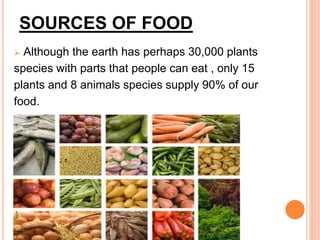
 Although the earth has perhaps 30,000 plants
species with parts that people can eat , only 15
plants and 8 animals species supply 90% of our
food.
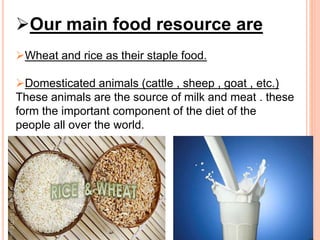
Our main food resource are
Wheat and rice as their staple food.
Domesticated animals (cattle , sheep , goat , etc.)
These animals are the source of milk and meat . these
form the important component of the diet of the
people all over the world.
Aquaculture (fish and sea food)
It is the production of food from aquatic habitants - marine
and fresh water . Fish and sea food contribute about 70
million metric tons of high quality proteins to the world’s diet .
Although aquaculture provides only small amount of the
world’s food at present, it is an important source of protein
for many contrives , especially in Asia and Europe.
DEFINITION :
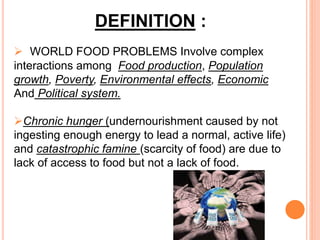
 WORLD FOOD PROBLEMS Involve complex
interactions among Food production, Population
growth, Poverty, Environmental effects, Economic
And Political system.
Chronic hunger (undernourishment caused by not
ingesting enough energy to lead a normal, active life)
and catastrophic famine (scarcity of food) are due to
lack of access to food but not a lack of food.
 Global food production has increased substantially
over past 2 decades.
 Producing food and other agricultural products by
conventional means uses more soil , water , plant ,
animal and energy resources ; Causing more pollution
and damage to environment.
 During last 50 years the world grain production has
increased 3 times but due to increasing population
growth rate in LESS DEVELOPED COUNTRIES (LDC)
has outstripped food production.
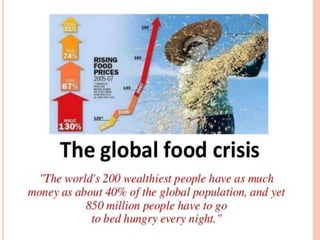
 Every year 40 million people die due to undernourish-
ment or malnutrition.
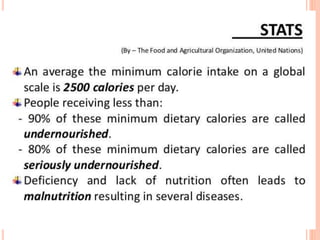
 People receiving less than 90% of the minimum dietary
calories (2500 cal./day) are called undernourished and if less
than 80% they are said undernourished.
 The lack of essential nutrients like proteins and minerals
leads to malnutrition resulting in several diseases.
 Thus every year our food problems is killing as many
people as were killed by the atomic bomb dropped on
Hiroshima during world war 2.
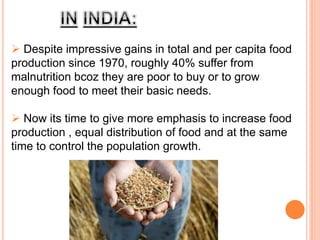
 Despite impressive gains in total and per capita food
production since 1970, roughly 40% suffer from
malnutrition bcoz they are poor to buy or to grow
enough food to meet their basic needs.
 Now its time to give more emphasis to increase food
production , equal distribution of food and at the same
time to control the population growth.
TWO KINDS OF FOOD
PROBLEMS :
 Malnutrition arises due to lack of minimum amount of
proteins , vitamins , lipids , carbohydrates and other
essential nutrients required for proper health and
growth.
 Malnutrition may occur in both rich and poor
countries .
 RICH COUNTRIES : OVER NUTRITION
 POOR COUNTRIES : UNDER NUTRITION
PROBLEMS DUE TO
MALNUTRITION :
1. ANEMIA : caused by inability to absorb iron
2. GOITER : caused by iodine deficiency leads to mental
retardation and deaf mustism.
3. MARAMUS : lack of protein and calories.
4. KWASHIARKAR : lack of protein in diet leads to neutral
development and learning disabilities.
5. PELLAGRA : deficiency of tryptophan and lysine
vitamins.
6. CHRONIC HUNGER : occurs when people have just
enough food to stay alive but not satisfactory lives.
2. UNDERNOURISHMENT :
 The problem of undernourishment occurs when the
body is not been given enough food or enough calories as
required to support its need.
 As a result , the body begins to breakdown its own
stored proteins and fats which reduces mental and
physical efficiency as well as affects adversely the body
immune system.
FACTORS TO
IMPROVE FOOD
PRODUCTION
FACTORS TO IMPROVE FOOD
PRODUCTIONS ARE AS FOLLOW:-
 Training farmers for new techniques of
agriculture, cultivation, & crop rotation.
 Construction of water storage reservoirs.
 Improvement in the irrigation system & canal
networking.
 Adopting water conservation & water harvesting
techniques.
 Adopting soil reclamation processes.
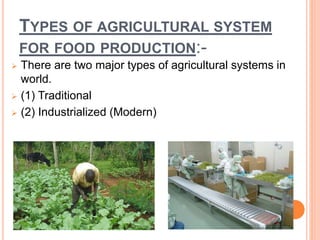
TYPES OF AGRICULTURAL SYSTEM
FOR FOOD PRODUCTION:-
 There are two major types of agricultural systems in
world.
 (1) Traditional
 (2) Industrialized (Modern)
TRADITIONAL AGRICULTURE
CONSISTS OF TWO MAIN TYPES :-
 (a) Traditonal subsistence : In which enough crops
or live stocks are produced for a family’s survival in
good years and there may be surplus to sell or to put
aside for hard times. Farmers use human labour and
draft animals.
 (b) Traditional intensive agriculture : In which
farmers increase their inputs of human and labours,
fertilizer and water to get a higher yield per area of
cultivated land to produce enough food to feed their
families and to sell for income.
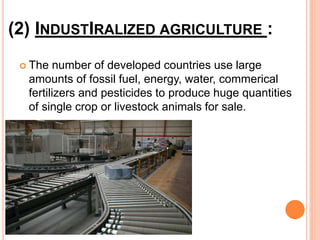
(2) INDUSTIRALIZED AGRICULTURE :
 The number of developed countries use large
amounts of fossil fuel, energy, water, commerical
fertilizers and pesticides to produce huge quantities
of single crop or livestock animals for sale.
ENVIROMENTAL
IMPACTS DUE TO
INCREASED FOOD
PRODUCTION :
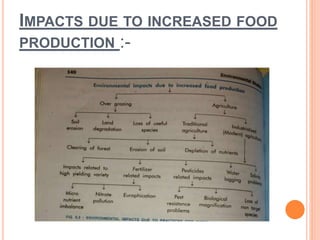
IMPACTS DUE TO INCREASED FOOD
PRODUCTION :-
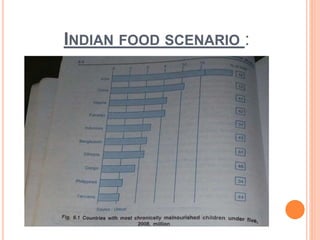
INDIAN FOOD SCENARIO :
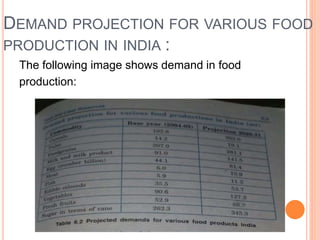
DEMAND PROJECTION FOR VARIOUS FOOD
PRODUCTION IN INDIA :
The following image shows demand in food
production:
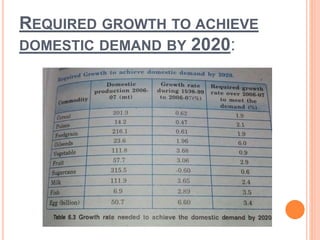
REQUIRED GROWTH TO ACHIEVE
DOMESTIC DEMAND BY 2020:
STEPS TO IMPROVE
FOOD PRODUCTION &
LIMITS OF
INCREASING FOOD
PRODUCTION
STEPS TO IMPROVE FOOD
PRODUCTION
 Available land acreage(વાવેતર વવસ્તાર) should be
properly and judiciously utilized.
 Soil fertility should be increased through wise use of
fertilizers(ખાતર) and organic manures.
 Mixed cropping should be practiced wherever
possible.
 Soil erosion(ધોવાણ) and loss of nutrients should be
prevented(અટકાવવા) by maintaining vegetation
cover throughout the year.
 High yield and disease resistant plant(ઊંચી ઉપજ અને રોગ
પ્રવતરોધક પ્લાન્ટ ) varieties should be introduce.
 Integrated and balance use of available water source
(surface and ground water) should be made.
 Weeds and pest should be efficiently controlled , integrated
pest control practices should be preferred over total reliance
on chemical pesticides.
 Combining use of traditional methods/equipments with
modern methods/equipments of agriculture.
 Crop rotation should be done.
LIMITS OF INCREASING FOOD
PRODUCTION
 There are ecological limits to how much food can be
produced , and there are growing signs that such limits
have been or soon will be reached in some parts of the
world.
 Even if agricultural technology and biotechnology enhance
productivity , the environmental impacts associated with
food production impose limits on the amount of food the
earth can produce.
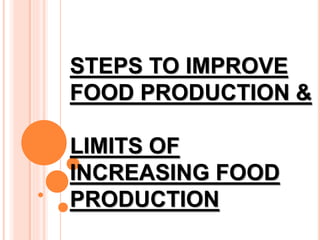
 Continuing to increase inputs of fertilizer , water and
pesticides eventually produces no additional increase in
the crop yields as the J-shaped curve of crop productivity
slows down , reaches its limits , levels off and becomes as
S-shaped curve.
 Grain yields per hectare are still increasing in almost every
country , but at a much slower rate.
 Worldwide , such yields dropped from an annual 2.3%
increase between 1950 and 1984 to 1% annual increase
between 1984 and 1993.
 Since 1985 yields for the major grains in the three
countries with the highest yields per hectare – USA (corn) ,
Great Britain (wheat) , Japan (rice) , have leveled off.
 Future increases in food yields per hectare on existing
cropland will result from improved strains of plants and
from expansion of green revolution technology to new parts
of the world.
PRESENTED BY :-
 VIVEK SINGH (21)
 BHAGYESH PATEL (22)
 UTKARSH GANDHI (23)
 KUNAL PATIL (24)
 SANJAY CHAUDHARY (25)

Food resources

  • 1.
  • 2.
  • 3.
    INTRODUCTION  Food isone of the basic requirements of human being it is the most important material that our body needs for its proper functioning and well being at all stages of our life human diet is not restricted to any special category of food.  Man eats a variety of foods, of plant and animal origin, as no single food provides us with all the nutrients that we need.
  • 4.
    SOURCES OF FOOD Although the earth has perhaps 30,000 plants species with parts that people can eat , only 15 plants and 8 animals species supply 90% of our food.
  • 5.
    Our main foodresource are Wheat and rice as their staple food. Domesticated animals (cattle , sheep , goat , etc.) These animals are the source of milk and meat . these form the important component of the diet of the people all over the world.
  • 6.
    Aquaculture (fish andsea food) It is the production of food from aquatic habitants - marine and fresh water . Fish and sea food contribute about 70 million metric tons of high quality proteins to the world’s diet . Although aquaculture provides only small amount of the world’s food at present, it is an important source of protein for many contrives , especially in Asia and Europe.
  • 8.
    DEFINITION :  WORLDFOOD PROBLEMS Involve complex interactions among Food production, Population growth, Poverty, Environmental effects, Economic And Political system. Chronic hunger (undernourishment caused by not ingesting enough energy to lead a normal, active life) and catastrophic famine (scarcity of food) are due to lack of access to food but not a lack of food.
  • 10.
     Global foodproduction has increased substantially over past 2 decades.  Producing food and other agricultural products by conventional means uses more soil , water , plant , animal and energy resources ; Causing more pollution and damage to environment.  During last 50 years the world grain production has increased 3 times but due to increasing population growth rate in LESS DEVELOPED COUNTRIES (LDC) has outstripped food production.
  • 11.
     Every year40 million people die due to undernourish- ment or malnutrition.  People receiving less than 90% of the minimum dietary calories (2500 cal./day) are called undernourished and if less than 80% they are said undernourished.  The lack of essential nutrients like proteins and minerals leads to malnutrition resulting in several diseases.  Thus every year our food problems is killing as many people as were killed by the atomic bomb dropped on Hiroshima during world war 2.
  • 12.
     Despite impressivegains in total and per capita food production since 1970, roughly 40% suffer from malnutrition bcoz they are poor to buy or to grow enough food to meet their basic needs.  Now its time to give more emphasis to increase food production , equal distribution of food and at the same time to control the population growth.
  • 14.
    TWO KINDS OFFOOD PROBLEMS :
  • 16.
     Malnutrition arisesdue to lack of minimum amount of proteins , vitamins , lipids , carbohydrates and other essential nutrients required for proper health and growth.  Malnutrition may occur in both rich and poor countries .  RICH COUNTRIES : OVER NUTRITION  POOR COUNTRIES : UNDER NUTRITION
  • 17.
    PROBLEMS DUE TO MALNUTRITION: 1. ANEMIA : caused by inability to absorb iron 2. GOITER : caused by iodine deficiency leads to mental retardation and deaf mustism. 3. MARAMUS : lack of protein and calories. 4. KWASHIARKAR : lack of protein in diet leads to neutral development and learning disabilities. 5. PELLAGRA : deficiency of tryptophan and lysine vitamins. 6. CHRONIC HUNGER : occurs when people have just enough food to stay alive but not satisfactory lives.
  • 18.
    2. UNDERNOURISHMENT : The problem of undernourishment occurs when the body is not been given enough food or enough calories as required to support its need.  As a result , the body begins to breakdown its own stored proteins and fats which reduces mental and physical efficiency as well as affects adversely the body immune system.
  • 20.
  • 21.
    FACTORS TO IMPROVEFOOD PRODUCTIONS ARE AS FOLLOW:-  Training farmers for new techniques of agriculture, cultivation, & crop rotation.  Construction of water storage reservoirs.  Improvement in the irrigation system & canal networking.  Adopting water conservation & water harvesting techniques.  Adopting soil reclamation processes.
  • 22.
    TYPES OF AGRICULTURALSYSTEM FOR FOOD PRODUCTION:-  There are two major types of agricultural systems in world.  (1) Traditional  (2) Industrialized (Modern)
  • 23.
    TRADITIONAL AGRICULTURE CONSISTS OFTWO MAIN TYPES :-  (a) Traditonal subsistence : In which enough crops or live stocks are produced for a family’s survival in good years and there may be surplus to sell or to put aside for hard times. Farmers use human labour and draft animals.  (b) Traditional intensive agriculture : In which farmers increase their inputs of human and labours, fertilizer and water to get a higher yield per area of cultivated land to produce enough food to feed their families and to sell for income.
  • 24.
    (2) INDUSTIRALIZED AGRICULTURE:  The number of developed countries use large amounts of fossil fuel, energy, water, commerical fertilizers and pesticides to produce huge quantities of single crop or livestock animals for sale.
  • 25.
  • 26.
    IMPACTS DUE TOINCREASED FOOD PRODUCTION :-
  • 27.
  • 28.
    DEMAND PROJECTION FORVARIOUS FOOD PRODUCTION IN INDIA : The following image shows demand in food production:
  • 29.
    REQUIRED GROWTH TOACHIEVE DOMESTIC DEMAND BY 2020:
  • 30.
    STEPS TO IMPROVE FOODPRODUCTION & LIMITS OF INCREASING FOOD PRODUCTION
  • 31.
    STEPS TO IMPROVEFOOD PRODUCTION  Available land acreage(વાવેતર વવસ્તાર) should be properly and judiciously utilized.  Soil fertility should be increased through wise use of fertilizers(ખાતર) and organic manures.  Mixed cropping should be practiced wherever possible.  Soil erosion(ધોવાણ) and loss of nutrients should be prevented(અટકાવવા) by maintaining vegetation cover throughout the year.
  • 32.
     High yieldand disease resistant plant(ઊંચી ઉપજ અને રોગ પ્રવતરોધક પ્લાન્ટ ) varieties should be introduce.  Integrated and balance use of available water source (surface and ground water) should be made.  Weeds and pest should be efficiently controlled , integrated pest control practices should be preferred over total reliance on chemical pesticides.  Combining use of traditional methods/equipments with modern methods/equipments of agriculture.  Crop rotation should be done.
  • 33.
    LIMITS OF INCREASINGFOOD PRODUCTION  There are ecological limits to how much food can be produced , and there are growing signs that such limits have been or soon will be reached in some parts of the world.  Even if agricultural technology and biotechnology enhance productivity , the environmental impacts associated with food production impose limits on the amount of food the earth can produce.
  • 34.
     Continuing toincrease inputs of fertilizer , water and pesticides eventually produces no additional increase in the crop yields as the J-shaped curve of crop productivity slows down , reaches its limits , levels off and becomes as S-shaped curve.  Grain yields per hectare are still increasing in almost every country , but at a much slower rate.
  • 35.
     Worldwide ,such yields dropped from an annual 2.3% increase between 1950 and 1984 to 1% annual increase between 1984 and 1993.  Since 1985 yields for the major grains in the three countries with the highest yields per hectare – USA (corn) , Great Britain (wheat) , Japan (rice) , have leveled off.  Future increases in food yields per hectare on existing cropland will result from improved strains of plants and from expansion of green revolution technology to new parts of the world.
  • 36.
    PRESENTED BY :- VIVEK SINGH (21)  BHAGYESH PATEL (22)  UTKARSH GANDHI (23)  KUNAL PATIL (24)  SANJAY CHAUDHARY (25)