Flywheels: An Alternative Energy Source Author:  Leicester College Date created: Date revised:  2009 Abstract:  The use of flywheels to capture and store rotational kinetic energy has been used in a range of systems for the past two hundred years or so. This document explores some of the modern applications of these devices and their implications for future use. An example of the calculation of the rotational kinetic energy is given and the parameters associated with this calculation are discussed. © Leicester College 2009. This work is licensed under a  Creative Commons Attribution 2.0 License .  HNC In Engineering  –  Mechanical Science  Edexcel HN Unit: Engineering Science (NQF L4)
Contents These files support the Edexcel HN unit – Design for Manufacture (NQF L4)  For further information regarding unit outcomes go to Edexcel.org.uk/ HN/ Engineering / Specifications Aims and objectives Flywheels – An Alternative Energy Storage Method  Flywheels - The Kinetic Battery  The energy stored in a flywheel is given by the following ... The moment of inertia is given by;   I =  kMr  2   The magnitude of the engineering challenge should not be ... Flywheels are preferred over conventional batteries in ma... NASA application of a flywheel to be used for deep space ... Terms associated with flywheels A typical flywheel problem; File Name Unit Outcome Key Words Macaullay Method 2.1,2.2,2.3 Beams, stress, loading, UDL, slope, deflection, method Poissons ratio 1.1, 1.2 Poisson ratio, equations, axial, lateral, strain, stress Balancing 4.1 Beams, balancing, rotation, mass, stress, shafts Selecting beams 2.2 Beams, columns, selection, slenderness, stress, section modulus Flywheels 4.3,4.4 Kinetic, battery, flywheel, inertia, energy storage, energy
Aims and objectives Aims Investigate the dynamics of rotating systems Determine the energy storage capabilities of flywheels Objectives Ability to understand and effectively use Angular motion theory and concepts Determine by calculation the energy capabilities of flywheels Explain in descriptive terms the technical aspects and engineering applications of flywheels
Flywheels –  An Alternative Energy Storage Method   © Peripitus 2007 Sourced from  http://commons.wikimedia.org/wiki/File:Giant_SA_meat_corporation_flywheel.jpg  and available under a  Creative Commons   Attribution-Share Alike 3.0 Unported  license.
Flywheels - The Kinetic Battery   Energy storage in a flywheel is as old as the potters wheel or the steam engine shown above.  In more modern times slow speed flywheels, combined with opportunity charging at bus stops have been used since the 1950s for public transport applications, however they are very bulky and very heavy and this has limited their adoption.
The energy stored in a flywheel is given by the following formula;   Rotational Kinetic Energy - E = ½ Iω 2   Where  I  is the moment of inertia of the flywheel (ability of an object to resist changes in its rotational velocity) and  ω  is its rotational velocity (Rad / sec)).   Note Increase I (mass away from centre) or rotational velocity and E increases
The moment of inertia is given by; I = kMr  2     Where  M  is the mass of the flywheel,  r  its radius and  k  is its inertial constant. k  depends on the shape of the rotating object. For a flywheel loaded at rim such as a bicycle wheel or hollow cylinder rotating on its axis,  k = 1 , for a solid disk of uniform thickness or a solid cylinder,  k = ½.   So for  a solid disk ;  I = Mr  2   /2
Modern super flywheels store kinetic energy in a high speed rotating drum which forms the rotor of a motor generator. When surplus electrical energy is available it is used to speed up the drum. When the energy is needed the drum provides it by driving the generator.
Modern high energy flywheels use composite rotors made with carbon-fibre materials. The rotors have a very high strength-to-density ratio, and rotate at speeds up to 100,000 rpm. in a vacuum chamber to minimize aerodynamic losses.  The use of super conducting electromagnetic bearings can virtually eliminate energy losses through friction.
The magnitude of the engineering challenge should not be underestimated   A 0.3m diameter flywheel, 0.3m  in length, weighing 10 kg spinning at 100,000 rpm will store 3 kWh of energy. However at this rotational speed the surface speed at the rim of the flywheel will be about 6000 kmph (3500mph). or 4.8 times the speed of sound and the centrifugal force on particles at the rim is equivalent to 1.7 million G. The tensile strength of material used for the flywheel rim must be over 500,000 psi (3.3 Gpa) to stop the rotor from flying apart.
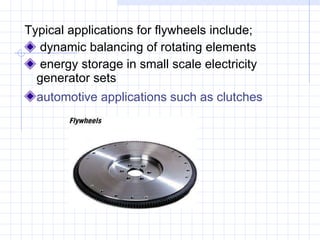
Typical applications for flywheels include;   dynamic balancing of rotating elements energy storage in small scale electricity generator sets automotive applications such as clutches
Flywheels are preferred over conventional batteries in many aerospace applications because of the following benefits   5 to 10+ times greater specific energy Lower mass / kW output Long life. Unaffected by number of charge / discharge cycles 85-95% round trip efficiency Fewer regulators / controls needed Greater peak load capability Reduced maintenance / life cycle costs
Advanced flywheels are also now used for protecting against interruptions to the national electricity grid.  The flywheel provides power during period between the loss of utility supplied power and either the return of utility power or the start of a sufficient back-up power system (i.e., diesel generator). Flywheels can discharge at 100 kilowatts (kW) for 15 seconds and recharge immediately at the same rate, providing 1-30 seconds of ride-through time. Back-up generators are typically online within 5-20 seconds.
Flywheels have also been proposed as a power booster for electric vehicles. Speeds of 100,000 rpm have been used to achieve very high power densities, however containment of the high speed rotor in case of accident or mechanical failure would require a massive enclosure negating any power density advantages. The huge gyroscopic forces of these high speed flywheels are an added complication. Practicalities have so far prevented the large scale adoption of flywheels for portable applications.
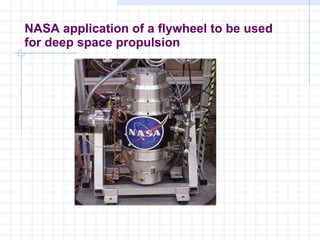
NASA application of a flywheel to be used for deep space propulsion
Terms associated with flywheels    = Angular velocity (rad/s)    = Angular acceleration (rad/s 2 ) T = Torque (Nm) = I   I = Moment of inertia (kgm 2 ) = mk 2  OR mr 2 /2 R = radius (m) m = mass (kg) k = radius of gyration (m) Ke = Kinetic energy (J)
A typical flywheel problem; A flywheel of mass 100kg and diameter 1.2m is accelerated from rest to a speed of 450 revs/min in 8 seconds. Determine the torque required to achieve this motion and the kinetic energy of the flywheel when up to operating speed. TRY IT !
This resource was created Leicester College and released as an open educational resource through the Open Engineering Resources project of the Higher Education Academy Engineering Subject Centre. The Open Engineering Resources project was funded by HEFCE and part of the JISC/HE Academy UKOER programme. © 2009 Leicester College This work is licensed under a Creative Commons Attribution 2.0 License.   The JISC logo is licensed under the terms of the Creative Commons Attribution-Non-Commercial-No Derivative Works 2.0 UK: England & Wales Licence.  All reproductions must comply with the terms of that licence. The HEA logo is owned by the Higher Education Academy Limited may be freely distributed and copied for educational purposes only, provided that appropriate acknowledgement is given to the Higher Education Academy as the copyright holder and original publisher. The Leicester College name and logo is owned by the College and should not be produced without the express permission of the College.

Flywheels- An Alternative Energy Storage Method

  • 1.
    Flywheels: An AlternativeEnergy Source Author: Leicester College Date created: Date revised: 2009 Abstract: The use of flywheels to capture and store rotational kinetic energy has been used in a range of systems for the past two hundred years or so. This document explores some of the modern applications of these devices and their implications for future use. An example of the calculation of the rotational kinetic energy is given and the parameters associated with this calculation are discussed. © Leicester College 2009. This work is licensed under a Creative Commons Attribution 2.0 License . HNC In Engineering – Mechanical Science Edexcel HN Unit: Engineering Science (NQF L4)
  • 2.
    Contents These filessupport the Edexcel HN unit – Design for Manufacture (NQF L4) For further information regarding unit outcomes go to Edexcel.org.uk/ HN/ Engineering / Specifications Aims and objectives Flywheels – An Alternative Energy Storage Method Flywheels - The Kinetic Battery The energy stored in a flywheel is given by the following ... The moment of inertia is given by; I = kMr 2  The magnitude of the engineering challenge should not be ... Flywheels are preferred over conventional batteries in ma... NASA application of a flywheel to be used for deep space ... Terms associated with flywheels A typical flywheel problem; File Name Unit Outcome Key Words Macaullay Method 2.1,2.2,2.3 Beams, stress, loading, UDL, slope, deflection, method Poissons ratio 1.1, 1.2 Poisson ratio, equations, axial, lateral, strain, stress Balancing 4.1 Beams, balancing, rotation, mass, stress, shafts Selecting beams 2.2 Beams, columns, selection, slenderness, stress, section modulus Flywheels 4.3,4.4 Kinetic, battery, flywheel, inertia, energy storage, energy
  • 3.
    Aims and objectivesAims Investigate the dynamics of rotating systems Determine the energy storage capabilities of flywheels Objectives Ability to understand and effectively use Angular motion theory and concepts Determine by calculation the energy capabilities of flywheels Explain in descriptive terms the technical aspects and engineering applications of flywheels
  • 4.
    Flywheels – An Alternative Energy Storage Method © Peripitus 2007 Sourced from http://commons.wikimedia.org/wiki/File:Giant_SA_meat_corporation_flywheel.jpg and available under a Creative Commons Attribution-Share Alike 3.0 Unported license.
  • 5.
    Flywheels - TheKinetic Battery Energy storage in a flywheel is as old as the potters wheel or the steam engine shown above. In more modern times slow speed flywheels, combined with opportunity charging at bus stops have been used since the 1950s for public transport applications, however they are very bulky and very heavy and this has limited their adoption.
  • 6.
    The energy storedin a flywheel is given by the following formula; Rotational Kinetic Energy - E = ½ Iω 2 Where I is the moment of inertia of the flywheel (ability of an object to resist changes in its rotational velocity) and ω is its rotational velocity (Rad / sec)). Note Increase I (mass away from centre) or rotational velocity and E increases
  • 7.
    The moment ofinertia is given by; I = kMr 2   Where M is the mass of the flywheel, r its radius and k is its inertial constant. k depends on the shape of the rotating object. For a flywheel loaded at rim such as a bicycle wheel or hollow cylinder rotating on its axis, k = 1 , for a solid disk of uniform thickness or a solid cylinder, k = ½.   So for a solid disk ; I = Mr 2   /2
  • 8.
    Modern super flywheelsstore kinetic energy in a high speed rotating drum which forms the rotor of a motor generator. When surplus electrical energy is available it is used to speed up the drum. When the energy is needed the drum provides it by driving the generator.
  • 9.
    Modern high energyflywheels use composite rotors made with carbon-fibre materials. The rotors have a very high strength-to-density ratio, and rotate at speeds up to 100,000 rpm. in a vacuum chamber to minimize aerodynamic losses. The use of super conducting electromagnetic bearings can virtually eliminate energy losses through friction.
  • 10.
    The magnitude ofthe engineering challenge should not be underestimated A 0.3m diameter flywheel, 0.3m in length, weighing 10 kg spinning at 100,000 rpm will store 3 kWh of energy. However at this rotational speed the surface speed at the rim of the flywheel will be about 6000 kmph (3500mph). or 4.8 times the speed of sound and the centrifugal force on particles at the rim is equivalent to 1.7 million G. The tensile strength of material used for the flywheel rim must be over 500,000 psi (3.3 Gpa) to stop the rotor from flying apart.
  • 11.
    Typical applications forflywheels include;   dynamic balancing of rotating elements energy storage in small scale electricity generator sets automotive applications such as clutches
  • 12.
    Flywheels are preferredover conventional batteries in many aerospace applications because of the following benefits 5 to 10+ times greater specific energy Lower mass / kW output Long life. Unaffected by number of charge / discharge cycles 85-95% round trip efficiency Fewer regulators / controls needed Greater peak load capability Reduced maintenance / life cycle costs
  • 13.
    Advanced flywheels arealso now used for protecting against interruptions to the national electricity grid. The flywheel provides power during period between the loss of utility supplied power and either the return of utility power or the start of a sufficient back-up power system (i.e., diesel generator). Flywheels can discharge at 100 kilowatts (kW) for 15 seconds and recharge immediately at the same rate, providing 1-30 seconds of ride-through time. Back-up generators are typically online within 5-20 seconds.
  • 14.
    Flywheels have alsobeen proposed as a power booster for electric vehicles. Speeds of 100,000 rpm have been used to achieve very high power densities, however containment of the high speed rotor in case of accident or mechanical failure would require a massive enclosure negating any power density advantages. The huge gyroscopic forces of these high speed flywheels are an added complication. Practicalities have so far prevented the large scale adoption of flywheels for portable applications.
  • 15.
    NASA application ofa flywheel to be used for deep space propulsion
  • 16.
    Terms associated withflywheels  = Angular velocity (rad/s)  = Angular acceleration (rad/s 2 ) T = Torque (Nm) = I  I = Moment of inertia (kgm 2 ) = mk 2 OR mr 2 /2 R = radius (m) m = mass (kg) k = radius of gyration (m) Ke = Kinetic energy (J)
  • 17.
    A typical flywheelproblem; A flywheel of mass 100kg and diameter 1.2m is accelerated from rest to a speed of 450 revs/min in 8 seconds. Determine the torque required to achieve this motion and the kinetic energy of the flywheel when up to operating speed. TRY IT !
  • 18.
    This resource wascreated Leicester College and released as an open educational resource through the Open Engineering Resources project of the Higher Education Academy Engineering Subject Centre. The Open Engineering Resources project was funded by HEFCE and part of the JISC/HE Academy UKOER programme. © 2009 Leicester College This work is licensed under a Creative Commons Attribution 2.0 License. The JISC logo is licensed under the terms of the Creative Commons Attribution-Non-Commercial-No Derivative Works 2.0 UK: England & Wales Licence. All reproductions must comply with the terms of that licence. The HEA logo is owned by the Higher Education Academy Limited may be freely distributed and copied for educational purposes only, provided that appropriate acknowledgement is given to the Higher Education Academy as the copyright holder and original publisher. The Leicester College name and logo is owned by the College and should not be produced without the express permission of the College.