International Journal of Innovative Research in Advanced Engineering (IJIRAE) ISSN: 2349-2163
Volume 1 Issue 6 (July 2014) http://ijirae.com
_________________________________________________________________________________________________
© 2014, IJIRAE- All Rights Reserved Page - 353
Review: Composite Flywheel for High Speed
Application
Kishor D.Farde*
Dr.Dheeraj.S.Deshmukh
Mechanical&N.M.U.Jalgaon Mechanical &N.M.U.Jalgaon
Abstract— Flywheel is a device to smoothen the cyclic fluctuation of speed change when delivering constant output
power from the engine. It has no influence on the mean speed of the prime mover. It has no influence on the varying
load demand on the prime mover or the delivered power from the prime mover. In the forgoing discussion, it is
observed that turning moment diagrams for the cycle show period during which torque is in excess of the mean torque
responsible for the constant power output and also periods during which the torque is less than the mean torque. Thus
the speed of the flywheel would increase during period of excess of torque during the cycle and the speed will fall
during the period of the deficit torque during the cycle. Thus a flywheel stores energy and releases energy during the
cycle without affecting mean energy output. Thus a properly designed flywheel has to ensure the cyclic fluctuations of
speed within prescribed limits preferably as small as possible. The main objective of our project is to reduce weight of
automobile by using composite material. In this Project Work taking Flywheel as an Automobile component and
applying FEA analysis using ANSYS to optimize weight and strength of flywheel. Here Performing Analysis on metal
flywheel, carbon fiber flywheel and composite i.e. metal and carbon fiber flywheel. By using ANSYS stresses obtained
& compared with analytical calculations, also weight is compared. Composite flywheel made from steel rim & carbon
fiber body will be safe for automobile applications like F1 car. From analysis & analytical results composite flywheel
for automobile can be selected.
Keywords—ANSYS, Carbonfibre , Composite, FEA
I. INTRODUCTION
Flywheels serve as kinetic energy storage and retrieval devices with the ability to deliver high output power at
high rotational speeds as being one of the emerging energy storage technologies available today in various stages of
development, especially in advanced technological areas, i.e., spacecrafts. Today, most of the research efforts are being
spent on improving energy storage capability of flywheels to deliver high power at transfer times, lasting longer than
conventional battery powered technologies. Mainly, the performance of a flywheel can be attributed to three factors, i.e.,
material strength, geometry (cross-section) and rotational speed. While material strength directly determines kinetic
energy level that could be produced safely combined (coupled) with rotor speed, this study solely focuses on exploring
the effects of flywheel geometry on its energy storage/deliver capability per unit mass, further defined as Specific Energy.
Proposed computer aided analysis and optimization procedure results show that smart design of flywheel geometry could
both have a significant effect on the Specific Energy performance and reduce the operational loads exerted on the
shaft/bearings due to reduced mass at high rotational speeds.
II. LITERATURE SURVEY
According to Bozidar Rosic, Aleksandar Marinkovic, Aleksandar Vencl (2004), there is vast possibility of 3D modeling
of flywheel using CATIA. The problem of making flywheel with desired dimensions is resolved.
Cibulka J.[2009] Published Paper On Kinetic Energy Recovery Systems (KERS) by means of Flywheel Energy Storages
(FES). KERS by means of FES are currently under development both for motor sport and road hybrid vehicles. The aim
of the work is the optimalization and implementation to the hybrid and electric road vehicles. Testing equipment for the
experimental analysis of the simplified FES was designed. Flywheel energy storage systems employing high speed
composite flywheels and advanced electric motor/generators are being evaluated by the Department of Defense (DoD),
NASA , and firms to replace electrochemical battery banks in satellites and manned space applications Flywheel energy
storage systems can provide extended operating life and significant reduction in weight and volume compared to
conventional electro- chemical systems. In addition, flywheels can provide momentum or reaction wheel functions for
attitude control.
J.D.Herbst,S.M.Manifold,B.T.Murphy Published Paper describes the design, fabrication, and spin testing of two 10 MJ
composite flywheel energy storage rotors. To achieve the demonstrated energy density of greater than 310 kJ/kg in a
volume of less than 0.05 m3, the rotors utilize flexible composite arbors to connect a composite rim to a metallic shaft,
resulting in compact, lightweight, high energy density structures.The paper also describes the finite element stress and
rotordynamics analyses, along with a description of the fabrication and assembly techniques used in the con- struction of
the rotor. A description of the experimental setup and a discussion of spin testing of the rotors up to 45,000 rpm (965
m/s tip speed) are also presented. Accurate measurements of rotor centrifugal growth made with laser triangulation
sensors confirmed predicted strains of greater than 1.2% in the composite rim.
International Journal of Innovative Research in Advanced Engineering (IJIRAE) ISSN: 2349-2163
Volume 1 Issue 6 (July 2014) http://ijirae.com
_________________________________________________________________________________________________
© 2014, IJIRAE- All Rights Reserved Page -354
In 2012 Sushama G Bawane, A P Ninawe and S K Choudhary had proposed flywheel design, and analysis the material
selection process. The FEA model is described to achieve a better understanding of the mesh type, mesh size and
boundary conditions applied to complete an effective FEA model. Kelvin Ludlam[2013] Published Paper that
Describes,A flywheel is an energy storage device that uses its significant moment of inertia to store energy by rotating.
Flywheels have long been used to generate or maintain power and are most identified with the industrial age and the
steam engine. In one sense it can be thought of as a rechargeable battery that store energy in the form of mechanical
energy instead of electrochemical. Flywheels have been gaining popularity as a possible replacement for chemical
batteries in vehicles, but until last year there was no record of a flywheels being used to increase the efficiency of a
bicycle. Composite materials also have safety advantage over metallic material. If a potential failure at high angular
velocity and the radial stresses exceed the material strength composite flywheel is less likely to break apart in free flying
projectiles. Instead circumferential cracks develop and the flywheel breaks apart gradually.
III .PROPOSED WORK
STEP 1: COLLECTING INFORMATION AND DATA RELATED TO FLYWHEEL.
STEP 2: A FULLY PARAMETRIC MODEL OF THE FLYWHEEL IS CREATED IN CATIA V5 SOFTWARE.
STEP 3: MODEL OBTAINED IN STEP 2 IS ANALYSED USING ANSYS 14.5, TO OBTAIN THE STRESSES AND MASS OF
FLYWHEEL.
STEP 4: MANUAL CALCULATIONS ARE DONE AND RESULTS ARE COMPARED WITH THOSE OBTAINED IN ANSYS.
STEP 5: FINALLY, WE COMPARE THE RESULTS OBTAINED FROM ANSYS AND MANUAL CALCULATIONS FOR DIFFERENT
STEEL, CARBON FIBER AND COMPOSITE MATERIAL FLYWHEEL.
TO COMPLETE THIS PROJECT, WE WILL FOLLOW THE FOLLOWING FLOW CHART TO DO THIS PROJECT IN A PROPER
SEQUENCE RESPECTIVELY.
Fig. 1: Typical block diagram for model analysis
IV. METHODOLOGY
FINITE ELEMENT ANALYSIS PROCEDURE
 Modal Analysis:
After creating an assembly, the analysis is done in ANSYS WORKBENCH 14.5. ANSYS is general-purpose
finite element analysis (FEA) software package. It is a numerical method of deconstructing a complex system
into very small pieces.
ANSYS engineering simulation product provides a complete set of elements behaviour, material models and
equation solvers for wide variety of mechanical design problems. It is analytical tool for performing structural,
vibrational, stress, modal analysis, etc. The FEM is one of the most important development in computational
methods to occur in twentieth century.
International Journal of Innovative Research in Advanced Engineering (IJIRAE) ISSN: 2349-2163
Volume 1 Issue 6 (July 2014) http://ijirae.com
_________________________________________________________________________________________________
© 2014, IJIRAE- All Rights Reserved Page -355
ANSYS Inc. is an engineering simulation software (CAE) developer that is headquartered south of Pittsburgh in
the south point business park in Cecil Township, Pennsylvnia, United States.
 Simulation Technology: Structural mechanics, multiphysics, fluid dynamics, explicit dynamics, electromagnetic,
hydrodynamics (AQWA).
 Workflow Technology: ANSYS Workbench platform, High performance computing, Geometry Interface,
Simulation process and data management.
 ANSYS offers engineering simulation solution sets in engineering simulation that a design process requires.
Companies in a wide variety of industries use ANSYS software. The tools put a virtual product through a
rigorous testing procedure (such as crashing a car into a brick wall, or running for several years on a tarmac road)
before it becomes a physical object.
A variety of specializations under the umbrella of mechanical engineering discipline (such as aeronautical,
biomechanical and automotive industries) commonly used integrated FEM in design and development of their
product, several modern FEM packages include specific component such as thermal, electromagnetic, fluid and
structural working environment. In a structural simulation, FEM helps tremendously in producing stiffness and
strength visualization and also in minimizing weight, materials and costs.
Analysis Procedure
 Before importing the .CATIA file to the ANSYS workbench, the file has to be converted into .IGS format.
 This conversion can be done by going to file option>save as> save as type: .igs format>save. There will be
some data loss during conversion and importing process resulting in approximate results in ANSYS
workbench.
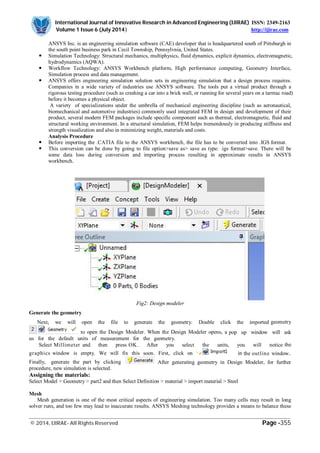
Fig2: Design modeler
Generate the geometry
Next, we will open the file to generate the geometry. Double click the imported geometry
to open the Design Modeler. When the Design Modeler opens, a pop up window will ask
us for the default units of measurement for the geometry.
Select Millimeter and then press OK. After you select the units, you will notice the
graphics window is empty. We will fix this soon. First, click on in the outline window..
Finally, generate the part by clicking After generating geometry in Design Modeler, for further
procedure, new simulation is selected.
Assigning the materials:
Select Model > Geometry > part2 and then Select Definition > material > import material > Steel
Mesh
Mesh generation is one of the most critical aspects of engineering simulation. Too many cells may result in long
solver runs, and too few may lead to inaccurate results. ANSYS Meshing technology provides a means to balance these
International Journal of Innovative Research in Advanced Engineering (IJIRAE) ISSN: 2349-2163
Volume 1 Issue 6 (July 2014) http://ijirae.com
_________________________________________________________________________________________________
© 2014, IJIRAE- All Rights Reserved Page -356
requirements and obtain the right mesh for each simulation in the most automated way possible. ANSYS Meshing
technology has been built on the strengths of stand-alone, class-leading meshing tools. The strongest aspects of these
separate tools have been brought together in a single environment to produce some of the most powerful meshing
available. We mesh so that the solver can solve for various equations as the complex model is finitely divided into
standard shape.
Meshing for analysis is complex and requires more refined meshing tools for accurate solution. For the current
analysis a fine mesh is used with smoothing and initial span angle kept fine. Initial seed size should be kept part since we
need the mesh to be distinct.
Advance> relevance center >fine
Generate the mesh by selecting Mesh > Generate Mesh
Applying boundary condition
Next, we will apply the boundary conditions to the geometry. In the Outline window, select modal>initial
condition>Fixed support. Make sure the Edge Selection Filter is selected, hold down Ctrl, and left mouse
click the outer rim Geometry >Apply.
Post – Processing:
Equivalent (Von-Mises) Stress is measured using a Stress Tool.
Solution:
Equivalent stress:
To add Equivalent stress to the solution, first click solution option. Add solution sub menu to menu bar. Now in the
solution sub menu click stress > equivalent stress to add the equivalent stress to the solution. It should appear in the
outline tree.
V. CONCLUSION
A composite material allows a higher rotational speed and this result in flywheel rotors with high specific energy and
light in weight. Composite materials are therefore a better choice than metals when designing flywheel rotors. The
theoretical specific energy of composite rotors is around five times higher than metallic ones. Composite materials also
have safety advantage over metallic material. If a potential failure at high angular velocity and the radial stresses exceed
the material strength composite flywheel is less likely to break apart in free flying projectiles. Instead circumferential
cracks develop and the flywheel breaks apart gradually. The faster we can spin a flywheel and the more massive we can
make it, the flywheel, and the more kinetic energy we can store in it. However, at extreme speeds, Even
metal flywheels can literally tear themselves apart from the shear forces which are generated. Further, the energy storage
characteristics of the flywheel are influenced more strongly by its maximal rotational velocity than by its mass.In future
work we can Design &analyse the composite flywheel i.e.made up of Steel(rim)&Flywheel body(Carbonfibre) to reduce
Weight for Space aircraft &F1 Car application.
REFERENCES
1. Christos C.Chamis &Lowis “ Rim-Spoke composite flywheel Stress &Vibration Analysis”
2. In 2005 John A. Akpobi & Imafidon A. Lawani[2005 ] “ computer-aided-designs of software for flywheels using object-
oriented programming approach of Visual Basic.”
3. Cibulka J.,[2009] “ Kinetic Energy Recovery System by Means of Flywheel Energy Storage”
4. J.D.Herbst,S.M.Manifold,B.T.Murphy, “Design,Fabrication &Testing of 10MJ Composite flywheel Energy storage Rotors”.
5. Kelvin Ludlum,[2013]Optimizing flywheel Design for use as a K.E.R.S.for a Bicycle.
6. Sushama G Bawane1*, A P Ninawe1 and S K Choudhary1 “ Analysis Optimization Of Flywheel”
7. Saeed Shojaei, Seyyed Mostafa Hossein Ali Pour Mehdi Tajdari Hamid Reza Chamani, “ algorithms based on dynamic analysis
of crank shaft for designing flywheel for I. C .engine”.
8. Sudipta Saha, Abhik Bose, G. Sai Tejesh, S.P. Srikanth , “Importance of the flywheel geometry design selection and its
contribution in the Energy storage performance.”
9. Dr. Robert Hebner,,Dr. Siddharth Pratap, Mr. Michael Lewis, Low-Cost Flywheel Energy Storage for Mitigating the Variability
of Renewable Power generation.
International Journal of Innovative Research in Advanced Engineering (IJIRAE) ISSN: 2349-2163
Volume 1 Issue 6 (July 2014) http://ijirae.com
_________________________________________________________________________________________________
© 2014, IJIRAE- All Rights Reserved Page -357
.

Review: Composite Flywheel for High Speed Application

  • 1.
    International Journal ofInnovative Research in Advanced Engineering (IJIRAE) ISSN: 2349-2163 Volume 1 Issue 6 (July 2014) http://ijirae.com _________________________________________________________________________________________________ © 2014, IJIRAE- All Rights Reserved Page - 353 Review: Composite Flywheel for High Speed Application Kishor D.Farde* Dr.Dheeraj.S.Deshmukh Mechanical&N.M.U.Jalgaon Mechanical &N.M.U.Jalgaon Abstract— Flywheel is a device to smoothen the cyclic fluctuation of speed change when delivering constant output power from the engine. It has no influence on the mean speed of the prime mover. It has no influence on the varying load demand on the prime mover or the delivered power from the prime mover. In the forgoing discussion, it is observed that turning moment diagrams for the cycle show period during which torque is in excess of the mean torque responsible for the constant power output and also periods during which the torque is less than the mean torque. Thus the speed of the flywheel would increase during period of excess of torque during the cycle and the speed will fall during the period of the deficit torque during the cycle. Thus a flywheel stores energy and releases energy during the cycle without affecting mean energy output. Thus a properly designed flywheel has to ensure the cyclic fluctuations of speed within prescribed limits preferably as small as possible. The main objective of our project is to reduce weight of automobile by using composite material. In this Project Work taking Flywheel as an Automobile component and applying FEA analysis using ANSYS to optimize weight and strength of flywheel. Here Performing Analysis on metal flywheel, carbon fiber flywheel and composite i.e. metal and carbon fiber flywheel. By using ANSYS stresses obtained & compared with analytical calculations, also weight is compared. Composite flywheel made from steel rim & carbon fiber body will be safe for automobile applications like F1 car. From analysis & analytical results composite flywheel for automobile can be selected. Keywords—ANSYS, Carbonfibre , Composite, FEA I. INTRODUCTION Flywheels serve as kinetic energy storage and retrieval devices with the ability to deliver high output power at high rotational speeds as being one of the emerging energy storage technologies available today in various stages of development, especially in advanced technological areas, i.e., spacecrafts. Today, most of the research efforts are being spent on improving energy storage capability of flywheels to deliver high power at transfer times, lasting longer than conventional battery powered technologies. Mainly, the performance of a flywheel can be attributed to three factors, i.e., material strength, geometry (cross-section) and rotational speed. While material strength directly determines kinetic energy level that could be produced safely combined (coupled) with rotor speed, this study solely focuses on exploring the effects of flywheel geometry on its energy storage/deliver capability per unit mass, further defined as Specific Energy. Proposed computer aided analysis and optimization procedure results show that smart design of flywheel geometry could both have a significant effect on the Specific Energy performance and reduce the operational loads exerted on the shaft/bearings due to reduced mass at high rotational speeds. II. LITERATURE SURVEY According to Bozidar Rosic, Aleksandar Marinkovic, Aleksandar Vencl (2004), there is vast possibility of 3D modeling of flywheel using CATIA. The problem of making flywheel with desired dimensions is resolved. Cibulka J.[2009] Published Paper On Kinetic Energy Recovery Systems (KERS) by means of Flywheel Energy Storages (FES). KERS by means of FES are currently under development both for motor sport and road hybrid vehicles. The aim of the work is the optimalization and implementation to the hybrid and electric road vehicles. Testing equipment for the experimental analysis of the simplified FES was designed. Flywheel energy storage systems employing high speed composite flywheels and advanced electric motor/generators are being evaluated by the Department of Defense (DoD), NASA , and firms to replace electrochemical battery banks in satellites and manned space applications Flywheel energy storage systems can provide extended operating life and significant reduction in weight and volume compared to conventional electro- chemical systems. In addition, flywheels can provide momentum or reaction wheel functions for attitude control. J.D.Herbst,S.M.Manifold,B.T.Murphy Published Paper describes the design, fabrication, and spin testing of two 10 MJ composite flywheel energy storage rotors. To achieve the demonstrated energy density of greater than 310 kJ/kg in a volume of less than 0.05 m3, the rotors utilize flexible composite arbors to connect a composite rim to a metallic shaft, resulting in compact, lightweight, high energy density structures.The paper also describes the finite element stress and rotordynamics analyses, along with a description of the fabrication and assembly techniques used in the con- struction of the rotor. A description of the experimental setup and a discussion of spin testing of the rotors up to 45,000 rpm (965 m/s tip speed) are also presented. Accurate measurements of rotor centrifugal growth made with laser triangulation sensors confirmed predicted strains of greater than 1.2% in the composite rim.
  • 2.
    International Journal ofInnovative Research in Advanced Engineering (IJIRAE) ISSN: 2349-2163 Volume 1 Issue 6 (July 2014) http://ijirae.com _________________________________________________________________________________________________ © 2014, IJIRAE- All Rights Reserved Page -354 In 2012 Sushama G Bawane, A P Ninawe and S K Choudhary had proposed flywheel design, and analysis the material selection process. The FEA model is described to achieve a better understanding of the mesh type, mesh size and boundary conditions applied to complete an effective FEA model. Kelvin Ludlam[2013] Published Paper that Describes,A flywheel is an energy storage device that uses its significant moment of inertia to store energy by rotating. Flywheels have long been used to generate or maintain power and are most identified with the industrial age and the steam engine. In one sense it can be thought of as a rechargeable battery that store energy in the form of mechanical energy instead of electrochemical. Flywheels have been gaining popularity as a possible replacement for chemical batteries in vehicles, but until last year there was no record of a flywheels being used to increase the efficiency of a bicycle. Composite materials also have safety advantage over metallic material. If a potential failure at high angular velocity and the radial stresses exceed the material strength composite flywheel is less likely to break apart in free flying projectiles. Instead circumferential cracks develop and the flywheel breaks apart gradually. III .PROPOSED WORK STEP 1: COLLECTING INFORMATION AND DATA RELATED TO FLYWHEEL. STEP 2: A FULLY PARAMETRIC MODEL OF THE FLYWHEEL IS CREATED IN CATIA V5 SOFTWARE. STEP 3: MODEL OBTAINED IN STEP 2 IS ANALYSED USING ANSYS 14.5, TO OBTAIN THE STRESSES AND MASS OF FLYWHEEL. STEP 4: MANUAL CALCULATIONS ARE DONE AND RESULTS ARE COMPARED WITH THOSE OBTAINED IN ANSYS. STEP 5: FINALLY, WE COMPARE THE RESULTS OBTAINED FROM ANSYS AND MANUAL CALCULATIONS FOR DIFFERENT STEEL, CARBON FIBER AND COMPOSITE MATERIAL FLYWHEEL. TO COMPLETE THIS PROJECT, WE WILL FOLLOW THE FOLLOWING FLOW CHART TO DO THIS PROJECT IN A PROPER SEQUENCE RESPECTIVELY. Fig. 1: Typical block diagram for model analysis IV. METHODOLOGY FINITE ELEMENT ANALYSIS PROCEDURE  Modal Analysis: After creating an assembly, the analysis is done in ANSYS WORKBENCH 14.5. ANSYS is general-purpose finite element analysis (FEA) software package. It is a numerical method of deconstructing a complex system into very small pieces. ANSYS engineering simulation product provides a complete set of elements behaviour, material models and equation solvers for wide variety of mechanical design problems. It is analytical tool for performing structural, vibrational, stress, modal analysis, etc. The FEM is one of the most important development in computational methods to occur in twentieth century.
  • 3.
    International Journal ofInnovative Research in Advanced Engineering (IJIRAE) ISSN: 2349-2163 Volume 1 Issue 6 (July 2014) http://ijirae.com _________________________________________________________________________________________________ © 2014, IJIRAE- All Rights Reserved Page -355 ANSYS Inc. is an engineering simulation software (CAE) developer that is headquartered south of Pittsburgh in the south point business park in Cecil Township, Pennsylvnia, United States.  Simulation Technology: Structural mechanics, multiphysics, fluid dynamics, explicit dynamics, electromagnetic, hydrodynamics (AQWA).  Workflow Technology: ANSYS Workbench platform, High performance computing, Geometry Interface, Simulation process and data management.  ANSYS offers engineering simulation solution sets in engineering simulation that a design process requires. Companies in a wide variety of industries use ANSYS software. The tools put a virtual product through a rigorous testing procedure (such as crashing a car into a brick wall, or running for several years on a tarmac road) before it becomes a physical object. A variety of specializations under the umbrella of mechanical engineering discipline (such as aeronautical, biomechanical and automotive industries) commonly used integrated FEM in design and development of their product, several modern FEM packages include specific component such as thermal, electromagnetic, fluid and structural working environment. In a structural simulation, FEM helps tremendously in producing stiffness and strength visualization and also in minimizing weight, materials and costs. Analysis Procedure  Before importing the .CATIA file to the ANSYS workbench, the file has to be converted into .IGS format.  This conversion can be done by going to file option>save as> save as type: .igs format>save. There will be some data loss during conversion and importing process resulting in approximate results in ANSYS workbench. Fig2: Design modeler Generate the geometry Next, we will open the file to generate the geometry. Double click the imported geometry to open the Design Modeler. When the Design Modeler opens, a pop up window will ask us for the default units of measurement for the geometry. Select Millimeter and then press OK. After you select the units, you will notice the graphics window is empty. We will fix this soon. First, click on in the outline window.. Finally, generate the part by clicking After generating geometry in Design Modeler, for further procedure, new simulation is selected. Assigning the materials: Select Model > Geometry > part2 and then Select Definition > material > import material > Steel Mesh Mesh generation is one of the most critical aspects of engineering simulation. Too many cells may result in long solver runs, and too few may lead to inaccurate results. ANSYS Meshing technology provides a means to balance these
  • 4.
    International Journal ofInnovative Research in Advanced Engineering (IJIRAE) ISSN: 2349-2163 Volume 1 Issue 6 (July 2014) http://ijirae.com _________________________________________________________________________________________________ © 2014, IJIRAE- All Rights Reserved Page -356 requirements and obtain the right mesh for each simulation in the most automated way possible. ANSYS Meshing technology has been built on the strengths of stand-alone, class-leading meshing tools. The strongest aspects of these separate tools have been brought together in a single environment to produce some of the most powerful meshing available. We mesh so that the solver can solve for various equations as the complex model is finitely divided into standard shape. Meshing for analysis is complex and requires more refined meshing tools for accurate solution. For the current analysis a fine mesh is used with smoothing and initial span angle kept fine. Initial seed size should be kept part since we need the mesh to be distinct. Advance> relevance center >fine Generate the mesh by selecting Mesh > Generate Mesh Applying boundary condition Next, we will apply the boundary conditions to the geometry. In the Outline window, select modal>initial condition>Fixed support. Make sure the Edge Selection Filter is selected, hold down Ctrl, and left mouse click the outer rim Geometry >Apply. Post – Processing: Equivalent (Von-Mises) Stress is measured using a Stress Tool. Solution: Equivalent stress: To add Equivalent stress to the solution, first click solution option. Add solution sub menu to menu bar. Now in the solution sub menu click stress > equivalent stress to add the equivalent stress to the solution. It should appear in the outline tree. V. CONCLUSION A composite material allows a higher rotational speed and this result in flywheel rotors with high specific energy and light in weight. Composite materials are therefore a better choice than metals when designing flywheel rotors. The theoretical specific energy of composite rotors is around five times higher than metallic ones. Composite materials also have safety advantage over metallic material. If a potential failure at high angular velocity and the radial stresses exceed the material strength composite flywheel is less likely to break apart in free flying projectiles. Instead circumferential cracks develop and the flywheel breaks apart gradually. The faster we can spin a flywheel and the more massive we can make it, the flywheel, and the more kinetic energy we can store in it. However, at extreme speeds, Even metal flywheels can literally tear themselves apart from the shear forces which are generated. Further, the energy storage characteristics of the flywheel are influenced more strongly by its maximal rotational velocity than by its mass.In future work we can Design &analyse the composite flywheel i.e.made up of Steel(rim)&Flywheel body(Carbonfibre) to reduce Weight for Space aircraft &F1 Car application. REFERENCES 1. Christos C.Chamis &Lowis “ Rim-Spoke composite flywheel Stress &Vibration Analysis” 2. In 2005 John A. Akpobi & Imafidon A. Lawani[2005 ] “ computer-aided-designs of software for flywheels using object- oriented programming approach of Visual Basic.” 3. Cibulka J.,[2009] “ Kinetic Energy Recovery System by Means of Flywheel Energy Storage” 4. J.D.Herbst,S.M.Manifold,B.T.Murphy, “Design,Fabrication &Testing of 10MJ Composite flywheel Energy storage Rotors”. 5. Kelvin Ludlum,[2013]Optimizing flywheel Design for use as a K.E.R.S.for a Bicycle. 6. Sushama G Bawane1*, A P Ninawe1 and S K Choudhary1 “ Analysis Optimization Of Flywheel” 7. Saeed Shojaei, Seyyed Mostafa Hossein Ali Pour Mehdi Tajdari Hamid Reza Chamani, “ algorithms based on dynamic analysis of crank shaft for designing flywheel for I. C .engine”. 8. Sudipta Saha, Abhik Bose, G. Sai Tejesh, S.P. Srikanth , “Importance of the flywheel geometry design selection and its contribution in the Energy storage performance.” 9. Dr. Robert Hebner,,Dr. Siddharth Pratap, Mr. Michael Lewis, Low-Cost Flywheel Energy Storage for Mitigating the Variability of Renewable Power generation.
  • 5.
    International Journal ofInnovative Research in Advanced Engineering (IJIRAE) ISSN: 2349-2163 Volume 1 Issue 6 (July 2014) http://ijirae.com _________________________________________________________________________________________________ © 2014, IJIRAE- All Rights Reserved Page -357 .