A GAS TURBINE
   Prepared By: Anup Mahato
CONTENT
 INTRODUCTION
 THEORY OF OPERATION
 BRAYTON CYCLE
 TYPES OF GAS TURBINE
 SCALE JET ENGINE
 MICROTURBINES
 GAS TURBINE IN SURFACE VEHICLE
 MARINE APPLICATION
 NON-MILITARY MARITIME
 TURBOFAN
 TURBOPROP
 ADVANTAGE & DISADVANTAGE
 CONCLUSION
INTRODUCTION
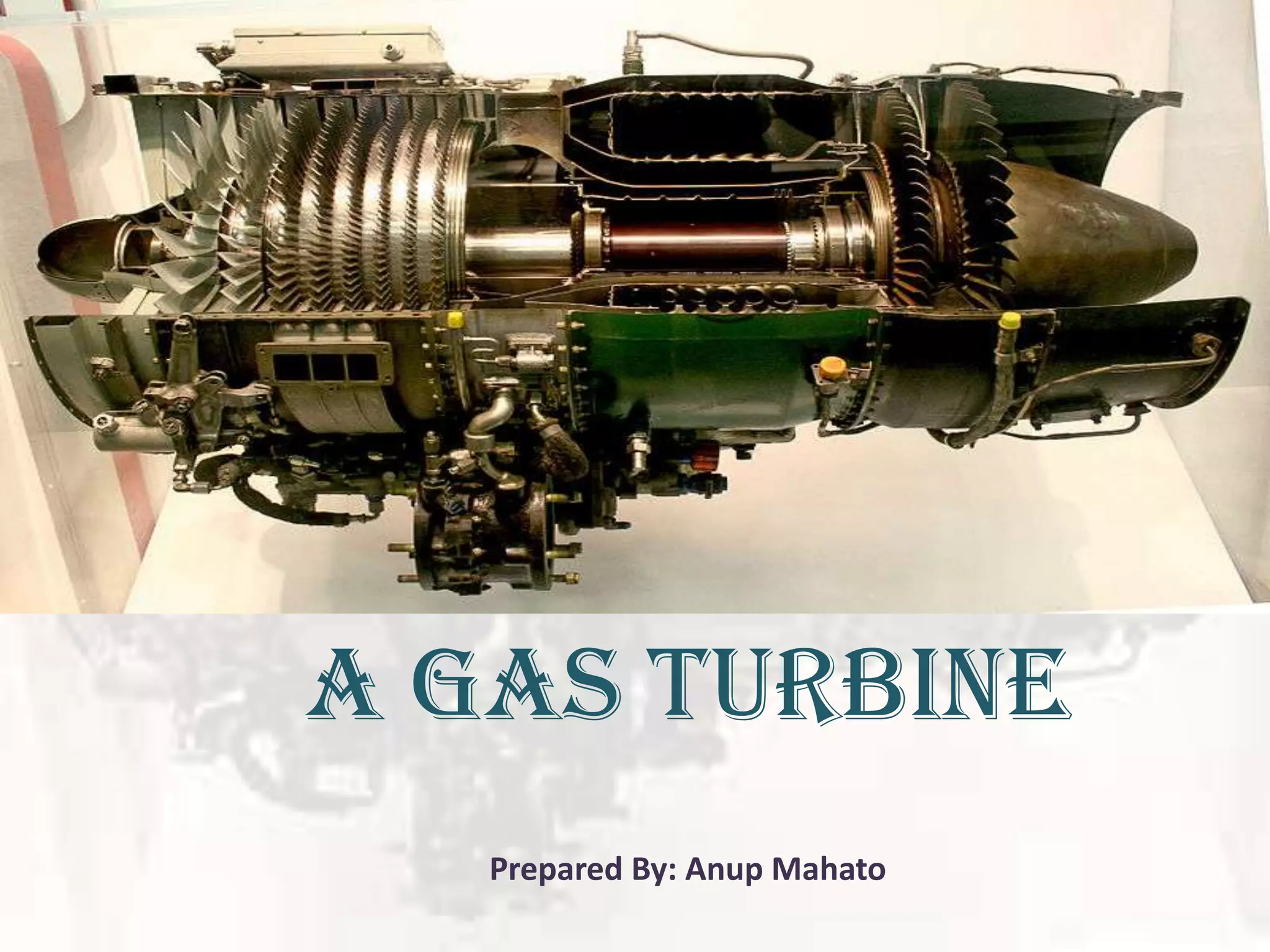
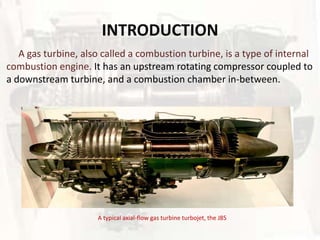
   A gas turbine, also called a combustion turbine, is a type of internal
combustion engine. It has an upstream rotating compressor coupled to
a downstream turbine, and a combustion chamber in-between.


                     A typical axial-flow gas turbine turbojet, the J85
THEORY OF OPERATION
• Energy is added to the gas stream in the combustor,
  where fuel is mixed with air and ignited. In the high
  pressure environment of the combustor, combustion of
  the fuel increases the temperature. The products of
  the combustion are forced into the turbine section.
  There, the high velocity and volume of the gas flow is
  directed through a nozzle over the turbine's blades,
  spinning the turbine which powers the compressor
  and, for some turbines, drives their mechanical output.
  The energy given up to the turbine comes from the
  reduction in the temperature and pressure of the
  exhaust gas.
BRAYTON CYCLE
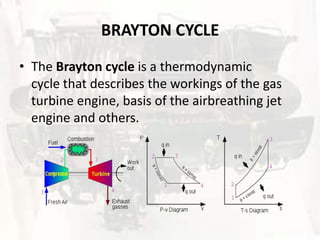
• The Brayton cycle is a thermodynamic
  cycle that describes the workings of the gas
  turbine engine, basis of the airbreathing jet
  engine and others.
EFFICIENCY
TYPES OF GAS TURBINE
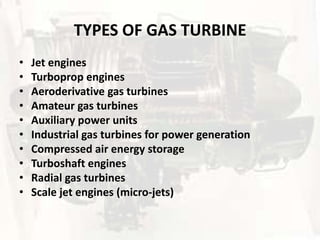
•   Jet engines
•   Turboprop engines
•   Aeroderivative gas turbines
•   Amateur gas turbines
•   Auxiliary power units
•   Industrial gas turbines for power generation
•   Compressed air energy storage
•   Turboshaft engines
•   Radial gas turbines
•   Scale jet engines (micro-jets)
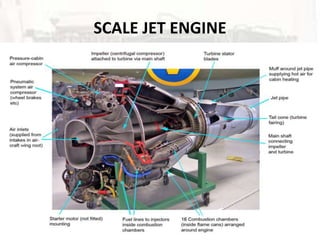
SCALE JET ENGINE
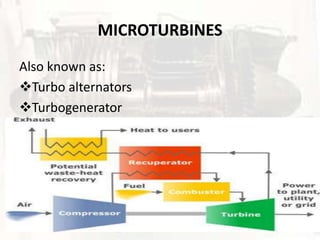
MICROTURBINES
Also known as:
Turbo alternators
Turbogenerator
GAS TURBINES IN SURFACE VEHICLES
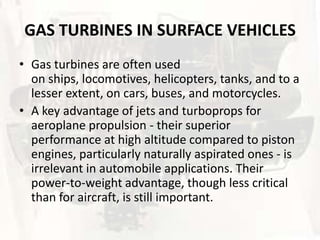
• Gas turbines are often used
  on ships, locomotives, helicopters, tanks, and to a
  lesser extent, on cars, buses, and motorcycles.
• A key advantage of jets and turboprops for
  aeroplane propulsion - their superior
  performance at high altitude compared to piston
  engines, particularly naturally aspirated ones - is
  irrelevant in automobile applications. Their
  power-to-weight advantage, though less critical
  than for aircraft, is still important.
PASSENGER ROAD VEHICLES

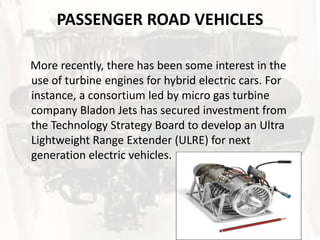
More recently, there has been some interest in the
use of turbine engines for hybrid electric cars. For
instance, a consortium led by micro gas turbine
company Bladon Jets has secured investment from
the Technology Strategy Board to develop an Ultra
Lightweight Range Extender (ULRE) for next
generation electric vehicles.
CONCEPT CARS
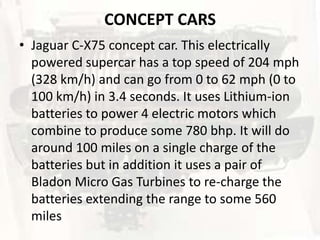
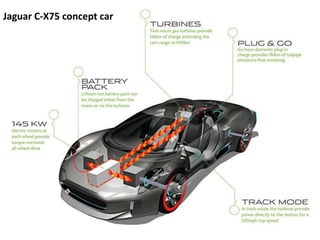
• Jaguar C-X75 concept car. This electrically
  powered supercar has a top speed of 204 mph
  (328 km/h) and can go from 0 to 62 mph (0 to
  100 km/h) in 3.4 seconds. It uses Lithium-ion
  batteries to power 4 electric motors which
  combine to produce some 780 bhp. It will do
  around 100 miles on a single charge of the
  batteries but in addition it uses a pair of
  Bladon Micro Gas Turbines to re-charge the
  batteries extending the range to some 560
  miles
Jaguar C-X75 concept car
RACING CARS
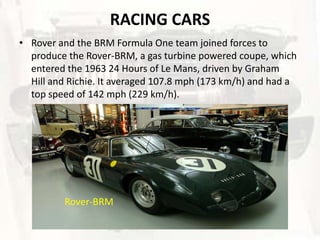
• Rover and the BRM Formula One team joined forces to
  produce the Rover-BRM, a gas turbine powered coupe, which
  entered the 1963 24 Hours of Le Mans, driven by Graham
  Hill and Richie. It averaged 107.8 mph (173 km/h) and had a
  top speed of 142 mph (229 km/h).


         Rover-BRM
MOTORCYCLES
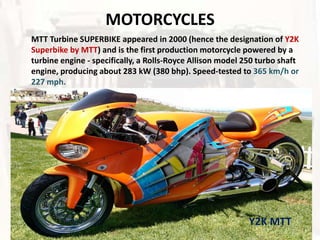
MTT Turbine SUPERBIKE appeared in 2000 (hence the designation of Y2K
Superbike by MTT) and is the first production motorcycle powered by a
turbine engine - specifically, a Rolls-Royce Allison model 250 turbo shaft
engine, producing about 283 kW (380 bhp). Speed-tested to 365 km/h or
227 mph.


                                                            Y2K MTT
MARINE APPLICATIONS
Naval
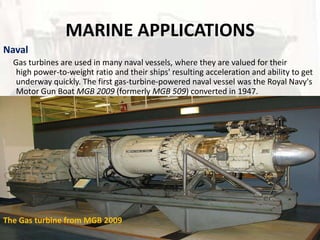
  Gas turbines are used in many naval vessels, where they are valued for their
   high power-to-weight ratio and their ships' resulting acceleration and ability to get
   underway quickly. The first gas-turbine-powered naval vessel was the Royal Navy's
   Motor Gun Boat MGB 2009 (formerly MGB 509) converted in 1947.


The Gas turbine from MGB 2009
NON-MILITARY MARITIME
 Gas turbines have been used
experimentally to power seagoing
commercial vessels since about 1949 (Anglo
Saxon Petroleum oil tanker "Auris").
In July 2000 the Millennium became the
first cruise ship to be propelled by gas
turbines, in a Combined Gas and Steam
Turbine configuration. The liner RMS Queen
Mary 2 uses a Combined Diesel and Gas
Turbine configuration.
TURBOFAN
Large jetliners use what are known
 as turbofan engines, which are nothing more than
 gas turbines combined with a large fan at the front of
 the engine.
The turbofan is basically the combination of two
 engines, the turbo portion which is a conventional
 gas turbine engine.
The low specific thrust/high bypass ratio turbofans
 used in today's civil jetliners (and some military
 transport aircraft) evolved from the high specific
 thrust/low bypass ratio turbofans used in such
 [production] aircraft back in the 1960s.
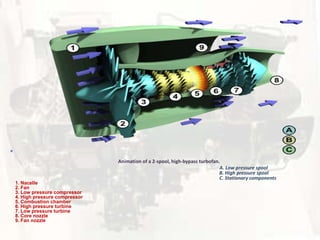
Animation of a 2-spool, high-bypass turbofan.
                                                                           A. Low pressure spool
                                                                           B. High pressure spool
                                                                           C. Stationary components
1. Nacelle
2. Fan
3. Low pressure compressor
4. High pressure compressor
5. Combustion chamber
6. High pressure turbine
7. Low pressure turbine
8. Core nozzle
9. Fan nozzle
TURBOPROP
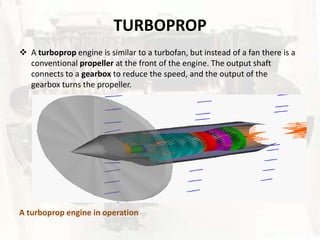
 A turboprop engine is similar to a turbofan, but instead of a fan there is a
  conventional propeller at the front of the engine. The output shaft
  connects to a gearbox to reduce the speed, and the output of the
  gearbox turns the propeller.


A turboprop engine in operation
ADVANTAGES OF GAS TURBINE
            ENGINES
Very high power-to-weight ratio, compared to
 reciprocating engines;
Smaller than most reciprocating engines of the
 same power rating.
Moves in one direction only, with far less
 vibration than a reciprocating engine.
Fewer moving parts than reciprocating engines.
Low operating pressures.
High operation speeds.
Low lubricating oil cost and consumption.
Can run on a wide variety of fuels.
DISADVANTAGES OF GAS TURBINE
            ENGINES
Cost is very high
Less efficient than reciprocating engines at
 idle speed
Longer startup than reciprocating engines
Less responsive to changes in power demand
 compared to reciprocating engines
THANK YOU

Gas Turbine PPT

  • 1.
    A GAS TURBINE Prepared By: Anup Mahato
  • 2.
    CONTENT  INTRODUCTION  THEORYOF OPERATION  BRAYTON CYCLE  TYPES OF GAS TURBINE  SCALE JET ENGINE  MICROTURBINES  GAS TURBINE IN SURFACE VEHICLE  MARINE APPLICATION  NON-MILITARY MARITIME  TURBOFAN  TURBOPROP  ADVANTAGE & DISADVANTAGE  CONCLUSION
  • 3.
    INTRODUCTION A gas turbine, also called a combustion turbine, is a type of internal combustion engine. It has an upstream rotating compressor coupled to a downstream turbine, and a combustion chamber in-between. A typical axial-flow gas turbine turbojet, the J85
  • 4.
    THEORY OF OPERATION •Energy is added to the gas stream in the combustor, where fuel is mixed with air and ignited. In the high pressure environment of the combustor, combustion of the fuel increases the temperature. The products of the combustion are forced into the turbine section. There, the high velocity and volume of the gas flow is directed through a nozzle over the turbine's blades, spinning the turbine which powers the compressor and, for some turbines, drives their mechanical output. The energy given up to the turbine comes from the reduction in the temperature and pressure of the exhaust gas.
  • 5.
    BRAYTON CYCLE • TheBrayton cycle is a thermodynamic cycle that describes the workings of the gas turbine engine, basis of the airbreathing jet engine and others.
  • 6.
  • 7.
    TYPES OF GASTURBINE • Jet engines • Turboprop engines • Aeroderivative gas turbines • Amateur gas turbines • Auxiliary power units • Industrial gas turbines for power generation • Compressed air energy storage • Turboshaft engines • Radial gas turbines • Scale jet engines (micro-jets)
  • 8.
  • 9.
    MICROTURBINES Also known as: Turboalternators Turbogenerator
  • 10.
    GAS TURBINES INSURFACE VEHICLES • Gas turbines are often used on ships, locomotives, helicopters, tanks, and to a lesser extent, on cars, buses, and motorcycles. • A key advantage of jets and turboprops for aeroplane propulsion - their superior performance at high altitude compared to piston engines, particularly naturally aspirated ones - is irrelevant in automobile applications. Their power-to-weight advantage, though less critical than for aircraft, is still important.
  • 11.
    PASSENGER ROAD VEHICLES Morerecently, there has been some interest in the use of turbine engines for hybrid electric cars. For instance, a consortium led by micro gas turbine company Bladon Jets has secured investment from the Technology Strategy Board to develop an Ultra Lightweight Range Extender (ULRE) for next generation electric vehicles.
  • 12.
    CONCEPT CARS • JaguarC-X75 concept car. This electrically powered supercar has a top speed of 204 mph (328 km/h) and can go from 0 to 62 mph (0 to 100 km/h) in 3.4 seconds. It uses Lithium-ion batteries to power 4 electric motors which combine to produce some 780 bhp. It will do around 100 miles on a single charge of the batteries but in addition it uses a pair of Bladon Micro Gas Turbines to re-charge the batteries extending the range to some 560 miles
  • 13.
  • 14.
    RACING CARS • Roverand the BRM Formula One team joined forces to produce the Rover-BRM, a gas turbine powered coupe, which entered the 1963 24 Hours of Le Mans, driven by Graham Hill and Richie. It averaged 107.8 mph (173 km/h) and had a top speed of 142 mph (229 km/h). Rover-BRM
  • 15.
    MOTORCYCLES MTT Turbine SUPERBIKEappeared in 2000 (hence the designation of Y2K Superbike by MTT) and is the first production motorcycle powered by a turbine engine - specifically, a Rolls-Royce Allison model 250 turbo shaft engine, producing about 283 kW (380 bhp). Speed-tested to 365 km/h or 227 mph. Y2K MTT
  • 16.
    MARINE APPLICATIONS Naval Gas turbines are used in many naval vessels, where they are valued for their high power-to-weight ratio and their ships' resulting acceleration and ability to get underway quickly. The first gas-turbine-powered naval vessel was the Royal Navy's Motor Gun Boat MGB 2009 (formerly MGB 509) converted in 1947. The Gas turbine from MGB 2009
  • 17.
    NON-MILITARY MARITIME  Gasturbines have been used experimentally to power seagoing commercial vessels since about 1949 (Anglo Saxon Petroleum oil tanker "Auris"). In July 2000 the Millennium became the first cruise ship to be propelled by gas turbines, in a Combined Gas and Steam Turbine configuration. The liner RMS Queen Mary 2 uses a Combined Diesel and Gas Turbine configuration.
  • 18.
    TURBOFAN Large jetliners usewhat are known as turbofan engines, which are nothing more than gas turbines combined with a large fan at the front of the engine. The turbofan is basically the combination of two engines, the turbo portion which is a conventional gas turbine engine. The low specific thrust/high bypass ratio turbofans used in today's civil jetliners (and some military transport aircraft) evolved from the high specific thrust/low bypass ratio turbofans used in such [production] aircraft back in the 1960s.
  • 19.
    Animation of a2-spool, high-bypass turbofan. A. Low pressure spool B. High pressure spool C. Stationary components 1. Nacelle 2. Fan 3. Low pressure compressor 4. High pressure compressor 5. Combustion chamber 6. High pressure turbine 7. Low pressure turbine 8. Core nozzle 9. Fan nozzle
  • 20.
    TURBOPROP  A turbopropengine is similar to a turbofan, but instead of a fan there is a conventional propeller at the front of the engine. The output shaft connects to a gearbox to reduce the speed, and the output of the gearbox turns the propeller. A turboprop engine in operation
  • 21.
    ADVANTAGES OF GASTURBINE ENGINES Very high power-to-weight ratio, compared to reciprocating engines; Smaller than most reciprocating engines of the same power rating. Moves in one direction only, with far less vibration than a reciprocating engine. Fewer moving parts than reciprocating engines. Low operating pressures. High operation speeds. Low lubricating oil cost and consumption. Can run on a wide variety of fuels.
  • 22.
    DISADVANTAGES OF GASTURBINE ENGINES Cost is very high Less efficient than reciprocating engines at idle speed Longer startup than reciprocating engines Less responsive to changes in power demand compared to reciprocating engines
  • 23.