Introduction
Conventional Breaking System
Regenerative Breaking & Its Working
Kinetic Energy Recovery System(K.E.R.S)
Discharge mode of K. E. R. S
Benefits of Regenerative Breaking System
Limitations of Regenerative Breaking System
Conclusion
Reference
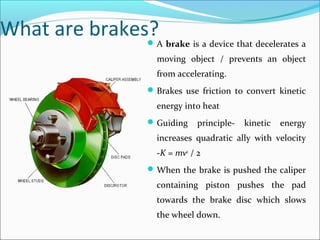
What are brakes?A brake is a device that decelerates a
moving object / prevents an object
from accelerating.
Brakes use friction to convert kinetic
energy into heat
Guiding principle- kinetic energy
increases quadratic ally with velocity
-K = mv2
/ 2
When the brake is pushed the caliper
containing piston pushes the pad
towards the brake disc which slows
the wheel down.
Convectional braking system
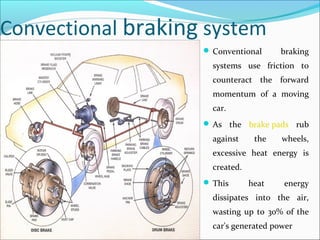
 Conventional braking
systems use friction to
counteract the forward
momentum of a moving
car.
 As the brake pads rub
against the wheels,
excessive heat energy is
created.
 This heat energy
dissipates into the air,
wasting up to 30% of the
car's generated power
Regenerative braking
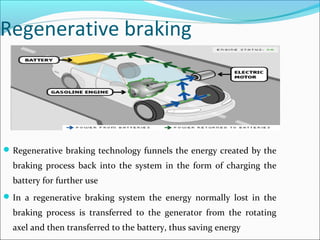
Regenerative braking technology funnels the energy created by the
braking process back into the system in the form of charging the
battery for further use
In a regenerative braking system the energy normally lost in the
braking process is transferred to the generator from the rotating
axel and then transferred to the battery, thus saving energy
How does it work
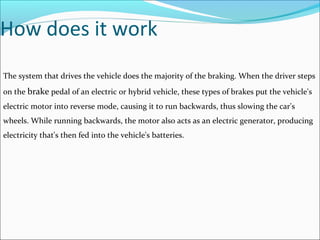
The system that drives the vehicle does the majority of the braking. When the driver steps
on the brake pedal of an electric or hybrid vehicle, these types of brakes put the vehicle's
electric motor into reverse mode, causing it to run backwards, thus slowing the car's
wheels. While running backwards, the motor also acts as an electric generator, producing
electricity that's then fed into the vehicle's batteries.
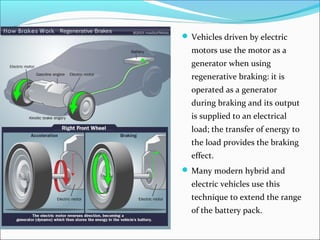
 Vehicles driven by electric
motors use the motor as a
generator when using
regenerative braking: it is
operated as a generator
during braking and its output
is supplied to an electrical
load; the transfer of energy to
the load provides the braking
effect.
 Many modern hybrid and
electric vehicles use this
technique to extend the range
of the battery pack.
v v
Motor
IC Engine
Generator Battery
Wheel
Wheel
Motor
Transmission
IC Engine
Generator Battery
Wheel
Wheel
Motor
Transmission
IC Engine
Generator Battery
Wheel
Wheel
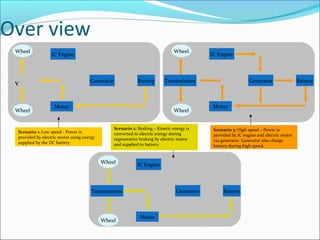
Scenario 1: Low speed - Power is
provided by electric motor using energy
supplied by the DC battery
Scenario 2: Braking – Kinetic energy is
converted to electric energy during
regenerative braking by electric motor
and supplied to battery.
Scenario 3: High speed – Power is
provided by IC engine and electric motor
via generator. Generator also charge
battery during high speed.
Over view
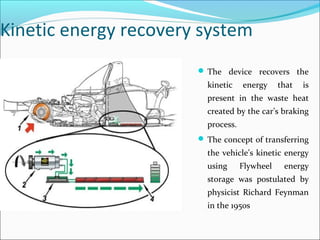
Kinetic energy recovery system
 The device recovers the
kinetic energy that is
present in the waste heat
created by the car’s braking
process.
 The concept of transferring
the vehicle’s kinetic energy
using Flywheel energy
storage was postulated by
physicist Richard Feynman
in the 1950s
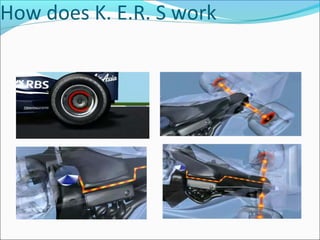
How does K. E.R. S work
When the driver brakes most of the kinetic energy is still converted to
heat energy but a portion is treated differently and is stored up in the
car.
 When the driver presses his boost button that stored energy is
converted back into kinetic energy
The mechanical KERS system utilises flywheel technology to recover
and store a moving vehicle’s kinetic energy which is otherwise wasted
when the vehicle is decelerated.
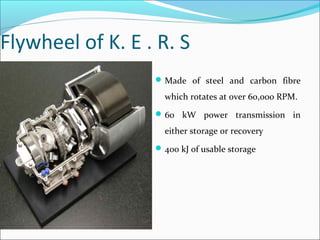
Flywheel of K. E . R. S
Made of steel and carbon fibre
which rotates at over 60,000 RPM.
60 kW power transmission in
either storage or recovery
400 kJ of usable storage
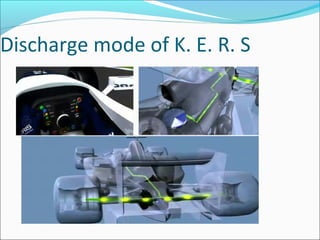
Discharge mode of K. E. R. S
During this stage when the driver pushes the boost button the
flywheel acts as a propulsion motor and discharges the energy to the
wheels
The Flywheel rotor is decelerated during boost discharge mode and
the energy is converted back.
Flywheel acts as a generator and sending energy back to electric
motor, which works as propulsion motor.
Benefits of regenerative
braking
Reduction of pollution
Increase in engine life
Breaking is not total loss
Wear Reduction
Reduction in pollution
Railway vehicle – The Delhi Metro saved around 90,000 tons of carbon
dioxide (CO2) from being released into the atmosphere by regenerating
112,500 megawatt hours of electricity through the use of regenerative
braking systems
Regenerative brakes have been able to improve the performance of engines.
This has been exhibited in the Motor sport industry –The system used by F! cars
is called K. E. R. S (Kinetic Energy Recovery System)
Increase engine efficiency
Breaking is not total loss
Conventional brakes apply friction to convert a vehicle’s kinetic energy
into heat. In energy terms, therefore, braking is a total loss: once heat is
generated, it is very difficult to reuse. The regenerative braking system,
however, slows a vehicle down in a different way.
Wear Reduction
An electric drive train also allows for regenerative breaking which
increases Efficiency and reduces wear on the vehicle brakes.
Limitations of regenerative braking
system
 The regenerative braking effect drops off at lower speeds, therefore the
friction brake is still required in order to bring the vehicle to a complete
halt.
 The friction brake is a necessary back-up in the event of failure of the
regenerative brake.
 Most road vehicles with regenerative braking only have power on some
wheels (as in a 2WD car) and regenerative braking power only applies to
such wheels, so in order to provide controlled braking under difficult
conditions (such as in wet roads) friction based braking is necessary on
the other wheels
Conclusion
The energy efficiency of a conventional brake is only about
20 percent, with the remaining 80 percent of its energy
being converted to heat through friction. The miraculous
thing about regenerative braking is that it may be able to
capture as much as half of that wasted energy and put it
back to work.
This reduces fuel consumption by 10 to 25 percent.
Hence regenerative braking plays an important role in fuel
consumption and also in the field of speed
Thank you

Regenerative braking system

  • 2.
    Introduction Conventional Breaking System RegenerativeBreaking & Its Working Kinetic Energy Recovery System(K.E.R.S) Discharge mode of K. E. R. S Benefits of Regenerative Breaking System Limitations of Regenerative Breaking System Conclusion Reference
  • 3.
    What are brakes?Abrake is a device that decelerates a moving object / prevents an object from accelerating. Brakes use friction to convert kinetic energy into heat Guiding principle- kinetic energy increases quadratic ally with velocity -K = mv2 / 2 When the brake is pushed the caliper containing piston pushes the pad towards the brake disc which slows the wheel down.
  • 4.
    Convectional braking system Conventional braking systems use friction to counteract the forward momentum of a moving car.  As the brake pads rub against the wheels, excessive heat energy is created.  This heat energy dissipates into the air, wasting up to 30% of the car's generated power
  • 5.
    Regenerative braking Regenerative brakingtechnology funnels the energy created by the braking process back into the system in the form of charging the battery for further use In a regenerative braking system the energy normally lost in the braking process is transferred to the generator from the rotating axel and then transferred to the battery, thus saving energy
  • 6.
    How does itwork The system that drives the vehicle does the majority of the braking. When the driver steps on the brake pedal of an electric or hybrid vehicle, these types of brakes put the vehicle's electric motor into reverse mode, causing it to run backwards, thus slowing the car's wheels. While running backwards, the motor also acts as an electric generator, producing electricity that's then fed into the vehicle's batteries.
  • 7.
     Vehicles drivenby electric motors use the motor as a generator when using regenerative braking: it is operated as a generator during braking and its output is supplied to an electrical load; the transfer of energy to the load provides the braking effect.  Many modern hybrid and electric vehicles use this technique to extend the range of the battery pack.
  • 8.
    v v Motor IC Engine GeneratorBattery Wheel Wheel Motor Transmission IC Engine Generator Battery Wheel Wheel Motor Transmission IC Engine Generator Battery Wheel Wheel Scenario 1: Low speed - Power is provided by electric motor using energy supplied by the DC battery Scenario 2: Braking – Kinetic energy is converted to electric energy during regenerative braking by electric motor and supplied to battery. Scenario 3: High speed – Power is provided by IC engine and electric motor via generator. Generator also charge battery during high speed. Over view
  • 9.
    Kinetic energy recoverysystem  The device recovers the kinetic energy that is present in the waste heat created by the car’s braking process.  The concept of transferring the vehicle’s kinetic energy using Flywheel energy storage was postulated by physicist Richard Feynman in the 1950s
  • 10.
    How does K.E.R. S work
  • 11.
    When the driverbrakes most of the kinetic energy is still converted to heat energy but a portion is treated differently and is stored up in the car.  When the driver presses his boost button that stored energy is converted back into kinetic energy The mechanical KERS system utilises flywheel technology to recover and store a moving vehicle’s kinetic energy which is otherwise wasted when the vehicle is decelerated.
  • 12.
    Flywheel of K.E . R. S Made of steel and carbon fibre which rotates at over 60,000 RPM. 60 kW power transmission in either storage or recovery 400 kJ of usable storage
  • 13.
  • 14.
    During this stagewhen the driver pushes the boost button the flywheel acts as a propulsion motor and discharges the energy to the wheels The Flywheel rotor is decelerated during boost discharge mode and the energy is converted back. Flywheel acts as a generator and sending energy back to electric motor, which works as propulsion motor.
  • 15.
    Benefits of regenerative braking Reductionof pollution Increase in engine life Breaking is not total loss Wear Reduction
  • 16.
    Reduction in pollution Railwayvehicle – The Delhi Metro saved around 90,000 tons of carbon dioxide (CO2) from being released into the atmosphere by regenerating 112,500 megawatt hours of electricity through the use of regenerative braking systems Regenerative brakes have been able to improve the performance of engines. This has been exhibited in the Motor sport industry –The system used by F! cars is called K. E. R. S (Kinetic Energy Recovery System) Increase engine efficiency
  • 17.
    Breaking is nottotal loss Conventional brakes apply friction to convert a vehicle’s kinetic energy into heat. In energy terms, therefore, braking is a total loss: once heat is generated, it is very difficult to reuse. The regenerative braking system, however, slows a vehicle down in a different way. Wear Reduction An electric drive train also allows for regenerative breaking which increases Efficiency and reduces wear on the vehicle brakes.
  • 18.
    Limitations of regenerativebraking system  The regenerative braking effect drops off at lower speeds, therefore the friction brake is still required in order to bring the vehicle to a complete halt.  The friction brake is a necessary back-up in the event of failure of the regenerative brake.  Most road vehicles with regenerative braking only have power on some wheels (as in a 2WD car) and regenerative braking power only applies to such wheels, so in order to provide controlled braking under difficult conditions (such as in wet roads) friction based braking is necessary on the other wheels
  • 19.
    Conclusion The energy efficiencyof a conventional brake is only about 20 percent, with the remaining 80 percent of its energy being converted to heat through friction. The miraculous thing about regenerative braking is that it may be able to capture as much as half of that wasted energy and put it back to work. This reduces fuel consumption by 10 to 25 percent. Hence regenerative braking plays an important role in fuel consumption and also in the field of speed
  • 20.