Presented By
D.HEMANTH KUMAR
1
INTRODUCTION
 MHD power generation is a direct energy
conversion,which converts the Heat Energy
directly into Electrical Energy without any
intermediate Mechanical Energy conversion.
 Magneto Hydro Dynamic (MHD) or Hydro
dynamics is the Academic Discipline which
studies the Dynamics of Electrically
conducting fluids Ex: Plasma, Liquid metals
and Salt water
 The Word MHD derived from Magneto-
Magnetic Field,Hydro-Liquid and
Dynamics-Movement
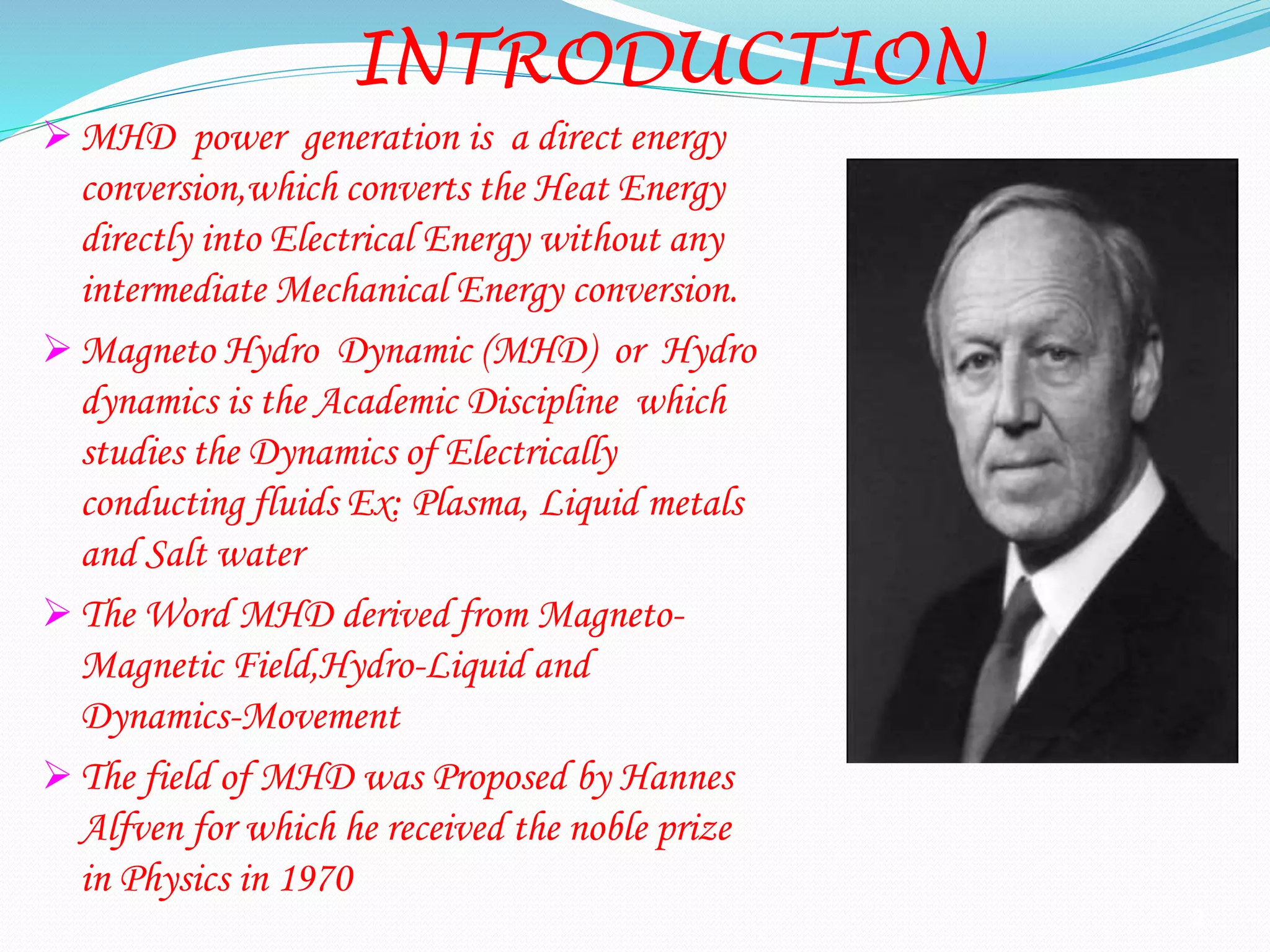
 The field of MHD was Proposed by Hannes
Alfven for which he received the noble prize
in Physics in 1970
2
HISTORY OF MHD
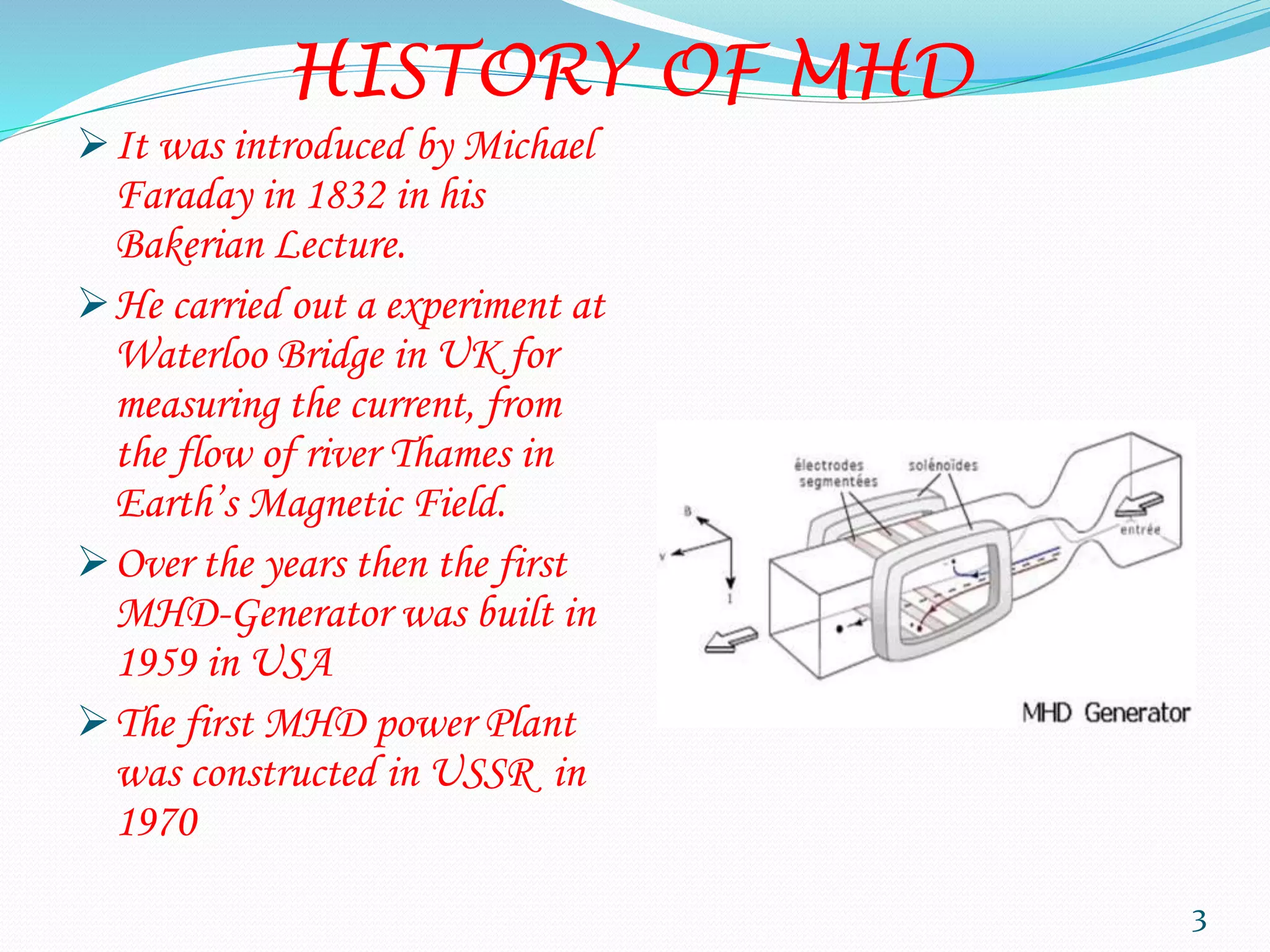
It was introduced by Michael
Faraday in 1832 in his
Bakerian Lecture.
He carried out a experiment at
Waterloo Bridge in UK for
measuring the current, from
the flow of river Thames in
Earth’s Magnetic Field.
Over the years then the first
MHD-Generator was built in
1959 in USA
The first MHD power Plant
was constructed in USSR in
1970
3
PRINCIPLE
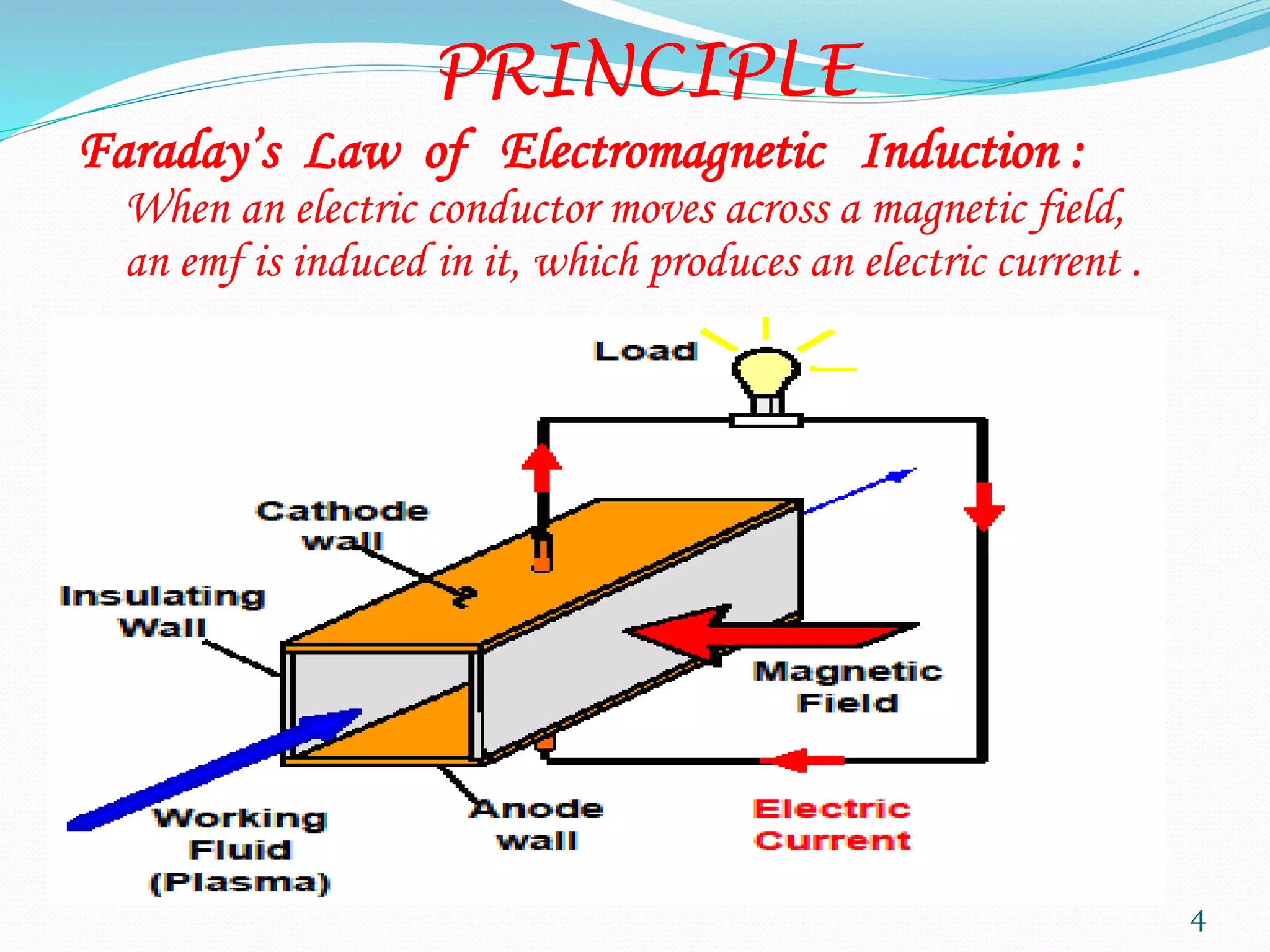
Faraday’s Law of Electromagnetic Induction :
When an electric conductor moves across a magnetic field,
an emf is induced in it, which produces an electric current .
4
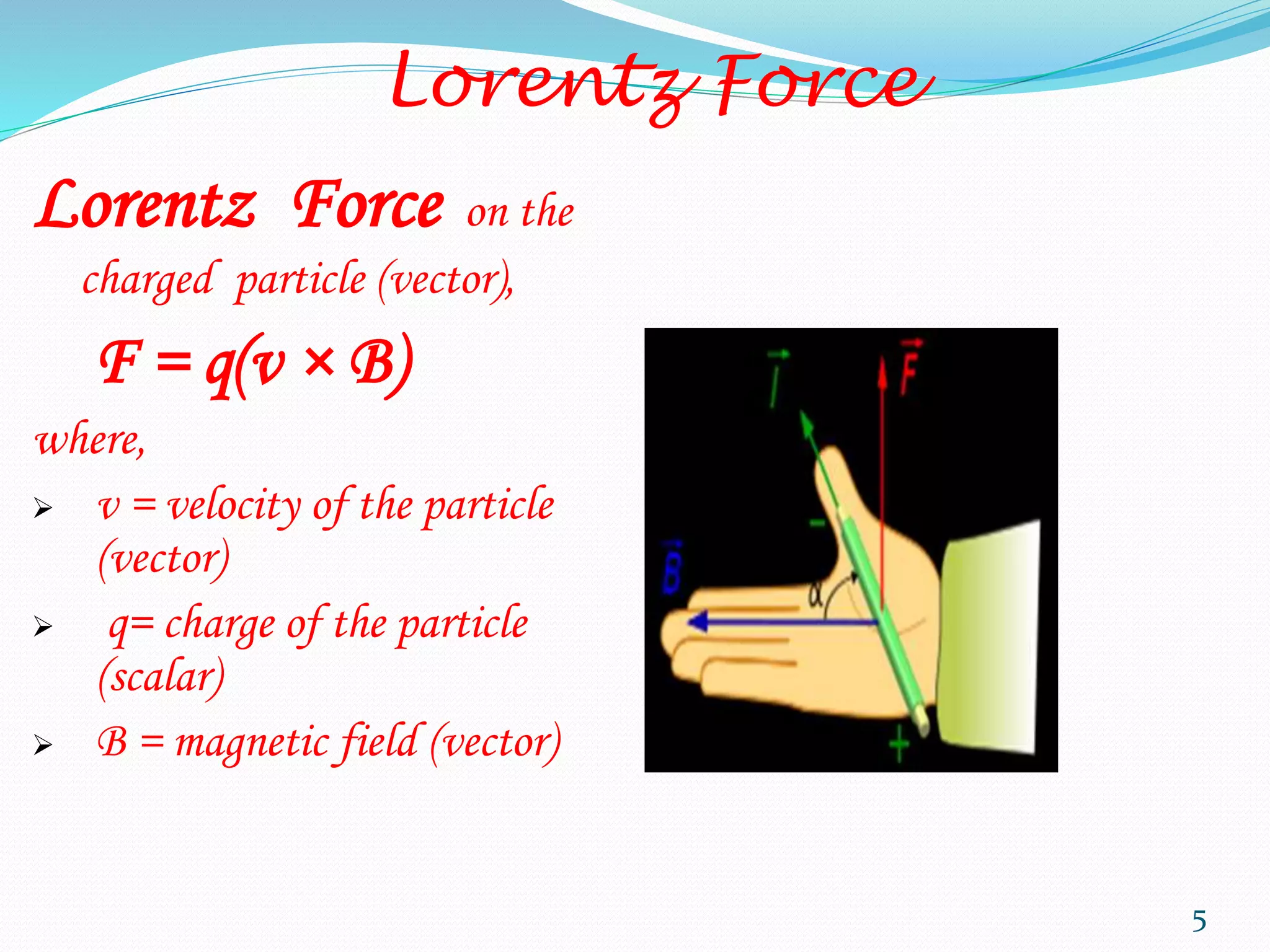
Lorentz Force
Lorentz Force on the
charged particle (vector),
F = q(v × B)
where,
 v = velocity of the particle
(vector)
 q= charge of the particle
(scalar)
 B = magnetic field (vector)
5
METHODS OF MHD POWER
GENERATION
Open Cycle MHD System
Closed Cycle MHD System
1.Seeded Inert Gas System
2.Liquid Metal System
6
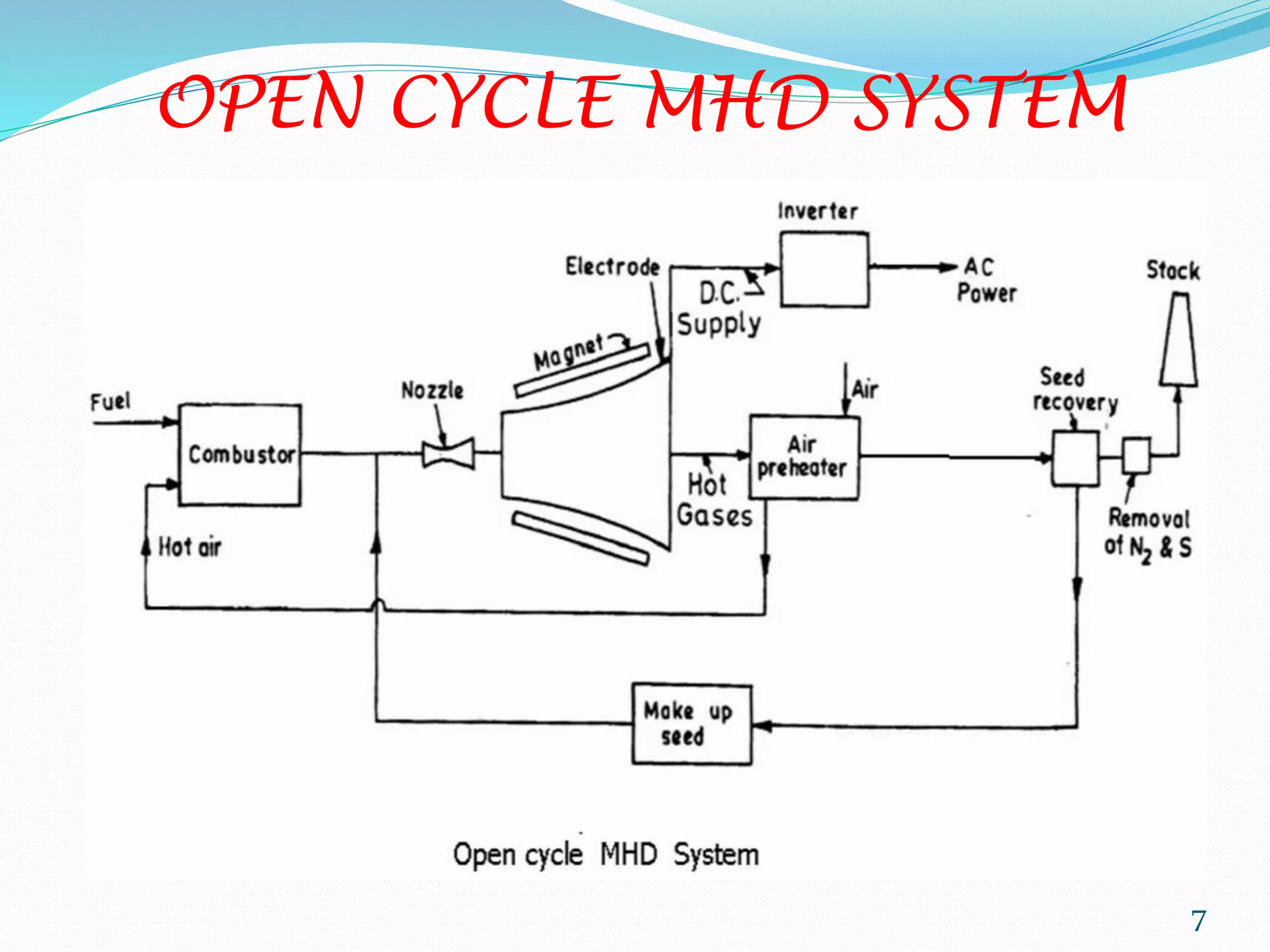
OPEN CYCLE MHD SYSTEM
7
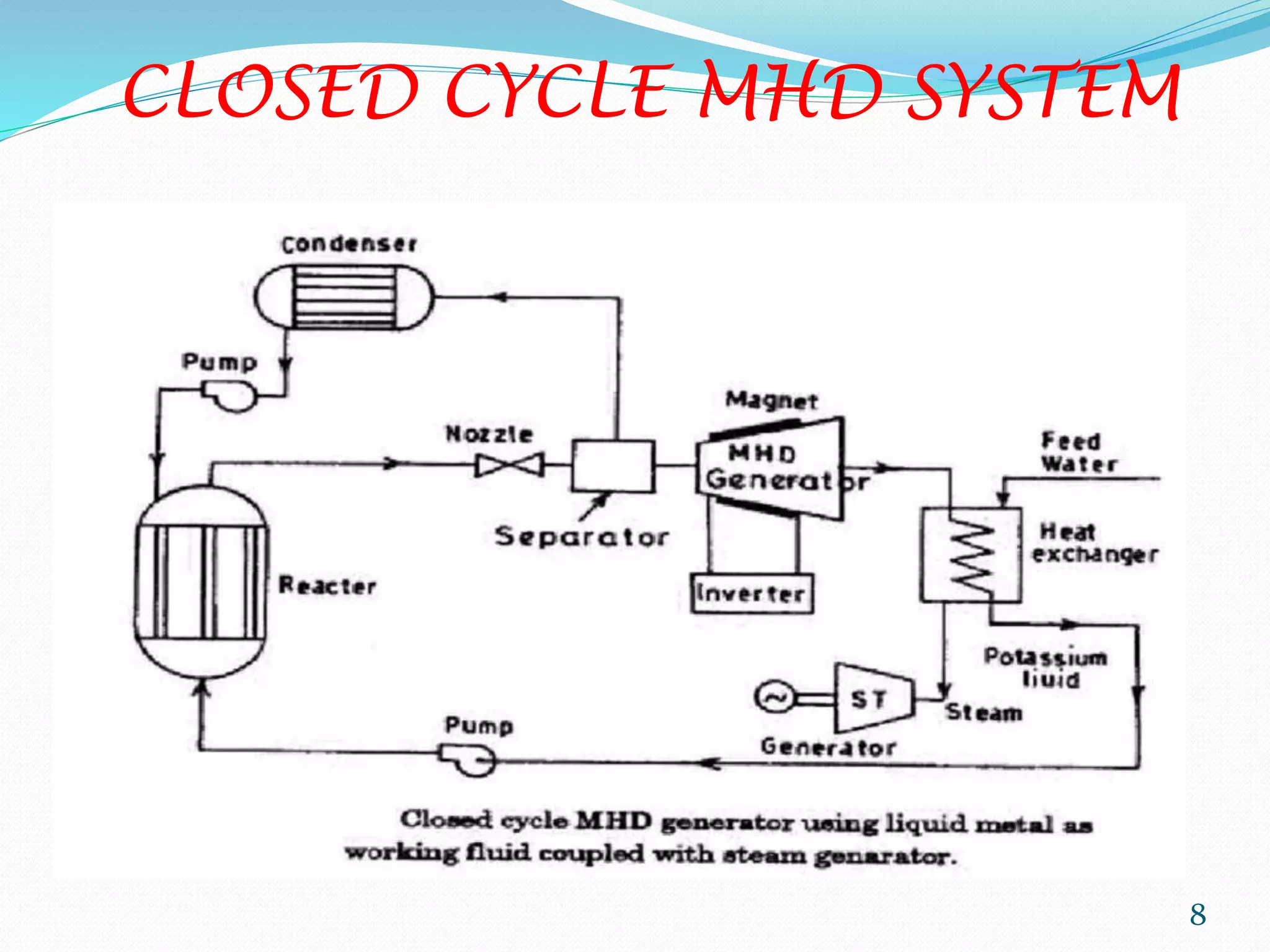
CLOSED CYCLE MHD SYSTEM
8
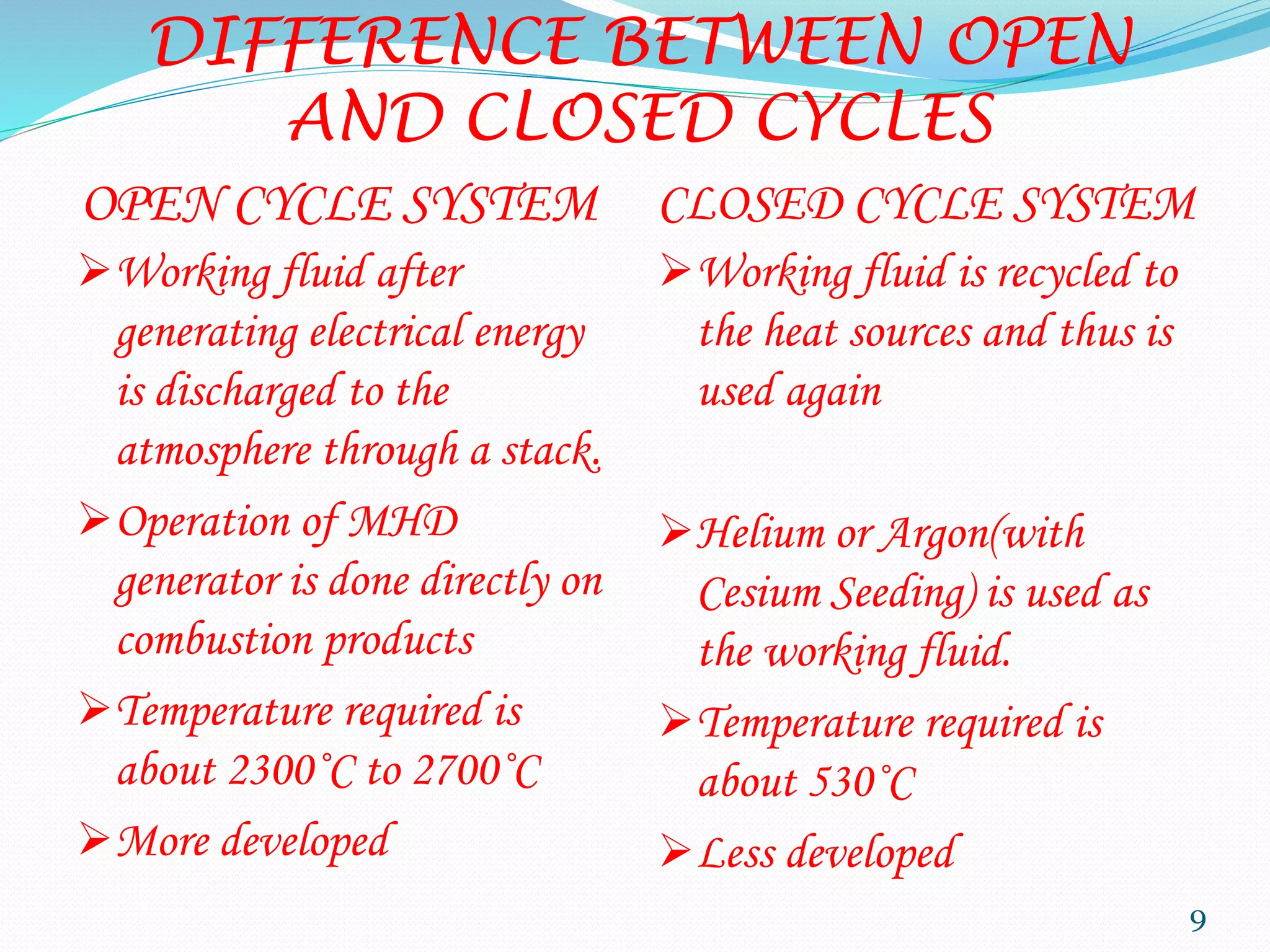
DIFFERENCE BETWEEN OPEN
AND CLOSED CYCLES
OPEN CYCLE SYSTEM CLOSED CYCLE SYSTEM
Working fluid after
generating electrical energy
is discharged to the
atmosphere through a stack.
Operation of MHD
generator is done directly on
combustion products
Temperature required is
about 2300˚C to 2700˚C
More developed
Working fluid is recycled to
the heat sources and thus is
used again
Helium or Argon(with
Cesium Seeding) is used as
the working fluid.
Temperature required is
about 530˚C
Less developed
9
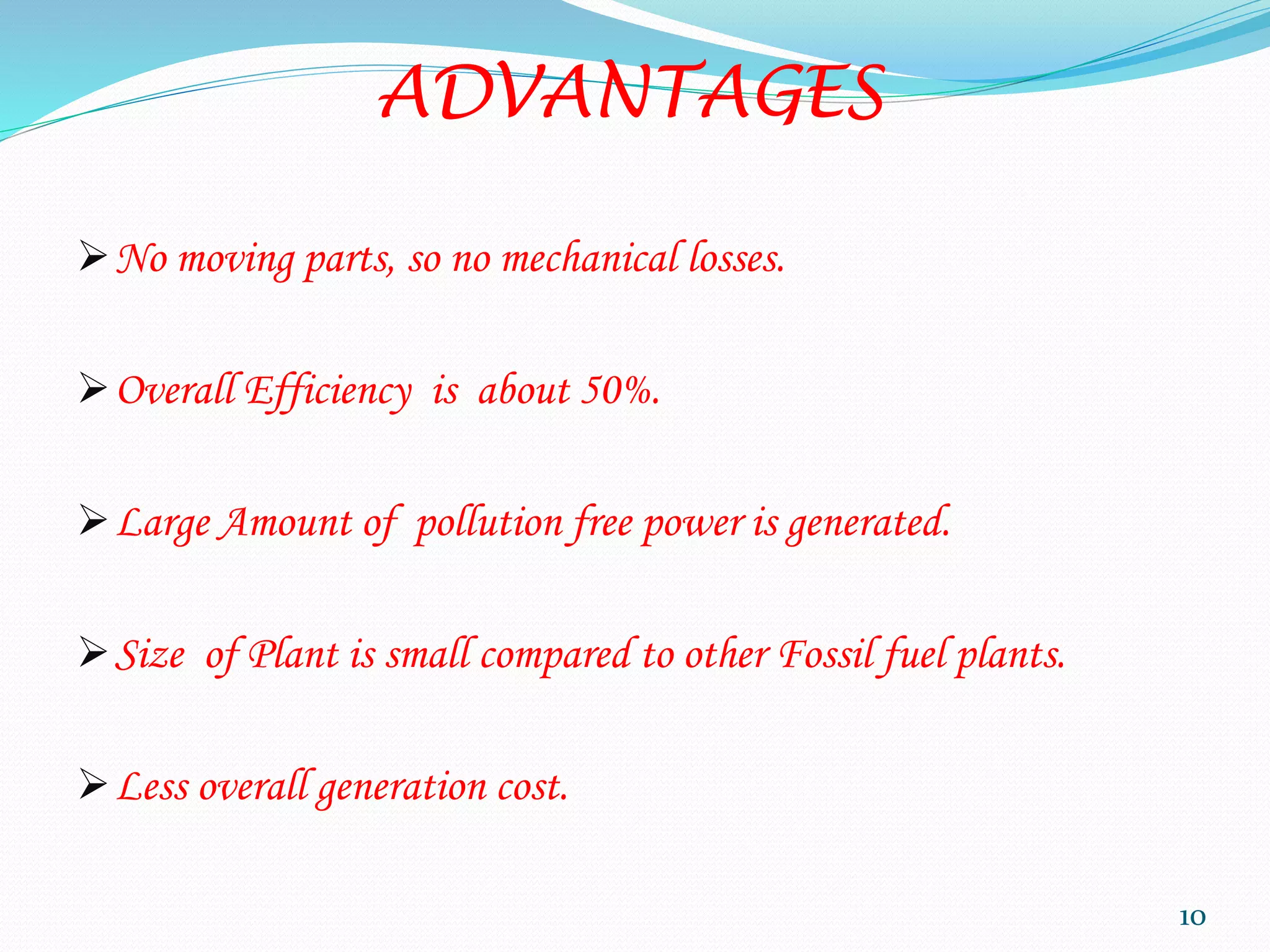
ADVANTAGES
No moving parts, so no mechanical losses.
Overall Efficiency is about 50%.
Large Amount of pollution free power is generated.
Size of Plant is small compared to other Fossil fuel plants.
Less overall generation cost.
10
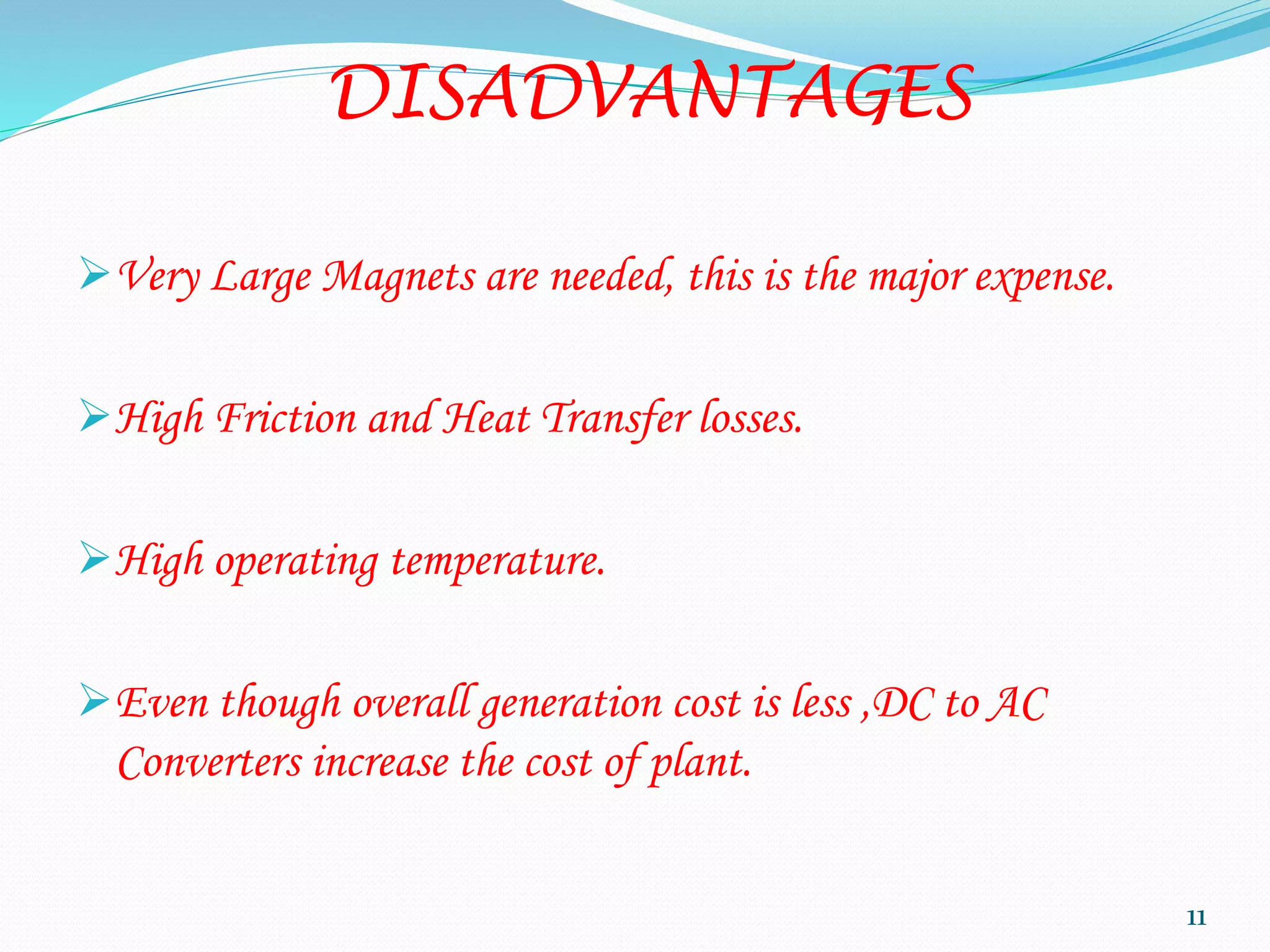
DISADVANTAGES
Very Large Magnets are needed, this is the major expense.
High Friction and Heat Transfer losses.
High operating temperature.
Even though overall generation cost is less ,DC to AC
Converters increase the cost of plant.
11
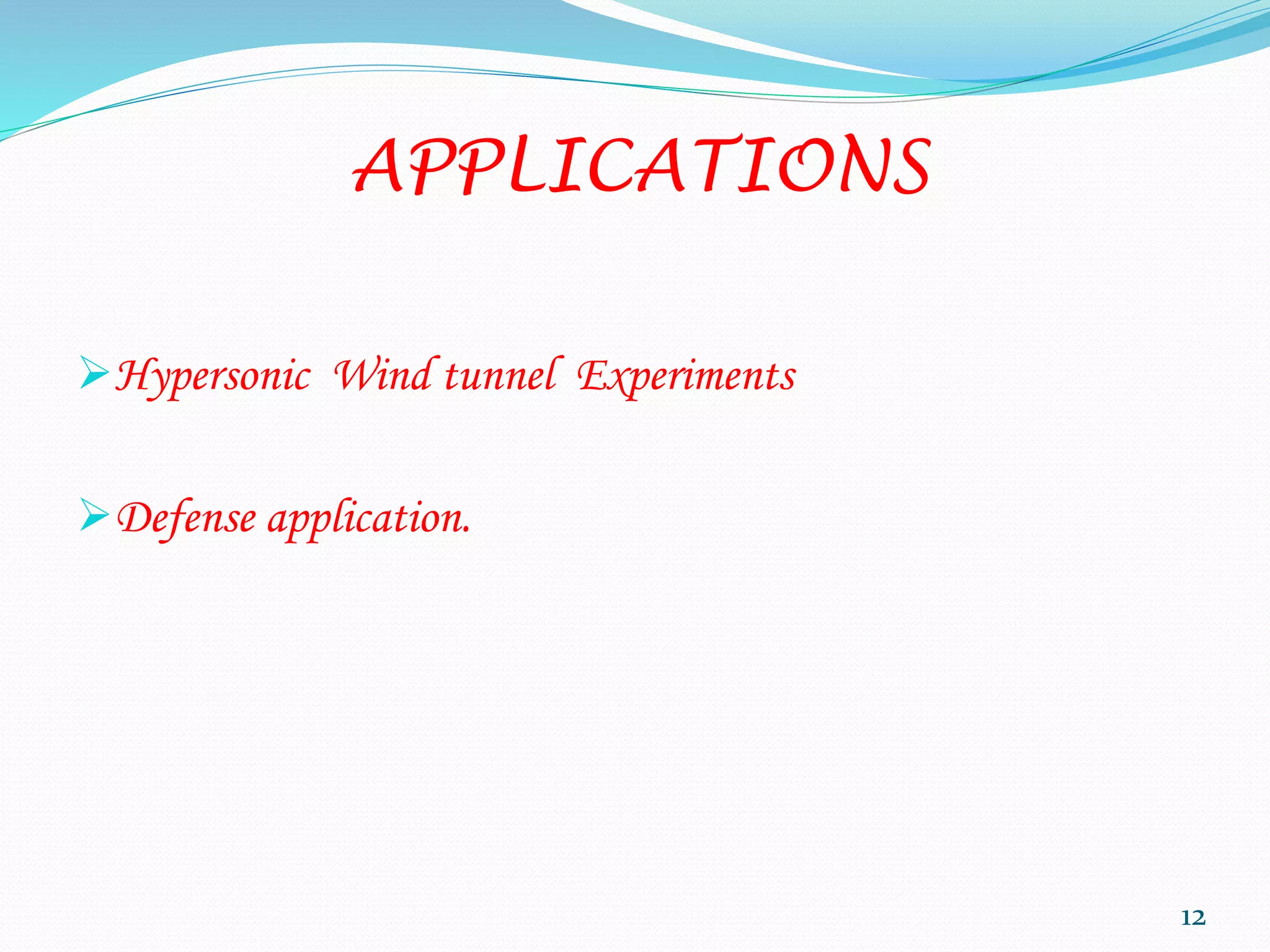
APPLICATIONS
Hypersonic Wind tunnel Experiments
Defense application.
12
CONCLUSION
MHD Power Generation is a Direct Energy conversion system,
which converts Heat Energy into Electrical Energy .By this
generation technique large power is generated without
pollution.
13
14

Magneto hydro dynamic (mhd) power generation

  • 1.
  • 2.
    INTRODUCTION  MHD powergeneration is a direct energy conversion,which converts the Heat Energy directly into Electrical Energy without any intermediate Mechanical Energy conversion.  Magneto Hydro Dynamic (MHD) or Hydro dynamics is the Academic Discipline which studies the Dynamics of Electrically conducting fluids Ex: Plasma, Liquid metals and Salt water  The Word MHD derived from Magneto- Magnetic Field,Hydro-Liquid and Dynamics-Movement  The field of MHD was Proposed by Hannes Alfven for which he received the noble prize in Physics in 1970 2
  • 3.
    HISTORY OF MHD Itwas introduced by Michael Faraday in 1832 in his Bakerian Lecture. He carried out a experiment at Waterloo Bridge in UK for measuring the current, from the flow of river Thames in Earth’s Magnetic Field. Over the years then the first MHD-Generator was built in 1959 in USA The first MHD power Plant was constructed in USSR in 1970 3
  • 4.
    PRINCIPLE Faraday’s Law ofElectromagnetic Induction : When an electric conductor moves across a magnetic field, an emf is induced in it, which produces an electric current . 4
  • 5.
    Lorentz Force Lorentz Forceon the charged particle (vector), F = q(v × B) where,  v = velocity of the particle (vector)  q= charge of the particle (scalar)  B = magnetic field (vector) 5
  • 6.
    METHODS OF MHDPOWER GENERATION Open Cycle MHD System Closed Cycle MHD System 1.Seeded Inert Gas System 2.Liquid Metal System 6
  • 7.
  • 8.
  • 9.
    DIFFERENCE BETWEEN OPEN ANDCLOSED CYCLES OPEN CYCLE SYSTEM CLOSED CYCLE SYSTEM Working fluid after generating electrical energy is discharged to the atmosphere through a stack. Operation of MHD generator is done directly on combustion products Temperature required is about 2300˚C to 2700˚C More developed Working fluid is recycled to the heat sources and thus is used again Helium or Argon(with Cesium Seeding) is used as the working fluid. Temperature required is about 530˚C Less developed 9
  • 10.
    ADVANTAGES No moving parts,so no mechanical losses. Overall Efficiency is about 50%. Large Amount of pollution free power is generated. Size of Plant is small compared to other Fossil fuel plants. Less overall generation cost. 10
  • 11.
    DISADVANTAGES Very Large Magnetsare needed, this is the major expense. High Friction and Heat Transfer losses. High operating temperature. Even though overall generation cost is less ,DC to AC Converters increase the cost of plant. 11
  • 12.
    APPLICATIONS Hypersonic Wind tunnelExperiments Defense application. 12
  • 13.
    CONCLUSION MHD Power Generationis a Direct Energy conversion system, which converts Heat Energy into Electrical Energy .By this generation technique large power is generated without pollution. 13
  • 14.