Flynn’s Classification
Presented By: Bishal Adhikari
Roll No.: 7
In 1966, Michael J. Flynn proposed a classification for computer architectures
based on the number of instruction streams and data streams(Flynn’s Taxonomy).
● Flynn’s Classification refers to a classification of parallel computer
architectures and machine’s structure.
● The sequence of instructions read from memory is called an instruction
stream. The operations performed on the data in the processor is called
a data stream.
Flynn’s Classification
1
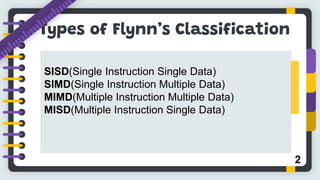
Types of Flynn’s Classification
SISD(Single Instruction Single Data)
SIMD(Single Instruction Multiple Data)
MIMD(Multiple Instruction Multiple Data)
MISD(Multiple Instruction Single Data)
2
3
4
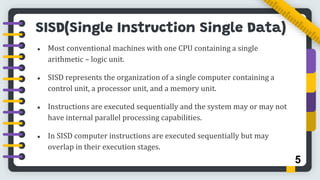
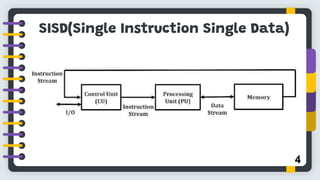
SISD(Single Instruction Single Data)
● Most conventional machines with one CPU containing a single
arithmetic – logic unit.
● SISD represents the organization of a single computer containing a
control unit, a processor unit, and a memory unit.
● Instructions are executed sequentially and the system may or may not
have internal parallel processing capabilities.
● In SISD computer instructions are executed sequentially but may
overlap in their execution stages.
5
6
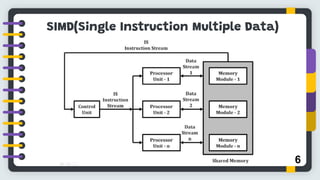
SIMD(Single Instruction Multiple Data)
● This category corresponds to array processors. They have multiple
processing/execution units and one control unit.
● SIMD represents an organization that includes many processing units
under the supervision of a common control unit.
● All processors receive the same instruction from the control unit but
operate on different items of data.
7
8
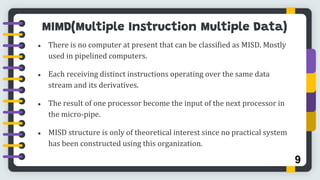
MIMD(Multiple Instruction Multiple Data)
● There is no computer at present that can be classified as MISD. Mostly
used in pipelined computers.
● Each receiving distinct instructions operating over the same data
stream and its derivatives.
● The result of one processor become the input of the next processor in
the micro-pipe.
● MISD structure is only of theoretical interest since no practical system
has been constructed using this organization.
9
10
MISD(Multiple Instruction Single Data)
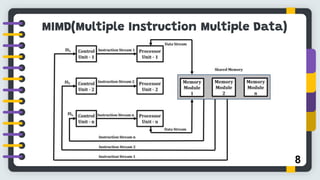
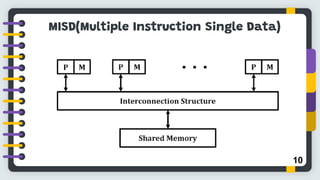
● Most multiprocessor system and multiple computer system can be
classified in this category.
● In MIMD, there are more than one processor unit having the ability to
execute several programs simultaneously.
● MIMD organization refers to a computer system capable of processing
several programs at the same time.
● Contains multiple processing units. Execution of multiple instructions
on multiple data.
11
Conclusion
In conclusion, while Flynn's Classification is well-established
and familiar in parallel programming, its limitation in
providing only four slots and the changing landscape of
parallel computing technologies pose challenges. The
system's granularity may be too coarse, resembling a binary
division of computers into parallel and sequential, which
oversimplifies the complex range of parallel computing
architectures.
12
Flynns-Classification or Flynn’s Taxonomy

Flynns-Classification or Flynn’s Taxonomy

  • 1.
    Flynn’s Classification Presented By:Bishal Adhikari Roll No.: 7
  • 2.
    In 1966, MichaelJ. Flynn proposed a classification for computer architectures based on the number of instruction streams and data streams(Flynn’s Taxonomy). ● Flynn’s Classification refers to a classification of parallel computer architectures and machine’s structure. ● The sequence of instructions read from memory is called an instruction stream. The operations performed on the data in the processor is called a data stream. Flynn’s Classification 1
  • 3.
    Types of Flynn’sClassification SISD(Single Instruction Single Data) SIMD(Single Instruction Multiple Data) MIMD(Multiple Instruction Multiple Data) MISD(Multiple Instruction Single Data) 2
  • 4.
  • 5.
  • 6.
    SISD(Single Instruction SingleData) ● Most conventional machines with one CPU containing a single arithmetic – logic unit. ● SISD represents the organization of a single computer containing a control unit, a processor unit, and a memory unit. ● Instructions are executed sequentially and the system may or may not have internal parallel processing capabilities. ● In SISD computer instructions are executed sequentially but may overlap in their execution stages. 5
  • 7.
  • 8.
    SIMD(Single Instruction MultipleData) ● This category corresponds to array processors. They have multiple processing/execution units and one control unit. ● SIMD represents an organization that includes many processing units under the supervision of a common control unit. ● All processors receive the same instruction from the control unit but operate on different items of data. 7
  • 9.
  • 10.
    MIMD(Multiple Instruction MultipleData) ● There is no computer at present that can be classified as MISD. Mostly used in pipelined computers. ● Each receiving distinct instructions operating over the same data stream and its derivatives. ● The result of one processor become the input of the next processor in the micro-pipe. ● MISD structure is only of theoretical interest since no practical system has been constructed using this organization. 9
  • 11.
  • 12.
    MISD(Multiple Instruction SingleData) ● Most multiprocessor system and multiple computer system can be classified in this category. ● In MIMD, there are more than one processor unit having the ability to execute several programs simultaneously. ● MIMD organization refers to a computer system capable of processing several programs at the same time. ● Contains multiple processing units. Execution of multiple instructions on multiple data. 11
  • 13.
    Conclusion In conclusion, whileFlynn's Classification is well-established and familiar in parallel programming, its limitation in providing only four slots and the changing landscape of parallel computing technologies pose challenges. The system's granularity may be too coarse, resembling a binary division of computers into parallel and sequential, which oversimplifies the complex range of parallel computing architectures. 12