1
Parallel Processing
B.Kohila
I-Msc(IT)
2
Topics Covered
 An Overview of Parallel Processing
 Parallelism in Uniprocessor Systems
 Organization of Multiprocessor
 Flynn’s Classification
 System Topologies
 MIMD System Architectures
3
An Overview of Parallel
Processing
 What is parallel processing?
 Parallel processing is a method to improve computer
system performance by executing two or more
instructions simultaneously.
 The goals of parallel processing.
 One goal is to reduce the “wall-clock” time or the
amount of real time that you need to wait for a problem
to be solved.
 Another goal is to solve bigger problems that might not
fit in the limited memory of a single CPU.
4
Parallelism in Uniprocessor Systems
 It is possible to achieve parallelism with a
uniprocessor system.
 Some examples are the instruction pipeline, arithmetic
pipeline, I/O processor.
 Note that a system that performs different
operations on the same instruction is not
considered parallel.
 Only if the system processes two different
instructions simultaneously can it be considered
parallel.
5
Parallelism in a Uniprocessor
System
 A reconfigurable arithmetic pipeline is an example
of parallelism in a uniprocessor system.
Each stage of a reconfigurable arithmetic pipeline has a
multiplexer at its input. The multiplexer may pass input
data, or the data output from other stages, to the stage
inputs. The control unit of the CPU sets the select
signals of the multiplexer to control the flow of data,
thus configuring the pipeline.
6
Vector Arithmetic Unit
A vector arithmetic unit contains multiple
functional units that perform addition, subtraction,
and other functions. The control unit routes input
values to the different functional units to allow the
CPU to execute multiple instructions
simultaneously.
For the operations AB+C and DE-F, the
CPU would route B and C to an adder and then
route E and F to a subtractor for simultaneous
execution.
7
Organization of Multiprocessor
Systems
 Flynn’s Classification
 Was proposed by researcher Michael J. Flynn in 1966.
 It is the most commonly accepted taxonomy of
computer organization.
 In this classification, computers are classified by
whether it processes a single instruction at a time or
multiple instructions simultaneously, and whether it
operates on one or multiple data sets.
8
Single Instruction, Single Data
(SISD)
 SISD machines executes a single instruction on
individual data values using a single processor.
 Based on traditional Von Neumann uniprocessor
architecture, instructions are executed sequentially
or serially, one step after the next.
 Until most recently, most computers are of SISD
type.
9
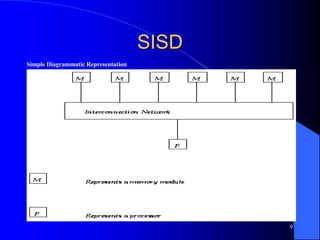
SISD
Simple Diagrammatic Representation
10
Single Instruction, Multiple
Data (SIMD)
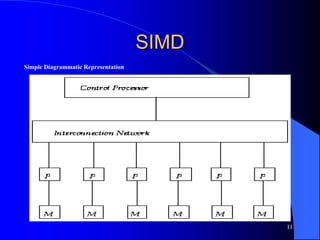
 An SIMD machine executes a single instruction
on multiple data values simultaneously using
many processors.
 Since there is only one instruction, each processor
does not have to fetch and decode each
instruction. Instead, a single control unit does the
fetch and decoding for all processors.
 SIMD architectures include array processors.
11
SIMD
Simple Diagrammatic Representation
12
Multiple Instruction, Multiple
Data (MIMD)
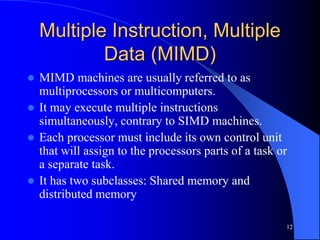
 MIMD machines are usually referred to as
multiprocessors or multicomputers.
 It may execute multiple instructions
simultaneously, contrary to SIMD machines.
 Each processor must include its own control unit
that will assign to the processors parts of a task or
a separate task.
 It has two subclasses: Shared memory and
distributed memory
13
Multiple Instruction, Single
Data (MISD)
 This category does not actually exist. This
category was included in the taxonomy for
the sake of completeness.
14
System Topologies
Topologies
 A system may also be classified by its
topology.
 A topology is the pattern of connections
between processors.
 The cost-performance tradeoff determines
which topologies to use for a multiprocessor
system.
15
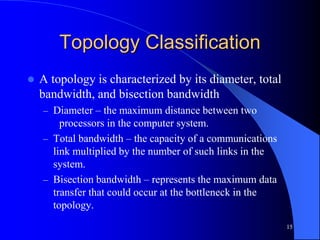
Topology Classification
 A topology is characterized by its diameter, total
bandwidth, and bisection bandwidth
– Diameter – the maximum distance between two
processors in the computer system.
– Total bandwidth – the capacity of a communications
link multiplied by the number of such links in the
system.
– Bisection bandwidth – represents the maximum data
transfer that could occur at the bottleneck in the
topology.
16
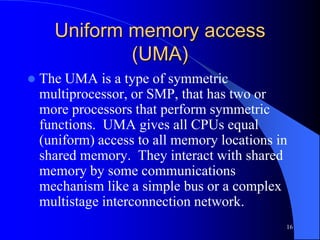
Uniform memory access
(UMA)
 The UMA is a type of symmetric
multiprocessor, or SMP, that has two or
more processors that perform symmetric
functions. UMA gives all CPUs equal
(uniform) access to all memory locations in
shared memory. They interact with shared
memory by some communications
mechanism like a simple bus or a complex
multistage interconnection network.
17
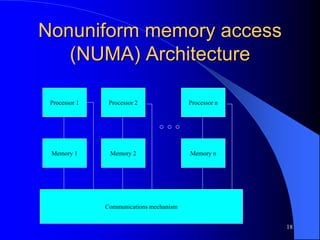
Nonuniform memory access
(NUMA)
 NUMA architectures, unlike UMA
architectures do not allow uniform access to
all shared memory locations. This
architecture still allows all processors to
access all shared memory locations but in a
nonuniform way, each processor can access
its local shared memory more quickly than
the other memory modules not next to it.
18
Nonuniform memory access
(NUMA) Architecture
Memory 1
Processor 1
Communications mechanism
Memory 2
Processor 2
Memory n
Processor n

Parallel processing

  • 1.
  • 2.
    2 Topics Covered  AnOverview of Parallel Processing  Parallelism in Uniprocessor Systems  Organization of Multiprocessor  Flynn’s Classification  System Topologies  MIMD System Architectures
  • 3.
    3 An Overview ofParallel Processing  What is parallel processing?  Parallel processing is a method to improve computer system performance by executing two or more instructions simultaneously.  The goals of parallel processing.  One goal is to reduce the “wall-clock” time or the amount of real time that you need to wait for a problem to be solved.  Another goal is to solve bigger problems that might not fit in the limited memory of a single CPU.
  • 4.
    4 Parallelism in UniprocessorSystems  It is possible to achieve parallelism with a uniprocessor system.  Some examples are the instruction pipeline, arithmetic pipeline, I/O processor.  Note that a system that performs different operations on the same instruction is not considered parallel.  Only if the system processes two different instructions simultaneously can it be considered parallel.
  • 5.
    5 Parallelism in aUniprocessor System  A reconfigurable arithmetic pipeline is an example of parallelism in a uniprocessor system. Each stage of a reconfigurable arithmetic pipeline has a multiplexer at its input. The multiplexer may pass input data, or the data output from other stages, to the stage inputs. The control unit of the CPU sets the select signals of the multiplexer to control the flow of data, thus configuring the pipeline.
  • 6.
    6 Vector Arithmetic Unit Avector arithmetic unit contains multiple functional units that perform addition, subtraction, and other functions. The control unit routes input values to the different functional units to allow the CPU to execute multiple instructions simultaneously. For the operations AB+C and DE-F, the CPU would route B and C to an adder and then route E and F to a subtractor for simultaneous execution.
  • 7.
    7 Organization of Multiprocessor Systems Flynn’s Classification  Was proposed by researcher Michael J. Flynn in 1966.  It is the most commonly accepted taxonomy of computer organization.  In this classification, computers are classified by whether it processes a single instruction at a time or multiple instructions simultaneously, and whether it operates on one or multiple data sets.
  • 8.
    8 Single Instruction, SingleData (SISD)  SISD machines executes a single instruction on individual data values using a single processor.  Based on traditional Von Neumann uniprocessor architecture, instructions are executed sequentially or serially, one step after the next.  Until most recently, most computers are of SISD type.
  • 9.
  • 10.
    10 Single Instruction, Multiple Data(SIMD)  An SIMD machine executes a single instruction on multiple data values simultaneously using many processors.  Since there is only one instruction, each processor does not have to fetch and decode each instruction. Instead, a single control unit does the fetch and decoding for all processors.  SIMD architectures include array processors.
  • 11.
  • 12.
    12 Multiple Instruction, Multiple Data(MIMD)  MIMD machines are usually referred to as multiprocessors or multicomputers.  It may execute multiple instructions simultaneously, contrary to SIMD machines.  Each processor must include its own control unit that will assign to the processors parts of a task or a separate task.  It has two subclasses: Shared memory and distributed memory
  • 13.
    13 Multiple Instruction, Single Data(MISD)  This category does not actually exist. This category was included in the taxonomy for the sake of completeness.
  • 14.
    14 System Topologies Topologies  Asystem may also be classified by its topology.  A topology is the pattern of connections between processors.  The cost-performance tradeoff determines which topologies to use for a multiprocessor system.
  • 15.
    15 Topology Classification  Atopology is characterized by its diameter, total bandwidth, and bisection bandwidth – Diameter – the maximum distance between two processors in the computer system. – Total bandwidth – the capacity of a communications link multiplied by the number of such links in the system. – Bisection bandwidth – represents the maximum data transfer that could occur at the bottleneck in the topology.
  • 16.
    16 Uniform memory access (UMA) The UMA is a type of symmetric multiprocessor, or SMP, that has two or more processors that perform symmetric functions. UMA gives all CPUs equal (uniform) access to all memory locations in shared memory. They interact with shared memory by some communications mechanism like a simple bus or a complex multistage interconnection network.
  • 17.
    17 Nonuniform memory access (NUMA) NUMA architectures, unlike UMA architectures do not allow uniform access to all shared memory locations. This architecture still allows all processors to access all shared memory locations but in a nonuniform way, each processor can access its local shared memory more quickly than the other memory modules not next to it.
  • 18.
    18 Nonuniform memory access (NUMA)Architecture Memory 1 Processor 1 Communications mechanism Memory 2 Processor 2 Memory n Processor n