

presents


Channel planning for
  wireless systems
Successful deployment
• A successful wireless network
  deployment is completely dependent
  on the Wireless planning process.
Many network deployments can fail
           to deliver
1. reliability,
2. capacity and
3. Performance

   due to poor planning and network
  design, a bad site survey or network
  implementation.
• Judiciously assigning the appropriate
  radio channels to each base station
     ==== is an important process
• That is much more difficult in practice than
  in theory
• For determining the appropriate frequency
  reuse ratio (or) cluster size & the
  appropriate separation between adjacent
  co- channel cells
• Cellular systems in practice
 seldom obey
the homogenous propagation path
 loss
Channels

• Generally the available mobile
  radio spectrum is divided into
  channels.

• Channels are part of an air
  interface standard that is used
  throughout a country or continent
Channels

      1) voice channel

2) control channel
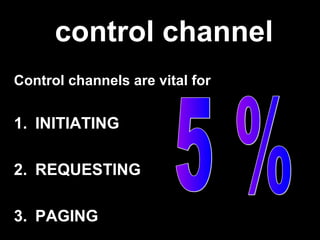
control channel
Control channels are vital for


1. INITIATING

2. REQUESTING

3. PAGING
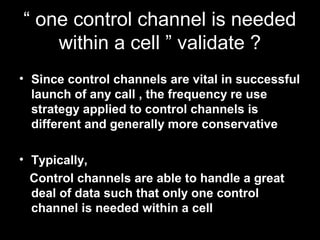
“ one control channel is needed
    within a cell ” validate ?
• Since control channels are vital in successful
  launch of any call , the frequency re use
  strategy applied to control channels is
  different and generally more conservative

• Typically,
  Control channels are able to handle a great
  deal of data such that only one control
  channel is needed within a cell
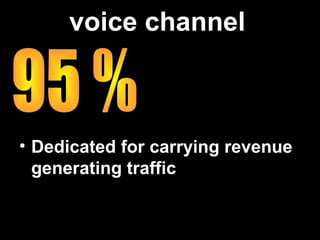
voice channel


• Dedicated for carrying revenue
  generating traffic
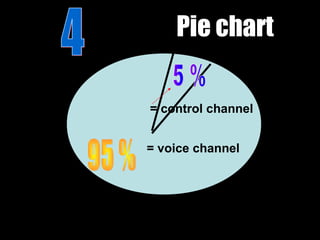
Pie chart

= control channel


= voice channel
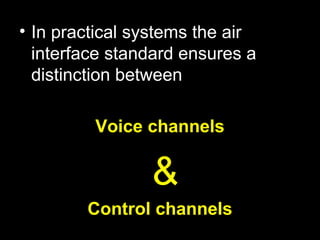
• In practical systems the air
  interface standard ensures a
  distinction between

         Voice channels

                &
        Control channels
Regarding usage

• Control channels are generally not
  allowed to be used as voice
  channel

                 &
• voice channels are generally not
  allowed to be used as Control
  channel
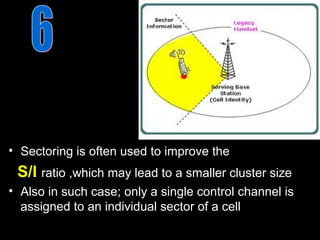
• Sectoring is often used to improve the
 S/I ratio ,which may lead to a smaller cluster size
• Also in such case; only a single control channel is
  assigned to an individual sector of a cell
f1/ f2 planning
• One of the key features of CDMA
  systems is that cluster size (N) = 1
• Also frequency planning is not nearly
 as difficult as TDMA
However ;
• Propagation considerations require most
  practical CDMA systems to use some sort of
  limited frequency reuse where propagation
  conditions are particularly ill- behaved in a
 particular RoC
BACKGROUND
• Newer cellular systems are designed to
  use wider bandwidth channels in order to
  provide much higher data rates.
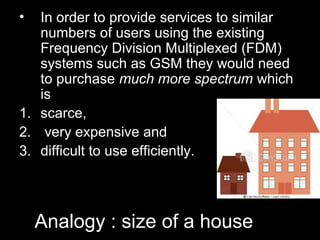
•  In order to provide services to similar
   numbers of users using the existing
   Frequency Division Multiplexed (FDM)
   systems such as GSM they would need
   to purchase much more spectrum which
   is
1. scarce,
2. very expensive and
3. difficult to use efficiently.


    Analogy : size of a house
Problem


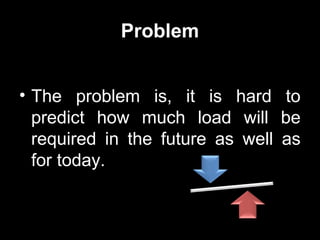
• The problem is, it is hard to
  predict how much load will be
  required in the future as well as
  for today.                        Interference


                     Load Balance
CDM
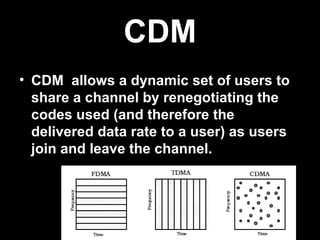
• CDM allows a dynamic set of users to
  share a channel by renegotiating the
  codes used (and therefore the
  delivered data rate to a user) as users
  join and leave the channel.
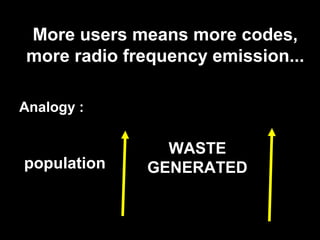
More users means more codes,
more radio frequency emission...

Analogy :

               WASTE
population   GENERATED
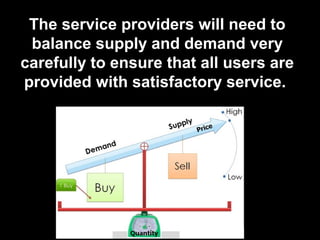
The service providers will need to
 balance supply and demand very
carefully to ensure that all users are
provided with satisfactory service.
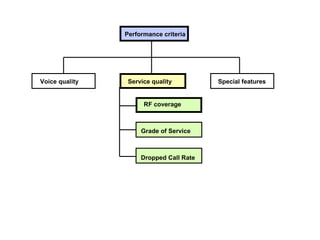
Performance criteria


Voice quality    Service quality         Special features


                      RF coverage


                     Grade of Service


                     Dropped Call Rate
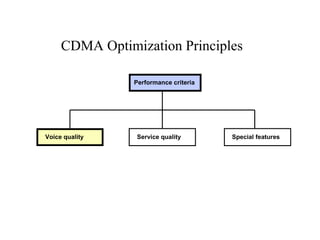
CDMA Optimization Principles

                Performance criteria


Voice quality   Service quality        Special features
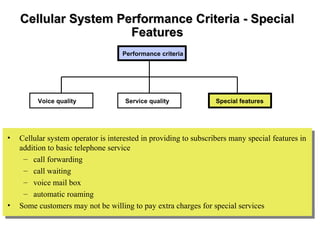
Cellular System Performance Criteria - Special
                     Features
                                    Performance criteria


         Voice quality               Service quality             Special features


•• Cellular system operator is interested in providing to subscribers many special features in
    Cellular system operator is interested in providing to subscribers many special features in
   addition to basic telephone service
    addition to basic telephone service
    –– call forwarding
        call forwarding
    –– call waiting
        call waiting
    –– voice mail box
        voice mail box
    –– automatic roaming
        automatic roaming
•• Some customers may not be willing to pay extra charges for special services
    Some customers may not be willing to pay extra charges for special services
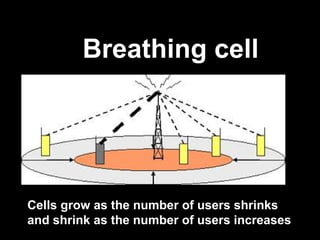
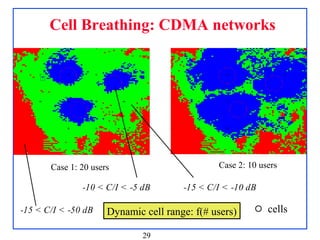
Breathing cell


Cells grow as the number of users shrinks
and shrink as the number of users increases
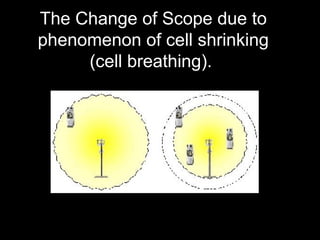
The Change of Scope due to
phenomenon of cell shrinking
     (cell breathing).
Cell Breathing: CDMA networks


    CasCase10 utilisateurs
        1 : 1: 20 users                     Cas 2 : 20 utilisateurs
                                              Case 2: 10 users

               -10 < C/I < -5 dB       -15 < C/I < -10 dB

-15 < C/I < -50 dB    Dynamic cell range: f(# users)         cellsles
                                                             cellu

                              29
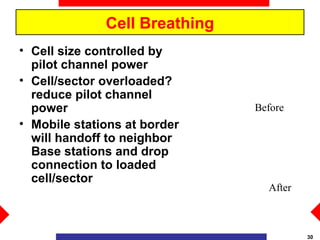
Cell Breathing
• Cell size controlled by
  pilot channel power
• Cell/sector overloaded?
  reduce pilot channel
  power                        Before
• Mobile stations at border
  will handoff to neighbor
  Base stations and drop
  connection to loaded
  cell/sector
                                 After


                                         30
Why does UMTS suffer from cells
   getting larger and smaller
  whereas GSM cells do not
 normally have this problem ?
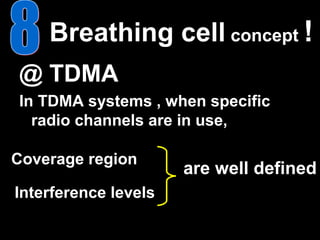
Breathing cell concept !
@ TDMA
In TDMA systems , when specific
  radio channels are in use,

Coverage region
                      are well defined
Interference levels
@ CDMA
 • The CDMA system has


    Dynamic              Coverage region

Time varying
• This coverage region varies
  depending on
  Instantaneous No: of users
  On the CDMA radio channel.
• This effect is known as

 Breathing cell
Near Far Problem

• All users transmit on the same frequency
• Signal from near users cause high
  interference to far users
• Reverse link power control is crucial
• Also saves phone battery


                                             36
Channel planning

Channel planning

  • 1.
  • 2.
    Successful deployment • Asuccessful wireless network deployment is completely dependent on the Wireless planning process.
  • 3.
    Many network deploymentscan fail to deliver 1. reliability, 2. capacity and 3. Performance due to poor planning and network design, a bad site survey or network implementation.
  • 4.
    • Judiciously assigningthe appropriate radio channels to each base station ==== is an important process • That is much more difficult in practice than in theory • For determining the appropriate frequency reuse ratio (or) cluster size & the appropriate separation between adjacent co- channel cells
  • 5.
    • Cellular systemsin practice seldom obey the homogenous propagation path loss
  • 6.
    Channels • Generally theavailable mobile radio spectrum is divided into channels. • Channels are part of an air interface standard that is used throughout a country or continent
  • 7.
    Channels 1) voice channel 2) control channel
  • 8.
    control channel Control channelsare vital for 1. INITIATING 2. REQUESTING 3. PAGING
  • 9.
    “ one controlchannel is needed within a cell ” validate ? • Since control channels are vital in successful launch of any call , the frequency re use strategy applied to control channels is different and generally more conservative • Typically, Control channels are able to handle a great deal of data such that only one control channel is needed within a cell
  • 10.
    voice channel • Dedicatedfor carrying revenue generating traffic
  • 11.
    Pie chart = controlchannel = voice channel
  • 12.
    • In practicalsystems the air interface standard ensures a distinction between Voice channels & Control channels
  • 13.
    Regarding usage • Controlchannels are generally not allowed to be used as voice channel & • voice channels are generally not allowed to be used as Control channel
  • 14.
    • Sectoring isoften used to improve the S/I ratio ,which may lead to a smaller cluster size • Also in such case; only a single control channel is assigned to an individual sector of a cell
  • 15.
    f1/ f2 planning •One of the key features of CDMA systems is that cluster size (N) = 1 • Also frequency planning is not nearly as difficult as TDMA
  • 16.
    However ; • Propagationconsiderations require most practical CDMA systems to use some sort of limited frequency reuse where propagation conditions are particularly ill- behaved in a particular RoC
  • 17.
  • 18.
    • Newer cellularsystems are designed to use wider bandwidth channels in order to provide much higher data rates.
  • 19.
    • Inorder to provide services to similar numbers of users using the existing Frequency Division Multiplexed (FDM) systems such as GSM they would need to purchase much more spectrum which is 1. scarce, 2. very expensive and 3. difficult to use efficiently. Analogy : size of a house
  • 20.
    Problem • The problemis, it is hard to predict how much load will be required in the future as well as for today. Interference Load Balance
  • 21.
    CDM • CDM allowsa dynamic set of users to share a channel by renegotiating the codes used (and therefore the delivered data rate to a user) as users join and leave the channel.
  • 22.
    More users meansmore codes, more radio frequency emission... Analogy : WASTE population GENERATED
  • 23.
    The service providerswill need to balance supply and demand very carefully to ensure that all users are provided with satisfactory service.
  • 24.
    Performance criteria Voice quality Service quality Special features RF coverage Grade of Service Dropped Call Rate
  • 25.
    CDMA Optimization Principles Performance criteria Voice quality Service quality Special features
  • 26.
    Cellular System PerformanceCriteria - Special Features Performance criteria Voice quality Service quality Special features •• Cellular system operator is interested in providing to subscribers many special features in Cellular system operator is interested in providing to subscribers many special features in addition to basic telephone service addition to basic telephone service –– call forwarding call forwarding –– call waiting call waiting –– voice mail box voice mail box –– automatic roaming automatic roaming •• Some customers may not be willing to pay extra charges for special services Some customers may not be willing to pay extra charges for special services
  • 27.
    Breathing cell Cells growas the number of users shrinks and shrink as the number of users increases
  • 28.
    The Change ofScope due to phenomenon of cell shrinking (cell breathing).
  • 29.
    Cell Breathing: CDMAnetworks CasCase10 utilisateurs 1 : 1: 20 users Cas 2 : 20 utilisateurs Case 2: 10 users -10 < C/I < -5 dB -15 < C/I < -10 dB -15 < C/I < -50 dB Dynamic cell range: f(# users) cellsles cellu 29
  • 30.
    Cell Breathing • Cellsize controlled by pilot channel power • Cell/sector overloaded? reduce pilot channel power Before • Mobile stations at border will handoff to neighbor Base stations and drop connection to loaded cell/sector After 30
  • 31.
    Why does UMTSsuffer from cells getting larger and smaller whereas GSM cells do not normally have this problem ?
  • 32.
    Breathing cell concept! @ TDMA In TDMA systems , when specific radio channels are in use, Coverage region are well defined Interference levels
  • 33.
    @ CDMA •The CDMA system has Dynamic Coverage region Time varying
  • 34.
    • This coverageregion varies depending on Instantaneous No: of users On the CDMA radio channel. • This effect is known as Breathing cell
  • 36.
    Near Far Problem •All users transmit on the same frequency • Signal from near users cause high interference to far users • Reverse link power control is crucial • Also saves phone battery 36