
Presentation on GSM
Network
• GSM-Introduction
• Architecture
• Technical Specifications
• Channels
• Hand Overs
• Characteristics and features
• Applications
Contents
What is GSM ?
Global System for Mobile (GSM) is a
second generation cellular standard
developed to cater voice services and
data delivery using digital modulation
GSM Services
 Tele-services
 Bearer or Data Services
 Supplementary services
Tele Services
• Telecommunication services that enable voice communication
via mobile phones
• Offered services
- Mobile telephony
- Emergency calling
Bearer Services
Supplementary Services
Call related services :
• Call Waiting- Notification of an incoming call while on the handset
• Call Hold- Put a caller on hold to take another call
• Call Barring- All calls, outgoing calls, or incoming calls
• Call Forwarding- Calls can be sent to various numbers defined by
the user
• Multi Party Call Conferencing - Link multiple calls together
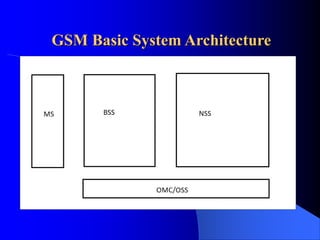
GSM Basic System Architecture
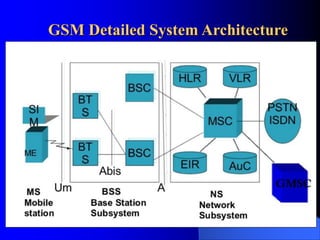
GSM Detailed System Architecture
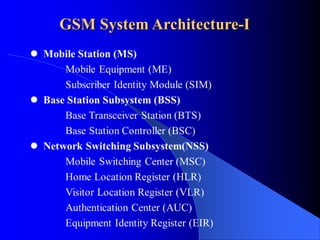
GSM System Architecture-I
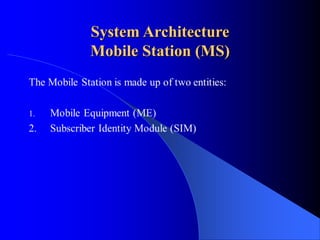
System Architecture
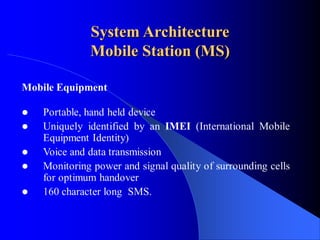
Mobile Station (MS)
System Architecture
Mobile Station (MS)
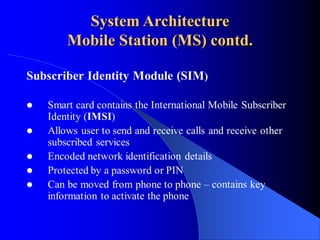
System Architecture
Mobile Station (MS) contd.
System Architecture
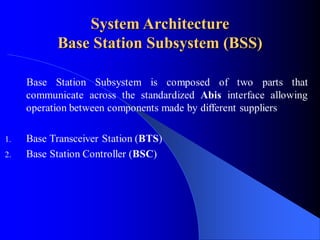
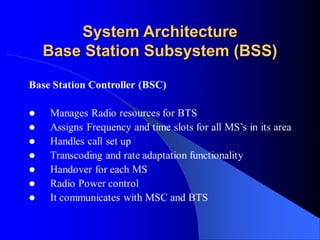
Base Station Subsystem (BSS)
System Architecture
Base Station Subsystem (BSS)
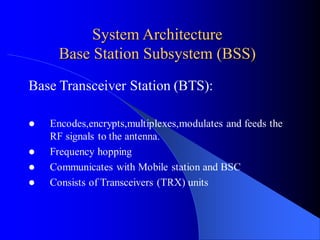
System Architecture
Base Station Subsystem (BSS)
System Architecture
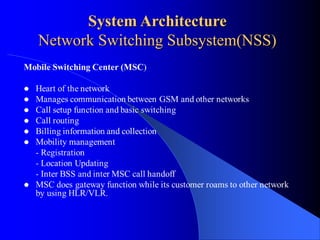
Network Switching Subsystem(NSS)
System Architecture
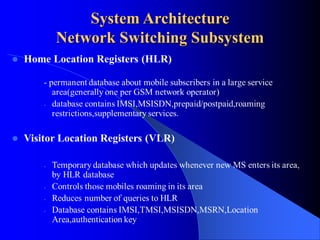
Network Switching Subsystem
System Architecture
Network Switching Subsystem
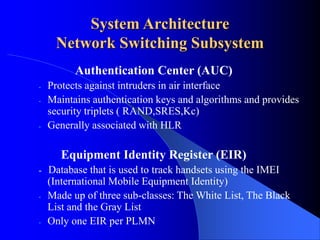
Authentication Center (AUC)
- Protects against intruders in air interface
- Maintains authentication keys and algorithms and provides
security triplets ( RAND,SRES,Kc)
- Generally associated with HLR
Equipment Identity Register (EIR)
- Database that is used to track handsets using the IMEI
(International Mobile Equipment Identity)
- Made up of three sub-classes: The White List, The Black
List and the Gray List
- Only one EIR per PLMN
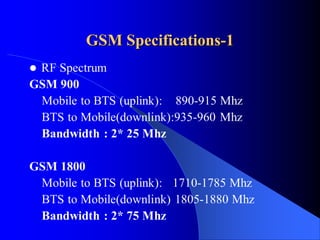
GSM Specifications-1
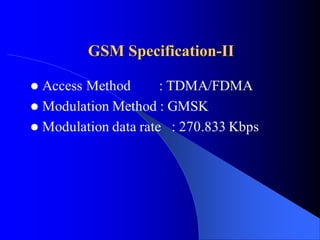
GSM Specification-II
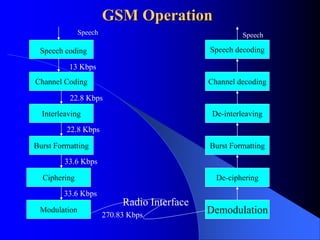
GSM Operation
Speech decoding
Channel decoding
De-interleaving
Burst Formatting
De-ciphering
Demodulation
Modulation
Ciphering
Burst Formatting
Interleaving
Channel Coding
Speech coding
Radio Interface
Speech Speech
13 Kbps
22.8 Kbps
22.8 Kbps
33.6 Kbps
33.6 Kbps
270.83 Kbps
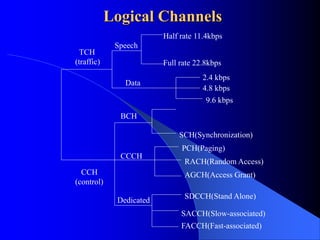
TCH
(traffic)
CCH
(control)
BCH
CCCH
Dedicated
2.4 kbps
4.8 kbps
9.6 kbps
SCH(Synchronization)
PCH(Paging)
RACH(Random Access)
AGCH(Access Grant)
SDCCH(Stand Alone)
SACCH(Slow-associated)
Half rate 11.4kbps
Full rate 22.8kbps
Speech
Data
Logical Channels
FACCH(Fast-associated)
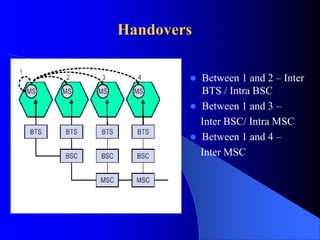
 Between 1 and 2 – Inter
BTS / Intra BSC
 Between 1 and 3 –
Inter BSC/ Intra MSC
 Between 1 and 4 –
Inter MSC
Handovers
Characteristics of GSM Standard
Advantages of GSM over Analog system
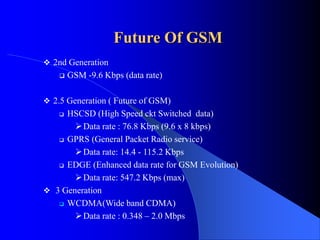
 2nd Generation
 GSM -9.6 Kbps (data rate)
 2.5 Generation ( Future of GSM)
 HSCSD (High Speed ckt Switched data)
Data rate : 76.8 Kbps (9.6 x 8 kbps)
 GPRS (General Packet Radio service)
Data rate: 14.4 - 115.2 Kbps
 EDGE (Enhanced data rate for GSM Evolution)
Data rate: 547.2 Kbps (max)
 3 Generation
 WCDMA(Wide band CDMA)
Data rate : 0.348 – 2.0 Mbps
Future Of GSM
Thanks !

GSM Architecture.ppt