ARM - AMBA
M. ANBUSELVI
ASP/ECE
Session Objectives
 To learn about Advanced Microcontroller Bus Architecture
Session Outcomes
 At the end of the session, students will be able to
 Understand the Advanced Microcontroller Bus Architecture
Outline
 To discuss about
 Advanced Microcontroller Bus Architecture
Advanced Microcontroller Bus Architecture
• ARM processor cores have bus interfaces that are optimized for
high-speed cache interfacing.
• Where a core is used, with or without a cache, as a component on
a complex system chip, some interfacing is required to allow the
ARM to communicate with other on-chip macrocells.
• ARM Limited specified the Advanced Microcontroller Bus
Architecture, AMBA, to standardize the on-chip connection of
different macrocells.
• Macrocells designed to this bus interface can be viewed as a kit of
parts for future system chips, and ultimately designing a complex
system on a chip based on a new combination of existing
macrocells
Advanced Microcontroller Bus Architecture
• The Advanced High-performance Bus (AHB)
• Used to connect high-performance system modules. It supports burst
mode data transfers and split transactions, and all timing is reference to
a single clock edge.
• The Advanced System Bus (ASB)
• used to connect high-performance system modules. It supports burst
mode data transfers.
• The Advanced Peripheral Bus (APB)
• Offers a simpler interface for low-performance peripherals.
• AHB to support for higher performance, synthesis and timing
verification.
• The APB is generally used as a local secondary bus which appears as a
single slave module on the AHB or ASB.
Advanced Microcontroller Bus Architecture
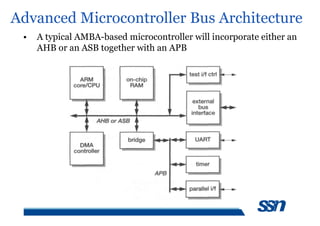
• A typical AMBA-based microcontroller will incorporate either an
AHB or an ASB together with an APB
Bus Arbitration
• A bus transaction is initiated by a bus master which requests
access from a central arbiter.
• The arbiter decides priorities when there are conflicting requests,
and its design is a system specific issue.
• The ASB only specifies the protocol which must be followed:
• The master, x, issues a request (AREQx) to the central arbiter.
• When the bus is available, the arbiter issues a grant (AGNTx) to
the master.
• (The arbitration must take account of the bus lock signal (BLOK)
when deciding which grant to issue to ensure that atomic bus
transactions are not violated.)
Bus Transfer - Master
• When a master has been granted access to the bus, it issues
address and control information to indicate the type of the
transfer and the slave device which should respond.
• The following signal is used to define the transaction timing:
• The bus clock, BCLK.
• The bus master which holds the grant then proceeds with the bus
transaction using the following signals:
• Bus transaction, BTRAN[1:0], indicates whether the next bus
cycle will be address-only, sequential or non-sequential.
• It is enabled by the grant signal and is ahead of the bus cycle to
which it refers.
• The address bus, BA[31:0]
Bus Transfer - Master
• Bus transfer direction, BWRITE.
• Bus protection signals, BPROT[1:0],
• which indicate instruction or data fetches and supervisor or user
access.
• The transfer size, BSIZE[1:0],
• specifies a byte, half-word or word transfer.
• Bus lock, BLOK,
• allows a master to retain the bus to complete an atomic read-
modify-write transaction.
• The data bus, BD[31:0],
• used to transmit write data and to receive read data.
• In an implementation with multiplexed address and data, the
address is also transmitted down this bus.
Bus Transfer - Slave
• A slave unit may process the requested transaction immediately,
accepting write data or issuing read data on ED[31:0], or signal
one of the following responses:
• Bus wait, BWAIT,
• allows a slave module to insert wait states when it cannot
complete the transaction in the current cycle.
• Bus last, BLAST,
• allows a slave to terminate a sequential burst to force the bus
master to issue a new bus transaction request to continue.
• Bus error, BERROR,
• indicates a transaction that cannot be completed.
• If the master is a processor it should abort the transfer.
Bus Reset
• The ASB supports a number of independent on-chip modules,
many of which may be able to drive the data bus (and some
control lines).
• Provided all the modules obey the bus protocols, there will only be
one module driving any bus line at any time.
• Immediately after power-on, however, all the modules come up in
unknown states.
• It takes some time for a clock oscillator to stabilize after power-
up, so there may be no reliable clock available to sequence all the
modules into a known state.
Bus Reset
• In any case,
• if two or more modules power-up trying to drive bus lines in
opposite directions, the
• output drive clashes may cause power supply crow-bar problems
which may prevent
• the chip from powering up properly at all.
• Correct ASB power-up is ensured by imposing an asynchronous
reset mode that
• forces all drivers off the bus independently of the clock.
References
• Steve Furber, ‘’ARM System - On - Chip architecture” Addison
Wesley, 2000

AMBA.ppt

  • 1.
    ARM - AMBA M.ANBUSELVI ASP/ECE
  • 2.
    Session Objectives  Tolearn about Advanced Microcontroller Bus Architecture
  • 3.
    Session Outcomes  Atthe end of the session, students will be able to  Understand the Advanced Microcontroller Bus Architecture
  • 4.
    Outline  To discussabout  Advanced Microcontroller Bus Architecture
  • 5.
    Advanced Microcontroller BusArchitecture • ARM processor cores have bus interfaces that are optimized for high-speed cache interfacing. • Where a core is used, with or without a cache, as a component on a complex system chip, some interfacing is required to allow the ARM to communicate with other on-chip macrocells. • ARM Limited specified the Advanced Microcontroller Bus Architecture, AMBA, to standardize the on-chip connection of different macrocells. • Macrocells designed to this bus interface can be viewed as a kit of parts for future system chips, and ultimately designing a complex system on a chip based on a new combination of existing macrocells
  • 6.
    Advanced Microcontroller BusArchitecture • The Advanced High-performance Bus (AHB) • Used to connect high-performance system modules. It supports burst mode data transfers and split transactions, and all timing is reference to a single clock edge. • The Advanced System Bus (ASB) • used to connect high-performance system modules. It supports burst mode data transfers. • The Advanced Peripheral Bus (APB) • Offers a simpler interface for low-performance peripherals. • AHB to support for higher performance, synthesis and timing verification. • The APB is generally used as a local secondary bus which appears as a single slave module on the AHB or ASB.
  • 7.
    Advanced Microcontroller BusArchitecture • A typical AMBA-based microcontroller will incorporate either an AHB or an ASB together with an APB
  • 8.
    Bus Arbitration • Abus transaction is initiated by a bus master which requests access from a central arbiter. • The arbiter decides priorities when there are conflicting requests, and its design is a system specific issue. • The ASB only specifies the protocol which must be followed: • The master, x, issues a request (AREQx) to the central arbiter. • When the bus is available, the arbiter issues a grant (AGNTx) to the master. • (The arbitration must take account of the bus lock signal (BLOK) when deciding which grant to issue to ensure that atomic bus transactions are not violated.)
  • 9.
    Bus Transfer -Master • When a master has been granted access to the bus, it issues address and control information to indicate the type of the transfer and the slave device which should respond. • The following signal is used to define the transaction timing: • The bus clock, BCLK. • The bus master which holds the grant then proceeds with the bus transaction using the following signals: • Bus transaction, BTRAN[1:0], indicates whether the next bus cycle will be address-only, sequential or non-sequential. • It is enabled by the grant signal and is ahead of the bus cycle to which it refers. • The address bus, BA[31:0]
  • 10.
    Bus Transfer -Master • Bus transfer direction, BWRITE. • Bus protection signals, BPROT[1:0], • which indicate instruction or data fetches and supervisor or user access. • The transfer size, BSIZE[1:0], • specifies a byte, half-word or word transfer. • Bus lock, BLOK, • allows a master to retain the bus to complete an atomic read- modify-write transaction. • The data bus, BD[31:0], • used to transmit write data and to receive read data. • In an implementation with multiplexed address and data, the address is also transmitted down this bus.
  • 11.
    Bus Transfer -Slave • A slave unit may process the requested transaction immediately, accepting write data or issuing read data on ED[31:0], or signal one of the following responses: • Bus wait, BWAIT, • allows a slave module to insert wait states when it cannot complete the transaction in the current cycle. • Bus last, BLAST, • allows a slave to terminate a sequential burst to force the bus master to issue a new bus transaction request to continue. • Bus error, BERROR, • indicates a transaction that cannot be completed. • If the master is a processor it should abort the transfer.
  • 12.
    Bus Reset • TheASB supports a number of independent on-chip modules, many of which may be able to drive the data bus (and some control lines). • Provided all the modules obey the bus protocols, there will only be one module driving any bus line at any time. • Immediately after power-on, however, all the modules come up in unknown states. • It takes some time for a clock oscillator to stabilize after power- up, so there may be no reliable clock available to sequence all the modules into a known state.
  • 13.
    Bus Reset • Inany case, • if two or more modules power-up trying to drive bus lines in opposite directions, the • output drive clashes may cause power supply crow-bar problems which may prevent • the chip from powering up properly at all. • Correct ASB power-up is ensured by imposing an asynchronous reset mode that • forces all drivers off the bus independently of the clock.
  • 14.
    References • Steve Furber,‘’ARM System - On - Chip architecture” Addison Wesley, 2000