Pipelining
Breaks down instructionsinto sub-operations that can run simultaneously
across multiple stages. For example, an instruction pipeline may need to
fetch an instruction and an operand at the same time.
Vector processing
Uses array processors to perform the same operation on multiple data
elements simultaneously. Vector processing is useful for high-performance
scientific computing
4.
The sequence ofinstructions read from memory constitutes an instruction
stream . The operations performed on the data in the processor constitutes
a data stream . Parallel processing may occur in the instruction stream, in
the data stream, or in both. Flynn's classification divides computers into
four major groups as follows:
Single instruction stream, single data stream (SISD)
Single instruction stream, multiple data stream (SIMD)
Multiple instruction stream, single data stream (MISD)
Multiple instruction stream, multiple data stream (MIMD)
5.
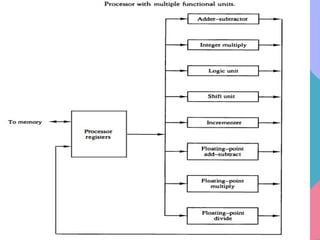
SISD represents theorganization of a single computer containing a control
unit, a processor unit, and a memory unit. Instructions are executed
sequentially and the system may or may not have internal parallel
processing capabilities. Parallel processing in this case may be achieved by
means of multiple functional units or by pipeline processing.
SIMD represents an organization that includes many processing units under
the supervision of a common control unit. All processors receive the same
instruction from the control unit but operate on different items of data. The
shared memory unit must contain multiple modules so that it can
communicate with all the processors simultaneously
MISD structure is only of theoretical interest since no practical system has
been constructed using this organization.
MIMD organization refers to a computer system capable of processing
several programs at the same time. Most multiprocessor and
multicomputer systems can be classified in this category
6.
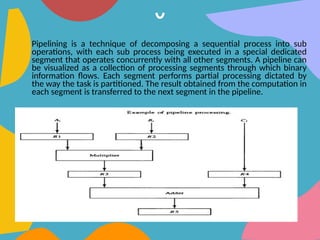
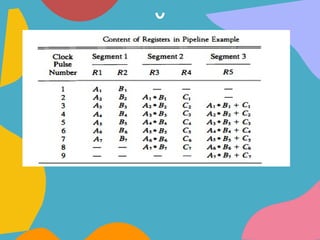
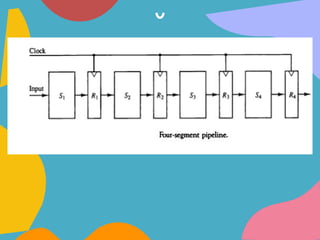
Pipelining is atechnique of decomposing a sequential process into sub
operations, with each sub process being executed in a special dedicated
segment that operates concurrently with all other segments. A pipeline can
be visualized as a collection of processing segments through which binary
information flows. Each segment performs partial processing dictated by
the way the task is partitioned. The result obtained from the computation in
each segment is transferred to the next segment in the pipeline.
9.
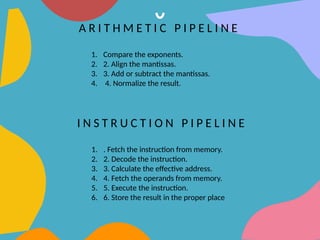
A R IT H M E T I C P I P E L I N E
1. Compare the exponents.
2. 2. Align the mantissas.
3. 3. Add or subtract the mantissas.
4. 4. Normalize the result.
I N S T R U C T I O N P I P E L I N E
1. . Fetch the instruction from memory.
2. 2. Decode the instruction.
3. 3. Calculate the effective address.
4. 4. Fetch the operands from memory.
5. 5. Execute the instruction.
6. 6. Store the result in the proper place
10.
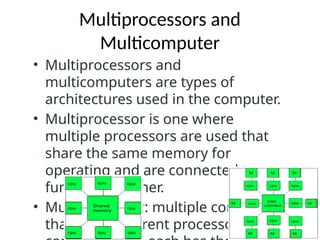
Multiprocessors and
Multicomputer
• Multiprocessorsand
multicomputers are types of
architectures used in the computer.
• Multiprocessor is one where
multiple processors are used that
share the same memory for
operating and are connected to
function together.
• Multicomputer: multiple computers
that have different processor are