Dr. S. Pradeep Narayanan, Assistant Professor,
Senior Grade I, SENSE, VIT Chennai.
ECE3004 –
Computer Organization and
Architecture
➢ Processor level parallelism - Dependency,
➢ Flynn taxonomy,
➢ Memory organization for Multiprocessors
system,
➢ Symmetric Multiprocessor,
➢ Cache Coherence and The MESI Protocol.
Module 7 : Multiprocessors
– It is the technique which provides simultaneous data processing for the purpose
of increasing the computational speed of a computer system.
– parallel can be achieved by multiple functional unit that perform identical or
different operations simultaneously.
- In computers, parallel processing is the processing of program instructions by
dividing them among multiple processors with the objective of running a
program in less time.
- The simultaneous use of more than one CPU to execute a program. Ideally,
parallel processing makes a program run faster because there are more engines
(CPUs) running it.
In practice, it is often difficult to divide a program in such a way that separate
CPUs can execute different portions without interfering with each other.
Parallel Processing
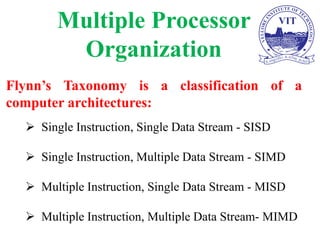
➢ Single Instruction, Single Data Stream - SISD
➢ Single Instruction, Multiple Data Stream - SIMD
➢ Multiple Instruction, Single Data Stream - MISD
➢ Multiple Instruction, Multiple Data Stream- MIMD
Multiple Processor
Organization
Flynn’s Taxonomy is a classification of a
computer architectures:
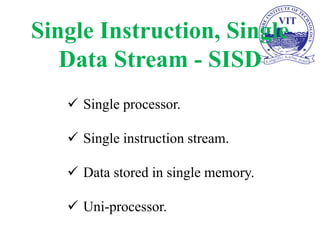
✓ Single processor.
✓ Single instruction stream.
✓ Data stored in single memory.
✓ Uni-processor.
Single Instruction, Single
Data Stream - SISD
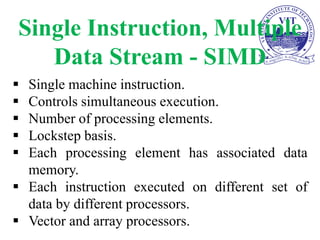
▪ Single machine instruction.
▪ Controls simultaneous execution.
▪ Number of processing elements.
▪ Lockstep basis.
▪ Each processing element has associated data
memory.
▪ Each instruction executed on different set of
data by different processors.
▪ Vector and array processors.
Single Instruction, Multiple
Data Stream - SIMD
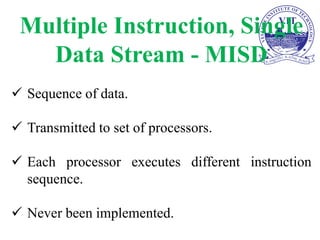
✓ Sequence of data.
✓ Transmitted to set of processors.
✓ Each processor executes different instruction
sequence.
✓ Never been implemented.
Multiple Instruction, Single
Data Stream - MISD
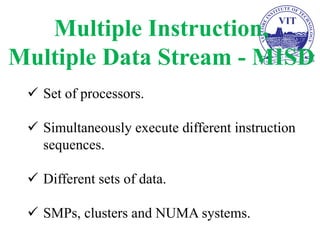
Multiple Instruction,
Multiple Data Stream - MISD
✓ Set of processors.
✓ Simultaneously execute different instruction
sequences.
✓ Different sets of data.
✓ SMPs, clusters and NUMA systems.
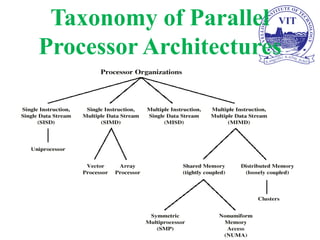
Taxonomy of Parallel
Processor Architectures
Thank You

M7_L1_PPT.computer organization and archi

  • 1.
    Dr. S. PradeepNarayanan, Assistant Professor, Senior Grade I, SENSE, VIT Chennai. ECE3004 – Computer Organization and Architecture
  • 2.
    ➢ Processor levelparallelism - Dependency, ➢ Flynn taxonomy, ➢ Memory organization for Multiprocessors system, ➢ Symmetric Multiprocessor, ➢ Cache Coherence and The MESI Protocol. Module 7 : Multiprocessors
  • 3.
    – It isthe technique which provides simultaneous data processing for the purpose of increasing the computational speed of a computer system. – parallel can be achieved by multiple functional unit that perform identical or different operations simultaneously. - In computers, parallel processing is the processing of program instructions by dividing them among multiple processors with the objective of running a program in less time. - The simultaneous use of more than one CPU to execute a program. Ideally, parallel processing makes a program run faster because there are more engines (CPUs) running it. In practice, it is often difficult to divide a program in such a way that separate CPUs can execute different portions without interfering with each other. Parallel Processing
  • 4.
    ➢ Single Instruction,Single Data Stream - SISD ➢ Single Instruction, Multiple Data Stream - SIMD ➢ Multiple Instruction, Single Data Stream - MISD ➢ Multiple Instruction, Multiple Data Stream- MIMD Multiple Processor Organization Flynn’s Taxonomy is a classification of a computer architectures:
  • 5.
    ✓ Single processor. ✓Single instruction stream. ✓ Data stored in single memory. ✓ Uni-processor. Single Instruction, Single Data Stream - SISD
  • 6.
    ▪ Single machineinstruction. ▪ Controls simultaneous execution. ▪ Number of processing elements. ▪ Lockstep basis. ▪ Each processing element has associated data memory. ▪ Each instruction executed on different set of data by different processors. ▪ Vector and array processors. Single Instruction, Multiple Data Stream - SIMD
  • 7.
    ✓ Sequence ofdata. ✓ Transmitted to set of processors. ✓ Each processor executes different instruction sequence. ✓ Never been implemented. Multiple Instruction, Single Data Stream - MISD
  • 8.
    Multiple Instruction, Multiple DataStream - MISD ✓ Set of processors. ✓ Simultaneously execute different instruction sequences. ✓ Different sets of data. ✓ SMPs, clusters and NUMA systems.
  • 9.
  • 10.