PRESENTED BY
ATIKUR RAHMAN
Department of Optometry, RIPANS
CONTENTS:
 Photoluminescence
 Fluorescence
 Energy level diagram
 Application of fluorescence
 Fluorescent materials
 Fluorescent lamp
 Phosphorescence
 Principle of phosphorescence
 Application of phosphorescence
 References
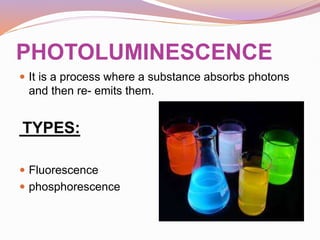
PHOTOLUMINESCENCE
 It is a process where a substance absorbs photons
and then re- emits them.
TYPES:
 Fluorescence
 phosphorescence
FLUORESCENCE
 It is the emission of electromagnetic radiation,
caused by excitation of atoms in a material, which
then re-emit almost immediately (within about 10−8
sec.)
 The initial excitation is usually caused by absorption
of energy.
 Emission of light suddenly stops on removal of
source of excitation.
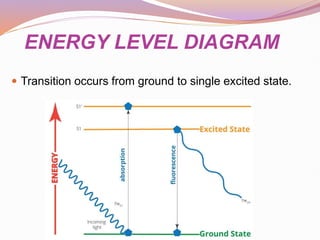
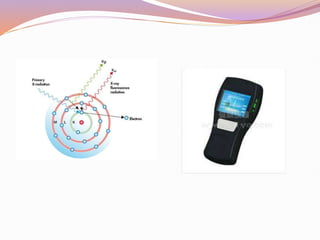
ENERGY LEVEL DIAGRAM
 Transition occurs from ground to single excited state.
APPLICATION :
 To identify structures in fixed and live biological
samples.
 Fluorescence has many practical applications,
including mineralogy, medicine, chemical
sensors(fluorescence spectroscopy), fluorescent
labelling, dyes, biological detectors and cathode-ray
tubes.
 X- ray fluorescence is used to analyze minerals.
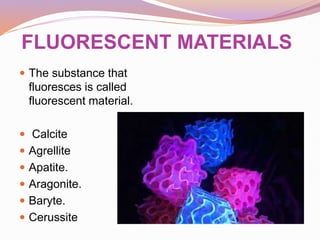
FLUORESCENT MATERIALS
 The substance that
fluoresces is called
fluorescent material.
 Calcite
 Agrellite
 Apatite.
 Aragonite.
 Baryte.
 Cerussite
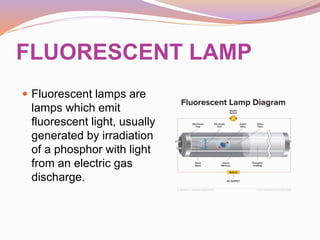
FLUORESCENT LAMP
 Fluorescent lamps are
lamps which emit
fluorescent light, usually
generated by irradiation
of a phosphor with light
from an electric gas
discharge.
PHOSPHORESCENCE
 Phosphorescence is the light energy emitted by a
certain form of chemical reaction in which the
reactants excess chemical energy is release as light
energy.
 It persists as an afterglow when the exciting is
removed.
PRINCIPLE OF
PHOSPHORESCENCE
 Any material observed light and enter in excited
state, then the emission of energy from triplet state
to ground singlet state is phosphorescence
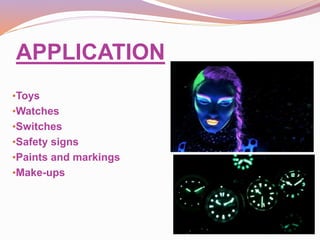
APPLICATION
•Toys
•Watches
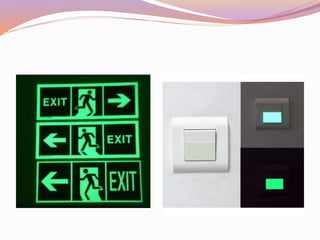
•Switches
•Safety signs
•Paints and markings
•Make-ups
Fluorescence and Phosphorescence by Atikur Rahman

Fluorescence and Phosphorescence by Atikur Rahman

  • 1.
  • 2.
    CONTENTS:  Photoluminescence  Fluorescence Energy level diagram  Application of fluorescence  Fluorescent materials  Fluorescent lamp  Phosphorescence  Principle of phosphorescence  Application of phosphorescence  References
  • 3.
    PHOTOLUMINESCENCE  It isa process where a substance absorbs photons and then re- emits them. TYPES:  Fluorescence  phosphorescence
  • 4.
    FLUORESCENCE  It isthe emission of electromagnetic radiation, caused by excitation of atoms in a material, which then re-emit almost immediately (within about 10−8 sec.)  The initial excitation is usually caused by absorption of energy.  Emission of light suddenly stops on removal of source of excitation.
  • 7.
    ENERGY LEVEL DIAGRAM Transition occurs from ground to single excited state.
  • 9.
    APPLICATION :  Toidentify structures in fixed and live biological samples.  Fluorescence has many practical applications, including mineralogy, medicine, chemical sensors(fluorescence spectroscopy), fluorescent labelling, dyes, biological detectors and cathode-ray tubes.  X- ray fluorescence is used to analyze minerals.
  • 12.
    FLUORESCENT MATERIALS  Thesubstance that fluoresces is called fluorescent material.  Calcite  Agrellite  Apatite.  Aragonite.  Baryte.  Cerussite
  • 13.
    FLUORESCENT LAMP  Fluorescentlamps are lamps which emit fluorescent light, usually generated by irradiation of a phosphor with light from an electric gas discharge.
  • 14.
    PHOSPHORESCENCE  Phosphorescence isthe light energy emitted by a certain form of chemical reaction in which the reactants excess chemical energy is release as light energy.  It persists as an afterglow when the exciting is removed.
  • 17.
    PRINCIPLE OF PHOSPHORESCENCE  Anymaterial observed light and enter in excited state, then the emission of energy from triplet state to ground singlet state is phosphorescence
  • 18.