PRESENTED BY
ATIKUR RAHMAN
Department of Optometry, RIPANS
What is color vision?
 Color vision is an ability to distinguish among various
wavelengths of light waves and to perceive the
differences in hue.
COLOR VISION DEFECTS
 It is a reduced ability to distinguish between certain
colors.
 Males are affected more than females.
 TYPES OF COLOR VISION DEFECT :
 Inherited color vision defect
 Acquired color vision defect
COLOR VISION TESTING
 Color vision test helps to identify red-green and blue
color blindness.
 TYPES OF COLOR VISSION TEST:
 Pseudo Isochromatic plates
 Arrangement Tests
 Anomaloscopes
PSEUDO ISOCHROMATIC PLATE
TESTS (PIC)
 PIC tests are designed on the basis of color confusions
made by persons with color defects.
 The test is in the form of booklet.
 Each figure is made up of dots that vary from the
background in hue as well as brightness.
PIC plates are designed in 4
different plates
 Transformation Plates
 Vanishing Plates
 Hidden Digit Plates
 Diagnostic Plates
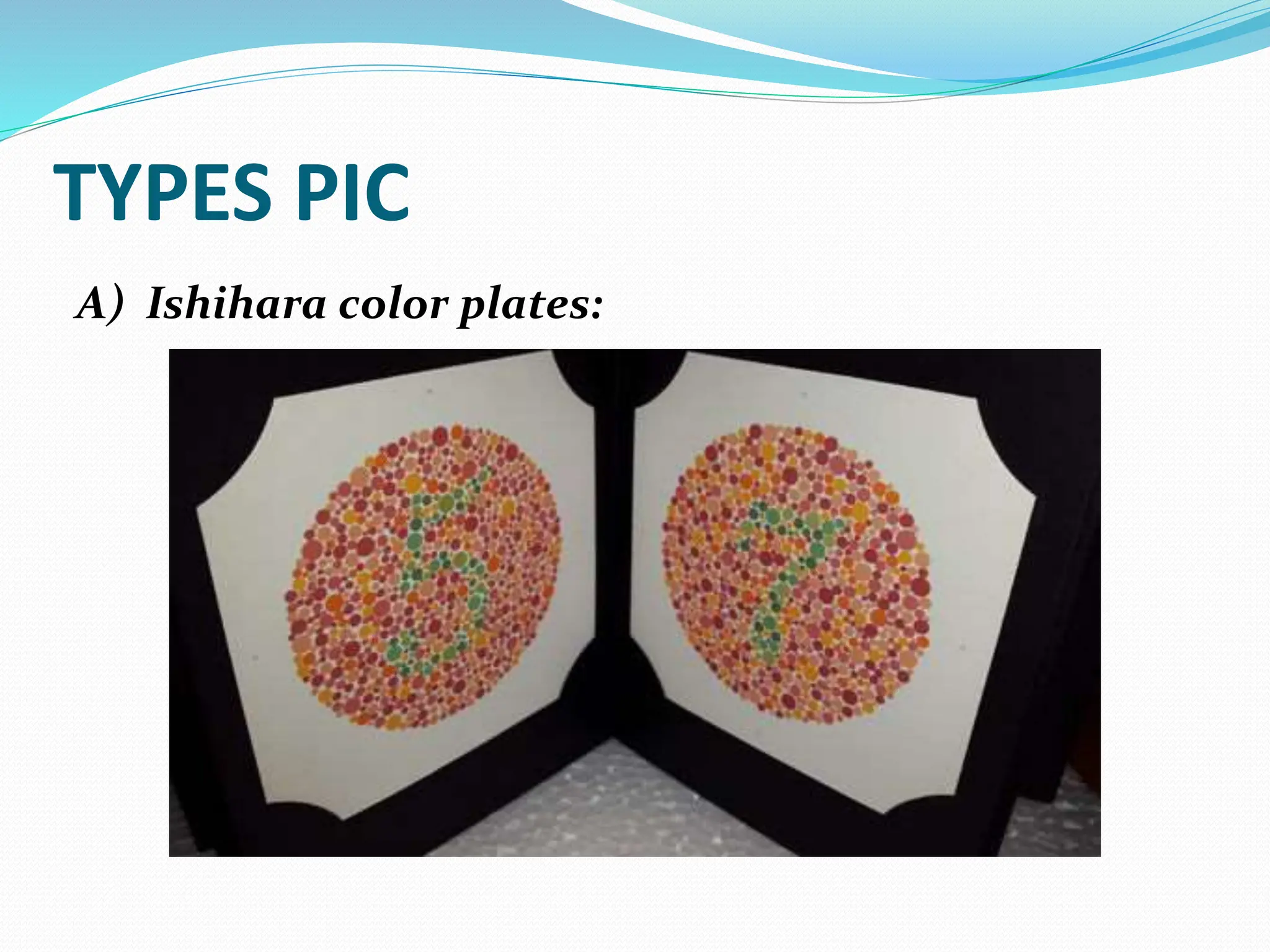
TYPES PIC
A) Ishihara color plates:
 Ishihara is the most popular PIC test & comes in 3
different forms 16 plates,24plates & 38 plates.
 The test should be performed under standard room
illumination.
 The patient should recognize each plate at 75 cm
within 3 sec.
B) American Optical Company (AOC) Plates:
 It comprises of a set of 15 plates.
 It is used as a screening test.
C) Divorine test
Divorine test
 It consist of set of 15 PIC plates.
 It is use for identifying patients with hereditary red-green
color deficiencies.
 The test booklet consist both PIC plates and a color
naming test.
ARRANGEMENT TESTS
 These tests are most useful for both inherited &
acquired color defects.
Types of Arrangement Test
 Fransworth-munsel D-15 Test
 Fransworth 100 Hue Test
Fransworth-munsel D-15 Test
 It is designed to distinguish the functionally color
blind from the moderately color defective & the
normal.
 It detect not only red-green anomalies but also yellow-
blue anomalies.
 It consist of 15 different colored caps.
Fransworth 100 Hue Test
 Fransworth 100 Hue Test(FM 100-hue) is a sensitive
test.
 It consist of 85 caps located in 4 trays of 21 or 22 caps
each.
 Two reference caps are fixed at two ends of each tray.
Nagel Anomaloscopes
 This instrument is based on Rayleigh equation.
 Commonly used in the diagnosis of red-green
deficiencies.
 Assesses the observers ability to make a specific colour
match.
 It can be distinguishing between dichromates and
anomalous trichromates.
ADVANTAGES AND DISADVANTAGE
OF NAGELS ANOMALOSCOPE TEST
ADVANTAGES
 Its superiority in distinguishing between dichromates
and anomalous trichromats.
 It remains the standard for classification of the four
types of red green defects.
 DISADVANTAGES
 Rarely used because of its difficulty to administer and
high cost.
PATIENTS SELECTION FOR THE
COLOR VISION TEST
 Choose patients who complains about the differences
in colour vision between two eyes.
 Test any patients who exhibit a sign of abnormality in
fundus.
 Choose patients who complains of unexplained
reduction in visual acuity.
MANAGEMENT OF COLOR VISION
DEFECTS
 It is important to counsel the patient for colour vision
defects.
 The practitioner should carefully listen to the patients
complain related with colour deficiency.
 There is no care for inherited colour defects.
Management of Inherited color
defects
 Patients Counseling.
 Color Filters.
Management of patients with Rod
Monochromatism
 The Rod monochromats usually have poor visual
acuity along with photophobia.
Management of patients with
acquired color defects
 Acquired color defects may affect each eye differently.
 The color vision testing should be done on frequent
intervals to monitor the success of treatment.
THANK YOU

Color Vision by Atikur Rahman (dept. optometry, RIPANS)

  • 1.
  • 2.
    What is colorvision?  Color vision is an ability to distinguish among various wavelengths of light waves and to perceive the differences in hue.
  • 3.
    COLOR VISION DEFECTS It is a reduced ability to distinguish between certain colors.  Males are affected more than females.  TYPES OF COLOR VISION DEFECT :  Inherited color vision defect  Acquired color vision defect
  • 5.
    COLOR VISION TESTING Color vision test helps to identify red-green and blue color blindness.  TYPES OF COLOR VISSION TEST:  Pseudo Isochromatic plates  Arrangement Tests  Anomaloscopes
  • 6.
    PSEUDO ISOCHROMATIC PLATE TESTS(PIC)  PIC tests are designed on the basis of color confusions made by persons with color defects.  The test is in the form of booklet.  Each figure is made up of dots that vary from the background in hue as well as brightness.
  • 7.
    PIC plates aredesigned in 4 different plates  Transformation Plates  Vanishing Plates  Hidden Digit Plates  Diagnostic Plates
  • 8.
    TYPES PIC A) Ishiharacolor plates:
  • 9.
     Ishihara isthe most popular PIC test & comes in 3 different forms 16 plates,24plates & 38 plates.  The test should be performed under standard room illumination.  The patient should recognize each plate at 75 cm within 3 sec.
  • 10.
    B) American OpticalCompany (AOC) Plates:  It comprises of a set of 15 plates.  It is used as a screening test.
  • 11.
  • 12.
    Divorine test  Itconsist of set of 15 PIC plates.  It is use for identifying patients with hereditary red-green color deficiencies.  The test booklet consist both PIC plates and a color naming test.
  • 13.
    ARRANGEMENT TESTS  Thesetests are most useful for both inherited & acquired color defects. Types of Arrangement Test  Fransworth-munsel D-15 Test  Fransworth 100 Hue Test
  • 14.
  • 15.
    Fransworth-munsel D-15 Test It is designed to distinguish the functionally color blind from the moderately color defective & the normal.  It detect not only red-green anomalies but also yellow- blue anomalies.  It consist of 15 different colored caps.
  • 16.
  • 17.
    Fransworth 100 HueTest  Fransworth 100 Hue Test(FM 100-hue) is a sensitive test.  It consist of 85 caps located in 4 trays of 21 or 22 caps each.  Two reference caps are fixed at two ends of each tray.
  • 18.
  • 19.
     This instrumentis based on Rayleigh equation.  Commonly used in the diagnosis of red-green deficiencies.  Assesses the observers ability to make a specific colour match.  It can be distinguishing between dichromates and anomalous trichromates.
  • 20.
    ADVANTAGES AND DISADVANTAGE OFNAGELS ANOMALOSCOPE TEST ADVANTAGES  Its superiority in distinguishing between dichromates and anomalous trichromats.  It remains the standard for classification of the four types of red green defects.  DISADVANTAGES  Rarely used because of its difficulty to administer and high cost.
  • 21.
    PATIENTS SELECTION FORTHE COLOR VISION TEST  Choose patients who complains about the differences in colour vision between two eyes.  Test any patients who exhibit a sign of abnormality in fundus.  Choose patients who complains of unexplained reduction in visual acuity.
  • 22.
    MANAGEMENT OF COLORVISION DEFECTS  It is important to counsel the patient for colour vision defects.  The practitioner should carefully listen to the patients complain related with colour deficiency.  There is no care for inherited colour defects.
  • 23.
    Management of Inheritedcolor defects  Patients Counseling.  Color Filters.
  • 24.
    Management of patientswith Rod Monochromatism  The Rod monochromats usually have poor visual acuity along with photophobia.
  • 25.
    Management of patientswith acquired color defects  Acquired color defects may affect each eye differently.  The color vision testing should be done on frequent intervals to monitor the success of treatment.
  • 26.