INTODUCTION
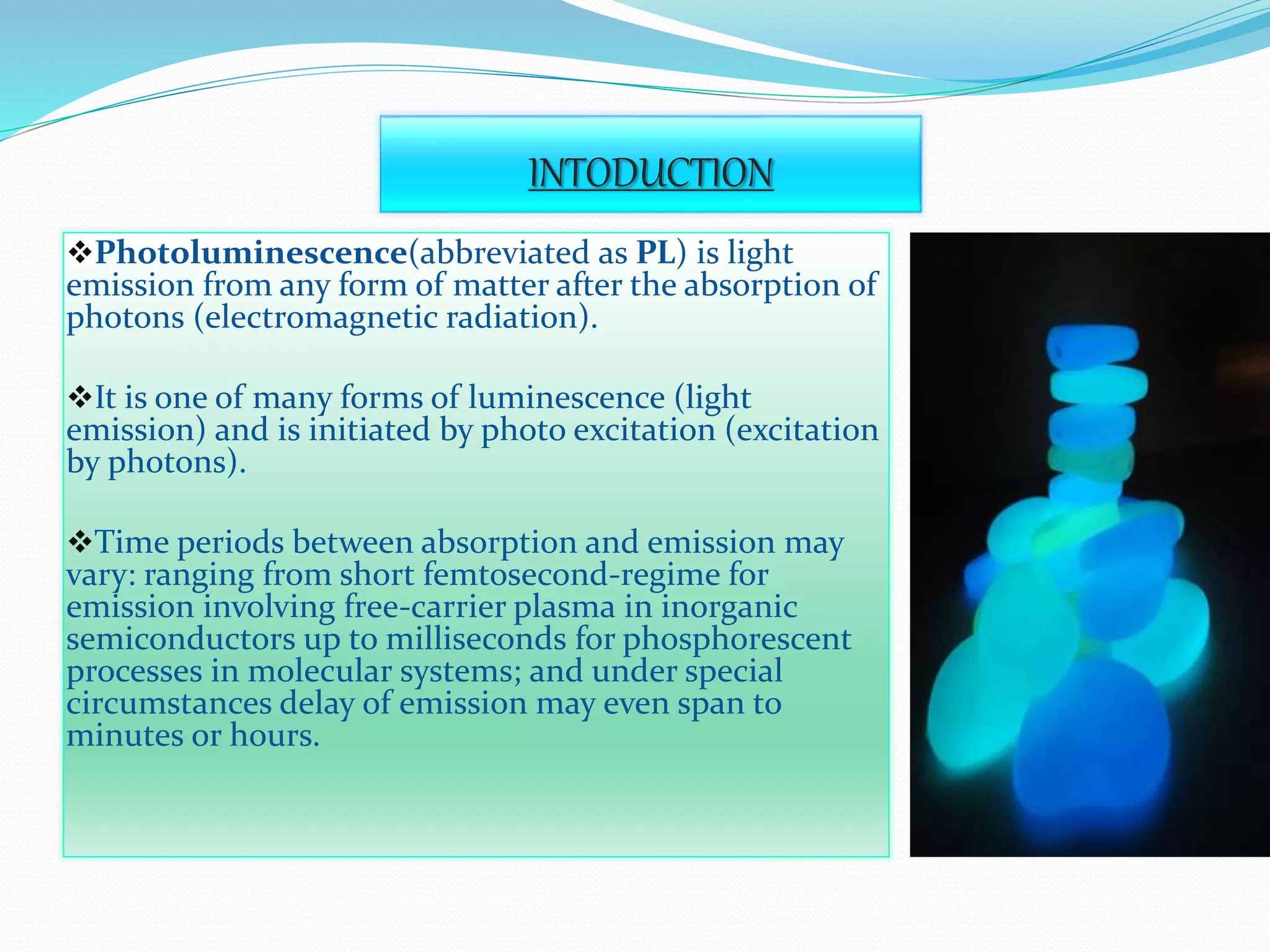
Photoluminescence(abbreviated as PL) is light
emission from any form of matter after the absorption of
photons (electromagnetic radiation).
It is one of many forms of luminescence (light
emission) and is initiated by photo excitation (excitation
by photons).
Time periods between absorption and emission may
vary: ranging from short femtosecond-regime for
emission involving free-carrier plasma in inorganic
semiconductors up to milliseconds for phosphorescent
processes in molecular systems; and under special
circumstances delay of emission may even span to
minutes or hours.
Resonance fluorescence
• Resonant excitation describes a situation in which photons of a
particular wavelength are absorbed and equivalent photons are very
rapidly re-emitted.
• in the gas phase, this process involves electrons but no significant
internal energy transitions involving molecular features of the
chemical substance between absorption and emission
Semi-conductors
• In crystalline inorganic semiconductors where an electronic band structure is
formed, secondary emission can be more complicated as events may contain
both coherent such as resonant Rayleigh scattering where a fixed phase
relation with the driving light field is maintained (i.e. energetically elastic
processes where no losses are involved) and incoherent contributions (or
inelastic modes where some energy channels into an auxiliary loss mode).
Forms of Photo Luminescence
Fluorescence
 The emission of light by a
substance that has absorbed light
or other electromagnetic radiation.
It is a form of luminescence.
 The emitted light has a
longer wavelength, and therefore
lower energy, than the absorbed
radiation. The most striking
example of fluorescence occurs
when the absorbed radiation is in
the ultraviolet region of the
spectrum, and thus invisible to the
human eye, while the emitted light
is in the visible region, which
gives the fluorescent substance a
distinct color that can only be seen
when exposed to UV light.
Fluorescent minerals emit visible light when
exposed to ultraviolet light
Bio fluorescent marine organisms
Phosphorescence
 Phosphorescence is a specific type
of photoluminescence related
to fluorescence. Unlike fluorescence, a
phosphorescent material does not
immediately re-emit the radiation it
absorbs.
 The slower time scales of the re-emission
are associated with "forbidden" energy
state transitions in quantum mechanics.
As these transitions occur very slowly in
certain materials, absorbed radiation
may be re-emitted at a lower intensity for
up to several hours after the original
excitation.
 Commonly seen examples of
phosphorescent materials are the glow-in-
the-dark toys, paint, and clock dials that
glow for some time after being charged with
a bright light such as in any normal reading
or room light. Typically the glowing then
slowly fades out within minutes to up to a
few hours in a dark room.
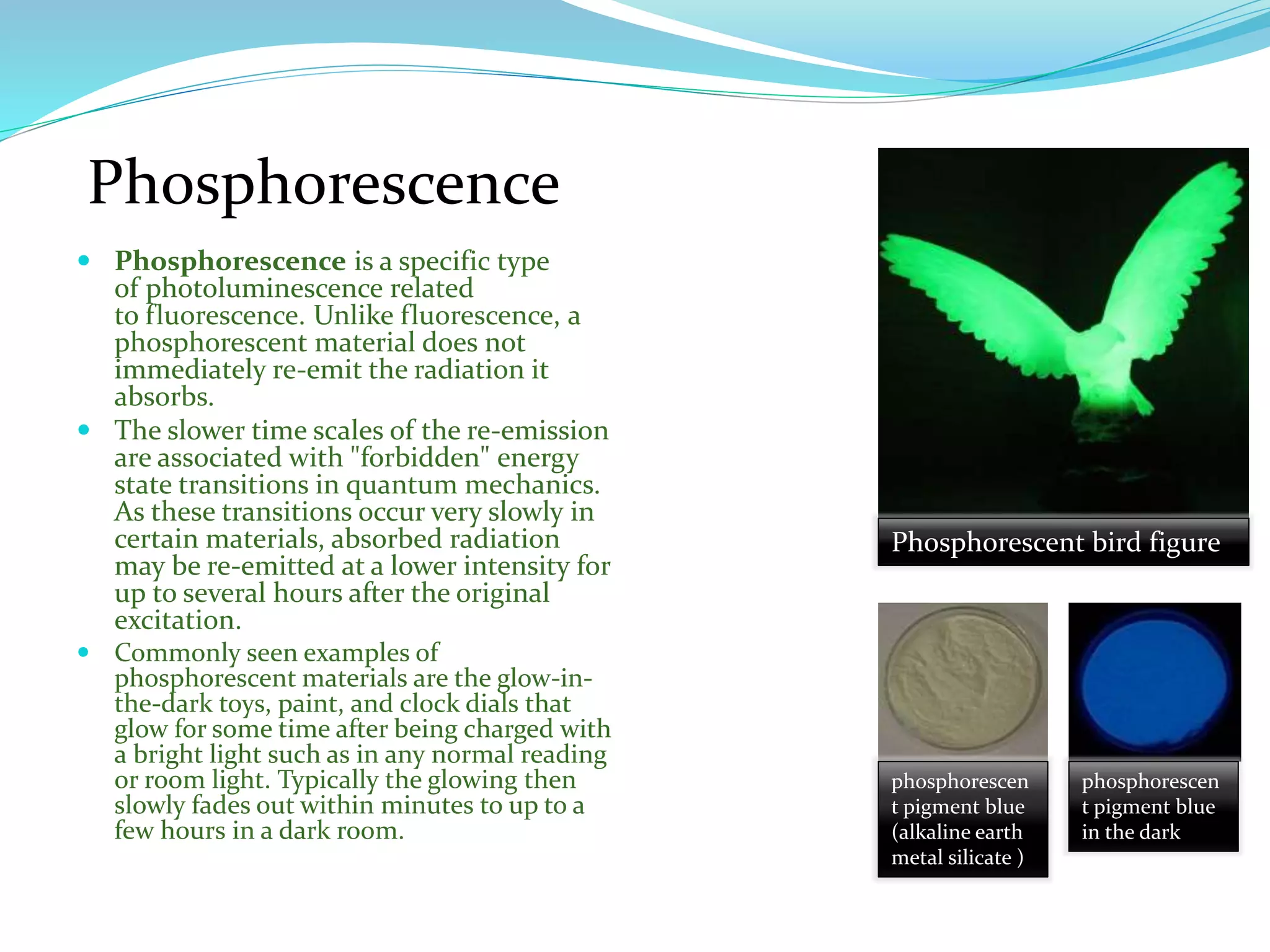
phosphorescen
t pigment blue
in the dark
phosphorescen
t pigment blue
(alkaline earth
metal silicate )
Phosphorescent bird figure
Phosphor thermometry
Phosphor thermometry is
an optical method for surface
temperature measurement. The
method exploits luminescence emitted
by phosphor material. Phosphors are
fine white or pastel-colored inorganic
powders which may be stimulated by
any of a variety of means to luminance,
i.e. emit light. Certain characteristics of
the emitted light change with
temperature, including brightness,
color, and afterglow duration. The latter
is most commonly used for temperature
measurement.
ZNS:Cu
Rare Earth doped Alumina silicates.
Ex.SrAlO4:Eu,Dy CaAlO4:Eu,Dy
Fullerene-doped polymers.
Fullerene-doped inorganic materials.
Photo luminescence
Photo luminescence

Photo luminescence

  • 2.
    INTODUCTION Photoluminescence(abbreviated as PL)is light emission from any form of matter after the absorption of photons (electromagnetic radiation). It is one of many forms of luminescence (light emission) and is initiated by photo excitation (excitation by photons). Time periods between absorption and emission may vary: ranging from short femtosecond-regime for emission involving free-carrier plasma in inorganic semiconductors up to milliseconds for phosphorescent processes in molecular systems; and under special circumstances delay of emission may even span to minutes or hours.
  • 3.
    Resonance fluorescence • Resonantexcitation describes a situation in which photons of a particular wavelength are absorbed and equivalent photons are very rapidly re-emitted. • in the gas phase, this process involves electrons but no significant internal energy transitions involving molecular features of the chemical substance between absorption and emission Semi-conductors • In crystalline inorganic semiconductors where an electronic band structure is formed, secondary emission can be more complicated as events may contain both coherent such as resonant Rayleigh scattering where a fixed phase relation with the driving light field is maintained (i.e. energetically elastic processes where no losses are involved) and incoherent contributions (or inelastic modes where some energy channels into an auxiliary loss mode). Forms of Photo Luminescence
  • 4.
    Fluorescence  The emissionof light by a substance that has absorbed light or other electromagnetic radiation. It is a form of luminescence.  The emitted light has a longer wavelength, and therefore lower energy, than the absorbed radiation. The most striking example of fluorescence occurs when the absorbed radiation is in the ultraviolet region of the spectrum, and thus invisible to the human eye, while the emitted light is in the visible region, which gives the fluorescent substance a distinct color that can only be seen when exposed to UV light. Fluorescent minerals emit visible light when exposed to ultraviolet light Bio fluorescent marine organisms
  • 5.
    Phosphorescence  Phosphorescence isa specific type of photoluminescence related to fluorescence. Unlike fluorescence, a phosphorescent material does not immediately re-emit the radiation it absorbs.  The slower time scales of the re-emission are associated with "forbidden" energy state transitions in quantum mechanics. As these transitions occur very slowly in certain materials, absorbed radiation may be re-emitted at a lower intensity for up to several hours after the original excitation.  Commonly seen examples of phosphorescent materials are the glow-in- the-dark toys, paint, and clock dials that glow for some time after being charged with a bright light such as in any normal reading or room light. Typically the glowing then slowly fades out within minutes to up to a few hours in a dark room. phosphorescen t pigment blue in the dark phosphorescen t pigment blue (alkaline earth metal silicate ) Phosphorescent bird figure
  • 6.
    Phosphor thermometry Phosphor thermometryis an optical method for surface temperature measurement. The method exploits luminescence emitted by phosphor material. Phosphors are fine white or pastel-colored inorganic powders which may be stimulated by any of a variety of means to luminance, i.e. emit light. Certain characteristics of the emitted light change with temperature, including brightness, color, and afterglow duration. The latter is most commonly used for temperature measurement.
  • 7.
    ZNS:Cu Rare Earth dopedAlumina silicates. Ex.SrAlO4:Eu,Dy CaAlO4:Eu,Dy Fullerene-doped polymers. Fullerene-doped inorganic materials.