Electrolyte Abnormalities in
Children
Presenter- Dr Aftab Ahmad Siddiqui
Moderators- Dr. Z Z Rab, Dr. Uzma Firdaus, Dr. Ayesha Ahmad,
Dr Shaad Abqari
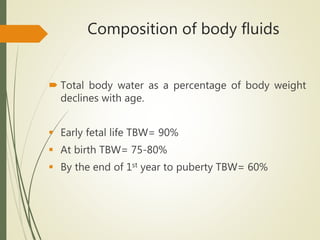
Composition of body fluids
๏‚ด Total body water as a percentage of body weight
declines with age.
๏‚ง Early fetal life TBW= 90%
๏‚ง At birth TBW= 75-80%
๏‚ง By the end of 1st year to puberty TBW= 60%
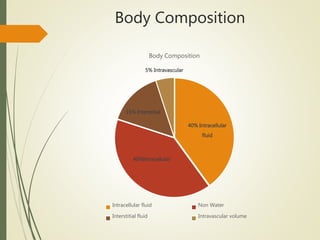
Body Composition
40% Intracellular
fluid
40%Intracellular
15% Interstitial
5% Intravascular
Body Composition
Intracellular fluid Non Water
Interstitial fluid Intravascular volume
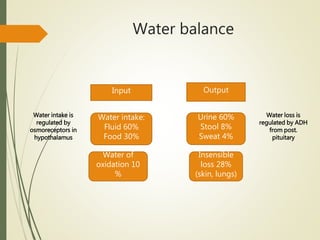
Water balance
Input Output
Water intake:
Fluid 60%
Food 30%
Urine 60%
Stool 8%
Sweat 4%
Water of
oxidation 10
%
Insensible
loss 28%
(skin, lungs)
Water intake is
regulated by
osmoreceptors in
hypothalamus
Water loss is
regulated by ADH
from post.
pituitary
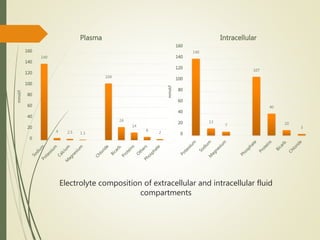
Electrolyte composition of extracellular and intracellular fluid
compartments
140
4 2.5 1.1
104
24
14
6
2
0
20
40
60
80
100
120
140
160
mmol/l
Plasma
140
13
7
107
40
10
3
0
20
40
60
80
100
120
140
160
mmol/l
Intracellular
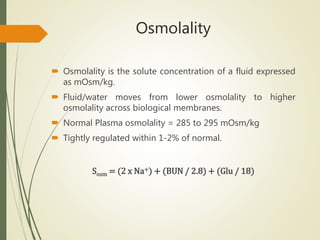
Osmolality
๏‚ด Osmolality is the solute concentration of a fluid expressed
as mOsm/kg.
๏‚ด Fluid/water moves from lower osmolality to higher
osmolality across biological membranes.
๏‚ด Normal Plasma osmolality = 285 to 295 mOsm/kg
๏‚ด Tightly regulated within 1-2% of normal.
Sosm = (2 x Na+) + (BUN / 2.8) + (Glu / 18)
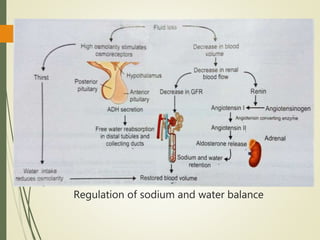
Regulation of sodium and water balance
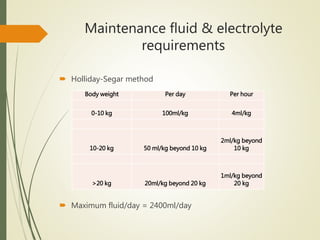
Maintenance fluid & electrolyte
requirements
๏‚ด Holliday-Segar method
๏‚ด Maximum fluid/day = 2400ml/day
Body weight Per day Per hour
0-10 kg 100ml/kg 4ml/kg
10-20 kg 50 ml/kg beyond 10 kg
2ml/kg beyond
10 kg
>20 kg 20ml/kg beyond 20 kg
1ml/kg beyond
20 kg
Maintenance fluid & electrolyte
requirements
๏‚ด Daily sodium requirement = 3meq/kg (children)
๏‚ด Daily potassium requirement = 2meq/kg
๏‚ด Daily chloride requirement = 2meq/kg
Maintenance fluid & electrolyte
requirements
๏‚ด Fluid/electrolyte requirements calculated on Holliday-segar
method are generally hypotonic (N/4 or N/5)
๏‚ด Recent evidence shows use of hypotonic fluids esp. in sick
children can cause hyponatremia.
๏‚ด 0.9% NS can be safely used in standard maintenence
volume.
(except in CHF, renal/hepatic failure, diabetes insipidus).
Maintenance fluid & electrolyte
requirements
๏‚ด No single i.v fluid is suitable in all situations, therapy to be
individualized.
๏‚ด Monitor with daily wt, input/output, serum electrolytes.
๏‚ด Maintenance fluids provide only about 20% of calories, therefore
child will lose wt due to catabolism.
Conditions that alter maintenance
fluid requirements
๏‚ด Increased fluid requirement
๏‚ง Fever (10-15% per 0C above
380C )
๏‚ง Radiant warmer/Phototherapy
๏‚ง Burns
๏‚ง Excessive sweating
๏‚ง High physical activity
๏‚ง Hyperventilation
๏‚ง Diarrhoea/vomiting
๏‚ง Polyuria
๏‚ง VLBW babies
Conditions that alter maintenance
fluid requirements
๏‚ด Decreased fluid requirement
๏‚ง Oliguria/Anuria
๏‚ง Humidified ventilator/incubator
๏‚ง Hupothyroidism
Sodium
๏‚ด Most abundant ion of the extracellular compartment
๏‚ด Normal serum sodium = 135 to 145 mEq/l.
๏‚ด Daialy sodium requirement is 2 to 3 mEq/kg body weight.
๏‚ด Requirement is nearly 2 to 3 fold higher in term & VLBW
preterm babies.
๏‚ด Adult requirements decreases to 1.5mEq/kg/day.
๏‚ด Extrarenal sodium losses can be significant via profuse
sweating ,burns, severe vomiting or diarrhoea.
Hyponatremia
๏‚ด Defined as serum Na < 135 meq/l.
๏‚ด Usually symptomatic when Na is < 125mEq/l or the decline is
acute(<24 hour).
๏‚ด Early features : headache, nausea, vomiting, lethargy and
confusion.
๏‚ด Advance manifestations: seizures, coma, decorticate posturing,
dilated pupil, anisocoria, papilledema, cardiac arrhythmias,
myocardial ischemias and central diabetes insipidus.
Hyponatremia
๏‚ด CAUSES of hyponatremia
๏ฑ Hypovolemic hyponatremia
๏‚ด Renal loss: diuretic use, osmotic diuresis, renal salt
wasting, adrenal insufficiency.
๏‚ด Extra-renal loss: diarrhoea, vomiting, sweat,cerebral salt
wasting syndrome, third spacing(effusion,ascites)
Hyponatremia
๏‚ด CAUSES of hyponatremia
๏ฑ Normovolemic hyponatremia
๏‚ด Conditions that predispose to SIADH - Inflammatory central
nervous system disease(meningitis, encephalitis), tumors,
pulmonary disease(severe asthma, pneumonia),drugs
(cyclophosphamide, vincristine).
Hyponatremia
๏‚ด CAUSES of hyponatremia
๏ฑ Hypervolemic hyponatremia
๏‚ด CHF, Cirrhosis, Nephrotic syndrome, Acute or chronic
renal failure
Hyponatremia-Treatment
๏‚ด Determine whether hyponatremia is acute(<24 hr) or chronic(>48hr),
symptomatic/asymptomatic.
๏‚ด Evaluate the volume status (hypervolemia, euvolemia, hypovolemia).
๏‚ด Sodium deficit (meq) = 0.6*Body wt(kg) * [desired Na โ€“ observed Na]
Hyponatremia-Treatment
๏‚ด Treat hypotension first (NS/RL/5%albumin), asymptomatic cases
prefer ORS.
๏‚ด Rate of correction = 0.6 to 1.0 mEq/l/hr till Na is 125 then at slower
rate over 48 to 72 hours.
๏‚ด For symptomatic cases give 3%NS @ 3-5 ml/kg over 1-2 hr. (increases
serum Na by 5-6mEq/l)
๏‚ด Stop further therapy with 3%NS when patient is symptom free or
acute rise in serum sodium is 10mEq/l in first 5 hour.
Hyponatremia-Treatment
๏‚ด Rise in serum Na can be estimated by Adrogue Madias formula-
ฮ” ๐‘๐‘Ž =
๐ผ๐‘›๐‘“๐‘ข๐‘ ๐‘Ž๐‘ก๐‘’ ๐‘๐‘Ž + ๐ผ๐‘›๐‘“๐‘ข๐‘ ๐‘Ž๐‘ก๐‘’ ๐พ โˆ’๐‘†๐‘’๐‘Ÿ๐‘ข๐‘š ๐‘๐‘Ž
[๐‘‡๐ต๐‘Š+1]
ฮ”[Na]= expected change in serum sodium/L of fluid given
TBW= total body water is 0.6*Body wt (kg)
Hyponatremia-Treatment
๏‚ด Fluid restriction alone is needed for SIADH.
๏‚ด Sodium and water restriction for hypervolemic hyponatremia.
๏‚ด V2-receptor antagonists or vaptans may be used in SIADH &
hypervolemic hyponatremia.
๏‚ด Diuretics for refractory cases.
Hypernatremia
๏‚ด Defined as serum Na >150mEq/l
Clinical features
๏‚ด Lethargy or mental status change which can proceed to coma and
convulsions.
๏‚ด Acute severe hypernatremia leads to osmotic shift of water from
neurons causing shrinkage of brain and tearing of meningeal vessels -
intracranial hemorrhage.
Hypernatremia
๏‚ด Causes of Hypernatremia
๏ฑ Net water loss
๏‚ด Insensible losses
๏‚ด Diabetes insipidus
๏‚ด Inadequate breastfeeding
๏‚ด Hypotonic fluid loss
๏‚ด Renal: osmotic diuretics, post obstructive, polyuric phase of acute tubular
necrosis
๏‚ด GI: vomiting,nasogastric drainage, diarrhea, laxative.
Hypernatremia
๏‚ด Causes of Hypernatremia
๏ฑ Hypertonic Sodium gain
๏‚ด Excess sodium intake
๏‚ด Sodium bicarbonate, saline infusion
๏‚ด Hypertonic feeds, boiled skimmed milk
๏‚ด Ingestion of sodium chloride
๏‚ด Hypertonic dialysis
๏‚ด Endocrine: Primary hyperaldosteronism, Cushing syndrome
Hypernatremia- Treatment
๏‚ด Treat hypotension first (NS/RL/5% Albumin bolus)
๏‚ด Correct deficit over 48 to 72 hours. Recommended rate of drop is
0.5mEq/l/hr (10-12mEq/l/day)
๏‚ด Hypotonic infusates are used as N/4 or N/5 saline, avoid sodium free
fluids. ( Calculate expected fall in Na by Adrogue Madias formula ).
Hypernatremia- Treatment
๏‚ด Seizures during correction of hypernatremia are treated using
3%NS as 5-6ml/kg infusion over 1-2 hr.
๏‚ด For significant hypernatremia ( >180-200mEq/l ) with concurrent
renal failure and or volume overload, renal replacement therapy
(peritoneal or hemodialysis, hemofiltration) is indicated.
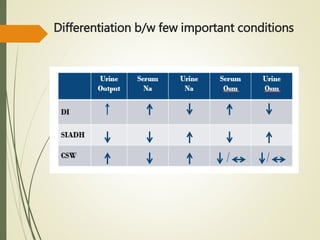
Differentiation b/w few important conditions
Potassium
๏‚ด Normal serum concentration=3.5-5.0mEq/l and intracellular 150mEq/l .
๏‚ด Source of potassium include meats, beans, fruits and potatoes.
๏‚ด Majority in muscles and majority of extracellular K in bones.
๏‚ด More significant in males around puberty.
๏‚ด Serum K concentration increases by approximately 0.6mEq/l with each
10 mOsm rise in plasma osmolality
Physiologic function of Potassium
๏‚ด Electrical responsiveness of nerve and muscle cells.
๏‚ด Contractility of cardiac, skeletal and smooth muscle cells.
๏‚ด Maintains cell volume.
Potassium Excretion
๏‚ด Normally 10% of K is excreted.
๏‚ด Excretion is increased by aldosterone, loop diuretics, osmotic diuresis,
glucocorticoids, ADH and delivery of negatively charged ions to the
collecting duct(e.g. bicarb).
๏‚ด Insulin, รŸ agonists and alkalosis enhance potassium entry into cells.
Hypokalemia
๏‚ด Serum K<3.5mEq/l.
๏‚ด Clinical features
๏‚ด Severe hypokalemia (<2.5mEq/l) cause muscle weakness (neck
flop, abdominal distension, ileus) and arrhythmia.
๏‚ด Hypokalemia increases the risk of digoxin toxicity by promoting
its binding to myocyte, potentiating its action and decreasing its
clearance.
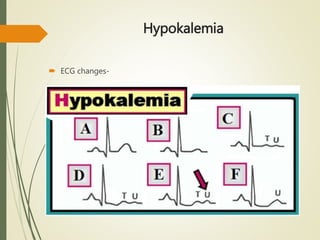
Hypokalemia
๏‚ด ECG changes-
Hypokalemia
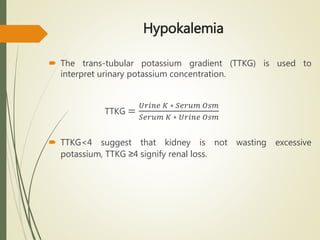
๏‚ด The trans-tubular potassium gradient (TTKG) is used to
interpret urinary potassium concentration.
TTKG =
๐‘ˆ๐‘Ÿ๐‘–๐‘›๐‘’ ๐พ โˆ— ๐‘†๐‘’๐‘Ÿ๐‘ข๐‘š ๐‘‚๐‘ ๐‘š
๐‘†๐‘’๐‘Ÿ๐‘ข๐‘š ๐พ โˆ— ๐‘ˆ๐‘Ÿ๐‘–๐‘›๐‘’ ๐‘‚๐‘ ๐‘š
๏‚ด TTKG<4 suggest that kidney is not wasting excessive
potassium, TTKG โ‰ฅ4 signify renal loss.
Causes of Hypokalemia
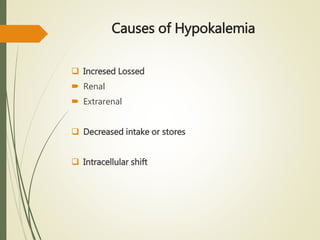
๏ฑ Incresed Lossed
๏‚ด Renal
๏‚ด Extrarenal
๏ฑ Decreased intake or stores
๏ฑ Intracellular shift
Causes of Hypokalemia
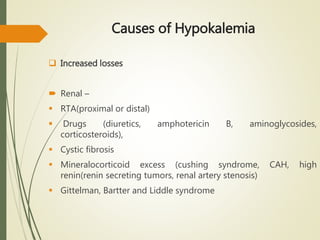
๏ฑ Increased losses
๏‚ด Renal โ€“
๏‚ง RTA(proximal or distal)
๏‚ง Drugs (diuretics, amphotericin B, aminoglycosides,
corticosteroids),
๏‚ง Cystic fibrosis
๏‚ง Mineralocorticoid excess (cushing syndrome, CAH, high
renin(renin secreting tumors, renal artery stenosis)
๏‚ง Gittelman, Bartter and Liddle syndrome
Causes of Hypokalemia
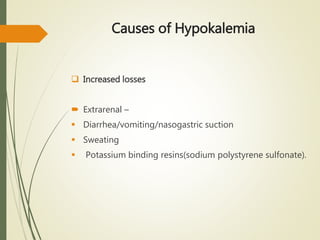
๏ฑ Increased losses
๏‚ด Extrarenal โ€“
๏‚ง Diarrhea/vomiting/nasogastric suction
๏‚ง Sweating
๏‚ง Potassium binding resins(sodium polystyrene sulfonate).
Causes of Hypokalemia
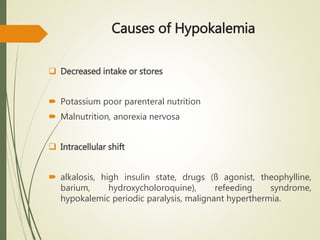
๏ฑ Decreased intake or stores
๏‚ด Potassium poor parenteral nutrition
๏‚ด Malnutrition, anorexia nervosa
๏ฑ Intracellular shift
๏‚ด alkalosis, high insulin state, drugs (รŸ agonist, theophylline,
barium, hydroxycholoroquine), refeeding syndrome,
hypokalemic periodic paralysis, malignant hyperthermia.
Hypokalemia-Treatment
๏‚ด Determine the underlying cause, whether associated with
hypertension and acidosis or alkalosis.
๏‚ด Hypertension may be due to primary hyperaldosteronism, renal
artery stenosis, CAH, glucocorticoid, liddle syndrome.
๏‚ด Relative hypotension and alkalosis suggest diuretic use or
tubular disorder (Bartter/Gittelman syndrome).
Hypokalemia-Treatment
๏‚ด Decrease ongoing losses (stop loop diuretics, replace GI losses). Use K
sparing diuretics, restore i.v volume, correct hypomagnesemia.
๏‚ด Disease specific therapy , e.g Indomethacin/ACE inhibitors for
Bartter/Gittelman syndrome.
๏‚ด Correct deficit over 24 hours.
๏‚ด Replace the deficit : oral route safer. Dose 2-4mEq/kg/day (max-120-
240mEq/day) in 3 or 4 divided doses.
Hypokalemia-Treatment
๏‚ด IV correction is used under strict ECG monitoring.
๏‚ด For rapid correction in severe hypokalemia (<2.5 or
arrhythmias) 0.5 to 1.0mEq/kg (max-40 mEq ) is given over 1
hour.
๏‚ด Infusate K should not exceed 40-60 meq/L.
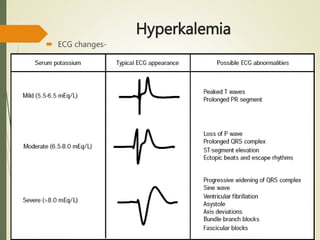
Hyperkalemia
๏‚ด Serum K>5.5mEq/l.
๏‚ด Factitious or pseudo hyperkalemia: squeezing of extremities during
phlebotomy, sample from limb being infused with K containing fluid or
hemolysed sample.
๏‚ด Clinical features: nausea vomiting paresthesias, muscle weakness(skeletal,
respiratory), fatigue, ileus, arrhythmia.
Hyperkalemia
๏‚ด ECG changes-
Causes of Hyperkalemia
๏ฑ Decreased losses
๏ฑ Increased intake
๏ฑ Extracellular shift
๏ฑ Cellular breakdown
Causes of Hyperkalemia
๏ฑ Decreased losses:
๏‚ด Renal failure
๏‚ด Renal tubular disorder- pseudohypoaldosteronism, urinary tract
obstruction.
๏‚ด Drugs- ACE inhibitors, ARB, K sparing diuretics, NSAIDS,
heparin.
๏‚ด Mineralocorticoid deficiency - Addision disease and 21-
hydroxylase deficiency.
Causes of Hyperkalemia
๏ฑ Increased intake
๏‚ด IV/Oral intake, PRBC transfusion.
๏ฑ Extracellular shift
๏‚ด Acidosis, low insulin state, drugs (รŸ blocker, digitalis,
succinylcholine, fluoride), hyperkalemic periodic paralysis,
malignant hyperthermia.
๏ฑ Cellular breakdown
๏‚ด tumor lysis syndrome, crush injury, massive hemolysis.
Hyperkalemia- Treatment
๏‚ด Itโ€™s a medical emergency.
๏‚ด Discontinue K+ containing fluids.
๏‚ด ECG monitoring.
๏‚ด If K > 7 or symptomatic with ECG changes- Administer Calcium
gluconate to stabilise myocardium (0.5ml/kg of 10%
Ca.gluconate over 5-10 min).
Hyperkalemia- Treatment
๏‚ด Enhance Cellular uptake of potassium-
๏‚ง Regular Insulin with glucose i.v (0.3 IU/g glucose over 2 hr).
๏‚ง NaHCO3 i.v 1-2 meq/kg over 20-30 min.
๏‚ง รŸ- agonist (salbutamol/terbutaline nebulized or i.v)
Hyperkalemia- Treatment
๏‚ด Ensure K elimination
๏‚ง K binding resin (kayexalate oral/per rectal 1g/kg)
๏‚ง Loop or thiazide diuretic ( if renal functions maintained )
๏‚ง Hemodialysis
๏‚ด Correct hypoaldosteronism if present : steroids.
Thank you

Electrolytes abnormalities

  • 1.
    Electrolyte Abnormalities in Children Presenter-Dr Aftab Ahmad Siddiqui Moderators- Dr. Z Z Rab, Dr. Uzma Firdaus, Dr. Ayesha Ahmad, Dr Shaad Abqari
  • 2.
    Composition of bodyfluids ๏‚ด Total body water as a percentage of body weight declines with age. ๏‚ง Early fetal life TBW= 90% ๏‚ง At birth TBW= 75-80% ๏‚ง By the end of 1st year to puberty TBW= 60%
  • 3.
    Body Composition 40% Intracellular fluid 40%Intracellular 15%Interstitial 5% Intravascular Body Composition Intracellular fluid Non Water Interstitial fluid Intravascular volume
  • 4.
    Water balance Input Output Waterintake: Fluid 60% Food 30% Urine 60% Stool 8% Sweat 4% Water of oxidation 10 % Insensible loss 28% (skin, lungs) Water intake is regulated by osmoreceptors in hypothalamus Water loss is regulated by ADH from post. pituitary
  • 5.
    Electrolyte composition ofextracellular and intracellular fluid compartments 140 4 2.5 1.1 104 24 14 6 2 0 20 40 60 80 100 120 140 160 mmol/l Plasma 140 13 7 107 40 10 3 0 20 40 60 80 100 120 140 160 mmol/l Intracellular
  • 6.
    Osmolality ๏‚ด Osmolality isthe solute concentration of a fluid expressed as mOsm/kg. ๏‚ด Fluid/water moves from lower osmolality to higher osmolality across biological membranes. ๏‚ด Normal Plasma osmolality = 285 to 295 mOsm/kg ๏‚ด Tightly regulated within 1-2% of normal. Sosm = (2 x Na+) + (BUN / 2.8) + (Glu / 18)
  • 7.
    Regulation of sodiumand water balance
  • 8.
    Maintenance fluid &electrolyte requirements ๏‚ด Holliday-Segar method ๏‚ด Maximum fluid/day = 2400ml/day Body weight Per day Per hour 0-10 kg 100ml/kg 4ml/kg 10-20 kg 50 ml/kg beyond 10 kg 2ml/kg beyond 10 kg >20 kg 20ml/kg beyond 20 kg 1ml/kg beyond 20 kg
  • 9.
    Maintenance fluid &electrolyte requirements ๏‚ด Daily sodium requirement = 3meq/kg (children) ๏‚ด Daily potassium requirement = 2meq/kg ๏‚ด Daily chloride requirement = 2meq/kg
  • 10.
    Maintenance fluid &electrolyte requirements ๏‚ด Fluid/electrolyte requirements calculated on Holliday-segar method are generally hypotonic (N/4 or N/5) ๏‚ด Recent evidence shows use of hypotonic fluids esp. in sick children can cause hyponatremia. ๏‚ด 0.9% NS can be safely used in standard maintenence volume. (except in CHF, renal/hepatic failure, diabetes insipidus).
  • 11.
    Maintenance fluid &electrolyte requirements ๏‚ด No single i.v fluid is suitable in all situations, therapy to be individualized. ๏‚ด Monitor with daily wt, input/output, serum electrolytes. ๏‚ด Maintenance fluids provide only about 20% of calories, therefore child will lose wt due to catabolism.
  • 12.
    Conditions that altermaintenance fluid requirements ๏‚ด Increased fluid requirement ๏‚ง Fever (10-15% per 0C above 380C ) ๏‚ง Radiant warmer/Phototherapy ๏‚ง Burns ๏‚ง Excessive sweating ๏‚ง High physical activity ๏‚ง Hyperventilation ๏‚ง Diarrhoea/vomiting ๏‚ง Polyuria ๏‚ง VLBW babies
  • 13.
    Conditions that altermaintenance fluid requirements ๏‚ด Decreased fluid requirement ๏‚ง Oliguria/Anuria ๏‚ง Humidified ventilator/incubator ๏‚ง Hupothyroidism
  • 14.
    Sodium ๏‚ด Most abundantion of the extracellular compartment ๏‚ด Normal serum sodium = 135 to 145 mEq/l. ๏‚ด Daialy sodium requirement is 2 to 3 mEq/kg body weight. ๏‚ด Requirement is nearly 2 to 3 fold higher in term & VLBW preterm babies. ๏‚ด Adult requirements decreases to 1.5mEq/kg/day. ๏‚ด Extrarenal sodium losses can be significant via profuse sweating ,burns, severe vomiting or diarrhoea.
  • 15.
    Hyponatremia ๏‚ด Defined asserum Na < 135 meq/l. ๏‚ด Usually symptomatic when Na is < 125mEq/l or the decline is acute(<24 hour). ๏‚ด Early features : headache, nausea, vomiting, lethargy and confusion. ๏‚ด Advance manifestations: seizures, coma, decorticate posturing, dilated pupil, anisocoria, papilledema, cardiac arrhythmias, myocardial ischemias and central diabetes insipidus.
  • 16.
    Hyponatremia ๏‚ด CAUSES ofhyponatremia ๏ฑ Hypovolemic hyponatremia ๏‚ด Renal loss: diuretic use, osmotic diuresis, renal salt wasting, adrenal insufficiency. ๏‚ด Extra-renal loss: diarrhoea, vomiting, sweat,cerebral salt wasting syndrome, third spacing(effusion,ascites)
  • 17.
    Hyponatremia ๏‚ด CAUSES ofhyponatremia ๏ฑ Normovolemic hyponatremia ๏‚ด Conditions that predispose to SIADH - Inflammatory central nervous system disease(meningitis, encephalitis), tumors, pulmonary disease(severe asthma, pneumonia),drugs (cyclophosphamide, vincristine).
  • 18.
    Hyponatremia ๏‚ด CAUSES ofhyponatremia ๏ฑ Hypervolemic hyponatremia ๏‚ด CHF, Cirrhosis, Nephrotic syndrome, Acute or chronic renal failure
  • 19.
    Hyponatremia-Treatment ๏‚ด Determine whetherhyponatremia is acute(<24 hr) or chronic(>48hr), symptomatic/asymptomatic. ๏‚ด Evaluate the volume status (hypervolemia, euvolemia, hypovolemia). ๏‚ด Sodium deficit (meq) = 0.6*Body wt(kg) * [desired Na โ€“ observed Na]
  • 20.
    Hyponatremia-Treatment ๏‚ด Treat hypotensionfirst (NS/RL/5%albumin), asymptomatic cases prefer ORS. ๏‚ด Rate of correction = 0.6 to 1.0 mEq/l/hr till Na is 125 then at slower rate over 48 to 72 hours. ๏‚ด For symptomatic cases give 3%NS @ 3-5 ml/kg over 1-2 hr. (increases serum Na by 5-6mEq/l) ๏‚ด Stop further therapy with 3%NS when patient is symptom free or acute rise in serum sodium is 10mEq/l in first 5 hour.
  • 21.
    Hyponatremia-Treatment ๏‚ด Rise inserum Na can be estimated by Adrogue Madias formula- ฮ” ๐‘๐‘Ž = ๐ผ๐‘›๐‘“๐‘ข๐‘ ๐‘Ž๐‘ก๐‘’ ๐‘๐‘Ž + ๐ผ๐‘›๐‘“๐‘ข๐‘ ๐‘Ž๐‘ก๐‘’ ๐พ โˆ’๐‘†๐‘’๐‘Ÿ๐‘ข๐‘š ๐‘๐‘Ž [๐‘‡๐ต๐‘Š+1] ฮ”[Na]= expected change in serum sodium/L of fluid given TBW= total body water is 0.6*Body wt (kg)
  • 22.
    Hyponatremia-Treatment ๏‚ด Fluid restrictionalone is needed for SIADH. ๏‚ด Sodium and water restriction for hypervolemic hyponatremia. ๏‚ด V2-receptor antagonists or vaptans may be used in SIADH & hypervolemic hyponatremia. ๏‚ด Diuretics for refractory cases.
  • 23.
    Hypernatremia ๏‚ด Defined asserum Na >150mEq/l Clinical features ๏‚ด Lethargy or mental status change which can proceed to coma and convulsions. ๏‚ด Acute severe hypernatremia leads to osmotic shift of water from neurons causing shrinkage of brain and tearing of meningeal vessels - intracranial hemorrhage.
  • 24.
    Hypernatremia ๏‚ด Causes ofHypernatremia ๏ฑ Net water loss ๏‚ด Insensible losses ๏‚ด Diabetes insipidus ๏‚ด Inadequate breastfeeding ๏‚ด Hypotonic fluid loss ๏‚ด Renal: osmotic diuretics, post obstructive, polyuric phase of acute tubular necrosis ๏‚ด GI: vomiting,nasogastric drainage, diarrhea, laxative.
  • 25.
    Hypernatremia ๏‚ด Causes ofHypernatremia ๏ฑ Hypertonic Sodium gain ๏‚ด Excess sodium intake ๏‚ด Sodium bicarbonate, saline infusion ๏‚ด Hypertonic feeds, boiled skimmed milk ๏‚ด Ingestion of sodium chloride ๏‚ด Hypertonic dialysis ๏‚ด Endocrine: Primary hyperaldosteronism, Cushing syndrome
  • 26.
    Hypernatremia- Treatment ๏‚ด Treathypotension first (NS/RL/5% Albumin bolus) ๏‚ด Correct deficit over 48 to 72 hours. Recommended rate of drop is 0.5mEq/l/hr (10-12mEq/l/day) ๏‚ด Hypotonic infusates are used as N/4 or N/5 saline, avoid sodium free fluids. ( Calculate expected fall in Na by Adrogue Madias formula ).
  • 27.
    Hypernatremia- Treatment ๏‚ด Seizuresduring correction of hypernatremia are treated using 3%NS as 5-6ml/kg infusion over 1-2 hr. ๏‚ด For significant hypernatremia ( >180-200mEq/l ) with concurrent renal failure and or volume overload, renal replacement therapy (peritoneal or hemodialysis, hemofiltration) is indicated.
  • 28.
    Differentiation b/w fewimportant conditions
  • 29.
    Potassium ๏‚ด Normal serumconcentration=3.5-5.0mEq/l and intracellular 150mEq/l . ๏‚ด Source of potassium include meats, beans, fruits and potatoes. ๏‚ด Majority in muscles and majority of extracellular K in bones. ๏‚ด More significant in males around puberty. ๏‚ด Serum K concentration increases by approximately 0.6mEq/l with each 10 mOsm rise in plasma osmolality
  • 30.
    Physiologic function ofPotassium ๏‚ด Electrical responsiveness of nerve and muscle cells. ๏‚ด Contractility of cardiac, skeletal and smooth muscle cells. ๏‚ด Maintains cell volume.
  • 31.
    Potassium Excretion ๏‚ด Normally10% of K is excreted. ๏‚ด Excretion is increased by aldosterone, loop diuretics, osmotic diuresis, glucocorticoids, ADH and delivery of negatively charged ions to the collecting duct(e.g. bicarb). ๏‚ด Insulin, รŸ agonists and alkalosis enhance potassium entry into cells.
  • 32.
    Hypokalemia ๏‚ด Serum K<3.5mEq/l. ๏‚ดClinical features ๏‚ด Severe hypokalemia (<2.5mEq/l) cause muscle weakness (neck flop, abdominal distension, ileus) and arrhythmia. ๏‚ด Hypokalemia increases the risk of digoxin toxicity by promoting its binding to myocyte, potentiating its action and decreasing its clearance.
  • 33.
  • 34.
    Hypokalemia ๏‚ด The trans-tubularpotassium gradient (TTKG) is used to interpret urinary potassium concentration. TTKG = ๐‘ˆ๐‘Ÿ๐‘–๐‘›๐‘’ ๐พ โˆ— ๐‘†๐‘’๐‘Ÿ๐‘ข๐‘š ๐‘‚๐‘ ๐‘š ๐‘†๐‘’๐‘Ÿ๐‘ข๐‘š ๐พ โˆ— ๐‘ˆ๐‘Ÿ๐‘–๐‘›๐‘’ ๐‘‚๐‘ ๐‘š ๏‚ด TTKG<4 suggest that kidney is not wasting excessive potassium, TTKG โ‰ฅ4 signify renal loss.
  • 35.
    Causes of Hypokalemia ๏ฑIncresed Lossed ๏‚ด Renal ๏‚ด Extrarenal ๏ฑ Decreased intake or stores ๏ฑ Intracellular shift
  • 36.
    Causes of Hypokalemia ๏ฑIncreased losses ๏‚ด Renal โ€“ ๏‚ง RTA(proximal or distal) ๏‚ง Drugs (diuretics, amphotericin B, aminoglycosides, corticosteroids), ๏‚ง Cystic fibrosis ๏‚ง Mineralocorticoid excess (cushing syndrome, CAH, high renin(renin secreting tumors, renal artery stenosis) ๏‚ง Gittelman, Bartter and Liddle syndrome
  • 37.
    Causes of Hypokalemia ๏ฑIncreased losses ๏‚ด Extrarenal โ€“ ๏‚ง Diarrhea/vomiting/nasogastric suction ๏‚ง Sweating ๏‚ง Potassium binding resins(sodium polystyrene sulfonate).
  • 38.
    Causes of Hypokalemia ๏ฑDecreased intake or stores ๏‚ด Potassium poor parenteral nutrition ๏‚ด Malnutrition, anorexia nervosa ๏ฑ Intracellular shift ๏‚ด alkalosis, high insulin state, drugs (รŸ agonist, theophylline, barium, hydroxycholoroquine), refeeding syndrome, hypokalemic periodic paralysis, malignant hyperthermia.
  • 39.
    Hypokalemia-Treatment ๏‚ด Determine theunderlying cause, whether associated with hypertension and acidosis or alkalosis. ๏‚ด Hypertension may be due to primary hyperaldosteronism, renal artery stenosis, CAH, glucocorticoid, liddle syndrome. ๏‚ด Relative hypotension and alkalosis suggest diuretic use or tubular disorder (Bartter/Gittelman syndrome).
  • 40.
    Hypokalemia-Treatment ๏‚ด Decrease ongoinglosses (stop loop diuretics, replace GI losses). Use K sparing diuretics, restore i.v volume, correct hypomagnesemia. ๏‚ด Disease specific therapy , e.g Indomethacin/ACE inhibitors for Bartter/Gittelman syndrome. ๏‚ด Correct deficit over 24 hours. ๏‚ด Replace the deficit : oral route safer. Dose 2-4mEq/kg/day (max-120- 240mEq/day) in 3 or 4 divided doses.
  • 41.
    Hypokalemia-Treatment ๏‚ด IV correctionis used under strict ECG monitoring. ๏‚ด For rapid correction in severe hypokalemia (<2.5 or arrhythmias) 0.5 to 1.0mEq/kg (max-40 mEq ) is given over 1 hour. ๏‚ด Infusate K should not exceed 40-60 meq/L.
  • 42.
    Hyperkalemia ๏‚ด Serum K>5.5mEq/l. ๏‚ดFactitious or pseudo hyperkalemia: squeezing of extremities during phlebotomy, sample from limb being infused with K containing fluid or hemolysed sample. ๏‚ด Clinical features: nausea vomiting paresthesias, muscle weakness(skeletal, respiratory), fatigue, ileus, arrhythmia.
  • 43.
  • 44.
    Causes of Hyperkalemia ๏ฑDecreased losses ๏ฑ Increased intake ๏ฑ Extracellular shift ๏ฑ Cellular breakdown
  • 45.
    Causes of Hyperkalemia ๏ฑDecreased losses: ๏‚ด Renal failure ๏‚ด Renal tubular disorder- pseudohypoaldosteronism, urinary tract obstruction. ๏‚ด Drugs- ACE inhibitors, ARB, K sparing diuretics, NSAIDS, heparin. ๏‚ด Mineralocorticoid deficiency - Addision disease and 21- hydroxylase deficiency.
  • 46.
    Causes of Hyperkalemia ๏ฑIncreased intake ๏‚ด IV/Oral intake, PRBC transfusion. ๏ฑ Extracellular shift ๏‚ด Acidosis, low insulin state, drugs (รŸ blocker, digitalis, succinylcholine, fluoride), hyperkalemic periodic paralysis, malignant hyperthermia. ๏ฑ Cellular breakdown ๏‚ด tumor lysis syndrome, crush injury, massive hemolysis.
  • 47.
    Hyperkalemia- Treatment ๏‚ด Itโ€™sa medical emergency. ๏‚ด Discontinue K+ containing fluids. ๏‚ด ECG monitoring. ๏‚ด If K > 7 or symptomatic with ECG changes- Administer Calcium gluconate to stabilise myocardium (0.5ml/kg of 10% Ca.gluconate over 5-10 min).
  • 48.
    Hyperkalemia- Treatment ๏‚ด EnhanceCellular uptake of potassium- ๏‚ง Regular Insulin with glucose i.v (0.3 IU/g glucose over 2 hr). ๏‚ง NaHCO3 i.v 1-2 meq/kg over 20-30 min. ๏‚ง รŸ- agonist (salbutamol/terbutaline nebulized or i.v)
  • 49.
    Hyperkalemia- Treatment ๏‚ด EnsureK elimination ๏‚ง K binding resin (kayexalate oral/per rectal 1g/kg) ๏‚ง Loop or thiazide diuretic ( if renal functions maintained ) ๏‚ง Hemodialysis ๏‚ด Correct hypoaldosteronism if present : steroids.
  • 50.