Electrolyte Imbalance
• Sodium
o hyponatremia
o hypernatremia
• Potassium
o hypokalemia
o hyperkalemia
sodium
• Sodium is the dominant cation of the ECF and it is
the principal determinant of extracellular osmolality.
• More than 40% of total body sodium is in bone.
• The low intracellular Na concentration(10 mEq/L) is
maintained by Na+,K+-ATPase.
• Its concentration determined by water balance
instead of sodium balance. When Na conc↑ →
↑osmolality → ↑ secretion of ADH↓ → renal water
conservation → Na conc returns to normal and vice
versa
• intake
– readily absorbed throughout the gastrointestinal
tract.
– breast milk(≈7 mEq/L)
– Mineralocorticoids↑ Na transport
– glucose enhances sodium absorption
• Excretion
– Stool, sweat(minimal)
– Urine(main) determined by effective plasma volume
Hypernatremia
• sodium concentration >145 mEq/L, although it is
sometimes defined as >150 mEq/L
• Moderate or severe hypernatremia has significant
morbidity, including the risks of overly rapid
correction.
• Brain hemorrhage is the most devastating
consequence of hypernatremia leading to seizures
and coma
pathophysiology
• 3 basic mechanisms
1. Excessive sodium
• usually iatrogenic in a hospital setting as a result of
correction of metabolic acidosis with sodium bicarbonate.
• Hyperaldosteronism
2. Water deficit
• nephrogenic and central diabetes insipidus
• Prematurity (↑water loss)
• Ineffective breast-feeding
• Adipsia (the absence of thirst)
3. Water and sodium deficits
• Diarrhea (inadequate intake because of emesis, lack of
access to water, or anorexia.)
• Diuretics, DM, CKD
Clinical Manifestation
• Dehydrated(sunken eyes, ↑ thirst, irritable, prolonged skin
fold)
• Failure to thrive (breast fed infants)
• CNS symptoms (irritable, restless, weak, and lethargic, high-
pitched cry and hyperpnea)
• hyperglycemia and mild hypocalcemia
• CSF protein is often ↑ in infants with significant
hypernatremia due to leakage from damaged blood vessels.
• Thrombotic complications in severe hypernatremic
dehydration(stroke, dural sinus thrombosis, peripheral
thrombosis, and renal vein thrombosis)
Diagnosis
• Urine analysis
– Osmolality
– electrolytes
• Serum Na
• RFT
Management
• Water deficit
• Treat underlying cause
• Monitoring
• hypernatremia should not be corrected rapidly.
• Goal of treatment- to decrease the serum sodium by
<12 mEq/L every 24 hr, a rate of 0.5 mEq/L/hr.
• As hypernatremia develops, the brain generates
idiogenic osmoles to increase the intracellular
osmolality and prevent the loss of brain water. most
prominent when hypernatremia has developed
gradually.
• If the serum Na concentration is lowered rapidly, there
is movement of water from the serum into the brain
cells to equalize the osmolality. The resultant brain
swelling manifests as seizures or coma
• In a child with hypernatremic dehydration the
first priority is restoration of intravascular
volume with isotonic fluid .
• Normal saline(10-20 mL/kg) is preferable to
lactated Ringer solution because the lower
sodium concentration of ringer can cause the
serum sodium to decrease too rapidly,
especially if multiple fluid boluses are given.
Water deficit
• The sodium concentration of the deficit replacement
fluid, the rate of fluid administration, and the
presence of continued water losses determine the
rate of decrease of the sodium concentration. The
following formula is often cited for calculating the
water deficit:
water deficit= body weight × 0.6(1-[145/current Na])
• Alternative approach —based upon the
observation that the administration of 3 mL of
electrolyte-free water per kilogram of lean
body weight given will lower the serum
sodium by approximately 1 meq/L . which is
nearly identical to the deficit calculated from
the water deficit formula.
• With sodium overload, hypernatremia is
corrected with sodium-free intravenous fluid (5%
dextrose in water [D5W]).
• When hypernatremia is due to sodium
intoxication peritoneal dialysis allows for removal
of the excess sodium.
• Hyperglycemia from hypernatremia is not treated
with insulin because the acute decrease in
glucose may precipitate cerebral edema by
lowering plasma osmolality
Treat underlying cause
• diabetes insipidus- desmopressin acetate
• Diarrhea
• Decrease salt intake
Hyponatremia
• Hyponatremia is a serum sodium level <135
mEq/L
• ratio of water to sodium is increased.
• can occur with low, normal, or high levels of
body sodium. Similarly, body water can be
low, normal, or high.
Etiology
• Hyperosmolarity(hyperglycemia)
• Extrarenal loss(GI, skin)
• Renal loss(diuretics, ATN, salt wasting)
• Euvolumic hyponatremia(SIADH, water intoxication)
• Hypervolumic hyponatremia
pathogenesis
• In hypovolumic hyponatremia the volume
depletion (Diarrhea and emesis due to AGE,
burns)
• Stimulates ADH synthesis, resulting in renal water
retention.
• decreases the GFR and enhances water resorption
• Hypoaldosteronism
• In hypervolemic hyponatremia increase in
water is greater than the increase in sodium
Clinical Manifestations
• Apnea
• Neurologic symptoms- anorexia, nausea,
emesis, malaise, lethargy, confusion, agitation,
headache, seizures, coma, and decreased
reflexes (due to brain swelling)
• muscle cramps and weakness(rhabdomyolysis
in water intoxication.)
Diagnosis
• history points to a likely etiology
• Plasma osmolality
• Serum Na
• RBS
• RFT
• Urine analysis
Management
• based on the pathophysiology of the specific
etiology
• avoid “overly rapid” correction. avoid correcting
conc by >12 mEq/L/24 hr or > 18 mEq/L/48 hr.
• correction of hyponatremia may cause central
pontine myelinolysis (CPM). This syndrome,
which occurs within several days of rapid
correction of hyponatremia, produces neurologic
symptoms, including confusion, agitation, flaccid
or spastic quadriparesis, and death.
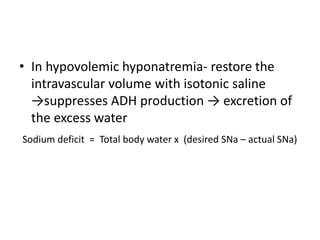
• In hypovolemic hyponatremia- restore the
intravascular volume with isotonic saline
→suppresses ADH production → excretion of
the excess water
Sodium deficit = Total body water x (desired SNa – actual SNa)
• In hypervolemic hyponatremia
–water and sodium restriction
–Vasopressin antagonists (tolvaptan),
–In severe salt and water overload associated
with renal failure, dialysis
• In isovolumic hyponatremia
– hypertonic saline
–Restrict water intake
–Give aprropriate formula
• iatrogenic hyponatremia due to the
administration of hypotonic intravenous fluids
should receive 3% saline if they are
symptomatic
Potassium
• Most abundant in the ICF (150 mEq/L)
• Normal serum level 0.4 mEq/L
• The majority of body potassium is contained
in muscle.(↑as the muscle mass increases)
• chemical gradient resulting from Na+,K+-
ATPase produce resting membrane potential
of cells
• Intake
• plentiful in food
• 90% of ingested K absorbed in the intestine(mostly SI)
• Excretion
• Some sweat
• Through colon
• Urine (major) facilitated by aldosterone
• Increased in alkalosis
• Decreased by insulin
Hyperkalemia
• Very alarming electrolyte abnormality due to its
potenial for lethal arrhythmia
• due to
– Adrenal disorders causing hypoaldosteronism
– Inadequate renal excretion
– Medication
– Increased intake
– Transcellular shift(acidosis, DM, rhabdomyolysis)
• Fictitious or spurious hyperkalemia- due to
hemolysis during a heelstick or phlebotomy,
but it can be the result of prolonged
tourniquet application or fist clenching→ local
potassium release from muscle.
Clinical Manifestations
• Due to role of potassium in membrane
polarization
• Chest pain, palpitations, dyspnea
• v/s- bradycardia, tachypnea
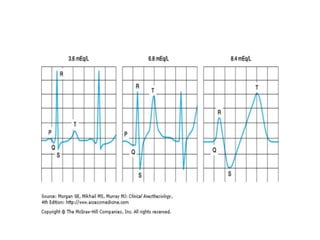
• Cardiac signs precede peaking of the T waves, ST-
segment depression, increased PR interval,
flattening of the P wave, and widening of the QRS
complex, ventricular fibrillation, asystole
• fasciculations, muscle weakness, and even an
ascending paralysis
Diagnosis
• History medications, diet and dietary supplements,
risk factors for kidney failure, reduction in urine output,
blood pressure, and volume status
• physical examination signs of arrhythmia
• electrolytes,
• RFT
• serum osmolality
• a complete blood count
• urinary pH.
• A urine Na+ concentration <20 mM indicates that distal
Na+ delivery is a limiting factor in K+ excretion
Management
• stop all sources of additional potassium (oral,
intravenous)
• The plasma potassium level, the ECG, and the
risk of the problem worsening determine the
aggressiveness of the therapeutic approach
• the potassium level is >6.0-6.5 mEq/L, an ECG
should be obtained to help assess the urgency
of the situation
• 2 basic goals:
 to stabilize the heart- Calcium
 to remove potassium from the body Na-
 sodium bicarbonate if metabolic acidosis
 Insulin to shift K in to cell with glucose to prevent hypoglycemia
 Nebulized albuterol
 Promote K loss: Kayexalate, diuretics, dialysis
Hypokalemia
• Serum k level <3.5mmol/L
• common in children, with most cases related to
gastroenteritis.
• Etiology
– Spurious
• High WBC
– Decreased intake
• Anorexia nervosa
– Intracellular shift
• Alkalosis, insulin, drugs, refeeding syndrome
– Increased loss(renal extra renal)
• Diarrhea, sweating, Kayexalate ingestion(extrarenal)
• In acid base dsturbances,
Clinical Manifestation
• Constipation, distention
• Exercise intolerance
• Dyspnea
• Urinary retention
• polyuria and polydipsia
• Rarely muscle paralysis (at <2.5 mEq/L)
• Poor linear growth
• ECG changes ( flat T wave, rising U wave,
arrhythmias)
• Hyperglycemia ( impaired insulin release)
diagnosis
• history- diet, gastrointestinal losses, and
medications
• Serum electrolyte
• Urine electrolyte
• ECG
management
• Potassium supplementation(cautious if renal function
decreased
• potassium deficit varies with severity of hypokalemia
• Oral K safer but not as rapid (2-4 mEq/kg/day , max of
120-240 mEq/day in divided doses
• IV cautious of hyperkalemia(0.5-1 mEq/kg, given over
1 hr)
• Spironolactone ( aldosterone antagonist)
• Potassium sparing diuretics (amiloride, triamterene)for
patients with excessive urinary losss)
• If hypokalemia, metabolic alkalosis, and volume depletion are
present restoration of intravascular volume with adequate
NaCl will decrease urinary K+ losses
Common electrolyte Imbalance in pediatrics

Common electrolyte Imbalance in pediatrics

  • 1.
    Electrolyte Imbalance • Sodium ohyponatremia o hypernatremia • Potassium o hypokalemia o hyperkalemia
  • 2.
    sodium • Sodium isthe dominant cation of the ECF and it is the principal determinant of extracellular osmolality. • More than 40% of total body sodium is in bone. • The low intracellular Na concentration(10 mEq/L) is maintained by Na+,K+-ATPase. • Its concentration determined by water balance instead of sodium balance. When Na conc↑ → ↑osmolality → ↑ secretion of ADH↓ → renal water conservation → Na conc returns to normal and vice versa
  • 3.
    • intake – readilyabsorbed throughout the gastrointestinal tract. – breast milk(≈7 mEq/L) – Mineralocorticoids↑ Na transport – glucose enhances sodium absorption • Excretion – Stool, sweat(minimal) – Urine(main) determined by effective plasma volume
  • 4.
    Hypernatremia • sodium concentration>145 mEq/L, although it is sometimes defined as >150 mEq/L • Moderate or severe hypernatremia has significant morbidity, including the risks of overly rapid correction. • Brain hemorrhage is the most devastating consequence of hypernatremia leading to seizures and coma
  • 5.
    pathophysiology • 3 basicmechanisms 1. Excessive sodium • usually iatrogenic in a hospital setting as a result of correction of metabolic acidosis with sodium bicarbonate. • Hyperaldosteronism 2. Water deficit • nephrogenic and central diabetes insipidus • Prematurity (↑water loss) • Ineffective breast-feeding • Adipsia (the absence of thirst) 3. Water and sodium deficits • Diarrhea (inadequate intake because of emesis, lack of access to water, or anorexia.) • Diuretics, DM, CKD
  • 6.
    Clinical Manifestation • Dehydrated(sunkeneyes, ↑ thirst, irritable, prolonged skin fold) • Failure to thrive (breast fed infants) • CNS symptoms (irritable, restless, weak, and lethargic, high- pitched cry and hyperpnea) • hyperglycemia and mild hypocalcemia • CSF protein is often ↑ in infants with significant hypernatremia due to leakage from damaged blood vessels. • Thrombotic complications in severe hypernatremic dehydration(stroke, dural sinus thrombosis, peripheral thrombosis, and renal vein thrombosis)
  • 7.
    Diagnosis • Urine analysis –Osmolality – electrolytes • Serum Na • RFT
  • 8.
    Management • Water deficit •Treat underlying cause • Monitoring
  • 9.
    • hypernatremia shouldnot be corrected rapidly. • Goal of treatment- to decrease the serum sodium by <12 mEq/L every 24 hr, a rate of 0.5 mEq/L/hr. • As hypernatremia develops, the brain generates idiogenic osmoles to increase the intracellular osmolality and prevent the loss of brain water. most prominent when hypernatremia has developed gradually. • If the serum Na concentration is lowered rapidly, there is movement of water from the serum into the brain cells to equalize the osmolality. The resultant brain swelling manifests as seizures or coma
  • 10.
    • In achild with hypernatremic dehydration the first priority is restoration of intravascular volume with isotonic fluid . • Normal saline(10-20 mL/kg) is preferable to lactated Ringer solution because the lower sodium concentration of ringer can cause the serum sodium to decrease too rapidly, especially if multiple fluid boluses are given.
  • 11.
    Water deficit • Thesodium concentration of the deficit replacement fluid, the rate of fluid administration, and the presence of continued water losses determine the rate of decrease of the sodium concentration. The following formula is often cited for calculating the water deficit: water deficit= body weight × 0.6(1-[145/current Na])
  • 12.
    • Alternative approach—based upon the observation that the administration of 3 mL of electrolyte-free water per kilogram of lean body weight given will lower the serum sodium by approximately 1 meq/L . which is nearly identical to the deficit calculated from the water deficit formula.
  • 13.
    • With sodiumoverload, hypernatremia is corrected with sodium-free intravenous fluid (5% dextrose in water [D5W]). • When hypernatremia is due to sodium intoxication peritoneal dialysis allows for removal of the excess sodium. • Hyperglycemia from hypernatremia is not treated with insulin because the acute decrease in glucose may precipitate cerebral edema by lowering plasma osmolality
  • 14.
    Treat underlying cause •diabetes insipidus- desmopressin acetate • Diarrhea • Decrease salt intake
  • 15.
    Hyponatremia • Hyponatremia isa serum sodium level <135 mEq/L • ratio of water to sodium is increased. • can occur with low, normal, or high levels of body sodium. Similarly, body water can be low, normal, or high.
  • 16.
    Etiology • Hyperosmolarity(hyperglycemia) • Extrarenalloss(GI, skin) • Renal loss(diuretics, ATN, salt wasting) • Euvolumic hyponatremia(SIADH, water intoxication) • Hypervolumic hyponatremia
  • 17.
    pathogenesis • In hypovolumichyponatremia the volume depletion (Diarrhea and emesis due to AGE, burns) • Stimulates ADH synthesis, resulting in renal water retention. • decreases the GFR and enhances water resorption • Hypoaldosteronism • In hypervolemic hyponatremia increase in water is greater than the increase in sodium
  • 18.
    Clinical Manifestations • Apnea •Neurologic symptoms- anorexia, nausea, emesis, malaise, lethargy, confusion, agitation, headache, seizures, coma, and decreased reflexes (due to brain swelling) • muscle cramps and weakness(rhabdomyolysis in water intoxication.)
  • 19.
    Diagnosis • history pointsto a likely etiology • Plasma osmolality • Serum Na • RBS • RFT • Urine analysis
  • 20.
    Management • based onthe pathophysiology of the specific etiology • avoid “overly rapid” correction. avoid correcting conc by >12 mEq/L/24 hr or > 18 mEq/L/48 hr. • correction of hyponatremia may cause central pontine myelinolysis (CPM). This syndrome, which occurs within several days of rapid correction of hyponatremia, produces neurologic symptoms, including confusion, agitation, flaccid or spastic quadriparesis, and death.
  • 21.
    • In hypovolemichyponatremia- restore the intravascular volume with isotonic saline →suppresses ADH production → excretion of the excess water Sodium deficit = Total body water x (desired SNa – actual SNa)
  • 22.
    • In hypervolemichyponatremia –water and sodium restriction –Vasopressin antagonists (tolvaptan), –In severe salt and water overload associated with renal failure, dialysis • In isovolumic hyponatremia – hypertonic saline –Restrict water intake –Give aprropriate formula
  • 23.
    • iatrogenic hyponatremiadue to the administration of hypotonic intravenous fluids should receive 3% saline if they are symptomatic
  • 24.
    Potassium • Most abundantin the ICF (150 mEq/L) • Normal serum level 0.4 mEq/L • The majority of body potassium is contained in muscle.(↑as the muscle mass increases) • chemical gradient resulting from Na+,K+- ATPase produce resting membrane potential of cells
  • 25.
    • Intake • plentifulin food • 90% of ingested K absorbed in the intestine(mostly SI) • Excretion • Some sweat • Through colon • Urine (major) facilitated by aldosterone • Increased in alkalosis • Decreased by insulin
  • 26.
    Hyperkalemia • Very alarmingelectrolyte abnormality due to its potenial for lethal arrhythmia • due to – Adrenal disorders causing hypoaldosteronism – Inadequate renal excretion – Medication – Increased intake – Transcellular shift(acidosis, DM, rhabdomyolysis)
  • 27.
    • Fictitious orspurious hyperkalemia- due to hemolysis during a heelstick or phlebotomy, but it can be the result of prolonged tourniquet application or fist clenching→ local potassium release from muscle.
  • 28.
    Clinical Manifestations • Dueto role of potassium in membrane polarization • Chest pain, palpitations, dyspnea • v/s- bradycardia, tachypnea • Cardiac signs precede peaking of the T waves, ST- segment depression, increased PR interval, flattening of the P wave, and widening of the QRS complex, ventricular fibrillation, asystole • fasciculations, muscle weakness, and even an ascending paralysis
  • 29.
    Diagnosis • History medications,diet and dietary supplements, risk factors for kidney failure, reduction in urine output, blood pressure, and volume status • physical examination signs of arrhythmia • electrolytes, • RFT • serum osmolality • a complete blood count • urinary pH. • A urine Na+ concentration <20 mM indicates that distal Na+ delivery is a limiting factor in K+ excretion
  • 31.
    Management • stop allsources of additional potassium (oral, intravenous) • The plasma potassium level, the ECG, and the risk of the problem worsening determine the aggressiveness of the therapeutic approach • the potassium level is >6.0-6.5 mEq/L, an ECG should be obtained to help assess the urgency of the situation
  • 32.
    • 2 basicgoals:  to stabilize the heart- Calcium  to remove potassium from the body Na-  sodium bicarbonate if metabolic acidosis  Insulin to shift K in to cell with glucose to prevent hypoglycemia  Nebulized albuterol  Promote K loss: Kayexalate, diuretics, dialysis
  • 33.
    Hypokalemia • Serum klevel <3.5mmol/L • common in children, with most cases related to gastroenteritis. • Etiology – Spurious • High WBC – Decreased intake • Anorexia nervosa – Intracellular shift • Alkalosis, insulin, drugs, refeeding syndrome – Increased loss(renal extra renal) • Diarrhea, sweating, Kayexalate ingestion(extrarenal) • In acid base dsturbances,
  • 34.
    Clinical Manifestation • Constipation,distention • Exercise intolerance • Dyspnea • Urinary retention • polyuria and polydipsia • Rarely muscle paralysis (at <2.5 mEq/L) • Poor linear growth • ECG changes ( flat T wave, rising U wave, arrhythmias) • Hyperglycemia ( impaired insulin release)
  • 35.
    diagnosis • history- diet,gastrointestinal losses, and medications • Serum electrolyte • Urine electrolyte • ECG
  • 36.
    management • Potassium supplementation(cautiousif renal function decreased • potassium deficit varies with severity of hypokalemia • Oral K safer but not as rapid (2-4 mEq/kg/day , max of 120-240 mEq/day in divided doses • IV cautious of hyperkalemia(0.5-1 mEq/kg, given over 1 hr) • Spironolactone ( aldosterone antagonist) • Potassium sparing diuretics (amiloride, triamterene)for patients with excessive urinary losss) • If hypokalemia, metabolic alkalosis, and volume depletion are present restoration of intravascular volume with adequate NaCl will decrease urinary K+ losses

Editor's Notes

  • #4 ORS, Na excretion through sweat increases in those with cystic fibrosis, aldosterone deficiency, or pseudohypoaldosteronism .