ELECTROLYTE
IMBALANCE
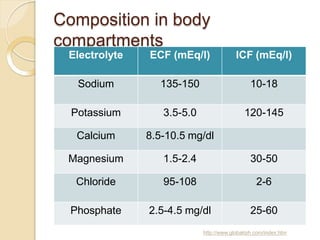
Composition in body
compartments
Electrolyte ECF (mEq/l) ICF (mEq/l)
Sodium 135-150 10-18
Potassium 3.5-5.0 120-145
Calcium 8.5-10.5 mg/dl
Magnesium 1.5-2.4 30-50
Chloride 95-108 2-6
Phosphate 2.5-4.5 mg/dl 25-60
http://www.globalrph.com/index.htm
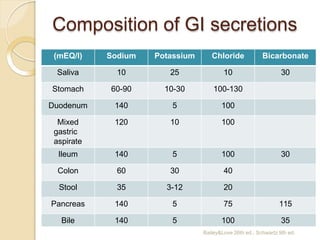
Composition of GI secretions
(mEQ/l) Sodium Potassium Chloride Bicarbonate
Saliva 10 25 10 30
Stomach 60-90 10-30 100-130
Duodenum 140 5 100
Mixed
gastric
aspirate
120 10 100
Ileum 140 5 100 30
Colon 60 30 40
Stool 35 3-12 20
Pancreas 140 5 75 115
Bile 140 5 100 35
Bailey&Love 26th ed., Schwartz 9th ed.
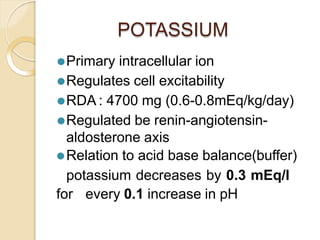
POTASSIUM
⚫Primary intracellular ion
⚫Regulates cell excitability
⚫RDA : 4700 mg (0.6-0.8mEq/kg/day)
⚫Regulated be renin-angiotensin-
aldosterone axis
⚫Relation to acid base balance(buffer)
potassium decreases by 0.3 mEq/l
for every 0.1 increase in pH
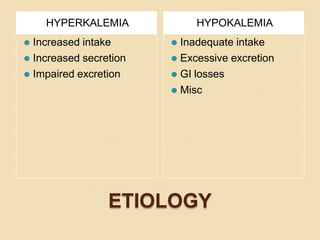
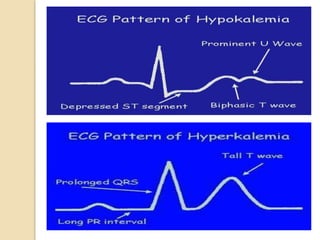
ETIOLOGY
HYPERKALEMIA HYPOKALEMIA
⚫ Increased intake
⚫ Increased secretion
⚫ Impaired excretion
⚫ Inadequate intake
⚫ Excessive excretion
⚫ GI losses
⚫ Misc
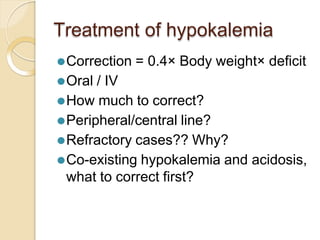
Treatment of hypokalemia
⚫Correction = 0.4× Body weight× deficit
⚫Oral / IV
⚫How much to correct?
⚫Peripheral/central line?
⚫Refractory cases?? Why?
⚫Co-existing hypokalemia and acidosis,
what to correct first?
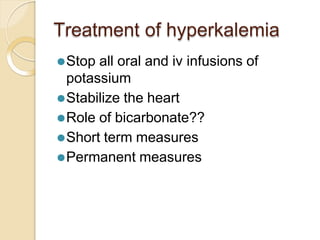
Treatment of hyperkalemia
⚫Stop all oral and iv infusions of
potassium
⚫Stabilize the heart
⚫Role of bicarbonate??
⚫Short term measures
⚫Permanent measures
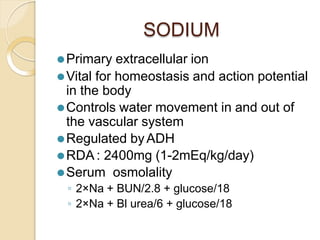
SODIUM
⚫Primary extracellular ion
⚫Vital for homeostasis and action potential
in the body
⚫Controls water movement in and out of
the vascular system
⚫Regulated byADH
⚫RDA : 2400mg (1-2mEq/kg/day)
⚫Serum osmolality
◦ 2×Na + BUN/2.8 + glucose/18
◦ 2×Na + Bl urea/6 + glucose/18
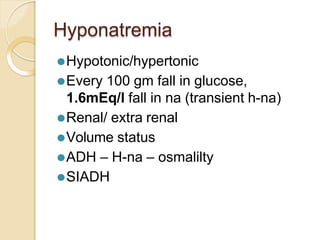
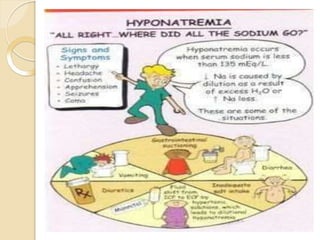
Hyponatremia
⚫Hypotonic/hypertonic
⚫Every 100 gm fall in glucose,
1.6mEq/l fall in na (transient h-na)
⚫Renal/ extra renal
⚫Volume status
⚫ADH – H-na – osmalilty
⚫SIADH
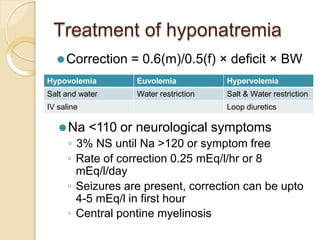
Treatment of hyponatremia
⚫Correction = 0.6(m)/0.5(f) × deficit × BW
⚫Na <110 or neurological symptoms
◦ 3% NS until Na >120 or symptom free
◦ Rate of correction 0.25 mEq/l/hr or 8
mEq/l/day
◦ Seizures are present, correction can be upto
4-5 mEq/l in first hour
◦ Central pontine myelinosis
Hypovolemia Euvolemia Hypervolemia
Salt and water Water restriction Salt & Water restriction
IV saline Loop diuretics
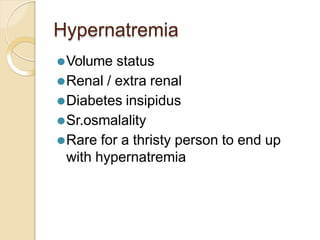
Hypernatremia
⚫Volume status
⚫Renal / extra renal
⚫Diabetes insipidus
⚫Sr.osmalality
⚫Rare for a thristy person to end up
with hypernatremia
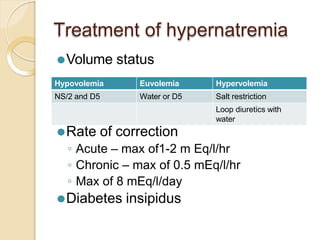
Treatment of hypernatremia
⚫Volume status
⚫Rate of correction
◦ Acute – max of1-2 m Eq/l/hr
◦ Chronic – max of 0.5 mEq/l/hr
◦ Max of 8 mEq/l/day
⚫Diabetes insipidus
Hypovolemia Euvolemia Hypervolemia
NS/2 and D5 Water or D5 Salt restriction
Loop diuretics with
water
CALCIUM
⚫Regulated by PTH and Calcitonin
⚫Vitamin D plays a role in absorption
⚫Coagulation cascade, neuromuscular
function
⚫Ionic 50%, protein bound 40%, anion
bound 10%
⚫RDA: 1-2g
⚫Ionic ca = total ca + [0.8×(4.5-albumin)]
⚫Relation to acid-base balance
◦ Acidosis decreases protein bound ca levels
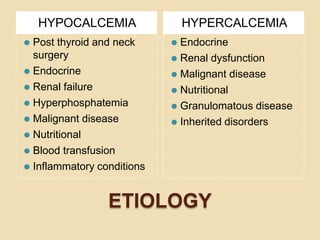
ETIOLOGY
HYPOCALCEMIA HYPERCALCEMIA
⚫ Post thyroid and neck
surgery
⚫ Endocrine
⚫ Renal failure
⚫ Hyperphosphatemia
⚫ Malignant disease
⚫ Nutritional
⚫ Blood transfusion
⚫ Inflammatory conditions
⚫ Endocrine
⚫ Renal dysfunction
⚫ Malignant disease
⚫ Nutritional
⚫ Granulomatous disease
⚫ Inherited disorders
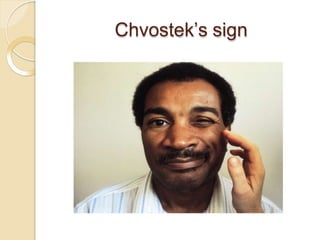
Chvostek’s sign
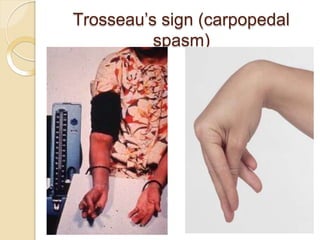
Trosseau’s sign (carpopedal
spasm)
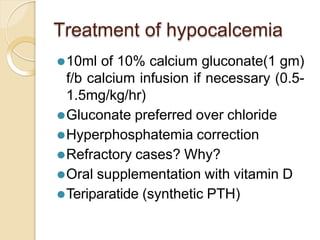
Treatment of hypocalcemia
⚫10ml of 10% calcium gluconate(1 gm)
f/b calcium infusion if necessary (0.5-
1.5mg/kg/hr)
⚫Gluconate preferred over chloride
⚫Hyperphosphatemia correction
⚫Refractory cases? Why?
⚫Oral supplementation with vitamin D
⚫Teriparatide (synthetic PTH)
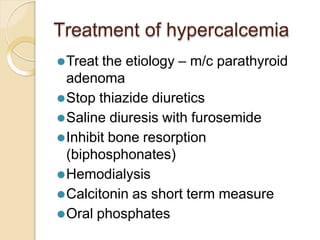
Treatment of hypercalcemia
⚫Treat the etiology – m/c parathyroid
adenoma
⚫Stop thiazide diuretics
⚫Saline diuresis with furosemide
⚫Inhibit bone resorption
(biphosphonates)
⚫Hemodialysis
⚫Calcitonin as short term measure
⚫Oral phosphates
MAGNESIUM
⚫Normal levels 1.5-2.4 m Eq/l
⚫Protein bound(30%), anion
bound(10%) and free(60%)
⚫Calcium channel antagonist and co
factor in ATP powered reactions
⚫Physiological test to detect tissue H-
Mg
⚫Mg is reabsorbed in Henle’s loop and
DCT
⚫RDA : 400mg
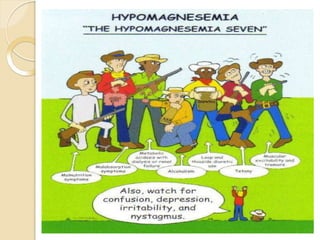
Hypomagnesemia
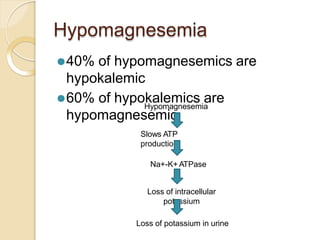
⚫40% of hypomagnesemics are
hypokalemic
⚫60% of hypokalemics are
hypomagnesemic
Hypomagnesemia
Slows ATP
production
Na+-K+ ATPase
Loss of intracellular
potassium
Loss of potassium in urine
Treatment of
hypomagnesemia
⚫1gm MgSo4 contains 0.1 g of
elemental magnesium
⚫8-12g IV over 24 hours f/b 4-6g IV for
the next three days
⚫Dose to be adjusted in renal
insufficiency
⚫Deep tendon reflexes, RR, Urine
output to be checked while giving Mg
correction
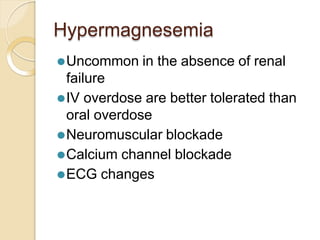
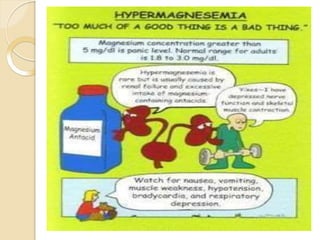
Hypermagnesemia
⚫Uncommon in the absence of renal
failure
⚫IV overdose are better tolerated than
oral overdose
⚫Neuromuscular blockade
⚫Calcium channel blockade
⚫ECG changes
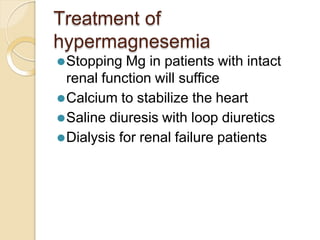
Treatment of
hypermagnesemia
⚫Stopping Mg in patients with intact
renal function will suffice
⚫Calcium to stabilize the heart
⚫Saline diuresis with loop diuretics
⚫Dialysis for renal failure patients

electrolyteimbalance.pptx

  • 1.
  • 2.
    Composition in body compartments ElectrolyteECF (mEq/l) ICF (mEq/l) Sodium 135-150 10-18 Potassium 3.5-5.0 120-145 Calcium 8.5-10.5 mg/dl Magnesium 1.5-2.4 30-50 Chloride 95-108 2-6 Phosphate 2.5-4.5 mg/dl 25-60 http://www.globalrph.com/index.htm
  • 3.
    Composition of GIsecretions (mEQ/l) Sodium Potassium Chloride Bicarbonate Saliva 10 25 10 30 Stomach 60-90 10-30 100-130 Duodenum 140 5 100 Mixed gastric aspirate 120 10 100 Ileum 140 5 100 30 Colon 60 30 40 Stool 35 3-12 20 Pancreas 140 5 75 115 Bile 140 5 100 35 Bailey&Love 26th ed., Schwartz 9th ed.
  • 4.
    POTASSIUM ⚫Primary intracellular ion ⚫Regulatescell excitability ⚫RDA : 4700 mg (0.6-0.8mEq/kg/day) ⚫Regulated be renin-angiotensin- aldosterone axis ⚫Relation to acid base balance(buffer) potassium decreases by 0.3 mEq/l for every 0.1 increase in pH
  • 5.
    ETIOLOGY HYPERKALEMIA HYPOKALEMIA ⚫ Increasedintake ⚫ Increased secretion ⚫ Impaired excretion ⚫ Inadequate intake ⚫ Excessive excretion ⚫ GI losses ⚫ Misc
  • 9.
    Treatment of hypokalemia ⚫Correction= 0.4× Body weight× deficit ⚫Oral / IV ⚫How much to correct? ⚫Peripheral/central line? ⚫Refractory cases?? Why? ⚫Co-existing hypokalemia and acidosis, what to correct first?
  • 10.
    Treatment of hyperkalemia ⚫Stopall oral and iv infusions of potassium ⚫Stabilize the heart ⚫Role of bicarbonate?? ⚫Short term measures ⚫Permanent measures
  • 11.
    SODIUM ⚫Primary extracellular ion ⚫Vitalfor homeostasis and action potential in the body ⚫Controls water movement in and out of the vascular system ⚫Regulated byADH ⚫RDA : 2400mg (1-2mEq/kg/day) ⚫Serum osmolality ◦ 2×Na + BUN/2.8 + glucose/18 ◦ 2×Na + Bl urea/6 + glucose/18
  • 13.
    Hyponatremia ⚫Hypotonic/hypertonic ⚫Every 100 gmfall in glucose, 1.6mEq/l fall in na (transient h-na) ⚫Renal/ extra renal ⚫Volume status ⚫ADH – H-na – osmalilty ⚫SIADH
  • 15.
    Treatment of hyponatremia ⚫Correction= 0.6(m)/0.5(f) × deficit × BW ⚫Na <110 or neurological symptoms ◦ 3% NS until Na >120 or symptom free ◦ Rate of correction 0.25 mEq/l/hr or 8 mEq/l/day ◦ Seizures are present, correction can be upto 4-5 mEq/l in first hour ◦ Central pontine myelinosis Hypovolemia Euvolemia Hypervolemia Salt and water Water restriction Salt & Water restriction IV saline Loop diuretics
  • 16.
    Hypernatremia ⚫Volume status ⚫Renal /extra renal ⚫Diabetes insipidus ⚫Sr.osmalality ⚫Rare for a thristy person to end up with hypernatremia
  • 18.
    Treatment of hypernatremia ⚫Volumestatus ⚫Rate of correction ◦ Acute – max of1-2 m Eq/l/hr ◦ Chronic – max of 0.5 mEq/l/hr ◦ Max of 8 mEq/l/day ⚫Diabetes insipidus Hypovolemia Euvolemia Hypervolemia NS/2 and D5 Water or D5 Salt restriction Loop diuretics with water
  • 19.
    CALCIUM ⚫Regulated by PTHand Calcitonin ⚫Vitamin D plays a role in absorption ⚫Coagulation cascade, neuromuscular function ⚫Ionic 50%, protein bound 40%, anion bound 10% ⚫RDA: 1-2g ⚫Ionic ca = total ca + [0.8×(4.5-albumin)] ⚫Relation to acid-base balance ◦ Acidosis decreases protein bound ca levels
  • 20.
    ETIOLOGY HYPOCALCEMIA HYPERCALCEMIA ⚫ Postthyroid and neck surgery ⚫ Endocrine ⚫ Renal failure ⚫ Hyperphosphatemia ⚫ Malignant disease ⚫ Nutritional ⚫ Blood transfusion ⚫ Inflammatory conditions ⚫ Endocrine ⚫ Renal dysfunction ⚫ Malignant disease ⚫ Nutritional ⚫ Granulomatous disease ⚫ Inherited disorders
  • 22.
  • 23.
  • 24.
    Treatment of hypocalcemia ⚫10mlof 10% calcium gluconate(1 gm) f/b calcium infusion if necessary (0.5- 1.5mg/kg/hr) ⚫Gluconate preferred over chloride ⚫Hyperphosphatemia correction ⚫Refractory cases? Why? ⚫Oral supplementation with vitamin D ⚫Teriparatide (synthetic PTH)
  • 26.
    Treatment of hypercalcemia ⚫Treatthe etiology – m/c parathyroid adenoma ⚫Stop thiazide diuretics ⚫Saline diuresis with furosemide ⚫Inhibit bone resorption (biphosphonates) ⚫Hemodialysis ⚫Calcitonin as short term measure ⚫Oral phosphates
  • 27.
    MAGNESIUM ⚫Normal levels 1.5-2.4m Eq/l ⚫Protein bound(30%), anion bound(10%) and free(60%) ⚫Calcium channel antagonist and co factor in ATP powered reactions ⚫Physiological test to detect tissue H- Mg ⚫Mg is reabsorbed in Henle’s loop and DCT ⚫RDA : 400mg
  • 29.
    Hypomagnesemia ⚫40% of hypomagnesemicsare hypokalemic ⚫60% of hypokalemics are hypomagnesemic Hypomagnesemia Slows ATP production Na+-K+ ATPase Loss of intracellular potassium Loss of potassium in urine
  • 30.
    Treatment of hypomagnesemia ⚫1gm MgSo4contains 0.1 g of elemental magnesium ⚫8-12g IV over 24 hours f/b 4-6g IV for the next three days ⚫Dose to be adjusted in renal insufficiency ⚫Deep tendon reflexes, RR, Urine output to be checked while giving Mg correction
  • 31.
    Hypermagnesemia ⚫Uncommon in theabsence of renal failure ⚫IV overdose are better tolerated than oral overdose ⚫Neuromuscular blockade ⚫Calcium channel blockade ⚫ECG changes
  • 33.
    Treatment of hypermagnesemia ⚫Stopping Mgin patients with intact renal function will suffice ⚫Calcium to stabilize the heart ⚫Saline diuresis with loop diuretics ⚫Dialysis for renal failure patients